HaitiABAA
9 résultats
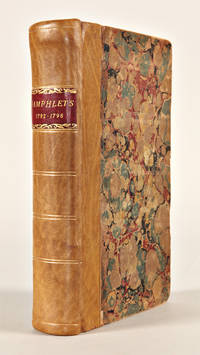
1792WRCAM45082Philadelphia 1792. 32pp. Bound with ten other titles detailed below. Contemporary marbled boards neatly rebacked in antique-style half calf gilt leather label. Contemporary manuscript contents list on front pastedown contemporary ownership inscription on fly leaf. Light foxing throughout. Very good. Fourth edition with notes and an appendix extracted from authentic original papers. An important narrative of the Haitian Revolution of 1791 recounting the many violent and brutal events to which the inhabitants were subject. The author writes: "At this time one hundred thousand negroes were in rebellion and all the buildings and plantations of more than half the Northern province appeared only as one general conflagration." <br> <br> This work is bound with ten other early American imprints primarily sermons as detailed below: <br> <br> 1 Aufrer Anthony: THE CANNIBALS' PROGRESS; OR THE DREADFUL HORRORS OF FRENCH INVASION. Newburyport Ma.: Edmund M. Blunt 1798. 351pp. EVANS 33332. <br> <br> 2 Gifford John: A LETTER TO THE HON. THOMAS ERSKINE. Philadelphia. 1797. 128pp. Lacks titlepage and second leaf. EVANS 32191. <br> <br> 3 Tappan David: A DISCOURSE DELIVERED TO THE RELIGIOUS SOCIETY IN BRATTLE-STREET BOSTON. Boston. 1798. 31pp. Half title. Second edition. EVANS 34628. <br> <br> 4 M'Keen Joseph: TWO DISCOURSES DELIVERED AT BEVERLY ON THE DAY OF THE NATIONAL FAST MAY 9 1798. Salem Ma.: Thomas C. Cushing 1798. 31pp. Half title. EVANS 34039. <br> <br> 5 Prince John: A DISCOURSE DELIVERED AT SALEM ON THE DAY OF THE NATIONAL FAST MAY 9 1798. Salem Ma.: Thomas C. Cushing 1798. 44pp. Half title. EVANS 34414. <br> <br> 6 Osgood David: SOME FACTS EVINCIVE OF THE ATHEISTICAL ANARCHICAL AND IN OTHER RESPECTS IMMORAL PRINCIPLES OF THE FRENCH REPUBLIC STATED IN A SERMON DELIVERED ON THE 9th OF MAY 1798. Boston. 1798. 27pp. Half title. EVANS 34284. <br> <br> 7 Thayer John: A DISCOURSE DELIVERED AT THE ROMAN CATHOLIC CHURCH IN BOSTON ON THE 9th OF MAY 1798. Boston. 1798. 31pp. Half title. EVANS 34646. PARSONS 196. WALGREN 417. <br> <br> 8 Tappan David: A DISCOURSE DELIVERED IN THE CHAPEL OF HARVARD COLLEGE JUNE 19 1798. Boston. 1798. 28pp. EVANS 34629. <br> <br> 9 Eckley Joseph: A DISCOURSE DELIVERED ON THE PUBLIC THANKSGIVING DAY NOVEMBER 29 1798. Boston. 1798. 23pp. Half title. EVANS 33664. <br> <br> 10 Morse Jedediah: A SERMON PREACHED AT CHARLESTOWN NOVEMBER 19 1798 ON THE ANNIVERSARY THANKSGIVING IN MASSACHUSETTS. Boston. 1798. 746pp. With the six pages included in the appendix of the second edition printed separately for those who purchased the first edition. EVANS 34151 34152. EVANS 24766. hardcover books
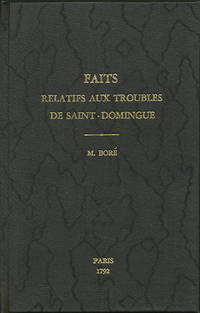
179235978Paris: De L'Imprimerie du Patriote François 1792. First edition. Cloth with gilt titles. Amateur repair of quarter-size hole on title page darkening several words faint foxing pencil annotations else a very good copy. 15 pp. Sm. 8vo. Caption title: Faits Relatifs aux Troubles de Saint-Domingue presentes au Comite Colonial en Vertu d'un Decret de I'Assemblee nationale par M. Bore citoyen et planteur de Saint-Domingue. Date supplied in manuscript. Memoirs of a planter from 1789 to 1791. OCLC shows only seven copies. Sabin 6423. Garrett French Colonial Question 153. Bissainthe M. Dict. de bib. haïtienne 4837. Catalogue de l'histoire de France VIII p. 733: 400. De L'Imprimerie du Patriote François hardcover books
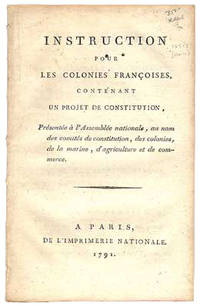
1791WRCAM35519Paris: De l'Imprimerie Nationale 1791. 174pp. in French. Dbd. Small pair of worm holes penetrating volume joining in rear half barely affecting text. Overall very good. Administrative orders for the colony of Saint- Domingue later Haiti passed by the National Assembly on June 15 1791 two months before the outbreak of the Haitian Rebellion. SABIN 34844. De l'Imprimerie Nationale unknown books
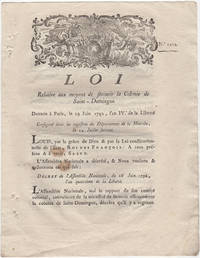
179243209Nancy France: Chez Haener Imprimeur du Départment de la Meurthe 1792. First edition. Self wrappers. A very good copy with pin holes along inner margin two soiled spots signed in ink on last page. 4 pp. Illus. with a woodcut headpiece. Sm. 4to. Signed illegible. Law authorizing negotiation with the United States minister to obtain food and construction materials in the amount of 4000000 livres to be paid by the French Treasury but to be reimbursed by taxes on the colony. The money was much needed as the loan decree dated 26 Juin 1792 came in the midst of unparalleled upheaval in Haiti. The revolution of the year before with its "horrible carnage" had now given way "to strategic military operations tactical maneuvers and new political alliances as the slaves gain territory and stabilize their positions. They raid plantations for military equipment loot the whites' forces after they are repelled and trade with the Spanish for weaponry" Kona Shen History of Haiti The Revolution Builds Brown University. library.brown.edu/haitihistory/6.html. Toussaint Louverture is a rising star Civil Commissions arrive from France free blacks and mulattos in Saint-Domingue are granted equal political rights Spain declares war on England and France and battle ensues for control of Haiti. The U.S. is concerned with conditions on the island and in fact Jefferson writes of his concern to the Marquis de Lafayette 16 June 1792. Rare. OCLC BN France and other European Libraries locate no copies of this issue No. 1412 with additional text concerning the Departement de la Meurthe. A Paris printing No. 1813 can be found at Cornell Univ. Minn. and JCB which also has a Toulouse printing. Manioc Bibliotheque shows a digitized version of the Paris imprint. Chez Haener, Imprimeur du Départment de la Meurthe unknown books
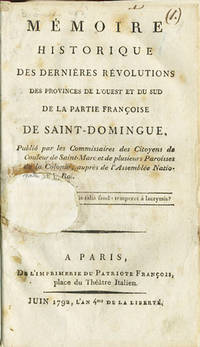
179237277Paris: Patriote Françoise 1792. First edition. Modern silk with gilt titles. Title page torn and repaired affecting a few words of the statement of responsibility and the quote below it small inked numeral foxing on a few leaves; else contents very good in an excellent binding. 114 pp. Sm. 8vo. Covers the slave insurrections in Haiti. OCLC shows only nine copies. Sabin 75161. Cundall 417. LCP. Afro-Americana 9128. Martin & Walter. Révolution française: IV/2 9677. Patriote Françoise unknown books
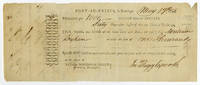
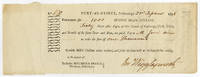
1796WRCAM52307Port-au-Prince 1796. 4 x 9 1/2 inches completed in manuscript docketed on verso. Minor toning and edge wear. Very good. A rare pay order for supplies made out to Baron Jean-Charles de Montalembert on behalf of the invading British occupation force in Haiti. The document is signed by John Wigglesworth agent to the Commander of the British forces in Haiti and later Britain's envoy to the leader of the Haitian Revolution Touissant Louverture. By early the next century Louverture would become ever so briefly chief of the first free Black Republic in Haiti. The payee Montalembert has docketed the verso with an additional docket in French transferring the funds to Dutilh & Wachsmuth a Philadelphia mercantile house. <br> <br> St. Domingo the French part of Haiti was a highly prosperous sugar coffee and cotton slave-estate island whose produce was described as exceeding that of the whole of the British Leeward and surrounding islands. In 1789 it was said to consist of 10000 white people 24000 free mixed-race people and 455000 negro slaves. Although free local laws decreed that mixed-race individuals could not accept any office or employment other than as planters. As news spread of the revolution this group revolted but were roundly defeated. Part of the white response to the uprising was to create their own local assembly which excluded those of mixed race and resolved to transfer the island's allegiance to Great Britain whereupon France sent Commissioners who according to some reports recruited negroes to fight the whites. <br> <br> Starting in August 1791 the slaves revolted in many towns implementing major massacres and destruction of estates and establishing free communities of their own. They were led by Touissant Louverture an ex-slave who later joined the French army after the country abolished slavery in 1793. Louverture swiftly rose to the rank of Commander in Chief of the French forces in Haiti and proved to be an effective leader. In 1794 the British army under the pretense of the Napoleonic war sent a force from Jamaica that occupied Port-au-Prince and some other towns a welcome development for the remaining white population on the island. This British force was commanded by General Sir Thomas Maitland of the 62 Foot Regiment for whom Wigglesworth was the army agent. <br> <br> In the end the British were not successful. By 1798 the army had been virtually wiped out by yellow fever and in April of that year Maitland withdrew the British forces from Haiti under a guarantee from Louverture that the remaining pro-British whites would be protected. In May 1801 Touissant established St. Domingo as an independent republic. This alarmed the French so badly that they subsequently sent an army of 25000 that recaptured the island within a year and then by a ruse conveyed Louverture to France where he soon after died in prison. <br> <br> Baron de Montalembert had commanded the Legion britaniques de Sainte-Domingue a force of 1200 men composed of white colonials recruits from Europe and possibly some free mixed-race Haitians. Montalembert's Grenadiers were one of the most dependable units fighting for the British until the aforementioned fever along with heavy casualties decimated the unit. They disbanded on June 25 1797. <br> <br> A rare early Haitian document signed by two principal figures in the British occupation during the Haitian Revolution. unknown books
1796WRCAM52305Port-au-Prince 1796. 4 x 9 1/2 inches completed in manuscript docketed on verso. Minor toning and corner wear. Very good. A rare pay order for supplies bought from William Dickson by the invading British occupation force in Haiti. The document is signed by John Wigglesworth agent to the Commander of the British forces in Haiti and later Britain's envoy to the leader of the Haitian Revolution Touissant Louverture. By early the next century Louverture would become ever so briefly chief of the first free Black Republic in Haiti. The payee Dickson has docketed the verso to pay "Mg. de Klegand" with an additional docket in French by de Klegand to pay Dutilh & Wachsmuth a Philadelphia mercantile house. <br> <br> St. Domingo the French part of Haiti was a highly prosperous sugar coffee and cotton slave-estate island whose produce was described as exceeding that of the whole of the British Leeward and surrounding islands. In 1789 it was said to consist of 10000 white people 24000 free mixed-race people and 455000 negro slaves. Although free local laws decreed that mixed-race individuals could not accept any office or employment other than as planters. As news spread of the revolution this group revolted but were roundly defeated. Part of the white response to the uprising was to create their own local assembly which excluded those of mixed race and resolved to transfer the island's allegiance to Great Britain whereupon France sent Commissioners who according to some reports recruited negroes to fight the whites. <br> <br> Starting in August 1791 the slaves revolted in many towns implementing major massacres and destruction of estates and establishing free communities of their own. They were led by Touissant Louverture an ex-slave who later joined the French army after the country abolished slavery in 1793. Louverture swiftly rose to the rank of Commander in Chief of the French forces in Haiti and proved to be an effective leader. In 1794 the British army under the pretense of the Napoleonic war sent a force from Jamaica that occupied Port-au-Prince and some other towns a welcome development for the remaining white population on the island. This British force was commanded by General Sir Thomas Maitland of the 62 Foot Regiment for whom Wigglesworth was the army agent. <br> <br> In the end the British were not successful. By 1798 the British army had been virtually wiped out by yellow fever and in April of that year Maitland withdrew the British forces from Haiti under a guarantee from Louverture that the remaining pro-British whites would be protected. In May 1801 Touissant established St. Domingo as an independent republic. This alarmed the French so badly that they subsequently sent an army of 25000 that recaptured the island within a year and by a ruse conveyed Louverture to France where he soon after died in prison. unknown books
1796WRCAM52308Port-au-Prince 1796. 3 1/2 x 9 3/4 inches completed in manuscript docketed on verso. Minor toning. Very good. A rare pay order for supplies intended for the British occupation force in Haiti made out to M. Juré Ainé. The document is signed by John Wigglesworth agent to the Commander of the British forces in Haiti and later Britain's envoy to the leader of the Haitian Revolution Touissant Louverture. By early the next century Louverture would become ever so briefly chief of the first free Black Republic in Haiti. The payee Jure has docketed the verso in French with an additional docket in French transferring payment to Dutilh & Wachsmuth a Philadelphia mercantile house. <br> <br> St. Domingo the French part of Haiti was a highly prosperous sugar coffee and cotton slave-estate island whose produce was described as exceeding that of the whole of the British Leeward and surrounding islands. In 1789 it was said to consist of 10000 white people 24000 free mixed-race people and 455000 negro slaves. Although free local laws decreed that mixed-race individuals could not accept any office or employment other than as planters. As news spread of the revolution this group revolted but were roundly defeated. Part of the white response to the uprising was to create their own local assembly which excluded those of mixed race and resolved to transfer the island's allegiance to Great Britain whereupon France sent Commissioners who according to some reports recruited negroes to fight the whites. <br> <br> Starting in August 1791 the slaves revolted in many towns implementing major massacres and destruction of estates and establishing free communities of their own. They were led by Touissant Louverture an ex-slave who later joined the French army after the country abolished slavery in 1793. Louverture swiftly rose to the rank of Commander in Chief of the French forces in Haiti and proved to be an effective leader. In 1794 the British army under the pretense of the Napoleonic war sent a force from Jamaica that occupied Port-au-Prince and some other towns a welcome development for the remaining white population on the island. This British force was commanded by General Sir Thomas Maitland of the 62 Foot Regiment for whom Wigglesworth was the army agent. <br> <br> In the end the British were not successful. By 1798 the British army had been virtually wiped out by yellow fever and in April of that year Maitland withdrew the British forces from Haiti under a guarantee from Louverture that the remaining pro-British whites would be protected. In May 1801 Touissant established St. Domingo as an independent republic. This alarmed the French so badly that they subsequently sent an army of 25000 that recaptured the island within a year and by a ruse conveyed Louverture to France where he soon after died in prison. unknown books
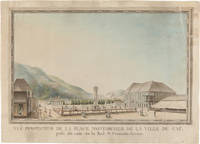
1790WRCAM51150Cap Français Saint Domingue 1790. Watercolor 10 1/2 x 16 3/4 inches mounted on 12 3/4 x 18-inch card captioned in manuscript. Some expertly repaired tears and minor soiling. Very good. Matted. A fine perspective view of Place de Montarcher one of the major public spaces in Cap Français modern-day Cap Haïtien with the large Vallière & Montarcher fountain at center surrounded by a lively street scene. Cap Français was by far the richest port city in the colony which helped transform Saint Domingue from a languid outpost into one of France's most profitable and richest colonies by the time of the French Revolution. The image is signed: "Le Cher Largues. pinxit 1790." Original views from 18th-century Haiti are extraordinarily rare in the market. unknown books