105 résultats
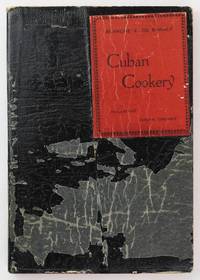
19316190Havana 1931. Very good. 150pp. Stiff black cloth covers printed paper label on front board. Front cover vertically creased light wear to boards; remnants of glassine stuck to covers. Contemporary inscription on front flyleaf. Internally clean. In a custom clamshell box. First edition of the first Cuban cook book published in English. Blanche Zacharie de Baralt 1865-1950 was born in New York; she married Luis Alejandro Baralt y Peoli in 1886 and the couple moved to his native Cuba in 1900. She earned a PhD in philosophy from the University of Havana in 1902 and went on to translate the poetry of Tagore and to write a book on Jose Marti. She also published this volume which was clearly geared toward the tourist market with the introduction emphasizing the idea of taking home the tastes of one's holiday abroad. Each chapter heading has an illustration and these were drawn by Federico Edelmann and Conrad W. Massaguer the one above the section for beans appears to show a cowboy riding along in a cloud of gas. Notably this work contains several important Cuban cocktails including the first appearance of the mojito referred to here as a Rum Cocktail or Cuban Mojo. Rare in the true first edition. unknown
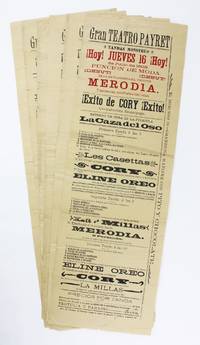
19085578Havana: Moises V. Codina 1908. Good plus. Seven broadsides each approximately 22 x 7.25 inches plus one double bill measuring about 22 x 15 inches. One broadside printed in red and black. Previously folded. Scattered shallow tears from edges not affecting text with some tape repairs on blank versos. A group of eight playbills spanning eight consecutive days in July 1908 that advertise performances and events at the Gran Teatro Payret in Havana. The theater was built by its namesake Jaoquin Payret in 1877 on a corner across from the Villanueva Railway Station now the Capitolio Nacional de la Habana and initially focused on opera and high-class performing arts to compete directly with other established theaters in the Cuban capital. The building had five floors and a capacity of 2300 but the upper balconies collapsed in 1882 after which the theater changed hands and began to showcase more varied popular offerings.<br /> <br /> These playbills publicize an array of performers including the ballet dancer Millas; a cabaret artist Eline Oreo; a magician and telepath Sidney Richards; Troupe Montrose a group of acrobats an Italian dance troupe Les Casettas; two clowns named Pito and Chocolate; and many others. Notably the programming also includes a heavy rotation of short and feature films such as La Electricidad Liquida 1907; El Inagarrables Pick Pocket 1908; Victima de la Ciencia 1907; En Chine: Voyage sur le Canal Impérial 1908; and Venganza del Dervich 1907. The playbill for Thursday July 16 with its headline and date in red proclaims the debut of Trouppe Merodia a seven-person group of acrobats and cyclists as well as the Cuban premiere of a film titled La Caza de Oso The Bear Hunt.<br /> <br /> The theater was closed by hurricane damage in 1926 but reopened as a cinema in 1935 and in the following years became known as the "Cathedral of Spanish Cinema." The building again fell into disuse and disrepair in the decades following the Cuban Revolution but was restored in 2008. A very interesting group that gives a great sense of day-to-day operations at one of Cuba's most important and historic theaters. Moises V. Codina unknown
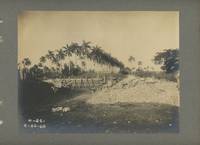
1906List3021La Habana Province Republic of Cuba 1906. Twenty-two photographs measuring 7 ¼ x 9 ½ inches mounted on heavy cardstock measuring 10 x 12 inches. Photos numbered and dated on negative. In album embossed with “Havana Central Railroad Co./ Progress Photographs/ GUANAJAYâ€. Photos with fine contrast and some wear; mounts with minor damage slightly warped with some detached from binding. Overall excellent. Havana Central Railroad Company was an American company formed in April 1905. It opened two electric tram lines—Havana to Guanajay in 1906 and Havana to Güines in 1907—before it was bought by the English company United Railways following the Panic of 1907. Offered here is a photo album showing the construction of the Guanajay line. The photographs show laborers assisted by horse-drawn carts digging culverts laying tracks and erecting bridges and buildings.<br /> <br /> This project came on the heels of the successful efforts of the Cuba Company another railroad company to make the emerging Cuban Republic amenable to American business.They did so first by using ‘revocable permits’ which could ostensibly be revoked by the new government when it was formed to circumvent the Foraker Amendment prohibiting concessions to American companies by the US’s military government; and second by using their close relationships to several members of the Cuban Constitutional Convention to include a law allowing irrevocable permits.1 These along with the Platt Amendment and Governor Leonard Wood’s General Railway Law led to what would amount to domination by US interests in Cuba particularly but not exclusively in the railroad industry.2<br /> <br /> Of interest to scholars of the early Republic of Cuba especially the history of US businesses in the country.<br /> <br /> 1 Juan C. Santamarina “The Cuba Company and the Expansion of American Business in Cuba 1898–1915†The Business History Review 74 no. 1 Spring 2000: 41–83.<br /> 2 Louis A. Pérez Jr. “Insurrection Intervention and the Transformation of Land Tenure Systems in Cuba 1895–1902†Hispanic American Historical Review 65 no. 2 1985: 229–254. unknown
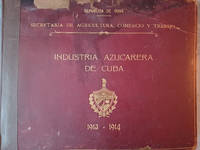
19153017<p>Portafolio azucarero de la industria azucarera de cuba 1912-1914 primera edicion libreria e imprenta la moderna poesia 1915 esta obra ha sido realizada siendo presidente de la republica de cuba dr mario garcia menocal y secretario de agriculturacomercio y trabajo el general emilio nunez caratulas originalesrestauradasgran libro ilustrado 424 pgs mas graficos libro con peso de 13 librascon 16 cm de largo por 12.5 cm de anchoes una obra super rarade colecciondonde se describen todos los centrales azucareros de cubacon fotos y sus caracteristicas publicada en el ano 1915 por la libreria e imprenta la moderna poesiaes una de las rarezas de la bibliografia cubana</p> Libreria e imprenta la moderna poesia hardcover
19624785Various locations in Cuba Europe and the United States 1962. Very good. 113 leaves of scrapbook cardstock illustrated with 388 photographs chiefly silver gelatin photographs several colored or in color in mounting corners. Most captioned in Spanish. Square folio. Contemporary brown cloth spring-loaded spine front cover stamped "CUBA." Joints split but holding well moderate rubbing and dust-soiling. Light foxing handful of images lacking some images slightly browned or with mild edge wear. An extensively-annotated vernacular family photograph album centering on the German-Cuban Coyula-Moeller family picturing their lives family members travels and more in Cuba the United States Germany and other locations in Europe mainly during the 1920s and '30s. The album was likely compiled by Gerardo Coyula y Moeller who was born in the early-1920s and attended Aloisiuskolleg in Bad Godesberg in the late-1930s. The album includes numerous pictures of Coyula y Moeller as a toddler young man and teenager traveling with his mother and various family members attending school and more with numerous photographs featuring the family and their environs in Cuba and Germany. The caption to a family photograph indicates that the Coyula family were shareholders in the German Club "Club Aleman" in Havana from 1939 to 1960. Other family members identified through the profuse captions include Aunt Merci Aunt Hortensia Uncle Gustavo Estela grandfather Enrique Moeller grandmother Rosa Gelpi and others.<br /> <br /> The album also contains several photographs relating to the Nazi Party in Germany before the war as well as two photographs with captions poignantly noting one young man who would die in a concentration camp in Germany. One of the latter examples pictures a young man named Gerd Wolf with the Spanish caption translated as "Rabbi Fidellis eating bananas - He was with the Resistance and died in the Dachau concentration camp." The Coyula y Moeller family were apparently shareholders in a German casino in Cuba. Notably an antecedent of the family was apparently friends with a German individual who is documented as later helping usher Hitler into power and the album records two additional Nazi individuals who "visited grandfather's house" and "fled to Brazil" to escape the consequences of their war crimes. Yet another family photograph shows a group of adults posed in a garden with the caption reading: "Nuestro amigo: Resulto ser Himmler" "Our friend: turned out to be Himmler". Indeed the image shows the man third from right is clearly Heinrich Himmler.<br /> <br /> In addition to pictures of the family at home in Cuba the album captures them in various locations in Germany mainly Bonn Hamburg and the aforementioned Bad Godesberg. The family also traveled to New York in the United States and Southampton England among other places with several photographs documenting their travels in each location. The album is also replete with identified photographs of a legion of family friends and acquaintances providing ample opportunity for deeper research into the connections within the family but also to the family's larger community. According to a previous owner the album came out of the noted Weber family in Cuba. An exceptional and well-preserved collection presenting the lives of this noted German-Cuban family. unknown