[Cuba]. [Slavery]Biblio.com
52 résultats
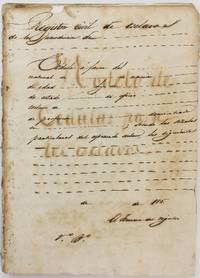
18503976Havana 1850. Good. 138pp. Folio. Stitched with remnants of leather binding along spine. A few blank leaves scattered throughout. Dampstaining and moisture damage at upper fore-edge of scattered leaves slightly affecting text. Moderate offsetting occasional ink burn. Light edge wear and tanning scattered foxing. An extensive list of slave owners in Cuba in the mid-19th century who were issued cedulas for their human property. Cedulas were integral documents for the identification and transportation of enslaved people in the bureaucracy of colonial Cuba and were usually required by the government. In the present manuscript the race and sex of the slaves being issued documents are usually identified -- Negra Negro mulata mulato Chino China e.g. -- though some are just entered as esclavos and there are several entries noted as dotaciones that is complements usually large of slaves on a plantation. The names of the owners are grouped alphabetically according to their first names generally though not in any strict order and the leaves of the manuscript are sometimes bound out of order. Often there are multiple listings of an owner most likely one for each slave in need of a cedula and in all there are approximately 2500 or more separate listings. The first leaf appears to be a model for the cedulas that were being issued to the listed slaveholders with dashes where the information on the slaves and slave owners is to be filled in. The entire document has the appearance of an index with numbers at the right side of each page indicating perhaps the page numbers in the master ledger where the original entry was made. Overall a fascinating and significant document. unknown
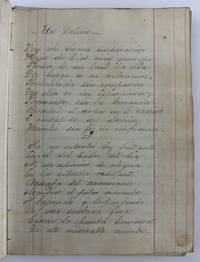
18894403Havana Cuba 1889. Good. 69pp. of manuscript text plus 77pp. of newspaper extracts. Contemporary quarter calf and marbled paper-covered boards. Moderate scuffing and wear to boards and edges spine scuffed. Hinges broken with text block only nominally attached by threads with many leaves detached. Ownership ink stamp on front free endpaper "Manuel F. Barranco" with a gilt insignia affixed below reading "MB." A unique and personal manuscript journal and scrapbook composed and maintained by an important but obscure Cuban-American poet and author Manuel Francisco Barranco y Miranda 1843-1894. Barranco was born in Puerto Principe and lived about half of his life in Cuba before emigrating to Florida in 1875. He married Mercedes Fernández y Fernández-Mora and the couple raised a family in Cuba Florida and New York. Mentions of Barranco are rare in available records but he seems to have been a colleague of famed Cuban revolutionary figure Jose Marti. Barranco and Marti were involved with a Cuban revolutionary emigrant colony in Key West as well as Cuban literary and political societies in Havana and New York such as La Liga. Regarding the latter one of Barranco's poems in the present work composed in eleven parts is titled "Versos recitados en la sesion ordinaria de la Sociedad Literaria Hispano-Americana la noche del 17 de Maya de 1889." The Sociedad Literaria Hispano-Americana or Spanish American Literary Society provides a further connection to Jose Marti as Marti was one of the most prominent members of the club in the 1880s and '90s. Barranco presumably spent the remainder of his life between Cuba and the eastern coast of the United States where he passed away in Tampa Florida in 1894.<br /> <br /> The present material was written and compiled by Barranco over about a thirty year period in the mid-19th century before and after he emigrated to the United States. The chief feature of the present work is contained in almost seventy pages of manuscript poetry by Barranco. The poems which number around a couple dozen compositions include "Un Delirio" written in six parts "Versas improvisados en el Bautiro de mi hija Ana Maria el dia 1 de Enero de 1875" "Versos improvisados en comemora cion del Bautiro de mi hija Ana Maria el dio 1 de Enero del 1876" "Al congreso de la Paz" and various sonnets and other poems dated between 1875 and 1889. Barranco authored a few poems here about his wife Mercedes with titles such as "A Mercedes" "Improvisados a la orrilla del mon - A Mercedes" and "Al contemplar tu retrato." He also composed poems about his mother Ana Maria Sebastiana de Miranda. Several of the later poems from 1888-89 are datelined Havana next to the date of composition indicating Barranco moved back and forth between Cuba and America.<br /> <br /> The manuscript text is supplemented by almost eighty pages of newspaper extracts featuring various articles letters and printed poetry by Barranco published under his own name and a pen name "Leunam." The subject matter of these pieces include education women literature and various family members and other subjects in his own poetry. An example of the latter is a memorial poem for his granddaughter Margarita Barranco who died in Puerto Principe in 1866. Following the manuscript poems themselves is a single handwritten page of contents relating to these newspaper extracts. The extracts very likely come from Cuban newspapers and periodicals since they predate his move to Florida in 1875. A printed note laid into the book reads: "A Bound Journal Containing Published and Unpublished Handwritten Letters and Poems by My Grandfather Manuel Francisco Barranco y Miranda in Habana in the mid-19th Century Probably During the Period 1859-1869." Not much else is easily discovered about Barranco providing an excellent chance for original research into the work of this obscure but important 19th-century Cuban-American poet and writer. unknown