105 résultats
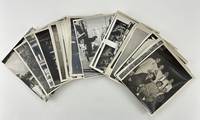
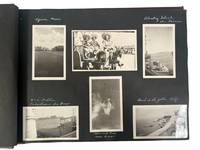
19624785Various locations in Cuba Europe and the United States 1962. Very good. 113 leaves of scrapbook cardstock illustrated with 388 photographs chiefly silver gelatin photographs several colored or in color in mounting corners. Most captioned in Spanish. Square folio. Contemporary brown cloth spring-loaded spine front cover stamped "CUBA." Joints split but holding well moderate rubbing and dust-soiling. Light foxing handful of images lacking some images slightly browned or with mild edge wear. An extensively-annotated vernacular family photograph album centering on the German-Cuban Coyula-Moeller family picturing their lives family members travels and more in Cuba the United States Germany and other locations in Europe mainly during the 1920s and '30s. The album was likely compiled by Gerardo Coyula y Moeller who was born in the early-1920s and attended Aloisiuskolleg in Bad Godesberg in the late-1930s. The album includes numerous pictures of Coyula y Moeller as a toddler young man and teenager traveling with his mother and various family members attending school and more with numerous photographs featuring the family and their environs in Cuba and Germany. The caption to a family photograph indicates that the Coyula family were shareholders in the German Club "Club Aleman" in Havana from 1939 to 1960. Other family members identified through the profuse captions include Aunt Merci Aunt Hortensia Uncle Gustavo Estela grandfather Enrique Moeller grandmother Rosa Gelpi and others.<br /> <br /> The album also contains several photographs relating to the Nazi Party in Germany before the war as well as two photographs with captions poignantly noting one young man who would die in a concentration camp in Germany. One of the latter examples pictures a young man named Gerd Wolf with the Spanish caption translated as "Rabbi Fidellis eating bananas - He was with the Resistance and died in the Dachau concentration camp." The Coyula y Moeller family were apparently shareholders in a German casino in Cuba. Notably an antecedent of the family was apparently friends with a German individual who is documented as later helping usher Hitler into power and the album records two additional Nazi individuals who "visited grandfather's house" and "fled to Brazil" to escape the consequences of their war crimes. Yet another family photograph shows a group of adults posed in a garden with the caption reading: "Nuestro amigo: Resulto ser Himmler" "Our friend: turned out to be Himmler". Indeed the image shows the man third from right is clearly Heinrich Himmler.<br /> <br /> In addition to pictures of the family at home in Cuba the album captures them in various locations in Germany mainly Bonn Hamburg and the aforementioned Bad Godesberg. The family also traveled to New York in the United States and Southampton England among other places with several photographs documenting their travels in each location. The album is also replete with identified photographs of a legion of family friends and acquaintances providing ample opportunity for deeper research into the connections within the family but also to the family's larger community. According to a previous owner the album came out of the noted Weber family in Cuba. An exceptional and well-preserved collection presenting the lives of this noted German-Cuban family. unknown
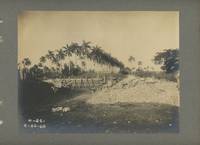
1906List3021La Habana Province Republic of Cuba 1906. Twenty-two photographs measuring 7 ¼ x 9 ½ inches mounted on heavy cardstock measuring 10 x 12 inches. Photos numbered and dated on negative. In album embossed with “Havana Central Railroad Co./ Progress Photographs/ GUANAJAYâ€. Photos with fine contrast and some wear; mounts with minor damage slightly warped with some detached from binding. Overall excellent. Havana Central Railroad Company was an American company formed in April 1905. It opened two electric tram lines—Havana to Guanajay in 1906 and Havana to Güines in 1907—before it was bought by the English company United Railways following the Panic of 1907. Offered here is a photo album showing the construction of the Guanajay line. The photographs show laborers assisted by horse-drawn carts digging culverts laying tracks and erecting bridges and buildings.<br /> <br /> This project came on the heels of the successful efforts of the Cuba Company another railroad company to make the emerging Cuban Republic amenable to American business.They did so first by using ‘revocable permits’ which could ostensibly be revoked by the new government when it was formed to circumvent the Foraker Amendment prohibiting concessions to American companies by the US’s military government; and second by using their close relationships to several members of the Cuban Constitutional Convention to include a law allowing irrevocable permits.1 These along with the Platt Amendment and Governor Leonard Wood’s General Railway Law led to what would amount to domination by US interests in Cuba particularly but not exclusively in the railroad industry.2<br /> <br /> Of interest to scholars of the early Republic of Cuba especially the history of US businesses in the country.<br /> <br /> 1 Juan C. Santamarina “The Cuba Company and the Expansion of American Business in Cuba 1898–1915†The Business History Review 74 no. 1 Spring 2000: 41–83.<br /> 2 Louis A. Pérez Jr. “Insurrection Intervention and the Transformation of Land Tenure Systems in Cuba 1895–1902†Hispanic American Historical Review 65 no. 2 1985: 229–254. unknown
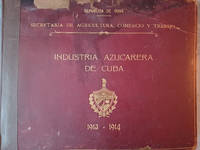
19153017<p>Portafolio azucarero de la industria azucarera de cuba 1912-1914 primera edicion libreria e imprenta la moderna poesia 1915 esta obra ha sido realizada siendo presidente de la republica de cuba dr mario garcia menocal y secretario de agriculturacomercio y trabajo el general emilio nunez caratulas originalesrestauradasgran libro ilustrado 424 pgs mas graficos libro con peso de 13 librascon 16 cm de largo por 12.5 cm de anchoes una obra super rarade colecciondonde se describen todos los centrales azucareros de cubacon fotos y sus caracteristicas publicada en el ano 1915 por la libreria e imprenta la moderna poesiaes una de las rarezas de la bibliografia cubana</p> Libreria e imprenta la moderna poesia hardcover
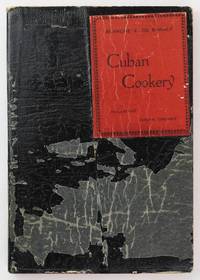
19316190Havana 1931. Very good. 150pp. Stiff black cloth covers printed paper label on front board. Front cover vertically creased light wear to boards; remnants of glassine stuck to covers. Contemporary inscription on front flyleaf. Internally clean. In a custom clamshell box. First edition of the first Cuban cook book published in English. Blanche Zacharie de Baralt 1865-1950 was born in New York; she married Luis Alejandro Baralt y Peoli in 1886 and the couple moved to his native Cuba in 1900. She earned a PhD in philosophy from the University of Havana in 1902 and went on to translate the poetry of Tagore and to write a book on Jose Marti. She also published this volume which was clearly geared toward the tourist market with the introduction emphasizing the idea of taking home the tastes of one's holiday abroad. Each chapter heading has an illustration and these were drawn by Federico Edelmann and Conrad W. Massaguer the one above the section for beans appears to show a cowboy riding along in a cloud of gas. Notably this work contains several important Cuban cocktails including the first appearance of the mojito referred to here as a Rum Cocktail or Cuban Mojo. Rare in the true first edition. unknown
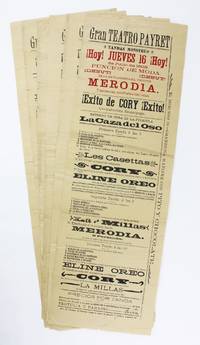
19085578Havana: Moises V. Codina 1908. Good plus. Seven broadsides each approximately 22 x 7.25 inches plus one double bill measuring about 22 x 15 inches. One broadside printed in red and black. Previously folded. Scattered shallow tears from edges not affecting text with some tape repairs on blank versos. A group of eight playbills spanning eight consecutive days in July 1908 that advertise performances and events at the Gran Teatro Payret in Havana. The theater was built by its namesake Jaoquin Payret in 1877 on a corner across from the Villanueva Railway Station now the Capitolio Nacional de la Habana and initially focused on opera and high-class performing arts to compete directly with other established theaters in the Cuban capital. The building had five floors and a capacity of 2300 but the upper balconies collapsed in 1882 after which the theater changed hands and began to showcase more varied popular offerings.<br /> <br /> These playbills publicize an array of performers including the ballet dancer Millas; a cabaret artist Eline Oreo; a magician and telepath Sidney Richards; Troupe Montrose a group of acrobats an Italian dance troupe Les Casettas; two clowns named Pito and Chocolate; and many others. Notably the programming also includes a heavy rotation of short and feature films such as La Electricidad Liquida 1907; El Inagarrables Pick Pocket 1908; Victima de la Ciencia 1907; En Chine: Voyage sur le Canal Impérial 1908; and Venganza del Dervich 1907. The playbill for Thursday July 16 with its headline and date in red proclaims the debut of Trouppe Merodia a seven-person group of acrobats and cyclists as well as the Cuban premiere of a film titled La Caza de Oso The Bear Hunt.<br /> <br /> The theater was closed by hurricane damage in 1926 but reopened as a cinema in 1935 and in the following years became known as the "Cathedral of Spanish Cinema." The building again fell into disuse and disrepair in the decades following the Cuban Revolution but was restored in 2008. A very interesting group that gives a great sense of day-to-day operations at one of Cuba's most important and historic theaters. Moises V. Codina unknown
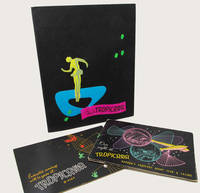
195534840Havana Cuba: The Tropicana circa 1955. 4 volumes. Original Printing. Original velour cover illustrated by hand using the technique of collage in yellow green blue pink and black and illustrated throughout with photographs designs and decorations the three brochures also in colour. Large 4to 28 x 23 cm Original velour with collage decorations to the cover the brochures of paper over board all coloured. 24 pages with numerous illustrations and 2 hand-made excerpts that allow a view of the following page. The large format brochure also includes: 1. 'Our Night at Tropicana. Havana's Fabulous Night Club & Casino' illustrated folder to insert a photograph here without photo. 2. The same with an original photograph of a party hand-dated 'Marzo 1962' and inscribed 'Boda de Cora y Vicente' with the names of the guests. The envelope is rubbed a bit. 3. The same in a different design with a photograph showing a lady in an evening dress. Her companion has been cropped from the photograph. Two additional postcards are provided here one showing the poolo of the Cabana Sun Club the other shows Calle Obispo in Havana in an older photograph. A fine copy of the 'This is Tropicana' cover and contents the brochures with a bit of age or evidence of use. VERY SCARCE. A beautiful collection from one of the most famous nightclubs of the 1950's. In 1950 Martin Fox bought Villa Mina and commissioned architect Max E. Borges to carry out the spectacular renovation with parabolic concrete arches and glass walls to roof the stage. On March 15 1952 the new Arcos de Cristal cabaret building was opened. Artists who performed at the Tropicana included star such as Nat King Cole and Josephine Baker and visitors included Edith Piaf Ernest Hemingway Jimmy Durante and Marlon Brando. Shortly after the revolution in 1959 the Tropicana like other casinos and nightclubs was nationalized. The Tropicana unknown
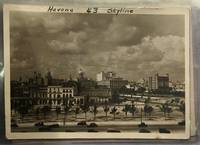
1930RF 565<p><b><i>17 original photos from La Habana.</i></b><br /></p><p>8vo. 17 photographs from Havana. Photographs are 17.5 cm x 12.5 cm.</p><p>Each photograph bears an ink handwritten description across the top: Prado & Morro Castle; Havana Skyline; Prado & Capitol; Residential Palace; El Morro no inscription; Race Track Havana; Prado from the Capitol; Prado from the Capitol another view Maine Monument; Capitol Grounds; Tropical Beer Garden; Main Monument & National Hotel Havana; Race Track another view; National Theatre and Capitol. Set of photographs of Havana from the 1920s 1930s. The inscriptions on each photograph are in English. Unidentified photographer. Interesting Cuban photographici conography. O02G000074 RF 565 X99X001603</p>
1908ZB573260Habana: Rambla y Bouza printers last two volumes with libreria 1908-1919. 40 volumes all issued; text browning especially at margins needs rebinding. - If you are reading this this item is actually physically in our stock and ready for shipment once ordered. We are not bookjackers. Buyer is responsible for any additional duties taxes or fees required by recipient's country. Photos available upon request. Habana: Rambla y Bouza, printers last two volumes with libreria unknown
19036457V.p. 1903. 36 postcards all completed in manuscript generally very good or better with some wear and rounded corners. <br /> <br /> A fascinating assemblage of cards written by Pre-Castro intellectuals to a Maria de Serra though a few are written to other women. It is difficult to pin down de Serra though we do know she was highly educated and very well-known and connected. It makes sense to us that she is perhaps the Maria de Serra mentioned by William Wells Brown in his important work The Rising Son or the Antecedents and advancement of the Colored Race 1874. On pg 260 Brown writes:<br /> <br /> "The free blacks in Cuba form an important element in her population and these people are found in all the professions and trades. .one of the best young ladies' academies at present existing at Havana is personally conducted by an accomplished negro woman Maria de Serra to whom many a lady of high rank owes her social and intellectual accomplishments."<br /> <br /> Further research may be fruitful in retrieving more information on this Maria de Serra.<br /> <br /> It goes without saying that the sentiments and signatures are the most appealing part of this collection. Many of the cards appear to contain original verse and all are quite legible and well preserved. Equally as lovely are the cards themselves many being of exceptional beauty as they were all chosen by artists and intellectuals. All in all a remarkable set worthy of further research. The correspondents are as follows:<br /> <br /> <br /> Diego Vicente Tejera; one of the most famous turn-of-the-century Cuban poets but also known as a short story writer orator and political activists.<br /> <p><br /> Nestor Cargonell; famous poet and writer. His son went on to become a Hollywood star.</p> <br /> <p>Conde Kostia pseudonym of Aniceto Valdivia; writer journalist poet critic lecturer dramatist founder of newspapers and Cuban diplomat.</p> <br /> <p>Rafael Maria Merchain; very influential poet and philosopher</p> <br /> <p>Enrique Fontanills; very prominent Cuban journalist.</p> <br /> <p>Florimel: great Cuban journalist writer and poet who died early in life.</p> <br /> <p>Manuel Raul Blanco Belmonte; Cuban poet.</p> <br /> <p>Ramon Meza; One of the most important Cuban writers of his time. Many of his books are considered classics and remain in print.</p> <br /> <p>Aurelio Cancio; Cuban journalist who founded "La Discusion" newspaper.</p> <br /> <p>Manuel Serafin Pichardo; one of the most popular Cuban poet of the 1900s.</p> <br /> <p>Frederico Mendes Cobos; a Cuban politician who became a a senator in 1902.</p> <br /> <p>Juan Maria Alberti: influential Cuban politician.</p> <br /> <p>Manuel Marquez Sterling; fine writer and politician.</p> <br /> <p>Jose Manuel Govin; journalist and director of the popular newspaper "El Munto"</p> <br /> <p>Cesar Cancio; Very popular Cuban poet born in St Spiritus.</p> <br /> <p>Pablo Bonachea; great Cuban journalist and director of "La Discussion" newspaper for one year.</p> <br /> <p>Jose Ernesto Trian; Cuban writer with political connections. Was ambassador to Venezuela.</p> <br /> <p>Manuel Tierso; Romantic Cuban poet</p> <br /> <p>Alvaro de la Iglesia. revered Cuban writer who penned the great "Cuban Traditions"</p> <br /> <p>Frederico Ledesma Balsunde: journalist and editor at "El Lucero."</p> <br /> <p>Fabio Fiallo; a leading Dominican writer poet and politician. He died in Cuba.</p> <br /> <p>Dulce Maria Borrero de Lujan; the most important Cuban woman writer and poet of her time.</p> <br /> <p>Frederico Hermida; author of any Cuban novels in the 1900s.</p> <br /> <p>Mariana Comas; Cuban essayist</p> <br /> <p>Joaquin Lopez Sena; renown Cuban poet and a politician from the 1900s to the 1920s.</p> <br /> <p>Eliseo Giberga; a very powerful and influential Cuban politician of the early 1900s.</p> <br /> <p>Manuek Coronado; an important Cuban journalist.</p> <br /> <p>Antonio San Miguel; Cuban writer and journalist.</p> <br /> <p>Pablo Santi Rois; Poet and respected journalist.</p> <br /> <p>Armando Celorio; One of the finest Cuban poets.</p> <br /> <p>Jose Maria Carbonell; famous Cuban poet and writer.</p> <br /> <p>Marcos Trazivark; famous Cuban writer and Musician.</p> <br /> <p>Esteban Joven; Cuban writer poet and essayist.</p> <br /> <p>Narciso de Puso; famous poet well entrenched in Cuban high society.</p> <br /> <p>Eduardo Mencis Capote; Cuban journalist popular among the elite.</p> <br /> <p>Lorenzo Frau Marsal; respected Cuban journalist</p> <br /> . unknown
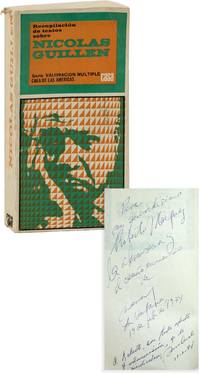
197488452Havana: Casa de las Americas 1974. First Edition. First Impression one of 18000 copies. Narrow octavo 22.75cm; original pictorial card wrappers; 67-4293pp; illus.; text is entirely in Spanish. Inscribed by Guillen on the title page to Puerto Rican editor translator and literary critic Roberto Márquez: "Para Roberto Márquez / con el fraternal cariño de Nicolas / La Habana Feb. 74." Signed directly beneath by an unknown figure and below that by Afro-Cuban poet and journalist Marcelino Arozarena 1912-1996. The opposing page is inscribed for Márquez in verse with a small drawing by an undetermined poet signed "David Feb.74." The verso of the half-title page is warmly inscribed by Cuban poet and critic Nancy Morejón who has written the foreword to this volume: "Para mi queridísimo Roberto Marquez / la admiracion y el cariño immenso de Nancy / La Habana / 19 de feb. de 1974." Directly beneath this is another warm year of publication inscription by an underemined individual. This volume has been extensively marked-up by Márquez whose contribution "Introducción a Guillén" appears on pp.127-138. Some wear to extremities a few nicks and tears to spine ends with some creases to wrappers; Very Good. <br /> <br /> A key volume of critical texts on Guillén 1902-1989 the national poet of Cuba by many of his contemporaries like Mirta Aguirre Angel Augier Roberto Fernández Retamar Nancy Morejón Alejo Carpentier Pablo Neruda Ciro Alegría and others. This copy bears a number of contemporary inscriptions to Márquez a Guillén scholar who has written extensively on his work and has translated several of the poet's works faithfully from Spanish into English. 88452. Casa de las Americas unknown
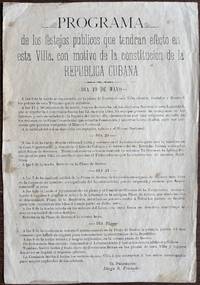
19013191Havana 1901. About very good. Broadside 12.5 x 9 inches. Light wear and soiling. Backed with tissue. Broadside outlining the celebrations planned for the adoption of the Cuban Constitution of 1901 following the eviction of both Spain and the United States from the country. Four days of celebrations were planned for May 19 20 21 and 22. Events including the singing of the National Anthem orchestral concerts fireworks dancing and other diversions. We find no record of this broadside in OCLC. An ephemeral piece commemorating Cuban independence. unknown
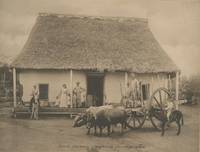
1913List3218Brooklyn New York: The Albertype Co 1913. Photo album of twenty-five 12 ½ x 10 inch pages containing fifty 8 x 6 inch photographs with cardstock cover. Cover and pages worn with marginal damage; pages mostly detached from string binding; photos with captions on negative; Near Fine with Fine contrast. Overall excellent to Near Fine. After the Spanish American War the Isle of Pines now Isla de Juventud in Cuba was contested territory because the 1901 Platt Amendment had specifically left ownership of the island up to a future treaty; the 1904 Hay-Quesada Treaty recognizing Cuban sovereignty over the island failed to be ratified by the US until 1925. American citizens controlled ninety-five per cent or more of the island’s land and were strongly in favor of American annexation. <br /> <br /> Offered here is a 1913 photo album exhibiting the island’s lush scenery productive farmland and luxurious American residences and resorts. The American property owners are identified by name and include American Residents and Property Owners’ Association President T.J. Keenan who in 1902 described the island under default administration by the Cuban government as “on the verge of anarchy . American interests are absolutely unprotectedâ€1; H.A. Christy Vice President of the Cincinnati Richmond & Muncie Railroad; coal and coke businessman John F. Atcheson and other elites. There are also shots of a number of hotels; grapefruit banana and pineapple farms belonging to the settlers; and recreation by both automobile and boat.<br /> <br /> Two photographs are not of American ventures: one of the home of José Sarda which housed José Martà before his exile to Spain labeled merely “Nueva Gerona Sarda Homsteadâ€; and one of a house labeled “San Juan Native Homestead†showing a family standing on the porch of their thatched-roof home with an oxcart before them.<br /> <br /> We find four copies of this photo book on OCLC. Of interest to historians of US imperialism in Cuba following the military withdrawal. <br /> <br /> 1 “The Isle of Pines President Orders Investigation of Affairs There†The Press-Herald November 15 1902 2. The Albertype Co unknown
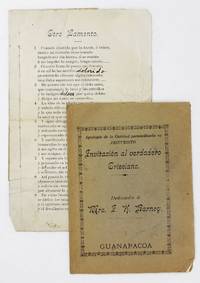
19036144Guanabacoa: Imprenta "El Progreso 1903. Good. 24;12pp. One small pamphlet in original printed wrappers plus a bifolium stitched together with four small broadside flyers. Previously folded. Some moderate creasing and wear with a few scattered short closed tears. Light dust soiling and toning. An assemblage of six individually printed poems composed in the early 20th century by obscure Cuban poet Anastasio Orozco y Etienne. The first poem "Apologia de la Caridad." is in its own wrappers and dedicated to Susan Hammond Barney the noted prison reformer Christian writer evangelist and world traveler. She is one of the founders of the Prisoners' Aid Society of Rhode Island and for many years was the President of the Women's Christian Temperance Union in Rhode Island. The second lengthier work titled "Otro Lamento" is printed on a bifolium and also carries religious themes. Stitched with this bifolium are four small broadside poems printed from 1901 to 1903. One of these is a tribute to President McKinley following his assassination and is dated the day of his death September 14 1901. The titles of the broadside poems in full are as follows:<br /> <br /> 1 A MacKinley sic. La Gloria Es de los Redentores.<br /> 2 El 10 de Octubre. Reminiscencia.<br /> 3 En Memoria del Pundonoroso Capitán Don Federico Capdevila.<br /> 4 Al Rev. H.B. Someillán. Su Regresso.<br /> <br /> OCLC records an 1882 work by Orozco y Etienne Emblema de las flores y de los colores en prosa y verso But not the later ephemeral works collected here. Interesting literary printing from a small newspaper press in Cuba just after the Spanish-American War. Imprenta "El Progreso unknown
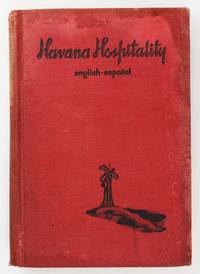
19506261Havana 1950. Good. 389pp. plus 33pp. of ads. Original red publisher's cloth stamped in black. Dampstained at edges and spine extremities worn; rear cover soiled. Contemporary inscription on front pastedown. Foxed some scattered soiling. An interesting bilingual Cuban cook book with recipes in English and Spanish on facing pages. The introduction explains that this is not a volume of recipes for the beginner bride or a how to guide but rather "the compilation of favorite recipes hitherto unpublished yet well-known and highly regarded in important Cuban-American circles and other parts of the world where men and women of taste and discernment throughout the years have succeeded in regaling the palates of intimate friends and distinguished gusts." Each recipe lists its contributor -- some of whom are noted as "Mrs." and some of whom are denoted as "Sra." Recipes range from Hot Grapefruit Cocktail to Sweet and Pungent Shrimp to Italian Spaghetti California Style and more. The St. Rita Guild is a Catholic parish organization designed to foster community. Fewer than ten copies in OCLC. A wonderful slice of domestic and social life in Cuba just before the Communist revolution. unknown
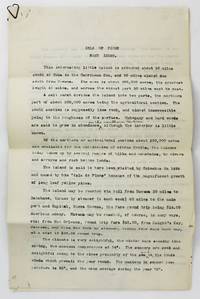
19105377N.p. 1910. Very good. 11pp. of folio typescript totaling around 3000 words with a handful of manuscript corrections. Old folds minor marginal stains from old paper clips. An anonymously-written typescript promotional and business prospectus touting the Isle of Pines Isla de la Juventud off the southern coast of Cuba in the West Indies. The author writes of the many advantages of the Isle of Pines noting "This interesting little island is situated about 50 miles south of Cuba in the Caribbean Sea" with a population of "well-to-do Americans who own about 95% of the island and are after the other 5%." The author also states that "the laborers are mostly 'Pineros' or Isle of Pines people and are very efficient. They are kind and courteous and seem well pleased with the present situation. They are paid from $1.00 to $1.50 per day according to the grade of work." More of the usual language encouraging emigration to the island follows describing the agriculture climate soil government business environment the "old Spanish cities on the island" and more along with several pages of cost estimates for creating a working ten-acre fruit grove. The anonymous author mentions that he and his partner in Nueva Gerona J.A. Miller bought forty acres in Cuchilla Alta or Santa Ana Estates at $40 per acre from H.R. Leland "the sole representative in the United States." The author states he has given up his profession as an engineer in order to devote his time and energy to building a grapefruit grove and pineapple farm and to get others interested in investing with him "We will organize a Development Company with a Citrus Fruit Expert at its head.". He concludes by reiterating that "the country itself is a delightful place to live.raises a superior quality of fruit" and he is glad he "learned about it in time to enable us to enjoy all the benefits of the 'Great Ground Floor.' unknown
19612137Various places in Florida Mexico Cuba & Spain 1961. About very good. 138 original prints each 8 x 10 inches; mostly large format images with twelve contact sheet containing multiple smaller images and including several duplicates. Light wear at edges; slight curling. Occasional patches of scuffing or soiling. Scattered manuscript annotations and ink stamps on blank versos of photographs. An interesting aggregation of approximately 150 unique professional images that depict the travels and activities of the Latin American Fiesta Association of Tampa Florida. The cultural heritage group was founded in 1940 and flourished from the late 1940s to the 1980s and organized or participated in local social events had an annual ball and traveled widely across Latin America. The photographs here date from 1949 to the early 1960s and document the travels of association members to Spain Mexico and Cuba. They attended numerous events entertainments dinners and other social gatherings as well as made visits to attractions and local cultural clubs. In Spain and Cuba their trips seem to have been limited to Madrid and Havana respectively and there are some interesting series of travel images in Cuba from just prior to the Revolution.<br /> <br /> The group seems to have made multiple trips to Mexico and traveled somewhat more widely. Scattered images show the activities of the association in Florida as well and many of the prints have contemporary manuscript captions and ink stamps of local photographers and photography studios on the versos. In all a wide-ranging and quite engaging group of large photographs that document this midcentury Latin American social club in Florida. unknown
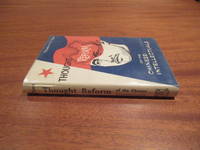
1960025662Hong Kong: Hong Kong University Press / Oxford University Press / Institute of Pacific relations 1960. First Edition First Printing . Hardcover. Near Fine/Near Fine Dustjacket. Xiii 247. Orange Cloth. One Of 2000 Copies Of The First Printing But This Copy With Printed $5 Us Price At Bottom Of Front Flap So Perhaps An American Issue. Slight Signs Of Usage To Book And Dj. Inscribed To Mr. And Mrs. Z. T. Nyi Zau Tsung Nyi Of Los Angeles "With High Esteem And Respect". Information From His Archives At Usc: Theodore H.E. Chen Ph.D. 1939 Was Chairman Of Usc's Department Of Asian Studies From 1940 To 1968 And From 1960 To 1971 He Directed The East Asian Studies Center In Support Of Which He Had Obtained The First Federal Grants. Chen Also Secured Outside Funding For A Project To Help Train And Advise High School Teachers Of Chinese And Japanese. A Native Of Fuzhou China Chen Was President Of Fukien Christian University In 1946 And 1947 While On Leave To Participate In Postwar Rehabilitation. He Also Helped Organize Tunghai University In Taiwan As A Representative Of The United Board Of Christian Colleges. He Was The Author Of Nine Books Including Thought Reform Of Chinese Intellectuals And Maoist Educational Revolution And Chinese Education. Dr Chen Hits An Easy Target; The Worst Governments Are Those Who Try To Control What And How People Think And How And Where They Communicate Because Their Leaders Have An Excess Of The Oldest Disease Of Officials Crap-In-The-Brain Which Prevents Them From Engaging In Exchanges Of Facts And Ideas. <br/> <br/> Hong Kong University Press / Oxford University Press / Institute of Pacific relations hardcover
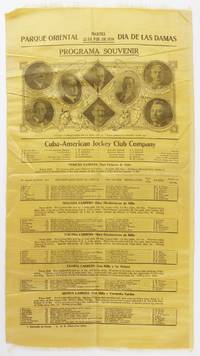
19164158Havana 1916. Very good. Broadside printed on light orange silk approximately 16.25 x 9 inches. Minor edge wear one small tear near bottom right. A seemingly unrecorded silk broadside issued by the Cuba-American Jockey Club Company advertising the lineup of horses and the schedule for a series of five races during Dia de las Damas "Ladies Day" at the Oriental Park racetrack in Marianao Havana in 1916. In addition the top of the broadside is printed with small oval- and diamond-shaped portraits picturing the nine officers of the club who are identified by name and their position within the club. Below these portraits is a listing of fourteen officers of the club. The Oriental Park Racetrack "Parque Oriental" opened in 1915 for winter racing which began in November and lasted into March each year. The racetrack was the only thoroughbred track in Cuba until Fidel Castro practically shut it down after the Cuban Revolution in 1959. The present broadside is a visual reminder of the influx of American business interests in Cuba in the early 20th century. No copies reported in OCLC. unknown
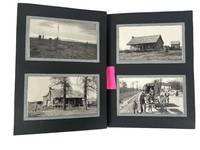
1924184851924. Photograph album 1920s-1930s documenting travel across the American Southwest and Cuba with images capturing landscapes infrastructure and communities during a period of regional development and increased mobility. Early photographs depict desert environments with saguaro cacti and yucca followed by rural farms mission-style buildings and roadside scenes including a family traveling by wagon in Texarkana. One image records the recently constructed Coolidge Dam in Arizona completed between 1924 and 1928 situating the album within contemporary efforts at water management and agricultural expansion in the Southwest. Additional photographs show individuals in domestic and rural settings including an African American man seated outside his home before transitioning to scenes of coastal and subtropical environments. The final portion of the album documents Cuba including street life harbor views with ships and fishing vessels and architectural landmarks such as Morro Castle reflecting the circulation of American travelers in the Caribbean during the interwar period.<br /> <br /> Photograph album containing 69 black and white silver gelatin photographs most measuring approximately 5.75 x 3 inches with one larger earlier portrait at the beginning measuring approximately 9.5 x 6 inches. The images are mounted in a cloth-covered board album with gilt lettering reading "Photographs" secured by a cord binding and measuring approximately 10 x 8.25 inches. The photographs are uncaptioned and arranged sequentially suggesting a travel-based compilation spanning multiple regions including Arizona Texas the Gulf South and Havana Cuba.<br /> <br /> 69 photographs mounted in original album; images clear and well-preserved. Light wear to album consistent with age; overall very good condition. A cohesive visual record of travel and regional life across the American Southwest and Cuba during the early twentieth century. unknown
1930221561930. This Photo Album captures a series of trips across California Mexico Dominican Republic Cuba Panama and other U.S. and North American travel documents the coastal and cross-border tourist experience of an American social group during the 1930s through the early 1950s.The album records a continuous itinerary of domestic and international travel with dated captions such as "July 19 1938 / On Board S/S Dixie from New Orleans La" situating the group within organized steamship routes linking the United States to Caribbean destinations.<br /> Oblong photograph album measuring approximately 11.5 x 15.25 inches containing 218 silver gelatin photographs mounted on black pages with images ranging from approximately 2.25 x 2.75 inches to 4.5 x 5.5 inches. Photographs are captioned on album pages and occasionally on versos identifying locations and dates. California scenes include Los Angeles Hollywood Olvera Street Pasadena gardens San Diego Balboa Park Mission Beach La Jolla Catalina Island and the Hotel del Coronado with recurring images of beaches coastal views small boats and leisure activities such as bathing and sightseeing. Additional images depict San Francisco landmarks including Alcatraz Island and Muir Woods. Travel beyond the United States includes Tijuana Mexico; Havana Cuba; Santo Domingo Dominican Republic; and Panama City with scenes of street activity ruins courtyards and waterfronts. A sequence from Catalina Island emphasizes seaside recreation while Caribbean and Central American images show plazas tropical vegetation and urban environments including Afro-Caribbean individuals in public spaces. Additional photographs document travel to New Orleans Utah Salt Lake City Nova Scotia and a location labeled "Indian Island."<br /> This album documents patterns of American tourism during the mid-twentieth century when organized travel by rail and steamship enabled access to domestic resorts and international destinations across the Americas. The combination of coastal California imagery with Caribbean and Latin American scenes reflects a broader گردش of leisure travel that emphasized climate landscape and cultural difference within reachable distance of the United States. The presence of consistent captions and chronological markers provides a structured record of travel routes and destinations contributing to research on tourism history visual culture and cross-border movement in the pre-jet era. Light wear to album and photographs with minor handling marks; overall very good condition. A substantial visual record of American travel practices and geographic mobility across the Americas in the mid-twentieth century. unknown
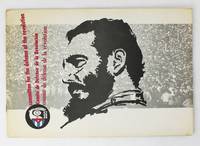
19656257Habana 1965. Very good. 16pp. Oblong pamphlet in original pictorial wrappers stapled. Light wear and toning at wrapper edges with a few faint creases. Internally clean. A visually rich pro-Casto and pro-Communist pamphlet that highlights the history and core activities of Cuba's Committee for the Defense of the Revolution CDR neighborhood-based civil defense organizations created by Castro in 1960 to defend the revolution and maintain social and political control at the local level. This often included activities like surveillance distribution of propaganda and vigilante justice. The pamphlet is illustrated with photos throughout and also contains a two-page spread with maps of the island and charts data and statistics about the Cuban people. It contains a year-by-year account of the Committee's achievements and activities and ends with a section concerning its relations with other countries and their visits to Cuba. The rear wrapper states that editions were published in English French and Spanish as evidenced by the trilingual title on the front cover but we find no evidence of any edition in OCLC. Scarce and with much interesting and propagandized information about Castro's local enforcers during the early years of the Communist regime. unknown
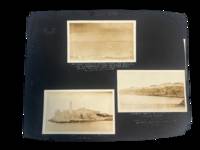
1920227281920. Havana Cuba travel photo album circa 1920s documents an American visitor's encounter with Havana during the interwar years when U.S. tourism commercial presence and Spanish-American War memory shaped how many American travelers interpreted the city. The vernacular photographs record arrival by steamship harbor landmarks civic buildings commercial streets factories boulevards monuments cemeteries and guarded public spaces giving insight into both Havana's urban landscape and the traveler's assumptions about access history and spectacle. The album's references to the USS Maine and Spanish-American War memorials place ordinary sightseeing within a longer history of U.S. intervention in Cuba; the Maine exploded in Havana Harbor on February 15 1898 killing more than 260 sailors and intensifying the crisis that led to war with Spain.<br /> <br /> Approximately 25 sepia-toned silver gelatin photographs each about 3 x 5 inches mounted to black album leaves with detailed handwritten captions in white pencil. The sequence begins aboard the S.S. Kroonland with one caption reading "My first view of Havana from the deck. three miles out at sea in a dark storm" followed by a landing view captioned "where we landed in Havana Cuba." The S.S. Kroonland returned to Panama Pacific Line service in 1923 on a New York to San Francisco route via Havana the Panama Canal and Los Angeles supporting the album's interwar travel context. The photographs then trace Havana's maritime and civic topography: harbor views Morro Castle captioned "Famous during the Spanish-American War" the waterfront in front of the fortress the Court House the President's Palace a "600-year-old church" the Henry Clay Cigar Store Havana's factory district and public boulevards "where all streets have parks in the center." Other images include a cemetery visit captioned "All people in Cuba are laid to rest above the ground" and a restricted-view street or carriage scene captioned "Officer would not let me take picture but when he turned I took it anyway" a revealing note on tourist privilege and unauthorized looking.<br /> <br /> Several images directly record the ways American travelers consumed Havana through imperial memory and Cuban nationalist commemoration. One monument is captioned "This was given by the Cuban people to the American soldiers that fell in the Spanish-American War" while another marks "the spot where the Maine sank at the entrance of the harbor." The album was made after Cuba's formal independence in 1902 and during the long aftermath of the Platt Amendment framework under which the United States retained extensive influence over Cuban affairs and intervened repeatedly in the early twentieth century. Album leaves chipped at edges several with corner losses not affecting images; prints generally sharp with strong contrast and clear annotations very good overall. Socially revealing Havana travel album documenting how a U.S. visitor pictured Cuba through steamship tourism colonial architecture cigar commerce Spanish-American War remembrance and the everyday authority structures of an interwar Caribbean capital. unknown
1906ZB705570Habana: 1906-1931 passim. Tomo I 1906 Tomo III 1906 a 1908 Tomo IV 1909 a 1911 Tomo VIII 1917 a 1919 Tomo 10 1921 a 1923 Tomo XII 1925-1927 Tomo XIII Vol. I 1927 a 1929 Tomo XIII Vol. 2 1929 a 1931 only; first editions; small usually thick quartos; ex library original cloth bindings smudged and worn with one side and a few text leaves detached most hinges cracked or broken text age toned but not fragile reading copies only. - If you are reading this this item is actually physically in our stock and ready for shipment once ordered. We are not bookjackers. Buyer is responsible for any additional duties taxes or fees required by recipient's country. Photos available upon request. Habana: hardcover
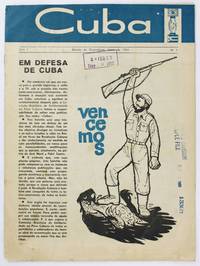
19615832Guanabara 1961. About very good. 111pp. Small folio. Original pictorial self-wrappers stapled. Contemporary and slightly later ink stamps to front wrap. Light edge wear. Some tanning and dust soiling. First issue of this evidently unrecorded periodical published by the "Comissão Brasileira de Solidariedade ao Pavo Cubano" in May 1961. The publication contains numerous positive stories on the progress of the Cuban Revolution and support of the cause from the Brazilian people. Illustrated throughout with photographs and drawings including the beginning of a serial comic on the history of the revolution at the rear. The front wrap depicts Fidel Castro with his foot on the chest of a supine eagle and a rifle raised triumphantly over his head. Interesting support for the Communist cause in Cuba from South America. Not in OCLC. unknown
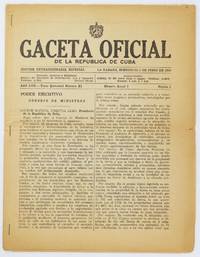
19595470Habana: June 3 1959. Good plus. 11pp. Small folio. Previously folded; stapled along gutter margin. Some edge and corner wear; closed tear to initial leaf from fore-edge along old fold. Toned cheap newsprint. A special edition of the Gaceta Oficial of Communist Cuba devoted to the printing of the First Agrarian Reform Law passed and signed on May 17 1959. The law effected the first major land redistribution under Fidel Castro and the Communist Party. Under its authority all properties were over 420 hectares were confiscated and redistributed to the people and native businesses. Prior to the law over 80% of Cuban land was owned by foreign mostly American companies. The preamble and sixty-seven articles lay out the motivations for the law the parameters for confiscation by the Department of Agriculture the mechanisms for seizure and redistribution and the creation of a new government organization to facilitate the land transfers the Instituto Nacional de Reforma Agraria. Signed in print by Fidel as Prime Minister Manuel Urrutia Lleo as President and a slew of other officials. June 3 unknown