4 résultats
19721018San Francisco: John Howell--Books 1972. First English Language Edition. Hardcover. Near fine/near fine. A near fine first English translation in a near fine dustjacket. Blue cloth boards with bright gilt title stamping on cover and spine. Sunning to endpaper edges otherwise fine. Orange endpapers. Rear pocket map present and pristine. Jacket showing a bit of dust stains otherwise fine. Illustrations in black and white with some in color. xviii 148 pp. Quarto 9 x 12 1/2 inches tall. O'Crouley's description of New Spain in the eighteenth century is a valuable contribution to scholarship mostly unknown until the late twentieth century when it was published. The original manuscript comprises 202 leaves bound in red leather in the Biblioteca Nacional de Madrid Ms. 972.02. It was published in English in 1972 as A Description of the Kingdom of New Spain by Sr. Dn. Pedro Alonso O'Crouley 1774.Once published it was widely reviewed in the scholarly literature. In 1975 it was published in a facsimile edition. For the English edition the translator Galvin rearranged some of the text to produce a more readable work. One scholar criticized this saying "This is a disservice to the text since part of its overall significance as an 'enlightened' compendium resides precisely in its structure as a miscellany." -- Wikipedia The volume is richly illustrated. He drew native plants and flowers cacao vanilla avocado sapote mamey passion flower and pricky pear cactus as well as animals not known in Europe. What has gained most attention are his depictions of race mixture castas which have been published in works on that topic. O'Crouley provides written text for the illustrations which were likely copies of existing casta groupings. He devotes an entire section of text to the condition of the Indians lamenting their current state. Unlike many casta paintings that show scenes of imagined everyday life of the racial types O'Crouley's lack any further context.11 He wrote short descriptions of New Spain's principal cities the capital Mexico City the second largest city Puebla; Valladolid now Morelia; Oaxaca; Guadalajara; Durango; Acapulco; and Veracruz. He travelled north to presidios of Los Adáes in Texas; El Paso del Norte; and the province of Nayarit. His description of New Mexico is considerably longer than the places coming before it. Also lengthy is the chapter on his voyage up the Gulf of California; his description of California itself; and an expedition to Nueva Andalucía Sinaloa and Sonora. John Howell--Books hardcover books
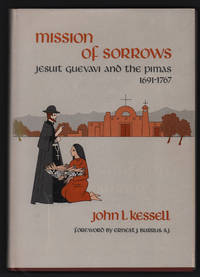
1970689Tucson AZ: University of Arizona Press 1970. First Edition. Hardcover. Near fine/fine. A near fine first edition in a fine unclipped dust jacket. Brown cloth boards front top corner bumped. Gilt title stamping. Mission map end papers. From the private library of Larry Southwick collector's marginalia pencilled at inner edge of half title. xvi 224 pp. including index. Quarto 7 1/4 x 10 1/2 inches tall. The Mission of Guevavi on the Santa Cruz River in what is now southern Arizona served as a focal point of Jesuit missionary endeavor among the Pima Indians on New Spain's far northwestern frontier. For three-quarters of a century from the first visit by the renowned Eusebio Francisco Kino in 1691 until the Jesuit Expulsion in 1767 the difficult process of replacing one culture with anotherthe heart of the Spanish mission systemwent on at Guevavi. Yet all but the initial years presided over by Father Kino have been forgotten. Drawing upon archival materials in Mexico Spain and the United Statesincluding accounts by the missionaries themselves and the surviving pages of the Guevavi record booksKessell brings to life those forgotten years and forgotten men who struggled to transform a native ranchería into an ordered mission community. Of the eleven Black Robes who resided at Guevavi between 1701 and 1767 only a few are well known to history. Otherssuch as Joseph Garrucho who presided more years at Guevavi than any other Padre; Alexandro Rapicani son of a favorite of Sweden's Queen Christina; Custodio Zimeno Guevavi's last Jesuithave the details of their roles filled in here for the first time. In this in-depth study of a single missionary center Kessell describes in detail the daily round of the Padres in their activities as missionaries educators governors and intercessors among the often-indifferent and occasionally hostile Pimas. He discusses the Pima uprising of 1751 and the events that led up to it concluding that it actually continued sporadically for some ten years. The growing ferocity of the Apache the disastrous results of certain government policiesespecially the removal of the Sobaípuri Indians from the San Pedro Valleyand the declining native population due to a combination of enforced culture change and epidemics of European diseases are also carefully explored. The story of Guevavi is one of continuing adversity and triumph. It is the story finally of expulsion for the Jesuits and a few short years later the end of Mission Guevavi at the hands of the Apaches. In Mission of Sorrows Kessell has projected meticulous research into a highly readable narrative to produce an important contribution to the history of the Spanish Borderlands." -- From the Publisher University of Arizona Press hardcover books
1928654Los Angeles: Wetzel Publishing Co. 1928. First English Language Edition. Hardcover. Very good. First English translation of Historia de los descubriementos antiguos de la Nueva Espa a. HOWES O 351 a. Blue cloth boards gilt title stamping on spine is crisp and bright. Corners lightly rubbed. Front hinge starting but text block sound and square. Errata tipped in. From the private library of Larry Southwick collector's marginalia pencilled near front hinge. Very good folding map has offset onto TOC and has a fine crease along part of the edge of map. No DJ. Frontis. xxxvi 351 pp. including index. Octavo 6 x 9 inches tall textblock. Baltasar Obregón born 1534 was a 16th-century Spanish explorer and historian. He is most notable for publishing the Historia de los descubrimientos de Nueva Espana an account of his travels in the New World. Obregón was born the son of an encomendera in the Spanish colony of New Spain. At the age of 19 Obregón joined up with a Spanish expedition to California from which he returned with travel experience. In 1554 at the age of 20 he joined the expedition of Francisco de Ibarra to explore the frontiers of Spanish territory and to secure mineral resources. The expedition was a success founding several settlements and allowing the Spanish to colonize Zacatecas. Later in life Obregón published an account of his travels the Historia de los descubrimientos de Nueva Espana in which he described the landscape of northern Mexico. After cataloging his own life he continued to publish the accounts of other Spanish expeditions such as that of Antonio de Espejo --- wikipedia Wetzel Publishing Co. hardcover books
1937203Baltimore: The Maya Society 1937. Second Edition. Hardcover. Very good. Friar Diego De Landa. A good edition HAND D83 with solid sturdy binding and cover. Original blue cloth boards with gilt stamping and Maya Society crest in gilt. The blue cloth is showing heavy spotting on the spine and front cover and the top front corner is bumped. Pages toned top edge darkened. Former owner's bookplate. From the private library of Larry Southwick. Laid in with a staplebound pamphlet for "Publications in the Field of Archaeology Anthropology etc. issued by the Carnegie Institute of Washington. May 1937." Heavily illustrated includes maps and related documents. 142 pp. Octavo 6 x 10 inches tall. An important primary source scarce in this edition "Modern scholars regard Landa with a mixture of frustration and admiration. At the same time he wrote his comprehensive work on Mayan culture his orders to destroy all icons and hieroglyphics obliterated the Mayan language . helping to undermine and destroy the civilization he so vividly described. Yet his book which was not printed until 1864 provided a phonetic alphabet that made it possible to decipher about one-third of the Mayan hieroglyphs and many of the remainder have since been deciphered." - Britannica The Maya Society hardcover books