30 résultats
1800183542Paris. : Henrics. An 9 1800. Contemporary marbled boards red spine label speckled edges. . Very good covers shelfworn at edges very light scattered foxing. . 8vo. French text. Scarce. Henrics. hardcover books
177740255London: T. Davies 1777. First Edition. 4 8 185 1 errata pp. 1 vols. 8vo. Early nineteenth-century full brown calf boards stamped in gilt with seal of The Society of Writers to the Signet black morocco spine label. Joints somewhat rubbed internally clean bright copy. First Edition. 4 8 185 1 errata pp. 1 vols. 8vo. First edition of this important critical work on one of Shakespeare's most notable characters. Jaggard p. 222 T. Davies unknown books
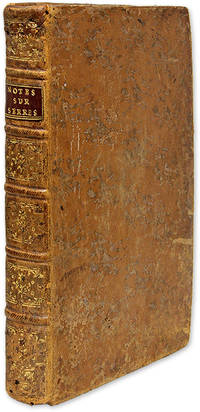
1787710321787. A Set of Manuscript Notes on an Eighteenth-Century Textbook on French Law Manuscript. Deloche Maurice Clement d.1842. Serres Claude 1695-1753. Notes sur les Institutes de Justinien Redigees dans l'Ordre des Institutes au Droit Francois de Serres par M. XXX. Grenoble 1787. viii 523 22 pp. Quarto 10-1/4" x 7". Contemporary mottled calf gilt spine with raised bands and lettering piece reading Notes Sur Serres edges rouged. Light rubbing and a few shallow scuffs to boards moderate rubbing to extremities a few minor worm holes to spine ends and rear board hinges cracked. Light toning text in neat hand within ruled borders a few notes in same hand laid in. $1950. A note in a later hand identifies the author as "Monsieur Mce Maurice Clement Deloche who died 18 May 1842." Apparently a fair copy this manuscript is a comprehensive set of notes on each section of Les Institutions du Droit Francois: Suivant l'Ordre de Celles de Justinien 1750 final edition 1778 by Serres. We were unable to identify which edition. Each note has a reference to the appropriate section. The manuscript is dated 1787 but it has additional notes from the Revolutionary era: three pages of notes at the beginning of the manuscript dated 1789 and 1793 and notes to the margins of a few leaves dated 1793 and 1794. As indicated by its title Serres's book is an elementary study of French law organized in the manner of Justinian's Institutes the classic textbook on Roman law from the Corpus Juris Civilis. unknown books
179441866London: Printed for M. Margarot; the London Corresponding Society; J. Ridgway etc. 1794. Engraved portrait. 1 vols. 8vo. Later Red cloth. Some spotting browning nd offsetting of text generally light. A very good copy. Engraved portrait. 1 vols. 8vo. Margarot was tried for sedition for having been a member of a group calling themselves "British Convention of the Delegates of the Friends of the People." He was a London merchant who shortly before had come up to Edinburgh. He was convicted and sentenced to 14 years transportation. This is the report of the trial with each speaker identified. Printed for M. Margarot; the London Corresponding Society; J. Ridgway, etc. unknown books
1794WRCAM36000Philadelphia 1794. 163pp. Dbd. Occasional light foxing. Lacks the portrait else very good untrimmed. In an archival folder. One of several 1794 American editions listed by Evans. Maurice Margarot an early member of the London Corresponding Society was arrested in October 1793 during his delegation to a national convention of British reformers in Edinburgh. He was tried in London for sedition found guilty and sentenced to fourteen years' transportation in Australia. He is remembered as one of the five "Scottish Martyrs." EVANS 27596. unknown books
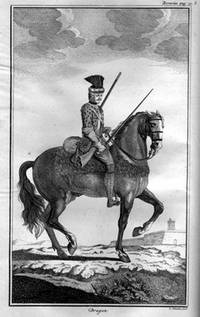
175825960La Haye: Pierre Gosse Junior 1758. Folio pp. xii 228 2 errata and binder's directions 2; 40 engraved plates 16 double page and 4 folding and 41 engraved vignettes; bound with: Bonneville Supplement aux Reveries ou Mémoires sur l'art de la guerre de Maurice Comte de Saxe La Haye Chez Pierre Gosse 1758 pp. 15 1; 21 engraved plates 4 double page and one folding; contemporary red morocco-backed boards spine in 7 compartments black morocco label in 1 gilt ornaments in the rest; the boards with an overlay of 20th century pastepaper endpapers renewed. A standard work on warfare by Maurice Comte de Saxe 1696-1750 marshal of France son of the king of Poland conqueror of the English pretender to the dukedom of Kurland and universal lover here printed under the editorship of Zacharie de Pazzi de Bonneville. It is a remarkable work on the art of war. Though described by Carlyle as 'a strange military farrago dictated as I should think under opium' it is in fact a classic. It was published posthumously in 1757. This is the only folio edition. <br/><br/> Pierre Gosse Junior hardcover books
17294773London: Printed and sold by J. Roberts 1729. 2xvi18pp. Disbound. Title-page a bit foxed. Printed and sold by J. Roberts unknown books
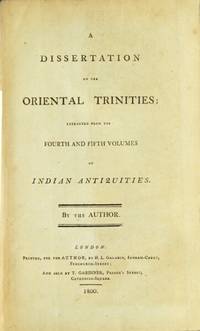
180019171London: for the author by H.L. Galabin 1800. First separate edition 8vo pp. vii 1 17-458; folding copper-engraved frontispiece of Vishnu Brahma and Seva plus 5 other folding copperplates; contemporary and perhaps original brown cloth-backed paper-covered boards paper label on spine; binding worn. Essentially an offprint from the author's larger work Indian Antiquities 7 vols. 1793-1800 and issued in a separate edition of 250 copies only but "revised newly arranged and divided into chapters." DNB calls him "one of the first to popularise a knowledge of the history and religions of the east." <br/><br/> for the author by H.L. Galabin hardcover books
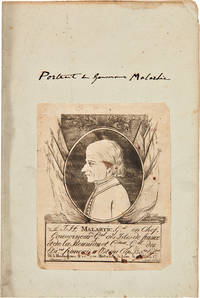
1800284241800. Engraving 5 x 4 inches. Light soiling. A few contemporary ink notations on verso. Engraved portrait of Governor Anne Joseph Hippolyte de Maurès Comte de Malartic governor of the island of Mauritius. The portrait is a line-drawing done in profile and framed in an oval. Flags flank either side of the oval frame and it is captioned beneath. There is some light wear to the tiny imprint information causing it to be slightly obscured but it is possible that the illustrator's name is "Girouai" and the engraver may be "Noiret." The engraving is a bit crude and printed on laid paper. It is likely that it was done shortly after Malartic's death in 1800. A most unusual and exotic image a tribute to the rich culture of printing that flourished on the remote island in the south Indian Ocean. unknown books
1800WRCAM48638N.p. but almost certainly Mauritius 1800. Engraving 5 x 4 inches. Light soiling. A few contemporary ink notations on verso. Very good. Engraved portrait of Governor Anne Joseph Hippolyte de Maurès Comte de Malartic governor of the island of Mauritius. The portrait is a line-drawing done in profile and framed in an oval. Flags flank either side of the oval frame and it is captioned beneath. There is some light wear to the tiny imprint information causing it to be slightly obscured but it is possible that the illustrator's name is "Girouai" and the engraver may be "Noiret." The engraving is a bit crude and printed on laid paper. It is likely that it was done shortly after Malartic's death in 1800. A most unusual and exotic image a tribute to the rich culture of printing that flourished on the remote island in the south Indian Ocean. unknown books
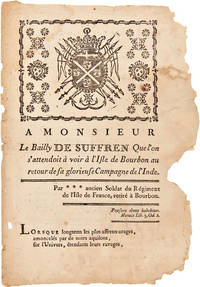
1784WRCAM48601Isle de France: Imprimerie Royale 1784. 4pp. on a single folded sheet. Quarto. Moderately worn with loss at fore- edge and gutter margins not affecting text. Lightly soiled and dampstained. Good. An early and unrecorded imprint from the colonial press at the French colony of Mauritius also known as the Ile de France. The text comprises a poem in eleven stanzas by an anonymous soldier from the Regiment of the Isle de France who retired to the island of Bourbon. As most early imprints from Mauritius are official documents this piece a work of local literature is particularly interesting and desirable. <br> <br> The Dutch were the first Europeans to become interested in the island taking possession in 1598. After exploiting the island's dense forests for a century and introducing the cultivation of sugar cane and cotton in 1710 the Dutch abandoned the colony. The French soon claimed it as "Ile de France" and the island remained under the control of the French East India Company until 1767. During the long war between France and England at the beginning of the 19th century Mauritius proved to be an important strategic naval base; as a result the British took charge of the island in 1810 and the Treaty of Paris confirmed official British possession in 1814. It remained an important sugar producing colony and in the 20th century agricultural production was expanded to include tea rice and other produce. <br> <br> Printing began on Mauritius in 1768. During the French period until 1810 only about 400 imprints were produced mostly in the form of official documents and newspapers though there are also almanacs and a few other items. All are quite rare. No copies located in OCLC and not recorded by Toussaint in his bibliography of Mauritius imprints. Imprimerie Royale unknown books
1784284321784. Quarto. 4pp. on a single folded sheet. Moderately worn with loss at fore edge and gutter margins not affecting text. Lightly soiled and dampstained. Early and unrecorded imprint from the colonial press at the French colony of Mauritius also known as the Ile de France. The text comprises a poem in eleven stanzas by an anonymous soldier from the Regiment of the Isle de France retired to the island of Bourbon. As most early imprints from Mauritius are official documents this piece as a work of local literature is particularly interesting and desirable. The Dutch were the first Europeans to become interested in the island taking possession in 1598. After exploiting the island's dense forests for a century and introducing the cultivation of sugar cane and cotton the Dutch abandoned the colony in 1710. The French soon claimed it as "Ile de France" and the island remained under the control of the French East India Company until 1767. During the long war between France and England at the beginning of the 19th century Mauritius proved to be an important strategic naval base and as a result the British took charge of the island in 1810 and the Treaty of Paris confirmed official British possession in 1814. It remained an important sugar producing colony and in the 20th century agricultural production was expanded to include tea rice and other produce. Printing began on Mauritius in 1768. During the French period until 1810 only about 400 imprints were produced mostly in the form of official documents and newspapers though there are also almanacs and a few other items. All are quite rare. No copies located in OCLC and not recorded by Toussaint in his bibliography of Mauritius imprints. unknown books
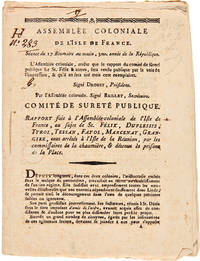
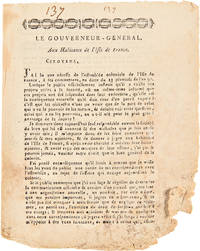
1794284251794. Small quarto. 28pp. Stitched as issued. Contemporary notation on first page some contemporary underlining in text. Minor soiling. Very good. A remarkable early imprint from the colonial press at the French colony of Mauritius also known as the Ile de France in the south Indian Ocean. The text contains a report of the French Revolutionary Committee of Public Safety regarding prisoners arrested on the island of Réunion being held as enemies of the Revolution. The document was printed in the capital Port Louis which was called Port de la Montagne from 1792 to 1795. The Dutch were the first Europeans to become interested in the island taking possession in 1598. After exploiting the island's dense forests for a century and introducing the cultivation of sugar cane and cotton in 1710 the Dutch abandoned the colony. The French soon claimed it as "Ile de France" and the island remained under the control of the French East India Company until 1767. During the long war between France and England at the beginning of the 19th century Mauritius proved to be an important strategic naval base and as a result the British took charge of the island in 1810 and the Treaty of Paris confirmed official British possession in 1814. It remained an important sugar producing colony and in the 20th century agricultural production was expanded to include tea rice and other produce. Printing began on Mauritius in 1768. During the French period until 1810 only about 400 imprints were produced mostly in the form of official documents and newspapers though there are also almanacs and a few other items. All are quite rare. No copies located in OCLC; Toussaint locates a copy at the Archives Nationales in Paris.<br/> <br/>Toussaint A247. unknown books
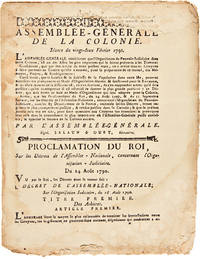
1791284301791. Folio. 24pp. Stitched as issued. Top corner of first leaf torn away affecting several lines of text. Lightly dampstained and worn throughout. Still very good. Early and unrecorded imprint from the colonial press at the French colony of Mauritius also known as the Ile de France. Issued at a critical moment at the beginning of the French Revolution the lengthy text concerns the government and judiciary of the island together with a proclamation by the King dated August 24 1790. The text nominally recognizes the authority of the King while taking measures to establish major autonomy of local government. The Dutch were the first Europeans to become interested in the island taking possession in 1598. After exploiting the island's dense forests for a century and introducing the cultivation of sugar cane and cotton in 1710 the Dutch abandoned the colony. The French soon claimed it as "Ile de France" and the island remained under the control of the French East India Company until 1767. During the long war between France and England at the beginning of the 19th century Mauritius proved to be an important strategic naval base and as a result the British took charge of the island in 1810 and the Treaty of Paris confirmed official British possession in 1814. It remained an important sugar producing colony and in the 20th century agricultural production was expanded to include tea rice and other produce. Printing began on Mauritius in 1768. During the French period until 1810 only about 400 imprints were produced mostly in the form of official documents and newspapers though there are also almanacs and a few other items. All are quite rare. No copies located in OCLC and not recorded by Toussaint in his bibliography of Mauritius imprints. unknown books
1794WRCAM48588Port de la Montagne i.e. Port Louis: Chez F.N. Bolle 1794. 28pp. Small quarto. Stitched as issued. Contemporary notation on first page some contemporary underlining in text. Minor soiling. Very good. A remarkable early imprint from the colonial press at the French colony of Mauritius also known as the Ile de France in the south Indian Ocean. The text contains a report of the French Revolutionary Committee of Public Safety regarding prisoners arrested on the island of Réunion being held as enemies of the Revolution. The document was printed in the capital Port Louis which was called Port de la Montagne from 1792 to 1795. <br> <br> The Dutch were the first Europeans to become interested in the island taking possession in 1598. After exploiting the island's dense forests for a century and introducing the cultivation of sugar cane and cotton in 1710 the Dutch abandoned the colony. The French soon claimed it as "Ile de France" and the island remained under the control of the French East India Company until 1767. During the long war between France and England at the beginning of the 19th century Mauritius proved to be an important strategic naval base. The British took charge of the island in 1810 and the Treaty of Paris confirmed official British possession in 1814. It remained an important sugar producing colony and in the 20th century agricultural production was expanded to include tea rice and other produce. <br> <br> Printing began on Mauritius in 1768. During the French period until 1810 only about 400 imprints were produced mostly in the form of official documents and newspapers though there are also almanacs and a few other items. All are quite rare. No copies located in OCLC; Toussaint locates a copy at the Archives Nationales in Paris. TOUSSAINT A247. Chez F.N. Bolle unknown books
1791WRCAM48597Isle de France: Chez F.N. Bolle 1791. 24pp. Folio. Stitched as issued. Top corner of first leaf torn away affecting several lines of text. Lightly dampstained and worn throughout. Still nearly very good. Early and unrecorded imprint from the colonial press at the French colony of Mauritius also known as the Ile de France. Issued at a critical moment at the beginning of the French Revolution the lengthy text concerns the government and judiciary of the island together with a proclamation by the King dated Aug. 24 1790. The text nominally recognizes the authority of the King while taking measures to establish major autonomy of local government. <br> <br> The Dutch were the first Europeans to become interested in the island taking possession in 1598. After exploiting the island's dense forests for a century and introducing the cultivation of sugar cane and cotton in 1710 the Dutch abandoned the colony. The French soon claimed it as "Ile de France" and the island remained under the control of the French East India Company until 1767. During the long war between France and England at the beginning of the 19th century Mauritius proved to be an important strategic naval base. The British took charge of the island in 1810 and the Treaty of Paris confirmed official British possession in 1814. It remained an important sugar producing colony and in the 20th century agricultural production was expanded to include tea rice and other produce. <br> <br> Printing began on Mauritius in 1768. During the French period until 1810 only about 400 imprints were produced mostly in the form of official documents and newspapers although there are also almanacs and a few other items. All are quite rare. No copies located in OCLC and not recorded by Toussaint in his bibliography of Mauritius imprints. Chez F.N. Bolle unknown books
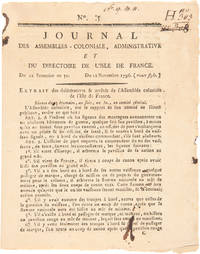
1790WRCAM48602Isle de France: Imprimerie Royale 1790. 29pp. Folio. Printed self-wrappers. Folded sheets several leaves loose. Moderate wear and soiling heavier to wrapper. Wrapper with some minor loss not affecting text. Good. Early and unrecorded imprint from the colonial press at the French colony of Mauritius also known as the Ile de France. An extract from the journals of the "Délibérations & Arretés de L'Assemblée- Générale de la Colonie de l'Isle de France" dated Sept. 25 1790 this document records the steps made to establish what was largely self-government at the outset of the French Revolution. <br> <br> The Dutch were the first Europeans to become interested in the island taking possession in 1598. After exploiting the island's dense forests for a century and introducing the cultivation of sugar cane and cotton in 1710 the Dutch abandoned the colony. The French soon claimed it as "Ile de France" and the island remained under the control of the French East India Company until 1767. During the long war between France and England at the beginning of the 19th century Mauritius proved to be an important strategic naval base. The British took charge of the island in 1810 and the Treaty of Paris confirmed official British possession in 1814. It remained an important sugar producing colony and in the 20th century agricultural production was expanded to include tea rice and other produce. <br> <br> Printing began on Mauritius in 1768. During the French period until 1810 only about 400 imprints were produced mostly in the form of official documents and newspapers although there are also almanacs and a few other items. All are quite rare. No copies located in OCLC and not recorded by Toussaint in his bibliography of Mauritius imprints. Imprimerie Royale unknown books
1790284331790. Folio. 2 9pp. Printed self-wrappers. Folded sheets several leaves loose. Moderate wear and soiling heavier to wrapper. Wrapper with some minor loss not affecting text. Early and unrecorded imprint from the colonial press at the French colony of Mauritius also known as the Ile de France. An extract from the journals of the "Délibérations & Arretés de L'Assemblée-Générale de la Colonie de l'Isle de France" dated Sept. 25 1790 this document records the steps made to establish what was largely self-government at the outset of the French Revolution. The Dutch were the first Europeans to become interested in the island taking possession in 1598. After exploiting the island's dense forests for a century and introducing the cultivation of sugar cane and cotton in 1710 the Dutch abandoned the colony. The French soon claimed it as "Ile de France" and the island remained under the control of the French East India Company until 1767. During the long war between France and England at the beginning of the 19th century Mauritius proved to be an important strategic naval base and as a result the British took charge of the island in 1810 and the Treaty of Paris confirmed official British possession in 1814. It remained an important sugar producing colony and in the 20th century agricultural production was expanded to include tea rice and other produce. Printing began on Mauritius in 1768. During the French period until 1810 only about 400 imprints were produced mostly in the form of official documents and newspapers though there are also almanacs and a few other items. All are quite rare. No copies located in OCLC and not recorded by Toussaint in his bibliography of Mauritius imprints. unknown books
1796284281796. Small quarto. 8pp. Loose sheets. Contemporary manuscript notations. Moderately soiled and worn. Final page loose torn in center of text with minor loss. Early imprint from the colonial press at the French colony of Mauritius also known as the Ile de France. The text deals with the Governor's reserve powers; it is signed in type by Governor Magallon. The Dutch were the first Europeans to become interested in the island taking possession in 1598. After exploiting the island's dense forests for a century and introducing the cultivation of sugar cane and cotton the Dutch abandoned the colony in 1710. The French soon claimed it as "Ile de France" and the island remained under the control of the French East India Company until 1767. During the long war between France and England at the beginning of the 19th century Mauritius proved to be an important strategic naval base and as a result the British took charge of the island in 1810 and the Treaty of Paris confirmed official British possession in 1814. It remained an important sugar producing colony and in the 20th century agricultural production was expanded to include tea rice and other produce. Printing began on Mauritius in 1768. During the French period until 1810 only about 400 imprints were produced mostly in the form of official documents and newspapers though there are also almanacs and a few other items. All are quite rare. No copies located in OCLC; Toussaint locates a copy at the Mauritius Archives.<br/> <br/>Toussaint A298. unknown books
1796WRCAM48594Port Nord-Ouest: Chez F.N. Bolle 1796. 8pp. Small quarto. Loose sheets. Contemporary manuscript notations. Moderately soiled and worn. Final page loose torn in center of text with minor loss. About good. Early imprint from the colonial press at the French colony of Mauritius also known as the Ile de France. The text deals with the Governor's reserve powers; it is signed in type by Governor Magallon. <br> <br> The Dutch were the first Europeans to become interested in the island taking possession in 1598. After exploiting the island's dense forests for a century and introducing the cultivation of sugar cane and cotton in 1710 the Dutch abandoned the colony. The French soon claimed it as "Ile de France" and the island remained under the control of the French East India Company until 1767. During the long war between France and England at the beginning of the 19th century Mauritius proved to be an important strategic naval base and as a result the British took charge of the island in 1810 and the Treaty of Paris confirmed official British possession in 1814. It remained an important sugar producing colony and in the 20th century agricultural production was expanded to include tea rice and other produce. <br> <br> Printing began on Mauritius in 1768. During the French period until 1810 only about 400 imprints were produced mostly in the form of official documents and newspapers though there are also almanacs and a few other items. All are quite rare. No copies located in OCLC; Toussaint locates a copy at the Mauritius Archives. TOUSSAINT A298. Chez F.N. Bolle unknown books
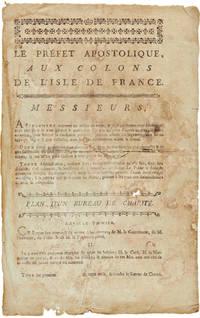
1788284311788. Folio. Broadsheet 12 3/4 x 8 inches. Moderate wear and soiling small hole in center of sheet affecting a few letters of text. Early and unrecorded imprint from the colonial press at the French colony of Mauritius also known as the Ile de France. The text contains the articles for establishing a Bureau de Charité for the island. The Dutch were the first Europeans to become interested in the island taking possession in 1598. After exploiting the island's dense forests for a century and introducing the cultivation of sugar cane and cotton the Dutch abandoned the colony in 1710. The French soon claimed it as "Ile de France" and the island remained under the control of the French East India Company until 1767. During the long war between France and England at the beginning of the 19th century Mauritius proved to be an important strategic naval base and as a result the British took charge of the island in 1810 and the Treaty of Paris confirmed official British possession in 1814. It remained an important sugar producing colony and in the 20th century agricultural production was expanded to include tea rice and other produce. Printing began on Mauritius in 1768. During the French period until 1810 only about 400 imprints were produced mostly in the form of official documents and newspapers though there are also almanacs and a few other items. All are quite rare. No copies located in OCLC and not recorded by Toussaint in his bibliography of Mauritius imprints. unknown books
1788WRCAM48600Isle de France: Imprimerie Royale 1788. Broadsheet 12 3/4 x 8 inches. Moderate wear and soiling; small hole in center of sheet affecting a few letters of text. Good. Early and unrecorded imprint from the colonial press at the French colony of Mauritius also known as the Ile de France. The text contains the articles for establishing a Bureau de Charité for the island. <br> <br> The Dutch were the first Europeans to become interested in the island taking possession in 1598. After exploiting the island's dense forests for a century and introducing the cultivation of sugar cane and cotton in 1710 the Dutch abandoned the colony. The French soon claimed it as "Ile de France" and the island remained under the control of the French East India Company until 1767. During the long war between France and England at the beginning of the 19th century Mauritius proved to be an important strategic naval base. The British took charge of the island in 1810 and the Treaty of Paris confirmed official British possession in 1814. It remained an important sugar producing colony and in the 20th century agricultural production was expanded to include tea rice and other produce. <br> <br> Printing began on Mauritius in 1768. During the French period until 1810 only about 400 imprints were produced mostly in the form of official documents and newspapers though there are also almanacs and a few other items. All are quite rare. No copies are located in OCLC and not recorded by Toussaint in his bibliography of Mauritius imprints. Imprimerie Royale unknown books
1796WRCAM48596Port Nord-Ouest: Chez F.N. Bolle 1796. 4pp. Small quarto. Single folded sheet. Contemporary manuscript notations. Light soiling and wear. Very good. Early and unrecorded imprint from the colonial press at the French colony of Mauritius also known as the Ile de France. The text contains the deliberations and acts of the colonial assembly of the island at a time when it was operating virtually independent from France. The acts all concern measures to be taken for the defense of the island at a time when British invasion was feared. <br> <br> The Dutch were the first Europeans to become interested in the island taking possession in 1598. After exploiting the island's dense forests for a century and introducing the cultivation of sugar cane and cotton in 1710 the Dutch abandoned the colony. The French soon claimed it as "Ile de France" and the island remained under the control of the French East India Company until 1767. During the long war between France and England at the beginning of the 19th century Mauritius proved to be an important strategic naval base and as a result the British took charge of the island in 1810 and the Treaty of Paris confirmed official British possession in 1814. It remained an important sugar producing colony and in the 20th century agricultural production was expanded to include tea rice and other produce. <br> <br> Printing began on Mauritius in 1768. During the French period until 1810 only about 400 imprints were produced mostly in the form of official documents and newspapers though there are also almanacs and a few other items. All are quite rare. No copies located in OCLC and not recorded by Toussaint in his bibliography of Mauritius imprints. Chez F.N. Bolle unknown books
1796284291796. Small quarto. 4pp. Single folded sheet. Contemporary manuscript notations. Light soiling and wear. Early and unrecorded imprint from the colonial press at the French colony of Mauritius also known as the Ile de France. The text contains the deliberations and acts of the colonial assembly of the island at a time when it was operating virtually independent from France. The acts all concern measures to be taken for the defense of the island at a time when British invasion was feared. The Dutch were the first Europeans to become interested in the island taking possession in 1598. After exploiting the island's dense forests for a century and introducing the cultivation of sugar cane and cotton the Dutch abandoned the colony in 1710. The French soon claimed it as "Ile de France" and the island remained under the control of the French East India Company until 1767. During the long war between France and England at the beginning of the 19th century Mauritius proved to be an important strategic naval base and as a result the British took charge of the island in 1810 and the Treaty of Paris confirmed official British possession in 1814. It remained an important sugar producing colony and in the 20th century agricultural production was expanded to include tea rice and other produce. Printing began on Mauritius in 1768. During the French period until 1810 only about 400 imprints were produced mostly in the form of official documents and newspapers though there are also almanacs and a few other items. All are quite rare. No copies located in OCLC and not recorded by Toussaint in his bibliography of Mauritius imprints. unknown books
177735862London: T. Davies 1777. First Edition. 8vo pp. 2 185 1. Bound in contemporary half calf expertly rebacked with new morocco label. ESTC T6248; Halkett & Laing Vol II p. 196. "Morgann 1726-1802 wrote several pamphlets on the burning questions of the day all of which were distinguished for their philosophic tone and dinstinctively literary style . The present work. by which Morgann is remembered has been generally praised. The vindication of Falstaff's courage is the ostensible object of the work and evoked Johnson's criticism . For style intellectuality knowledge of human nature and consequent profound appreciation of Shakespeare Morgann's essay has not been surpassed"-DNB. T. Davies unknown books