61 résultats
178855874Einsidlen: imp. de F. de Sales Benziger 1788. First Edition. Frontispieces losses to fore edge margins of those in vols. I & II. 3 vols. 8vo. Contemporary calf gilt spine labels. Somewhat rubbed labels to vol. II perished. Worming to foot of vol. I some soiling to prelims of vol. II. First Edition. Frontispieces losses to fore edge margins of those in vols. I & II. 3 vols. 8vo. History of Kloster Einsiedeln in eastern central Switzerland. Sound clean copy. imp. de F. de Sales Benziger unknown
1759007542London: at the Buck in Pater-nostere Row; and at the Wheatsheaf in Cheapside: J. at the Buckland; and T. Field 1759. 3rd Edition . Hardcover. Very Good. 8vo - over 7¾ - 9¾" tall. An account of the arrival of Christianity in Roman London. Uncommon! In worn full calf corners bumped & worn. Faded spine raised bands gilt tooling gilt title to maroon calf label edges bumped with loss cracked along joints. Internally 2 iii-viii 1 2-552 pp woodcut to tp numerous printers devices contemp. ink name to epd Williams front board has been very well re-hinged some offsetting evidence of book plate removal to fpd the front free EP's are lacking otherwise a nice tight clean example. 201118 mm. ESTC T97260. The word "Caerludd" is used to refer to London throughout. While this is the 3rd edition the earlier editions are practically impossible. ESTC Locating 1 copy of the second edition of 1740 lacking all but the title leaf two OK copies and 1 copy of the first and one copy of the another volume called a second edition but with a printing date of 1750. Our third edition is in fact the first reasonable edition. ESTC locating 18 copies world wide. There is an etched landscape vignette on the title page with a sun rising with a face on it and a group of people facing us on our right. The dialogues include several Welshmen with welsh names who also say what town or place they come from with the Welsh name given. There are ten sections each beginning with a decorative capitol and a type ornament vignette. <br/> <br/> J. at the Buckland; and T. Field hardcover
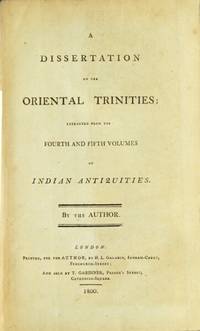
180019171London: for the author by H.L. Galabin 1800. First separate edition 8vo pp. vii 1 17-458; folding copper-engraved frontispiece of Vishnu Brahma and Seva plus 5 other folding copperplates; contemporary and perhaps original brown cloth-backed paper-covered boards paper label on spine; binding worn. Essentially an offprint from the author's larger work Indian Antiquities 7 vols. 1793-1800 and issued in a separate edition of 250 copies only but "revised newly arranged and divided into chapters." DNB calls him "one of the first to popularise a knowledge of the history and religions of the east. for the author by H.L. Galabin unknown
179270902London:: Printed for the Author and Sold by P. Elmsley 1792-1800. First edition. old mottled calf neatly rebacked retaining the original spines and gilt-lettered red labels. There is shallow chipping to the extremities of some of the spines; all volumes tight and sound. Some mis-folding to the plates and a few neat tissue repairs; generally contents very attractive. 8vo. Illustrated with thirty fine engraved plates many folding. Additional postage applicable for this multiple-volume set. Printed for the Author, and Sold by P. Elmsley, unknown
1800284241800. Engraving 5 x 4 inches. Light soiling. A few contemporary ink notations on verso. Engraved portrait of Governor Anne Joseph Hippolyte de Maurès Comte de Malartic governor of the island of Mauritius. The portrait is a line-drawing done in profile and framed in an oval. Flags flank either side of the oval frame and it is captioned beneath. There is some light wear to the tiny imprint information causing it to be slightly obscured but it is possible that the illustrator's name is "Girouai" and the engraver may be "Noiret." The engraving is a bit crude and printed on laid paper. It is likely that it was done shortly after Malartic's death in 1800. A most unusual and exotic image a tribute to the rich culture of printing that flourished on the remote island in the south Indian Ocean. unknown
1791284301791. Folio. 10 3/4 x 8 1/4 inches. 24pp. Stitched as issued. Top corner of first leaf torn away affecting several lines of text. Lightly dampstained and worn throughout. Still very good. Early and unrecorded imprint from the colonial press at the French colony of Mauritius also known as the Ile de France. Issued at a critical moment at the beginning of the French Revolution the lengthy text concerns the government and judiciary of the island together with a proclamation by the King dated August 24 1790. The text nominally recognizes the authority of the King while taking measures to establish major autonomy of local government. The Dutch were the first Europeans to become interested in the island taking possession in 1598. After exploiting the island's dense forests for a century and introducing the cultivation of sugar cane and cotton in 1710 the Dutch abandoned the colony. The French soon claimed it as "Ile de France" and the island remained under the control of the French East India Company until 1767. During the long war between France and England at the beginning of the 19th century Mauritius proved to be an important strategic naval base and as a result the British took charge of the island in 1810 and the Treaty of Paris confirmed official British possession in 1814. It remained an important sugar producing colony and in the 20th century agricultural production was expanded to include tea rice and other produce. Printing began on Mauritius in 1768. During the French period until 1810 only about 400 imprints were produced mostly in the form of official documents and newspapers though there are also almanacs and a few other items. All are quite rare. No copies located in OCLC and not recorded by Toussaint in his bibliography of Mauritius imprints. unknown
1794284251794. Small quarto. 9 x 6 3/4 inches. 28pp. Stitched as issued. Contemporary notation on first page some contemporary underlining in text. Minor soiling. A remarkable early imprint from the colonial press at the French colony of Mauritius also known as the Ile de France in the south Indian Ocean. The text contains a report of the French Revolutionary Committee of Public Safety regarding prisoners arrested on the island of Réunion being held as enemies of the Revolution. The document was printed in the capital Port Louis which was called Port de la Montagne from 1792 to 1795. The Dutch were the first Europeans to become interested in Mauritius taking possession in 1598. After exploiting the island's dense forests for a century and introducing the cultivation of sugar cane and cotton in 1710 the Dutch abandoned the colony. The French soon claimed it as "Ile de France" and the island remained under the control of the French East India Company until 1767. During the long war between France and England at the beginning of the 19th century Mauritius proved to be an important strategic naval base and as a result the British took charge of the island in 1810 and the Treaty of Paris confirmed official British possession in 1814. It remained an important sugar producing colony and in the 20th century agricultural production was expanded to include tea rice and other produce. Printing began on Mauritius in 1768. During the French period until 1810 only about 400 imprints were produced mostly in the form of official documents and newspapers though there are also almanacs and a few other items. All are quite rare. No copies located in OCLC; Toussaint locates a copy at the Archives Nationales in Paris.<br/> <br/> Toussaint A247. unknown
1796284291796. Small quarto. 4pp. Single folded sheet. Contemporary manuscript notations. Light soiling and wear. Early and unrecorded imprint from the colonial press at the French colony of Mauritius also known as the Ile de France. The text contains the deliberations and acts of the colonial assembly of the island at a time when it was operating virtually independent from France. The acts all concern measures to be taken for the defense of the island at a time when British invasion was feared. The Dutch were the first Europeans to become interested in the island taking possession in 1598. After exploiting the island's dense forests for a century and introducing the cultivation of sugar cane and cotton the Dutch abandoned the colony in 1710. The French soon claimed it as "Ile de France" and the island remained under the control of the French East India Company until 1767. During the long war between France and England at the beginning of the 19th century Mauritius proved to be an important strategic naval base and as a result the British took charge of the island in 1810 and the Treaty of Paris confirmed official British possession in 1814. It remained an important sugar producing colony and in the 20th century agricultural production was expanded to include tea rice and other produce. Printing began on Mauritius in 1768. During the French period until 1810 only about 400 imprints were produced mostly in the form of official documents and newspapers though there are also almanacs and a few other items. All are quite rare. No copies located in OCLC and not recorded by Toussaint in his bibliography of Mauritius imprints. unknown
17771388592London: T. Davies 1777. First Edition. Hardcover. Octavo 2 185 1 pages. In Fair condition. Bound in full brown leather with black leather label bearing gilt titling to spine; gilt ornamentation to spine and boards. Front board detached; split starting at rear joint. Light plus wear to edges and corners of boards tail of spine; moderate loss of leather at head of spine. Surfaces of boards lightly shelf worn. Text block with light plus age toning and foxing; scattered minor stains. Text block edges marbled. Bookplate of James St. Aubyn to front pastedown. Handwritten label with library call number pasted to rear free endpaper; Folger Shakespeare Library duplicate stamp also on rear free endpaper. 1388592. Special Collections - Downstairs. T. Davies hardcover
1800183542Paris.: Henrics. An 9 1800. Contemporary marbled boards red spine label speckled edges. Very good covers shelfworn at edges very light scattered foxing. 8vo. French text. Scarce. Henrics. hardcover
17622240LA HAYE: Chez Pierre Gosse Junior 1762. Folio menor.- Plena piel lomera con nervios tejuelo y estampaciones dorados planos con ruedas dorados como filetes.- 2 tomos en 1 volumen.- I: Portadilla.- Portada a dos tintas y con grabado central.- XVI.- 160 páginas.- 37 láminas fuera de texto grabadas al cobre y plegadas.- II: Portadilla.- Portada a dos tintas y con grabado central.- 196 páginas.- Grabados del número 38 al 56. Posible segunda edición de esta ya clásica obra sobre Arte Militar. Sus 56 grabados al cobre dan a la obra una bella calcográfica poco común. Brunet y Gaesse solo citan la primera edición de 1756 Chez Pierre Gosse, Junior unknown
178828431Au Port-Louis Isle de France: Imprimerie Royale Rue de l'Hôpital. Printed by François Nicolas Bolle b. 1741 1788. Folio. 12 3/4 x 8 inches. 2 pp. letterpress broadsheet printed on recto and verso on a blue laid paper with watermark and attractive printer's ornaments; a list of 12 steps numbered I-XII for establishing an Apostolic Bureau of Charity under a new governmental administration. Early Mauritius imprint printed at the dawn of the French Revolution from when the island was the French colony of Isle de France; this letterpress broadside a "fine specimen of the typographic art" announces the creation of an Apostolic Bureau of Charity. Toussaint<br/> <br/> Early and unrecorded imprint from the colonial press at the French colony of Mauritius then known as the Isle de France. Isle de France was a French colony in the Indian Ocean from 1715 to 1810 comprising the African country in the Mascarene Islands now known as Mauritius and its dependent territories. It was governed by the French East India Company and formed part of the French colonial empire. Under the French the island witnessed major changes including the importation of enslaved people and the undertaking of vast infrastructural works that transformed the capital Port-Louis into a major center of international shipping warehousing and commerce. The present text contains twelve articles for establishing a Bureau de Charité for the island. The Bureau was announced by the Apostolic Prefect Charles Joseph Darthé who had been appointed by the Pope. Apostolic Prefects were Ecclesiastics representing the Holy See at the head of a territorial constituency in a mission country here being the Isle de France. Often when printing was introduced into a new land such as here clergy would be the only people with access to printing presses besides government officials. However Mauritius is something of an exception to this rule: "priests had little to do with printing . . . there is practically nothing worth recording in the way of religious publications." Toussaint The charitable plan laid out by the Prefect not unlike current-day means-tested social programs is almost absurdly complex in its bureaucratic levers and requirements. Pierre Saunois b. 1730 brought the first printing press to Mauritius in 1767. The first known imprint was a short poem by Saunois dedicated to the Dauphine of France Marie Josèphe de Saxe in 1768. The first newspaper and the first book a French-Malagasy phrase-book for missionaries appeared in 1773. During the French colonial period until the island's annexation by Britain in 1810 the output of Isle de France's early presses included besides a number of official publications several books of literary or scientific interest some of which were important enough to be commended by the Académie des Sciences an especially erudite series of almanacs written by Laurent Masson-Abraham from 1769 to 1794 and newspapers the earliest of which was issued in 1773. But also included were "quite a number of books and pamphlets representative of every branch of intellectual activity: scientific literary religious and political." Toussaint If one considers the small size of this island 710 square miles its isolated position and that its European population was barely 10000 strong in 1810 "its achievement in this field appears all the more remarkable." Toussaint About 400 imprints are extant of those that were produced in the Isle de France from 1768-1810; they are scattered in repositiories in Mauritius France and England the most important collection of which is the Mauritius Archives. All are rare. No copies of this broadside are located in OCLC and it was not recorded by Toussaint any of his bibliographies of Mauritius imprints. The Dutch were the first Europeans to become interested in the island taking possession in 1598. After exploiting the island's dense forests for a century and introducing the cultivation of sugar cane and cotton the Dutch abandoned the colony in 1710. The French soon claimed it as "Isle de France" and the island remained under the control of the French East India Company until 1767. During the long war between France and England at the beginning of the nineteenth century Mauritius proved to be an important strategic naval base and as a result the British took the island in 1810. The Treaty of Paris confirmed official British possession in 1814. It remained an important sugar producing colony and in the twentieth century its agricultural production expanded to include tea rice and other crops.<br/> <br/> Bonnefoy Table General Alphabetqiue et Analytique p. 135. Daruty de Grandpré "L'Imprimerie aux Mascareignes et à Madagascar" Nouvelle Revue Historique et Littéraire de l'île Mauice No. 45 1902: pp. 455-456 and No. 46 1902: pp. 461-470. Toussaint Early Printing in the Mascarene Islands 1767-1810 passim; Early Printing in Mauritius Réunion Madagascar and the Seychelles pp. 11-34. Toussaint and Adolphe Bibliography of Mauritius 1502-1954 passim. Imprimerie Royale, Rue de l'Hôpital. Printed by François Nicolas Bolle (b. 1741) unknown
1800v0545London: John Dean for J. Wright 1800. Important first-person account of the Spanish conquest of the Aztec empire written some 50 years after the events described based in part on discussions with others involved at the time. Diaz counters de las Casas' depiction of the Spaniards as needlessly cruel and emphasizes the role of the common soldier objecting to accounts he felt gave too much credit to Cortes. First edition in English. Hardcover as pictured - original or early leather covers effectively if not attractively rebacked in cloth with reinforced hinges some time ago. General wear chipping scuffing & rubbing; ink & pencil names & note inside front cover; pages tanned with minor stains here and there offsetting/tanning from ink minor foxing; ink name & marks on pages 1 & 2. Text otherwise clean; viii 514 pages errata page; frontispiece map. . First Edition in English. Hard Cover. Good. Quarto. John Dean for J. Wright Hardcover
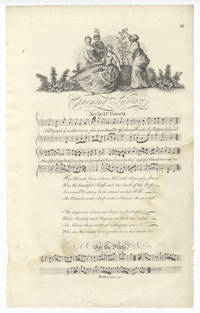
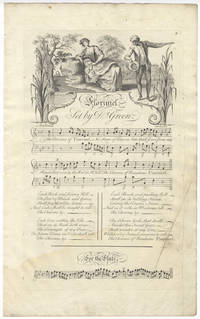
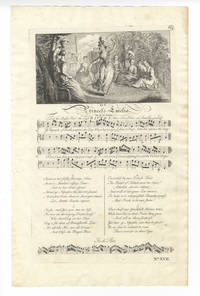
174036709London 1740. Unbound. Very Good. 1 leaf with a large elaborate vignette to head illustrating the song with music and text below set for voice and figured bass with a separate part for flute. Signed in the plate by the engraver Bickham. Ca. 326 x 200 mm. 12.75" x 7.85" plate mark.<br /> <br /> Slightly worn; minor browning to edges; minor dampstaining; edges slightly chipped. From the second edition of Bickham's monumental work first published in 1737-1739. BUC p. 107. RISM BII p. 245. <br /> <br /> Green was an English composer and organist. "Though remembered chiefly for his church music he was also an important composer of keyboard music songs and extended vocal works." H. Diack Johnstone in Grove Music Online.<br /> <br /> "Bickham 1706-1771 was principally famous in music circles for his two illustrated folio volumes The Musical Entertainer first issued in fortnightly parts each containing four plates from January 1737 to December 1739. The 200 plates are songs headed and surrounded with pictorial embellishments illustrative of the song . and engraved in the style of and even copied directly from Gravelot and Watteau. This work was the first of its kind to be published in England and quickly produced imitators such as Lampe's British Melody engraved by Benjamin Cole." Frank Kidson et al. in Grove Music Online. <br /> <br /> A charming engraving.<br /> <br /> The Musical Entertainer is considered one of the finest 18th century illustrated books. Complete copies of this monumental work are exceptionally rare. unknown
174036698London 1740. Unbound. Very Good. 1 leaf with a large elaborate vignette to head illustrating the song with music and text below set for voice and figured bass with a separate part for flute. Signed in the plate by the engraver G. Bickham. Ca. 326 x 200 mm. 12.75" x 7.85" plate mark.<br /> <br /> Slightly worn creased and dampstained; minor browning to upper edge. From the second edition of Bickham's monumental work first published in 1737-1739. BUC p. 107. RISM BII p. 245. <br /> <br /> Green was an English composer and organist. "Though remembered chiefly for his church music he was also an important composer of keyboard music songs and extended vocal works." H. Diack Johnstone in Grove Music Online.<br /> <br /> "Bickham 1706-1771 was principally famous in music circles for his two illustrated folio volumes The Musical Entertainer first issued in fortnightly parts each containing four plates from January 1737 to December 1739. The 200 plates are songs headed and surrounded with pictorial embellishments illustrative of the song . and engraved in the style of and even copied directly from Gravelot and Watteau. This work was the first of its kind to be published in England and quickly produced imitators such as Lampe's British Melody engraved by Benjamin Cole." Frank Kidson et al. in Grove Music Online. <br /> <br /> A charming engraving.<br /> <br /> The Musical Entertainer is considered one of the finest 18th century illustrated books. Complete copies of this monumental work are exceptionally rare. unknown
1743M1449Catherine Street in the Strand: J. Walsh Mufick-printer and instrument-maker to His Majesty 1743. 1st Edition . Hardcover. Vg. Folio. ND 1743. Dedication page to The King KING GEORGE II. 139 ii ;155 ipp. Neither volume dated. 2 volumes bound in one. For various number of voices with cintinuo. Figured bass unrealized. Includes Greenes most famous work "Lord let me know mine end" Psalm 39 page 91.Original full calf boards. Spine loose worn and boards detached but a nice tight text block and well worth restoring. Owner signature in ink Wm. Knyvett. Appox. 40 cms. A SCARCE ITEM <br/> <br/> J. Walsh, Mufick-printer and instrument-maker to His Majesty hardcover
174036782London 1740. Unbound. Very Good. 1 leaf with a large elaborate vignette to head illustrating the song with music and text below set for voice and figured bass with a separate part for flute. Ca 326 x 200 mm. 12.75" x 7.85" plate mark.<br /> <br /> Slightly worn; minor browning to edges; minor soiling and dampstaining; slightly creased. From the second edition of Bickham's monumental work first published in 1737-1739. BUC p. 107. RISM BII p. 245. <br /> <br /> Green was an English composer and organist. "Though remembered chiefly for his church music he was also an important composer of keyboard music songs and extended vocal works." H. Diack Johnstone in Grove Music Online.<br /> <br /> "Bickham 1706-1771 was principally famous in music circles for his two illustrated folio volumes The Musical Entertainer first issued in fortnightly parts each containing four plates from January 1737 to December 1739. The 200 plates are songs headed and surrounded with pictorial embellishments illustrative of the song . and engraved in the style of and even copied directly from Gravelot and Watteau. This work was the first of its kind to be published in England and quickly produced imitators such as Lampe's British Melody engraved by Benjamin Cole." Frank Kidson et al. in Grove Music Online. <br /> <br /> A charming engraving.<br /> <br /> The Musical Entertainer is considered one of the finest 18th century illustrated books. Complete copies of this monumental work are exceptionally rare. unknown
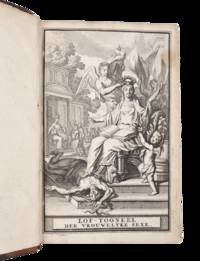
17042202<p>48 378 12 pp. With an engraved frontispiece.</p><p>Contemporary mottled calf with ribbed and gold-tooled spine sprinkled edges.</p><p>Rare first and only edition of a peculiar and polemical work which uses a female abecedarium to attack Catholic invective against women. Arranged alphabetically—from <em>Avidum animal</em> to <em>Zelus Zelotipus</em>—the author ironically surveys women's wit eloquence moral qualities and physical appearance combining satire polemic and learned rhetoric. The book also offers insight into early-eighteenth-century Protestant debates on marriage gender and Catholic religious culture.<br />The author was an Amsterdam merchant and former Catholic priest who converted to Calvinism and became known for his vehemently anti-Catholic writings often directed against monastic life and clerical celibacy. <em>Zeege-pralende lof-tooneel der vrouwelyke sexe</em> must be read within this broader religious and ideological agenda: Johannes Mauritius presents Catholic denunciations of women as a deliberate strategy employed by "the Papists" to justify the prohibition of marriage and to lure men into the cloister. He was the father of the prodigy poet jurist and later Suriname governor Joan Jacob Mauricius 1692–1768 whose early intellectual development was shaped by his father's militant anti-Catholicism and literary ambitions.</p><p><strong>Condition: </strong>corners slightly bumped front joint splitting. Small faint stain on the first few pages see pictures. Otherwise in very good condition.</p><p><strong>Reference: </strong>Muller 482; De Vries 190; Scheepers I 452.</p> Johannes Strander
180054439London:: Printed For J. Wright Piccadilly By John Dean 1800. 1800. First edition in English. 4to. Translated from the original Spanish by Maurice Keatinge. Leather and boards viii 514 1 pp. frontispiece map preface. One of the most important firsthand accounts of the Spanish conquest of Mexico. Written by Bernardo Diaz del Castillo a foot soldier who served under Hernan Cortes during the expedition that led to the fall of the Aztec Empire. The book covers the expedition from Cuba to Mexico in 1519; first encounters with Indigenous peoples along the Gulf Coast; the alliance with the Tlaxcalans; the march to Tenochtitlan; meetings between Cortes and Moctezuma II; the uprising in Tenochtitlan and the retreat known as the La Noche Triste; the siege and fall of Tenochtitlan in 1521; etc. The book provides detailed descriptions of Indigenous cities markets and customs; military operations and logistics; relationships among Spanish commanders; daily life of common soldiers; the cultural shock experienced by Europeans encountering Mesoamerican civilization; etc. Encyclopedia Britannica: "Bernal Diaz del Castillo 1495 – 1584 was a Spanish soldier and author who took part in the conquest of the Aztec nation. Diaz's account is written in an unassuming colloquial style and has both historical and artistic value." A.S.W. Rosenstock 19 #193: "All the later histories of America have acknowledged their debt to Bernal Diaz and his work has been acclaimed one of the most valuable source books of the period." The author was an original member of Cortez’s expedition to conquer the Aztec nation. He was involved in the initial planning stages all the way to its culmination. One of the most important sources on the conquest of the Aztec Empire and Mexico. The original leather spine label is missing but a new leather label approximating the original has been placed inside this copy. Retains the original leather boards which exhibit perimeter wear. Internally there are repairs to the hinges with some toning of the text but remarkably free of foxing. In all a very good copy. Printed For J. Wright, Piccadilly, By John Dean, 1800. hardcover
1798620131798. Lipsiae : Klaubarth 1798 4° 4 52 pp. orig. Broschur. Erstdruck! "De Doctrina Electricitatis Eiusque Usu Potissimum Medico Dissertatio De Doctrina Electricitatis Eivsqve Vsv Potissimvm Medico Dissertatio / Qvam Avctoritate Gratiosi Medicorvm Ordinis Praeside Carolo Gottlob Kvhn Phil. Ac Med. Doct. Med. Profess. Pvbl. Extraord. Facvlt. Med. Lips. . Pro Gradv Doctoris D. III. Avg. MDCCXCVIII. H. L. Q. C. Pvblice Defendet Avctor Georgivs Avgvstvs Mavritivs Wohlrab Soravia-Lvsatvs Medicinae Baccal." Carl Gottlob Kühn 1754-1840 Georg August Moritz Wohlrab 1758- unknown
1800395781800. Paris u.å. 4to. 704 720 416 s. Rikt illustrert med xylografier. I 2 sent 1800talls skinnryggbd. Tittelbl. og noen bl. gulplettet. Bind I med sprekker i ytre falser. . unknown
171847265London: various publishers 1917-18. 1st editions. Near Fine. octavo. 1/2 leather 51 35 20 40 20 14 52 24 15 23pp. frontis. b/w pls. maps 10 WWI pamphlets bound together usually retaining original wrappers various publishers hardcover
176756224Leipzig und Liegnitz David Siegert 1767. Contemp. full calf. Raised bands. Richly gilt spine. Titlelabel with gilt lettering. A small nick to one raised band. Stamp on title-page. XCVI3946 pp. 25 folded engraved plates. Clean and fine. <br/><br/><em>Struensee's translation of "Les Reveries; ou Mémoires sur L'Art de la Guerre". - Klaus jordan 2625. </em> hardcover
176256450Leipsig Weidmann 1762. 4to. Bound in one contemp. full mottled calf. raised bands. Titlelabel with gilt lettering. Stamp on foot of title-page. Title-pages in red/black. 2 large titlevignettes. 2XVI160;2196 pp. 56 double-page folded engraved plates. A few leaves with light marginal browning. Clean and fine. <br/><br/><em>First edition. Jähns 1503. - Sloos. Warfare and the Age of Printing 3097. </em> hardcover
17567435<b><i>Les Reveries ou Memoires Sur L'Art de la Guerre de Maurice Comte de Saxe Duc de Courlande et de Semigalle Marechal-General des Armées de S.M.T.C. &c. &c. &c. Dediés a Messieurs les Officiers Generaux.</i></b><i> Par Mr. de Bonneville Capitaine Ingenieur de Campagne de Sa Maheste le Roi de Prusse.</i><br /><i><br /></i>Illustrated with 40 full-page and folding plates and 42 engraved vignettes. Folio. Bound in full mid-18th century English paneled calf expertly rebacked with raised bands and morocco spine label. A La Haye Chez Pierre Gosse Junior . . . 1756. First Edition.<p>Maurice Comte de Saxe was the greatest French military general of the 18th century. Having been born as the illegitimate son of Augustus II King of Poland he eventually rose to become Marshall of France. His greatest exploits came during the War of the Austrian Succession where he seized Prague by surprise in a daring invasion captured the fortress of Eger Cheb and gained his famous victory at Fontenoy. The latter made possible the 1745 Jacobite rising and was credited by Napoleon with preserving the <i>Ancien Regime</i> in France for a further 30 years.</p><p>Saxe's <i>Reveries</i> is one of the great classics of 18th century military strategy and theory. "He puts forward his ideal military model his 'legion' and taking issue with the views and practices of his age he advances many original ideas. However rather than discussing his military doctrines the aim of this book is to elucidate the intellectual premises that dominated his mind: he saw a need to subject military affairs to reasoned criticism and intellectual treatment and the ensuing military doctrines were perceived as forming a definitive system." Gat <i>Origins of Military Thought</i>.</p>With the bookplate of the United Service Institution presented by Major General Samuel Lambert. Samuel Lambert served with distinction in the campaign under Sir John Moore in 1808-09 and in the expedition to Walcheren in the later year. He was engaged in the defense of Cadiz in 1810 - 1811 and served throughout the peninsular campaigns of 1812 1813 and 1814. He died in 1848 while serving as Commander of Her Majesty's Forces in Jamaica. Minor wear to binding at edges and corners; o/w a fine wide-margined copy.