8 résultats
1800621911800. unknown
17240219MMC6CADAnstey Christopher 1724 - 1805. Hardcover. Very Good. FULL LEATHER< London:Printed for J. Dodsley in Pall Mall. 1776. 8vo. Stated 10th edition. 175 pp. Contemporary full brown calf w/ crimson spine label. Edgewear at extremities/back joint starting/ copperplate frontis Printed for J. Dodsley in Pall Mall Good on the outside very good inside. Handsome heavy stock. In no dustjacket. Bright color pictorial boards. Toning at blank endpapers only; no reader remainder or ex-library marks. First ed.thus hardcover
1775un03C.012GB: Printed for the Author By S. Hazard Bath 1776 and sold by Dodsley . 1775. Last leaf bears date Dec 5 1775. Text consists of 46 unnumbered pages. Last leaf has some old repair. Bound in old plain grey paper covered boards with pale brown paper spine. Endpapers also old. However it is possible the book was trimmed and rebound many years ago. SOLD AS IS. Just a good reading copy . 1st Edition. Hardback. Good/No DW. Printed for the Author By S. Hazard, Bath, 1776 and sold by Dodsley ... Hardcover
1763DEMO016396IBarcelona: Maria Angela Marti Viuda 1763. Enlarged edition. Hardcover. Very Good. 24mo; 8 76 8 203 25 pages flexible vellum lacking three for the four ties. Ex libris Don Felipe Fernandez Calle Prieta likely the author of a practical grammar of the Spanish language; rubber stamp on lower margin of first contents page. Text ends with leaf T8 the 17th page of the Tabla. Very Scarce. <br/><br/>A popular standard guide in Spanish for business and personal correspondence. With new curious additions and annotations by Ginés Juan Portillo y Soto. Scarce Spanish literature. WorldCat shows no copy in the USA. Maria Angela Marti Viuda hardcover
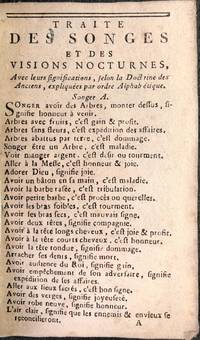
18002712bCaen: Chalopin 1800. 12mo 137 x 84 mm. 12 pp. Drop-title. Stab-stitched in original blue printed wrappers. Modern folding moroco-backed chemise and slipcase. A late chapbook incarnation of Vulson de La Colombière's treatise on dream interpretation first published 1660 this pocket-sized alphabetical list of dreams and their meanings had a practical purpose being sold as an aid for the selection of lottery numbers but see below.The association of dreams and lottery numbers derived from the Italian smorfia tradition which linked and still does the lottery and its numbers to dreams and the occult. The word smorfia refers to keys associating dreams with winning numbers also sometimes called cabala and by extension to the ephemeral publications containing these keys. "A feature of the Italian lottery throughout its history is the intense interest in occult methods of predicting the winning numbers. Foremost is the smorfia - a slang word meaning a wry grimace but also having overtones associated with the dream god Morpheus son of Hypnos God of Sleep." Adrian Seville History Today Vol. 49 no. 3 March 1999. In this brief pamphlet the connection with the lottery is indicated by a list of the 27 "most commonly pulled" lottery numbers printed at the end. Oddly all end in either 3 7 or 9. The dream descriptions however provide no lottery numbers. These highly abbreviated one-or-two-line summaries are simply followed by a verbal description of their degree and type of luck or lack of it or their meaning. Thus "to dream of being a tree" portends illness "kissing a dead person" promises long life though just kissing anyone signifies trouble. Arranged by keyword the list covers an impressive range of dream subjects: seeing oneself swimming in the sea loss and harm having long teeth trouble from one's parents dreaming that one is a doctor good luck hearing bells ringing signifies honor with boredom! etc.The attribution to the Caen chapbook printer/publishers Pierre-Jean-Aimé and Théodore Chalopin was made by René Helot who found several copies of the pamphlet in the Chalopin archives. OCLC locates 2 copies at the BnF and the Newberry. Cf. Helot La Bibliothèque bleue en Normandie 1928 245. Chalopin unknown
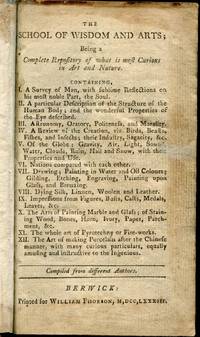
17833220072<b>FIRST BERWICK EDITION.</b> <i>12mo pp. iv 5-339 1 blank viii contents; a little browned in places but generally clean throughout; in recent half sheep over marbled boards spine with red morocco label lettered in gilt.</i><br /><br /><br />Scarce Berwick printing of this appealing lady and gentleman's pocket guide on subjects such as the human body astronomy oratory morality nations animals painting gilding to name but a few. As far as we are aware the work was first published in Gainsborough in 1776.<br /><br />OCLC records three copies in North America at Brown Library of Congress and Winterthur Museum. William Phorson hardcover
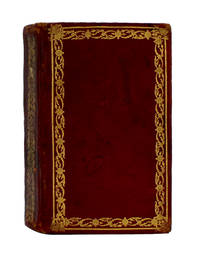
179812270Madrid: Imprenta Real 1798. 108x64mm. 4¼x2½". Madrid Imprenta Real 1798. 2 tomos en un volumen. En 12º 108 x 64mm. 1 mapa de España a doble página coloreado a mano en la época retrato de Carlos III dibujados por Goya y grabado por Carmona portada grabada 216 216 pp. Encuadernación de la época en marroquén rojo ruedas doradas en los planos formando rectángulos lomera decorada con un hierro dorado que se repite cabeza y cortes dorados. Edición original de este apreciado calendario y guÃa de forasteros de Madrid completo del mapa retrato y portada grabada. Es uno de los <em>Kalendarios</em> más apreciados por contener el retrato del rey grabado por Carmona sobre dibujo del maestro Francisco Goya. Ejemplar vestido con una atractiva encuadernación de la época en marroquén rojo. Publicación de periodicidad anual fundada en 1722 por Luis Félix de Miraval y SpÃnola y que hasta 1734 se titula Kalendario particular. A partir de 1725 su impresor será Juan Sanz; después lo serán sus herederos y desde 1730 Antonio Sanz su sobrino que en 1769 cederá los derechos a la Corona española a cambio de una pensión vitalicia. En su portada se expresa que contiene los nacimientos de los reyes reinas los setenta miembros que componen el sacro colegio cardenalicio los prÃncipes de Europa los ministros que componen los tribunales de Su Magestad en sus reinos con indicación de sus residencias particulares en Madrid. En definitiva se trata de una guÃa completÃsima de la Administración del Estado del antiguo régimen con la indicación de sus órganos ejecutivos y consultivos consejos reales juntas instituciones cientÃficas y académicas y demás organismos y entidades que la monarquÃa española fue creando a lo largo del siglo dieciocho entre estas la propia Real Biblioteca Pública antecedentes de la Biblioteca Nacional de España y las reales academias con los nombres de los arzobispos y obispos de España y de las Indias la composición de los tribunales chancillerÃas y audiencias relación de reinos y provincias y partidos con los nombres de sus gobernadores intendentes y corregidores. En la edición de 1767 comienza a incluir grabados como los de Carlos III los PrÃncipes de Asturias o el del Palacio de Aranjuez y después los de Carlos IV y la reina Maria Luisa para en el siglo XIX incluir los de Fernando VII y los de su hija la joven reina Isabel II. Asimismo llegará a estampar una docena de mapas de España y planos de Tomás López y sus hijos. En 1774 saldrá ya de la Imprenta Real de la Gazeta incluirá las relaciones de caballeros de Carlos III de catedráticos de los Estudios Reales de embajadores y cónsules y vicecónsules del Rey en el extranjero la cronologÃa de los reyes de España o el calendario de las principales ferias. Imprenta Real unknown
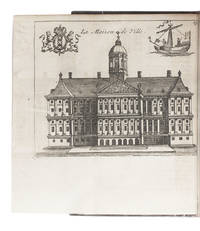
1720D84DQOR1MSG6Amsterdam: Paul de la Feuille 1720. Contemporary gold-tooled mottled calf with a red morocco title label lettered in gold on the spine gold-tooled board edges and red sprinkled edges. 8vo. Ad 1 with 28 engraved illustrations on 24 folding leaves including 20 illustrations of Amsterdam's most famous buildings and 4 leaves showing Dutch and European flags printed on both sides of the paper. Further with a small woodcut vignette on the title page one woodcut decorated initial and one woodcut headpiece. Ad 2 with a woodcut floral vignette on the title page and typographical tables in the text. 2 works in 1 volume. With: 2 Tarif general des Provinces Unies pour les droits d'entrée & de sortie que payent les marchandises tant en ce païs qu'à la Mer Baltique au passage du Sont.Amsterdam Paul de la Feuille 1718. Enlarged third and best edition - the first with running text instead of dialogues - of an interesting description of the city of Amsterdam together with a work containing the tariff rates for import and export of all kinds of goods and merchandise imposed by the Dutch Republic in alphabetical order. Also included are the tariff rates imposed in the Sont entrance of the Baltic sea and the last ordinances on the subject dated 1652 and 1655.The first edition of the Guide was published in Amsterdam by Daniel de la Feuille in 1701 and was mostly bound together with an edition of the Tarif of 1707 a second edition was printed in 1709.The plates show the most important buildings of the city such as the city hall now the Royal Palace of Amsterdam the stock exchange the main churches the 4 city gates the buildings of the Dutch East India Company VOC the Portuguese Synagogue etc.; the plates with the flags are from Fokkens' L'Art de Blason.Some minor dust soiling along the edges of the leaves the folding plates and quire K are slightly browned. Otherwise in very good condition.l Kress library S.2892; Ad 1: Nijhoff & V. Hattum 117; STCN 300355386 3 copies; WorldCat 65353974 838244431 46615043 313124792 46652734 1159002974 122306935 433419188 886395040 17 copies; cf. Cat. Goldsmith I10831 ed. 1772; not in Einaudi; ad 2: STCN 180657542 7 copies. Paul de la Feuille, unknown