93 résultats
183645406Berlin G. Eichler 1836. In "Archiv für Anatomie Physiologie und Wissenschaftliches Medicin Herausgegeben von Johannes Müller". Jahrgang 1836. Pp. 66-89 a. pp. 90-139. The entire volume offered in its 6 parts in 5 all 5 issues uncut with orig. printed warppers. 2CCXXIV390 pp. and 15 engraved plates. The 2 first issues with a faint dampstain to lower part of leaves and plates. <br/><br/><em>First appearance of an importent paper in the history of biology in which Schwann describes his discovery and isolation of pepsin the substance in the stomach that aids digestion of eggwhite. It is the FIRST KNOWN ANIMAL ENZYME. The paper appeared at the same time in "Annalen der Physik und Chemie. Hrsg. von J.C. Poggendorff".Theodor Schwann 1810-1882 was a great German physiologist pathologist and experimenter. One of the founders of the cell doctrine and of the idea of the living nature of yeast. Born at Neuss near Düsseldorff. A catholic educated in the Jesuit Gymnasium in Cologne. Intended for the church but took to medicine. He was a pupil of Johannes Müller and a collegueand lifelong friend of J. Henle the anatomist. In Berlin Schwann was Johannes Müller's assistent for five years and it was then that he discovered pepsin in 1836 the paper offered.Parkinson "Breakthroughs" 1836 B. - Garrison & Morton no. 991.The first paper offered written together with Johannes Müller records the preliminary investigaions leading to the discovery of Pepsin. - Garrison & Morton no. 990.The volume also contains another famous paper by ROBERT REMAK "Vorläufige Mittheilung microscopischer Beobachtungen über den innern Bau der Cerebrospinalnerven und über die Entwicklung ihrer Formenelemente. Hierzu Tafel IV. Pp. 145-161. This paper contains the first announcement of his DISCOVERY OF "FIBRES OF REMAK" the non-medullated nerve-fibres. Garrison & Morton no. 1260. </em> unknown
186153357Paris Mallet-Bachelier 1861. 4to. No wrappers. In: "Comptes Rendus Hebdomadaires des Séances de L'Academie des Sciences" Tome 52 No 8. Pp. 321- 368. Entire issues offered. Pasteur's paper: pp. 344-347. Minor marginal brownspots. <br/><br/><em>First printing of a milestone paper in microbiology being the paper in which Pasteur disclosed his discovery of organisms that lived without oxygen. Two years later he named them anaerobic or zymics contrasting to aerobic which only lived in the presence of free oxygen."In 1861 he turned his attention to the butyric fermentation and made another importent discovery viz. that this fermentation proceeds in the absence of oxygen. In the fermented material he found cylindrical rods which he showed were the cause of the fermentation. Following the nomenclature and ideas of the time he regarded them as animal in character and named them Vibrio." Bullock "The History of Bacteriology" p. 61. </em> unknown
185943325Leipzig Johann Ambrosius Barth 1859. Without wrappers as issued in "Annalen der Physik und Chemie. Hrsg.von Poggendorff" Bd. 107 Viertes Stück.= Heft No. 8 of 1859. The entire issue offered Heft 4 of vol. 107 with titlepage to vol. 107. Pp. 497-660. - Plücker's papers: pp. 497-539 a. 638-643. Clean and fine. <br/><br/><em>First printing of this milestone paper describing Plückers first observations on Cathode Rays which he called "the beautiful and mysterious green glow" and produced by discharges in tubes exhausted by means of the Geissler pump. These importent observations lead directly to Röntgens discovery of the Röntgen Rays."Cathode rays were first observed by Julius Plücker in 1859 the paper offered. They are rays which are found in the neighbourhood of the point of exit of an electrical current passing through a Geissler tube. These rays stimulated intense interest and experiment. William Crookes greatly improved these discharge tubes and intensified the degree of rarification of gases within them. The tubes in this form is known as Crookes tube. Crookes declared his conciction that the cathode rays represented matter in a fourth hitherto unobserved form.It was reserved for J.J. Thomson in 1908 to discover the true nature of the cathode rays."PMM no 386. </em> unknown
184245440Kjöbenhavn Bianco Luno 1842 a. 1845. 4to. Bound in one contemp. halfcalf spine gilt. A small tear to backhinge at lower compartment of spine. IV76 pp. and 3 double-page folded lithographed plates with many figs. XIV88 pp. and 2 double-apge lithographed plates with many figs. Light browning to the last leaves of the second work. <br/><br/><em>The scarce first edition of the work in which Steenstrup describes his discovery of the principle of 'ALTERNATION OF GENERATIONS'' sexual and asexual in plants and animals. "Steenstrup showed that certain animals produce offspring which never resemble them but which on the other hand bring forth progeny which return in form and nature to their grandparents or more distant ancestors." Garrison & Morton No 217. A German translation was published the same year and an English in 1845. Norman 2009 German translation. "The second major publication - the first dealing with geology - of 1842 was "Om Forplantning og Udvikling gjennem vexlende Generationsrækker." the work offered Steenstrup's comprehensive presentation of the form of reproduction that he called 'alternation of generations' that is the alternation of asexual and sexual reproduction or metagenesis. This phenomenon had previously been described by Chamisso but Steenstrup included a greater number of observations based on a significantly wider range of subjects and provided an importent chapter on its meaning. Steenstrup's growing reputation won him an appointment as professor of zoology at the University of Copenhagen where he tought from 1846 until 1885."DSB XII p. 9. </em> unknown
187844231Paris G. Masson 1878. 8vo. Contemp. hcalf raised bands gilt spine. Light wear along edges. Small stamps on verso of titlepage. In: "Annales de Chimie et de Physique" 4e Series - Tome 15. 512 pp. a. 3 folded engraved plates. The entire volume offered. Janssen's memoir: pp. 414-426. <br/><br/><em>First appearance of this milestone paper in chemistry physics and astronomy announcing the discovery of the helium lines in the spectrum of the sun. It was Lockyer in the same year that named it 'helium' for Helios the Greek God of the Sun. Helium was not discovered on the earth before 1895 by William Ramsay and it was Crookes who established its identity with the helium Janssen and Lockyer observed in the spectrum of the sun."He Janssen met immortality by travelling to India in 1868 to study the total eclipse. It was then that he observed the helium line and forwarded the spectral data to ockyer. He also noted the size of the solar prominences. The day after the eclipse he attempted to take their spectra again and succeeded despite the absence of the obscuring moon. he then announced jubilantly that it was the day after the eclipse that was the real eclipse day for him. Lockyer also reported this method of studying prominences without an eclipse.Like Lockyer he lived to see his observation of the helium line vindicated by Ramsay's discovery of that element on earth."Asimov."This the discovery of helium lines in the sun by Lockyer was announced on the same day by the French astronomer Janssen who was in India observing a total eclipse. As a result the French government some ten years later struck a medallion showing the heads of both scientists.By that time the two men had made a much more dramatic discovery at the same time this time in cooperation. Janssen studying the spectrum ofthe sun during the eclipse had noted a fine line he did not recognize. he send a report on this to Lockyer an acknowledges expert on solar spectra. Lockyer compared the reported position of the line with lines of known elements concluding that it must belong to a yeat unknown element possibly not even existing on the earth. He named the element from the Greek word for the sun."Asimov.Parkinson "Breakthroughs" 1868 A. - The volume contains other notable papers by Dumas Berthelot et al. </em> hardcover
189646854Paris Gauthier-Villars 1896. 4to. Near contemp. full cloth. Spine gilt and with gilt lettering. Bookmark "The Chemists Club" in gold on lower part of spine. Light wear along edges. In: "Comptes Rendus Hebdomadaires des Séances de L'Academie des Sciences" Tome 122 Entire volume offered.1633 pp. The papers: 420-421 pp. 501-502 pp. 559-564 pp. 689-694 pp. 762-767 and pp. 1086-1088. <br/><br/><em>First appearance of the six landmark papers in which Becquerel documents his discovery of Radio-activity PROMPTING THE NUCLEAR AGE.Becquerel was an expert in fluorescence and phosphorescence continuing the work of his father and grandfather. Follwing the discovery of X-rays by Röntgen Bexquerel investigated fluorescent materials to see if they also emitted X-rays. He exposed a fluorescent uranium salt pechblende to light and then placed it on a wrapped photographic plate.He found that a faint image was left on the plate which he believed was due to the pichblende emitting the light it had absorbed as a more penetrating radiation. However by chace he left a sample that had not been exposed to light on top of a photographic plate in a drawer. he noticed that the photographic plate also had a a faint image of the pechblende. After several chemical tests he concluded that these "Becquerel rays" were a property of atoms. He had by chace discovered radio-activity and prompted thee beginning of the nuclear age. He shared the Nobel Prize for Physics in 1903 with Marie and Pierre Curie. The "Becquerel Rays" were later discovered to be a composite of three forms of emanation distinguished by Rutherford as alpha beta and gamma rays.Dibner: 163 the later Mémoire from 1903 - PMM: 393 1903- Mémoire - Garrison & Morton: 2001 only the first paper. - Magie "A Sourve Book in Physics" p. 610 ff. - Norman:157. </em> hardcover
180842218London W. Bulmer and Co. 1808. 4to. No wrappers as extracted from "Philosophical Transactions" 1808 - Part I. Pp. 1-44. <br/><br/><em>First printing of this importent historical paper in chemistry in which Davy shows that electricity is capable of decomposing some alkalies isolating two new substances and discovering potassium and sodium. Neville in his Historical Chemical Library vol. I p.340 writes about this paper "ONE OF THE GREAT CLASSIC RESEARCHES IN CHEMISTRY in which Davy announced in this his second Bakterian lecture the isloation of metallic potassium and sodium by the electrolytic decomposition of their fused oxides.""He Davy began his own electrical experiments.The results were spectacular. On October 6 1807 the current passing through molten potash liberated a metal which Davy called potassium. The little globules of shining metal tore the water molecule apart as it eagerly recombined with oxygen and the liberated hydrogen burst into lavender flame. Davy danced about in a delirium of joy. A week later he isolated sodium from soda."Asimow. The paper offered here describes these discoveries."Humphry Davy was one of the most brilliant chemists of the early nineteenth century. His early study of nitrous oxide brought him his first reputation but his later and most importent investigations were devoted to electrochemistry. Following Galvani's experiments and the discovery of the voltaic pile interest in galvanic electricity had become widespread. The first electrolysis by means of the pile was carried out in 1800 by Nicholson and Carisle who obtained oxygen and hydrogen from water. Davy began to examine the chemical effects of electricity in 1800 and his numerous discoveries were presented in his Bakerian lecture to the Royal Society on November 20 1806.A Source Book in Chemistry p. 243. - Wheeler Gift: 2514. </em> unknown
180845884London W. Bulmer and Co. 1808. 4to. No wrappers as extracted from "Philosophical Transactions" 1808 - Part I. Pp. 1-44. Clean and fine wide-margined. <br/><br/><em>First printing of this importent historical paper in chemistry in which Davy shows that electricity is capable of decomposing some alkalies isolating two new substances and discovering potassium and sodium. Neville in his Historical Chemical Library vol. I p.340 writes about this paper "ONE OF THE GREAT CLASSIC RESEARCHES IN CHEMISTRY in which Davy announced in this his second Bakterian lecture the isloation of metallic potassium and sodium by the electrolytic decomposition of their fused oxides.""He Davy began his own electrical experiments.The results were spectacular. On October 6 1807 the current passing through molten potash liberated a metal which Davy called potassium. The little globules of shining metal tore the water molecule apart as it eagerly recombined with oxygen and the liberated hydrogen burst into lavender flame. Davy danced about in a delirium of joy. A week later he isolated sodium from soda."Asimow. The paper offered here describes these discoveries."Humphry Davy was one of the most brilliant chemists of the early nineteenth century. His early study of nitrous oxide brought him his first reputation but his later and most importent investigations were devoted to electrochemistry. Following Galvani's experiments and the discovery of the voltaic pile interest in galvanic electricity had become widespread. The first electrolysis by means of the pile was carried out in 1800 by Nicholson and Carisle who obtained oxygen and hydrogen from water. Davy began to examine the chemical effects of electricity in 1800 and his numerous discoveries were presented in his Bakerian lecture to the Royal Society on November 20 1806.A Source Book in Chemistry p. 243. - Wheeler Gift: 2514. </em> unknown
183248987Paris Crochard 1832. Contemp. hcloth gilt lettering to spine. In: "Annales de Chimie et de Physique Par MM. Gay-Lussac et Arago." tome 50 Series 2. Entire volume offered. 448 pp. 2 folded engraved plates. Faraday's papers: pp. 5-67 a. pp. 113-162. Some scattered brownspots. <br/><br/><em>First French editions of the 2 first memoirs of Faradays groundbreaking researches on electricity constituting the first 2 papers of his "Experimental Researches in Electricity" and containing his fundamental discovery of electromagnetic induction THE FOUNDATION OF NEARLY ALL THE ELECTRICITY IN USE TODAY. In 1820 Oersted had generated magnetism from electricity Faraday here finds the opposite effect generating electricity by magnetism. He also described the first electrical generator second paper. THESE PAPERS ARE SOME OF THE GREAT CLASSICS OF CHEMISTRY AND PHYSICS."Faraday demonstrated this theory involving the lines of force.by inserting a magnet into a coil of wire attached to a galvanometer. While the magnet was being inserted or removd current flowed through the wire. If the magnet was held stationary and the coil moved over it one way or the other there was current in the wire. In either case the magnetic lines of force about the magnet were cut by the wire.If the magnet and coil were both held motionless whether the magnet was within the coil or not there was no current.Faraday hd thus discovered electricalinduction.It was to lead to great things but this was not apparent."Asimov."Although his discovery of the electric motor and the dynamo was almost entirely identical to his theoretical discoveries it laid the foundation of the modern electrical industry - electric light and power teælephony wireless telegraphy televison etc. - by providing for the production of continous mechanical motion from an electrical source and vice versa." PMM 308.Horblit 29 - Milestones 62. - Dibner 64. - PMM 308.The volume contains further notable papers. Elie de Beaumont "Zweiter geologischer Brief.an A.v. Humboldt über die relative Alter der Gebirgszüge" pp. 1-58 a. 2 plates one handcoloured papers by Döbereiner E. Lenz Moser Mitscherlich de Saussure J. Dumas F.E. Neumann Gay-Lussac Johannes Müller "Beobachtungen zur Analyse der Lymphe des Bluts und des Chylus" pp. 513-590. </em> hardcover
189549207London Harrison and Sons 1895. 4to. Orig. full cloth. Gilt lettering to spine. Blindtooled covers. First corner a bit bumped. In "Philosophical Transactions" Vol. 186 - I Series A. XIV26024 pp. Entire volume offered. The paper: p. 187-241 a. 8 textillustrations apparatus. The title-page with faint brownspots. Otherwise internally clean and fine. <br/><br/><em>First printing of this importent paper in the history of chemistry Lord Rayleigh's most famous discovery announcing the discovery of this new gas the first finding of one of the rare gases inert gases having unusual properties and forming a distinct group in the periodic table and all with zero valency."The original paper in the "Philosophical Transactions" will undoubtly rank as a classic the investigation having been a particularly brilliant ine." Ernst von Meyer in History of Chemistry. For this discovery Lord Rayleigh and W. Ramsay received the Nobel Prize 1904. The volume also contains WILLIAM CROOKES "On the Spectra of Argon" OSBORNE REYNOLD "On the Dynamical Theory of Incompressible Viscous Fluids and the determination of the Criterion" KARL PEARSON "Contributions to the Mathematical Theory of Evolution. - II. Skew Variations in Homogenous Materials" etc.After having made several measuring of the densities of gases "Rayleigh came across a curious puzzle. With oxygen he always obtained the same density regardless of how the oxygen might be produced whether from one particular compound from a second compound or from the air. The situation was different with nitrogen. The nitrogen he obtained from air constantly showed a slightly higher density than the nitrogen he obtained from any of various compounds. Rayleigh could think of several ways in which the nitrogen obtained from air might be contaminated but none of the possibilities checked out experimentally. He was so frustrated that he went so far as to write to the journal "Nature" asking for suggestions. Ramsay a brilliant Scottish chemist asked permission to tackle the problem and received it. The upshot was that a new gas somewhat denser that nitrogen was discovered to exist in the atmosphere. It was named argon and it was the first of a series of rare gases of unusual properties whose existence had never been suspected."Asimow.Dibner Heralds of Science No. 50 - Neville Historical Chemical Library vol. II p.358. </em> hardcover
187042423London Taylor and Sons 1870. 4to. No wrappers as extracted from "Philosophical Transactions" 1869 Vol. 159 - Part I. Pp. 425-444 and 2 lithographed plates 1 with the spectrum of helium 1 with his spectroscope not requiring eclipses to function. Clean and fine. <br/><br/><em>First appearance of this milestone paper in chemistry physics and astronomy announcing the discovery of helium in the sun and naming it 'helium' for Helios the Greek God of the Sun. In the same paper he demonstrates his invention of the spectroscope by which the prominences of the sun could be observed and studied without an eclipse by leading the light from the very edge of the sun through a prism. - Helium was not discovered on the earth before 1895 by William Ramsay and it was Crookes who established its identity with the helium Lockyer observed in the spectrum of the sun."This the last discovery was announced on the same day by the French astronomer Janssen who was in India observing a total eclipse. As a result the French government some ten years later struck a medallion showing the heads of both scientists.By that time the two men had made a much more dramatic discovery at the same time this time in cooperation. Janssen studying the spectrum ofthe sun during the eclipse had noted a fine line he did not recognize. he send a report on this to Lockyer an acknowledges expert on solar spectra. Lockyer compared the reported position of the line with lines of known elements concluding that it must belong to a yeat unknown element possibly not even existing on the earth. He named the element from the Greek word for the sun."Asimov. </em> unknown
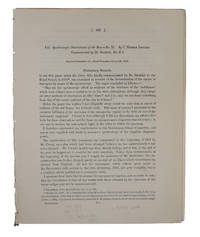
183244146Leipzig Johann Ambrosius Barth 1832. Contemp. hcalf. raised bands gilt spine. Light wear along edges. In "Annalen der Physik und Chemie. Hrsg. von J.C. Poggendorff" Band 25. Entire volume offered. VIII648 pp. and 6 folded engraved plates. Small stamps on verso of titlepage and plates. Faraday's papers: pp. 91-142 a. pp. 142-186. with 3 folded engraved plates. Clean and fine. <br/><br/><em>First German editions of the 2 first memoirs of Faradays groundbreaking researches on electricity constituting the first 2 papers of his "Experimental Researches in Electricity" and containing his fundamental discovery of electromagnetic induction THE FOUNDATION OF NEARLY ALL THE ELECTRICITY IN USE TODAY. In 1820 Oersted had generated magnetism from electricity Faraday here finds the opposite effect generating electricity by magnetism. He also described the first electrical generator second paper. THESE PAPERS ARE SOME OF THE GREAT CLASSICS OF CHEMISTRY AND PHYSICS."Faraday demonstrated this theory involving the lines of force.by inserting a magnet into a coil of wire attached to a galvanometer. While the magnet was being inserted or removd current flowed through the wire. If the magnet was held stationary and the coil moved over it one way or the other there was current in the wire. In either case the magnetic lines of force about the magnet were cut by the wire.If the magnet and coil were both held motionless whether the magnet was within the coil or not there was no current.Faraday hd thus discovered electricalinduction.It was to lead to great things but this was not apparent."Asimov."Although his discovery of the electric motor and the dynamo was almost entirely identical to his theoretical discoveries it laid the foundation of the modern electrical industry - electric light and power teælephony wireless telegraphy televison etc. - by providing for the production of continous mechanical motion from an electrical source and vice versa." PMM 308.Horblit 29 - Milestones 62. - Dibner 64. - PMM 308.The volume contains further notable papers. Elie de Beaumont "Zweiter geologischer Brief.an A.v. Humboldt über die relative Alter der Gebirgszüge" pp. 1-58 a. 2 plates one handcoloured papers by Döbereiner E. Lenz Moser Mitscherlich de Saussure J. Dumas F.E. Neumann Gay-Lussac Johannes Müller "Beobachtungen zur Analyse der Lymphe des Bluts und des Chylus" pp. 513-590. </em> hardcover
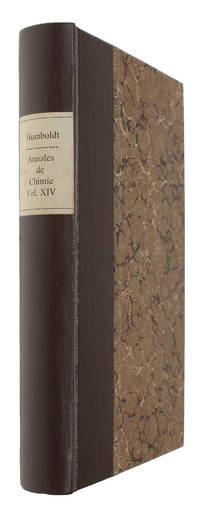
183244145Paris Crochard 1832. Contemp. hcalf. gilt spine light wear along edges. In: "Annales de Chimie et de Physique Par MM. Gay-Lussac et Arago." tome 50 Series 2. Entire volume offered. 448 pp. 2 folded engraved plates. Faraday's papers: pp. 5-67 a. pp. 113-162. <br/><br/><em>First French editions of the 2 first memoirs of Faradays groundbreaking researches on electricity constituting the first 2 papers of his "Experimental Researches in Electricity" and containing his fundamental discovery of electromagnetic induction THE FOUNDATION OF NEARLY ALL THE ELECTRICITY IN USE TODAY. In 1820 Oersted had generated magnetism from electricity Faraday here finds the opposite effect generating electricity by magnetism. He also described the first electrical generator second paper. THESE PAPERS ARE SOME OF THE GREAT CLASSICS OF CHEMISTRY AND PHYSICS."Faraday demonstrated this theory involving the lines of force.by inserting a magnet into a coil of wire attached to a galvanometer. While the magnet was being inserted or removd current flowed through the wire. If the magnet was held stationary and the coil moved over it one way or the other there was current in the wire. In either case the magnetic lines of force about the magnet were cut by the wire.If the magnet and coil were both held motionless whether the magnet was within the coil or not there was no current.Faraday hd thus discovered electricalinduction.It was to lead to great things but this was not apparent."Asimov."Although his discovery of the electric motor and the dynamo was almost entirely identical to his theoretical discoveries it laid the foundation of the modern electrical industry - electric light and power teælephony wireless telegraphy televison etc. - by providing for the production of continous mechanical motion from an electrical source and vice versa." PMM 308.Horblit 29 - Milestones 62. - Dibner 64. - PMM 308. </em> unknown
182843318Leipzig Johann Ambrosius Barth 1828. Without wrappers as issued in "Annalen der Physik und Chemie. Hrsg.von Poggendorff" Bd. 14 Zweites Stück. =Jahrgang 1828 zehntes Stück. Pp. 191-306 a. 3 engraved plates. the entire issue offered Heft 2 together with the titlepage to 14. Band. Brown's paper: pp. 294-313. Clean and fine. Small stamp on verso of titlepage. <br/><br/><em>First appearance in German of this monumental paper in atomic theory and kinematics as it was the first evidence for atomism that was an observation rather than a deduction from abstract principles."In 1827 as he was viewing a suspension of pollen in Water under the microscope he noted that the individual grains were moving about irregularly. This he thought was the result of the life hidden within the pollen grains. However when he studied dye particles indubitably nin-livin suspended in water he found the same erratic motion. This has been called "Brownian motion" ever since and Brown could merely report on the observation. He had no explanation for it. Nor had anyone else until the development of the kinetic theory of gases by men such as Maxwell a generation later. It seemed plain. after Maxwell and especially after the work of Einstein and Perrin a half century after Maxwell that the Brownian Motion was actually a visible effect of the fact that water was composed of particles. It was the first evidence for atomism that was an observation rather than a deduction." Asimov.The issue contains other importent papers by C. Naumann G. Magnus Th. Saussure "Kohlensäuregas in der Atmosphäre" andothers.PMM: 290 the English paper from 1828 - Sparrow Milestones of Science No 31. - Magie "A Source Book in Physics p. 251-255. - Dibner Heralds of Science No 156. </em> unknown
184849336Paris Victor Masson 1848 a. 1851. 8vo. 2 contemp. hcalf raised bands gilt spine. Light wear along edges. Small stamps on verso of titlepages and on verso of 1 plate. In "Annales de Chimie et de Physique" 3me Series - Tome XXIV and XXXI. 6512 pp. and 2 plates 512 pp. a. 4 plates.2 entire volumes offered. Pasteur's papers: pp. 442-459 a. pp. 459-460 1 double-page folded engraved plate pp. 67-102 a. 1 plate. Some scattered brownspots to first part of the first volume not affecting P's papers. <br/><br/><em>First full exposition of Pasteur's momentous and revolutionary discovery of "molecular assymetry" and founding the science of Polarimetry.The discovery was first announced by Pasteur in may 1848 by the printing of the preliminary report of only 4 short pages in order to establish priority. The announcement - 4 pages - was published in Comptes rendus hebdomadaires de l’Académie des Sciences Paris Seance of May 15 1848 26 21 535-538 Published on May 1848."In 1848.Pasteur studied the crystals of tartrates one of the substances that exhibited the now-clockwise now-counterclockwise effect under the microscope and found that the crystals were mirror images of the others. The two crystals resembled each other as a right-hand glove resembles a left-hand glove.This was a revolutionary discovery and it took some courage to announce it. A few years before the well-known chemist Mitscherlich had studies the same tartrate crystals and declared them all to be identical. Pasteur was only a twenty-sic-year-old unknown. neverthelless he announced his findings and went before Biot to repeat the separation ofthe crystals before the eyes of the aged authority in the field. Biot was convinced and Pasteur received the Rumford medal of the Royal Society for his work.Pasteur had thus founded the science of polarimetry in which the measurements of the manner in which the plane of polarized light was twisted could be used to help to determine the structure of organic substance to follow various chemical reactions and so on."Asimov. Leicester & Klickstein "A Source Book of Chemistry" p. 374-379. </em> hardcover
182046026Paris Crochard 1820. No wrappers. In "Annales". In "Annales de Chimie et de Physique Par MM. Gay-Lussac et Arago" Tome XIV Cahier 4 Titlepage to vol. 14 pp. 337-442. Entire issue offered. Ørsted's paper: pp. 417-25. A few scattered brownspots. <br/><br/><em>First French translation and the first translation of Oersted's epoch-making announcement in his Latin pamphlet "Extperimenta circa effectum conflictus electrici in acun magneticam. Hafniæ 1820" privately printed in a very small number and only distributed to colleques in Europe. This discovery and confirmation of the connection between 2 forces electricity and magnetism must be considered one of the happiest events in the history of science both with regard to scientific and practical results. - "From the moment that Ørsted's discovery became known it created an enormous sensation. The results communicated were so astounding that they were received with a certain distrust but they were stated with such accuracy that it could hardly be permitted to entertain any doubts. In the course of a short time the treatise was translated into all the chief languages." Kirstine Meyer. - Dibner:61 - PMM: 282 - Horblitt: 3 b. - Sparrow: 152. </em> unknown
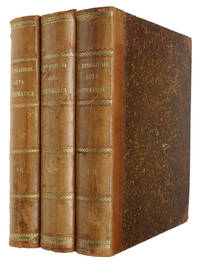
188460243Berlin Stockholm Paris F. & G. Beijer 1882-84. Large4to 272 x 230 mm. Three volumes uniformly bound in contemporary half calf with gilt lettering to spine. In "Acta Mathematica" volume 1-5. Light wear to extremities boards and spines with scratches. Stamp to verso of front board in all volumes. First three leaves in first volume detached otherwise internally fine and clean. Vol. I pp. 1-62; Pp. 193-294; Vol. II pp. 97-113; Vol. III. pp. 49-92; Vol. IV pp. 201-312; Vol. V pp. 209-278. <br/><br/><em>First publication of these groundbreaking papers which together constitute the discovery of Automorphic Functions. "Before he was thirty years of age Poincaré became world famous with his epoch-making discovery of the "automorphic functions" of one complex variable or as he called them the "fuchsian" and "kleinean" functions." DSB.These manuscripts written between 28 June and 20 December 1880 show in detail how Poincaré exploited a series of insights to arrive at his first major contribution to mathematics: the discovery of the automorphic functions. In particular the manuscripts corroborate Poincaré's introspective account of this discovery 1908 in which the real key to his discovery is given to be the recognition that the transformations he had used to define Fuchsian functions are identical with those of non-Euclidean geometry. See Walter Poincaré Jules Henri French mathematician and scientist.The idea was to come in an indirect way from the work of his doctoral thesis on differential equations. His results applied only to restricted classes of functions and Poincaré wanted to generalize these results but as a route towards this he looked for a class functions where solutions did not exist. This led him to functions he named Fuchsian functions after Lazarus Fuchs but were later named automorphic functions. First editions and first publications of these epochmaking papers representing the discovery of "automorphic functions" or as Poincaré himself called them the "Fuchsian" and "Kleinian" functions."By 1884 Poincaré published five major papers on automorphic functions in the first five volumes of the new Acta Mathematica. When the first of these was published in the first volume of the new Acta Mathematica Kronecker warned the editor Mittag-Leffler that this immature and obscure article would kill the journal. Guided by the theory of elliptic functions Poincarë invented a new class of automorphic functions. This class was obtained by considering the inverse function of the ratio of two linear independent solutions of an equation. Thus this entire class of linear diffrential equations is solved by the use of these new transcendental functions of Poincaré." Morris Kline.Poincaré explains how he discovered the Automorphic Functions: "For fifteen days I strove to prove that there could not be any functions like those I have since called Fuchsian functions I was then very ignorant; every day I seated myself at my work table stayed an hour or two tried a great number of combinations and reached no results. One evening contrary to my custom I drank black coffee and could not sleep. Ideas rose in crowds; I felt them collide until pairs interlocked so to speak making a stable combination. By the next morning I had established the existence of a Class of Fuchsian functions those which come from hypergeometric series; i had only to write out the results which took but a few hours.the transformations that I had used to define the Fuchsian functions were identical with those of Non-Euclidean geometry." </em> hardcover
182035260Paris Crochard 1820. Recent hcloth. Some repairs to inner margin of titlepage to "Annales". In "Annales de Chimie et de Physique Par MM. Gay-Lussac et Arago" Tome XIV pp. 417-25. The whole volume present: 448 pp. and 3 folded engraved plates. <br/><br/><em>First French translation and the first translation of Oersted's epoch-making announcement in his Latin pamphlet "Extperimenta circa effectum conflictus electrici in acun magneticam. Hafniæ 1820" privately printed in a very small number and only distributed to colleques in Europe. This discovery and confirmation of the connection between 2 forces electricity and magnetism must be considered one of the happiest events in the history of science both with regard to scientific and practical results. - "From the moment that Ørsted's discovery became known it created an enormous sensation. The results communicated were so astounding that they were received with a certain distrust but they were stated with such accuracy that it could hardly be permitted to entertain any doubts. In the course of a short time the treatise was translated into all the chief languages." Kirstine Meyer. - Dibner:61 - PMM: 282 - Horblitt: 3 b. - Sparrow: 152. </em> hardcover