Libri . de fide et legibus.
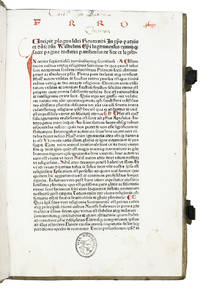
1475ABC_47019Augsburg: Günther Zainer 1475. Contemporary richly blind-tooled vellum over wooden boards two brass clasps blue edges "Nr. 56" in red ink written at the foot of the spine. Small folio. Set in a hybrid roman type with gothic elements a single column of 43 lines per page plus running heads with the first 3 lines including the title in a slightly larger rotunda gothic. With all initials supplied in manuscript in red rubricated throughout. Incunable first edition of De fide et legibus On faith and laws one of the most important works of William of Auvergne post 1180 - 1249 in which he incorporates classical Arabic philosophical works of Ibn Sina Al-Farabi and others and it is the first of his works to be printed. It forms one of seven parts of his principal monumental work Magisterium divinale The divine teaching a compendium of philosophy and theology that attempts to explain the whole natural world. William of Auvergne was one of the most prominent French philosophers and theologians of the early 13th century. He was Bishop of Paris from 1228 until his death in 1249 and although he was in the very Christian position of bishop he was one of the first Western scholars to try to integrate classical Arabic Greek and Jewish philosophy for example Ibn Sina Al-Farabi Ibn Rushd and Solomon ibn Gabirol with Christian doctrine. These writings had recently become available in Latin translation. On the one hand this allowed William to oppose errors he considered dangerous for Christian beliefs but on the other hand and more importantly he found a large source of philosophical inspiration in these Arabic and other texts.In the present work divided into ten parts each of several chapters William of Auvergne talks about reason and the intellect and its power and abilities faith and love the nature of error on faith and miracles and the power of both but also on natural philosophy magic superstition and other idolatries of that time. He dwells for example on credulity heresy and demonology. He also refers to some questionable passages in the Jewish and Mosaic law which he nevertheless explains as measures to guide the people against idolatry and magic.With a contemporary inscription: "Cart. in Buxheim. Contenta" and a small stamp of the "Bibl. Buxheim'" on the first page. The book therefore originally belonged to the Carthusians at Buxheim in Germany. The publisher Günther Zainer was known for his gifts to the Carthusian monastery in Buxheim and our copy of William of Auvergne's work was probably one of them. The monastery's library was sold in the 19th-century. Also with the bookplate of the library of George Dunn 1865-1912 an English bibliophile with an impressive library at Woolley Hall and a particular interest in paleography and early printing. Binding slightly stained and rubbed first and last leaf somewhat loose some water stains especially at the end of the book but still a beautiful copy in good condition.l BMC II 323; Goff G 711; GW 11863; Hain-Copinger 8317; IGI 4602; ISTC ig00711000; Oates 883; Polain 1807; Proctor 1556; for the author: Thorndike III pp. 338-371. Günther Zainer, hardcover
Antiquariaat FORUM BV · Pays-Bas45 000,00 €