73 résultats
182148806Paris Crochard 1821. 8vo. Uncut and unopened in orig. printed wrappers. In: "Annales de Chimie et de Physique Redigées par MM. Gay-Lussac et Arago" Tome XVII - Mai Issue. Pp. 1-112 including titlepage to vol. 17. - The rapport: pp. 80-102. Fresnel's paper: pp. 102-111. Clean and fine. <br/><br/><em>First appearance of the joint report. This investigation of Fresnel's paper by Arago mainly written by Arago as a polemic directed at Biot and Ampère is a central document in the rather bitter confrontation between Arago and Biot on the wave theory of light put forward by Fresnel.Fresnel's paper is the first part of three of his "Calcul des teintes". </em> unknown
18202667Paris: Crochard 1820. First edition. Half-calf. Very Good. THE ORIGINS OF ELECTROMAGNETISM. AMPÈRE'S FIRST DISCUSSION OF THE RELATIONSHIP BETWEEN ELECTRIC CURRENT-FLOW AND MAGNETISM. Ampère often worked by publishing his ideas chiefly in Annales de chimie et de physiques at times as much as once a week. When he had further thoughts on the topic he would publish revisions. The "first great memoir on electrodynamics" the present paper is the seed of what would become a series of papers "establishing the laws of forces acting between conductors carrying current" DSB p. 144; Dibner Heralds 62. In this - the first appearance of Ampère's discussion of electric current-flow as it relates to magnetism - Ampère effectively establishes a new field of science and paves the way for developments in electrodynamics.<br /> <br /> In this volume the original periodical publication Ampère's discussion begins on pp. 59-76 and continues on pp. 170-218.<br /> <br /> AMPÈRE ANDRÉ MARIE. "Mémoire . De l'Action mutuelle de deux courans électriques". IN: Annales de chimie et de physiques vol. 15. Paris: Crochard 1820. pp. 59-76 170-218. Octavo later three quarter calf over early boards. 448 pp. 5 full-page plates by Adam Sculp including one fold-out plate. Some toning to extreme edge of text very occasional light spotting otherwise fine.<br /> <br /> References:<br /> <br /> DSB: L. Pearce Williams "Ampère André-Marie" Dictionary of Scientific Biography 16 vols. New York: Scribner's 1980 I: Pierre Abailard-L.S. Berg pp. 139-147<br /> <br /> Dibner Bern Heralds of Science New York: Burndy Library and The Smithsonian Institute 1980<br /> <br /> Norman Jeremy M. and Diana H. Hook The Haskell F. Norman Library of Science and Medicine San Francisco: Jeremy Norman 1991. Crochard unknown
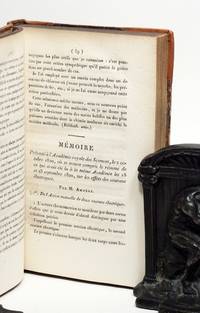
1822317221822. Recueil d'observation électromagnetiques Paris 1822 8° pp.259-292 Fig. 1 der 8.Tafel und die 9. Tafel Broschur. Blondel 31/1 32/2 unknown
1826292813Paris.: Bachelier. 1826. 2nd Edition. Stabbed plain blue wraps. Very good ink name owner’s stamp and number label to cover owner’s stamp to title page. 8vo. 21.5x13 cm. French text. Ampere’s description of his electro-mechanical “solenoidâ€. Uncommon. weight: 0.1 lb. One folding plate. Bachelier. paperback
1824317101824. Paris Crochard & Bachelier 1824 8° 24 pp. 1 folding plates untrimmed in contemporary wrapper; preserved in fine halfleather book case. Rare first edition! In 1824 Ampère invented the solenoid "Ampére knonstruiert zur Beobachtung der Wirkung galvanischer Ströme das Solenoid eine beweglich aufgehängte vom Strom druchflossene Drahtspirale welche sich nach Ampère's Gesetz so einstellt daß ihre Achse mit dem magnetischen Meridian zusammenfällt. Er brauchte den Kunstgriff die Drahtenden in Quecksilber zu sTellen" Darmstädter p.345 Weaver 814; Poggendorff I Sp.40; Cushing A.168 and Sotheran had only the second edition 1828 hardcover
182445511Paris Crochard 1824. 8vo. Without wrappers. In 'Annales de Chimie et de Physique' Series 2 - Volume 26 Cahier 4. Pp. 337-448 entire issue offered. With htitle to volume 26. Amperes' paper: pp. 390-411 and 2 folded engraved plates. <br/><br/><em>First appearence of the paper in which Ampere describes his invention of the SOLENOID the electro-magnetic device he used in his early electrodynamical experiments."A solenoid is a coil wound into a tightly packed helix. In physics the term solenoid refers to a long thin loop of wire often wrapped around a metallic core which produces a magnetic field when an electric current is passed through it. Solenoids are important because they can create controlled magnetic fields and can be used as electromagnets. The term solenoid refers specifically to a magnet designed to produce a uniform magnetic field in a volume of space where some experiment might be carried out."Poggendorff I p. 29. - Ronalds p. 10. </em> unknown
1835637041835. C. R. Acad. Sci. 1/ 7. - 14 Septembre 1835 4° pp.109-122 feine Broschur. First Edition! unknown
181545113Paris Crochard 1815. Contemp. hcalf. Spine gilt. Slightly rubbed. A few scratches to binding. Wear to top of spine. Small stamps on verso of titlepage.In: "Annales de Chimie ou Recueil de Mémoires concernant la Chemie" Tome 94. 336 pp. a. 1 plate the plate in facs. not belonging to Ampere's paper. Ampere's paper: pp. Some scattered brownspots. <br/><br/><em>First appearance of Amperes second paper on molecular physics."The noumenal aspect of chemistry fascinated Ampère. Although his derivation of Avogadro’s law came three years after Avogadro had enunciated it the law is known today in France as the Avogadro-Ampère law. This was Ampère’s first excursion into molecular physics and was followed almost immediately by a second. In 1815 he published a paper demonstrating the relation between Mariotte’s Boyle’s law and volumes and pressures of gases at the same temperature. The paper is of some interest as a pioneer effort along with Laplac’s great papers on capillarity in the application of Mathematical analysis to the molecular realm."DSB.The volume contains 3 importent papers by Jean-Baptiste Biot on polarisation of light and Berzelius "Experiences pour déterminer les proportions définies dans lequelles les élémens de la nature organique sont combinés" "Suite." 1-2 pp. 5-33 pp. 170-190 a. pp. 296-232 </em> unknown
181643465Paris Crochard 1816 No wrappers as extracted fron 'Annales de Chimie et de Physique' Volume 1 and 2 2e Series. Pp. 295-308 a. pp. 373-394 Vol. 1 pp. 5-32 a. pp. 105-125 Vol. 2. With both halftitles to vols. 1 a. 2. Htitles shaved in inner margins no loss of letters. All 4 papers having some scattered brownspots. <br/><br/><em>First appearance of Ampere's notable memoir issued in 4 parts in which he tries to set up a classification system for the elementary entities in chemistry tieing the elements together in a natural classification a dim foreshadowing of the periodic table."Here in the paper offered he drew attention to the similarities between Lavoisier's and his fellowers classification of elements in terms of their reactions with oxygen and Linnaeus' classification of plants in terms of their sexual organs. Bernard de Jussieu had successfully challenged Linnaeus with a natural system that took the whole plant into account and sought affinities between all parts of the plant not just the flowers as the basic classification. Ampère now wished to do the same thing for chemistry. By discovering a natural classification i.e. one that tied the elements together by real and rather than artificial relations Ampère hoped to prove a new insight into chemical reactions. His classificatory scheme therefore was not merely an ordering ofthe elements but like the later periodic table of Dimitri Mendeleev a true instrument of chemical research. Ampères system was as artificial as Lavoisier's.Thepapermay be noted however as an early attempt to find relationships between elements that would bring some order into the constantly growing number of elementary bodies."DSB I p. 143. </em> unknown
1822317111822. Paris Méquignon-Marvis 1822 8° 3 91 II pp. 33 Fig. untrimmed in contemporary brochure; preserved in halfleather book box; fine copy. First Edition of a scare and early publication on electricity and magnetism "A very valuable Treatise' Mottelay. 'In a four page circular letter dated Copenhagen July 21st 1820 H.C. Oersted communicated his great discovery that a closed voltaic circuit exerts forces on an adjacent magnetic needle. In more modern language: a current-carrying electric circuit gives rise to magnetic forces in its surroundings. Oersted had found the long sought affinity between electricity and magnetism' Ekelöf Catalogue of Books and Papers in Electricity and Magnetism p. 286. 'Scarcely had the news of Oersted's discovery reached France when a French philosopher Ampère set to work to develop the important consequences which it involved. Physicists had long been looking for the connection between magnetism and electricity and had perhaps inclined to the view that electricity was somehow to be explained as a magnetic phenomenon. It was in fact under the influence of such ideas that Oersted was led to his discovery. Ampère showed that the explanation was to be found in an opposite direction. He discovered the ponderomotive action of one electric current on another and by a series of well-chosen experiments he established the elementary laws of electro-dynamic action starting from which by a brilliant train of mathematical analysis he not only evolved the complete explanation of all the electro-magnetic phenomena observed before him but predicted many hitherto unknown. The results of his researches may be summarized in the statement that an electric current in a linear circuit of any form is equivalent in its action whether on magnets or other circuits to a magnetic shell bounded by the circuit whose strength at every point is constant and proportional to the strength of the current. By his beautiful theory of molecular currents he gave a theoretical explanation of that connection between electricity and magnetism which had been the dream of previous investigators . "Oersted" remarks Babinet "was the Christopher Columbus of magnetism; Ampère became its Pizarro and its Fernando Cortez"' Mottelay Bibliographical History of Electricity and Magnetism p. 474. Ampère's collaborator in the present publication Jacques Babinet 'did excellent work in different areas of physics. He was an early advocate of the wave theory of light and produced important results in the theory of refraction' Ekelöf p. 287. An additional interesting aspect of the present paper is a first outline of Ampère's ideas concerning an electric telegraph p. 71. The work is in fact an offprint from the Supplement to the French translation of Thomas Thompson's System of Chemistry: Système de Chimie. Traduit . par J. Riffault. The supplement is entitled: Supplément . présentant ce qui a été fait de nouveau dans cette science . depuis l'époque 1819 où cette traduction a paru Paris 1822 see Cole 1283. In the supplement the text of Ampère and Babinet occupies pp. 163-256. Overmier and Senior p. 127; not in Gartrell or Wheeler Gift. hardcover
182248224Paris Crochard 1822. No wrappers. In: "Annales de Chimie et de Physique Par MM. Gay-Lussac et Arago." Tome 20 Premier Cahier Pp. 5- 112 a. 1 engraved plate. Entire issue offered. Ampère's paper: pp. 60-74 a. 1 engraved folded plate depicting apparatus. Some brownspots to the plate. <br/><br/><em>First apperance of this importent paper in which Ampère his creation of a new kind of electric motor where he succeeded in spinning a cylindrical magnet around its axis by connecting it to a battery generating a steady current.With the invention of the battery Allessandro Volta 1800 the generation of a magnetic field from electric current Hans Christian Oersted 1820 the foundation for building electric motors was laid.Togetner with this paper comes the importent paper in which Ampère introduced his "LAW OF FORCE" the force which exists between two current elements. - Extract from the same volume of "Annalen" pp. 398-421. The text refers to the plate attached to the first paper offered here. </em> unknown
182448831Paris Crochard 1824. 8vo. Contemp. hcloth with gilt lettering to spine. In 'Annales de Chimie et de Physique' Series 2 - Volume 26. 448 pp. a. 5 large folded engraved plates. Entire volume offered. Ampere's papers: pp. 134-162 246-258 a. 390-411. A bit of browning to halftitle and verso of last plate. A few scattered brownspots. <br/><br/><em>The first paper is the first appearance of one of Ampere's importent contributions to electrodynamic. This memoir was later incorporated in his great memoir of 1827 "Mémoire sur la théorie mathématique des phénomenes electro-dynamiques." published 1827 the "Principia" of electrodynamics.The second paper is the first appearence of the paper in which Ampere describes his invention of the SOLENOID the electro-magnetic device he used in his early electrodynamical experiments."A solenoid is a coil wound into a tightly packed helix. In physics the term solenoid refers to a long thin loop of wire often wrapped around a metallic core which produces a magnetic field when an electric current is passed through it. Solenoids are important because they can create controlled magnetic fields and can be used as electromagnets. The term solenoid refers specifically to a magnet designed to produce a uniform magnetic field in a volume of space where some experiment might be carried out."The volume contains further importent papers by Poisson "Sur la Chaleur rayonnante" pp. 225-246 Note. pp. 442-44 Gay-Lussac Savart Pelletier et Caventou Becquerel etc. </em> hardcover
182444786Paris Crochard 1824. 8vo. Without wrappers. In 'Annales de Chimie et de Physique' Series 2 - Volume 26 issue 2 and 3. With titlepage to vol. 26. Pp. 113-224 a. pp. 225-336 1 folded engraved plate entire issues offered. Ampere's papers: pp. 134-162 a. pp. 246-258. <br/><br/><em>First appearance of one of Ampere's importent contributions to electrodynamic. This memoir was later incorporated in his great memoir of 1827 "Mémoire sur la théorie mathématique des phénomenes electro-dynamiques." published 1827 the "Principia" of electrodynamics. </em> unknown
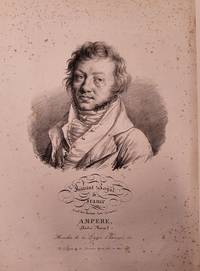
18201011DG1820. um 1820. Lithorgraphie von Louis Leopold Boilly. Bildgrösse: 18 x 18 cm. Blattgrösse: 34 x 25 cm. Französischer Physiker und Mathematiker. - Blatt stockfleckig. unknown
182041350Paris Crochard 1820. 8vo. Without wrappers as extracted from "Annales de Chimie et de Physique" Volume 15 pp. 59-76 and pp.170-218. Five engraved plates accompanying the memoires showing the experimental equipments. Half-title and title-page to volume 15 present. <br/><br/><em>First edition of the first announcement of Ampère's discoveries on electromagnetism. Ampère first heard of Ørsted's discovery of electromagnetism on the 4th of September when Arago announced Ørsted's results to the Paris Academy of Sciences. In Ørsted's experiment a current-carrying wire is held over and under a compass needle - the result being that the needle is positioned at 45 degrees in respect to the wire. Ampére immediately saw that this result made no physical sense and realized that the true nature of the effect could not be observed until the force of terrestrial magnetism was somehow neutralized; what Ørsted had observed and reported on was the resultant of the force from the wire and that from the earth's magnetic field. Ampère discovered that the compass needle sets at 90 degrees to the current-carrying wire when the effect of terrestrial magnetism is eliminated. He also observed that current-carrying wires which are formed as spirals act as permanent magnets and this lead him to his theory that electricity in motion produces magnetism and that permanent magnets must contain electrical currents. And thus Ampère laid the foundation of the new field of electrodynamics.Ampère announced his theory and experimental results for the first time in a series of memoires read before the Paris Academy of Sciences in September and October 1820. These memoires were first published in the September and October issues of Arago's "Annales de Chimie et de Physique" the offered items. In November Ampère had a separate printing of his findings published under the title 'Mémoires sur I'action mutuelle de deux courans électriques sur celle qui existe entre un courant électrique et un aimant ou le globe terrestre et celle de deux aimans I'un sur I'autre.' Dibner 62 Norman 43. On the title-page of this publication it is stated 'Extrait des Annales de Chimie et de Physique' and therefore this publication is often identified as an offprint of the two offered papers see the Norman sales catalogue for an example. This is however untrue since it contains considerable changes and additions in comparison with text of the journal issues see Williams: What were Ampère's Earliest Discoveries in Electrodynamics ISIS volume 74 p.492.Honeyman 82 Barchas 51 Wheeler 762. Sparrow Milestones No 8. </em> unknown
182043521Paris Crochard 1820. 8vo. In 'Annales de Chimie et de Physique' Volume 15 pp. 59-76; 170-218. The entire volme 15 offered in a nice contemporary half calf with gilt spine. A bit of wear to extremities. Five engraved plates accompanying the memoires. A very fine copy. <br/><br/><em>First edition of the first announcement of Ampère's discoveries on electromagnetism. Ampère first heard of Ørsted's discovery of electromagnetism on the 4th of September when Arago announced Ørsted's results to the Paris Academy of Sciences. In Ørsted's experiment a current-carrying wire is held over and under a compass needle - the result being that the needle is positioned at 45 degrees in respect to the wire. Ampére immediately saw that this result made no physical sense and realized that the true nature of the effect could not be observed until the force of terrestrial magnetism was somehow neutralized; what Ørsted had observed and reported on was the resultant of the force from the wire and that from the earth's magnetic field. Ampère discovered that the compass needle sets at 90 degrees to the current-carrying wire when the effect of terrestial magnetism is eliminated. He also observed that current-carrying wires which are formed as spirals act as permanent magnets and this lead him to his theory that electricity in motion produces magnetism and that permanent magnets must contain electrical currents. And thus Ampère laid the foundation of the new field of electrodynamics.Ampère announced his theory and experimental results for the first time in a series of memoires read before the Paris Academy of Sciences in September and October 1820. These memoires were first published in the September and October issues of Arago's 'Annales de Chimie et de Physique' i.e. the offered item. In November Ampère had a seperate printing of his findings published under the title 'Mémoires sur I'action mutuelle de deux courans électriques sur celle qui existe entre un courant électrique et un aimant ou le globe terrestre et celle de deux aimans I'un sur I'autre.' Dibner 62 Norman 43. On the title-page of this publication it is stated 'Extrait des Annales de Chimie et de Physique' and therefore this publication is often identified as an offprint of the two offered papers see the Norman sales catalogue for an example. This is however untrue since it contains considerable changes and additions in comparison with text of the journal issues see Williams: What were Ampère's Earliest Discoveries in Electrodynamics ISIS volume 74 p.492.Honeyman 82 Barchas 51 Wheeler 762. </em> unknown
182559780Paris Crochard 1825. 8vo. Bound in contemporary half calf with gilt lettering to spine. In: "Annales de Chimie et de Physique Par MM. Gay-Lussac et Arago." tome 29. Entire volume offered. Very light occassional foxing otherwise a fine and clean copy with no institutional stamps. Pp. 381-404; 373-381. Entire volume: 448 pp. folded plate. <br/><br/><em>First appearance of this famous memoir in which Ampère presented his collected results on electrodynamics to the French Academy creating the foundation of 19th century developments in electricity and magnetism. In the words of James Clark Maxwell "We can scarcely believe that Ampère really discovered the law of action by means of the experiments which he describes. We are led to suspect what indeed he tells us himself that he discovered the law by some process which he has not shown us and that when he had afterwards built up a pefect demonstration he removed all traces of the scaffolding by which he raised it." The offered memoir was published BEFORE the famous "Theorie mathématique des phénomènes électro-dynamiques uniquement déduite de L'expérience" which did not appear until 1827. That 1827-Memoire incorporates together with a new presentation of Ampère's results from 1820 1822 1823 the offered memoir 1825. Horblit: 100 - Dibner: 62. "From 1814 until 1820 Ampére did not perform the kind of research that would have made it into the annals of the histrory of science but on September 11 1820 when he heard Francois Arago speak about Oersted's work he got fresh inspiration and started the work that made him famous. Arago related how Oersted had found that a steady electric current influences the orientation of a compass needle. After a weak Ampère had determined experimentally that that two straight parallel and current-carrying wires execute a force on each other. The magnitude of the force is inversely proportional to the distance between the wires and proportional to the strenghts of the current. During the following years he continued his researches both experimentally and theoretically. he built an instrument for measuring electricity that later was developed into the galvanometer. Finally in 1825 he presented his collected results to the Academy IN ONE OF THE MOST CELEBRATED MEMOIRS IN THE HISTORY OF NATURAL PHILOSOPHY The paper offered." Citizen's Compendium p. 2. - Norman No 47. The volumes contain many other notable papers by: Wöhler Fresnel Marcet Berzelius Felix Savart De la Rive Braconnet Boussingault Magnus Poncelet Vaugelin Poisson Gay-Lussac Faraday Laplace etc. </em> unknown
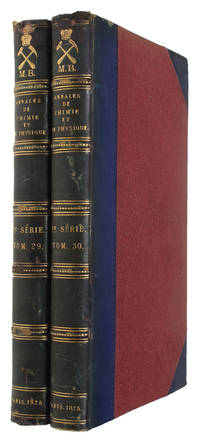
182548082Paris Crochard 1825. 8vo. Bound in 2 uniform later hcloth. Gilt lettering to spines. In: "Annales de Chimie et de Physique Par MM. Gay-Lussac et Arago." tome 29 a. 30. - 448 pp. and 3 folded engraved plates 448 pp. and 2 folded engraved plates. The entire volumes offered. Ampère's papers: pp. 381-404 tome 29 Suite pp. 29-41 tome 30 "Lettre à Gerhardi": pp. 373-381 tome 29. Some scattered brownspots. <br/><br/><em>First appearance of this famous memoir in which Ampère presented his collected results on electrodynamics to the French Academy creating the foundation of 19th century developments in electricity and magnetism. In the words of James Clark Maxwell "We can scarcely believe that Ampère really discovered the law of action by means of the experiments which he describes. We are led to suspect what indeed he tells us himself that he discovered the law by some process which he has not shown us and that when he had afterwards built up a pefect demonstration he removed all traces of the scaffolding by which he raised it."The offered memoir was published BEFORE the famous "Theorie mathématique des phénomènes électro-dynamiques uniquement déduite de L'expérience" which did not appear until 1827. That 1827-Memoire incorporates together with a new presentation of Ampère's results from 1820 1822 1823 the offered memoir 1825. Horblit: 100 - Dibner: 62."From 1814 until 1820 Ampére did not perform the kind of research that would have made it into the annals of the histrory of science but on September 11 1820 when he heard Francois Arago speak about Oersted's work he got fresh inspiration and started the work that made him famous. Arago related how Oersted had found that a steady electric current influences the orientation of a compass needle. After a weak Ampère had determined experimentally that that two straight parallel and current-carrying wires execute a force on each other. The magnitude of the force is inversely proportional to the distance between the wires and proportional to the strenghts of the current. During the following years he continued his researches both experimentally and theoretically. he built an instrument for measuring electricity that later was developed into the galvanometer. Finally in 1825 he presented his collected results to the Academy IN ONE OF THE MOST CELEBRATED MEMOIRS IN THE HISTORY OF NATURAL PHILOSOPHY The paper offered." Citizen's Compendium p. 2. - Norman No 47.The volumes contain many other notable papers by: Wöhler Fresnel Marcet Berzelius Felix Savart De la Rive Braconnet Boussingault Magnus Poncelet Vaugelin Poisson Gay-Lussac Faraday Laplace etc. </em> hardcover
182547420Paris Crochard 1825. Extracted from "Annales de Chimie et de Physique Par MM. Gay-Lussac et Arago." tome 29 a. 30. Ampère's papers: pp. 381-404 a. 1 folded engraved plate tome 29 Suite pp. 29-41 tome 30 "Lettre à Gerhardi": pp. 373-381 tome 29. With both halftitlepages to vol. 29 a. 30. Scattered brownspots. <br/><br/><em>First appearance of this famous memoir in which Ampère presented his collected results on electrodynamics to the French Academy creating the foundation of 19th century developments in electricity and magnetism. In the words of James Clark Maxwell "We can scarcely believe that Ampère really discovered the law of action by means of the experiments which he describes. We are led to suspect what indeed he tells us himself that he discovered the law by some process which he has not shown us and that when he had afterwards built up a pefect demonstration he removed all traces of the scaffolding by which he raised it."The offered memoir was published BEFORE the famous "Theorie mathématique des phénomènes électro-dynamiques uniquement déduite de L'expérience" which did not appear until 1827. That 1827-Memoire incorporates together with a new presentation of Ampère's results from 1820 1822 1823 the offered memoir 1825. Horblit: 100 - Dibner: 62."From 1814 until 1820 Ampére did not perform the kind of research that would have made it into the annals of the histrory of science but on September 11 1820 when he heard Francois Arago speak about Oersted's work he got fresh inspiration and started the work that made him famous. Arago related how Oersted had found that a steady electric current influences the orientation of a compass needle. After a weak Ampère had determined experimentally that that two straight parallel and current-carrying wires execute a force on each other. The magnitude of the force is inversely proportional to the distance between the wires and proportional to the strenghts of the current. During the following years he continued his researches both experimentally and theoretically. he built an instrument for measuring electricity that later was developed into the galvanometer. Finally in 1825 he presented his collected results to the Academy IN ONE OF THE MOST CELEBRATED MEMOIRS IN THE HISTORY OF NATURAL PHILOSOPHY The paper offered." Citizen's Compendium p. 2. - Norman No 47. </em> unknown
182543749Paris Crochard 1825. 8vo. 2 contemporary half calfs w. richly gilt spines. Light wear at top of spines. Minor scratches to upper compartments of spines. Small stamps on verso of title-pages and verso of plates. In: "Annales de Chimie et de Physique Par MM. Gay-Lussac et Arago." tome 29 a. 30. - 448 pp. and 3 folded engraved plates 448 pp. and 2 folded engraved plates. The entire volumes offered. Ampère's papers: pp. 381-404 tome 29 Suite pp. 29-41 tome 30 "Lettre à Gerhardi": pp. 373-381 tome 29. Clean and fine throughout. <br/><br/><em>First appearance of this famous memoir in which Ampère presented his collected results on electrodynamics to the French Academy creating the foundation of 19th century developments in electricity and magnetism. In the words of James Clark Maxwell "We can scarcely believe that Ampère really discovered the law of action by means of the experiments which he describes. We are led to suspect what indeed he tells us himself that he discovered the law by some process which he has not shown us and that when he had afterwards built up a pefect demonstration he removed all traces of the scaffolding by which he raised it."The offered memoir was published BEFORE the famous "Theorie mathématique des phénomènes électro-dynamiques uniquement déduite de L'expérience" which did not appear until 1827. That 1827-Memoire incorporates together with a new presentation of Ampère's results from 1820 1822 1823 the offered memoir 1825. Horblit: 100 - Dibner: 62."From 1814 until 1820 Ampére did not perform the kind of research that would have made it into the annals of the histrory of science but on September 11 1820 when he heard Francois Arago speak about Oersted's work he got fresh inspiration and started the work that made him famous. Arago related how Oersted had found that a steady electric current influences the orientation of a compass needle. After a weak Ampère had determined experimentally that that two straight parallel and current-carrying wires execute a force on each other. The magnitude of the force is inversely proportional to the distance between the wires and proportional to the strenghts of the current. During the following years he continued his researches both experimentally and theoretically. he built an instrument for measuring electricity that later was developed into the galvanometer. Finally in 1825 he presented his collected results to the Academy IN ONE OF THE MOST CELEBRATED MEMOIRS IN THE HISTORY OF NATURAL PHILOSOPHY The paper offered." Citizen's Compendium p. 2. - Norman No 47.The volumes contain many other notable papers by: Wöhler Fresnel Marcet Berzelius Felix Savart De la Rive Braconnet Boussingault Magnus Poncelet Vaugelin Poisson Gay-Lussac Faraday Laplace etc. </em> unknown
182845872Paris Crochard 1828. No wrappers. In: "Annales de Chimie et de Physique Par MM. Gay-Lussac et Arago." tome 39 Sec. Cahier With halftitle to vol. 39. pp. 113-224. Entire issue offered. Ampere's paper: pp. 113-145 a. 1 folded engrave plate. The plate with a few mostly marginal brownspots. <br/><br/><em>First appearance of Ampere's mathematical treatment of Fresnel's ondulatory theory of light agreeing with Fresnel and opposed to Biot and Laplace who advocated a corpuscular theory. </em> unknown
182051054Paris 1820. Small 8vo. Contemporary original blank blue paper wrappers. Annulated stamp to title-page otherwise a nice clean and fresh copy. 68 pp. 5 engraved plates. <br/><br/><em>First edition in the extremely scarce off-print of the first announcement of Ampère's seminal discoveries on electromagnetism which laid the foundation for electrodynamics. Ampère first heard of Ørsted's discovery of electromagnetism on the 4th of September when Arago announced Ørsted's results to the Paris Academy of Sciences. In Ørsted's experiment a current-carrying wire is held over and under a compass needle - the result being that the needle is positioned at 45 degrees in respect to the wire. Ampére immediately saw that this result made no physical sense and realized that the true nature of the effect could not be observed until the force of terrestrial magnetism was somehow neutralized; what Ørsted had observed and reported on was the resultant of the force from the wire and that from the earth's magnetic field. Ampère discovered that the compass needle sets at 90 degrees to the current-carrying wire when the effect of terrestial magnetism is eliminated. He also observed that current-carrying wires which are formed as spirals act as permanent magnets and this lead him to his theory that electricity in motion produces magnetism and that permanent magnets must contain electrical currents. And thus Ampère laid the foundation of the new field of electrodynamics."Ampère professor of mathematics at the Polytechnique heard of Oersted's discovery and immediately set up a series of experiments to determine the exact relationships of current-flow and magnetism. In a week Ampère presented the first of a series of papers establishing the laws of forces acting between conductors carrying current." Dibner. Ampère's seminal results were announced in a series of memoires read before the Paris Academy of Sciences in September and October 1820. These memoires were first published in the September and October issues of Arago's "Annales de Chimie et de Physique" and in November Ampère had the scarce seperate printing of his findings published under the title "Mémoires sur I'action mutuelle de deux courans électriques sur celle qui existe entre un courant électrique et un aimant ou le globe terrestre et celle de deux aimans I'un sur I'autre". It is this publication that is considered "his first great memoir on electrodynamics" DSB.Sparrow: 8; Dibner: 62; Honeyman: 83; Barchas 51 only the periodical-issue; Wheeler 762 only the periodical-issue. </em> unknown
182843747Paris Crochard 1828. No wrappers. In: "Annales de Chimie et de Physique Par MM. Gay-Lussac et Arago." tome 37 sec. cahier Titlepage to vol. 37 pp. 113-223. Entire issue offered. Ampere's paper: pp. 113-139 a. 1 large folded engraved plate. <br/><br/><em>First appearance of Ampere's last major paper on magnetism and electricity. As in his most importent paper from 1827 he shows the unification of the electric and the magnetic fields and treats the relations mathematically. </em> unknown
182143862Paris Crochard 1821. Without wrappers. In: Annales de Chimie et de Physique Par MM. Gay-Lussac et Arago." Tome 18. Cahier 1 a. 3. Titlepage a. htitle to vol. 18. Pp. 4 1-112 a. pp. 225-336 a. 2 folded engraved plates. Entire issues offered. Ampère's papers: pp. 88-106 pp. 313-333 The plates depicts experimental arrangements and Ampère's initial Rotation Apparatus. <br/><br/><em>Fisrt edition and first printings of the demonstrations of Ampere's new Equilibrium technique. When Faraday had completed his importent paper on Electro-magnetic motions he send it to Ampere. Ampere invented the Rotation Apparatus in order to repeat Faraday's experiment on the electro-magnetic rotation. He produced an uninterrupted rotation either of magnetic pole around a wire or of a wire around a magnetic pole. From these experiments originated a new theory of electricity and magnetism. . </em> unknown
182141248Paris Crochard 1821. Contemp. full cloth. Light wear to spine ends. Gilt lettering to spine. In: Annales de Chimie et de Physique Par MM. Gay-Lussac et Arago." Tome 18. 448 pp. and 6 folded engraved plates 4 of these belonging to the described papers. Ampère: pp. 88-106 pp. 313-333 and 4 plates. Faraday: pp. 337-379. Savary: pp. 370-379. The plates depicts experimental arrangements and Ampère's initial Rotation Apparatus. The whole volume present. <br/><br/><em>Fisrt edition and first printings of the demonstrations of Ampere's new Equilibrium technique. When Faraday had completed his importent paper on Electro-magnetic motions the paper offered here in the first French edition he send it to Ampere. Ampere invented the Rotation Apparatus in order to repeat Faraday's experiment on the electro-magnetic rotation. He produced an uninterrupted rotation either of magnetic pole around a wire or of a wire around a magnetic pole. From these experiments originated a new theory of electricity and magnetism. - The third memoir is the First French edition of Faraday's famous paper "On some New Electro-Magnetical Motions and on the Theory of Magnetism" Quaterly Journal of Science October 1821 in which is recorded for the first time the conversion of electrical into mechanical energy. It also contains the first notion of the "Line of Force". He employed a magnet and a wire with a flowing current which causd each separately to rotate round the other. He concluded that a current-carrying wire is sorraunded by a circular "line of force". Oersted had spoken of the "electrical conflict" surrounding the wire and had noted that "this conflict performs circles". </em> hardcover