[Law Flanders, 1591]Biblio.com
2 résultats
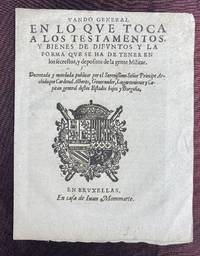
15963764Brussels: Juan Mommarte 1596. First Edition. Very good. Small 4to. 6 ff. with the arms of Spain on the title. Small wormhole in first three leaves affecting text but a very good crisp copy unbound. INHERITANCE LAW IN SPANISH-RULED FLANDERS IN 1596: WHAT DID SHAKESPEARE KNOW <br /> <br /> "Recent research on inheritance law in 'Hamlet' reveals that the author of that play had a precise and extensive knowledge of inheritance law and that this knowledge informs many aspects of the plot and the interrelationships of characters." SOURCE: "Could Shakespeare Think Like a Lawyer Inheritance Law in Hamlet: How Inheritance Law Issues in Hamlet May Shed Light on the Authorship Question" by Thomas G. Regnie in: Shakespeare Oxford Fellowship Online. <br /> <br /> Ours is certainly the copy described in the 1967 Quaritch Catalogue 883 Foreign Books Printed Before 1600 item 74 $14 and it is the only copy that has ever appeared on the market according to Rare Book Hub which currently lists more than 12 million transactions in its database. <br /> <br /> To our knowledge there are no copies outside The Netherlands. Juan Mommarte unknown
1503D20057Venice: Octaviani Scoti per Bonetus de Locatellis 1503. Hardcover. Very Good. Small folio printed in gothic type in two columns woodcut initials & text diagrams; woodcut printer's device on final leaf. Bound in modern half parchment with printed paper boards. A copy with significant contemporary marginal notes in several sections the annotations run tight up against the outer margin. Title page cut down by one inch at the foot; some scattered spotting & worming but generally a nice copy of an early and uncommon to the market post-incunable edition worthy of future study. A recent edition was published in 2024 by the Aquinas Institute. Beth Mortensen summarizes the significance of the text: "All of us living in this Cartesian age grow accustomed to thinking of our bodies as animated machinesmachines that function better or worse subject to innumerable material factors. De Anima On the Soul reminds us that the human person is one whole and the soul is actively making the body what it is. This means that among other things the quality of the bodys functioning does not determine a human beings 'quality of life' and it is completely irrelevant to that persons worth or dignity." see: aquinas institute - commentary on de anima. <br/><br/> Octaviani Scoti per Bonetus de Locatellis hardcover