416 résultats
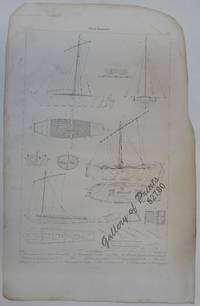
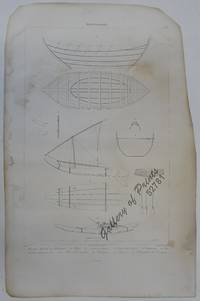
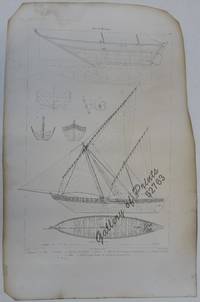
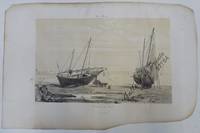
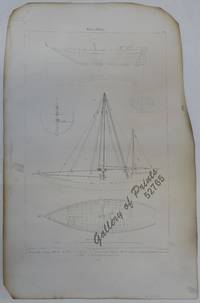
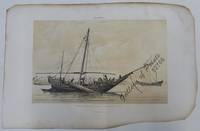
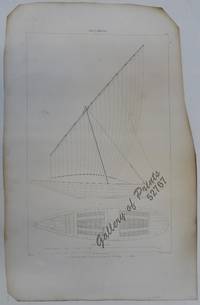
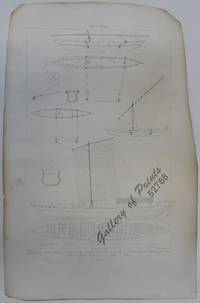
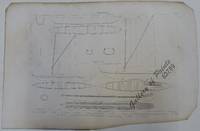
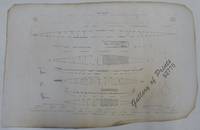
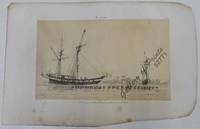
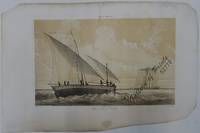
184152778sepia lithograph. EXTREMELY RARE view from 'Essai sur la Construction Navale des Peuples Extra-Europeens'. Reference: Graesse V. 134; Cat. Nederl. Scheepvart Mus. 758; Polak 7321; Sabin 58593; Taylor 72; not in Kroepelin & Hill Collections. Condition: with dark spot and stains affecting plate with paper loss along margins with burn marks along edges. Arthus Bertrand, Paris.
184152780lithograph. EXTREMELY RARE view from 'Essai sur la Construction Navale des Peuples Extra-Europeens'. Reference: Graesse V. 134; Cat. Nederl. Scheepvart Mus. 758; Polak 7321; Sabin 58593; Taylor 72; not in Kroepelin & Hill Collections. Condition: with light spots and water stains affecting plate with paper loss along margins with burn marks along edges. Arthus Bertrand, Paris.
184152781lithograph. EXTREMELY RARE view from 'Essai sur la Construction Navale des Peuples Extra-Europeens'. Reference: Graesse V. 134; Cat. Nederl. Scheepvart Mus. 758; Polak 7321; Sabin 58593; Taylor 72; not in Kroepelin & Hill Collections. Condition: with light spots and stains affecting plate with paper loss along margins with burn marks along edges. Arthus Bertrand, Paris.
184152763lithograph. EXTREMELY RARE view from 'Essai sur la Construction Navale des Peuples Extra-Europeens'. Reference: Graesse V. 134; Cat. Nederl. Scheepvart Mus. 758; Polak 7321; Sabin 58593; Taylor 72; not in Kroepelin & Hill Collections. Condition: with light spots and stains affecting plate with paper loss along margins with burn marks along edges. Arthus Bertrand, Paris.
184152764sepia lithograph. EXTREMELY RARE view from 'Essai sur la Construction Navale des Peuples Extra-Europeens'. Reference: Graesse V. 134; Cat. Nederl. Scheepvart Mus. 758; Polak 7321; Sabin 58593; Taylor 72; not in Kroepelin & Hill Collections. Condition: with light spots and stains affecting plate with paper loss along margins with burn marks along edges. Arthus Bertrand, Paris.
184152765lithograph. EXTREMELY RARE view from 'Essai sur la Construction Navale des Peuples Extra-Europeens'. Reference: Graesse V. 134; Cat. Nederl. Scheepvart Mus. 758; Polak 7321; Sabin 58593; Taylor 72; not in Kroepelin & Hill Collections. Condition: with light spots and stains not affecting plate with paper loss along margins with burn marks along edges. Arthus Bertrand, Paris.
184152766sepia lithograph. EXTREMELY RARE view from 'Essai sur la Construction Navale des Peuples Extra-Europeens'. Reference: Graesse V. 134; Cat. Nederl. Scheepvart Mus. 758; Polak 7321; Sabin 58593; Taylor 72; not in Kroepelin & Hill Collections. Condition: with light spots and stains not affecting plate with paper loss along margins with burn marks along edges. Arthus Bertrand, Paris.
184152767lithograph. EXTREMELY RARE view from 'Essai sur la Construction Navale des Peuples Extra-Europeens'. Reference: Graesse V. 134; Cat. Nederl. Scheepvart Mus. 758; Polak 7321; Sabin 58593; Taylor 72; not in Kroepelin & Hill Collections. Condition: with light spots and stains affecting plate with paper loss along margins with burn marks along edges. Arthus Bertrand, Paris.
184152768lithograph. EXTREMELY RARE view from 'Essai sur la Construction Navale des Peuples Extra-Europeens'. Reference: Graesse V. 134; Cat. Nederl. Scheepvart Mus. 758; Polak 7321; Sabin 58593; Taylor 72; not in Kroepelin & Hill Collections. Condition: with light spots and stains affecting plate with paper loss along margins with burn marks along edges. Arthus Bertrand, Paris.
184152769lithograph. EXTREMELY RARE view from 'Essai sur la Construction Navale des Peuples Extra-Europeens'. Reference: Graesse V. 134; Cat. Nederl. Scheepvart Mus. 758; Polak 7321; Sabin 58593; Taylor 72; not in Kroepelin & Hill Collections. Condition: with light spots and stains affecting plate with paper loss along margins with burn marks along edges. Arthus Bertrand, Paris.
184152770lithograph. EXTREMELY RARE view from 'Essai sur la Construction Navale des Peuples Extra-Europeens'. Reference: Graesse V. 134; Cat. Nederl. Scheepvart Mus. 758; Polak 7321; Sabin 58593; Taylor 72; not in Kroepelin & Hill Collections. Condition: with light spots and stains affecting plate with paper loss along margins with burn marks along edges. Arthus Bertrand, Paris.
184152771sepia lithograph. EXTREMELY RARE view from 'Essai sur la Construction Navale des Peuples Extra-Europeens'. Reference: Graesse V. 134; Cat. Nederl. Scheepvart Mus. 758; Polak 7321; Sabin 58593; Taylor 72; not in Kroepelin & Hill Collections. Condition: with dark spots on lower margin with stains affecting plate with paper loss along margins with burn marks along edges. Arthus Bertrand, Paris.
1873183763Paris : M. Levy 1873. First Edition. Paperback. Very good copy in the original stiff-card wrappers; edges somewhat nicked and dust-dulled as with age. Particularly and surprisingly well-preserved; tight bright clean and strong. In protective glassine wrapper. ; 8vo 8"" - 9"" tall; 297 pages; Physical desc. : 297 p ; 22 cm. Subjects: Labour and labouring classes - Great Britain. Labor laws and legislation - Great Britain. Language: French. Paris : M. Levy paperback
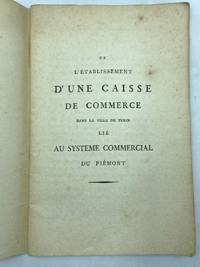
180213233Torino: DE L’IMPRIMERIE D LA CAISSE DE L’EXTRAORDINAIRE 1802. Macchiette e segni d'uso sulla brossura. Opuscolo in originale brossura d’attesa in carta bianca cm 20x13 pp 36. Macchiette e segni d’uso sulla brossura. Funzionario nell’erario francese sin dal primo ministero di Necker le chevalier Hennet nonostante provate simpatie monarchiche seppe rendere la propria carriera impermeabile ai burrascosi mutamenti politici dell’epoca e nel 1801 fu nominato Commissario straordinario all’organizzazione delle finanze del Piemonte da poco annesso alla Francia; in questa veste per rispondere al malcontento subalpino pubblicò in francese e italiano un Rapporto presentato il 14 nevoso dell’Anno X Repubblicano all’Amministratore Generale Jourdan sulla riforma fiscale messa in atto nella 27a Divisione Militare sottolineandone le presunte migliorie rispetto alla tassazione sabauda. Di poco successivo è questo raro pamphlet la cui prefazione anonima ricorda come Hennet abbia proposto l’istituzione tanto di un nuovo Monte di Pietà che era stato chiuso dai Francesi e sarà riaperto nel 1804 quanto di una Cassa di sconto e commercio e che a questa seconda proposta l’Auteur a livré à la presse cet ouvrage succint que la multiplicté de ses occupations l’empêchent de rendre plus digne du sujet important qu’il traite. Nell’introduzione Hennet «attento studioso delle finanze piemontesi» Bracco analizza la situazione produttiva il bilancio delle esportazioni i problemi relativi alla circolazione monetaria e ai tassi d’interesse in Piemonte e conclude che un più facile accesso al credito per il commercio e l’industria sarebbe preludio ad un necessario rinnovamento sociale portando i cittadini impegnati in un travail doux et reglé a essere più istruiti ed onesti e meno inclini al reclutamento militare alle credenze superstiziose al brigantaggio. Il testo prosegue con tre capitoli che esaminano la necessità di istituire una Caisse ou Banque de Commerce i vantaggi di accentrarla a Torino insieme a Borsa e Tribunal de Commerce e i principi di questo istituto con riferimenti allo statuto della Banca di Francia e al funzionamento dell’azionariato della Caisse d'escompte du commerce. Raro non in Einaudi un solo esemplare censito in ICCU. Bibliografia: Bracco La finanza comunale in Levra Storia di Torino VI Einaudi 2000. DE L’IMPRIMERIE D LA CAISSE DE L’EXTRAORDINAIRE unknown
18653136325Parisiis: Apud A. Franck 1865. Covers a little marked.Edge of pageblock intentionally spotted with ink.Pages cut.Text in good condition.This book has hardback covers. Ex-library With usual stamps and markings In fair condition suitable as a study copy. No dust jacket. Please note the Image in this listing is a stock photo and may not match the covers of the actual item400grams ISBN: Parisiis: Apud A. Franck, hardcover
1880138353Paris: Librairie des Sciences Médicales V.ve Frédéric Henry 1880. In-8 p. mm. 226x140 cartonato moderno conserv. piatto anteriore brossura originale pp. XI1702 con 9 figure nel testo così composto: Première partie: Des Appareils récepteurs transmetteurs - 1ere classe - 2e classe - Du courant de pile // Seconde partie: Applications du téléphone - Applications du microtéléphone Etude de la voix articulée. Etude du bruit musculaire. Etude des bruits intra thoraciques. Etude des bruits circulatoires. De quelques autres applications du microtéléphone. Con fioriture e aloni ma complessivamente un discreto esemplare. Librairie des Sciences Médicales V.ve Frédéric Henry, unknown
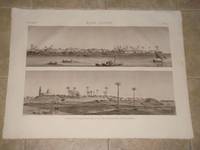
180925341Paris: Imprimerie Impériale 1809. Fine. Imprimerie Impériale Paris 1809-1829 53.50 x 70 cm une feuille Original unshaved full-page etching from the Imperial edition of the Description de l'Égypte or Recueil des observations et recherches faites en Égypte pendant l'expédition française publié par les ordres de Sa Majesté l'Empereur Napoléon le Grand A Collection of the observations and research carried out in Egypt during the French expedition published on the orders of his Majesty the Emperor Napoleon the Great'.Produced between February 1802 and 1830 on the orders of Naopleon Bonaparte and published between 1809 and 1828 1000 copies were printed and distributed to institutions on vergé paper with an 'Égypte ancienne et moderne' watermark visible when held up to the light. Light marginal spotting not touching image otherwise in very fresh fine condition. An engraving from the Description de l'Egypte one of the masterpieces of French printing and the birth of a new field: Egyptology. A gigantic survey of Egypt at the time of Bonaparte's conquests in 1798 and 1799 the work is divided into 13 volumes of engravings making up 892 plates of which 72 colored as well as presenting the splendors of the Egypt of the Pharaohs in 9 volumes. The other volumes discuss natural history and present a fascinating portrait of Coptic and Islamic Egypt as it was seen by Bonaparte's Eastern Armies. The Egyptian campaign' militarily a disaster demonstrates through the engravings of the Description d'Egypte the scientific success it nonetheless became thanks to the 167 expert members of the Commission of the Sciences and Arts of the Institut d'Egypte Egyptian Institute who followed Napoleon's army. The Institut gathered together in Egypt the mathematician Monge the chemist Berthollet the naturalist Geoffroy Saint-Hilaire as well as numerous artists engineers architects and doctors. They were tasked with re-discovering modern and ancient Egypt and displaying its natural treasures as well as the know-how of its inhabitants.This edition the so-called Imperial edition of the plates for the Description de l'Egypte was printed in four large formats two of which were specially created for it and christened Moyen-Egypte and Grand-Egypte. A special press was built to print it the process extending over 20 years from 1809 to 1829. The Imperial edition proved so popular that a second edition this time in black and white and without the Egypte ancienne et moderne watermark known as the Royal Edition was published during the Restoration by the printing house of C.-L.-F. Panckoucke Paris.The engravings of the Description d'Egypte owe a great deal to Baron Dominique-Vivant Denon illustrator diplomat collector and later Director of the Musée Napoléon the Louvre. His exploration of the South of Egypt gave Bonaparte the idea of sending the experts of the Institut there thus creating a faithful and complete portrait of the area. This was the research gathered together from 1802 in the mammoth Description de L'Egypte.Denon embarked on this story of archeological exploration at the age of 51 reaching first Alexandria and then Cairo before exploring Upper Egypt. Along with the members of the Institut d'Egypte the Natural History Museum's painter H.J. Redouté brother of Pierre-Joseph Redouté author of Roses the mineralogist Dolomiue and the draughtsman Joly Denon then explored the Nile Delta and Lower Egypt. When however he joined the 21st Light Infantry Regiment as it marched across Upper Egypt in pursuit of the retreating Mameluks in November 1798 he found himself the only civilian. In the very midst of the battle itself he reeled off sketches of the works of art that peppered his path right up to the threshold of the Sudan. He said that he had crossed a country that is apart from its name entirely unknown to Europeans and therefore everything was worth describing Voyages dans la Basse et la Haute Egypte pendant les campagnes Imprimerie Impériale unknown
180925365Paris: Imprimerie Impériale 1809. Fine. Imprimerie Impériale Paris 1809-1829 53.50 x 70 cm une feuille Original unshaved full-page etching from the Imperial edition of the Description de l'Égypte or Recueil des observations et recherches faites en Égypte pendant l'expédition française publié par les ordres de Sa Majesté l'Empereur Napoléon le Grand A Collection of the observations and research carried out in Egypt during the French expedition published on the orders of his Majesty the Emperor Napoleon the Great'.Produced between February 1802 and 1830 on the orders of Naopleon Bonaparte and published between 1809 and 1828 1000 copies were printed and distributed to institutions on vergé paper with an 'Égypte ancienne et moderne' watermark visible when held up to the light. Light marginal spotting not touching image otherwise in very fresh fine condition. An engraving from the Description de l'Egypte one of the masterpieces of French printing and the birth of a new field: Egyptology. A gigantic survey of Egypt at the time of Bonaparte's conquests in 1798 and 1799 the work is divided into 13 volumes of engravings making up 892 plates of which 72 colored as well as presenting the splendors of the Egypt of the Pharaohs in 9 volumes. The other volumes discuss natural history and present a fascinating portrait of Coptic and Islamic Egypt as it was seen by Bonaparte's Eastern Armies. The Egyptian campaign' militarily a disaster demonstrates through the engravings of the Description d'Egypte the scientific success it nonetheless became thanks to the 167 expert members of the Commission of the Sciences and Arts of the Institut d'Egypte Egyptian Institute who followed Napoleon's army. The Institut gathered together in Egypt the mathematician Monge the chemist Berthollet the naturalist Geoffroy Saint-Hilaire as well as numerous artists engineers architects and doctors. They were tasked with re-discovering modern and ancient Egypt and displaying its natural treasures as well as the know-how of its inhabitants.This edition the so-called Imperial edition of the plates for the Description de l'Egypte was printed in four large formats two of which were specially created for it and christened Moyen-Egypte and Grand-Egypte. A special press was built to print it the process extending over 20 years from 1809 to 1829. The Imperial edition proved so popular that a second edition this time in black and white and without the Egypte ancienne et moderne watermark known as the Royal Edition was published during the Restoration by the printing house of C.-L.-F. Panckoucke Paris.The engravings of the Description d'Egypte owe a great deal to Baron Dominique-Vivant Denon illustrator diplomat collector and later Director of the Musée Napoléon the Louvre. His exploration of the South of Egypt gave Bonaparte the idea of sending the experts of the Institut there thus creating a faithful and complete portrait of the area. This was the research gathered together from 1802 in the mammoth Description de L'Egypte.Denon embarked on this story of archeological exploration at the age of 51 reaching first Alexandria and then Cairo before exploring Upper Egypt. Along with the members of the Institut d'Egypte the Natural History Museum's painter H.J. Redouté brother of Pierre-Joseph Redouté author of Roses the mineralogist Dolomiue and the draughtsman Joly Denon then explored the Nile Delta and Lower Egypt. When however he joined the 21st Light Infantry Regiment as it marched across Upper Egypt in pursuit of the retreating Mameluks in November 1798 he found himself the only civilian. In the very midst of the battle itself he reeled off sketches of the works of art that peppered his path right up to the threshold of the Sudan. He said that he had crossed a country that is apart from its name entirely unknown to Europeans and therefore everything was worth describing Voyages dans la Basse et la Haute Egypte pendant les campagnes Imprimerie Impériale unknown
180925354Paris: Imprimerie Impériale 1809. Fine. Imprimerie Impériale Paris 1809-1829 71 x 53.50 cm une feuille Original unshaved full-page etching from the Imperial edition of the Description de l'Égypte or Recueil des observations et recherches faites en Égypte pendant l'expédition française publié par les ordres de Sa Majesté l'Empereur Napoléon le Grand A Collection of the observations and research carried out in Egypt during the French expedition published on the orders of his Majesty the Emperor Napoleon the Great'.Produced between February 1802 and 1830 on the orders of Naopleon Bonaparte and published between 1809 and 1828 1000 copies were printed and distributed to institutions on vergé paper with an 'Égypte ancienne et moderne' watermark visible when held up to the light. Light marginal spotting not touching image otherwise in very fresh fine condition. An engraving from the Description de l'Egypte one of the masterpieces of French printing and the birth of a new field: Egyptology. A gigantic survey of Egypt at the time of Bonaparte's conquests in 1798 and 1799 the work is divided into 13 volumes of engravings making up 892 plates of which 72 colored as well as presenting the splendors of the Egypt of the Pharaohs in 9 volumes. The other volumes discuss natural history and present a fascinating portrait of Coptic and Islamic Egypt as it was seen by Bonaparte's Eastern Armies. The Egyptian campaign' militarily a disaster demonstrates through the engravings of the Description d'Egypte the scientific success it nonetheless became thanks to the 167 expert members of the Commission of the Sciences and Arts of the Institut d'Egypte Egyptian Institute who followed Napoleon's army. The Institut gathered together in Egypt the mathematician Monge the chemist Berthollet the naturalist Geoffroy Saint-Hilaire as well as numerous artists engineers architects and doctors. They were tasked with re-discovering modern and ancient Egypt and displaying its natural treasures as well as the know-how of its inhabitants.This edition the so-called Imperial edition of the plates for the Description de l'Egypte was printed in four large formats two of which were specially created for it and christened Moyen-Egypte and Grand-Egypte. A special press was built to print it the process extending over 20 years from 1809 to 1829. The Imperial edition proved so popular that a second edition this time in black and white and without the Egypte ancienne et moderne watermark known as the Royal Edition was published during the Restoration by the printing house of C.-L.-F. Panckoucke Paris.The engravings of the Description d'Egypte owe a great deal to Baron Dominique-Vivant Denon illustrator diplomat collector and later Director of the Musée Napoléon the Louvre. His exploration of the South of Egypt gave Bonaparte the idea of sending the experts of the Institut there thus creating a faithful and complete portrait of the area. This was the research gathered together from 1802 in the mammoth Description de L'Egypte.Denon embarked on this story of archeological exploration at the age of 51 reaching first Alexandria and then Cairo before exploring Upper Egypt. Along with the members of the Institut d'Egypte the Natural History Museum's painter H.J. Redouté brother of Pierre-Joseph Redouté author of Roses the mineralogist Dolomiue and the draughtsman Joly Denon then explored the Nile Delta and Lower Egypt. When however he joined the 21st Light Infantry Regiment as it marched across Upper Egypt in pursuit of the retreating Mameluks in November 1798 he found himself the only civilian. In the very midst of the battle itself he reeled off sketches of the works of art that peppered his path right up to the threshold of the Sudan. He said that he had crossed a country that is apart from its name entirely unknown to Europeans and therefore everything was worth describing Voyages dans la Basse et la Haute Egypte pendant les campagnes Imprimerie Impériale unknown
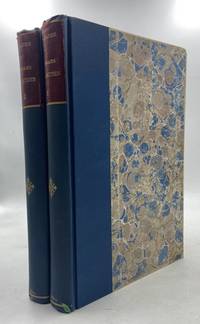
186213540Paris: Chez MM. Rollin et Feuardent 1862. Qualche alone sulle tavole tracce di ex libris sulle sguardie mancanza sull’occhietto del primo tomo estranea al testo. Due volumi opera completa in mezza tela con titoli dorati su tassello in pelle amaranto cm 24.5 x 17 pp 4 VIII 325 1 4 376 3 complessive LXX tavole incise. In francese. Qualche alone sulle tavole tracce di ex libris sulle sguardie mancanza sull’occhietto del primo tomo estranea al testo. Edizione originale del maggior lavoro di Sabatier pubblicato come «suite et complément» dell’opera di Henry Cohen sulla monetazione imperiale romana. Da non confondersi con le ristampe novecentesche di Leipzig e Graz. Chez MM. Rollin et Feuardent hardcover
18769922099Librairie De Firmin Didot Et Cie 1876. This is an ex-library book and may have the usual library/used-book markings inside.This book has hardback covers. Clean from markings. In good all round condition. No dust jacket. 217 pages. 8vo. Brown cloth binding. Gilt stamp on front and rear covers. Gilt lettering on backstrip. Adhesive residue on front cover. Yellow end papers. Bookplate inside front cover. Untrimmed page edges. Firm binding. Pages clean. Please note the Image in this listing is a stock photo and may not match the covers of the actual item600grams ISBN: Librairie De Firmin Didot Et Cie hardcover
181729207Paris: Chez l'Auteur 1817. Second edition. Large folding engraved map some short tears along gutter small hole along fold else very good. 1 vols. 8vo. Contemporary sheep-backed marbled boards. Boards rubbed some staining and starting of joints rubbing of spine some light spotting of text else very good. Second edition. Large folding engraved map some short tears along gutter small hole along fold else very good. 1 vols. 8vo. Chez l'Auteur unknown
181229210Paris: De L'Imprimerie de J. G. Dentu 1812. First edition. Large folding engraved map. 1 vols. 8vo. Contemporary calf-backed marbled boards. Head of spine pulled some rubbing label rubbed else fine. First edition. Large folding engraved map. 1 vols. 8vo. De L'Imprimerie de J. G. Dentu unknown
184257968Leipzig Rein'schen Buchhandlung 1842. Contemp. hcalf. Gilt spine. cased together with the map in a contemp. hcalf case with gilt spine. 2521 pp. and 1 large folded engraved map mounted on linen in sections. unknown
186160566Paris: Dunod Editeur successeur de Victor Dalmont Librairie 1861. Two vols. 1st - 4to. viii 64; 2nd - Folio. 11 x 14 in. 4 pp. With 24 large double-page steel-engraved plates executed by L. Guiquet folded & mounted on linen stubs at gutter margin nearly all retaining their original tissue guard. Uniformly bound in full green morocco gilt fleurette borders ruled borders gilt inner dentelles raised bands & gilt decoration on spines white silk moire endpapers a.e.g. minor edgewear & rubbing some bumping & wear to corners of the Atlas vol. occasional light foxing still a VG set. First editions of this uncommon set tracing the engineering and construction efforts by Vuignier 1798-1865 noted Parisian engineer to develop and expand the warehouse docks canal locks and canal infrastructure of the Canal de l’Ourcq into the Bassin de la Villette the largest artificial lake in Paris constructed under the reign of Napoleon I. Vuigner had not only overseen the construction of the original grain warehouse docks to feed Paris with the newly created canal link but from 1839-1840 was the original general manager of the Ourcq Canal Concession who designed and oversaw the construction of the five locks connecting the Canal de l’Ourcq into the Bassin de la Villette solving the severe sloping issue. As part of the development works carried out by Napoleon III and Baron Haussmann Vuigner oversaw the upgrading of the warehouse docks along the canals connecting to the Canal de l’Ourcq in order to solve water flow and depth issues of the Pont de Flandre and the Quai de la Gironde which are depicted here in drawings as are improved pumps and mechanisms for the locks. Two of the original warehouses survived at the end of the Bassin de la Villette and later converted into artists lofts but now they have been replaced by the MK2 cinema complexes and the areas in and around the Bassin and Canals have become thriving and popular outdoor areas. Worldcat locates 7 sets of both volumes Badische U of Hannover Paris-CNAM Paris-Mines Paristech U of Valencia Biblioteca Nacional Espana Sevilla. Dunod, Editeur, successeur de Victor Dalmont, Librairie, hardcover