82 résultats
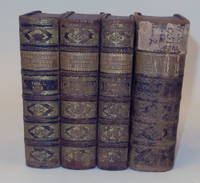
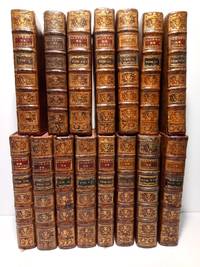
17958233Paris: Jahyer et Geslin 1795-1798. Lievi sbucciature sui dorsi complessivamente ben conservato; leggera gora sull'ultima carta del tomo secondo e sulla tavola all'antiporta del tomo terzo della suite dedicata alle Elegie lieve gora sull'angolo della segnatura “e†del tomo terzo; una tavola del tomo secondo slegata ma presente. Tre volumi opera completa in mezza pelle ottocentesca con titoli dorati e falsi nervi sul dorso sbucciature 8vo cm13x21.5 pp 4 XX 375 1 4 593 1 4 388; complessive 15 tavole. Segnatura: 2 a10 A-Z8 Aa4 2 A-Z8 Aa8 Bb2 Cc4 C4 bianca e incollata alla sguardia 3 a-z8 aa2 bb8. Lievi sbucciature sui dorsi complessivamente ben conservato; leggera gora sull'ultima carta del tomo secondo e sulla tavola all'antiporta del tomo terzo della suite dedicata alle Elegie lieve gora sull'angolo della segnatura “e†del tomo terzo; una tavola del tomo secondo slegata ma presente. Elegie di Tibullo con traduzione di Mirabeau a fronte; seguono la versione anch'essa con testo a fronte del Liber Basiorum di Jean Second Jan Everaerts e alcune novelle di argomento mitologico. La traduzione del Livre de Baisers fu composta da Mirabeau durante la prigionia a Vincennes e dedicata all'amante Sophie de Ruffey il cui nome è sostituito nel testo a quello di Neera “parce qu'il m'eût été impossible d'adresser à une autre qu'à Sophie des choses si tendresâ€; qui pubblicata per la prima volta e imprimée sur l'original écrit de la main de Sophie questa raccolta di 19 basia più Un bacio è poco di Guarini anch'esso liberamente tradotto a fronte è adorna del noto ritratto di Sophie col motto In Bel Corpo anima bella inciso da Jean-Louis Delignon su disegno di Antoine Borel. L'apparato iconografico è quasi interamente firmato da Borel ed è composto dai ritratti di Sophie e di Mirabeau quest'ultimo inciso da Etienne Claude Voysard e da dodici tavole incise da François-Rolland Elluin per le elegie di Tibullo; un'ulteriore quindicesima tavola è dedicata alla traduzione de La rete di Vulcano overo gli amori di Marte et di Venere di Ferrante Pallavicino che apre il terzo volume disegnata da Clément-Pierre Mariller e incisa da Jean Baptiste Michel Dupréel. Qualche dubbio nelle bibliografie sulla datazione di quest'opera presumibilmente completata fra il 1795 e il 1798 e qui offerta nella variante con frontespizio con la data posteriore AN VI 1798 nonostante il colophon del tomo II porti la data AN 3 1795. Cohen-Ricci II 993; Graesse VII 159 Jahyer et Geslin unknown
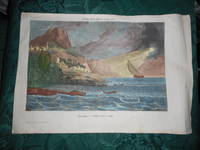
1800114423A Paris: chez Basset rue St Jacques 64. Very Good- with no dust jacket. 1800. Unknown. Softcover. Hand coloured engraving. Image VG - blank margins have a some faults. NO date but possibly between 1780/1840 likely a later impression of a late 18th Century print . Light printing impression surrounding the print. 'Sarasin P.' on the left hand side the Artist under the image and 'la chaussee Sculp' on the right hand side. Additional printed caption "VUE DES CÔTES D'ECOSSE" inverted mirror image on the upper margin. Paper very lightly marked and quite creased and 'rolled' to the edges with some closed tears - no loss neatly repaired with archive tape to the reverse to those broad blank margins otherwise a very good engraving. This interesting view of the coast prepared for a 'peep box' represents a mountainous and stormy sea shore in apparently Scotland. A small village is shown on the shore and near the top of the mountain with fishing boats and nets in the sea. "Vue Optique or perspective view refers to a genre of etching popular during the second half of the 18th century and into the 19th. Such 'Vues' were specifically developed to provide the illusion of depth when viewed through a zograscope also known as an "optical diagonal machine" or viewers with similar functions. Optical viewers were generally popular with well-to-do European families in the late 18th and early 19th centuries. What makes this particular image even more interesting is that I have found for sale by another dealer an ALMOST identical view BUT entitled 'Vue des Côtes de SIBERIE' View of the Coasts of Siberia there are some differences but the basic layout is the same but that print was published in Paris by Laurent Pierre La Chaussée but also undated. I am unable to ascertain the chronology of these two prints and whether one might be a 'pirated' version . THIS print has the Publisher as 'A Paris chez Basset rue St Jacques 64' at the left hand side by the outer bottom print impression line. Other than those mentioned above there are no other publication details or text on this print. Paul Andre Basset was a Paris print publisher printseller wallpaper manufacturer and the son of André Basset. He married in 1787 and was very active during the revolutionary period. He was situated in Paris at rue Saint Jacques no.64 where his firm remained until at least 1885. The Image alone without the broad borders measures approx 15.5" x 10.0" 39.3 cm x 25.5 cm . See Images ; Oblong Folio 13" - 23" tall . chez Basset, rue St Jacques 64, paperback
176824720Paris De Bure pere 1768. Small 8vo. Cont. full mottled calf. Back gilt and worn. Leather at lower compartment lacks. Spine ends gone. First leaves dampstained decreasing toward end. Engraved frontisp. 4626 pp. hardcover
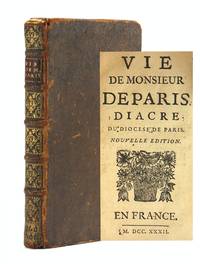
1732508272Not Identified 1732. Second Edition. Leather. VERY GOOD. Second Edition printed the year following the 1731 first edition. Written and printed anonymously. The author has been identified as Barthelmey Doyen; the printer remains unknown. 4 204 p. Small 8vo 3.75x6.5'. Brown calf with ornate gilt stamped spine and burgundy morocco label red speckled edges. Edges rubbed; Heraldic bookplate from the Bibliotheque du Chateau de Wideville. Clean and fresh text binding sound. Biography of the Roman Catholic deacon Francois de Paris 1690-1727: 'Deacon theologian and supporter of Jansenists. His pious life led people to consider him as a saint; miracles were reported to occur at his grave in Saint-Médard's cemetary in Paris with people experiencing convulsions; they were known as 'Convulsionnaires of Saint-Médard'. British Museum. [Not Identified] unknown
179110990Venezia: Presso Antonio Zatta e figli 1791-1793. Mancanti dall’origine due cartine Elide e Messenia; difetti sui soli margini di circa 10 carte del tomo XI morsure/mancanze che non intaccano il testo estese a tutta la larghezza del margine per circa 5cm sul bordo superiore e 3cm sull’esterno delle pagine da 167 a 176 con la sola perdita del numero di pagina sull’ultima carta; trascurabili e assai contenute nelle altre carte; per il resto esemplare genuino e completo complessivamente discreto esemplare da studio. Dodici tomi in mezza pelle coeva con titoli dorati su tassello 8vo piccolo cm11x16 complessive circa 5000 pagine con 29 su 31 tavole ripiegate in coloritura d’epoca. Tomo I: pp XVI 309 3 4 tavole; tomo II: pp 301 3 7 tavole; tomo III: pp 288 3 tavole; tomo IV: pp 196 3 tavole; tomo V: pp 311 1 2 tavole; tomo VI: pp 332 4 tavole; tomo VII: pp 8 304 2 tavole; tomo VIII: pp 8 312 1 tavola; tomo IX: pp 8 344; tomo X: pp 8 360 1 tavola; tomo XI: pp 359 1 2 tavole; tomo XII: pp VIII 384. Mancanti dall’origine due cartine Elide e Messenia; difetti sui soli margini di circa 10 carte del tomo XI morsure/mancanze che non intaccano il testo estese a tutta la larghezza del margine per circa 5cm sul bordo superiore e 3cm sull’esterno delle pagine da 167 a 176 con la sola perdita del numero di pagina sull’ultima carta; trascurabili e assai contenute nelle altre carte; per il resto esemplare genuino e completo complessivamente discreto esemplare da studio. Romanzo didattico sulle antichità greche che costò all’autore trent’anni di lavoro e conobbe enorme fortuna a cavallo fra il XVIII e il XIX secolo pilastro del neoclassicismo tardo Settecentesco e del filellenismo che avrebbe infiammato i cuori della gioventù romantica europea pochi anni dopo; la prima edizione italiana qui offerta è arricchita di numerose tavole incise da Antonio Zatta e in coloritura coeva ed è tradotta presumibilmente secondo Melzi Dizionario. 3 217 da Vincenzo Antonio Formaleoni Fiorenzuola d’Arda 1752 - Mantova 1797 viaggiatore cartografo tipografo e romanziere collaboratore di Zatta e Zannoni nonché protagonista di vicende di spionaggio fra la Francia giacobina e la Serenissima. Brunet I 675; Graesse I 300 Presso Antonio Zatta e figli unknown
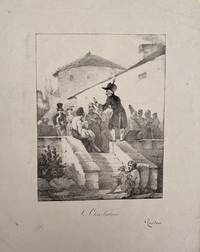
1740120COMPTE JACQUES LAURE DE BRETENIL ACTIVE 1730-1750 IN PARIS. UN CHARLATAN. Lithograph. 15. 6 1/8 x 4 1/4.
1789470262ª Ed. española. Con las Licencias Necesarias.- Madrid: En la Oficina de Benito Cano Año MDCCLXXXIX 1789.- 5 h. LIV 406 p.: Con dos láminas plegadas al final grabadas al cobre; 4º menor 211 x 154 cm; Cuidada impresión sobre excelente papel verjurado fuerte y limpio; Enc. en Plena Piel pasta antigua de la época Lomo cuajado en oro tejuelo cortes tintados en color granate.- RARO. Libro en excelente estado de conservación con el papel perfecto sin la más mínima mancha. La encuadernación con normales y ligeras señales del tiempo. El Dr. Petit fue un famoso cirujano que desarrolló el sistema del torniquete. Adquirió gran notoriedad dada su habilidad y experiencia por sus estudios de casos de hemorragia fístula lagrimal y operación de frenillo por su tratado sobre enfermedades óseas y sobre todo por su tratado general sobre operaciones quirúrgicas en el que trabajó doce años y fue terminado póstumamente por François-Dominique Lesné 17221800. CIRUGIA EN GENERAL Y TRAUMATOLOGIA Libro en español Benito Cano hardcover
1742SS13441London:: Printed for John and Paul Knapton. . . 1742-53. 1742. 5 volumes. 8vo. Vol.1: 4 x 11-456 16; Vol.2: 2 407 15 10; Vol.3: 2 422 16; Vol.4: 2 410 14 11-26; Vol.5: 2 426 14 pp. The first 10 pages of the "Addenda" are bound at the end of vol.2 pp.11-26 are bound at the end of vol.4. 44 of 45 engraved plates mostly folding I: 17; II: 6; III: 6; IV: 6; V: 9 of 10 plates pl. 10 supplied in facs. see p. 422 TOTAL: 44 2 folding tables vol. I tables some folding addenda indexes; 2nd wasp plate vol. V with small scrape effecting some of the image. Original speckled calf; rebacked and with later endleaves vols. I III & V with joints gently mended with kozo. PROVENANCE: Bookplates of Henry and Carol Faul mounted on top of the following engraved bookplate for the American Academy of Arts & Sciences: "Sub libertate Florent" dated 1780 "The Gift of . . ." -- also with their gilt-stamp applied to the foot of the later spines "American Academy"; Rubber stamps discarded of the Linda Hall Library Kansas City MO. Very good. HENRY FAUL'S COPY -- WORKED FOR ENRICO FERMI & BIKINI ATOLL TEST. A collection of early scientific papers from leading figures all belonging to the Royal Academy of Sciences at Paris the French equivalent to the Royal Society of London. The abridged papers all appeared between 1699 and 1720 and include diverse topics such as anatomy apiculture astronomy incl. Moon chemistry electricity entomology gases geography geology herpetology invertebrates magnetism medicine meteorology mineralogy monsters music mollusks natural history optics physics scientific instruments including the barometer microscope zoology and more. / AMONG THE NUMEROUS CONTRIBUTORS OR NOTABLES MENTIONED: Agricola Amontons Baert Juan de Barros Bernoulli Bignon Borelli Bouvet Robert Boyle Carre Cassini Chazelles Chevalier Coronelli Dampier Descartes Dodart Fermat Fontenay Fontenelle Galileo Gandolphe Gassendi Gesner Gouye Halley Van Helmont de la Hire du Hamel Huygens Jeaugeon Kepler Kircher Leibnitz Lemery Leuwenhoek Malpighi de Marca Mariotte Mollard Gregory Nazianzen Isaac Newton de Nointel Ortelius Parent Picard Renau Riccioli Sanctorius Strabo Tournefort Varignon etc. PROVENANCE: 1 American Academy of Arts & Sciences bookplate: The Academy seal features Minerva the goddess of wisdom science and trade and the arts. Her temple on the Aventine Hill was a meeting place for skilled craftsman writers and actors. She is also depicted as a warrior a symbol appropriate for an organization created in the midst of the American Revolution. Around Minerva are representations of the new country—on her right a field of Indian corn a stand of oaks and the outline of a town; at her feet a hoe a plow and a sickle; on her left a quadrant and a telescope a ship heading for shore and the sun completely risen above the cloud. Over the whole is the motto SUB LIBERTATE FLORENT which suggests that arts and sciences flourish best in. -- 2 Rubber stamps discarded of the Linda Hall Library Kansas City MO. -- 3 Henry and Carol Faul. Henry Faul was a geologist working on Enrico Fermi's team at the University of Chicago. He was responsible for prospecting uranium ore in Colorado and Utah. He also travelled to Manhattan Project sites at Los Alamos and in Washington DC. Following the war Faul continued to work on nuclear projects and participated in the Bikini Atoll test. He received his M.S. from the University of Chicago during the war and went on to get his Ph.D. from the Massachusetts Institute of Technology. ESTC T131275. Printed for John and Paul Knapton. . . , 1742-53. unknown
176014266Amsterdam 1760. Boards. Good. Four volumes in uniform period leather bindings. 12mo 6 1/2 x 4 inches. Spines with gilt decorations raised bands and leather labels. Clean internally. Bindings are worn but fundamentally sound.<br /> <br /> Tome Premier: III-XVI 727 pages. Tome Second: 2 743 pages. Tome Troisieme: 2 648 pages. These three volumes comprise a set and contain the indices of the Royal Academy of Sciences of Paris for the years 1699-1734 inclusive. Headband of Tome Second torn. Marbled pastedown endpapers with plain flyleaves. Published in 1741 by Chez Pierre Mortier. These three volumes contain a general table of the matters contained in the Royal Academy of Sciences of Paris from 1699 to 1734 inclusive.<br /> <br /> Tome Quatrieme: 8 404 XXXVI 372 2 III-VIII 256 pages. This volume has a paper label with manuscript notations at the head of the spine. Marbled endpapers. Published in 1760 by Chez J. Schreuder Et Chez Pierre Mortier le Jeune. The first section 8 404 pages is a general table of the matters contained in the Royal Academy of Sciences of Paris from 1735-1751 inclusive. BOUND WITH XXXVI 372 pages the "Histoire de L'Academie Royale Des Sciences Centie'me ou Dernier Volume De La Premiere Centurie. Contenant un Abregd Historique de chaque Sceince. Avec une liste generale des Memoires de Mathematique & de Physique jusqu'a l'annee 1751. inclusivement." History of the Royal Academy of Sciences Hundredth or Last Volume of the First Century. Containing an Historical Summary of each Science. With a general list of Memoirs of Mathematics & Physics up to the year 1751 inclusive. BOUND WITH III-VII 256 pages "Memoires de L'academie Royale Des Sciences. Jusqu'a L'Année MDCCLI. Inclusivement. Contenus dans la premiere Centurie des Volumes de l'Edition de Hollande." Memoirs of the Royal Academy of Sciences. Up to the Year MDCCLI. Inclusively. Contained in the First Century of Volumes of the Holland Edition. This last section has no title page. Boards. unknown
176226629Berlin Stettin und Leipzig Johann Heinrich Rüdigern 1762-75. 4to. Bound in 13 fine uniform full calf raised bands gilt backs. Remains of paperlabels on backs. Top of spine on one volume frayed. Small rubber stamp on titles. A few brownspots. A good copy. Having in all 374 of 585 fine engraved plates 1 plate supplied in xerox-copy. Plates measure around 37x24cm. <br/><br/><em>First German edition of one of the main works of the 18th century in the fields of crafts and technology as it is a translation of the famous series "Description des Arts et Metiers" issued by Academie Royale des Sciences 1760-75. The French edition was published in folio. Band 1: Kohlenbrennen Lichtziehen Ankerschmieden Nadler Papiermacher. 31 plates and 1 table;Band 2: Eisenhämmer. Teil 1-2 Wachsziehen Pergamentmachen Leder-Vergoldung Schieferbrüche. 22 plates; Band 3: Eisenhämmer. Teil 3-4 Spielkartenherstellung Seidenfärberei Pappenmacher. 29 plates 1 plate supplied in xerox-copy; Band 4: Böttcherkunst Weißgerber Ziegelstreichen Zuckersieden Silber affinieren. 30 plates; Band 5: Messingherstellung Tuchmacherkunst Lohgerberei. 33 plates. Band 6: Tuchfrisierkunst Saffianleder-Herstellung Leder auf ungarische Art Weißgerber Hutmacher Dachdecker. 19 plates; Band Band 7: Tapetenweberei Kalkbrennerkunst Ziegelstreichen in Holland Ziegelhütten Ball- und Raquettenmacher. 30 plates and 1 table; Band 8: Perückenmacherkunst Müller Nudelmacher und Bäcker. 15 plates; Band 9: Schuster Schlösserkunst. 48 plates; Band 10: Steinkohlenbergbau Indigobereiter. 22 plates; Band 11: Eisenbergwerke und Hüttenwerke in der Steiermark Leimsiederei Fischerei Teil 1. 25 plates and 1 table; Band 12: Fischerei Teil 2. 50 plates; Band 13: Fischerei Teil 3 Porzellanherstellung. 23 plates and 1 engr. frontisp.; Band 14: Glasmalerei und Glasarbeiten. Mit 13 von 14 Tafeln; Band 15: Wollenzeugfabrikant. 17 plates; Band 16: Seifensider Leinwandhandel Schneiderhandwerk Leinenmanufaktur Tabaksmanufaktur. 27 plates; Band 17: Bleiarbeiter mathematische und astronomische Instrumente Baumwoll-Samtfabrikation. 38 plates; Band 18: Stickerkunst Siebmacher Riemer und Sattler mit Kutschenbau Drahtzieherei Stahlblattmacher. 51 plates Band 19: Schiffbaukunst. 18 plates and 1 engr. frontisp.;Band 20: Zinngießerkunst. 32 plates; Band 21: der Strumpfwirkerstuhl und sein Gebrauch. 14 plates. </em> hardcover
176256316Königsberg und Leipzig Kanter Berlin Stettin Leipzig Rüdigern 1762-75. 4to. Bound in 13 uniform contemp. full calf. Raised bands. Richly gilt spines. Titlelabels with gilt lettering. On all boards the gilt monogram on red background of King Christian VII. A stamp on title-pages. Around 6000 pp. 4 folded tables and 366 folded engraved plates 1 plate in xerox-copy. Occassionally a few minor brownspots but fine and clean. <br/><br/><em>First German edition of this importent collection of books on crafts which is a translation of "Descriptions des Arts et Métiers." published in French between 1761 and 1788. The full French series comprises 113 parts cahiers in 27 folio volumes along with three supplements and "provide detailed accounts of a wide range of handcraft and manufacturing processes carried out in France at that time. The volumes are well-illustrated with precise engravings by Jean Elie Bertrand 1737-1779 a noted typographer from Neuchâtel where the printing was done. Many of them provide the background for shorter articles in Diderot's Encyclopedia which was appearing at much the same time. The project had its origin in request from Colbert in 1675 to the Academy Royal des Sciences for detailed accounts of various mechanic arts to be prepared and for new machines to be reported upon. This led to the formation of the Bignon Commission under Abbé Bignon. René-Antoine Ferchault de Réaumur 1683-1757 became editor soon after he joined the Academy. He inherited number of drawings the earliest prepared in 1693 and an illustrated manuscript on printing type and book binding which had been prepared in 1704. It was left to Réaumur's successor Duhamel du Monceau to bring about the publication of the series probably as the result of the competition from the Encyclopedia." Wikipedia.Brunet II618 ff. only French editions - Graesse II 367 only the French editions. - Fromm 7040. </em> hardcover
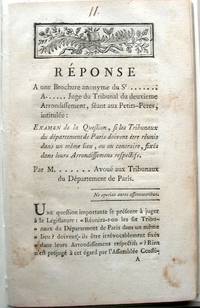
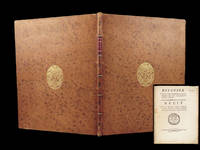
1791OB1042-11<p>Se Vende A Paris au Palais & chez les Marchands de Nouveautés 1791. Soft Cover. 36 pages; 19.5 cm. Title continues: "intitulée: Examen de la Question si les Tribunaux du département de Paris doivent être réunis dans un même lieu ou au contraire fixés dans leurs Arrondissemens respectifs. Par M. Avoué aux Tribunaux du Département de Paris." Caption title; imprint at end. Not found in WorldCat nor Martin & Walter. This reflects the administrative turmoil and conflicting ideologies during the first years of the French Revolution. One of a collection of 40 Royalist and counter-revolutionary tracts of the French Revolution. Stock#OB1042-11. Very Good in marbled paper wrappers.</p> Se Vende A Paris, au Palais, & chez les Marchands de Nouveautés paperback
177729277<p>Printed in Paris by Quillau in 1777 this volume documents one of the earliest landmarks in modern obstetrics. Issued by the Faculté de médecine de Paris it reports the successful symphysiotomy performed on Madame Souchot intended as an alternative to the Caesarean section in obstructed childbirth. The first section contains the proceedings of the Faculty printed in both Latin and French while the second part includes the memoir of Dr. Jean-René Sigault who described the procedure in detail and addressed its clinical application. Bound in contemporary leather with gilt stamp on the front cover the book remains tight and secure with only minimal rubbing along the extremities. Quarto format 10.5 x 8.25 inches 26.7 x 21 cm. Collation: Part I 13 pp; Part II 16 pp. First edition. #29277 PHOTOS AVAILABLE UPON REQUEST.</p> Impr. de Quillau hardcover
1716ANT042Not Indicated 1716. Full leather. Complete two volume set bound together as one. Deliberation on the Bull Unigenitus against Quesnel's French Translation of the NT. Provenance of 800 Franks. 12mo. Full leather binding with raised bands. Gold gilt decorations along spine and outer edges of boards. Red leather and gold gilt title block. Fore-edges of leaves are speckled red. Board edges are rubbed and most of gilt is rubbed away. Bottom corners are worn bumped and chipped so that some of the cardboard beneath shows. One bump on back board near top band of spine. Back free end page is torn along the bottom and missing a small piece. Overall this book is in excellent condition. xvi 588 4 pages. Not Indicated hardcover
175310706DB1753. Bd. 1 von 3. Paris Delaguette 1753. Gestochenes Frontispiz nach Boucher von le Bas gestochene Titelvignette gestochene Kopfvignette 8 Bl. 546 S. Pergamentband der Zeit mit umlaufendem Rotschnitt etwas fleckig und Vorderkante etwas angeplatzt. Schönes breitrandiges Exemplar. Papier stellenweise stärker braunfleckig bzw. gebräunt. EA. - SGC II: XIV 382 3 Bde. Paris 1753-59; nicht bei Blake. - Enthält 15 Arbeiten aus den Jahren 1732-1743 zu 7 verschiedenen von der Kgl. Akademie für Chirurgie vorgegebenen Themen. Die preisgekrönten Abhandlungen betreffen u. a. Krebschirurgie und -amputation von Medalon le Cat und Bassius. Mit Ausnahme des 4. Themas 'Sur les playes faites par Armes à feu' darüber nur 1 Arbeit wurden zu allen anderen 3 oder 2 Beiträge unterschiedlicher Autoren abgedruckt. unknown
17539553AB1753. Paris Delaguette 1753. Gestochenes Frontispiz F. Boucher inv. J. P. Le Bac sculp. 1742 gestochene Titelvign. 1 gestochene Textvign. 8 Bl. 546 S. Lederband der Zeit mit Rückenvergoldung und umlaufendem Sprenkelschnitt etwas bestoßen. Marmorierte Vorsätze. Besitzvermerk von alter Hand. Nur wenig braunfleckig. Enthält: Medalon P.: Sur la différence des tumeurs à extirper ou à ouvrir simplement; & sur le choix du cautère ou de l'instrument tranchant dans ces différens cas; sur le même sujet par C. N. Le Cat et H. Bassius; Le Cat C. N.: Sur l'usage des tentes & autres dilatans; Le Cat C. N.: Sur les pansemens rares ou fréquens; Le Cat C. N.: Sur les playes faites par armes à feu; Le Cat C. N.: Sur l'amputation du carcinôme des mammelles nommé cancer; sur le même sujet par J. M. F. La Sone; Alary B.: Sur les différentes espèces de médicamens répercussifs & leur usage dans les différentes maladies chirurgicales; sur le même sujet par G. Kulbel; Pontier P.: Sur les différentes espèces de remédes résolutifs & sur leur usage dans les différentes maladies chirurgicales; sur le même sujet par Hugon le fils et Mopillier le jeune. unknown
17579554AB1757. Paris Delaguette 1757. Gestochene Titelvignette 1 gestochene Textvignette 3 Bl. S. 1-728. Lederband der Zeit mit Rückenvergoldung und umlaufendem Sprenkelschnitt etwas bestoßen. Marmorierte Vorsätze. Mit Besitzvermerk von alter Hand. S. 729 uff. mit dem Register zu Bd. 2 ab T bis Schluß fehlen. 3 Seiten handschriftliche Auflistung weiterer Werke in Band III IV und V. Nur wenig braunfleckig. Enthält: Grassot: Déterminer ce que c'est que les remèdes émolliens expliquer leur manière d'agir distinguer leurs différentes espèces & marquer leur usage dans les maladies chirurgicales; sur le même sujet par P. Guiot et A. Louis; Louis A.: Mémoire sur les anodyns; sur le même sujet par P. Guiot et P. Fabre; Grashuis J.: Mémoire sur les remédes suppuratifs; sur le même sujet par C. E. Eschenbach; Flurant C.: Traité des médicamens détersifs; sur le même sujet par A. Louis et P. Fabre; Charmeton J. B.: Discours sur les remédes dessicatifs & les caustiques; sur le même sujet par Ange Nannoni. unknown
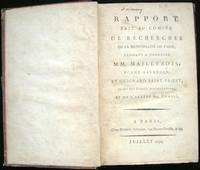
1790NS0211Paris Buisson 1790. Report presented by Jean Philippe Gárran de Coulon one of the committee members. Martin & Walter 2:14304. Hard Cover. 52 151 pages; 20.5 cm. VG contemporary half-leather binding worn. Stock#NS0211. Buisson. hardcover
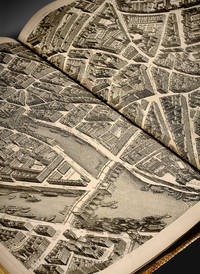
1739ABAA25-22<p>S.l. 1739.</p><p>Folio 558 x 443 mm bound in red morocco covers decorated with fleur-de-lys borders fleurs-de-lys in the corners coat of arms in the center spine ribbed and decorated with fleur-de-lys of various sizes stars and gilt fillets inner border decorated with fleurs-de-lys gilt edges. <em>Contemporary binding.</em></p><p>First issue of the most famous antique map of Paris called " plan de Turgot ".</p><p>James de Rothschild. 2312; Cohen 807.</p><p>It is composed of one plan of combination and of 20 engraved plates on double-page 800 x 515 mm representing the capital house by house in a panoramic view. " <em>We propose by making this engraved map to show at a glance all the buildings and all the streets of Paris</em> " informed the editor.</p><p>"This bird's eye map the widest of this sort ever tackled is known under the improper designation of 'Plan de Turgot'. It is composed besides the map of combination of twenty leaves that altogether form five ranks. Each leave as a surround of 79 centim. large on 50 high. The twenty assembled leaves thus form a square of about 316 centim. on 245 excluding the margin. This surface would bother more than one Parisian amateur whose allocation is way too narrow to have it in its cabinet.</p><p>The engraved title is at the bottom of the leaves 18 and 19 in the middle of a cartouche with a very circumvented shape surrounded with volutes and topped with the allegorical figure of the city of Paris resting on her shield.</p><p>This map takes usually the form of a large folio atlas; each leaf printed on thick paper is folded in two and glued on guard. It is said that most copies were bound at the time with more or less luxury to be distributed for free with no doubt to distinguished figures; all sheepskin or Levant morocco bindings are decorated in their center with the arms of Paris. Some copies were printed with wide margins.</p><p>This map ends the series of bird's eye maps and if after this period we still see some of those published it would be older maps copied or refreshed. Louis Bretez who drew it around 1734 derogated the generally admitted custom of positioning maps according to the noon mark because willing to give of Paris an image in front view he had to prefer with the model of previous geographers a system that would allow to see in front view the gates of our ancient churches so numerous still churches that for the most part had their facades directed westward. It is deplorable that the map as it was conceived wasn't created on an earlier date at least from a century. It would have been because of its dimensions of a much higher interest for the archaeologists of today.</p><p>The drawing ordered by Turgot was achieved in 1734; it represents thus the state of Paris at this time. Claude Lucas who engraved it is probably the one who worked on the maps of the districts of La Caille 1714 or perhaps his son.</p><p>The choice that was made of a bird's eye map must have led to huge costs…</p><p>The image of Paris represented here still offers I say it again a big appeal and documentation for archaeology. The few number of ancient buildings that have survived is so quickly diminishing day by day or is suffering from strange metamorphoses with the hideous mask of replastering so much that the Paris of Turgot threatened by our thousands of projects of alignment and expansion will soon have to be called in turn the 'old Paris' …. A. Bonnardot <em>Etudes archéologiques sur les anciens plans de Paris</em> pp. 199-203.</p><p>These plates remarkably engraved show in a vivid way the former layout in perspective of the Parisian sites residences and monuments.</p><p>Copy printed on thick paper illustrated with brilliant proofs preserved in a binding by Padeloup with the arms of Paris.</p><p>The title is engraved in the center of a blending of two plates. 1600 x 540 mm.</p><p><strong>FR</strong></p><p>S.l. 1739.</p><p>In-folio relié en maroquin rouge plats ornés d'une roulette fleurdelisée fleurs-de-lys aux angles armoiries au centre dos à nerfs orné de fleurs de lys de différentes tailles d'étoiles et de filets dorés coupes décorées roulette intérieure fleurdelisée tranches dorées. <em>Reliure de l'époque.</em></p><p>558 x 443 mm.</p><p><strong>Premier tirage du plus célèbre plan ancien de Paris dit Plan de Turgot.</strong></p><p>James de Rothschild. 2312 ; Cohen 807.</p><p>Il se compose d'un plan d'assemblage et de 20 planches gravées à double page 800 x 515 mm représentant la Capitale maison par maison en vue panoramique. " <em>On s'est proposé en faisant graver ce plan de faire voir d'un seul coup d'œil tous les édifices et toutes les rues qu'elle renferme</em> " avertit l'éditeur.</p><p>" Ce plan à vol d'oiseau le plus vaste en ce genre qu'on ait entrepris est connu sous la désignation impropre de 'Plan de Turgot'. Il se compose outre le plan d'assemblage de vingt feuilles qui réunies forment cinq rangs. Chaque feuille a d'encadrement 79 centim. De largeur sur 50 de hauteur. Les vingt feuilles réunies forment donc un carré d'environ 316 centim. Sur 245 non compris la marge. Cette surface embarrasserait plus d'un amateur parisien trop étroitement logé pour en garnir son cabinet.</p><p>Le titre gravé se trouve au bas des feuilles 18 et 19 au milieu d'un cartouche de forme très contournée entouré de volutes et surmonté de la figure allégorique de la ville de Paris appuyée sur son blason.</p><p>Ce plan forme le plus souvent un atlas grand in-folio ; chaque feuille tirée sur un papier fort est pliée en deux et collée sur onglet. Il paraitrait que la plupart des exemplaires furent reliés dans le temps avec plus ou moins de luxe pour être distribués gratuitement sans doute à tous les personnages éminents ; toutes les reliures en mouton ou en maroquin du Levant sont ornées au centre des armes de Paris. Il y a des exemplaires tirés sur grandes marges.</p><p>Ce plan termine la série des plans à vol d'oiseau et si passé cette époque on en voit paraitre encore quelques-uns de ce genre ce sont des plans plus anciens copiés ou rajeunis. Louis Bretez qui le dessina vers 1734 dérogea à l'usage généralement admis d'orienter les cartes selon la méridienne parce que voulant donner de Paris une image en élévation il dut à l'exemple des anciens géographes préférer un système qui permît de voir de face les portails de nos anciennes églises si nombreuses ncore églises qui pour la plupart avaient leur façade tournée vers l'occident. Il est à regretter que le plan tel qu'il a été conçu n'ait pas une date antérieure d'au moins un siècle. Il eût été à raison de sa dimension d'un bien haut intérêt pour les archéologues d'aujourd'hui.</p><p>Le dessin ordonné par Turgot était achevé en 1734 ; il représente donc l'état de Paris à cette époque. Claude Lucas qui le grava est le même sans doute qui travailla aux plans des quartiers de La Caille 1714 ou peut-être son fils.</p><p>Le choix qu'on fit du genre à vol d'oiseau dut entrainer des frais immenses…</p><p>L'image de Paris qu'il représente offre encore je le répète beaucoup d'attraits et de documents à l'archéologie. Le petit nombre de vieux édifices qui ont survécu disaparaît de nos jours si rapidement ou subit de si étranges métamorphoses sous le hideux masque du replâtrage que la Paris de Turgot en proie à nos mille projets d'alignements et d'agrandissements devra bientôt s'appeler à son tour le 'vieux Paris' …. A. Bonnardot <em>Etudes archéologiques sur les anciens plans de Paris</em> pp. 199-203.</p><p><strong>Ces planches d'une gravure remarquable montrent d'une façon très vivante la disposition ancienne en perspective des sites des demeures et des monuments parisiens.</strong></p><p><strong>Exemplaire imprimé sur papier fort orné de brillantes épreuves revêtu d'une reliure de Padeloup aux armes de la ville de Paris. </strong></p><p>Le titre est gravé au centre d'un assemblage de deux planches 1600 x 540 mm.</p> hardcover
1774006282Paris: Chez P. Fr. Didot Le Juene Libraire. Calf spines gilt five raised bands. Marbled paste downs endpapers and edges. Paper label at base of spine. 544 pp. Six 6 birght engraved folded plates in text. Very bright handsome copy. Edge wear. One volume. . Very Good. Hardcover. 1774. Chez P. Fr. Didot Le Juene, Libraire hardcover
176420218Paris: Chez P. Alex. Le Prieur tomos 1 al 12 M. DCC.LXIV 1764 y 1771 y Chez P. Fr. Didot le jeune tomos 13 al 15 M.DCC.LXXIV 1774.- EN TOTAL SON 15 VOLS.: 1º con 2 h. 391 p. / 2º con 2 h. 439 p. y 6 láminas plegadas / 3º con 1 h. 479 p. y 12 láminas plegadas / 4º con CLXXIV232 p. y 4 láminas plegadas / 5º con 1 h 489 p. y 16 láminas plegadas / 6º con 1 h. 406 p. y 2 láminas plegadas / 7º con 1 h. 432 p. y 3 láminas plegadas / 8º con 1 h. 456 p. y 5 nláminas plegadas / 9º con 2 h. 516 p. y 11 láminas plegadas / 10º con 213 p. y 4 láminas plegadas / 11º con 2 h. 516 p. y 2 láminas plegadas / 12º con 2 h.388 p. y 2 láminas plegadas / 13º con XLVIII 431 p. y 9 láminas plegadas / 14º con 2 h. 534 p. 1 h. y 4 láminas plegadas / 15º con VIII 544 p. y 6 láminas plegadas Todas suman un conjunto de 89 láminas plegadas de anatomía e instrumental quirúrgico finamente grabadas al cobre; 8º menor 17 x 104 cm; Buena impresión sobre fuerte papel verjurado; Texto en francés; Plena Piel Epoca lomo cuajado en oro cortes pintados en rojo.- RARO. Las encuadernaciónes con ligeros roces en bordes y esquinasque han sido restaurados. Pequeñas faltas en las cabezas de las lomeras y los tejuelos de algunos tomos. Pero en conjunto la obra presenta un buen aspecto con el interior en excelente estado. Aunque los libros son de dos imprentas presentan un aspecto perfectamente uniforme. Según datos de la actual Académie Nationale de Chirurgie de Francia estas primeras Mémoires de l'Académie Royale de Chirurgie fueron publicadas entre los años 1743-1774. DESCRIPCION EXACTA DE FECHAS POR TOMOS: Paris Chez Le Prieur Tome I partie I 1764; Tome I partie II 1765; Tome I partie III 1743; Tomes IV V y VI 1768; Tomes VII VIII y IX 1771; Tomes X XI y XII 1768; Y Paris Chez P. Fr. Didot le jeune Tomes XIII XIV y XV 1774. CIRUGIA EN GENERAL Y TRAUMATOLOGIA Livre en français P. Alex Le Prieur y Fr. Didot le jeune hardcover
176453476Paris L'Imprimerie Royale 1764. 4to. Without wrappers. In "Histoire de L'Academie Royale des Sciences. Année MDCCLXII. Avec les Memoires de Mathematiques & de Physique pour la même Année." Pp. 337-401 and 1 large folded engraved map Cours de la Riviere d'Yvette de celle de Biêvres ou des Gobelins et du Canal qui doit mener à Paris l'eau de l'Yvette Prise à Vaugien. 30x52 cm. <br/><br/><em>First edition of the paper in which Deparcieux laid out the plan for bringing the water of the Yvette River to Paris - the plan which was first carried out after his death. </em> unknown
1788048102Lisbon: Regia Officina Typografica 1788. First Edition. Hardcover Full Leather. Good Condition. Contemporary acid calf worn at edges old library label to spine and title page stain to last few pages not obscuring text. Translated from the French edition published in 1778r. Details a major outbreak of rinderpest cattle plague in 1775. 166pp.<br /> <br /> Rinderpest was a major disease of cattle and is believed to have been wiped out in 2011 making it one of two infectious diseases to have been eradicated smallpox being the other. Size: duodecimo 12mo. Quantity Available: 1. Shipped Weight: Under 1 kilo. Category: Medicine & Health; Inventory No: 048102. Regia Officina Typografica hardcover
178526318Paris & Berne. Chez Buisson Libraire./ Chez la Societe Typographique.1785 & 1778 1785. Soft cover. 19cm xxxv112 & 85pp. title page & chapter heading vignettes 5 plates original paper over boards chipped paper spine label covers worn front hinge cracked some slight dam staining in the text very good copy sncds. - The official journal of The Royal Society of Agriculture founded in Paris in 1761. Articles in this issue of 1785 include methods and the problems of growing wheat trees corn turnips and plums. The appended article by Abbe Fortis is a study with 3 costume illustrations of the customs and culture of the Morlach people of Dalmatia. Paris & Berne. Chez Buisson, Libraire./ Chez la Societe Typographique.1785 & 1778 unknown
1782052599Paris: Guill. De La Haye. ca. 1782 1782. Soft cover. Very Good. Folio - over 12 - 15" tall. Original b/w map. Oblong folio. 25 x 37 cm. In French. Jean-Denis Barbié dit Barbié du Bocage né le 28 avril 1760 à Paris et mort dans cette ville le 28 décembre 1825 est un géographe et cartographe français doyen de la Faculté de lettres de Paris membre de l'Institut. It shows Black Sea and its shores with their old toponyms very detailed. <br/> <br/> Guill. De La Haye., [ca. 1782] paperback