Gershwin, George; and Gershwin, IraBiblio.com
185 résultats
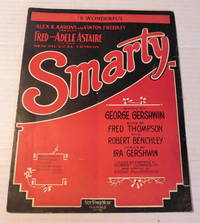
192799583<p>New York: New World Music Corporation 1927. 1927. Very good. - Quarto 12 inches high by 9 inches wide. Softcover bound in decorative black red & white wraps with pictorial ads for other sheet music by George Gershwin. The covers are slightly rubbed & creased with a couple of tiny tears to the edges. 4 pages numbered 2 through 5 laid loose as issued within the covers. The pages are slightly soiled with a short tear to the top edge of the last leaf. Very good.</p><p>RARE sheet music for Gershwin's song '''S Wonderful" performed in the original pre-Broadway production of "Funny Face" then titled "Smarty" at the Shubert Theatre in Philadelphia.</p><p>Originally called "Smarty" George & Ira Gershwin's musical would subsequently be renamed "Funny Face" after it first opened in Philadelphia on October 11 1927 to bad reviews. The musical comedy starring Fred Astaire and his sister Adele was the first time Astaire danced in evening clothes. Following major rewrites the play traveled to Washington and Atlantic City before opening as "Funny Face" at Broadway's Alvin Theare on November 22 of 1927.</p> New York: New World Music Corporation, 1927. paperback
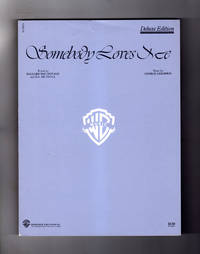
192463163New York : Warner Brothers Inc. 1924. Soft cover. Near Fine. 4to - over 9¾ - 12" tall. Near Fine; see scans and description. New York: Warner Brothers Inc. 1924. 'Somebody Loves Me' Vintage Sheet Music 1924. Deluxe Edition. Edition. Music by George Gershwin; Words by Ballard MacDonald and B.G. De Sylva. Tall quarto 12" x 9" center-folded wraps 4 pp. Very superior condition Near Fine. Short closed tear at top scan tiny corner tick at lower left scan. Otherwise flawless. Though 1924 is the only stated date on the piece the original Warner Brothers price sticker of $2.50 lower right front cover and the superior condition might indicate this was produced at some point in time more recent than that. Other examples with the product code number VS0378 upper left front cover do not appear on the internet. Sharp handsome collectible. See all scans. Ships in a new sturdy protective box - not a bag. Lph2 <br/> <br/> Warner Brothers Inc. paperback
1934000903TORONTO ONTARIO CANADA 1934. On offer is a super Massey Hall concert programme date January 19 1934 for a performance by George Gershwin boldly signed by the composer over his printed name. Traces of a few tape repairs to the some of the edges and folds not affecting text or signature. Overall G. . Good. 8vo - over 7¾" - 9¾" tall. Programme. unknown
1956304984New York Henry Holt 1956. 1956. First edition. 8vo. Illustrated. Dust jacket unclipped; small chips; few nicks. Very good. 384 pages. No other signatures or bookplates. Signed and inscribed on front free endpaper by Ewen to 20th Century-Fox executive Buddy Adler: "For Buddy Adler with best wishes of the author David Ewen Feb. 12 1956.". Inscribed by Authors. 1st Edition. Hardcover. Very Good/Very Good. New York, Henry Holt, 1956. hardcover
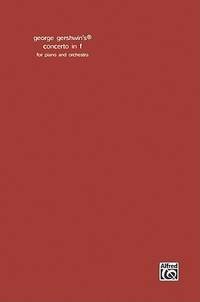
1983Q-0897242610Alfred Publishing 1983-11-01. Paperback. New. In shrink wrap. Looks like an interesting title! Alfred Publishing paperback
193953588New York: New World Music Corp./ Harms Inc. 1939. First Thus. Paperback. Very good. 9 x 12 inches. 36 pages. Condition is Very Good; previous owners' names at top of front cver pages are very clean and unmarked. STK New World Music Corp./ Harms Inc. paperback
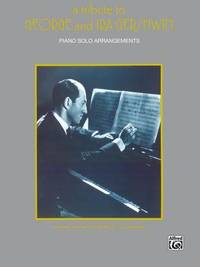
1994Q-0769235794Alfred Music 1994-12-01. Paperback. New. In shrink wrap. Looks like an interesting title! Alfred Music paperback
1994DADAX0769235794Alfred Music 1994-12-01. paperback. New. 7.42x0.24x10.22. Buy with confidence. Excellent Customer Service & Return policy. Alfred Music paperback
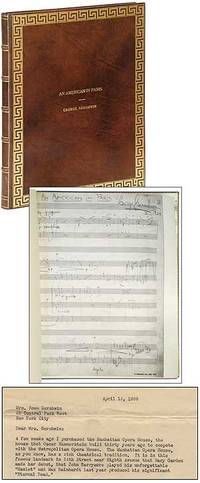
193899122New York: Privately printed 1938. Hardcover. Fine. Facsimile of the handwritten score. Folio. Full leather ruled with a Greek key design and lettered in gilt. Blue silk endpapers all edges gilt. Fine. Laid in is a Typed Letter Signed dated 12 April 1938 from Abraham Ellis to Gershwin's mother Rose who was the unmarried composer's heir. Ellis announces in the letter that he has just purchased the Manhattan Opera House which became the Manhattan Center and that with Rose's permission he would like to rename the rebuilt auditorium the Gershwin Room. This volume was apparently a private photographic reproduction of the score that was produced for family and friends before the manuscript was eventually donated to the Library of Congress. Gershwin's mother's copy with the letter dated less than a year after the composer's untimely death. A classic of 20th Century composition and inspiration for the Vincente Minnelli film scripted by Alan Jay Lerner around Gershwin's music and starring Gene Kelly Leslie Caron and Oscar Levant. Privately printed hardcover
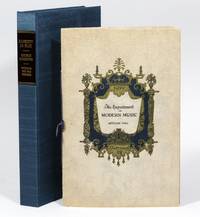
19242957New York: Aeolian Hall 1924. First edition. Very Good. ORIGINAL PROGRAM FOR THE FIRST PERFORMANCE OF GERSHWIN'S RHAPSODY IN BLUE. About six weeks before the premiere of Rhapsody in Blue George Gershwin was shooting pool at the Ambassador Billiard Parlor on Broadway and 52nd Street when his brother Ira entered the hall carrying an early edition of the New York Tribune. Ira proceeded to read an article from the paper announcing a new experimental music concert organized by bandleader Paul Whiteman. In this concert Ira continued a piece by George Gershwin would be performed. Adrian Symphony Orchestra<br /> <br /> This was news to Gershwin who had been asked some months earlier by Whiteman to contribute a piece but had turned down the request believing the several months not enough time. And now Gershwin had only six weeks. Whiteman as it turned out had decided to include Gershwin’s name after learning his musical nemesis—Vincent Lopez—would be releasing a similar concert series. Whiteman knew Gershwin’s name would bring his concert more coverage and went ahead with the inclusion hoping to propel his concert above Lopez’s Adrian Symphony Orchestra.<br /> <br /> Understanding Whiteman’s difficult position Gershwin agreed to write the piece planning to begin work during an upcoming train ride from New York to Boston where he was headed for an out-of-town preview for a new musical of his. Gershwin later claimed that the sounds of this train hitching and roaring down the track inspired the thematic division of his score into five themes: Ritornello Train aptly named Stride Shuffle and Love. Gershwin hoped to harness the energy of modern machinery in this piece to convey the hustle and bustle of city life. Adrian Symphony Orchestra; Dotsey<br /> <br /> As Gershwin later commented on his writing process:<br /> <br /> “I set to work composing with unwonted rapidity. No set plan was in my mind – no structure to which my music would conform. The rhapsody as you see began as a purpose not a plan. I tried to conceive the composition as a whole. I heard it as a sort of musical kaleidoscope of America – of our vast melting-pot of our unduplicated national pep of our blues our metropolitan madness.†Dotsey<br /> <br /> Gershwin himself had been raised in close contact with the diverse musical traditions of the Lower East Side exposed to the competing influences of Russian Eastern European African American and popular American music. Resultantly he decided that a mixture of jazz classical in conjunction with the rhythmic and thematic implements of almost all these styles was the perfect medium for portraying the city’s kaleidoscopic bustle. Adrian Symphony Orchestra<br /> <br /> Rhapsody in Blue received mixed reviews upon its release. The New York Times noted the piece displayed “extraordinary talent†and public opinion was largely positive. Still many critics felt that Rhapsody in Blue lacked focus calling it a string of disconnected themes. Hebblethwaite Adrian Symphony Orchestra<br /> <br /> Much of this confusion stemmed from the genuinely innovative fusion at the heart of Rhapsody in Blue. As mentioned Gershwin took classical form and infused it with the varied musical influences of his youth—blues ragtime Jewish folk music and Harlem jazz. To some extent Gerswhin’s intention was to write these genres in a way which concentrated their essence within small segments of a classical concerto as a more culturally dominant format of music. Though some viewed these borrowings as derivative of their original cultural contexts Gershwin’s usages of Klezmer-like arrangements for example nonetheless represented a groundbreaking expansion of popular music enabling the usage of non-classical genres in dominant American culture. Adrian Symphony Orchestra; Dotsey<br /> <br /> Later reflecting on his work Gershwin wrote about his usage of Jazz:<br /> <br /> “There had been so much chatter about the limitations of jazz not to speak of the manifest misunderstandings of its function. Jazz they said had to be in strict time. It had to cling to dance rhythms. I resolved if possible to kill that misconception with one sturdy blow.†Dotsey<br /> <br /> Although Gershwin hoped to expand the possibilities of jazz he failed to credit the African American traditions that clearly inspired him claiming in this program that jazz “sprang into existence ten years ago from nowhere in particular.†In this way Gershwin’s Great American kaleidoscope remained incomplete.<br /> <br /> Despite being one of the most famous works of the 20th century audiences will never know exactly what the original performance sounded like. Pressed for time Gershwin improvised many of the solo parts himself. This program is one of the very few surviving records of that original performance. Although enough programs were printed for a 1100 seat hall only a few examples survive. No copies exist at auction and there are only three institutional holdings— at the New York Public Library the George and Ira Gershwin Collection at the Library of Congress and the Center for Popular Music at Middle Tennessee State University. <br /> <br /> Rhapsody in Blue is loud dramatic and undeniably iconic—but few if any living people remember the sensation and sound of its improvised premiere. Very few material records have been preserved. This program offers a rare opportunity to relive the texture of that historic moment. <br /> <br /> The show’s program provides biographies of Whiteman’s collaborators. The biography of Gershwin reads as follows:<br /> <br /> “Mr. Gershwin has written a “Rhapsody in Blue†which he has consented to play accompanied by the orchestra. He is capable of everything from “Swanee†to “A Stairway to Paradiseâ€: from “Ingenue Baby†and “Virginia†to “Do It Again.†Delicacy even dreaminess is a quality he alone brings into Jazz music. Gershwin’s sense of variation in rhythm of shifting accents of emphasis and color is faultless. He has moreover an insatiable curiosity about everything connected with his work and for that matter with music in general. He is learning and he is not forgetting and being one of the youngest of the composers he is actually one of the brightest hopes of our popular music.â€<br /> <br /> Further descriptions of Gershwin’s Rhapsody in Blue:<br /> <br /> “This is the first rhapsody written for solo instrument and modern orchestra. Prophesy being not the function of an annotator it may be said that the importance of the rhapsody quite apart from its own value must depend to an extent upon its being kept alive in a repertoire—and there is no organization to do this unless the present concert is as its conductor hopes only the beginning of a series. Gershwin is a close student of music and a listener; yet there is not a derivative phrase in his work. He has composed a rhapsody and has chosen to build it out of materials known to him: the rhythms of popular American music the harmonies produced by American jazz bands. None of the thematic material has been used before; the rhapsody is not a pastiche. The structure is simple and it resembles concertos written by pianists in what seems at first the predominance of the single instrument. Mr. Gershwin’s manuscript is complete for the piano. The orchestral treatment was developed by Mr. Grofé.<br /> <br /> The rhapsody is a free development of almost all of Gershwin’s qualities alluded to in the earlier pages of this program. It has a little more crispness a shade more of jazz and a shade less of gentleness than some of his compositions; there is more of “A Stairway to Paradise†than of “Do It Againâ€; and this is natural in a composition intended specifically for jazz orchestra.<br /> <br /> Those who care for jazz will naturally be grateful to Mr. Whiteman for urging Mr. Gershwin to compose this Rhapsody. He had had it in mind for some time but had no intention of going to work upon it until the announcement was made that the Rhapsody would be played at this concert. For those who remain skeptical another test-case may be provided. It is not inconceivable that an intelligent conductor of a symphony orchestra may want to play the rhapsody; it would probably need re-scoring but the saxophone which has been used ever since Meyerbeer in serious music need not be exiled.â€<br /> <br /> The program also includes photos of Mr. Whiteman and his band alongside collaborators such as Gershwin and Victor Herbert.<br /> <br /> Provenance: With signature and Yale address of "Frederick Ullman" in pencil on back. Anecdotally later gifted by Ira Gershwin's wife Lenore to her vocational nurse and caretaker; appearing on the market now for the first time. <br /> <br /> New York: Aeolian Hall 1924. Concert program measuring 9.5 x 6.25 inches. 12 pages in original decorated textured grey wrappers; side-stitched with original blue cord. Housed in custom silk box. Abrasion to text at bottom of page 1 with loss of a few words. Wrappers in a remarkable state of preservation; very clean and fresh with some light rubbing to cover decoration corresponding to the textured ridges on cover. <br /> <br /> EXCEEDINGLY RARE: We find no records at auction and three institutional holdings only: at the New York Public Library the George and Ira Gershwin Collection at the Library of Congress and the Center for Popular Music at Middle Tennessee State University. Aeolian Hall unknown
192623613N. Y.: Albert and Charles Boni 1926. First edition. Presentation copy inscribed by George Gershwin to Hellen Ingram Merrill the wife of Charles Merrill founder of Merrill Lynch and the mother of the poet James Merrill on the front free endpaper: “To Hellen - All the best on her birthday from George Gershwinâ€. Beneath his inscription Gershwin has written a single bar of music followed by the identification “Rhapsody in Blue†and the date August 14 1926. The particular bar is a pivotal one in the composition from which point "the whole mood of the work" changes. Several of Gershwin’s compositions are included in this anthology namely “Excerpt from Krazy Kat. A Jazz Pantomime†“The Half of It Dearie Blues†“Concerto in F. II Movement Excerpt†and “Rhapsody in Blue for Jazz Band and Pianoâ€. In 1925 Hellen Ingram married Charlies Merrill and gave birth to their son James Merrill in March of 1926. Charles Merrill owned “The Orchard†in Southampton New York. Designed by Stanford White it was one of the finest summer estates on Long Island and the Merrills entertained lavishly there. One of their many guests was George Gershwin and it was no doubt at Hellen’s twenty-eighth birthday party that he inscribed this copy of The Blues. Whether Gershwin gave this copy of Blues to Hellen as her birthday present is also plausible. Some foxing and soiling covers lightly soiled and rubbed but a very good copy which appears to have been used at the piano rather than merely read. 4to original two-toned cloth. Some foxing and soiling covers lightly soiled and rubbed but a very good copy which appears to have been used at the piano rather than merely read. Albert and Charles Boni unknown
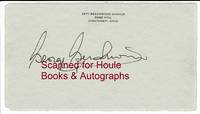
1933502090Bold Signature in black ink on a stiff gray card 1933. 3 1/2" x 6 1/4". Together with a mailing envelope bearing 2 cancelled stamps postmarked New York April 21 1933 and with Gershwin's holograph return address on verso.
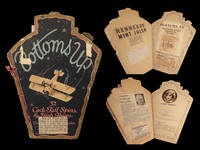
192841301<p><strong>1928 COCKTAIL RECIPES 1st ed Bottoms Up Mixology Alcoholic Beverages PROHIBITION</strong></p><p>"<em>Bottoms Up</em>" is a unique cocktail guide curated by "Two Knights and a Maid" with the aid of John Walker and the Haig Bros. Presented as "<em>52 Cock-Tail Spins for High Flyers from the Recipes of Many Celebrities</em>" on its cover the book curiously features only 28 drink recipes. These concoctions come from luminaries such as Fanny Brice W.C. Fields George Gershwin and Florenz Ziegfeld. Standing out for its publication during the Prohibition era in the U.S. it's distinguished as one of the earliest compilations of celebrity cocktail recipes. The book's design is equally distinctive with a die-cut cocktail shaker shape and an illustrated biplane on its card stock covers.</p><p>Item number: #41301</p><p>Price: $599</p><p>BUZZA George GERSHWIN George; WALKER John Contrib.; HAIG Bros. Contrib.</p><p><strong><em>Bottoms Up. Being a Glossary of Useful Information for the Thirsty. Compiled by Two Knights and a Maid. Assisted by John Walker and the Haig Bros.</em></strong></p><p>Chicago; Minneapolis; New York: Gordon Volland; The Buzza Company ©1928. First Edition.</p><p><u>Details</u>: </p><p><!-- if !supportLists-->· <!--endif-->Collation: Complete</p><p><!-- if !supportLists-->o <!--endif-->41 leaves</p><p><!-- if !supportLists-->o <!--endif-->Numerous instances of ephemera and adhesive stains throughout</p><p><!-- if !supportLists-->· <!--endif-->Language: English</p><p><!-- if !supportLists-->· <!--endif-->Binding: Softcover; secure</p><p><!-- if !supportLists-->· <!--endif-->Size: ~9in X 6.25in 22.5cm x 16cm</p><p>Our Guarantee:</p><p>Very Fast. Very Safe. Free Shipping Worldwide.</p><p>Customer satisfaction is our priority! Notify us with 7 days of receiving and we will offer a full refund without reservation!</p><p>41301</p><p>Photos available upon request. </p> Gordon Volland; The Buzza Company
1994Q-0896032531Humana Press 1994-01-11. Hardcover. New. In shrink wrap. Looks like an interesting title! Humana Press hardcover
1994SONG0896032531Humana Press 1994-01-11. 3. hardcover. Used: Good. 6.14x1.63x9.21. Buy with confidence. Excellent Customer Service & Return policy. Humana Press hardcover
1994DADAX0896032531Humana Press 1994-01-11. 3. hardcover. New. 6.14x1.63x9.21. Buy with confidence. Excellent Customer Service & Return policy. Humana Press hardcover
20002-0444543589Elsevier Science 2000. Paperback. New. 472 pages. 10.31x7.60x1.11 inches. Elsevier Science paperback
2000__0444503315Elsevier Science Ltd 2000. Hardcover. New. 1st edition. 446 pages. 10.75x7.75x1.00 inches. Elsevier Science Ltd hardcover
1926848G0744USA: Harms Inc. 1926. Sheet music. Fair. Paperback. First Edition. 4to - over 9¾" - 12" tall. 8 pages. As featured in Alex. A. Aarons and Vinton Freedley' musical comedy "Oh Kay!." Above-average wear. Not pretty but a worthy working copy. Harms, Inc. Paperback
19961-0769235786Alfred Publishing 1996. Paperback. New. 124 pages. 8.70x5.90x0.30 inches. Alfred Publishing paperback
19971-1576238679Warner Bros Pubns 1997. Sheet music. New. 84 pages. 12.00x9.25x0.50 inches. Warner Bros Pubns unknown
1992Q-1576238679Alfred Publishing 1992-06-01. Paperback. New. In shrink wrap. Looks like an interesting title! Alfred Publishing paperback
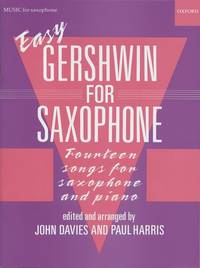
1989Q-0193566796OUP Oxford 1989-03-16. Sheet music. New. New. In shrink wrap. Looks like an interesting title! OUP Oxford unknown
1944000668Chappell 1944. Chappell 1944. Sheet music pub by Chappell - pages torn but intact .with the signature of George Gershwin in bottom hand corner of front cover.- not sure whether this signature is original or printed. Signed by Author. <br/><br/> Chappell unknown
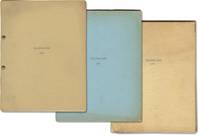
1944163101Hollywood CA: Film Music Notes 1944. Three vintage gatherings of the periodical "Film Music Notes" FMN comprising all 26 issues published in 1942 through 1944 bound in three volumes each with titled wrappers "Film Music Notes / 1942" "Film Music Notes / 1943" and "Film Music Notes / 1944" with manuscript graphite red and blue pencil annotations on 39 pages of fourteen issues. The three gatherings found here comprise the first full three years of the periodical's publication beginning with "Volume I / January 1942 / Number IV" and ending with "Volume IV / December 1944 / Number III." Detailed inventory available upon request.<br /> <br /> The three bound gatherings are:<br /> <br /> "Film Music Notes / 1942" comprised of all eight issues published in 1942 from Vol. 1 No. IV through Vol. II No. III with each issue ranging from seven to nine pages. In 1942 FMN published only eight issues rather than the nine found in 1943 and 1944 combining the May and June issues into one "May-June 1942" issue Vol. II No. III.<br /> <br /> "Film Music Notes / 1943" comprised of all nine issues published in 1943 from Vol. II No. IV through Vol. III No. III with each issue ranging from eight to twelve pages.<br /> <br /> "Film Music Notes / 1944" comprised of all nine issues published in 1944 from Vol. III No. IV through Vol. IV No. III with each issue ranging from eleven to twenty three pages.<br /> <br /> The first issue of FMN Vol. 1 No. 1 not included in the bound volumes here was published in October 1941 and was spearheaded largely by the efforts of a group of Hollywood women on behalf of the National Federation of Music Clubs the Federation. On June 1 1941 as part of the "Festival of Motion Pictures" at the Federation's biennial American Music Festival the Federation feeling the Academy Awards were not adequately recognizing musicians and composers held their first film music awards night. The overwhelming success of the awards night as well as growing requests from music educators for resources and advise on how to teach about film music lead Federation members headed by chairperson Grace Widney Mabee to begin the publication of the groundbreaking periodical four months later which during its inception was largely built upon the Federation's existing structures and resources. In 1943 FMN was integral to the formation of the National Film Music Council NFMC created largely by Federation members and FMN contributors and editors Mabee Sigmund Spaeth FMN Advisory Chairman Constance Purdy FMN editor and others and was announced in the "Foreword" of FMN Vol. 2 No.1 October 1943 found in the volumes offered here. FMN continued publication for seventeen years ending in 1958.<br /> <br /> Issues of FMN are generally comprised of a "Foreword" followed by "Comments and Open Forum" which by the November 1942 issue Vol. II No. II had transitioned to "News Items" film reviews which focus on the use of music in film and range from five to 28 reviews per issue as well as various articles essays and biographies. Regular contributing authors found in the three bound volumes here include: Gail Kubik composer Margery Morrison FMN Associate Editor Purdy actress musician and FMN Editor Naomi Reynolds of The Musician's Congress and Spaeth musicologist author and FMN Advisory Chairman.<br /> <br /> Contributing authors found in the volumes on offer here include: <br /> <br /> Composers: Scott Bradley Rudy De Saxe Adolph Deutsch Nat W. Finston Arthur Kleiner William Lava Vernon Leftwich Alfred Newman Miklós Rózsa David Rudhyar Jack Schaindlin Max Steiner Herbert Stothart Franz Waxman Roy Webb and Charles Wolcott. <br /> <br /> As well as: Alice Evans Field MPPDA studio liason Chauncey Haines Jr. musician Hal Hall "The American Cinematographer" editor John Huntley British film historian Isabel Morse Jones LA Times critic and musician Jay Leyda experimental filmmaker Louis Lipstone head of Paramount Pictures music department Harry Mines LA Daily News critic Ivan Narodny Russian revolutionary and émigré Mildred Norton LA Daily News critic Cecil Stokes creator of the Auroratone and Dr. Bruno David Ussher musicologist and LA music critic.<br /> <br /> Articles found in the volumes on offer here include: "Cartoon Music of the Future" "George Pal's Puppetoons" "The Auroratone" "Scoring the Jungle Book" "Russian Music" "The Importance of Motion Picture Music" "Music in Government Films" a "Special Article" on Constantin Bakaleinikoff composer and Director of Music Department of RKO-Radio "Music of the Americas" "Screen Music Assumes New Stature" "Procedure of Preparing a Musical Score for a Picture" "José Iturbi Comes to the Screen" "Dmitri Shostakovich - Film Composer" "A Visit to the Music Recording Stage at Warner Bros." "What Music Arranging Does for the Pictures" "An Afternoon in the Home of Erich Wolfgang Korngold" "New Russian Music Born of War" "The Sixth Sense in Film Mechanics" "Notes on the Life and Works of Aaron Copland" "Rhapsody in Blue: A Day on the Gershwin Set" "British Film Music" "Mexican Films in Hollywood" and "An Institute of Music in Contemporary Life" among many others.<br /> <br /> All three volumes Very Good or better pages supple mimeograph duplication each bound with two gold brads.<br /> <br /> "Film Music Notes / 1942:" Tan titled wrappers eight issues 61 pages total. Pages Near Fine wrapper Very Good plus with light soiling and edgewear bound with two gold brads.<br /> <br /> "Film Music Notes / 1943:" Blue titled wrappers nine issues 85 pages total. Pages Near Fine wrapper Very Good plus with light soiling and edgewear bound with two gold brads.<br /> <br /> "Film Music Notes / 1944:" Tan titled wrappers nine issues. 132 pages total. Pages Near Fine with five paperclips on five different articles wrapper Very Good plus with light soiling edgewear and light dampstaining to the bottom left corner bound with two gold brads. Film Music Notes unknown