52 résultats
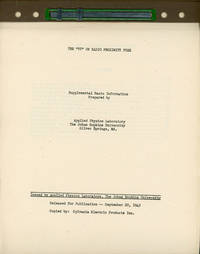
1945155716New York: Sylvania Electric Products Inc. 1945. Large octavo 1-2 1-76 77-79 leaves fastened into an Accopress Binder. A proximity fuze is a fuze that detonates an explosive device automatically when the distance to the target becomes smaller than a predetermined value. Proximity fuzes are designed for targets such as planes missiles ships at sea and ground forces. They provide a more sophisticated trigger mechanism than the common contact fuze or timed fuze. The proximity fuze was one of the most important technological innovations of World War II. It was so important that it was a secret guarded to a similar level as the atom bomb project or D-Day invasion. Adm. Lewis L. Strauss wrote that "One of the most original and effective military developments in World War II was the proximity or "VT" fuze. It was of incalculable value to both the Army and Navy . While no one invention won the war the proximity fuze must be listed among the very small group of developments such as radar upon which victory very largely depended." A fine copy. Accompanied by the October 1945 issue of THE SYLVANIA BEAM revealing the existence the weapon which twenty-five Sylvania plants and laboratories had worked on in secret during World War II. #155716 Sylvania Electric Products Inc. unknown books
192719220New York: n. p. ca. 1927. First edition. Wrappers a bit soiled and slightly worn; in very good condition. Original printed orange wrappers 9.5 x 6 inches wire stitched 8 pages. Illus. An early example of transmission of visual information over networks a promotional pamphlet from RCA on the wireless transmission of images as a boon to business banking news and law enforcement; RCA offers the service between New York and London and between San Francisco and Honolulu. One image here is a letter dated 1927; the service between San Francisco and London directly did not open until 1929. With a fairly detailed lay explanation of the technology behind the scanning transmission and printing of these images over long distances; the cost here quoted is $16 per inch of image transmitted. OCLC notes two locations of a single kindred promotional item with Radiogram in the title; no other examples found. n. p., unknown books