127 résultats
18010381341801. 1st Edition 1st Printing. No Binding. Very Good. Original Engraving. Original Engraving. One Of A Large Collection Of Original Antique Engravings Formed By A Southern California Artist In The Early To Middle Twentieth Century. Each Plate Has Small Glue Marks On Reverse Where They Were Tipped In To An Album. Joseph Priestley 1733-1804 English Chemist And Presbyterian Minister Who Later Emigrated To The Usa. <br/> <br/> unknown
1885030676Madrid: Real Academica De Medicina / Gregorio Estrada 1885. First Edition Thus . Hardcover. Good. 51 3; 88 Pp. Two Volumes In One With 1885 Issue At Front. Very Scarce; Worldcat Shows Only One Copy Each Of The 1865 And 1922 Editions No Copy Of These Editions Shown In Institutional Holdings. Quarter Morocco Gilt Over Marbled Paper Covered Boards. Floral Endpapers. Quite Worn A Few Small Losses To Spine But Gilt Lettering Bright And Complete Hinges Solid No Names Or Marks Paper Aged. <br/> <br/> Real Academica De Medicina / Gregorio Estrada hardcover
1842264115Braunschweig: Vieweg und Sohn 1842. Fourth edition. xi 351 pp. 1 vols. 8vo. Quarter calf and brown marbled boards black spine label. Rubbed. Collector's stamp on flyleaf and first sectional title some toning. Very good. Fourth edition. xi 351 pp. 1 vols. 8vo. Early edition of the pioneering work in organic chemistry and nutrition by Justus Liebig 1803-1873 the greatest chemist of his time. PMM 310a for first edition 1840 Vieweg und Sohn unknown
184235974New York: Wiley and Putnam 1842. First Edition. Hardcover. Fair. Octavo. 1 8 pages publisher advertisements iv 5-255 pages 40 page appendix 8 pages publisher advertisements. Green cloth hardcover with blind stamped designs on boards. Gilt stamped title on spine. Small tear to cloth upper spine. Light stains on the front cover. Cloth spine faded to brown. Light to moderate toning and foxing to pages. Inscription written on the right front flyleaf reads "Eugene Lynch from his friend initials J.L.C. Balt. 1842." "Eugene Lynch not legible 1842" inscription in old pen on the title page. A faint pencil inscription written top of the title page "From Colburn 174 Balt. St." This copy is possible signed by the author. Found inside the book is a 1981 typed letter by the previous owner thanking a friend for finding "a signed copy no less." of this work. Wiley and Putnam hardcover
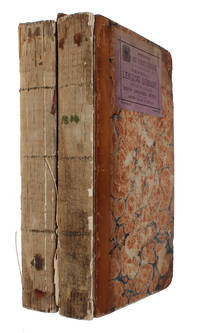
1874D18934Paris 1874. Hardcover. Very Good. A pair of lovely manuscript books belonging to an E. Flamant on lectures by Professor Lallemant. 2 volumes approximately 126 leaves 8vo. In French. Written in black ink with finely executed in-text diagrams in ink. Each bound in contemporary cloth-backed decorative paper-covered boards. The lectures delivered at Ecole Normale included mechanics fluids atmospheric pressure and aerodynamics and include images of hot air balloons. <br/><br/> hardcover
1893000012739Paris: J. Montorier 1893. First edition. Hardcover. Near Fine. 12mo. 5 8-132 6 pp. Polished contemporary brown sheep with the spine in five compartments gilt lettering on the spine; top edge gilt. Marbled endpapers and pastedowns. Bound by Françoise Le Boulenger. Bound without the half-title. Illustrated with a frontispiece portrait of Marcano. NeglectedScience.com "Vicente Marcano". Marcano was an accomplished chemist. This biography was done by his brother a physician. Marcano researched agriculture elements and minerals in Venezuela. Minor sunning to the spine a few subtle pencil marginalia. J. Montorier hardcover
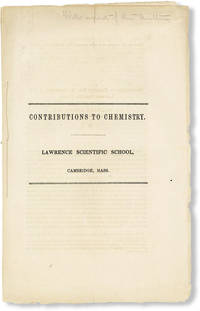
186548958Cambridge: American Journal of Science and Art 1865. Offprint. Octavo 24cm.; stitched self-wrappers; 9pp. Spine ends starting to split light chipping along extremities faint vertical fold else a Good or better unopened copy. Faint pencil inscription at head of upper cover: "With respects of the author." The second in a series of collected abstracts this first appearing in the "American Journal of Science and Art" Vol. XXXIX January 1865. Not separately catalogued in OCLC as of April 2020 though we find a copy of No. 1 at the Library of Congress. [American Journal of Science and Art unknown
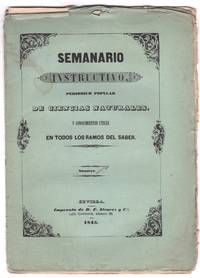
184545761Sevilla: Imprenta de D. Francisco Alvarez y Co. 1845. First edition. Paper wrappers. Edges of wrappers and leaves with tears otherwise issues 1 and 3 very good issue 2 rlacks last seven pages. 16 pp.; 8 of 16 pp.; 16 pp. Sm. 4to. The first three issues of this 'popular newspaper of natural sciences and useful knowledge' which ran from February through July of 1845. Much of each issues was devoted to mining and chemistry with a long article on "origen Y Progresos de la Quimica. Rear wrappers lists subscription points throught Spain.<br /> 1. Año 1: Número 1 2 de Febrero de 1845; 16 pp.<br /> 2. Año 1. Número 2 9 de Febrero de 1845; pp. 17-24 incomplete - lacking pp. 25-32.<br /> 3. Año 1. Número 3 16 de Febrero de 1845; pp. 33-48.<br /> <br /> Scarce. Not in OCLC. Not in any European nor Spanish library catalogues. One copy located at the Univ. Connecticut Duque de T' Serclaes periodical collection. Chaves y Rey: Historia y bibliografía de la prensa sevillana 120. Imprenta de D. Francisco Alvarez y Co. unknown
18784874818Longmans Green and Co 1878. Volumes 1 & 2. This is an ex-library book and may have the usual library/used-book markings inside.This book has hardback covers. In good all round condition. No dust jacket. Re-bound by library. Cloth bindings with gilt lettering on the backstrip. Pages are clean all edges coloured red. Please note the Image in this listing is a stock photo and may not match the covers of the actual item2400grams ISBN: Longmans Green and Co hardcover
1862h2333London: Edward Stanford. G : in Good condition plus without dust jacket. Some darkening to boards. Ex-library from the Royal College of Surgeons Ireland. 1862. New and Revised Edition. Green hardback cloth cover. 190mm x 130mm 7" x 5". 124pp. Illustrated with numerous engravings. . Edward Stanford hardcover
180146023Paris Chez Fuchs An IX1801. Boundin 3 contemp. hcalf. Gilt spuines. Light wear along edges. In: "Annales de Chimie ou Recueil de Mémoires concernant la Chemie" Tome 36 37 and 38. Entire volumes offered. 336;3302;3342 pp. and 5 engraved plates. Berthollet's paper: pp. 302-317 pp. 151-181 221-252 pp. 3-29 113-134. <br/><br/><em>Together with the memoir printed at the same time in "Mémoires de l'Institut." this is the first appearance of B's groundbreaking work on the nature of chemical affinity and the fact that many factors influence chemical reactions comparing chemical affinity to the force of gravity. The paper was at the end of the year published separately.The theory set forth here "led directly to Prout's investigations which yielded a knowledge of definite chemical proportions and thus played a very importent part in preparing the way for the development of the Atomic Theory on which the whole modern chemistry is based."Duveen p. 75."Berthollet read a memoir on the general theory of affinities while he was still in Egypt. This was the starting point of his complete new system of chemistry first briefly sketched in Recherches sur les lois de l’affinité 1801 and later developed into the comprehensive two volume Essai de statique chimique. Here he attempted to provide a proper basis for chemistry so that its experimental results could be viewed in the light of theoretical first principles. Berthollet developed a theory and a model adequate for the understanding and the interpretation of the rapidly growing body of chemical knowledge in his time. He was aware that the positive work of constructing a new theory had yet to be performed after the shock of Lavoisier’s criticism of the old chemistry.DSB.Parkinson "Breakthroughs" 1801 C. </em> unknown
181146030Paris Chez J. Klostermann fils 1811-12. Bound in 6 contemp. hcalf. Gilt spines slightly rubbed. Wear to top of spines. In: "Annales de Chimie ou Recueil de Mémoires concernant la Chemie" Tome 78 79 80 81 82 and 83. Entire volumes offered. The 14 parts: Tome 78: pp. 5-37 105-132 217-242. - Tome 79: pp. 113-142 233-264. - Tome 80: pp. 5-37 225-258. - Tome 81: pp. 5-36 278-303. - Tome 82: pp. 5-33 113-125 225-72. Tome 83: pp. 5-35 a. pp. 117-127. With in all 3 engraved plates. Some scattered brownspots. <br/><br/><em>The papers represents one of the first announcements of Berzelius' discovery of the fixed chemical proportions determining the weights and valencies of the various constituent elements in inorganic compounds. The papers were published at the same time in Swedish German both here in Annalen and in Schweiger's Journal and in French. By running many hundreds of analysis of chemical compounds he gave so many examples of the law of definite proportions that the world of chemistry could no longer doubt its validity and in so doing he gave experimental evidence to the atomic theory. He hereby laid a solid fundation for the further development of chemistry. A reprint is found in Ostwald's Klassiker der exakten Wissenschaften No. 35.According to Söderbaum Jac. Berzelius 2 p.12 "It was a giant work one of the most importent in the history of chemistry which was here presented. One is even more impressed when one remembers that it was a pioneer undertaking in every sense of the term. Analytic and synthetic methods existed before Berzelius' time to be sure but there were no precise methods of the sort which he required. They all had to be elaborated at the cost of time and labour."J. Erik Jorpes "Jac. Berzelius" p.45."In general Berzelius's efforts were directed toward the consolidation and extension of the atomic theory. He improved chemical analysis and determined the composition of a large number of compounds thus verifying the laws of constant and multiple proportions and furnishing the most accurate equivalent weights then available. By ingenious methods he arrived at the correct atomic composition of most common substances and thus was enabled to draw up in 1826 a table of atomic weights very nearly identical with the modern one."Leicester & Klicktein "A Source Book in Chemistry" p. 258.Parkinson "Breakthroughs" 1810-20 C. </em> unknown
181349243London Robert Baldwin 1813. 8vo. Contemp. hcalf. Marbled boards. Spine lacks and boards loose. In: "Annals of Philosophy; or Magazine of Chemistry Mineralogy Mechanics. By Thomas Thomson". Vol. II. - VIII480 pp. a. 7 plates. Entire volume offered. Berzelius' paper: pp. 276-284 357-368. Some browning and brownspots to plates. <br/><br/><em>First printing of this milestone papers in the history of chemistry where Berzelius introduced his famous chemical symbolism the offered paper is the first on the subject - Leicester & Klickstein calls it the "Preliminary note whereby an element is generally represented by the first letter of its Latin name or in the event of elements having the same first letter by the first two letters. Even though his atomic symbols were introduced in 1813 see the note on p. 359 it was quite a few years before Berzelius's symbols were adopted by the chemistry community. But once accepted they became the new international language of chemistry. Berzelius "contributed more to the development of the atomic theory and to the setting up of accurate values of the atomic weights than did any other worker of the time. Of his contributions moreover to the development of the atomic theory and the advancement of chemical science not the least valuable was the introduction of a chemical symbolism which with slight modification is in use at the present day. By giving his symbols a quantitative meaning - the symbol of an element representing one atomic proportion by weight - it was possible "to show briefly and clearly the number of elementary atoms in each compound and after the determination of their relative weights present the results of each analysis in a simple and easely retained manner". This symbolism was speedily adopted on the Continent but in England only after some considerable time."Findlay "A Hundred Years of Chemistry" p. 14.Parkinson "Breakthroughs" 1813 C. - Leicester & Klickstein "A Source Book in Chemistry" p. 258 ff. - Holmberg 1813:28 a. </em> hardcover
181346988London Robert Baldwin 1813 a. 1814. 8vo. 2 contemp. hcalf. Marbled boards. Spines lacks and boards detached. In: "Annals of Philosophy; or Magazine of Chemistry Mineralogy Mechanics. By Thomas Thomson". Vol. II and Vol. III. Entire volumes offered. Berzelius' papers: pp. 276-284 357-368 the first paper in vol. II pp. 443-454 vol. II a. pp. 51-62 93-106 244-257 a. 353-364. vol. III. Internally fine and clean. <br/><br/><em> First printing of these milestone papers in the history of chemistry where Berzelius introduced his famous chemical symbolism whereby an element is generally represented by the first letter of its Latin name or in the event of elements having the same first letter by the first two letters. Even though his atomic symbols were introduced in 1813 see the note on p. 359 in the first paper it was quite a few years before Berzelius's symbols were adopted by the chemistry community. But once accepted they became the new international language of chemistry.Berzelius "contributed more to the development of the atomic theory and to the setting up of accurate values of the atomic weights than did any other worker of the time. Of his contributions moreover to the development of the atomic theory and the advancement of chemical science not the least valuable was the introduction of a chemical symbolism which with slight modification is in use at the present day. By giving his symbols a quantitative meaning - the symbol of an element representing one atomic proportion by weight - it was possible "to show briefly and clearly the number of elementary atoms in each compound and after the determination of their relative weights present the results of each analysis in a simple and easely retained manner". This symbolism was speedily adopted on the Continent but in England only after some considerable time."Findlay "A Hundred Years of Chemistry" p. 14.Parkinson "Breakthroughs" 1813 C. - Leicester & Klickstein "A Source Book in Chemistry" p. 258 ff. - Holmberg 1813:28 a. The volume contains other notable papers THOMAS THOMSON "On the Discovery of the Atomic Theory" pp. 329-338. and JOHN DALTON "Remarks on the Essay of Dr. Berzelius on the Cause of Chemical Proportions" pp. 174-180 Vol. III. </em> hardcover
181143628Halle Rengerschen Buchhandlung 1811 1811 1812. Without wrappers as published in "Annalen der Physik. Herausgegeben von Ludwig Wilhelm Gilbert" Bd. 37 Drittes u. Viertes Stück Bd. 38 Sechtes Stück Bd. 40 Zweites u. Drittes Stück. The entire issues offered 5 issues. With titlepage to vol. 37 38 a. 40. Pp. 233-480 a. 3 engraved plates. pp. 121-236 a. 2 engraved plates. pp. 117-348 a. 1 engraved plate. Berzelius's papers: pp. 249-337 a. 415-472.- Pp. 161-226. - Pp. 162-208 a. 235-330. <br/><br/><em>The papers represents one of the first announcements of Berzelius' discovery of the fixed chemical proportions determining the weights and valencies of the various constituent elements in inorganic compounds. The papers were published at the same time in German both here in Annalen and in Schweiger's Journal and in French. By running many hundreds of analysis of chemical compounds he gave so many examples of the law of definite proportions that the world of chemistry could no longer doubt its validity and in so doing he gave experimental evidence to the atomic theory. He hereby laid a solid fundation for the further development of chemistry.According to Söderbaum Jac. Berzelius 2 p.12 "It was a giant work one of the most importent in the history of chemistry which was here presented. One is even more impressed when one remembers that it was a pioneer undertaking in every sense of the term. Analytic and synthetic methods existed before Berzelius' time to be sure but there were no precise methods of the sort which he required. They all had to be elaborated at the cost of time and labour."J. Erik Jorpes "Jac. Berzelius" p.45."In general Berzelius's efforts were directed toward the consolidation and extension of the atomic theory. He improved chemical analysis and determined the composition of a large number of compounds thus verifying the laws of constant and multiple proportions and furnishing the most accurate equivalent weights then available. By ingenious methods he arrived at the correct atomic composition of most common substances and thus was enabled to draw up in 1826 a table of atomic weights very nearly identical with the modern one."Leicester & Klicktein "A Source Book in Chemistry" p. 258.Parkinson "Breakthroughs" 1810-20 C. </em> unknown
18305135733John Murray 1830. Volumes 1 and 2. Ex-library books and may have the usual library/used-book markings inside. Hardback covers. In poor condition suitable as a reading copy. Badly darkened and marked boards which are edge worn and dog-eared. Half calf bound spine is edge worn. front board partially detached. Internally pages age toned darkened with marks throughout. Please note the Image in this listing is a stock photo and may not match the covers of the actual item1800grams ISBN: John Murray hardcover
18197535667John Murray 1819. This is an ex-library book and may have the usual library/used-book markings inside.This book has hardback covers. In poor condition suitable as a reading copy. Octavo clothbound. Includes fold-out illustration of the laboratory at the Royal Institution. Front cover detached but present. Shelfworn bumped corners. Untrimmed edges. Foxed throughout. Backstrip cracked and frayed at edges Please note the Image in this listing is a stock photo and may not match the covers of the actual item1150grams ISBN: John Murray hardcover
186643745London Taylor and Francis 1866 a. 1877. 4to. No wrappers as extracted from "Philosophical Transactions" Vol. 156 - Part II a. vol. 167 - Part I. Pp. 781-859 a. pp. 35-116. Clean and fine. <br/><br/><em>First appearance of both papers controversial as Brodie here tries to established a new chemical philosophy refusing atomism and founding the calculation of chemical processes on Boolean Algebra defining chemical symbols with mathematical terms and notations. The work is a remarkable attempt to set chemistry on a rational deductive basis. - The introduction in the second paper meets the main points raised by his critics."In 1866 the Royal Society began to publish Brodie’s "The Calculus of Chemical Operations" Philosophical Transactions 156 1866 781-859; 167 1877 35-116 which introduced Greek symbols for the chemical elements to replace the roman alphabet Berzelian symbols that contemporary chemists used to represent atomic weights. Brodie’s symbols however represented operations on space volumes not weights for besides its revolutionary symbolism the calculus also demanded an appreciation of George Boole’s algebraic logic which Brodie had studied after the publication of Boole’s Investigation of the Laws of Thought in 1854. In this an equation such as y = xy is a symbolic statement that y is a subset of x in which the symbol x is an operator on y. Although professional mathematicians like William Donkin and Henry Smith later advised Brodie it appears that he developed the system without professional help. The principal difficulty about the calculus for the present-day historian and philosopher of science is the need to explain it before going on to discuss it and the difficulty of giving any concise description of it. Boole had developed the concept of symbolic operators in algebraic analysis. These provided a code as to how the symbols were to be understood and manipulated. Brodie exploited this in the idea of a chemical operator or chemical operations that he symbolized by Greek letters. It is probably unwise therefore to interpret Brodie’s philosophy as analogous to Percy Bridgman’s later operationism. He proposed that if two substances with the empirically-derived weights x and y combined to form a new compound with weight xy then x y = xy. From such weight equations he constructed a symbolic algebra that bypassed any atomistic interpretation."William H. Brock in "Hyle Biography". </em> unknown
187747000Paris Gauthier-Villars 1877. 4to. No wrappers. In: "Comptes Rendus Hebdomadaires des Séances de L'Academie des Sciences" Tome 85 No 26 entire issue offered. With htitle and titlepage to vol. 85. Titlepage with a stamp on verso seen on front. Pp. 1185-1248. Cailletet's paper: pp. 1213-1214. Pictet's paper: pp. 1214-1217. With an illustration of the apparatus in the text. <br/><br/><em>First printing of these two milestone papers in Low-temperature Chemistry. This process of liquefaction of oxygene was achieved independently in the same year by Cailletet and Pictet using different methods. Cailletet used the Joule-Thomson effect; oxygen was cooled while highly compressed then allowed to rapidly expand cooling it further resulting in the production of small droplets of liquid oxygen. Pictet's method was more elaborate using compounds pumps. This compound is shown on the illustration in the text.Parkinson "Breakthroughs" 1877 C. - Magee "Source Books in Physics" p. 192-93 Cailletet and pp. 194-96 Pictet. </em> unknown
1869054330New York Ny: Charles Scribner & Co. 1869. First American Edition . Hardcover. Good. Color Frontispiece Illustrations Throughout. Xii 265 34 Iv. Red Cloth Gilt. First American Printing 1869. Largely Based On Work Of Tyndall The Work Summarizes The New Theory Of Heat Which Discusses It Independent Of Its Causes. Wear Fraying At Spine And Edges Hinges Solid No Marks. <br/> <br/> Charles Scribner & Co. hardcover
18472111902160200374Jiemon Katsumura Akitaya Taiemon Ihachi Suharaya 1847. Soft Cover. Fine. Number of books: 9 books Jiemon Katsumura Akitaya Taiemon Ihachi Suharaya paperback
1884970726.15London Christy and Co 1884. Hardcover. Very Good. Cloth quarter leather several endpapers detached 140 pages including ads and plates one in color ex Patent Office dup lib stamps but text vg overall vg. London, Christy and Co hardcover
185844228Paris Victor Masson 1858. 8vo. Contemp. hcalf raised bands gilt spine. Light wear along edges. Small stamps on verso of titlepage. In: "Annales de Chimie et de Physique" 3e Series - Tome 53. 512 pp. a. 2 folded engarved plates.The entire volume offered. Couper's paper: pp. 469-489. Some scattered brownspots. <br/><br/><em>First appearance of this milestone paper in organic chemistry - a shorter note was published in Comptes Rendus in June 1858 - in which independently of Kekulé Couper introduces the CONCEPT OF BONDS represented as a dash or a dotted line in chemistry and also observes the very importent fact that carbon atoms forms the backbone of organic compounds."It was not till 1858 that a satisfactory theory of molecular constitution was advanced simultaneously and endependently by thwo young chemists Friedrich August Kekulé and Archibald Scott Couper. The theory of molecular constitution put foreward.by Couper and Kekulé rested on two main postulates the quadriivalency of carbon.and the capacity of the carbon atom for mutual linking or combining together to form a carbon "chain". By this hypothesis of the mutual linking together of carbon atoms - which waslater confirmed by experiment - it was possible to explain the formation of organic compounds containing a large number of carbon atoms. On the foundation of their postulates two postulates moreover they showed how the molecular constitution or mutual linking together of the atoms of a compound could be represented diagrammatically and the relstions between different compounds made readily intelligible. In his classic paper "On a New Chemical Theory" the paper offered here in its first appearance advanced beyond Kekulé by representing the constitutions of the compounds by means of GRAPHIC FORMULA in which as at the present day the valencies pf the atoms are represented by lines.his formulae are similar to those at present in use."Findlay pp. 34 ff"The theory of Kekulé and Couper gave the chemists the maeans of solving the problems of chemical constitution; and by means of the graphic or constitutional formulae it became possible to represent the molecular constitution of known compounds and to foresee the possible existence of isomeric compounds."Findlay.Parkinson "Breakthroughs" 1858 C.The volume contains another importent monumental memoir MARCELLIN BERTHELOT "Sur la Synthèse des Carbures D'Hydrogene" pp. 69-208. Here he prsents his review of his work in organic chemistry during the previous ten years. "In his conclusion Berthelot argued that chemistry differed from a descriptive science such as natural history by being creative and that in this it resembled the mathematical sciences."DSB </em> hardcover
185847569Paris Mallet-Bachelier 1858. 4to. No wrappers. In: "Comptes Rendus Hebdomadaires des Séances de L'Academie des Sciences" Tome 46 No 24. Pp. 1121- 1173 entire issue offered. Couper's paper: pp. 1157-1160. A faint dampstain to right margins. <br/><br/><em>First appearance of this milestone announcement in organic chemistry - a longer memoir was published in "Annales de Chimie et de Physique" later in the same year 1858 - in which independently of Kekulé Couper introduces the CONCEPT OF BONDS represented as a dash or a dotted line in chemistry and also observes the very importent fact that carbon atoms forms the backbone of organic compounds."It was not till 1858 that a satisfactory theory of molecular constitution was advanced simultaneously and endependently by thwo young chemists Friedrich August Kekulé and Archibald Scott Couper. The theory of molecular constitution put foreward.by Couper and Kekulé rested on two main postulates the quadriivalency of carbon.and the capacity of the carbon atom for mutual linking or combining together to form a carbon "chain". By this hypothesis of the mutual linking together of carbon atoms - which waslater confirmed by experiment - it was possible to explain the formation of organic compounds containing a large number of carbon atoms. On the foundation of their postulates two postulates moreover they showed how the molecular constitution or mutual linking together of the atoms of a compound could be represented diagrammatically and the relstions between different compounds made readily intelligible. In his classic paper "On a New Chemical Theory" the paper offered here in its first appearance advanced beyond Kekulé by representing the constitutions of the compounds by means of GRAPHIC FORMULA in which as at the present day the valencies pf the atoms are represented by lines.his formulae are similar to those at present in use."Findlay pp. 34 ff"The theory of Kekulé and Couper gave the chemists the maeans of solving the problems of chemical constitution; and by means of the graphic or constitutional formulae it became possible to represent the molecular constitution of known compounds and to foresee the possible existence of isomeric compounds."Findlay.Parkinson "Breakthroughs" 1858 C. </em> unknown
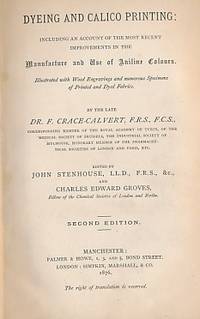
1876e8736Manchester: Palmer & Howe. Cover worn and detached from text block. Some age toning and offsetting from fabric specimens. Text block firm. 1876. Second Edition. Green hardback cloth cover. 230mm x 140mm 9" x 6". xxix 509pp ad. 'Illustrated with wood engravings and numerous Specimens of Printed and Dyed Fabrics'. Fold out table and laid on samples. Heavy item - shipping supplement may apply for overseas. . Palmer & Howe hardcover