127 résultats
18869981005Chatto and Windus 1886. This is an ex-library book and may have the usual library/used-book markings inside.This book has hardback covers. In fair condition suitable as a study copy. Re-bound by library. 8vo. Rebound cloth boards. Foxing. Internally clean. Tightly bound. Please note the Image in this listing is a stock photo and may not match the covers of the actual item500grams ISBN: Chatto and Windus hardcover
18849500424Chatto and Windus 1884. This is an ex-library book and may have the usual library/used-book markings inside.This book has hardback covers. In good all round condition. No dust jacket. 8vo. Blue cloth bound. Blind boarders on front and back boards. Gilt lettering on frontboard and backstrip. Blind design on front board. Gilt design on backstrip. Bumped corners. Library sticker on front end page. Front board is loose but attached. Black end pages. Split page block. Internally clean and clear. Please note the Image in this listing is a stock photo and may not match the covers of the actual item500grams ISBN: Chatto and Windus hardcover
186643745London Taylor and Francis 1866 a. 1877. 4to. No wrappers as extracted from "Philosophical Transactions" Vol. 156 - Part II a. vol. 167 - Part I. Pp. 781-859 a. pp. 35-116. Clean and fine. <br/><br/><em>First appearance of both papers controversial as Brodie here tries to established a new chemical philosophy refusing atomism and founding the calculation of chemical processes on Boolean Algebra defining chemical symbols with mathematical terms and notations. The work is a remarkable attempt to set chemistry on a rational deductive basis. - The introduction in the second paper meets the main points raised by his critics."In 1866 the Royal Society began to publish Brodie’s "The Calculus of Chemical Operations" Philosophical Transactions 156 1866 781-859; 167 1877 35-116 which introduced Greek symbols for the chemical elements to replace the roman alphabet Berzelian symbols that contemporary chemists used to represent atomic weights. Brodie’s symbols however represented operations on space volumes not weights for besides its revolutionary symbolism the calculus also demanded an appreciation of George Boole’s algebraic logic which Brodie had studied after the publication of Boole’s Investigation of the Laws of Thought in 1854. In this an equation such as y = xy is a symbolic statement that y is a subset of x in which the symbol x is an operator on y. Although professional mathematicians like William Donkin and Henry Smith later advised Brodie it appears that he developed the system without professional help. The principal difficulty about the calculus for the present-day historian and philosopher of science is the need to explain it before going on to discuss it and the difficulty of giving any concise description of it. Boole had developed the concept of symbolic operators in algebraic analysis. These provided a code as to how the symbols were to be understood and manipulated. Brodie exploited this in the idea of a chemical operator or chemical operations that he symbolized by Greek letters. It is probably unwise therefore to interpret Brodie’s philosophy as analogous to Percy Bridgman’s later operationism. He proposed that if two substances with the empirically-derived weights x and y combined to form a new compound with weight xy then x y = xy. From such weight equations he constructed a symbolic algebra that bypassed any atomistic interpretation."William H. Brock in "Hyle Biography". </em> unknown
185046363London Richard Taylor 1850 a.1851. 4to. No wrappers as extracted from "Philosophical Transactions" 1850 and 1851. Pp. 1-45 pp. 805-836 and pp. 483-494. Clean and fine. <br/><br/><em>First appearance of this pioneer work in which Graham introduces the terminology and fundamental concepts of colloid chemistry."Although some isolated investigations on colloids had been carried out before Graham his publications in this field laid the foundations of colloid chemistry. In "On the Diffusion of Liquids" Graham applied to liquids the exact method of inquiry he had applied to gases twenty years before and he succeeded in placing the subject of liquid diffusion on about the same footing as that to which he had raised the subject of gaseous diffusion prior to the discovery of his numerical law. He showed that the rate of diffusion was approximately proportional to the concentration of the original solution increased with rise in temperature and was almost constant for groups of chemically similar salts at equal absolute not molecular concentrations and different with different groups. He believed that liquid diffusion was similar to gaseous diffusion and vaporization with dilute solutions but with concentrated solutions he noted a departure from the ideal relationship similar to that in gases approaching liquefaction under pressure."DSB. </em> unknown
18564838422Longman Brown Green Longmans & Roberts 1856. This is an ex-library book and may have the usual library/used-book markings inside.This book has hardback covers. In fair condition suitable as a study copy. Medium grubby blue cloth 8vo with decorative blind border mirrored on boards. Gilt motif on front board. Gilt lettering on sun faded backstrip. Bumped corners and some fraying including a small tear in top of backstrip. Split hinges. Brown end papers printed with articles. One missing. Illustrated title page. Interior is secure and clear of markings save for some grubbiness and foxing. Trimmed. Illustrated. Please note the Image in this listing is a stock photo and may not match the covers of the actual item550grams ISBN: Longman, Brown, Green, Longmans & Roberts hardcover
1899ME-43London U.K.: Charles Griffin & Co. 1899. Classic reference text contains detailed fold-out tables and notes covering iron ores steel coal coke limestone boiler incrustation blast furnace slag gaseous fuels copper zinc lead alloys white lead water for technical purposes atomic weights and factors etc. Gilt spine. Small label to spine; pocket remnant and small stamp to endpapers. Minimal shelfwear. Scarce. First Edition. Hard Cover. Very Good. 8vo - over 7¾" - 9¾" tall. Ex- Professional Library. Charles Griffin & Co. Hardcover
184947031Paris Bachelier 1849. 4to. No wrappers. In: "Comptes Rendus Hebdomadaires des Séances de L'Academie des Sciences" Tome 28 No 7. Pp. 189-240 entire issue offered. Wurtz's paper: pp. 223-226. <br/><br/><em>First appearance of the announcement of Wurtz's outstanding discovery of Liebig’s prediction that there might be organic compounds analogous to ammonia and derivable from it by the replacement of hydrogen - the amines. The entire memoir was not published in full until 1855 in 'Annales de Chimie et de Physique'.Wurtz is most noted for his investigation of glycols and for his discovery of the amines. The latter discovery in 1849 the paper offered was very significant at the time for ot suggested the possibility of a new type the ammonia type which helped to explain the behaviour of nitrogenous compounds. Leicester & Klickstein "A Source Book." pp. 362-63. - Parkinson "Breakthroughs" 1849 C. </em> unknown
185844228Paris Victor Masson 1858. 8vo. Contemp. hcalf raised bands gilt spine. Light wear along edges. Small stamps on verso of titlepage. In: "Annales de Chimie et de Physique" 3e Series - Tome 53. 512 pp. a. 2 folded engarved plates.The entire volume offered. Couper's paper: pp. 469-489. Some scattered brownspots. <br/><br/><em>First appearance of this milestone paper in organic chemistry - a shorter note was published in Comptes Rendus in June 1858 - in which independently of Kekulé Couper introduces the CONCEPT OF BONDS represented as a dash or a dotted line in chemistry and also observes the very importent fact that carbon atoms forms the backbone of organic compounds."It was not till 1858 that a satisfactory theory of molecular constitution was advanced simultaneously and endependently by thwo young chemists Friedrich August Kekulé and Archibald Scott Couper. The theory of molecular constitution put foreward.by Couper and Kekulé rested on two main postulates the quadriivalency of carbon.and the capacity of the carbon atom for mutual linking or combining together to form a carbon "chain". By this hypothesis of the mutual linking together of carbon atoms - which waslater confirmed by experiment - it was possible to explain the formation of organic compounds containing a large number of carbon atoms. On the foundation of their postulates two postulates moreover they showed how the molecular constitution or mutual linking together of the atoms of a compound could be represented diagrammatically and the relstions between different compounds made readily intelligible. In his classic paper "On a New Chemical Theory" the paper offered here in its first appearance advanced beyond Kekulé by representing the constitutions of the compounds by means of GRAPHIC FORMULA in which as at the present day the valencies pf the atoms are represented by lines.his formulae are similar to those at present in use."Findlay pp. 34 ff"The theory of Kekulé and Couper gave the chemists the maeans of solving the problems of chemical constitution; and by means of the graphic or constitutional formulae it became possible to represent the molecular constitution of known compounds and to foresee the possible existence of isomeric compounds."Findlay.Parkinson "Breakthroughs" 1858 C.The volume contains another importent monumental memoir MARCELLIN BERTHELOT "Sur la Synthèse des Carbures D'Hydrogene" pp. 69-208. Here he prsents his review of his work in organic chemistry during the previous ten years. "In his conclusion Berthelot argued that chemistry differed from a descriptive science such as natural history by being creative and that in this it resembled the mathematical sciences."DSB </em> hardcover
185847569Paris Mallet-Bachelier 1858. 4to. No wrappers. In: "Comptes Rendus Hebdomadaires des Séances de L'Academie des Sciences" Tome 46 No 24. Pp. 1121- 1173 entire issue offered. Couper's paper: pp. 1157-1160. A faint dampstain to right margins. <br/><br/><em>First appearance of this milestone announcement in organic chemistry - a longer memoir was published in "Annales de Chimie et de Physique" later in the same year 1858 - in which independently of Kekulé Couper introduces the CONCEPT OF BONDS represented as a dash or a dotted line in chemistry and also observes the very importent fact that carbon atoms forms the backbone of organic compounds."It was not till 1858 that a satisfactory theory of molecular constitution was advanced simultaneously and endependently by thwo young chemists Friedrich August Kekulé and Archibald Scott Couper. The theory of molecular constitution put foreward.by Couper and Kekulé rested on two main postulates the quadriivalency of carbon.and the capacity of the carbon atom for mutual linking or combining together to form a carbon "chain". By this hypothesis of the mutual linking together of carbon atoms - which waslater confirmed by experiment - it was possible to explain the formation of organic compounds containing a large number of carbon atoms. On the foundation of their postulates two postulates moreover they showed how the molecular constitution or mutual linking together of the atoms of a compound could be represented diagrammatically and the relstions between different compounds made readily intelligible. In his classic paper "On a New Chemical Theory" the paper offered here in its first appearance advanced beyond Kekulé by representing the constitutions of the compounds by means of GRAPHIC FORMULA in which as at the present day the valencies pf the atoms are represented by lines.his formulae are similar to those at present in use."Findlay pp. 34 ff"The theory of Kekulé and Couper gave the chemists the maeans of solving the problems of chemical constitution; and by means of the graphic or constitutional formulae it became possible to represent the molecular constitution of known compounds and to foresee the possible existence of isomeric compounds."Findlay.Parkinson "Breakthroughs" 1858 C. </em> unknown
183748086Paris Crochard et Comp. 1837. Orig. printed wrappers. No backstrip. In: "Annales de Chimie et de Physique Par MM. Gay-Lussac et Arago." tome 64 Cahier 2 Fevrier 1837. Pp. 113-224. Entire issue offered with printed wrappers. Wöhler a. Liebig's papers: pp. 185-209 a. pp. 209-217. <br/><br/><em>First appearance of this classic paper in organic chemistry in which Wöhler and Liebig showed how Amygdalin could be decomposed by a vegetable emulsion the first example of a glycoside. The papers were issued at the same time in "Annalen der Physik und Chemie"."The conclusions which you have drawn from the investigation of bitter-almond oil" wrote Berzelius to Liebig and Wöhler "are certainly the most importent which have so far been reached in the domain of vegetable chemistry and give promise of shedding an unexpected light over this part of the science.The facts which you have set forth inspire such reflections that they may be regarded as the dawn of a new day in vegetable chemistry."Berzelius-Wöhler Briefwechsel."During the years that Liebig was preoccupied with the ether theory and with organic acids he also carried out two importent investigations with Wöhler. In october 1836 Wöhler wrote that he had discovered a way to transform amygdalin to oil of bitter almonds and hydrocyanid acis by distilling it with manganese and sulfuric acid and he invited Liebig to join in pursuing the topic. Two days later he made a more remarkable discovery. It had occurred to him that perhaps thetransformation of amygdalin could be effected by the albumin in the almonds in a manner similar to the action of yeast in sugar.Wöhler suspected that the decomposition was an example of what Berzelius had recently defined as catalysis. Liebig and Wöhler then divided up the detailed examination of the properties and composition of amygdalin. They precipitated from the emulsion of almonds a substance which when dissolved retain its action. They named the active substance "emulsion". Its effectiveness in very small quantities confirmed that it acted like yeast."DSB VIII p. 342. </em> unknown
182844898Paris Crochard 1828. 8vo. Without wrappers. Extract from 'Annales de Chimie et de Physique' Series 2 - Volume 37. Pp. 330-334. <br/><br/><em>First appearance in French of this milestone paper marking the beginnings of organic chemistry in which Wöhler describes how he managed to synthezise urea from cyanate of ammonia. The French version here is translated from the German paper "Ueber künstliche Bildung des Harnstoffs." which was issued the same year 1828. This broke down the old distinction between organic and inorganic substances. "This was the first synthesis of an organic compound and this accomplishment is generally regarded as the beginning of organic chemistry."Sparrow "Milestones of Science" p.37. The discovery destroyed the vitalistic theory which held that organic compounds could be produced only by living organisms and led eventually to the brilliant results that have been achieved in attempts to synthesize other organic compounds.Dibner: Heralds of Science no. 45. - Sparrow: Milestones of Science no. 197. - Garrison & Morton no. 671. See also DSB XIV p.475. </em> unknown
18695781655Macmillan and Co 1869. This is an ex-library book and may have the usual library/used-book markings inside.This book has hardback covers. In fair condition suitable as a study copy. Medium brown cloth 8vo with black gilt and coloured illustration on front board. Simple blind border on back board. Black borders gilt lettering and gilt motif on backstrip. Bumped corners and light fraying. Half title page semi detached. Rear hinge split. Frontispiece. Interior is secure clean and clear save for some foxing. Illustrated. Trimmed. Please note the Image in this listing is a stock photo and may not match the covers of the actual item1050grams ISBN: Macmillan and Co hardcover
18695781656Macmillan and Co. 1869. This is an ex-library book and may have the usual library/used-book markings inside.This book has hardback covers. In poor condition suitable as a reading copy. Medium brown cloth 8vo with black gilt and coloured illustration on front board. Simple blind border on back board. Black borders gilt lettering and gilt motif on backstrip. Fraying to backstrip ends and a long split in seam. Bumped corners and some general wear. Black end papers. Hinges split. Frontispiece detached. Interior is secure clean and clear save for some foxing. Illustrated. Trimmed. Please note the Image in this listing is a stock photo and may not match the covers of the actual item1050grams ISBN: Macmillan and Co. hardcover
1891035660London: Longmans Green And Co 1891. First English Language Edition 1st Printing. Hardcover. Near Fine. Xvi 316 Pp. Blue Cloth Gilt. First Edition First Printing With 1891 Date On Title Page And Preface But Publisher's April 1896 Catalog At End Thus A Later 1896 Issue Of The First 1891 Printing Booknear Fine Very Bright Gilt Brilliant Endpapers Immaculate No Names Or Marks Small Areas Of Rear Cover With A Numberof Small And Very Faint Brown Stains. <br/> <br/> Longmans, Green, And Co hardcover
18472111902160200374Jiemon Katsumura Akitaya Taiemon Ihachi Suharaya 1847. Soft Cover. Fine. Number of books: 9 books Jiemon Katsumura Akitaya Taiemon Ihachi Suharaya paperback
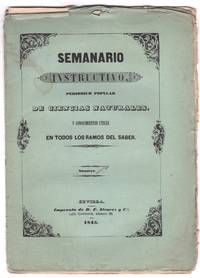
184545761Sevilla: Imprenta de D. Francisco Alvarez y Co. 1845. First edition. Paper wrappers. Edges of wrappers and leaves with tears otherwise issues 1 and 3 very good issue 2 rlacks last seven pages. 16 pp.; 8 of 16 pp.; 16 pp. Sm. 4to. The first three issues of this 'popular newspaper of natural sciences and useful knowledge' which ran from February through July of 1845. Much of each issues was devoted to mining and chemistry with a long article on "origen Y Progresos de la Quimica. Rear wrappers lists subscription points throught Spain.<br /> 1. Año 1: Número 1 2 de Febrero de 1845; 16 pp.<br /> 2. Año 1. Número 2 9 de Febrero de 1845; pp. 17-24 incomplete - lacking pp. 25-32.<br /> 3. Año 1. Número 3 16 de Febrero de 1845; pp. 33-48.<br /> <br /> Scarce. Not in OCLC. Not in any European nor Spanish library catalogues. One copy located at the Univ. Connecticut Duque de T' Serclaes periodical collection. Chaves y Rey: Historia y bibliografía de la prensa sevillana 120. Imprenta de D. Francisco Alvarez y Co. unknown
18715666350Longmans Green and Co 1871. This is an ex-library book and may have the usual library/used-book markings inside.This book has hardback covers. With usual stamps and markings In good all round condition. No dust jacket. Rebound in black cloth. Hinges reinforced front and back. Some foxing. Pages in overall good clean condition. Please note the Image in this listing is a stock photo and may not match the covers of the actual item800grams ISBN: Longmans Green and Co hardcover
183342378London Richard Taylor 1833. 4to. No wrappers as extracted from "Philosophical Transactions" 1833 - Part II. Pp. 253-284. Clean and fine. <br/><br/><em>First appearance of a main paper in the history of chemistry. "Graham's major contribution to inorganic chemistry is presented in a paper entitled "Researcheson thee Arseniates Phosphates." 1833 the paper offered.his elucidation of the differences between the three phosphoric acids and his discovery of their polybasicity provided Liebig with the clue to the modern concept of polybasic acids."A Source Book in Chemistry p. 333."In the Preface to.Graham's papers.Dr. Angus Smith has indicated in precise.language Graham's position in that chain of thinkers which includes Leucippus Lucretius Newton and Dalton Thorpe"Thomas Graham the Scottish Chemist first president of the Chemical Society of London and one of the chief founders of physical chemistry. He formulated Graham's Law of diffusion relating the rate of diffusion of gases to their densities discovered and named the process of dialysis used for separating colloids from crystalloids studied the three forms of phosphoric and arsenics acids that led to the developpement of the concept of polybasic acids a major contribution to inorganic chemistry the paper offered. </em> unknown
18482745467Taylor & Walton 1848. Most of binding strip missing front cover loose foxingj.This book has hardback covers. Ex-library With usual stamps and markings In poor condition suitable as a reading copy. No dust jacket. Please note the Image in this listing is a stock photo and may not match the covers of the actual item400grams ISBN: Taylor & Walton hardcover
180146023Paris Chez Fuchs An IX1801. Boundin 3 contemp. hcalf. Gilt spuines. Light wear along edges. In: "Annales de Chimie ou Recueil de Mémoires concernant la Chemie" Tome 36 37 and 38. Entire volumes offered. 336;3302;3342 pp. and 5 engraved plates. Berthollet's paper: pp. 302-317 pp. 151-181 221-252 pp. 3-29 113-134. <br/><br/><em>Together with the memoir printed at the same time in "Mémoires de l'Institut." this is the first appearance of B's groundbreaking work on the nature of chemical affinity and the fact that many factors influence chemical reactions comparing chemical affinity to the force of gravity. The paper was at the end of the year published separately.The theory set forth here "led directly to Prout's investigations which yielded a knowledge of definite chemical proportions and thus played a very importent part in preparing the way for the development of the Atomic Theory on which the whole modern chemistry is based."Duveen p. 75."Berthollet read a memoir on the general theory of affinities while he was still in Egypt. This was the starting point of his complete new system of chemistry first briefly sketched in Recherches sur les lois de l’affinité 1801 and later developed into the comprehensive two volume Essai de statique chimique. Here he attempted to provide a proper basis for chemistry so that its experimental results could be viewed in the light of theoretical first principles. Berthollet developed a theory and a model adequate for the understanding and the interpretation of the rapidly growing body of chemical knowledge in his time. He was aware that the positive work of constructing a new theory had yet to be performed after the shock of Lavoisier’s criticism of the old chemistry.DSB.Parkinson "Breakthroughs" 1801 C. </em> unknown
183647788Paris Crochard 1836. 8vo. Contemp. hcalf. Raised bands gilt spine. A few scratches to spine. In: "Annales de Chimie et de Physique Par MM. Gay-Lussac et Arago." 2e Series Tome 66. 448 pp. a. 1 folded engraved plate. Entire volume offered. Laurent's papers: pp. 136-213 a. pp. 314-335. Internally fine and clean. <br/><br/><em>First printing of Laurent's long paper in which he tried to develope the rules of substitution into a chemical system oforganic compounds the "Nucleus theory". Laurent is considered one of the most importent chemists in the 18th centuryHis first theoretical efforts were largely taxonomic in character. He then began to develop a pictorial model based on atomistic representations as considered by earlier French crystallographers. Laurent’s "nucleus theory" or "theory of derived radicals"located every substance at the intersection of two kinds of transformations: substitutions which operate on the matter inside the fundamental radical and do not affect its general chemical behavior and external modifications which influence various chemical functions. DSB."In his studies of the derivatives of naphtalene Laurent was impressed by the fact the the fundamental properties of these compounds remained in spite of the various substitutions which took place in them. A certain nucleus seemed to impose its properties on all its derivatives. This nucleus theory was the basis for the unitary which was specifically formulated by Gerhardt."Leicester & Klickstein "A Source Book in Chemistry" p. 345.The volume contains other notable papers by Regnault D'Arcet Chevreuil Rose Gay-Lussac and Carlo Matteucci's importent memoir "Sur la Propagation du Courant Electriques dans les Liquides" pp. 225-313. </em> hardcover
183645079Paris Crochard 1836. Contemp. hcloth. In: "Annales de Chimie et de Physique Par MM. Gay-Lussac et Arago." 2e Series Tome 66. 448 pp. a. 1 folded engraved plate. Entire volume offered. Laurent's papers: pp. 136-213 a. pp. 314-335. Some scattered brownspots. <br/><br/><em>First printing of Laurent's long paper in which he tried to develope the rules of substitution into a chemical system oforganic compounds the "Nucleus theory". Laurent is considered one of the most importent chemists in the 18th centuryHis first theoretical efforts were largely taxonomic in character. He then began to develop a pictorial model based on atomistic representations as considered by earlier French crystallographers. Laurent’s "nucleus theory" or "theory of derived radicals"located every substance at the intersection of two kinds of transformations: substitutions which operate on the matter inside the fundamental radical and do not affect its general chemical behavior and external modifications which influence various chemical functions. DSB."In his studies of the derivatives of naphtalene Laurent was impressed by the fact the the fundamental properties of these compounds remained in spite of the various substitutions which took place in them. A certain nucleus seemed to impose its properties on all its derivatives. This nucleus theory was the basis for the unitary which was specifically formulated by Gerhardt."Leicester & Klickstein "A Source Book in Chemistry" p. 345.The volume contains other notable papers by Regnault D'Arcet Chevreuil Rose Gay-Lussac and Carlo Matteucci's importent memoir "Sur la Propagation du Courant Electriques dans les Liquides" pp. 225-313. </em> hardcover
188744236Paris G. Masson 1887. 8vo. Contemp. hcalf raised bands gilt spine. Light wear along edges. Small stamps on verso of titlepage. In: "Annales de Chimie et de Physique" 6e Series - Tome 12. 576 pp. Entire volume offered. Moissan's paper: pp. 472-537. Many textillustrations of apparatus in woodcut. <br/><br/><em>First appearance of the paper in which Moissan describes his isolation and observation of the properties of fluorine gas and his succes in producing diamond with his pectacular arc method. Fo these achievements he was the first French to be awarded the Nobel Price in chemistry 1906.The existence of the element fluorine had been well known for many years but all attempts to isolate it had failed and some experimenters had died in the attempt."Moissan eventually succeeded in preparing fluorine in 1886 by the electrolysis of a solution of potassium hydrogen difluoride KHF2 in liquid hydrogen fluoride HF. The mixture was needed because hydrogen fluoride is a non-conductor. The device was built with platinum/iridium electrodes in a platinum holder and the apparatus was cooled to -50 °C. The result was to completely isolate the hydrogen produced from the negative electrode from the fluorine produced at the positive one.This is essentially still the way fluorine is produced today." Wikipedia.Partington IV p. 912. - Weeks "Discovery of teh Elements" p. 272 ff. - Parkinson "Breakthroughs" 1885 C. </em> hardcover
183848918Paris Crochard 1838. Contemp. hcalf. Raised bands spine gilt. In: "Annales de Chimie et de Physique Par MM. Gay-Lussac et Arago." 2e Series Tome 68. 448 pp. entire volume offered. Wöhler & Liebig's paper: pp. 225-336. Clean and fine. small stamps to verso of titlepage. <br/><br/><em>First French edition of this importent paper in the development of organic chemistry. It is the last joint paper of importence from "these two men .pioneers in the development of organic chemistry form a twin constellation in the chemical firmament"Alexander Findley in "A Hundred Years of Chemistry" p. 23. The paper is a translation of "Untersuchungen über die Natur der Harnsäure" published at the same time in Justus Liebigs Annalen der Chemie 1838 Wöhler and Liebig collaborated on one more major piece of work a study of uric acid. The paper offered. Wöhler suggested the subject and the idea seems to have come from his medical interests. Uric acid was not easily obtainable–snake excrement was the only substantial source–and relationships with urea and allantoin were suspected by Wöhler. As a student he had won a prize in 1828 for an essay on the conversion in the human body of chemicals taken orally and excreted in urine. The technique adopted by Liebig and Wöhler was to subject uric acid ad the derivatives they prepared to oxidation and reduction by reagents of different concentrations and strengths. Wöhler seems to have been the first to heat reagents together in sealed glass tubes but after an explosion he thought metal ones safer.Their 100-page paper described fourteen new compounds and their preparation and analysis.7 An attempt to establish a new radical called "uril" C8N4O4 was less successful. Perhaps even more significant than the sophisticated practical and theoretical organic chemistry was the new spirit revealed. Writing to Berzelius in 1828 Wöhler was doubtful whether animal substances could be prepared in the laboratory. In 1832 he began the paper on the benzoyl radical with a description of organic chemistry as "the dark region of organic nature." But in 1838 his work with Liebig led him to write at Liebig’s suggestion: "The philosophy of chemistry will conclude from this work that it must be held not only as probable but as certain that all organic substances insofar as they no longer belong to the organism will be prepared in the laboratory. Sugar salicin morphine will be produced artificially. It is true that the route to these and products is not yet clear to us because the intermediaries from which these materials develop are still unknown but we shall learn to know them."DSB. </em> hardcover
1871025478Paris: Gauthier-Villars 1871. First Edition . Original Blue Printed Wrappers. Very Good . 8 7/8" Tall. 40 Pp. Original Blue Printed Wrappers. Preserved Nicely In A Well Made Maroon Chemise And Slipcase With Morocco Spine Label Gilt. Inscribed And Signed By Pasteur " Hommage De L'autour / L. Pasteur" In Small Handwriting At Upper Right Of Front Cover. A Scarce Book In The Trade Particularly Scarce When Inscribed And Otherwise Unmarked As Here And A Very Early Inscription From Pasteur In Any Case. <br/> <br/> Gauthier-Villars unknown