Bayer JohannABAA
2 résultats
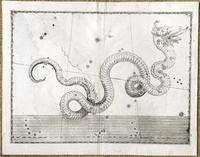
16392230<p><strong>Bayer Uranometria Celestial Chart. </strong></p><p>The constellation Serpens from the second edition of Johann Bayaer’s <em>Uranometria…</em> Augsburg Christophorus Mangus 1639 or later. Fine condition good margins centerfold. One corner of the margin has been restored see detail. Image is about 11 x 15 inches sheet is about 12 ¾ x 16 ¼ inches.</p><p>The verso of this chart is blank indicating the second edition. The first edition had the star catalogue printed on the verso of the plates. The first printing of the second edition was in 1639 but because of its popularity the atlas was reprinted many times into the early 18th century. Bayer was the first to use Greek letters to name stars in each constellation in order of magnitude an innovation still in use today. According to Warner Bayer used Tycho Brahe’s catalogue of stars for stellar positions. The constellation Serpens as seen on this chart was chosen by Warner to illustrate her entry of Bayer in "The Sky Explored"</p> unknown books
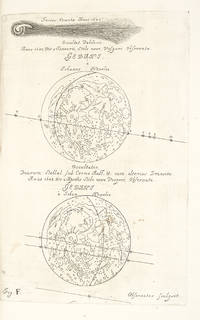
16853340Danzig:: Sumptibus auctoris typis D.F. Rhetii 1685. SOLE EDITION. Folio:. 34.8 x 22.5 cm. 6 lvs. 24 196 pp. Collation: 6 4 4 4 A-Z4 AA6. With engraved title page vignette and 7 1 double-page engraved plates. Bound in 18th c. half calf and marbled boards with very slight wear. Spine with citron morocco label gilt. A nice copy with a few early marginal paper repairs no loss. The final two leaves of the table with repaired tears the second of these with a small natural paper flaw costing a few letters. Complete with the seven plates engraved by Hevelius himself. "Annus Climactericus" was the last of Hevelius' works published in the author's lifetime. The book comprises observations of the planets sun moon and fixed stars many of which were made alongside the English astronomer Edmond Halley. The observations were made from 8 January until 25 September 1679 subsequent to the publication of the second volume of Hevelius' "Machina Coelestis" almost the entire press run of which was lost in the fire that destroyed Hevelius' observatory on 26 September 1679. Hevelius also included new observations of the binary star Omicron Ceti which Hevelius had been observing for 25 years and which he had named "Mira" and grappled with the problem of its changing size and color. In addition the book includes Hevelius' observations of the Great Comet of 1680 illustrated by a magnificent double-page plate engraved by Hevelius the total lunar eclipse of February 1682 the comet of 1682 the solar eclipse of July 1684 each also accompanied by a plate "Observator Sculpsit." observations of several Great Conjunctions etc.There are also numerous letters to and from members of the Royal Society of England: Henry Oldenburg John Wallis John Flamsteed Nehemiah Grew and Halley as well as several European astronomers among them Ismaël Boulliau. The letters deal primarily with Hevelius' feud with Robert Hooke over the merits of the use of telescopic sights for celestial observation vide infra.The "Climactic Year" to which the title of the book refers is 1679 the year in which Hevelius published his "Machinae Coelestis pars Posterior" which comprised 49 years worth of Hevelius' celestial observations; and the year in which his observatory burned to the ground. In the introduction Hevelius gives his own account of the fire that consumed not only the observatory building itself but also Hevelius' instruments "tam astronomicis quam opticis" his library his printing press and print making workshop and the irreplaceable stock of his self-published works. He also describes the psychological and emotional toll that the fire took on him and thanks God that at last his spirit "in cineribus hactenus fere supultum" was revived by the arrival of the Great Comet of 1680 and that he was able to make new observations.Hevelius Hooke and Halley: The Controversy over Open-Sight Instruments vs. Telescopic ObservationThe "Annus Climactericus" is of great importance in the history of science marking as it does the climax of a contentious debate between Hevelius who argued that his "open-sighted" instruments employing fore- and near-sights but no lenses or cross-hairs were more accurate than those fitted with telescopic sights micrometers with telescopic lenses and cross-hairs and Robert Hooke who argued against that position.Hooke and Hevelius had been arguing politely over the relative merits of both kinds of instruments since the 1660s but matters came to a head in 1673 with the publication of Hevelius' "Machinae Coelestis Pars Prior" in which Hevelius forcefully enumerated the limitations of telescopic sights and Hooke's critique of the book in which he wrote that readings taken with Hevelius' instruments could not be more accurate than ½ minute of arc. Moreover he mocked Hevelius' instruments which Hooke asserted were no better than the antiquated ones used by Tycho almost a century earlier his observations and methods. Moreover he asserted that Hevelius was not only providing the scientific community with incorrect data but was impeding scientific progress itself.Hevelius responded with a letter to Henry Oldenburg in which he asserted that his observations were in fact accurate to within 5 seconds of arc that he had never seen data that proved Hooke's assertions and that he resented Hooke's ad hominem attacks. Inevitably the astronomer John Flamsteed was drawn into the controversy and though he had great respect for Hevelius and voiced his disapproval of Hooke's attacks felt compelled to note some of the errors in Hevelius' observations. Hevelius responded and the two men carried on a correspondence in which they argued over the data and during which Hevelius leveled charges of jealousy against Flamsteed and voiced his conviction that Flamsteed and Hooke were now conspiring against him. Fortunately the rift was eventually healed. Part of the correspondence is included in the "Annus Climactericus".1679: A Comparative Test:The arrival at Danzig of Edmond Halley who brought with him his portable 2 –foot quadrant fitted with telescopic sights presented an opportunity to compare results obtained with both types of instruments. The two men made observations side-by-side from 26 May to 18 July 1679 using Halley's instrument and Hevelius' own quadrant "with which he made regular observations of the Sun the large sextant for angular distances between stars planets and the limbs of the Moon and his 12-foot telescope for occultations." Hevelius' wife Elizabeth Hevelius' personal printer and two other observers also participated.Before Halley left Danzig he wrote at Hevelius' request what amounted to a testimonial to the accuracy of Hevelius' open-sighted instruments. Halley wrote that he could testify "to the certainty of the instruments against all who would cast doubt on Hevelius' observations. He had seen with his own eyes that not just occasional observations but many by different observers with the large sextant agreed incredibly well together and any discrepancies were very small which he greatly admired."Cook p. 100In the introduction to the "Annus Climactericus" Hevelius excoriated Hooke and boasted that his calculations demolished Hooke's assertions of the inferiority of Hevelius' methods. The book was reviewed in the Philosophical Transactions of September-October 1685 by Hooke's antagonist John Wallis who censured Hooke for his behavior toward Hevelius and took pains to rehearse each of Hevelius' criticism of Hooke and to summarize the 27 letters of support that Hevelius printed in the "Annus". Hooke responded to Hevelius in February 1686 in an effort to vindicate himself and Hevelius in turn wrote that he would publish his long-awaited star catalog "Uranographia" to furnish proof of the superiority of his methods but Hevelius' death the following year put an end to the dispute.Postscript: Hevelius and HalleyHevelius printed Halley's positive assessment of the Danzig astronomer's instruments and calculations in the "Annus Climactericus" p. 101-102 and thereby drew Halley into the controversy with Hooke. Moreover Hevelius misrepresented the reason for Halley's visit stating that he had invited Halley to Danzig the visit was Halley's own idea that he had asked him to bring the telescopic quadrant which Halley had actually brought with him to make observations of the southern constellations on St. Helena and that Halley came to Danzig as an official representative of the Royal Society of which Halley was not yet a member.This all irritated Halley who in order to extricate himself from the Hevelius-Hooke controversy downplayed his original estimation of the accuracy of Hevelius' calculations. Halley also realized that while attesting to the accuracy of Hevelius' instruments he seemed to side with Hevelius against Hooke whose belief in the superiority of telescopic sights was in fact Halley's own.While he never attacked Hevelius he put it forth that his earlier enthusiasm had been in part motivated by a desire to placate a "peevish old man." In the end there was a poetic resolution to the tension between the two men: When Elizabeth Hevelius had her husband's star catalogue printed in 1690 three years after Hevelius' death She included Halley's own catalogue of the stars of the southern hemisphere which was based on Halley's observations made on St. Helena with the 2-ft quadrant just before his visit to Hevelius in 1679. VD17 39:125045B; DSB 6 363; Honeyman 1675. For a thorough discussion of the Hevelius-Hooke controversy see Saridakis "Converging Elements in the Development of Late Seventeenth-Century Disciplinary Astronomy: Instrumentation Education and the Hevelius-Hooke Controversy" p. 129 ff.; For an assessment of the relative accuracy of Halley's and Hevelius' computations at Danzig see Cook "Edmond Halley: Charting the Heavens and the Seas" p. 93 ff.; For Hevelius' work on the binary star Mira Ceti see Hatch "Hevelius- History and Identity" in "Change and Continuity in Early Modern Cosmology" p 158 ff.; For D. Capellus' contemporary account of the fire and a detailed inventory of Hevelius' losses see MacPike "Hevelius Flamsteed Halley" Appendix I. London 1937 Sumptibus auctoris, typis D.F. Rhetii, books