Biblio.com
68 résultats
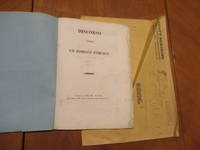
1845025962Vicenza: Dalla Tipografia Tremeschin / Annali Delle Scienze Del Regno Lombardo-Veneto 1845. First Separate Edition . Soft cover. Good. Folding Plate at End. Original Plain Blue Wrappers. Title Colophon 12 Un-Numbered Pages Folding Plate At End. Offprint From Issues Iii And Iv Of The Annali Delle Scienze Del Regno Lombardo-Veneto Of 1845. Small Label "Miscell. 7 / 23 Biblioteca E. Levi" On Front Cover No Other Names Or Marks. Short Edge Tears To Covers But Complete. <br/> <br/> Dalla Tipografia Tremeschin / Annali Delle Scienze Del Regno Lombardo-Veneto paperback
186325702Salem 1863. 1 vols. approximately 3/4 x 1 1/2 inches. The signature tipped in with about 20 other clipped signatures one with initials into the inside wrapper and first and second pages of "Dancing as a Social Amusement. By Professed Christians or their Children" New York: Published by the American Tract Society ca. 1860 Some creasing of signature slips. Pamphlet in original printed wrappers some fraying and creasing text loose discreet pencilled library markings else very good. 1 vols. approximately 3/4 x 1 1/2 inches. Albert Stowell Flint 1853-1923the noted astronomer. Flint born in Salem Mass. a Harvard and M.I.T. graduate was best known for his work on the meridian circle on the paralaxes of stars also his contributions to the reobservation of the secondary stars in Auwer's catalogue and his participation in the determination of the latitude of the Princeton Observatory. In 1881 he was a computer in the Naval Observatory in Washington. He was the author of "Meridian Observations for Stellar Parallax."¶ The other signatures many names of old Salem families are of Augusta Arrington C. H. Hodgdon William Proctor J. McCallum Henry M. Batchelder George Dow Charles W. Winn E. S. Merrill H. Reeves George N. Dow C. Wilson W. B. Winn Albert W. Edgerly Caroline Weeks Edward W. Flint H. E. Lewis Harriet M. Tyler Nathaniel M. Brown John Henry Ropes and the initials "E. H. F." Two of the signatures bear the date March 1863 and one reads Salem Mass. Old Salem Families. <br/><br/> unknown
189676030Kiel: Druck von S. Schsidt 1896. First offprint edition. Quarto. 140-47 1 pp. Publisher's printed gray wrappers. Old Crease through the middle cause short seperations at spine and fore-edge old tide mark to upper margin. Russell made measurements at Sydney for many years. Henry Chamberlain Russell Russell was an astronomer meteorologist and one of the most eminent men of science in Australia in the nineteenth century. Upon leaving the University at the end of 1859 he was appointed assistant to the Government Astronomer. He became the Government Astronomer in 1870 and subsequently held the position for 35 years. Druck von S. Schsidt unknown
18561620Albany: Charles van Benthuysens Print 1856. First Edition. Engraved Portrait after a photograph by Mathew Brady. 1 vols. 8vo. Later 3/4 brown morocco over marbled boards spine gilt with raised bands bound by Stikeman. Extremities slightly rubbed; a Very Good copy. First Edition. Engraved Portrait after a photograph by Mathew Brady. 1 vols. 8vo. In addition to the "Discourse" by Everett this book issued in honor of the dedication of the Dudley Observatory at Albany contains various speeches and a long poem dedicated to the American Association for the Advancement of Science by Alfred B. Street. The speeches include a eulogy by Washington Hunt and remarks by A. B. Gould Benjamin Pierce and A.D. Bache. The Observatory had not as yet been built when this book was published. This was simply it seems a celebration of sorts given in honor of the donors of funds to build it. Mr. Dudley's widow to whom the discourse is dedicated was the most generous of donors pledging the then enormous sum of $12000. Although other editions of the "Discourse" with condensations of the events appear in NUC there seems to be no copy of this edition located. Charles van Benthuysens Print unknown
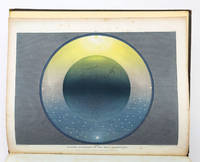
1846ST19286London: Printed by Catchpool & Trent for Simpkin Marshall & Co 1846. FIRST EDITION. 320 x 255 mm. 12 1/2 x 10". xiii 3 96 pp. <br/> Publisher's original blind-decorated dun-colored cloth gilt titling to upper cover smooth spine newer endpapers. WITH 11 COLOR ENGRAVINGS after Frost by W. P. Chubb & Son printed in oil colors by George Baxter all with original tissue guards. Front free endpaper with small ink signature of John Hill. See: Francis Reid "Isaac Frost's 'Two Systems of Astronomy' 1846: Plebeian Resistance and Scriptural Astronomy" in "The British Journal for the History of Science" Vol. 38 No. 2 Jun. 2005 pp. 161-177. Cloth rather spotted corners bumped but the binding solid with no wear to joints or hinges. A few spots of foxing to title page half of the tissue guards with overall very faint foxing/browning the illustrations with minor foxing at edges and in margins but the images themselves clean and bright and all in all a really excellent copy the text wide-margined and quite clean and fresh and the plates with rich coloring.<br/> <br/> Illustrated with beautiful color plates this anti-Newtonian work promotes a view of the universe based on the backward-looking beliefs professed by a Protestant sect known as the Muggletonians. Named after co-founder Lodowicke Muggleton the Muggletonians emerged in London in 1651 based on the claims of two tailors who professed to be the "Last Witnesses" described in the Book of Revelation. Rejecting the new directions in philosophical reason Muggletonians believed in a purely scriptural interpretation of the universe. According to E. P. Thompson's 1994 "Witness Against the Beast" the Muggletonians had curious notions quite contrary to other Protestant denominations: they believed that the soul is mortal that Jesus and God are one and the same that Heaven was left without divine supervision from Jesus' death until the day of judgment that Heaven resides six miles above the Earth that God stands between five and six feet tall and other unconventional things. Although the sect initially avoided both worship and evangelizing during the 19th century some followers became more outspoken about their beliefs and even published books appealing to the general public. Our author Isaac Frost 1793-1858 was a prominent Muggletonian and successful owner of a brass foundry who along with his brother Joseph invested large sums to promote their belief system--the present work being an especially notable example. Divided into two main sections the text first describes the Newtonian system of heliocentric astronomy and then turns to Frost's scriptural interpretation and geocentric views. As Reid tells us "According to Frost Scripture clearly states that the Sun the Moon and the Stars are embedded in a firmament made of congealed water and revolve around the Earth that Heaven has a physical reality above and beyond the stars and that the planets and the Moon do not reflect the Sun's rays but are themselves independent sources of light. Our book was apparently written as a reaction against the lecturers who expressed Newtonian astronomy--which was often for them and their audiences simply shorthand for heliocentrism." The 11 plates that illustrate these extraordinary ideas are the work of George Baxter a pioneering printer who revolutionized color printing techniques by combining metal engravings with woodblock printing using oil-based inks to produce high-quality affordable prints. The plates here are appropriately ethereal and otherworldly utilizing a beautiful palette with subtle gradations and esoteric figures to create memorable pseudo-scientific imagery. Although this work appears at auction with some regularity it is almost always incomplete no doubt because the attractiveness of its plates encourages harvesting. Useful price comparisons include a complete copy said to be in fine condition selling for £7500 in 2016 and six loose prints from the book fetching £6875 in 2015. [Printed by Catchpool & Trent for] Simpkin, Marshall, & Co unknown
187197507New Haven: Printed by Tuttle Morehouse & Taylor 1871. 1871. Good. THE FIRST APPEARANCE OF THE ESSAY "ON JUPITER AND ITS SATELLITES" BY THE FIRST FEMALE ASTRONOMER IN THE U.S.A. - Octavo 8-1/2 inches high by 5-3/8 inches wide. The contemporary brown calf and marbled boards are detached but present and the spine has perished and is thus lacking. The text block is intact and tight. 978 pages in all with the pagination as follows: Volume I: pages i-viii & 1-484; and Volume II: pages i-viii & 1-480. Pages 327/328 are skipped in numbering as published which collates with the copy at the Peter H. Raven Library at the Missouri Botanical Garden. The volume is illustrated with 3 plates including one folding as well as several textual illustrations. Although the title page to the second volume indicates the presence of a map intended to illustrate E.W. Hilgard's article "On the Geological History of the Gulf of Mexico" page 391 the map is not here present if it ever was included. The endpapers are foxed and there is some light soiling to the title page of the first volume. The edges of the first few leaves are lightly darkened with a tiny spot of dampstaining to the top edge of those leaves. A very good tight copy which would be well worth rebinding. <p>Most noteworthy is the first publication of Maria Mitchell's essay "On Jupiter and its Satellites" illustrated with a plate volume I pages 393-395.<p>The first American scientist to discover a comet Maria Mitchell 1818-1889 was the first female astronomer in the United States. Working as the librarian of the Nantuckett Atheneum Maria Mitchell read through the day and spent her nights with her father at the observatory he built atop the Pacific Bank. Her discovery in 1847 of the comet which came to be named "Miss Mitchell's Comet" brought her international acclaim. She was awarded a gold medal by King Frederick of Denmark and elected as the first woman to join the American Academy of Arts and Sciences the following year. Mitchell traveled throughout Europe after leaving the Atheneum in 1856 meeting with astronomers the world over. She became involved and active in the anti-slavery movement and the suffrage movement and was subsequently instrumental in the formation of the American Association for the Advancement of Women. After the Civil War Mitchell was recruited to join the faculty at Vassar College where with a 12 inch telescope then the third largest in the US she specialized in studying the surfaces of Jupiter and Saturn. She made waves by encouraging her female students to come out at night for classes and celestial observations and brought in noted feminists including Julia Ward Howe to speak on political issues. Continuously championing the advancement of women she gave an important speech entitled "The Need for Women in Science" during the 1876 centennial. Mitchell was one of only 3 women to be elected to the Hall of Fame of Great Americans in 1905. She was also inducted into the National Woman's Hall of Fame in Seneca Falls New York. A lunar crater on the moon was named in her honor.<p>Also worth noting is Professor L. Respighi's essay "On the Solar Protuberances" illustrated with a folding plate volume I pages 283-287.<p>The Italian astronomer Lorenzo Respighi 1824-1889 was appointed appointed professor of mechanics and hydraulics at the University of Bologna. In that context his first works were mathematical and included a well-known memoir on the principles of differential calculus. Captivated by astronomy he succeeded Calandrelli as director of the astronomical observatory at the University of Bologna in 1855. After making observations on comets Respighi became director of the Campidoglio observatory in Rome where he devoted his attention to studying solar phenomena. His studies of the spectra of sunspots were particularly important as he observed the splitting of the absorption lines later described by Hale as the result of the Zeeman effect.<p>Henry James Clark's essay "The American Spongilla a Craspedote Flagellate Infusorian" illustrated with a plate is here published on pages 426 through 436 of volume II.<p>The American naturalist Henry James Clark 1826-1873 was a pupil of Asa Gray at the Cambridge botanical garden. He became an assistant to Louis Agassiz after graduating from Harvard and was professor of Zoology and of Natural History at numerous colleges and universities. From 1872 until his death in 1873 Clark was Professor of Veterinary Science at the Massachusetts Agricultural College in Amherst Massachusetts. He contributed to a number of periodicals and authored "Mind in Nature" 1863 and "Mode of Development of Animals" 1865. New Haven: Printed by Tuttle, Morehouse & Taylor, 1871. hardcover
182026937np 1820. Caption title as issued. 8pp stitched. Light wear untrimmed small hole affects a couple of letters. Good. With the contemporary ownership signature of Wm. B. Stilson.<br /> <br /> Descriptions of the major constellations imprint unknown but certainly the United States. This rare pamphlet leads with Orion followed by the Pleiades Castor & Pollux and moves right along. <br /> Not in Sabin American Imprints Eberstadt Decker. OCLC 28681901 3- AAS NYPL Emory. unknown
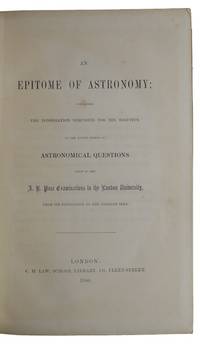
1853TA4<p>8vo. 6 9-58pp complete despite this apparent pagination jump which is found in all copies. With ten lithographed plates lettered A-D and numbered I-VI. Original publisher's blind-stamped blue cloth. Slightly rubbed to extremities offsetting to glassine interleaving else a crisp copy. Inscribed 'To Fred Bone with the donor's best wishes. Percy House Christmas 1864' to FFEP.</p><p>A rare and fabulously illustrated series of answers designed for students of the A.B. Pass examinations in the early years of the London University founded as a secular alternative to Oxford and Cambridge in 1835. The authorship not explicitly stated is inferred from the preface - which is signed Grove School York where the schoolmaster and popular text-book writer John Tabor taught - notes the work is excerpted and extended from 'An Outline of the London University Course of Mathematics containing the Questions Solutions" &c'. Moreover the plates lettered A-D are captioned 'From a Series of Drawings by J. Tabor Grove School York'.</p><p>The thoroughly detailed model answers include significant reference to the planets of our solar system including the then recent discovery of Neptune 'justly considered one of the greatest achievements of mathematical science. Its existence was simultaneously inferred by Adams and Le Verrier from some irregularities which were noticed in the motion of Uranus'.</p><p>COPAC and OCLC together locate copies at just four British institutions BL Cambridge Oxford and NLS and none elsewhere.</p> C.H. Law, School Library. hardcover
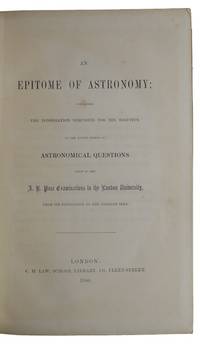
1853AQ26197London: C.H. Law School Library 1853. 6 9-58pp complete despite this apparent pagination jump which is found in all copies. With ten lithographed plates lettered A-D and numbered I-VI. Original publisher's blind-stamped blue cloth. Slightly rubbed to extremities offsetting to glassine interleaving else a crisp copy. Inscribed 'To Fred Bone with the donor's best wishes. Percy House Christmas 1864' to FFEP. A rare and fabulously illustrated series of answers designed for students of the A.B. Pass examinations in the early years of the London University founded as a secular alternative to Oxford and Cambridge in 1835. The authorship not explicitly stated is inferred from the preface - which is signed Grove School York where the schoolmaster and popular text-book writer John Tabor taught - notes the work is excerpted and extended from 'An Outline of the London University Course of Mathematics containing the Questions Solutions" &c'. Moreover the plates lettered A-D are captioned 'From a Series of Drawings by J. Tabor Grove School York'. The thoroughly detailed model answers include significant reference to the planets of our solar system including the then recent discovery of Neptune 'justly considered one of the greatest achievements of mathematical science. Its existence was simultaneously inferred by Adams and Le Verrier from some irregularities which were noticed in the motion of Uranus'. COPAC and OCLC together locate copies at just four British institutions BL Cambridge Oxford and NLS and none elsewhere. . First edition. 8vo. C.H. Law, School Library hardcover
181155122London: Printed for J. Johnson and co. St. Paul’s Churchyard 1811. 8vo. viii 384 pp. Copper-engraved frontisp. 19 copper-engraved plates most folding. Black half-calf over marbled boards gilt lettering on spine rebacked minor wear to corners rubbing occasional light foxing still VG copy from the library of Charles Douglas Halford 1793-1865 attended Cambridge and finished MA by 1826 East Bergholt Suffolk squire. Sixth revised & expanded edition of Bonnycastle’s 1751-1821 informative work astronomy and astronomical instruments. His astronomy textbook first issued in 1786 was designed for students without a mathematical background and proved so popular it continued to be used until the 1820s. Printed for J. Johnson and co., St. Paul’s Churchyard, hardcover
181155844Philadelphia: Published by Kimber and Conrad No. 93 Market Street T.& G. Palmer printers 1811. 8vo. 4 242 pp. Numerous text diagrams and engravings 1 large folding copper-engraved plate at rear for the appendix. Contemporary speckled tree calf gilt ruling on spine red & gilt morocco spine label slight bumping rubbing to corners minor shelfwear very light occasional toning still VG bright copy. First American edition stated of the author’s informative work on astronomy including sections on determining longitude and latitude the discoveries of Kepler the Transits of Venus and Mercury as well as being the first introduction to the American market of the observations by Nevil Maskelyne on the Great Trigonometrical Survey reprinted in this volume. This copy includes the very scarce folding plate often lacking. Vince 1749-1821 was a mathematician astronomer and clergyman at the Univ. of Cambridge awarded the Copley Medal in 1780. Published by Kimber and Conrad, No. 93, Market Street, T.& G. Palmer, printers, unknown
1856D16855Boston: Little Brown and Company 1856. First Edition. Paperback. Good. 8vo. Original tan printed wrappers; rear wrapper detached. 50pp. First Edition. Inscribed by the author to John Pendleton Kennedy American writer and friend of E. A. Poe. Everett was a U.S. Senator and a great orator. It was his address on the field of Gettysburg that preceded the most famous address in U.S. history by Lincoln. In the present oration Everett discusses Charles Babbages newly developed Calculating Engine wherein he mentions asking Babbage if the device could ever be made small enough to one day to fit in ones own pocket. <br/><br/> Little, Brown and Company paperback
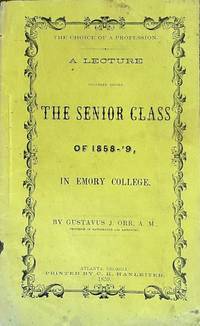
185936176Atlanta: Printed by C. R. Hanleiter 1859. First Edition. Wraps. Good. Stitched wraps. 16 pages. Yellow outer wraps present. A couple of dried spots on the front cover. Moderate toning to the contents. <br /> <br /> Emory College was founded in 1836 in Oxford Georgia. It was named after Methodist bishop John Emory. The main College relocated to Atlanta in the early 1900's and was renamed Emory University. The Oxford Emory College campus is still open today and is part of Emory University. Early Atlanta imprint by C. R. Hanleiter one of the first printers in Atlanta. Printed by C. R. Hanleiter unknown
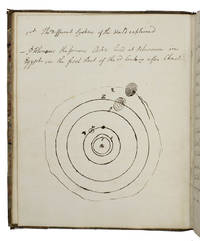
1820ABC_45977England 1820. Late 18th-century half calf marbled sides. 4to. Manuscript volume of notes on practical astronomy and mathematics in English written in ink on Dutch paper with a Maid of Dordrecht watermark without countermark. The leaves are numbered from the front 101 and 26 leaves of text and diagrams 39 blank leaves in the middle last 26 leaves in reverse order illustrated with several astronomical and mathematical diagrams including one of a solar system. A fascinating manual of astronomy written in English particularly as it relates to the form of the motions of the heavens dating from the period 1780-1825 probably from the beginning of that range. It is written in a single hand with the exception of one page though with some variations indicating that different parts of the MS were written at different times. The MS could have been prepared for personal use or as part of public tuition probably the former. The writer summarizes the subject matter of the manual on the first leaf: Astronomy is that part of Natural Philosophy which treats of the Phenomena of the heavenly Bodies. It is divided into 2 Parts Physical and Plain: by the latter we discover their Motions from the Apparent Motions; by the former the Causes of these real Motions. The manuscript comprises three parts with distinct subject matter. The first part covers the motion of the earth around the sun and its rotation about its axis with the consequences for the apparent motions of the sun and the heavens; with the moon and its phases and motion; and with lunar and solar eclipses. There are several references to John Keills An introduction to the true astronomy London 1721 or later editions. The second part principally discusses section 11 of Newtons Principia 1713 or later editions in particular as it relates to the motion of the moon. This part ends with a short section on algebra particularly polynomials which seems to have been composed more haphazardly than the remainder of the text. The third part which runs backwards starting from the end of the notebook gives demonstrations of various results in Book I of Principia notably the theorem that the orbits of the bodies in the solar system do not precess if and only if the central attractive force operating on them is exactly inverse-square. This is an important result not only for Newtons system of universal gravitation but also for the observational astronomy of the solar system which is discussed in the opening section of the book. Between the end of the second part and that of the third there are a few blank leaves and others have been torn out but the text appears to be complete.The manuscript appears to work through at least two different texts beginning with Keills on astronomy. There is a section devoted to what is called the precession of the equinoxes the westward drift of the points where the ecliptic and equator intersect due to the precession of the earths axis - the author notes that Sir Isaac Newton has demonstrated that it arises from the broad spheroidal figure of the earth. The author then turns to sunspots and the arguments for and against their being on the surface of the sun. Then comes a long discussion of the planets: the planes and periods of their orbits phases conjunctions retrograde motions apparent brightness and their distances from the sun. The second and third parts are notably more mathematical in nature than the first.The third part of the manuscript consists of a reading of various sections of Newtons Principia 1713 or later editions. Again it appears to work through and in some cases repeat Newtons proofs rather than representing a translation or paraphrase. It is not based on Mottes translation nor does it correspond with Thorps partial translation and edition. It does not appear to be based on any other intermediary between Newton and the writer such as Pemberton but to rely on Newtons Latin original here rendered in places pretty exactly into English. It renders propositions 43 to 59 of section 9 of book 1 of the Principia which concern the motion of bodies in moveable orbits and the motion of the apsides. This topic remains of considerable interest to astronomers and historians of astronomy. The manuscript hand remains fairly constant throughout the book: some variations more likely indicate the same writer at a different times or with a different pen than a different writer. The manuscript hand and paper together date the manuscript fairly securely to the period 1750-1825. If our hypothesis that the author used Thorps edition of Principia is correct that would date the manuscript no earlier than 1777. The section on the planets in the first part does not mention Uranus Georgium sidus discovered by William Herschel in 1781. Since the anonymous author seems to have followed astronomical discoveries closely this suggests a date no later than 1781. We therefore tentatively date the composition ca. 1777/81.We are indebted to Scott Mandelbrote for his assistance with the description of this notebook.Binding slightly rubbed. A couple pages have a tear at the foot and others are stained. Otherwise in very good condition. unknown
1871830281871. PERIODICALS - ASTRONOMY. MEMOIRS OF THE ROYAL ASTRONOMICAL SOCIETY PART I VOL. XXXIX 1870-1871: ON THE GRAPHICAL CONSTRUCTION OF A SOLAR ECLIPSE BY PROF. ARTHUR CAYLEY. London: Published by the Society 1871. 17 pp. 1 two-color plate a diagram. 4to. text side-sewn within printed paper wrappers. Wrappers are age-toned and split along spine with a Small pencil initial to top of front wrapper. Text and plate clean and fresh. Very good. unknown
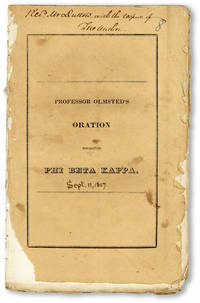
182744516New Haven: Hezekiah Howe 1827. First Edition. Octavo 23.5cm.; publisher's peach wrappers printed within double rule; 24pp. Previously removed from larger volume coin-sized loss at bottom spine edge of upper cover not approaching text upper wrapper fore-edge rather chipped some soil and foxing later ink shelf number to upper cover and title page else Good to Very Good overall. Inscribed at head of front cover: "Revd. Mr. Duttow with the respect of the author." Address by the American physicist who would pioneer the study of meteor science in 1833 following the Leonid Meteor Shower over North America becoming the first American to observe Halley's Comet in 1835. SHOEMAKER 30115 misspelling author name "Olmstead". Hezekiah Howe unknown
189650094Lynn MA: Nichols Press 1896. First Separate Edition. Octavo 23.5cm.; publisher's cream stitched card printed wrappers; 12pp. Wrapper extremities rather toned and brittle with a few small chips to extremities else Good and internally sound. Obituary of the late astronomer Benjamin Apthorp Gould 1824-1896 first published in the "Boston Transcript" December 12 1896. Nichols Press unknown
187248012New York: D. Van Nostrand 1872. First Edition. Presentation copy inscribed "To Commander J.S. Skerrett with the regards of the author" undated but apparently contemporary. Octavo; publisher's pebbled cloth stamped in gilt and blind; 11416pp. Errata slip inserted folowing author's introduction; 16pp publisher's catalog of "Naval Books." Bit of discoloration at base of front cover; private library stamp to front endpaper and title page; Very Good. A basic treatise on astral navigation written as a textbook for students at the U.S. Naval Academy where the author was an assistant professor in the Department of Astronomy. Inscribed to J.S. Skerrett at this time commanding officer of the U.S.S. Portsmouth. A nice copy of what was according to a contemporary review in the journal Popular Science ".a harmful book being full of doubtful statements of confused mathematics and questionable precepts and one not likely to improve the art of navigation or the science of nautical astronomy in any way. D. Van Nostrand unknown
1810d1090bLondon: Dudley Adams. G : in Good condition without dust jacket. Cover rubbed scuffed and stained. Heavy marginal staining in early pages. Some foxing. Marginal staining to some plates. 1810. 30th Edition. Brown hardback half-leather cover with marbled boards. 210mm x 130mm 8" x 5". xxiv 242pp. 14 b/w plates some folding. . Dudley Adams hardcover
1896022957Cambridge: At the University Press 1896. First Edition First Printing . Hardcover. Fair/No Jacket. 8vo - over 7¾ - 9¾" tall. 8vo. 414 pages indexed. Hardcover bound in blue cloth. Rubbing and wear to the binding with the spine of the headcap a bit chipped or frayed. An ex-library copy with minimal markings. Bookplate on front pastedown empty pocket on rear pastedown and a scratched-out number at the lower left corner of the title page. The top right corner of the title page is clipped. A sound copy with secure inner hinges. Text is clean. George Biddle Airy 1801-1892 was an English mathematician and an astronomer who helped map the courses of a number of planets. He also helped establish Greenwich as the prime meridian. <br/> <br/> At the University Press hardcover
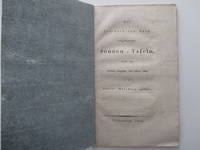
180915525AB1809. Eisenberg 1809. 215 : 13 cm. 37 pages. Contemporary wrappers. First edition. - Zach was one of the first scientist who was keen to spread the knowledge about astronomy to a broader audience. unknown
1803002528London: J. Johnson 1803. Fourth edition. Hardcover. Fair. 8vo 443 pages 3/4 calf top cover detached; ex libris James Shuter with his leopard bookplate. <br/><br/>Illustrated with copper-plates. "He was appointed Professor of Mathematics at the Royal Military Academy Woolwich." J. Johnson hardcover
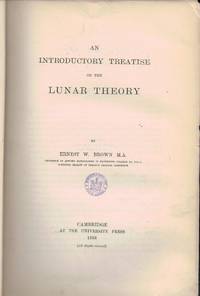
1896g5137Cambridge: Cambridge University Press. G : in good condition without dust jacket. Boards rubbed with wear to corners. Ex Newcastle reference library. 1896. First Edition. Blue hardback cloth cover. 270mm x 190mm 11" x 7". xvi 292pp. . Cambridge University Press hardcover
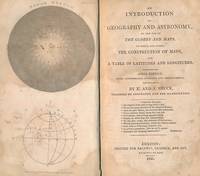
1821r7650London: Baldwin Cradock & Joy. Worn condition. Boards detached. Prelims stained with ink inscriptions. Some foxing but content in overall good condition. 1821. Sixth Edition. Brown hardback leather cover. 180mm x 110mm 7" x 4". xvi 392pp. . Baldwin, Cradock, & Joy hardcover
1867021213Clarendon Press: 1867. 816 pages 224 illustrations. "Astronomy is not cultivated in this country either as a study or as a recreation to the extent that it is on the Continent of Europe and in America. I am not exactly prepared to say why this should be so but perhaps a clue can be found. There is a lack of works in the English language which are at one and the same time attractive to the general reader serviceable to the student and handy for purposes of reference to the professional Astronomer; in fact of works which are popular without being vapid and scientific without being unduly technical." VERY GOOD- HARDCOVER . Brown cloth worn at spine edges and corners of book else a nice clean tight copy. Bookplate on the front pastedown. . Hard Cover. Very Good-/Not Issued with a Dust Jacket. 8vo - over 7¾" - 9¾" tall. Clarendon Press: Hardcover