68 résultats
1842SZEPEBKS007872IToledo: J. de Cea 1842. Hardcover. Near Fine. 16mo. - 4782 pp. - Contemporary full leather spine with 3 bands and title in gilt on leather label. - Marbled endpapers. - With "Fe de algunas erratas mas principales" on last page. - With engraved bookplate in red and black of Armando Colarelo Valledor. - Very fine. - The Spanish astronomer and mathematician Jose REGUERO ARGUELLES 1803-1853 of Asturias established his fame with the present work and later he also published a three-volume "Astronomia fisca" 1850-51. - Armando Colarelo Valledor 1879-1850 was a prolific Spanish playwright and literary critic. - Very rare: WorldCat gives only two locations Biblioteca Nacional de Espana Madrid and Red de LecturaPublica de Euskadi. Vitoria -gazteiz <br/> <br/> J. de Cea hardcover
183126848Berlin: Akademische Druckerei. Very Good. 1831. First Edition. Original Wraps. An attractive first edition of Hansen's first major work incl. Addendum Nachschrift on pp 316 - 326 in original blue wrappers; many leaves still unopened. Some very minor spotting on a few leaves; The study of the mutual perturbations of Jupiter and Saturn by professor and theoretical astronomer Peter Andreas Hansen 1795-1874 director of Ernestinische Sternwarte in Seeberg prized by the Royal Academy of Sciences in Berlin July 8 1930; 4to; xvi 326 2 pages; DSB VI p. 103. § DSB VI p. 103; Poggendorff I 1013; Cat. Of Crawford Library p. 220; not in Houzeau-Lancaster. . Akademische Druckerei paperback
1895024390Rostock Germany 1895. Good condition. Brief illegible ink note on cover. Minor crease. 1895. First Edition. Bound in the blue original wraps stamped in black. This is from the library of and bears the small ink stamp of American mathematician Temple Rice Hollcroft 1889 - 1967. Hollcroft received B.S. in 1912 and A.B. in 1914 from Hanover College and then A.M. in 1915 from the University of Kentucky. He received his Ph.D. in 1917 from Cornell University under Virgil Snyder. Hollcroft was a mathematics professor at Wells College from 1918 to 1954 from which he retired as professor emeritus. Hollcroft served for 14 years as Associate Secretary of the American Mathematical Society. In 1932 in Zurich he was an Invited Speaker of the International Congress of Mathematician ICM. His subject was THE GENERAL WEB OF SURFACES AND THE SPACE INVOLUTION DEFINED BY IT . Being invited to talk at the ICM has been called "the equivalent of induction to a hall of fame." - from Wikipedia. First Edition. Softcover. Good condition. Illus. by NOT a library discard. 9 pages. Great Packaging Fast Shipping. Paperback
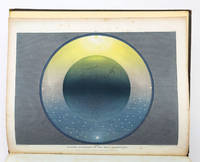
1846ST19286London: Printed by Catchpool & Trent for Simpkin Marshall & Co 1846. FIRST EDITION. 320 x 255 mm. 12 1/2 x 10". xiii 3 96 pp. <br/> Publisher's original blind-decorated dun-colored cloth gilt titling to upper cover smooth spine newer endpapers. WITH 11 COLOR ENGRAVINGS after Frost by W. P. Chubb & Son printed in oil colors by George Baxter all with original tissue guards. Front free endpaper with small ink signature of John Hill. See: Francis Reid "Isaac Frost's 'Two Systems of Astronomy' 1846: Plebeian Resistance and Scriptural Astronomy" in "The British Journal for the History of Science" Vol. 38 No. 2 Jun. 2005 pp. 161-177. Cloth rather spotted corners bumped but the binding solid with no wear to joints or hinges. A few spots of foxing to title page half of the tissue guards with overall very faint foxing/browning the illustrations with minor foxing at edges and in margins but the images themselves clean and bright and all in all a really excellent copy the text wide-margined and quite clean and fresh and the plates with rich coloring.<br/> <br/> Illustrated with beautiful color plates this anti-Newtonian work promotes a view of the universe based on the backward-looking beliefs professed by a Protestant sect known as the Muggletonians. Named after co-founder Lodowicke Muggleton the Muggletonians emerged in London in 1651 based on the claims of two tailors who professed to be the "Last Witnesses" described in the Book of Revelation. Rejecting the new directions in philosophical reason Muggletonians believed in a purely scriptural interpretation of the universe. According to E. P. Thompson's 1994 "Witness Against the Beast" the Muggletonians had curious notions quite contrary to other Protestant denominations: they believed that the soul is mortal that Jesus and God are one and the same that Heaven was left without divine supervision from Jesus' death until the day of judgment that Heaven resides six miles above the Earth that God stands between five and six feet tall and other unconventional things. Although the sect initially avoided both worship and evangelizing during the 19th century some followers became more outspoken about their beliefs and even published books appealing to the general public. Our author Isaac Frost 1793-1858 was a prominent Muggletonian and successful owner of a brass foundry who along with his brother Joseph invested large sums to promote their belief system--the present work being an especially notable example. Divided into two main sections the text first describes the Newtonian system of heliocentric astronomy and then turns to Frost's scriptural interpretation and geocentric views. As Reid tells us "According to Frost Scripture clearly states that the Sun the Moon and the Stars are embedded in a firmament made of congealed water and revolve around the Earth that Heaven has a physical reality above and beyond the stars and that the planets and the Moon do not reflect the Sun's rays but are themselves independent sources of light. Our book was apparently written as a reaction against the lecturers who expressed Newtonian astronomy--which was often for them and their audiences simply shorthand for heliocentrism." The 11 plates that illustrate these extraordinary ideas are the work of George Baxter a pioneering printer who revolutionized color printing techniques by combining metal engravings with woodblock printing using oil-based inks to produce high-quality affordable prints. The plates here are appropriately ethereal and otherworldly utilizing a beautiful palette with subtle gradations and esoteric figures to create memorable pseudo-scientific imagery. Although this work appears at auction with some regularity it is almost always incomplete no doubt because the attractiveness of its plates encourages harvesting. Useful price comparisons include a complete copy said to be in fine condition selling for £7500 in 2016 and six loose prints from the book fetching £6875 in 2015. [Printed by Catchpool & Trent for] Simpkin, Marshall, & Co unknown
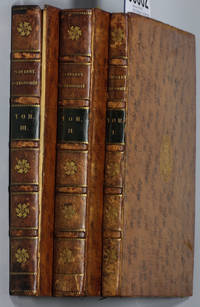
182235002St Petersbourg Russia: L'Academie Imp. Des Sciences. Good with no dust jacket. 1822. First Edition. Hardcover. Quite beautiful full calf leather. 10 folding engraved plates. 8 xvi 286; 4 x 568; 4 viii 524 pages including half-titles. 3 volumes. 4to 256x214 mm contemporary calf gilt with Signet Library arms on covers Volume 3 front cover detached others covers starting; minor foxing on Volume 1 opening leaves. St. Petersburg: Imprimerie de l'Académie Impériale des Sciences 1822. First edition in French of Schubert's 1798 Theoretische Astronomie. Houzeau & Lancaster 11811. Paper stamps inside front covers Libraire Alain Brieux withdrawn. According to Google this was a bookstore of Science and medicine. Printed in Russian Empire under the rule of Alexander I Tsar of Russia 18011825 who ruled during the chaotic time of the Napoleonic Wars. He died without issue and the Decembrist revolt of liberal army officers resulted in his brother Nicholas I being crowned. From the GUTZWILLER ASTRONOMY &SCIENCE BOOKS collection. . L'Academie Imp. Des Sciences hardcover
1893037662New York: Macmillan And Co 1893. 2nd Edition 1st Printing. Hardcover. Very Good. 404 Pp. 7 Pp Publisher's Ads At Rear.New Edition Revised Throughout By The Author . January 1893". Tan Cloth Stamped In Black And Red. Lightly Used A Few Tiny Frays Along Bottom Edge Of Spine Hinges Solid Spine Leaned. Handwritten Name Of "George Ellery Heale" And Direct From The Astronomer George Ellery Hale's Personal Library But Does Not Match Examples Of His Signature Nor Of Crawford's; Possibly A Gift To Hale. <br/> <br/> Macmillan And Co hardcover
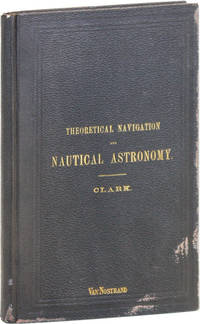
187248012New York: D. Van Nostrand 1872. First Edition. Presentation copy inscribed "To Commander J.S. Skerrett with the regards of the author" undated but apparently contemporary. Octavo; publisher's pebbled cloth stamped in gilt and blind; 11416pp. Errata slip inserted folowing author's introduction; 16pp publisher's catalog of "Naval Books." Bit of discoloration at base of front cover; private library stamp to front endpaper and title page; Very Good. A basic treatise on astral navigation written as a textbook for students at the U.S. Naval Academy where the author was an assistant professor in the Department of Astronomy. Inscribed to J.S. Skerrett at this time commanding officer of the U.S.S. Portsmouth. A nice copy of what was according to a contemporary review in the journal Popular Science ".a harmful book being full of doubtful statements of confused mathematics and questionable precepts and one not likely to improve the art of navigation or the science of nautical astronomy in any way. D. Van Nostrand unknown
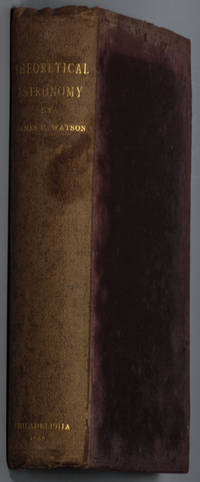
186835004N Y: Lippincott. Very Good with no dust jacket. 1868. First Edition. Hardcover. 662 pages. 8vo 255x165 mm original cloth spine faded and stained peripheral discoloration on covers; scattered minor spotting. Small loss tocloth covering towards bottom of front hinge. Hinges binding and text block quite solid. First edition of the author's major work. 'It established Watson as one of the leading American experts in celestial mechanics and orbital theory' ANB. BEA pages 1198-99; Houzeau & Lancaster 11822. PROVENANCE-Astronomy and Science Books from the Collection of Martin C. Gutzwiller. . Lippincott hardcover
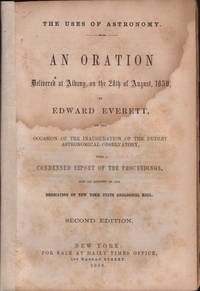
18561620Albany: Charles van Benthuysens Print 1856. First Edition. Engraved Portrait after a photograph by Mathew Brady. 1 vols. 8vo. Later 3/4 brown morocco over marbled boards spine gilt with raised bands bound by Stikeman. Extremities slightly rubbed; a Very Good copy. First Edition. Engraved Portrait after a photograph by Mathew Brady. 1 vols. 8vo. In addition to the "Discourse" by Everett this book issued in honor of the dedication of the Dudley Observatory at Albany contains various speeches and a long poem dedicated to the American Association for the Advancement of Science by Alfred B. Street. The speeches include a eulogy by Washington Hunt and remarks by A. B. Gould Benjamin Pierce and A.D. Bache. The Observatory had not as yet been built when this book was published. This was simply it seems a celebration of sorts given in honor of the donors of funds to build it. Mr. Dudley's widow to whom the discourse is dedicated was the most generous of donors pledging the then enormous sum of $12000. Although other editions of the "Discourse" with condensations of the events appear in NUC there seems to be no copy of this edition located. Charles van Benthuysens Print unknown
1856D16855Boston: Little Brown and Company 1856. First Edition. Paperback. Good. 8vo. Original tan printed wrappers; rear wrapper detached. 50pp. First Edition. Inscribed by the author to John Pendleton Kennedy American writer and friend of E. A. Poe. Everett was a U.S. Senator and a great orator. It was his address on the field of Gettysburg that preceded the most famous address in U.S. history by Lincoln. In the present oration Everett discusses Charles Babbages newly developed Calculating Engine wherein he mentions asking Babbage if the device could ever be made small enough to one day to fit in ones own pocket. <br/><br/> Little, Brown and Company paperback
185634176New York: Daily Times Office 1856. Second Edition. Wraps. Fair. Disbound wraps. Approx. 8" x 5.5". New paper spine. 41 pages 1 page blank. Persistent brown stain through the upper section of the pages. Everett's speech touches upon the Voyage of Hendrick Hudson; Discovery of the Hudson River; Champlain's Voyage and the Growth of Colonies; Galileo's Discoveries; Early Days of Albany; New Amsterdam; Scientific Progress Wonders of Astronomy the Telescope; Geographical Science and more. Title first printed by Little Brown and Company in Boston the same year. Daily Times Office unknown
1898622237Boston: Houghton Mifflin and Co. 1898. First edition hard cover with a loose plastic jacket no dust jacket both in very good condition. Green cloth boards have gilt title and author to front board gilt book details to spine. Gilt pageblock head present. General shelf and handling wear including light creasing and wear to board edges spine head and foot with tanning to pageblock this leading into pastedowns and page edges. The lower half of page 331 is damaged at the leading edge caused by the careless cutting of the leaves upon first use; page 330 has the narrow strip still attached to its own leading edge. Otherwise content is unmarked pages tightly bound. CN. First Edition. Hardcover. Very Good/No Dust Jacket. Houghton Mifflin and Co. Hardcover
1896045659New York: D. Appleton And Company 1896. 2nd Edition . Hardcover. Very Good. Plates. Xii 363 Pp. Three Quarter Morocco Over Marbled Boards Top Edge Gilt. Lightly Used But A Little Fraying Along Top Edge Of Spine Which Also Has A Few Faint Damp Spots. Bookplate Of Mary D. Sternbergh Widow Of J. H. Sternbergh Of Reading Pa Who Left A Fortune Of Over $2000000 In 1913. <br/> <br/> D. Appleton And Company hardcover
1887053297New York: John B. Alden 1887. Reprint . Hardcover. Near Fine. 183 Pp. Greenish-Black Cloth Stamped In Blind. Reprint 1887. Near Fine But A Few Pencil Notes And Underlinings. Per Wikipedia Ormsby Macknight Or Mcknight Mitchell 1810 -1862 Was An American Astronomer And Major General In The American Civil War. A Multi-Talented Man He Was Also An Attorney Surveyor Professor And Publisher. He Is Notable For Publishing The First Magazine In The United States Devoted To Astronomy. Known In The Union Army As "Old Stars" He Is Best Known For Ordering The Raid That Became Famous As The Great Locomotive Chase During The American Civil War. <br/> <br/> John B. Alden hardcover
1803046362Philadelphia: Published by Jacob Johnson 1803. First American Edition . Hardcover. Good. 16mo - over 5¾ - 6¾" tall. 16mo. 137 3 pages. Hardcover bound in original full brown leather. The binding shows wear and bumping but is sound with rubbed but secure hinges. Headcap of the spine is chipped. Small wormhole near the foot of the spine. Complete with endpapers and illustrated with 5 full-page copperplate engravings collates complete as well as several smaller text woodcuts. Early owner's signature on the recto of the frontis reads "Solomon Mordecai / Warrenton North Carolina Jan.y. 1st 1804." Another early signature for "Jos. Mordecai" is at the top of the title page. The Mordecai family was an important Jewish family in eastern North Carolina in the late 18th and early 19th centuries. Jacob Mordecai founded the Warrenton Female Academy in 1809 and was assisted by his son Solomon and several daughters. This title was first published in 1761 by John Newbery in England thought to have actually be written by Oliver Goldsmith under the pseudonym of Tom Telescope. It was a science book written for youth. This is the First American edition. The Second American edition of 1808 is much more common. The "Teacher of Philadelphia" referred to on the title page is believed to have been Robert Patterson Professor of Mathematics at the University of Pennsylvania. This is a decent sturdy copy of a rare and important edition. <br/> <br/> Published by Jacob Johnson hardcover
1805037262Oxford: Clarendon Press 1805. Reprint . Hardcover. Very Good. Xxiv 389 Pp. Volume I Only With Lives Of Donne Wotton And Hooker Only. Full Calf Re-Backed Neatly To Style Gilt. From Library Of Astronomer George Ellery Hale Dated In London In 1910 But That Inscription Has Been Clipped Away Not Present. . <br/> <br/> Clarendon Press hardcover
18112222177<p>Fifth edition. 16mo. Frontispiece pictorial title page with secondary title "The Ruins or A Surrey of the Revolutions of Empires." Later full gilt stamped green leather. Folding map; folding astrological chart at end. Very good. 232 pages.</p><p>Printed by Plummer and Brewis Love-Lane Little Eastcheap.</p><p>Bookplate of poet and critic Vivian De Sola Pinto 1895-1969.</p> Printed for Thomas Tegg hardcover
1871484427N. J. Newark 1871. Hardcover in good condition. No jacket. 29 pages with one-page appendix. Boards are lightly marked and edge-worn. Minor bumps on spine. Page block and pages are lightly marked and tanned. Light creases throughout pages. Minor tears on lower edges of FEP and title page. Text is clear throughout. HCW. Hardcover. Good. Used. N. J. Newark Hardcover
181155844Philadelphia: Published by Kimber and Conrad No. 93 Market Street T.& G. Palmer printers 1811. 8vo. 4 242 pp. Numerous text diagrams and engravings 1 large folding copper-engraved plate at rear for the appendix. Contemporary speckled tree calf gilt ruling on spine red & gilt morocco spine label slight bumping rubbing to corners minor shelfwear very light occasional toning still VG bright copy. First American edition stated of the author’s informative work on astronomy including sections on determining longitude and latitude the discoveries of Kepler the Transits of Venus and Mercury as well as being the first introduction to the American market of the observations by Nevil Maskelyne on the Great Trigonometrical Survey reprinted in this volume. This copy includes the very scarce folding plate often lacking. Vince 1749-1821 was a mathematician astronomer and clergyman at the Univ. of Cambridge awarded the Copley Medal in 1780. Published by Kimber and Conrad, No. 93, Market Street, T.& G. Palmer, printers, unknown
185054740London: John Kendrick 1850. Revised edition. . Hardcover. G/No Jacket. 12mo - over 6¾" - 7¾" tall. Covers edge-rubbed and bumped and worn at corners; light foxing to frontis;; wear to head and tail of spine; all edges gilt; 218p frontis. Size: 12mo - over 6¾" - 7¾" tall <br/> <br/> John Kendrick hardcover
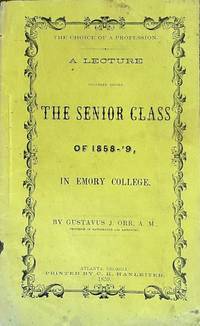
185936176Atlanta: Printed by C. R. Hanleiter 1859. First Edition. Wraps. Good. Stitched wraps. 16 pages. Yellow outer wraps present. A couple of dried spots on the front cover. Moderate toning to the contents. <br /> <br /> Emory College was founded in 1836 in Oxford Georgia. It was named after Methodist bishop John Emory. The main College relocated to Atlanta in the early 1900's and was renamed Emory University. The Oxford Emory College campus is still open today and is part of Emory University. Early Atlanta imprint by C. R. Hanleiter one of the first printers in Atlanta. Printed by C. R. Hanleiter unknown
1874A47183Philadelphia PA: J. B. Lipincott & Co. . 1874. First American Edition; First Printing. Hardcover. Very Good-. This book is in Very Good- condition and is lacking a dust jacket. The spine ends corners and edges of the book covers have bumping rubbing and fraying. Both top and bottom edges of of the spine have chips torn off. The text pages are generally clean though there are spots of foxing throughout. There is a previous owner's inked name and address on the first free page. "Proctor was elected a fellow of the Royal Astronomical Society in 1866. He became honorary secretary in 1872 and contributed eighty-three separate papers to its Monthly Notices. Of these the more noteworthy dealt with the distribution of stars star clusters and nebulae and the construction of the sidereal universe. He was an expert in all that related to map-drawing and published two star-atlases. A chart on an isographic projection exhibiting all the stars contained in the Bonner Durchmusterung was designed to show the laws according to which the stars down to the 9–10th magnitude are distributed over the northern heavens. His Theoretical Considerations respecting the Corona Monthly Notices xxxi. 184 254 also deserve mention as well as his discussions of the rotation of Mars by which be deduced its period with a probable error of 0.005. He also vigorously criticised the official arrangements for observing the transits of Venus of 1874 and 1882. He was elected as a member to the American Philosophical Society in 1874." from Wikipedia ; 438p. pages . J. B. Lipincott & Co. hardcover
189620110417127901Ginn & Company 1896. Hardcover. Acceptable. Top and bottom spine slightly torn; boards have minor scratches; owner's name and date on blank facing page; binding and text tight and clean old water damage to cover cracked cover Ginn & Company hardcover
1872045652Boston: Estes and Lauriat 1872. Hardcover. Very Good/No Jacket. 12mo. Offprint or continued publication of a larger work. Pages 55-177 3 as issued. Hardcover bound in original brown cloth with spine titles in gilt. Moderate rubbing and wear to the binding. The spine has some white shelf numbers partly rubbed off at the headcap. An ex-library copy with a removed bookplate on the front pastedown and a library blind stamp on the title page. A sound copy with secure inner hinges and clean text. Contains two color plates including the frontis and several black and white text illustrations. This appears as an offprint but in fact it was published this way as a regularly published stand-alone work. It details the science of ascertaining information of distant stars the composition of their gasses etc. through analysis of the the light through telescopes. This was a ground-breaking tool in observing the universe beyond our solar system in the 19th century. <br/> <br/> Estes and Lauriat hardcover
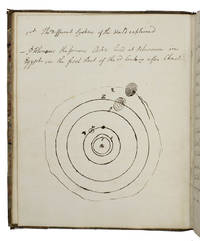
1820ABC_45977England 1820. Late 18th-century half calf marbled sides. 4to. Manuscript volume of notes on practical astronomy and mathematics in English written in ink on Dutch paper with a Maid of Dordrecht watermark without countermark. The leaves are numbered from the front 101 and 26 leaves of text and diagrams 39 blank leaves in the middle last 26 leaves in reverse order illustrated with several astronomical and mathematical diagrams including one of a solar system. A fascinating manual of astronomy written in English particularly as it relates to the form of the motions of the heavens dating from the period 1780-1825 probably from the beginning of that range. It is written in a single hand with the exception of one page though with some variations indicating that different parts of the MS were written at different times. The MS could have been prepared for personal use or as part of public tuition probably the former. The writer summarizes the subject matter of the manual on the first leaf: Astronomy is that part of Natural Philosophy which treats of the Phenomena of the heavenly Bodies. It is divided into 2 Parts Physical and Plain: by the latter we discover their Motions from the Apparent Motions; by the former the Causes of these real Motions. The manuscript comprises three parts with distinct subject matter. The first part covers the motion of the earth around the sun and its rotation about its axis with the consequences for the apparent motions of the sun and the heavens; with the moon and its phases and motion; and with lunar and solar eclipses. There are several references to John Keills An introduction to the true astronomy London 1721 or later editions. The second part principally discusses section 11 of Newtons Principia 1713 or later editions in particular as it relates to the motion of the moon. This part ends with a short section on algebra particularly polynomials which seems to have been composed more haphazardly than the remainder of the text. The third part which runs backwards starting from the end of the notebook gives demonstrations of various results in Book I of Principia notably the theorem that the orbits of the bodies in the solar system do not precess if and only if the central attractive force operating on them is exactly inverse-square. This is an important result not only for Newtons system of universal gravitation but also for the observational astronomy of the solar system which is discussed in the opening section of the book. Between the end of the second part and that of the third there are a few blank leaves and others have been torn out but the text appears to be complete.The manuscript appears to work through at least two different texts beginning with Keills on astronomy. There is a section devoted to what is called the precession of the equinoxes the westward drift of the points where the ecliptic and equator intersect due to the precession of the earths axis - the author notes that Sir Isaac Newton has demonstrated that it arises from the broad spheroidal figure of the earth. The author then turns to sunspots and the arguments for and against their being on the surface of the sun. Then comes a long discussion of the planets: the planes and periods of their orbits phases conjunctions retrograde motions apparent brightness and their distances from the sun. The second and third parts are notably more mathematical in nature than the first.The third part of the manuscript consists of a reading of various sections of Newtons Principia 1713 or later editions. Again it appears to work through and in some cases repeat Newtons proofs rather than representing a translation or paraphrase. It is not based on Mottes translation nor does it correspond with Thorps partial translation and edition. It does not appear to be based on any other intermediary between Newton and the writer such as Pemberton but to rely on Newtons Latin original here rendered in places pretty exactly into English. It renders propositions 43 to 59 of section 9 of book 1 of the Principia which concern the motion of bodies in moveable orbits and the motion of the apsides. This topic remains of considerable interest to astronomers and historians of astronomy. The manuscript hand remains fairly constant throughout the book: some variations more likely indicate the same writer at a different times or with a different pen than a different writer. The manuscript hand and paper together date the manuscript fairly securely to the period 1750-1825. If our hypothesis that the author used Thorps edition of Principia is correct that would date the manuscript no earlier than 1777. The section on the planets in the first part does not mention Uranus Georgium sidus discovered by William Herschel in 1781. Since the anonymous author seems to have followed astronomical discoveries closely this suggests a date no later than 1781. We therefore tentatively date the composition ca. 1777/81.We are indebted to Scott Mandelbrote for his assistance with the description of this notebook.Binding slightly rubbed. A couple pages have a tear at the foot and others are stained. Otherwise in very good condition. unknown