3 résultats
189161761London: Longmans Green & Co. 1891. 8vo. viii 426 2 pp. plus 24 pp. publisher’s ads. With 232 woodcut engraved text illustrations & diagrams. Green embossed publisher’s cloth ruled borders at upper & lower fore-edges rebacked black & gilt morocco spine label still G copy w/ former exlib ownership stamps on interior pages. Second edition of this well-illustrated and informative Victorian handbook on use of the magic lantern and many other scientific optical instruments in creating effects for scientific study as well as for exhibition and instruction. Included are significant sections on manipulating the magic lanterns creating glass slides carriers & special effects; colour theory and instruments depicting colour polarizing apparatus magnetism revealed by optical projection and more. Longmans, Green & Co., hardcover
185543859Leipzig Johann Ambrosius Barth 1855. Without wrappes. In: "Annalen der Physik und Chemie. Hrsg. von J.C. Poggendorff" 94. Bd. No 1 "Heft" No 1 1855. Pp. 1-176 a. 4 folded engraved plates. Entire issue offered. Titlepage to vol. 94 small stamp on verso. Fick's paper: pp. 59-86. Helmholtz's paper: pp. 1-28. Clean and fine. <br/><br/><em>First appearance of Fick's importent paper in molecular physics in which he annouced his two laws of diffusion.Fick's first law relates the diffusive flux to the concentration field by postulating that the flux goes from regions of high oncentration to regions of low concentration with a magnitude that is proportional to the concentration gradient spatial derivative. - Fick's second law predicts how diffusion causes the concentration field to change with time. Wikipedia.First appearance of HELMHOLTZ'S fundamental paper in physiological optics in which he examined the sensitivity of the eye for the individual elements of the violet end of the spectrum; he was able to detect a whole series of distinct tones of purple: he alters the name 'invisible rays' to that of 'ultra-violet rays'; discussion of the relations of the wavelenghts of complementary colours and the intensity required if the mixture of simple complementarity colours is to produce white. He answered these questions quantatively. "THE TREATISE the paper offered WHICH HAS BEEN FUNDAMENTAL FOR ALL LATER WORK OF THE SAME KIND concludes with an inquiry into the validity of Newton's Colour Circle which Helmholtz designates as one of the most brilliant inspirations of that great thinker."Leo Koenigsberge "Hermann von Helmholtz" pp. 131-133. </em> unknown
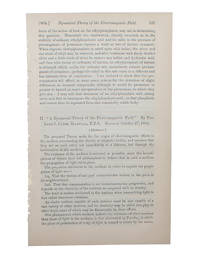
186441709London Taylor and Francis 1864. No wrappers as extracted from"Proceedings of the Royal Society". From November 19 1863 to December 22 1864 inclusive." Vol. XIII. Pp 531-536. <br/><br/><em>First printing of the first announcement of Maxwell unification of light-waves electricity and magnetism the most importent of the papers relating to his electromagnetic theory in which he brought electro-magnetical phenomena on a clear mathematical form. The present paper is an abstract of the larger paper which was read to the Royal Academy in 1864 but only issued the year later 1865 in "Philosophical Transactions of the Royal Society" where it was printed in full and as an abstract in "Philosophical Magazine" 1865."A generation later Einstein's work on relativity was founded directly oupon Maxwell's electromagnetic theory; it was this that led him to equate Faraday with Galileo and Maxwell with Newton." PMM No 355 but only the paper from 1865. - Dibner. Heralds of Science No 68 1865 paper. </em> unknown