21 résultats
185825131Long Island New York: W. R. Burling 1858. Two small 'payment received' for subscriptions to this newspaper one dated 1858- 59 for the Estate of John Tredwell George Burling the agent selling; the other for 1868 Est. of A. L. Sands W. Eldridge the agent. Different type-styles & ornament on each. Approx. 2" x 5" size; old fold lines a little light wear. In good condition and interesting 19th century Long Island newspaper industry history ephemera. Manuscript. Not Bound. Very Good. W. R. Burling paperback books
190025132Inwood N.Y. : C. & G. Parks 1900. Dated March 1 1900; Inwood N.Y. Morris Ave. near McNeil Ave.; to William Willet Jr. Committee of Joseph McKim; for plastering two ceilings. Approx. 6 7/8" x 8 1/4" size; old fold lines a little light wear. In very good condition and interesting early 20th century Long Island construction industry history ephemera. Manuscript. Not Bound. Very Good. C. & G. Parks paperback books
183174280Baltimore: Publisher Not Identified. Good. 1831. Pamphlet. This pamphlet is string-bound soft-bound in tan printed wrappers. There is some light wear to the edges. The binding is solid. the contents are legible but with intermittent foxing and toning throughout. . (Publisher Not Identified) unknown books
18931469852D Cong. 2d Sess.: SED20. 1893. 229pp Disbound Very Good. SED20. unknown books
185938669Providence: Knowles Anthony & Co. Printers 1859. First edition. Stitched paper wrappers. A fair copy lacking rear wrapper and last 16 pages of biographies edge worn chipped bottom fore edge corner for first several leaves wrappers lightly soiled and toned. 182 of 199 pp. 8vo. Provides great detail on agricultural and industrial activity in Rhode Island was well as reviews of technology and agricultural methods. Some biographies. Sabin 70736n. Knowles, Anthony & Co., Printers unknown books
183129476New York 1831. 31 1 pp. Disbound foxed Good. Caption title as issued.<br/><br/> A report on the status of the iron and steel industries and a call for their protection by federal tariff legislation.<br/>AI 7164 4. unknown books
1831WRCAM23722Baltimore 1831. 44pp. Dbd. A bit foxed. Very good. Calls for the continued protection of American industry by duties tariffs and other protective measures. AMERICAN IMPRINTS lists only the Library of Congress copy. AMERICAN IMPRINTS 5637. unknown books
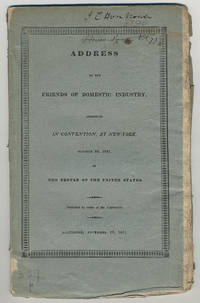
18313680Baltimore: Pr. by Sands & Neilson 1831. 8vo. 44 pp. <br><br>A defense of Congress's power to regulate commerce by imposing tariffs on foreign goods. Contents include a list of members in the back. <br>Â Â Â Â <br>Â Â Â Â Sabin 398; Goldsmiths'-Kress 26742; American Imprints 7163; BAL 11039. Original wrappers. Wrappers torn at spine with rear wrapper separating. Rubber stamps: "New Jersey Historical Society" and "deaccessioned." Ownership signature on front cover. Smudged ink inscription on title-page without touching text. Stains and short tears in upper margins of first few pages. Occasional spots of foxing. Untrimmed. Pr. by Sands & Neilson unknown books
185838668Providence: Knowles Anthony & Co. Printers 1858. First edition. Stitched paper wrappers. A good copy with chipped spine front wrapper detached edges toned contents clean and bright. 131 pp. 8vo. Provides great detail on agricultural and industrial activity in Rhode Island was well as reviews of technology and agricultural methods. Some biographies. Knowles, Anthony & Co., Printers unknown books
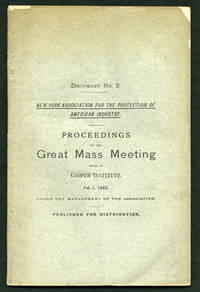
188327291New York: New York Association for the Protection of American Industry 1883. First edition. Stapled paper wrappers. A very good copy with nicks on the spine small chips to the wrappers some edgewear mildly creased leaves clean. 70 pp. 8vo. New York Association for the Protection of American Industry Document no. 2. Peter Cooper's opening remarks could have been written today: "The advocates of free trade . are trying to persuade . people that it is for our interest to buy from other countries all the manufactures that they have to offer. These advocates of free trade propose that our mechanics shall either work at the starvation wages of foreign laborers or be forced to abandon their trades." Other speeches on free trade including William Dodge William Evarts Dexter Hawkins and Cyrus Hamlin President of Middlebury College on the blight of free trade. The ojectives of the New York Association for the Protection of American Industry was: "1. To disseminate ideas favorable to just protection of manufactures. 2. The development protection and advancement of the various industries of the United States. 3. The restoration and development of ocean navigation in American-built ships sufficient for the exigencies of trade commerce and manufactures and for the advantage and safety of the country. 4. The security of the comfort and improvement of workmen and-by encouraging allowances or pensions after long-continued service in important establishments-of their support in old age." New York Association for the Protection of American Industry unknown books
185538667Providence: Knowles Anthony & Co. Printers 1855. First edition. Stitched paper wrappers. A very good copy with small chips and creases to front wrapper spine worn contents bright. xvi 135 pp. 8vo. Includes: ""The Agricultural Wealth of Rhode Island and the Duties it imposes upon her Citizens. An Address before the Rhode-Island Society for the Encouragement of Domestic Industry and the Rhode-Island Horticultural Society at their Fifth Industrial Exhibition in Providence; Delivered September 14 1854 by Rev. William Clift Stonington Ct." with a separate title page. Provides great detail on agricultural and industrial activity in Rhode Island was well as reviews of technology and agricultural methods. Some biographies. William Clift 1817-1890 Amherst graduate pastor of the Stonington Congregational church rote much on agriculture and "was a bold and valiant enemy of rum and tobacco." Sabin 70736n. Knowles, Anthony & Co., Printers unknown books
1870WRCAM52030Utica N.Y.: Curtiss & Childs 1870. 27pp. plus eight lithographic plates. Original brown wrappers printed in gilt. Spine heavily chipped moderate edge wear. Moderate tanning some offsetting from plates. Good plus. A scarce pamphlet documenting the cattle business of William D. Walcott and Samuel Campbell in upstate New York. Walcott and Campbell were initially partners in the cotton business owning one of the factories that gave New York Mills its name but the acquisition of more land in and around the town led them to import and breed significant numbers Shorthorn cattle becoming prominent members of that industry as well. This pamphlet catalogues some of the cattle bred between 1865 and 1869 accompanied by several illustrations of the stock. Not in OCLC. Curtiss & Childs unknown books
188234833La Paz: Imprenta de la Libertad 1882. First edition. Cloth. Title page with chip to top inner edge and neat label with name inked out shallow rough area on fore edge of last few leaves otherwise a very good copy. i 97 1 iii pp. 4to. Bolivian tariffs. Scarce. OCLC shows no copies for this year but Univ. Texas holds similar volumes for 1879 and 1890 and Univ. Illinois has 1894. Parreño sale 70. Imprenta de la Libertad hardcover books
187533711Somverville MA 1875. Broadside 5" x 10". A few old folds. Signed in type by A.T. Small Jas. E. Crawford Able Jones Sarah J. Price and J. Campbell as the Committee on Charges. Official Council blindstamp at the bottom right corner. Very Good. <br/><br/> The Sovereigns of Industry established in 1874 grew out of the Patrons of Husbandry a mutual aid society for farmers. The Sovereigns sought members among all workingmen not just farmers. Its purpose articulated by its founder William H. Earle of Massachusetts was "elevating the character improving the condition of and as far as possible perfecting the happiness of the laboring classes" through the establishment of consumer cooperatives. The cooperative network would allow workers to "control the whole of what they produce and exchange it as near as may be even with other hand-workers thus saving to themselves the fortunes which those who are devoted to manipulating other people's labour and to getting rich thereby have heretofore taken by extortion." Commons John R. et al.: HISTORY OF LABOUR IN THE UNITED STATES: NATIONALISATION 1860-1877 VOLUME II New York: 1921 Pages 172-173. <br/> A scandal occurred in Union Council No. 71 Somerville Massachusetts. A conspiracy to usurp the authority of the Council majority on the location of a new Hall was charged. The conspirators allegedly were guilty of self-dealing by choosing a Hall for their own personal gain. "Riotous disorderly and disgraceful proceedings" erupted.<br/>Not located on OCLC as of May 2017. unknown books
1832WRCAM16639Np 1832. 32pp. Later half calf and marbled boards a very good copy. Rare tariff pamphlet focusing on the evils of free trade. Includes excerpts from Alexander Hamilton's manufactures report and a speech by Calhoun defending the tariff. The NUC locates only one copy at Union College. SHAW & SHOEMAKER 12521. hardcover books
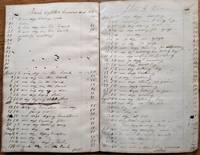
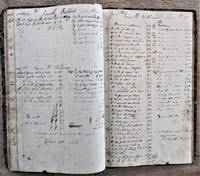
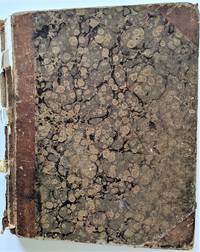
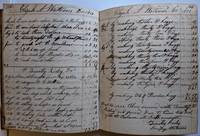
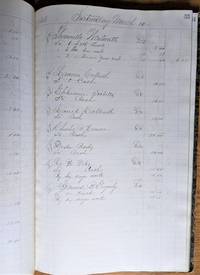
1836765Wolfeboro N. H. 1836. Tall Folio. 385 x 155 mm. 15 ¼ x 6 inches. 68 pp. Contemp. marbled boards leather spine; some minor deterioration to parts of the calf spine a few signatures sprung otherwise a good sound ledger. Cobbler David H. Whitehouse 1807-1839 lived primarily in Wolfeboro Carroll County New Hampshire. This volume of records appears to have kept up to his death at age 33. His wife was Mary M. Giles Whitehouse 1806 - 1899 and they had two children; Joseph and Abigail. Whitehouse's customers came mostly from Carroll County including the towns of Brookfield Conway Moultonborough and Wakefield.  Whitehouse's signature appears on the front fly leaf and on the folio numbered 27. Entries include the date cost and job including various types of shoes; slippers calfskin shoes repairing boots boots and women's shoes. Whitehouse also purchases material for his trade including a shoemaker's seat and tools. The book also includes some household expenses and foodstuffs etc. Customer names include Dudley Pike Ephraim Parsons James C. Perkins John Chadwick Charles Colman Thomas W Mordough Joseph Malcham John Rollins and  Nathaniel Barker to name a few of the local names prominent in the ledger.  The first two pages of the book has a written transcript of the first 11 stanzas of Tennyson's poem "The May Queen'; two stanzas of the "Pirate Song or Serenade"; and a seven-stanza poem "To my Sister" dedicated at the bottom "To my sister Abby." All the text appears to be in the same hand.  . unknown books
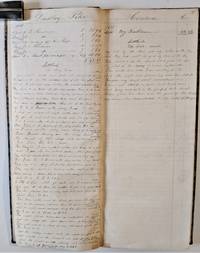
1851859Bellefonte PA 1851. <p>Large 4to.  305 x 200 mm. 12 ¼ x 8 inches. 170 pp. Well used manuscript written in ink. Contemporary calf backed boards; rubbed and a bit worn spine chipped.</p> <br /> <p>This is a ledger account book belonging to John Robison a Pennsylvania shoemaker. Like many artisans in Nineteenth century America Robison found income not only in his trade but also through other sources. Robison farmed the land he lived on selling products such as grain wheat and potatoes. Robison also ran a general store providing neighbors with commodities such as butter flour wool salt and vinegar. Shoemaking however proved to be Robison's most lucrative form of income and there are accounts for heeling. mending "half soaling" and "soaling."</p> <br /> <p>The exact location of Robison's business is difficult to determine although two Pennsylvania towns Bellefonte and Elk Township are both mentioned in the book. Most of the entries are ledger lines naming a customer the service provided or item sold to them and the amount received. In some cases the ledger details wages Robison paid to laborers hired to work his fields who provided services such as plowing and mowing hay. It also seems that Robison occasionally let a spare room in his house to boarders charging two dollars per week.</p> <br /> <p>The most interesting entries do not deal with Robison's business transactions. On one page a "spiritual song" is transcribed. On the facing page is a "cure for the splint" a malady effecting horses. The following page recounts an adventure of Robison in Elk Township in which he assisted a "subscriber" in catching a five year old mare that had escaped his property.</p> <br /> <p>This ledger is a very interesting record of the daily activities of a craftsman in a rural nineteenth century town. It provides a unique look into the means by which such people made their living as well as the workings of rural Pennsylvania markets.</p> <br /> <p> </p> . unknown books
1859855Androscoggin County Maine 1859. <p>Tall folio. 320 x 200 mm. 13 x 8 inches. 85 pp. Contemporary marbled boards calf spine; head of spine chipped and a bit torn; text block foxed. With faults a sound and well-organized ledger written in a legible hand.</p><br /> <p>Early shoemaker's account book from Lisbon Androscoggin County Maine. William Booker 1812-1881 lived with his second wife Martha and several children in Lisbon which is located west of Portland. Although Booker's name does not appear on a title page we derive his name through account settlements in the book.</p><br /> <p>Income and expenses are shown including cost of tanned leather from sheep and calf of various qualities and sizes leather making supplies nails etc. and income is derived from shoes manufacture and repair.  Intermingled with the costs of doing business Booker records in detail the costs of living in the town of Lisbon. His ledger is a veritable roadmap to the economy of the town its residents and its service businesses that he supplied and which in turn supplied his family. </p><br /> <p>Some of the larger customer accounts are Lyman Jordan of Brunswick Ebenezer Combs of Lisbon Ammi Merrill Henry I. Holland Hale Huskey Josiah Fransworth James M. Brickett Jackson Webber and Joshua Remington.  The last few pages of the book show an account for "letting of Horse" Hackett & Webber as well as a total of shoes made from "3rd March 1842"; 1 025 pairs.</p><br /> With fertile and easily cultivated soil farming was an early industry in the small town of Lisbon. Sawmills and gristmills were built using water power from the streams. Larger brick mills followed to manufacture textiles. In 1864 the Worumbo Mill was established to produce woolens and would remain a principal employer until it burned in 1987. By 1880 Booker had changed his profession to stone mason perhaps signifying the phasing out of the handmade shoe industry. unknown books
1846769Boston 1846. 8vo.  230 x 185 mm. 7 ¼ x 9 inches.  114 pp. Contemporary boards leather tips. Spine broken with some signatures sprung.  Written in a legible hand in ink. One of the more detailed account books that documents not only the personal business transactions of a Boston Brahmin but also his payments to dozens of local churches societies poor houses and libraries including his membership dues in the Boston Athenaeum. Freeman Allen was born in 1800 and according to the Abner Forbes in his Book Rich Men of Massachusetts was worth over $ 300000 in 1852. "He began poor. Became of shoe dealer one of the largest in Boston." The business accounts cover personal investments loans income and expenditures of the partnership of Allen Harris & Potter Company Boot Shoe and Leather dealers.  The company was listed in the Boot and Shoe Recorder as ". one of Boston's largest and most successful houses in the shoe trade" Allen Harris & Potter was organized in 1846 and continued until 1853 when Allen's stack was purchased by John Cheney Potter and a new partnership. The account book records the initial investments in Allen Harris and Potter and the terms of the partnership. Among the many transactions listed are a "Store 55-57 Pearl St bought of Dowley for $5500 pd for in cash" "Nov 12 1852 1 share Boston Athenaeum cost $151" stock in third municipality New Orleans many bank and railroad shares and a lot at Mt Auburn. In 1850 he bought two tickets to a Jenny Lind concert. Allen's business brought him wealth and he contributed to the Newton Whig Campaign and bought a piano forte from Chickering. The household kept servants and for his daughter Harriet Elizabeth Allen he paid tuition at Emerson School and for French Lessons and Riding School. For son Henry Freeman Allen he purchased skates a sleigh ride paid for "Mr. Sullivan School" eye glass congress boots and Chess men and board. In 1857 he was paying tuition for his son at Harvard. Freeman Allen married Harriet Reed moved to Newton and had children Henry Freeman Allen and Harriet Elizabeth Allen. His son Henry Freeman Allen 1838-1914 became an Episcopal priest and married Georgiana May Stowe 1843-1890 the youngest daughter of Harriet Beecher Stowe and Calvin E. Stowe in 1865.  He had estates in Newton and in Boston at 29 Pemberton Square. Another address was 37 1/2 Beacon Street. A humorous anecdote appeared about the firm summing up the partnership Allen Harris & Potter in the Shoe and Leather Reporter 1890. "Of the firm for instance Allen Harris & Potter Mr. Potter was the principal sales man when I knew him. . . . Mr. Harris took care of the counting room; I never saw him out of it except in the street on his way to and from dinner. Mr. Allen did what he had a mind to." Forbes Abner. Rich Men of Massachusetts Boston 1852 pp. 10 148. Boot and Shoe Recorder 1890. Volume 33 pp. 75. Shoe and Leather Reporter 1890. p. 1021. unknown books
1833768Glastonbury CT. 1833. Square 8vo.  195 x 160 mm. 7 ¾ x 6 ¼ inches. 300 manuscript pages in ink written in a legible hand including an index on the front free endpaper. Bound in contemporary leather backed marbled paper boards and tips; binding showing some wear marbled paper edges of lined paper is brown with age but in good condition. Very good and attractive account book. Unusually interesting book of accounts that graphically reflect the barter economy of early 19th century in New England. Skilled labor Yankee ingenuity and willingness to do take on all kinds of work is traded for food and household goods and finally reconciled for the exchange of small cash payments. These accounts show a brisk business in the making of powder kegs hoops and all types of barrels soap cider oyster etc. There are accounts recording payment to Waltrous's son Elijah who worked for him for six months in 1817 and was paid $96.00.  The ledger shows the cost of "Taping" or mending shoes cost anywhere from twenty to fifty cents and the crafting of a new pair about two dollars.  It also shows the costs of purchasing wood and other supplies to make his barrels and the differing cost for white oak red oak willow chestnut and pine are recorded. Most citizens of the town are named in his accounts including Moses Ensign Levi Smith Isabella Post Capt. Daniel W. Griswold Samuel Pitkin Leverett and Lucius Talcott John Moseley Jonathan Welles and Stephen Bell.  There are also a number of detailed of accounts for some women of Glastonbury including Isabella Post ff. 128 133 Eunice Mosley ff. 49 140 and Dorance Wells ff. 119. Also mentioned as a client is the Eagle Factory. Watrous settled his accounts periodically and often these notations contain the signatures of the debtor if the accounts were found owing. His own purchases are included and range from food staples to shoe leather a sealskin cap an almanack. and an English reader a sley sic to W. Hartford and various goods for "Mrs. Watrous". Dudley Watrous or Waterhouse was born in 1790 in Hebron Connecticut of Jonathan and Abiah Webster Watrous. Dudley's father served in the Revolutionary War at times under his grandfather Lieutenant Nathaniel Waterhouse. His mother was a descendant of Gov. John Webster of Connecticut. Dudley worked as a cooper and also as a shoemaker and shoe repairer. He married Prudence S. Nichols and lived most of his life in Glastonbury outside Hartford. He died at the age of 77 in Hebron. unknown books
1866854Dover New Hampshire 1866. <p>Tall folio. 340 x 215 mm. 13 ¾ x 8 ½ inches. 106 pp. Lined numbered pages. Text in very legible hand. Leather spine over marbled board covers. Spine rubbed some wear to the marbled paper covering; otherwise very good condition. Legible ink.</p><br /> <p>Fine ledger of the nineteenth century shoe industry in New Hampshire particularly Farmington and Dover. The first leaves of the ledge record expense for machines purchased tools and supplies such as uppers lasts blacking nails brushes paste and stiffenings suggesting the opening or reopening of a business six months after the end of the Civil War. Dozens of employees are named and a typical worker James B. Edgley received thirteen dollars for six days work in 1865 averaging about $2.50 per day.</p><br /> <p>Prior to the mid-19th century and the advent of shoemaking machinery shoes and boots were handmade by local cordwainers. Subdivision of labor inherent in a factory system was introduced in these small shops with one man occupied in cutting another stitching and another attaching the sole. It was also common for larger shops to prepare the leather stock that was then sent out to local cordwainers or smaller shops to be assembled into the finished shoe. It is believed that the first shoe "factory" of this type in New Hampshire was established in Weare in 1823 followed by those in Farmington 1835 Rochester 1843 then Dover 1847. By 1859 there were six boot/shoe manufacturers listed in the Dover city directory.</p><br /> <p>During the Civil War many companies had to stop production but advances in shoemaking machinery post war allowed for major expansion of the shoemaking industry in Dover and elsewhere. The number of boot and shoe manufacturers in Dover remained fairly steady in the 1860s and 1870s with about a half dozen active factories at any one time. It was not uncommon for two competing shoe manufacturers to share the same building. By 1874 there were eight boot/shoe manufacturers operating in Dover.</p><br /> <p>Elvin C. Kinnear was born in New Castle Rockingham New Hampshire in 1827 of William and Mary Martin Kinnear. He married Catherine M. Curtis and they had at least four children. Kinnear was one of the largest manufacturers in Farmington New Hampshire for a number of years. He continued for some ten or twelve years when he moved to Dover and continued the manufacture until 1880 when he moved to Rockland Massachusetts. Moving again sometime after 1880 Kinnear died in Fargo North Dakota in 1904. He was listed as a "merchant" at that time.</p>. unknown books