Calculating Machines PatentBiblio.com
51 résultats
1900205091900. EngineeringInvention and Business Felt Dorr Eugene. British Patents for Improvements in Calculating Machines 1900-1904 document the development of one of the earliest commercially successful key-driven mechanical calculators reflecting the rapid mechanization of clerical labor at the turn of the twentieth century. These patents relate to the Comptometer first introduced in 1890 by the Chicago firm Felt and Tarrant and represent the extension of American technology into British commercial and financial systems. Banking insurance railways and trade demanded increasingly rapid numerical computation at the turn of the century meaning mechanical calculation was becoming integral to infrastructure.<br /> <br /> Calculating Machines. British Patents: together 2 patents. Patent No. 19675 1900 includes 3 pages and 3 folding diagrams; Patent No. 13094 1904 includes 11 pages and 5 folding diagrams. 1900-1904. The 1900 patent specification describes modifications "intended to adapt such machines to be used in making calculations in British money" addressing the complexities of pounds shillings and pence within a decimal-based mechanical framework. The 1904 patent details improvements to the Comptometer's registering wheels refining accuracy and mechanical efficiency. These documents trace the technical evolution of Felt's invention whose origins lay in his 1885 "macaroni box" prototype and whose commercial success positioned the Comptometer as a principal rival to Burroughs calculators in the early twentieth century. Together the specifications and folding diagrams provide primary evidence of iterative design in early computing machinery and the formal legal mechanisms through which intellectual property structured industrial competition.<br /> <br /> Disbound some leaves loose. Overall very good. As working technical documents issued during a formative period in mechanical computation these patents illuminate the foundations of modern calculating technology in the pre-electronic era. unknown
187643524London Taylor and Francis 1876-79. Witout wrappers as three issues from "Proceedings of the Royal Society of London" Vol. 24 No. 167 Vol. 27 No.187 Vol. 28 No. 191. Pp. 250-344 pp. 284-408 a. pp. 103-232. Papers: In No. 167:pp. 262-265 James Thomson pp. 266-68 pp. 269-271 pp. 271-275. In No. 187: pp. 371-373. In No. 191: pp. 111-113 W. Thomson. Titlepages to vols. 24 27 a. 28 present. 2 papers with textillustrations. <br/><br/><em>First appearance of all the 6 founding papers around the invention of the "Harmonic Analyzer" and with the mathematical theory for the differential analyzor containing both the mathematical theories and the practical descriptions of the analyzer and further also having the paper by Lord Kelvin's brother the first paper offered in which the machinery is shown for the first time."A ball and disk integrator was the vital invention needed to build the FIRST AUTOMATIC ANALOG COMPUTING MACHINES. Lord kelvin used this integrator -devised for a planimeter in the 1860s by his brother James Thomson - on two new kinds of analog computers: a harmonic analyzer and a tide predictor. he later specified a more general machine - a differential analyzer."Eames in "A Computer Perspective"."The harmonic analyzer was used in conjunction with Thomson's tide predictor.The present paper "Harmonic Analyzer" contains the first full description of the harmoniz analyzer which was "designed rudimentally" p. 371 in Thomson's "On an integrating machine having a new kinematic principle"also offered hereJames Thomson's integrator - "one of the first really workable integrating devices" Williams 1985 207 - served as the basis for other analog machines designed by William Thomson for solving simultaneous linear equations and integrating differential equations. Thomson first described such a machine composed of several Thomson integrators connedted together in his paper on "Mechanical integration of the linear differentialequations of the decond order." also offred here; however the "idea could then hardly be carried out forone reason because an integrator which is simply a variable- speed drive could not then be buitl both accurate and capable of carrying sufficient load to move numerous mechanical parts" Bush 193 450. The full realization of Thomson's idea did not come until fifty years later when Vannevar Bush invented the torque amplifier for use in his differential analyzer."Hook and Norman. </em> unknown
1801024864Meurant, Paris 1801. Karton/ Leder Gut
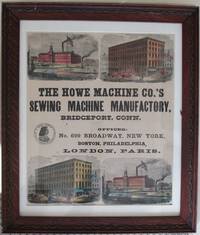
187636504np 1876. Beautifully hand colored engraving depicting four eye-level views of Howe Machine Company factories surrounded by busy streets ferries and carriages. A coin with profile of Elias Howe Jr. is at center left. Attractively framed and matted. Image 13-1/4" x 15-1/4" by sight. Not examined out of frame. Fine. <br /> <br /> The Company's New York offices were located at 699 Broadway from 1867-1876. We locate this extremely attractive broadside only in the Jay Last Collection at the Huntington Library. unknown
187636504np 1876. Beautifully handcolored engraving depicting four eye-level views of Howe Machine Company factories surrounded by busy streets ferries and carriages. A coin with profile of Elias Howe Jr. is at center left. Attractively framed and matted. Image 13-1/4" x 15-1/4" by sight. Not examined out of frame. Fine. <br/><br/> The Company's New York offices were located at 699 Broadway from 1867-1876. We locate this extremely attractive broadside only in the Jay Last Collection at the Huntington Library. unknown books
18972111902160201434Kazuki Yoshida Dainippon Textile Association 1897. Soft Cover. Fine. Volume: 1 Kazuki Yoshida Dainippon Textile Association paperback
185548992Paris Mallet-Bachelier 1855. 4to. No wrappers. In: "Comptes Rendus Hebdomadaires des Séances de L'Academie des Sciences" Tome 41 No 15. Pp. 537- 563. Entire issue offered. Babbage's paper: pp. 557-560. Some faint mostly marginal brownspots. <br/><br/><em>First printing of this importent paper being babbage's report on the Scheutz differnce calculator explaining its functions by way of his own notations."Babbage's report on the differnce engine built by the Swedish printer Georg Scheuts 1785-1873 and his son Edvard 1821-81 based on Babbage's own designs. In 1854 the Scheutzes took their engine no. 2 to England in the hopes of marketing it. There they were introduced to Babbage who received them with great friendliness and showed a lively interest in their work. Babbage devoted two whole days to investigating Scheutz' engine for which he had much praise especially for the way they had succeeded in building it with the funds at their disposals. As part of his effort to promote the Scheutz Engine Babbage gave a talk on it before the Academie des Sciences illustrated with drawings by his son henry in which Babbage's system of mechanical notation was used to describe the machines construction and functions. This talk was published the paper offered without illustrations in the Academie 'Comptes rendus'. Hook & Norman "Origins of Cyberspace" No. 73. </em> unknown
1850TECH0709Mchn., Literarisch-artistische Anst. d. Cotta'schen Buchhdlg. o. J. (um 1850). Folio, gestoch. Doppeltitel, 6 S. Index, 64 teilkol., gestoch. Doppeltafeln, HLn. d. Zt., berieben, bestoß., Rü. fehlt, Deckeln locker, Titel. stock- u. fingerfl., die Tafeln fast alle fingerfl., insges. jedoch innen in gutem Zustand. Nur Tafelband. - Die großformatigen Tafeln in detaillierter technischer Zeichnung (jeweils mit zahlreichen kleineren Abbildungen) zeigen Schrauben, Wellen, Lager, Verzahnungen, Rollen, Kupplungen, Auslösungen, Hemmungen, Kurbeln, Zahnstangen, Ventile und Kolben, ferner eine größere Anzahl Tafeln zum Thema Wasserräder und am Ende zwei "Musterblätter" für technische Zeichnungen mit der Aufnahme einer hydraulischen Presse zur Oel-Fabrikation.
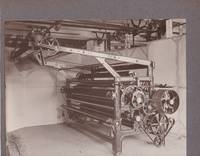
18908Archive consists of the trade catalog art work for cloth finishing and packaging machinery built by the Parks & Woolson Machine Co. of Springfield VT. The earliest art work 1890s was executed by the Lincoln & Smith Press of Boston then the James McKinnon Co. designers engravers and electrotypers of Springfield Mass. but all the 1920s work was by the Springfield Photo-Engraving Co. which may have been their successors. The normal procedure was for the artist to take a photograph in the earlier versions a mounted studio photograph then a "blue" from a glassplate negative then a glossy black & white photo and interpret it according to instructional notation. In the earlier work this was done by painting right on the photograph. But the 1920s work the majority of the collection is painted on separate board with tissue overlay. Some of the latest versions also have photographic proofs of the printing plate made from the artwork. In the marginal notes appear the names of some of Parks & Woolson's clients for specific machines: Renfrew Manufacturing Co.; Clinton Woolen Mfg. Co.; Lebanon Woolen Mills; Woonsocket Rubber Co.; Farr Alpaca Co. The names of such machines as have titles show the inheritance from the English textile manufacturing trade: Lancashire Winder and Uxbridge Inspecting Machine or their origin in the United States: the Vermont napper or the Pennsylvania plush shear and occasionally the inventor: Baird Webster P.T. Wilson etc. Parks & Woolson themselves were fond of strange combination words to describe their own multi-stage machines: Seamlethru; Transferotor. This archive shows in great detail the changes in a wide range of machinery to finish and fold or roll cloth over a crucial period in the textile industry as well as illuminating the interpretation of a machine photograph for half-tone duplication.
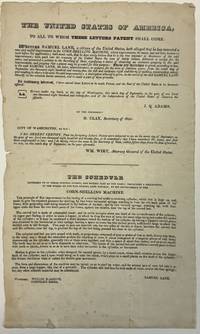
182525214Washington D.C. 1825. Printed broadside 8" x 13.5". Light toning untrimmed minor edgewear old folds couple of pinholes at junctions but not affecting any text. Very Good.<br /> <br /> This rare broadside announcement of a patent issued to Samuel Lane of Maine is signed in type by President John Quincy Adams Secretary of State Henry Clay and Attorney General William Wirt. It contains a complete Description "in the words of the said Samuel Lane himself" of his improvements to the corn-shelling machine. <br /> In 1828 Lane was the first to receive a patent for a combine. One of the witnesses to Lane's Description was William Blagrove probably the first full-time Patent Agent in Washington DC appointed in 1819.<br /> Not located on OCLC AAS Catalog American Imprints. unknown
182525214Washington D.C. 1825. Printed broadside 8" x 13.5". Light toning untrimmed minor edgewear old folds couple of pinholes at junctions but not affecting any text. Very Good.<br/><br/> This rare broadside announcement of a patent issued to Samuel Lane of Maine is signed in type by President John Quincy Adams Secretary of State Henry Clay and Attorney General William Wirt. It contains a complete Description "in the words of the said Samuel Lane himself" of his improvements to the corn-shelling machine. <br/> In 1828 Lane was the first to receive a patent for a combine. One of the witnesses to Lane's Description was William Blagrove probably the first full-time Patent Agent in Washington DC appointed in 1819.<br/>Not located on OCLC AAS Catalog American Imprints. unknown books
188136888New York: Root & Tinker 1881. Oblong 4to broadsheet 9-1/2" x 12." Light dusting Very Good. <br/><br/> The recto is a color Lithograph. President Garfield and his Cabinet are depicted Garfield in the center shaking hands. The Capitol Building is in the background. At the bottom of the image in tiny print are the names of the persons depicted. The verso advertises the Company with illustrations of its flagship product "The Hartford" "The most elegant machine ever put upon the market. An entire work cabinet in itself from the size and solid framing of its drawers."<br/> The Weed Sewing Machine Company "obtained the patent rights of the late Theodore. E. Weed of Fairfield Connecticut inventor of a sewing machine prized for its simple construction and ease of operation making it competitive with the designs of Elias Howe 1846 Allen B. Wilson and Isaac Singer. The Weed Company played a major role in making Hartford one of three machine tool centers in New England and even outranked the Colt Armory in size if not fame. Weed eventually was the birthplace of both the bicycle and automobile industries" online essay 'The Miracle on Capital Avenue' in Connecticut Explored.<br/>OCLC 45451588 1- Smithsonian as of June 2020. Not in Romaine or Winterthur. Root & Tinker unknown books
186348991Paris Mallet-Bachelier 1863. 4to. No wrappers. In: "Comptes Rendus Hebdomadaires des Séances de L'Academie des Sciences" Tome 56 No 8. Pp. 317- 364. Entire issue offered. The paper: pp. 330-339. <br/><br/><em>First apperance of this detailled report and examination by the French mathematiciens Mathieu Chasles and Delaunay of the calculating machine invented by Martin Wiberg as an improvement on the Scheutz machine. The machine could produce tables of logarithms."Wiberg modified the Scheutz difference engine making it smaller and lighter and used it to calculate a series of interest tables published in 1860. Efter improving the print mechanism of his machine Wiberg presented it to the Academy of Sciences in Paris which voted in 1863 to "accorder son approbation à cette belle et ingénieuse machine" the paper offered. Wiberg later used the machine to produce a set of tables of seven-place logarithms of the numbers from 1 to 1000000 together with logarithms of trigonometric functions published in 1876 under the title 'Tables de logarithmes calculées et imprimées au moyen de la machine à calculer sw M. Wiberg'. Hook & Norman "Origins of Cyberspace" No. 82. </em> unknown
186359088Paris Mallet-Bachelier 1863. 4to. No wrappers. In: "Comptes Rendus Hebdomadaires des Séances de L'Academie des Sciences" Tome 56 No 8. Pp. 317- 364. Entire issue offered. The paper: pp. 330-339. <br/><br/><em>First apperance of this detailled report and examination by the French mathematiciens Mathieu Chasles and Delaunay of the calculating machine invented by Martin Wiberg as an improvement on the Scheutz machine. The machine could produce tables of logarithms. </em> unknown
188642668London Harrison and Sons 1886. 4to. No wrappers as extracted from "Philosophical Transactions" 1885. Vol. 176 - Part II Pp. 367-402 a. 34 textillustr. <br/><br/><em>First appearance of an importent paper in the history of calculating machines."In his first year at Liverpool he published a paper on 'The theory of continuous calculating machines and of a mechanism of this class on a new principle' in the prestigious Philosophical Transactions of the Royal Society. This work investigated how to advance the design of integrator mechanisms and fit them for tasks more complex than mere numerical calculating machines and was extremely important in the development of analogue computing."Jane Carruthers </em> unknown
1884120254Hartford Conn. : Hartford Sorghum Machine Co 1884. First Edition. Hardback. Very good copy in finely bound in full gilt-blocked brown buckram. ; Description: ill. Subjects: Sugar pamphlets. Spine tile: ""Sugar Pamphlets"". Date is suggested/cannot be verified. Hartford, Conn. : Hartford Sorghum Machine Co hardcover
190012998Beloit WI: The Berlin Machine Works. Fine. ~1900. Hardcover. No date; could be anywhere from 1890's to the 1920's. Period b/w engravings one of which is a gorgeous two page piece of art. This is big stuff meant for cutting up entire trees when the trees were worth cutting up. Bound in coarse green cloth on heavy card covers. ; 4to 11" - 13" tall; 63 pages . The Berlin Machine Works hardcover
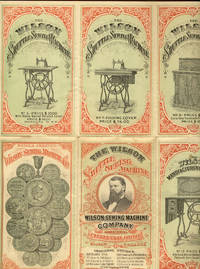
187440485Buffalo: Clay Cosack & Co. 1874. 1874. SEWING MACHINES OHIO. 13 1/2" x 12" sheet folds to 3 1/2" x 6" 16 panels illustrated. One side provides six panels of views and prices for Wilson Shuttle Sewing Machines one panel for medals awarded the company and one panel for the front cover. The other side provides eight panels that describe the awards won by the company and the fact that it is the oldest machine in the market. Lightly rubbed on front cover and spine else a very good copy. Clay, Cosack & Co., 1874. unknown
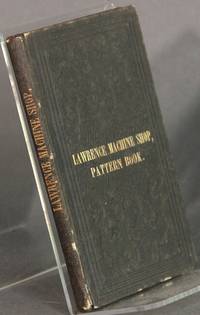
185654024Lawrence MA 1856. 16mo pp. 2 138 2 plus 24 pages of blank ruled paper for notes; original brown cloth with title stamped in gilt on spine and upper cover; edgewear contemporary owner's signature on endpaper very good. Key by number to patterns of gears hangers and pulleys giving weights diameters remarks etc. 3 in OCLC as of May '19. <br/><br/> hardcover books
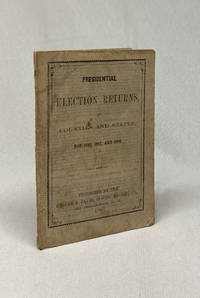
18609485New York: Grover & Baker Sewing Machine Co 1860. Sewn binding. Very good. 16mo about 3.75" x 5.75" 30pp. illustrated. Very good in the original sewn wrappers. A few minor stains and faint general foxing but a clean sound example. Scarce little pamphlet with detailed county-by-county data from the previous three presidential elections in anticipation of what would be one of the most consequential elections in American history the 1860 context between Stephen Douglas and Abraham Lincoln. The pamphlet's purpose is two-fold however as it advertises sewing machines from the Grover and Baker company including numerous testimonials printed among the election data and also several engraved images of various models. Primarily an advertisement for the company produced at their expense but designed to hook in the politics junkie amid the fervor of the 1860 election. Perhaps a dozen copies located in OCLC and some of these may be digital holdings. Not separately catalogued by AAS. Grover & Baker Sewing Machine Co unknown
1870106353<p>This broadside is 16½x10¼" and is tipped into an archival rag mat. Very slight aging though delicate this ad is in wonderful condition; near fine to fine. The Aiken Knitting Machine Co was located in New York City with their factory in Franklin N.H. The printed images show their various types of knitting machines and winder for spooling yarn with the direction to "Please Put Up In Your Office". The Aiken family moved to New Hampshire in 1938 and were fairly well known industrialists and inventors. In May 1855 Jonas B. Aiken secured a patent Patent 12933 for a knitting machine. Their machines appeared to get a lot of good press in the 1860s and they seemed to have established a very respectable business. </p> Baptist & Taylor,
1870106353<p>This broadside is 16½x10¼" and is tipped into an archival rag mat. Very slight aging though delicate this ad is in wonderful condition; near fine to fine. The Aiken Knitting Machine Co was located in New York City with their factory in Franklin N.H. The printed images show their various types of knitting machines and winder for spooling yarn with the direction to "Please Put Up In Your Office". The Aiken family moved to New Hampshire in 1938 and were fairly well known industrialists and inventors. In May 1855 Jonas B. Aiken secured a patent Patent 12933 for a knitting machine. Their machines appeared to get a lot of good press in the 1860s and they seemed to have established a very respectable business. </p> Baptist & Taylor, books
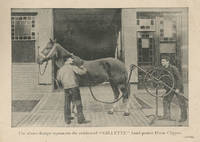
189750186N.P.: Privately printed n.d. ca 1897. ca 1897. First edition. 3 3/4" x 5 1/4" original black and white paper advertisement printed on both sides. Front side offers a photo of two men man using the "Gillette" hand-power horse clipper. Opposite side offers pricing and general information about the machine. Hand Power Machine $50; Steam of Electric Power Machine $75. Light soiling and with light wear to edges. Very good. Privately printed, n.d. (ca 1897). unknown
187945987Paris G. Masson Imprimerie Gauthier-Villars 1879. 8vo. Contemporary half calf raised bands gilt spine. Light wear along edges. Small stamps on verso of title-page. In "Annales de Chimie et de Physique" Cinquiéme Series - Tome XVI. 576 pp. a. 2 folded plates. Entire volume offered. Breguet's paper: pp. 5-48 a. 1 large folded engraved plate. <br/><br/><em>First edition of this importent paper giving the first physical theory of the Grammo machine's magnetic function. - Wheeler Gift No. 3990.A Gramme machine Gramme ring Gramme magneto or Gramme dynamo is an electrical generator which produces direct current named for its Belgian inventor Zénobe Gramme and was built as either a dynamo or a magneto. It was the first generator to produce power on a commercial scale for industry. </em> hardcover
18892125New York & Boston: Ames Plow 1889. Octavo 84 pages. Profusely illustrated. Printed throughout in blue ink. A handsome small trade catalogue for this manufacturer and distributor of carts barrows presses mills sausage stuffing equipment presses etc. Some wear to spine of printed wrapper wrapper started at front hinge otherwise very good. Scarce. Ames Plow unknown books