7 résultats
170945238Paris Jean Boudot 1709 a. 1711. 4to. Without wrappers. Extracted from "Mémoires de l'Academie des Sciences. Année 1708" and Annèe 1709. Pp. 339-365 a. 1 folded engraved plate pp. 320-350 a. 1 folded engraved plate. <br/><br/><em>First printing of two importent papers in the further development of Cartesian analytical geometry."The irrepressible Michel lRolle.in the Memoires of the Academie des Sciences for 1708-1709 the papers offered raised doubts about the correctness of the Cartesian graphical solution of equations as he had about the validity of the calculus of L'Hospital. He pointed out that to solve fx= 0 one arbitrarily chooses a curve gxy = 0 and on combining it with fx = 0 one obtains new curves hxy = 0 the intersection of which with gxy = 0 furnish the solution of fx = 0; and he realized that in this way extraneous solutions may be introduced. Imaginary branches further comp0licated the problem and although Rolle sawthe difficulties he was unable to solve them."Boyer "History of Analytical Geometry" p. 155. </em> unknown
172745242London T. Bowles 1727. Small 8vo. Contemp. full calf raised bands blindtooled covers Cambridge-binding. Wear to spine ends and spine. Hinges weakening but still holding. Titlepage in red/black. 21956 pp. and 80 full page engraved illustrations. Some soiling and browning mainly marginal last 10 engravings with a faint dapmstain. The charming plates are engraved by Leclerc. <br/><br/><em>Scarce English edition the third of Leclerc's charming and very popular treatise on elementary practical geometry and perspective.Sebastien Leclerc 1637-1714 was originally an engraver who studied physics and geometry in relation to perspective theory a field of which he became famous. In 1672 he was appointed to "l'Academie de Peinture" as professor in perspective. He was also engraver to Louis XIV and was appointed professor at "l'Ecole des Gobelins". </em> hardcover
178544970Paris Moutard 1785. 4to. Extracted from "Mémoires fe Mathematique et de Physique Présentés à l'Academie des Sciences par divers Savans" Tome X. Pp. 511-550 a. 2 folded engraved plates. Clean and fine. <br/><br/><em>First appearance of this importent paper by the "greatest geometer of the century" in which he solves some main problems in coordinate geometry especially he introduced the "distant formula" for three dimensions years before it was used by Lagrange. He laid the foundation of a completely new branch of mathematics known as descriptive geometry. The paper was delivered already in 1771 but not published until 1785. "His first important original work was "Memoire sur les développées les rayons de courbure et différents genres d inflexions des courbes á double courbure" He published an extract from it in June 1769 in the Journal encycyclop´matiques and in October 1770 he finished a more complete version that he read before the Academie des Sciences in August 1771; the latter however was not published until 1785 Mémoires de mathématiques et de physique présentés á ’Academic par divers scavanns. By then some of the most important ideas in the memoir no longer seemed so original because Monge had employed them in other works published in the intervening years. Nevertheless this memoir is of exceptional interest for it presents most of the new conceptions that Monge developed in his later works as well as his very personal method of exposition which combined pure geometry analytic geometry and infinitesimal calculus."DSB. </em> unknown
179788<p>RARE FIRST EDITION OF LORENZO MASCHERONI's TREATISE ABOUT THE USE OF THE COMPASS IN GEOMETRY</p><p>UNTRIMMED AND UNCUT COPY IN ORIGINAL PAPER WRAPPER</p><p>Mascheroni Lorenzo. <i>La geometria del compasso di Lorenzo Mascheroni. </i>Pavia : presso gli eredi di Pietro Galeazzi anno V della Repubblica francese 1797.</p><p>8to 223 x 130 mm original printer's wrappers; pp. 2 XVIII 264 14 leaves of folding plates woodcut decoration at title page friezes and headletters. </p><p>The principle of economy in geometric constructions</p><p>First edition of Mascheroni's most important work with a dedication in verse to Napoleon in which he proves that any geometrical construction of Euclidean geometry can be carried out by means of compasses alone admitting that a straight line is constructed once two of its points have been defined thus demonstrating how a certain principle of economics in geometric constructions proclaimed by all the great mathematicians of the past from Pappus to Descartes was regularly and violated by the use of two tools where only one was enough.</p><p>His approach was to first demonstrate how to use the compass alone to bisect a given arc of a circle add and subtract two given segments find the fourth proportional given three segments find the point of intersection of two given lines and the points of intersection between a given line and a circle.</p><p>At this point Mascheroni theoretically demonstrated how all constructions completed with ruler and compass can be considered as a composition of the elementary operations defined above and therefore obtained using only the compass. In the spirit of the Enlightenment this work is not meant to be just theoretical but is also designed to facilitate the construction of precision instruments. </p><p>Although some authors such as the Danish G. Mohr had sought before Mascheroni the solution of certain geometrical problems by using the compass alone he was able to deal with the subject of the geometry of the compass with such depth and in such a general way to make his forerunner forgotten.</p><p>Lorenzo Mascheroni 1750 - 1800 was an Italian mathematician scholar and academic who since 1778 taught physics and mathematics at the Bergamo seminary.</p><p>His most important contributions concern mathematical analysis with studies related to integral calculus and natural logarithms construction science with its original studies on arc-breaking calculus and geometry with the demonstration that solvable problems with row and compasses can also be solved with just the compass.</p><p>His name is also linked to the Euler-Mascheroni constant of which he calculated the first 32 decimal digits. The Euler – Mascheroni constant also called Euler's constant is a mathematical constant recurring in analysis and number theory usually denoted by the lowercase Greek letter gamma γ.</p><p>It is defined as the limiting difference between the harmonic series and the natural logarithm.</p><p>Napoleon whose passion for science and mathematics is known met Mascheroni in 1796 during the invasion northern Italy and was intrigued by his theories ion the use of the compasses becoming they say a great expert. "General we could expect from you everything but geometry lessons": with this sentence the mathematician Laplace and Lagrange welcomed Napoleon's explanations on Mascheroni's constructions whose book just a year after the Italian edition in 1798 was translated into French by Charette.</p><p>Conditions: Light marks of use along the text small warmholes never touching the text in general very good copy printed on strong paper untrimmed and uncut in its original paper wrapper.</p><p>References: RICCARDI P. "Biblioteca Matematica Italiana Milano 1952 vol. 1 134 9.1 "Pregiata e Rara".</p> Pietro Galeazzi paperback
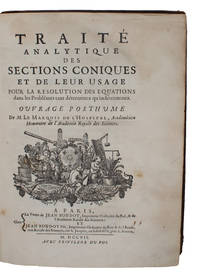
170748217Paris Jean Boudot et Jean Boudet fils 1707. 4to. Contemporary full calf. A bit of cracking to front hinges so that cords are seen but cover not loosening. Spine with 6 raised bands richly gilt compartments. Wear to top of spine. Two small old paperlabels one to upper compartment one to frontcover. Covers slightly rubbed. 44595 pp. Large woodcut vignette on titlepage 2 other vignettes one engraved one in woodcut. 32 folded engraved plates and one smaller folded plate Fig. A. An old owners stamp on flyleaf. Internally clean and fine. A few tiny brownspots. Wide-margined and printed on good paper. <br/><br/><em>Scarce first edition of l'Hôspital's second book - his second successfull textbook - the manuscript of which was left completed at his death in 1704. His first book "Analyse des infiniment petits pour l’intelligence des lignes courbes" 1696 was the first textbook of the differential calculus and his name lives on in the name of the rule for finding the limiting value of a fraction whose numerator and denominator tend to zero. His mathyematical teacher was Jean Bernoulli.The year in which Newton published the anti-Cartesian "Arithmeticus" there appeared in France a conspicuously successfull textbook on Cartesian geometry along the lines of that of Guisnée. This was the "Traité Analytique des Sections Coniques". a book which contains less original material than that of Guisnée but which is more extensive and closer to the modern manner of treatment. The work had been intended for publication at the time the authors famous calculus textbook appeared in 1696 but l'Hospital's illness apparently led to delay and it appeared posthumously in 1707. It is Cartesian in emphasis and although it consists of but one volume follows generally the tripartite plan of Lahire and Ozanam: first an algebraic quasi-analytic treatment of the Conic Sections along the lines of Apollonian theory; then an analytic study of the loci and finally a long section on the customary construction by conics of the roots of cubic and quartic polynominal equations. LHospital sometimes used two axes and seems to have recognized the interchangeability of these but he betrays some hesitation. In general L'Hospital like Descartes was more interested in analytic geometry as a measure of ecpressing loci algebraivcally than as a method of deriving the properties of a curve from its equation." Carl B. Boyer "History of Analytic geometry" pp. 150-154. </em> hardcover
177031785Berlin Haude & Spener 1770. 4to. No wrappers as issued in "Mémoires de l'Academie Royale des Sciences et Belles Lettres" tome XXIV pp. 327-354 and 1 engraved plates. <br/><br/><em>First edition. Lambert's work on non-Euclidean geometry is among the most important in the field. Carl Boyer writes "No one else came so close to the truth without actually discovering non-Euclidean geomtry." History of Mathematics pp. 504. Lambert wrote his famous book 'Theorie der Parallellinien' in 1766 but it was not published until 1786 nearly a decade after his death. Lambert originally set out to prove Euclid's parallel postulate in a similar way to that which Saccheri had used in his 'Euclides Vindicatus' but in contrast he did not interpret the consequences of non-Euclidean geometry as absurd. The offered paper 'Observations Trigonometriques' is the only work by Lambert on non-Euclidean geometry which was published during his life-time. Here he made the important discovery of the duality between spherical and hyperbolic geometry i.e. that hyperbolic trigonometries can be deduced from spherical trigonometries by using imaginary angles and consequently he introduced the hyperbolic functions for the first time. By illustrating this duality Lambert gave strong evidence of the consistency of non-Euclidean geometries. See Kline's Mathematical Thought from Ancient to Modern Times pp. 404 & 868. </em> unknown
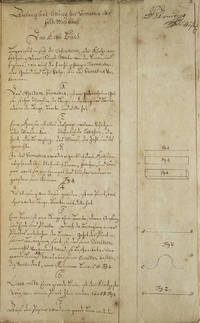
1728315966University of Halle 1728. Abundantly illustrated with watercolor drawings and tables. 1 vols. 4to. Disbound remnants of contemporary reversed calf and marbled boardslosses to top edges. Abundantly illustrated with watercolor drawings and tables. 1 vols. 4to. Extensive German manuscript on geometry with handsome period-colored illustrations. The first part discusses the relationship of the diameter to the circumference with an introduction on Pi comparing findings by Euclid Archimedes and Ptolemy as well as 16th- and 17th-century scholars like Augustin Hirschvogel Albrecht Dürer Nicolaus de Cusa Ludolph van Ceulen Kepler Adam Kochansky François Viète Carlo Renaldini and Adriaan Metius. The second features problems theorems and solutions to geometrical exercises on linear and proportional measures of inscribed and circumscribed polygons. A few pages contain occasional verse and notes on chemical preparations.<br /> <br /> Johann Gottlieb Arndt was an engineer and taught mathematics at the University of Halle in 1728-32. He also published on physical mathematical and economic education. unknown