6 résultats
183557591No place 1835. old sheep and marbled boards. Binding rubbed; tight and sound. 8vo. The owner's dated signature appears inside the front cover. hardcover
183441598Berlin G. Reimer 1834. 4to. No wrappers. In "Journal für die reine und angewandte Mathematik. Hrsg. von A.L. Crelle" Bd. 12 Heft 1 IV88 pp. the whole issueHeft 1 offered with titlepage to volume 12. Jacobi's paper: pp. 1-69. a. 1 engraved plate. <br/><br/><em>First edition of a main paper dealing with n-dimensional geometry."Of the papers devoted to n-fold integrals Jacobi's 1834 paper "De binis quibuslibit." is of crucial importence in this connection the theory of algebraic forms of variables. Here besides the problem of computing multiple integrals an importent problem of the theory of algebraic forms is solved." Andrei Nik. Kolmogorov. </em> unknown
182941605Berlin G. Reimer 1829. 4to. No wrappers. Extracted from "Journal für die reine und angewandte Mathematik. Hrsg. von A.L. Crelle" Bd. 4. - Plücker's paper pp. 349-370 <br/><br/><em>First edition of a major paper in the arithmetization of geometry introducing the so-called triangular coordinates. "In 1829 Plücker contributed to Crelle's Journal the paper offered here with a revolutionary point of view that broke completely with the old Cartesian view of coordinates as line segments. The equation of a straight line in homogenous coordinates has the form ax by ct=0.Plücker saw that one could modify the usual language and call abc the homogenous coordinates of a line.Plücker had discovered the immidiate analytic counterpart of the geometric principle of duality about which Gergonne and Poncelet had quarreled; it now became clear that the justification that pure geometry had sought in vain was here supplied by the algebraic point of view." Boyer History of Mathematics. </em> unknown
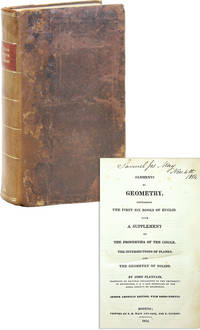
181447988Boston: T.B. Wait and Sons 1814. Second American Edition With Improvements. Octavo 23cm.; contemporary calf recently rebacked new red morocco spine label retaining original endpapers; 2xxviii4315152pp. Boards rather rubbed small dampspot to upper cover some browning to endpapers a few tiny holes to rear free endpaper else Good or better internally sound. Provenance: Copy of seventeen-year-old Samuel Joseph May 1797-1871 future reformer abolitionist and women's rights advocate with his ownership signature dated November 4 1814 to title page front pastedown p. 1 together with his gift inscription to fellow Harvard student Warren Goddard to rear flyleaf verso with Goddard's lengthy ownership inscription as a student at Harvard on front free endpaper a second ownership inscription of Goddard's on front flyleaf noting that the book was actually bought off of May. May graduated from Harvard in 1817 and went on to serve as a Unitarian clergyman collaborating with his friend William Lloyd Garrison in co-founding the New England Anti-Slavery Society the American Anti-Slavery Society and the pacifist New England Non-Resistance Society. SHAW & SHOEMAKER 32520. T.B. Wait and Sons unknown
185942296London Richard Taylor and William Francis 1859. 4to. No wrappers as extracted from "Philosophical Transactions" Vol. 149 - Part I. Pp. 61-90. Clean and fine. <br/><br/><em>First appearance of this pathbreaking paper in which Cayley unites 'Metrical Geometry' and 'Projectice Geometry' by introducing "imaginary" elements to metrical properties."The fundamental notions in metrical geometry are the distance between two points and the angle between two lines. Replacing the concept of distance by another also involving "imaginary" elements Cayley provided the means for unifying Euclideangeometry and the common non-Euclidean gemoetries into one comprehensive theory."Bell in "Men of Mathematics".In non-Euclidean geometry prepared the way for Klein's splendid discovery that the geometry of Euclid and the non-Euclidean geometries of Lobatchewsky and Riemann are all threee merely different aspects of a more general kind of geometry which includes them as special cases.Dealing with the relations between metrical and projective geometry Klein remarks In "Entwicklung der Mathematik" Teil I p. 148: "Vor allem kommt für uns sein Cayley's berühmtes 'A Sixth Memoir upon Quantics" im betrachtt. Quantioc heisst soviwel "Form" d.h. homogenes Polynom von zwei drei oder mehr Variablen wonach man binäre tertiäre usw. Formen unterscheidet." </em> unknown
187353254London and New York Macmillan and Co. 1873. 4to. Orig. full brown cloth gilt spine pictorial gilt frontcover. Near mint condition. Small embossed stamp at upper corner of title-page David Dunlop ObservatoRy Library. In: "Nature a weekly illustrated Journal of Science." Volume VIII May 1873 to October 1873. XII562 pp. Entire volume offered. Riemann's paper: pp. 14-17 a. 36-37. Internally clean and fine no traces of use. <br/><br/><em>First English translation of this milestone work on the foundations of geometry. It "is one of the key work from which derives the modern study of differential geometry and especially the study of manifolds of dimension greater than two. It was to prove central to the overthrow of Euclidean geometry as the source of geometrical ideas and to Einstein's general theory of relativity after 1915." Grattan-Guiness "Landmark Writings in Western Mathematics 1640-1940.It is a translation of Riemann's famous Habilitationsvortrag held in 1854 in secondary literature it is often misidentified as his Habilitationsschift but that was concerned with Fourier series and was delivered the year before. Riemann begins his lecture with a remark about a certain darkness that lies at the foundation of geometry. This darkness obscures the relations between that which geometry assumes i.e. the notion of space and the first principles of constructions in space. In Riemann's oponion one must take another approach towards this problem than the usual axiomatic method used ever since Euclid. The approach taken by Riemann is to a large extent guided by Gauss's work on the intrinsic geometry of surfaces; 'Disquisitiones generales circa superficies curvas' 1828. In this work Gauss showed that the curvature of a surface can be determined without reference to the ambient Euclidean space in which it lies i.e. that the curvature is an intrinsic property of the surface. Based on this Gauss showed several fundamental theorems about figures on the surface by referring only to the surface itself i.e. indicating that the surface itself is a space with its own geometry independent of the geometry of the ambient Euclidean space. Riemann argues that the true objects and properties of geometry are those which can be studied within the space itself and he defines a general n-dimensional space in a similar manner to the parametric representation of a surface. Riemann believed that we know space only locally he therefore bases his study of the geometry of such a general space or manifold as they are known today on the infinitesimal methods of calculus. This choice is a crucial departure from the classical axiomatic methods used by Euclid Lobachevsky and Bolyai. The notion of distance or metric on a manifold is a generalization of the usual Euclidean distance formula in n-dimensions. Particular choices of space and metric reveal both the hyperbolic geometries of Lobachevsky and Bolyai and elliptic or Riemannian geometry. Riemann's approach to geometry is of paramount importance this work "did more to change our ideas about geometry and physical space than any work on the subject since Euclid's Elements." Landmark Writings in Western Mathematics p.507. "The importance of this treatise is not confined to pure mathematics. Without it Einstein would not have been able to develop his general theory of relativity." Printing and the Mind of Man p.177. </em> hardcover