246 résultats
199730257<p>HBNODJ SLIPCASE HAS RED & WHITE ILLIUSTRATION ON FRONT OF GENTLEMAN SEATED SLIPCASE EDGE WEAR SEPARATION clear tape repairs 1944 on Title Pg COPY # 713 LIMITED NUMBERED 1ST EDITION VG/VG- AS-IS EXTREMITIES CHIPS WEAR DJ 1ST EDITION THUS Printed from Plates in Original Limited Edition of 1000 BEIGE CLOTH GREY ILLUSTRATED BOARDS IN WORN SLIPCASE Set in an aristocratic estate in Victorian England pronounced by critics as the oldest full length English mystery novel and to this day the best. Outlandish HORROR During a battle in India a sacred shrine is robbed of a jewel by a British soldier and the curse of the East Indian God follows the gem through generations of English ownership. A group of Fanatical East Indians follow the Moonstone to England where a mysterious death overtakes every heir to the fatal jewel Against the Gentle Background of an Aristocratic Estate in Victorian EnglandMoves a Story so Intriguing in Mystery Fascinating in Character Presentation & Beguiling in the Telling. During a Gory Battle in Far Off India a Sacred Shrine is entered & Robbed of a Jewel by an Adventurous British Soldier & the Curse of the East Indian God follows </p> DORAN DOUBLEDAY & CO LIMITED EDITIONS GARDEN CITY NY hardcover
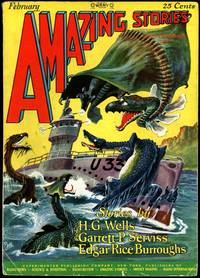
192729018New York: Experimenter Publishing Company 1927. Pages tanned mild edge wear small paper loss base of spine two large chips upper and lower left rear corners. A very good to nearly fine copy with attractive front cover. 29018. Large octavo single issue cover by Frank R. Paul pictorial wrappers. Pulp magazine bedsheet format. Features part one of "The Land That Time Forgot" by Edgar Rice Burroughs. Other authors include H.G. Wells Edwin Balmer and William MacHarg Garrett P. Serviss and others. Reference: Tymm and Ashley Science Fiction Fantasy and Weird Fiction Magazines pp. 14-49. Experimenter Publishing Company unknown
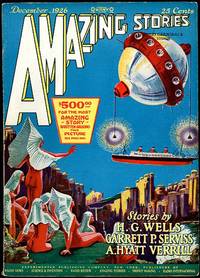
192630572New York: Experimenter Publishing Company 1926. Pages tanned and supple slight edge rubbing a fine copy. 30572. Large octavo single issue cover by Frank R. Paul pictorial wrappers. Pulp magazine bedsheet format. Fiction by H. G. Wells Garrett P. Serviss Fitz-James O'brien Edwin Balmer and William H. MacHarg and others. Reference: Tymm and Ashley Science Fiction Fantasy and Weird Fiction Magazines pp. 14-49. Experimenter Publishing Company unknown
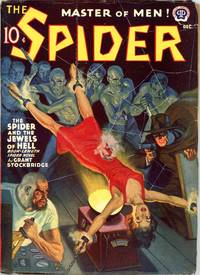
194034799Chicago: Popular Publications Inc. 1940. Mild tanning to text paper slight trim to right edge several tiny tears tiny chip and small closed tear to upper left corner closed tear around upper right corner a nearly fine copy. 34799. Octavo single issue cover by Rafael DeSoto pictorial wrappers. Pulp magazine. "The Spider and the Jewels of Hell" with Norvell Page writing as "Grant Stockbridge." The character was established to be a direct competitor to Street and Smith's Shadow magazine. After Doc Savage and The Shadow this was the most popular hero character. The Spider character was considered one of the most brutal and violent of the pulp era. Reference: Cook Mystery Detective and Espionage Magazines pp. 521-527. Tymm and Ashley Science Fiction Fantasy and Weird Fiction Magazines pp. 602-604. Popular Publications, Inc. unknown
19402110502150414612Nagoya Local Traffic Investigation Committee 1940. Soft Cover. Fine. Volume: 1 Nagoya Local Traffic Investigation Committee paperback
19062111902160200727Toyuridono Castle General High School 1906. Soft Cover. Fine. Volume: 1 Toyuridono Castle General High School paperback
194072114Berkeley and Los Angeles: University of California Press 1940. First edition. Narrow octavo. 14 pp. Publisher's printed wrappers. Together with 274 IBM punch cards each with the same printed title across the top - "Quadratic Character of m" and with Robinson's name and copyright data. Both housed together in the publisher's cloth case with metallic snap and spine lettering in black. Bit of wear to bottom case joint but overall an excellent copy.From the introduction - "Since quadratic congruences play a fundamental role in the theory of numbers it seems very desirable to have a simple way to solve them even when moderately large numbers are involved. The method of exclusion when combined with a suitable mechanical device such as these stencils provides an easy method for solution" Raphael M. Robinson was a leading figure in mathematics and taught at Berkeley from 1937 to 1973."Even among world-renowned mathematicians Robinson was exceptional. In an age of specialization he contributed significantly to six fields: logic set theory geometry complex analysis number theory and combinatorics; and in a subject often considered a young person's game he continued to produce significant mathematics into his eighties. He also anticipated most of the mathematical community by a good 20 years in making use of computers to obtain results in pure mathematics. In 1951 never having seen one of the new computing machines and working only from a manual he coded the first successful program to test very large numbers for primality. “That the code was without error was and still is a remarkable feat†according to the recently published history of the Institute for Numerical Analysis on the UCLA campus. “In an age where most of our journals are filled with papers which even if good exploit theories for their own sake. it is refreshing and stimulating to encounter one of Robinson's papers†one of the foremost number theorists of the century has written. “In each of them he takes a problem old or new which can be stated in simple and intelligible terms and either solves it or at least adds much that is new. His scholarship is impeccable; it is plain that he never writes until he has thought deeply and until he has sought out every relevant piece of existing knowledge.â€Approximately a quarter of Robinson's publications are distributed among seven different topics in logic and the foundations of mathematics. The one to which he gave most attention was that of undecidable theories an interest that he shared with his wife Julia. By way of illustration the mathematical structure consisting of the integers with their operation of addition is said to have a decidable theory. This means it is possible to program a computer so that given any sentence about the structure in a logically defined language the computer will make a finite computation that determines whether the sentence is true or false. Another mathematical structure with a decidable theory is that of all real numbers with their operations of addition and multiplication. This was shown by Alfred Tarski also of Berkeley But a major mathematical discovery of this century was the fact that that the structure of integers with both operations of addition and multiplication has an undecidable structure because there is no computer program that can decide the truth or falsity of every sentence of its language. In several papers Robinson was able to show that a number of other mathematical theories are also undecidable. His most valuable contribution however was devising a theory with a finite number of axioms that is “essentially undecidableâ€--a concept introduced by Tarski. The book Undecidable Theories Mostowski Robinson and Tarski has provided a tool for researchers to identify undecidable theories in all parts of mathematics. " Calisphere. University of California Press hardcover
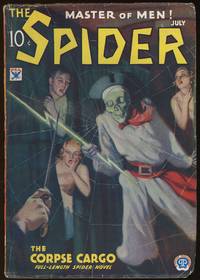
193432337Chicago: Popular Publications Inc. 1934. Creamy paper minimal edge wear tiny loss at lower right corner a nearly fine copy. 32337. Octavo single issue cover by John Howitt pictorial wrappers. Pulp magazine. "THE CORPSE CARGO" by Grant Stockbridge pseudonym. Reference: Cook Mystery Detective and Espionage Magazines pp. 521-527. Tymm and Ashley Science Fiction Fantasy and Weird Fiction Magazines pp. 602-604. Popular Publications, Inc. unknown
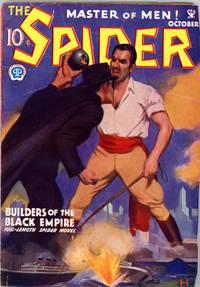
193434722Chicago: Popular Publications Inc. 1934. Mild tanning to text paper small closed tear to upper and lower edges bright red spine a fine copy. 34722. Octavo single issue cover by John Howitt pictorial wrappers. Pulp magazine. "Builders of the Black Empire" with Norvell Page writing as "Grant Stockbridge." The character was established to be a direct competitor to Street and Smith's Shadow magazine. After Doc Savage and The Shadow this was the most popular hero character. The Spider character was considered one of the most brutal and violent of the pulp era. Reference: Cook Mystery Detective and Espionage Magazines pp. 521-527. Tymm and Ashley Science Fiction Fantasy and Weird Fiction Magazines pp. 602-604. Popular Publications, Inc. unknown
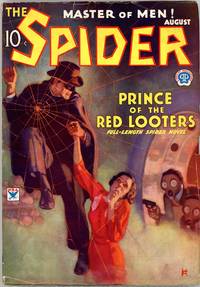
193434719Chicago: Popular Publications Inc. 1934. Mild tanning to text paper slight color fade at spine to orange slight edge wear a nearly fine copy. 34719. Octavo single issue cover by John Howitt pictorial wrappers. Pulp magazine. "Prince of the Red Looters" with Norvell Page writing as "Grant Stockbridge." The character was established to be a direct competitor to Street and Smith's Shadow magazine. After Doc Savage and The Shadow this was the most popular hero character. The Spider character was considered one of the most brutal and violent of the pulp era. Reference: Cook Mystery Detective and Espionage Magazines pp. 521-527. Tymm and Ashley Science Fiction Fantasy and Weird Fiction Magazines pp. 602-604. Popular Publications, Inc. unknown
1999__0750306165Inst of Physics Pub Inc 1999. Hardcover. New. 1st edition. 192 pages. 9.00x6.00x1.25 inches. Inst of Physics Pub Inc hardcover
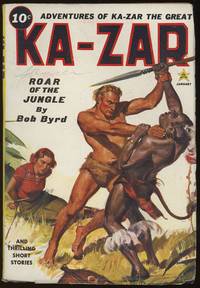
193732685Chicago: Manvis Publications Inc. 1937. Mild tanning to text paper slight wear to yapp edges light pencil name to upper front cover a fine copy. 32685. Octavo single issue cover by J.W. Scott pictorial wrappers. Pulp magazine. All Ka-Zar stories written by Bob Byrd a house pseudonym here Thomson Burtis. A Tarzan pastiche. Reference: Tymn and Ashley eds Science Fiction Fantasy and Weird Fiction Magazines pp. 368-69. Manvis Publications, Inc. unknown
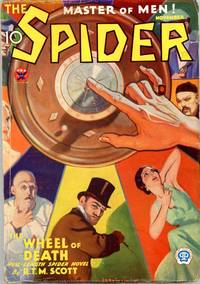
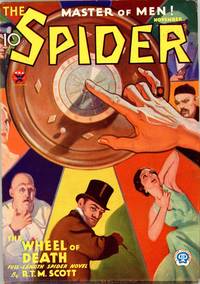
193334708Chicago: Popular Publications Inc. 1933. Mild tanning to text paper mild edge wear with a few tiny tears reading crease at spine rear cover re-glued with several chips to left edge mild color fade to spine a very good to nearly fine copy. 34708. Octavo single issue cover by John Howitt pictorial wrappers. Pulp magazine. The second issue. "The Wheel of Death" by R. T. M. Scott. This is the last to be written by Scott starting with the next third issue a house pseudonym was used. The character was established to be a direct competitor to Street and Smith's Shadow magazine. After Doc Savage and The Shadow this was the most popular hero character. The Spider character was considered one of the most brutal and violent of the pulp era. Reference: Cook Mystery Detective and Espionage Magazines pp. 521-527. Tymm and Ashley Science Fiction Fantasy and Weird Fiction Magazines pp. 602-604. Popular Publications, Inc. unknown
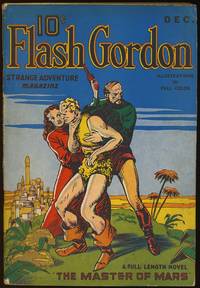
193631578New York: C.J.H. Publications Inc. 1936. Text paper tanned but quite supple light edge wear with tiny closed tears at the upper and lower spine. A very good or better copy with bright front cover. 31578. Large octavo single issue illustrations by Fred Meagher pictorial wrappers saddle stapled. Pulp magazine. The only issue which includes eight full page color illustrations. An attempt to blend the comic strip and pulp field which did not find the right audience. Includes the lead story which stars Flash Gordon and three other SF stories. Reference: Tymm and Ashley Science Fiction Fantasy and Weird Fiction Magazines pp. 273-274. C.J.H. Publications, Inc. unknown
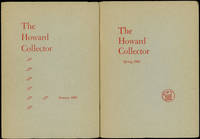
196121274Pasadena TX: Glenn Lord 1961-1973. Some age tanning to edges of early issues a nearly fine to fine set except for the Winter 1965 issue has a closed tear to the lower front cover and some wear along upper front edge a very good copy. Complete sets are uncommon. 21274. Small octavo printed wrappers. All published. A major source for material by and about Robert E. Howard. Many Howard poems letters and fragments of fiction are printed here for the first time. Most issues are scarce especially the early numbers. Glenn Lord unknown
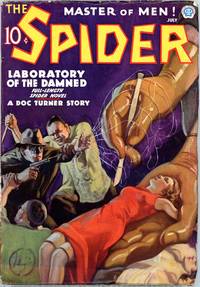
193634746Chicago: Popular Publications Inc. 1936. First edition. Mild tanning to text paper slight edge wear slight wear to spine ends a bright fine copy. 34746. Octavo single issue cover by John Howitt pictorial wrappers. Pulp magazine. "Laboratory of the Damned" with Norvell Page writing as "Grant Stockbridge." The character was established to be a direct competitor to Street and Smith's Shadow magazine. After Doc Savage and The Shadow this was the most popular hero character. The Spider character was considered one of the most brutal and violent of the pulp era. Reference: Cook Mystery Detective and Espionage Magazines pp. 521-527. Tymm and Ashley Science Fiction Fantasy and Weird Fiction Magazines pp. 602-604. Popular Publications, Inc. unknown
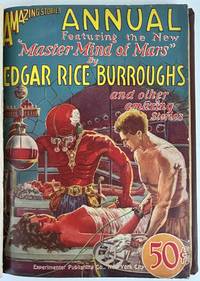
192731969New York: Experimenter Publishing Co. 1927. Text paper mildly tanned front cover shows a touch of edge rubbing a lovely copy bound in brown cloth which has preserved this issue quite nicely. This issue does not appear to be trimmed for binding. 31969. Large octavo single issue bound volume pictorial wrappers in brown cloth with spine stamped in gold. Bedsheet-sized pulp bound. This features the first printing of "Master Mind of Mars" by Edgar Rice Burroughs. The only issue of AMAZING STORIES ANNUAL. Released in July 1927 its 100000-print run sold out. The success of the ANNUAL encouraged Gernsback to launch AMAZING STORIES QUARTERLY in January 1928. Reference: Tymn and Ashley eds Science Fiction Fantasy and Weird Fiction Magazines pp. 49-51. Experimenter Publishing Co. unknown
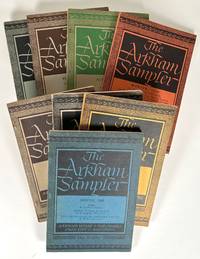
194833277Sauk City Wisconsin: Arkham House 1948-1949 volume 1 number 1-volume 2 number 4. First edition. Touch of wear to corner tips and spine ends to several issues the usual rust staining from the staples a nearly fine to fine set. A very nice set. 33277. Octavo printed wrappers. All published. A short lived but important periodical. In addition to printing first appearances of fiction by Ray Bradbury H. P. Lovecraft Clark Ashton Smith Robert Bloch Theodore Sturgeon A. E. van Vogt and many others the magazine published essays criticism memoirs and book reviews. One issue was devoted to science fiction. The final issue included an index. All issues were limited to 1200 copies except the "All Science-Fiction Issue" that had a 2000-copy print run. Reference: Parnell Monthly Terrors pp. 14-15 listing contents. Tymn and Ashley eds. Science Fiction Fantasy and Weird Fiction Magazines pp. 112-114. Arkham House unknown
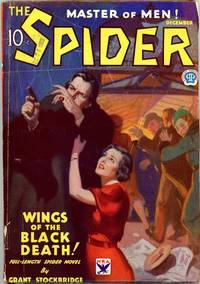
193334710Chicago: Popular Publications Inc. 1933. Mild tanning to text paper slight edge wear reading crease with separation at lower left spine edge inked date stamp to upper front cover spine is bright red a nearly fine to fine copy. 34710. Octavo single issue cover by John Howitt pictorial wrappers. Pulp magazine. The third issue. With this issue and the remainder of the run the house pseudonym of Grant Stockbridge is used. This issue "Wings of Black Death" with Norvell Page writing as "Grant Stockbridge." The character was established to be a direct competitor to Street and Smith's Shadow magazine. After Doc Savage and The Shadow this was the most popular hero character. The Spider character was considered one of the most brutal and violent of the pulp era. Reference: Cook Mystery Detective and Espionage Magazines pp. 521-527. Tymm and Ashley Science Fiction Fantasy and Weird Fiction Magazines pp. 602-604. Popular Publications, Inc. unknown
193334709Chicago: Popular Publications Inc. 1933. Mild tanning to text paper slight edge wear closed tears at upper spine edge mild spine fade a nearly fine to fine copy. 34709. Octavo single issue cover by John Howitt pictorial wrappers. Pulp magazine. The second issue. "The Wheel of Death" by R. T. M. Scott. This is the last to be written by Scott starting with the next third issue a house pseudonym was used. The character was established to be a direct competitor to Street and Smith's Shadow magazine. After Doc Savage and The Shadow this was the most popular hero character. The Spider character was considered one of the most brutal and violent of the pulp era. Reference: Cook Mystery Detective and Espionage Magazines pp. 521-527. Tymm and Ashley Science Fiction Fantasy and Weird Fiction Magazines pp. 602-604. Popular Publications, Inc. unknown
193334571New York: Street & Smith Publications Inc. 1933-1949. Tanning to pages of all some minor losses throughout front and back covers present bindings are bright with the exception of volumes 10-13 which are quite faded. All issues trimmed for binding. Overall the magazines are very good to nearly fine. The complete list report upon request. Note for shipping extra funds required. 34571. Octavo thirty-two volumes pictorial wrappers uniformly bound in green cloth. A complete file of 181 issues in bound volumes. Doc Savage was a precursor to the modern super hero. Clark "Doc" Savage Jr. was trained from birth with a rigorous regimen resulting in extraordinary strength and intelligence. He never killed unless necessary he had scientific gadgets a headquarters and a secret base a fortress of solitude. The stories combined mystery adventure and some science fiction. He also had a team of five experts in various fields to assist in his adventures. His stories were extremely popular during the pulp era and then found a new audience in the 1960s-70s when the series was reprinted in paperback. The novels were written using the house pseudonym of Kenneth Robeson the main author was Lester Dent who wrote nearly 80% of the novels. Other author contributors as Robeson included William Bogart Alan Hathway Harold Davis Laurence Donovan and W. Ryerson Johnson. There were many excellent contributors to the short stories which rounded out the magazine with authors such as Steve Fisher E. Hoffman Price Q. Patrick John D. MacDonald Bruno Fischer Frank Herbert William Lindsay Gresham to name a few. Street and Smith publishing executive Henry Ralston and editor John Nanovic established the initial idea for Clark "Doc" Savage Jr. - .a brawny 'superman' a master of many fields-surgeon mineralogist engineer inventor linguist. His skin was a glowing bronze.his hair was a matching hue and so too his eyes resembling gold flake. He would be known as the Man of Bronze."- Server Encyclopedia of Pulp Fiction Writers p.81. "Doc Savage was intended to be an adventure character but under Lester Dent's imaginative manipulations he became something more - the first superhero and an inspiration for countless pulp comic-book and television characters." - Cook Mystery Detective and Espionage Magazines pp. 521-527. "The enormously wealthy Doc Savage – headquartered in a fantasticated New York with his five sidekicks who specialize in various crafts and sciences at the borderline of sf – devotes his life to combating criminal conspiracies almost all masterminded by the kind of charismatic villain later given definitive form by Ian Fleming in the James Bond books. Doc Savage himself clearly influenced the creation of Superman." - SFE online. A note on artists Walter Baumhofer contributed the initial look to the character with his striking cover painting through late 1936. Other artists include Robert George Harris Emery Clarke Modest Stein and George Rozen. An ideal collection for an institution. Reference: Tymm and Ashley Science Fiction Fantasy and Weird Fiction Magazines pp. 183-185. Street & Smith Publications, Inc. unknown