Mendenhall, T CBiblio.com

34 résultats
1891036016Boston: Houghton Mifflin And Company 1891. 2nd Edition 2nd Printing. Hardcover. Very Good . Figures In Text. 243 Pp. Ad At Rear. Second Edition Copyright 1890 Preface Dated 1890 Title Page Dated 1891 So Apparently A Later Printing Of The Second Edition. Revised. Light Wear A Few Points Of Fraying Gilt Bright Spine Cloth With Some Fading. Yellow Bookplate Illustrated In Black Of The Theosophical University Library At Point Loma With Their Stamp On The First Page No Other Marks; Small Erasure At Foot Of Spine Probably An Erased Call Number. <br/> <br/> Houghton, Mifflin And Company hardcover
1893w160721591London: MacMillan 1893. 507pp black pebbled cloth gold writing on spine minor rubbing at spine ends and corner tips slight crack in end page paper along front inside lower spine hinge is still tight two different bookplates for "Louis Maxwell Potts" on front end page first edition many figures and equations footnotes index glossary references ten chapters . First Edition. Hard Cover. Very Good. London: MacMillan Hardcover
1830e7571London: Baldwin & Cradock. G : in Good condition. Rebound. Scattered browning. Fore edge of 17 leaves pages 307-344 damaged and brittle up to 40mm but with no impact on text. Six leaves pages 335- 347 damaged at mid gutter with some loss and impact on text. Some occasional pencil and ink comment. Ex.lib. 1830. First Edition. Brown hardback cloth cover. 210mm x 130mm 8" x 5". 583pp. . Baldwin & Cradock hardcover
1886038804London : Gebbie & Co 1886. 1st Edition 1st Printing. No Binding. Near Fine. 18" X 12 7/8" One Of A Series Of High Quality Productions Published By Gebbie In 1886 With Tissue Guard And With The Explanatory Text Page. <br/> <br/> Gebbie & Co unknown
1885010230London: Deighton Bell and Co. 1885. Book. Very Good. Cloth. 1st Edition. 8vo - over 7¾ - 9¾" tall. viii 97 p. two plates 2 16 p publisher's catalogue. Bound in original red cloth with gilt lettering front cover old cloth tape repair to spine Very Good cloth soiled and spotted last few pages with damping at top edge not affecting text small stamp of the Cincinnati Public Library verso of title page no other library markings with slight indication of book plate removal rear paste down. SCARCE."This is to the best of my knowledge the first English-language monograph to deal specifically with chemical dynamics.". George Downing Liveing and the Origins of Chemical Thermodynamics in Great Britain" William B. Jensen Bull. Hist. Chem. Vol. 38 No. 1 2013 . Deighton, Bell and Co. Hardcover
188965142Paris: Gautier-Villars 1889. First Edition. hardcover. near fine. 2 volumes. 8 folding diagrams numerous text diagrams. Small 4to 1/2 brown morocco. decoratively gilt spines blind stamped pattern on covers. Paris: Gautier-Villars 1891- 1889 1891. Near Fine.<br/> <br/> Comprises vols. IV & V of the collection of memoirs. Includes an extensive bibliography.<br/> <br/> Gautier-Villars unknown
188733695BB1887 . Paris: Gauthier-Villars 1887. Gr.-8°. 2 Bll. 403 S. Privat-Halbleinen Bibliotheksexemplar; mehrere Stempel in Titelei; leicht lichtrandig; sonst gut erhalten unknown
1863006976Braunschweig: Verlag von Friedrich Vieweg Und Sohn 1863. Book. Very Good. Cloth. Later Printing. 8vo - over 7¾" - 9¾" tall. Both volumes dated 1863 and both are Very Good in original cloth period prior owner name stamped 4 times to front end pages and once to rear paste downs moderate foxing throughout both volumes boards rubbed fold-out color plate in vol. 2 with 2" tear at fold. Numerous wood engravings throughout both volumes. Wiedemann became famous through his works on electromagnetism and made important contributions to the fields of chemistry and physics. Verlag von Friedrich Vieweg Und Sohn Hardcover
189743860Leipzig Johann Ambrosius Barth 1897. No wrappers. In: "Annalen der Physik und Chemie Neue Folge" Bd. 61 No 7. Titlepager to vol. 61. Pp. 417-640 a. 1 folded plate. Entire issue offered. Kaufmann's paper: pp. 544-552 textillustrations. A stamp to upper corner of titlepage. Clean and fine. <br/><br/><em>First printing of this landmark paper in particle physics in which Kaufmann found that the cathode are negatively charged particles that certain properties of the cathode rays are independent of the nature of the gas that they traverse and determining the ratio e/m. charge/mass"To define the 'birth of an era' is perhaps best left for parlor games. Let me write of the BIRTH OF PARTICLE PHYSICS nevertheless define it to take place in April 1897 and appoint Kaufmann and Thomson as keepers of the gate. Their respective experimental arrangements.are of comparable quality their experimental results equally good."Pais "Inward Bound" p. 84."In 1897 three physicists Weichert Kaufmann and Thomson in independent experiments found that cathode rays are indeed negatively charged particles having the peculiar property that the ratio of the mass and the charge of these particles is in the order of 1000 times smaller than for the lightest ion the ion of the hydrogen. The term 'electron' which had previously been used to denote the 'elementary charge' was soon adopted as the name of the new particle. The electron was the first of the later so-called 'elementary particles' to be discovered." Siegmund Brandt "The Harvest of a Century" No. 4 p.16 ff. </em> unknown
1887103834DLaupp Tübingen 1887. Hardcover. Fair/None. 1/2 Leather with marbled boards. Board edges bumped and the leather on spine mostly gone. 487 page text block is unmarked and solidly bound in actually very good condition. In German. The original classic of Electricity and Magnetism Laupp,, Tübingen hardcover
1886031026New York: William Wood And Co. 1886. 5th or later Edition 1st Printing. Hardcover. Good. Five Color Plates 923 Woodcuts. Xiv 11 1031 Pp. Twelfth Edition Copyright And Published In 1886. Original Brown Cloth Gilt And Blind-Stamped. Worn Gilt Still Bright Frayed Across Top And Bottom Edges Of Spine Lightly Frayed At Corners; Hinges Cracked At Endpapers And Before Half-Title But Binding Solid. Owner's Name "Saturnino S. Peralta" On Front Pastedown Another Owner's Name Dated 1884 On Front Free Endpaper No Other Marks. <br/> <br/> William Wood And Co. hardcover
1833r2330London: Longman Hurst Rees Orme Brown & Green. G : in Good condition without dust jackets. Rebacked with modern black cloth. Slight foxing. 1833. 5th Edition. Grey hardback boards with black cloth spines. 210mm x 140mm 8" x 6". xxx 701pp; 332pp ads. Volume I and Volume II part I. Volume II part II never published. . Longman, Hurst, Rees, Orme, Brown, & Green hardcover
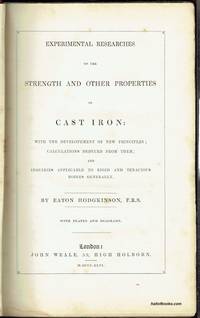
1846230200John Weale 1846. 1st. Hardback. Fair. First seperate edition hardback 1846 with no jacket as issued. In overall fair-to-good used condition with some minor signs of age handling and storage - paper-covered boards with red cloth spine worn to edges tanned and a little soiled; title label to spine tanned and chipped. Binding tight and hinges sound. Internally clean no annotation or inscriptions - ownership signature neat to front endpaper dated 11/08/1848; tanning to page-ends with light scattered foxing here and there but text charts tables plates and diagrams bright and clear throughout. Includes publishers catalogue of Engineering and Architectural titles to rear. Photographs available. Not an old library book. John Weale hardcover
1856010227London: Richard Taylor and William Francis 1856. Book. Very Good. Cloth. 1st Edition. 8vo - over 7¾ - 9¾" tall. First Edition in original green embossed cloth with bright gilt lettering at spine Very Good corners turned in widely scattered small spots of browning hinges tight. With three engraved plates one folding and errata slip tipped at p. 445. The inked signature of Robert Siegfried front paste down. viii 496 pp. Richard Taylor and William Francis Hardcover
1864010636London: Trubner & Co. 1864. Book. Very Good. Cloth. First British Edition. 12mo - over 6¾ - 7¾" tall. First British Edition from the then last German eighth including the "Advertisement by the Editor" and the " Introductory Letter" by the author. Green cloth covered blind stamped boards with gilt lettering to the spine. Very Good. Spine has 2 small holes 3" tear to cloth at top back joint both hinges starting but holding nicely. Two different prior owner book plates to front paste down James H. Graff of Baltimore and William B. Jensen noted Univ. of Cincinnati chemist and educator. A printed portrait of Buchner tipped onto front end page. Small book seller stamp to bottom of front end page. A foundational text of 19th-century scientific materialism SCARCE in the First English language edition. . Trubner & Co. Hardcover
1811009891Paris: Chez H. Nicolle 1811. Book. Very Good Plus. Hardcover. Second Edition. 8vo - over 7¾" - 9¾" tall. Second augmented and corrected edition of the work originally published under the title "Da Tails Scientifiques". Two volumes handsomely bound in contemporary full mottled calf the backs intricately gilt decorative end papers. Very Good some rubbed spots to end papers. a few small rubs at edges. Chez H. Nicolle Hardcover
187719567London: Longmans Green & Co. Very Good- in No Dust Jacket dust jacket. 1877. First Edition. Hardcover. Boards show shelf wear end papers show light discoloration. Previous owner's name "Samuel Jacobsohn" stamped in ink on title page contents page and last page of text.; A tight solid book hinges intact. Untrimmed fore and bottom page edges. Minimal pencil marks. Dark red cloth covered boards blind stamped on front board and gilt titles on spine.; B&W Illustrations; 8vo 8" - 9" tall; 509 pages; In small print on title page - "Reprinted from the transactions of the Royal Irish Academy; The reports of the British Association for the Advancement of Science; etc." Lloyd was Provost of Trinity College in Dublin. . Longmans, Green & Co. hardcover
1893055105Clarendon Press Oxford 1893. 1st Edition . Hardcover. Near Fine. Drawings Photographs. Xvi 578 2 Pp And 8 Pp Catalogs At End. First Edition Probable Second Issue With 4 Errata Printed At End Of Contents Rather Than On An Inserted Slip. Green Cloth Gilt And Stamped In Blind. Black Endpapers. Slight Wear Near Fine And Scarce Thus Gilt Bright Cloth Clean And Unfaded No Marks; Half Title Present <br/> <br/> Clarendon Press, Oxford hardcover
186743456London Taylor and Francis 1867. 4to. No wrappers as extracted from "Philosophical Transactions" Vol. 157 - Part I. Titlepage to volume 155 and pp. 49-88. Titlepage with minor light browning at corners. Internally clean. A small stamp on verso of titlepage. <br/><br/><em>First appearance of this seminal paper in its full version from "Transactions" representing the announcement of Maxwell's final "Theory of Gases" and introduces the "Maxwell Distribution" in its final form a statistical means of describing aspects of the kinetic theory of gases a theory together with his electromagnetic theory are considered to be SOME OF THE GREATEST ADVANCES IN PHYSICS OF ALL TIMES. Everett considers this paper 1868 to be Maxwell's greatest single paper. Maxwell's discoveries laid the foundations of special relativity and quantum mechanics.One of Maxwell's major investigations was on the kinetic theory of gases. Originating with Daniel Bernoulli this theory was advanced by the successive labours of John Herapath John James Waterston James Joule and particularly Rudolf Clausius to such an extent as to put its general accuracy beyond a doubt; but it received enormous development from Maxwell who in this field appeared as an experimenter on the laws of gaseous friction as well as a mathematician.In 1866 he formulated statistically independently of Ludwig Boltzmann the Maxwell-Boltzmann kinetic theory of gases. His formula called the Maxwell distribution gives the fraction of gas molecules moving at a specified velocity at any given temperature. In the kinetic theory temperatures and heat involve only molecular movement. This approach generalized the previously established laws of thermodynamics and explained existing observations and experiments in a better way than had been achieved previously. Maxwell's work on thermodynamics led him to devise the Gedankenexperiment thought experiment that came to be known as Maxwell's demon. </em> unknown
18812111902160200219Takahashi Matsunosuke 1881. Soft Cover. Fine. Number of books: 3 Takahashi Matsunosuke paperback
1872035726London: Macmillan & Co 1872. 1st Edition 1st Printing. Hardcover. Good. Xv 592 Errata At Bottom Of P. 592 52 Pp Publisher's Catalog Dated April 1872. First Printing; About A Quarter Of The Book Contains Papers Published Here For The First Time. Green Cloth Gilt Brown Endpapers. Gilt Complete And Bright Cloth Worn With Fraying At Corners And At Ends Of Spine And In Three One Inch Long Thin Lines On Rear Spine Edge And Joint Cracked Through At Top 1" Of Front Spine Edge Hinges Cracked At Endpapers And Before Title Page But Binding Solid. No Names Or Marks. <br/> <br/> Macmillan & Co hardcover
1894034321New York: Scientific American Inc. 1894. First Edition . Illustrated Wrappers. Good. Cover And Interior Page With Text And Photos Of The Columbia. Light Wear With A Few Short Edge Tears. International Postage At Usps Priority Mail Box Rate <br/> <br/> Scientific American, Inc. unknown
1873005243Paris and Londres: Gauthier-Villars 1873. Book. Very Good. Leather Spine/Cloth Boards. First Edition. Small Quarto. 2nd volume only. Very Good leather spine label with gilt titles boards a bit rubbed book plate front pastedown from the Library of the Royal Naval College Greenwich along with their stamp dated 1875 at title page and page 1. No other markings. Joseph Plateau 1801-1883 was a Belgian physicist He was the first person to demonstrate the illusion of a moving image has a mathematical problem named for him and is highly regarded for his studies of soap films capillary action and surface tension. Gauthier-Villars Hardcover
182046032Paris Crochard 1820. Uncut with orig. printed wrappers Juin-issue. In "Annales de Chimie et de Physique Par MM. Gay-Lussac et Arago" Tome XIV Juin issue pp. 113-222. Entire issue in orig. wrappers. Savart's paper: pp. 113-172 and 3 folded engraved plates. <br/><br/><em>First printing of a pioneer paper on the acoustics of the violin and on the construction of the Trapezoidal Fiddle."In his earliest work Savart gave the first explanation of the function of certain parts of the violin. To learn how vibrations are transmitted from the strings to the rest of the instrument he induced vibrations in a free wood plate by passing a vibrating string over a bridge at its center; he also used Chladni’s sand-pattern technique to observe the resulting nodal lines. Savart showed that the bridge transmits the string’s vibrations; that the plate can be made to vibrate at any frequency; and that the corresponding mode is a modification of an unforced mode. He demonstrated that the sound post also serves to transmit vibrations and he explained that it therefore should not be placed under a nodal line. Thinking that symmetry and regularity would produce the best tone Savart built a trapezoidal violin with rectangular sound holes. When the instrument was played before a committee that included Biot the Composer Cherubini and other members of the Academy of Sciences and the Académie des Beaux-Arts its tone was judged as extremely clear and even but somewhat subdued."DSB.The issue also contains Eilhard Mitscherlich' famous paper in the first French version "Sur la Relation qui existe entre la forme cristalline et les proportions chimiques" pp. 172-190. </em> unknown
182046029Paris Crochard 1820. No wrappers. In "Annales". In "Annales de Chimie et de Physique Par MM. Gay-Lussac et Arago" Tome XIV Juin issue pp. 113-222. Entire issue offered with halftitlepage to vol. 14. Savart's paper: pp. 113-172 and 3 folded engraved plates. Plates with some scattered brownspots. <br/><br/><em>First printing of a pioneer paper on the acoustics of the violin and on the construction of the Trapezoidal Fiddle."In his earliest work Savart gave the first explanation of the function of certain parts of the violin. To learn how vibrations are transmitted from the strings to the rest of the instrument he induced vibrations in a free wood plate by passing a vibrating string over a bridge at its center; he also used Chladni’s sand-pattern technique to observe the resulting nodal lines. Savart showed that the bridge transmits the string’s vibrations; that the plate can be made to vibrate at any frequency; and that the corresponding mode is a modification of an unforced mode. He demonstrated that the sound post also serves to transmit vibrations and he explained that it therefore should not be placed under a nodal line. Thinking that symmetry and regularity would produce the best tone Savart built a trapezoidal violin with rectangular sound holes. When the instrument was played before a committee that included Biot the Composer Cherubini and other members of the Academy of Sciences and the Académie des Beaux-Arts its tone was judged as extremely clear and even but somewhat subdued."DSB.The issue also contains Eilhard Mitscherlich' famous paper in the first French version "Sur la Relation qui existe entre la forme cristalline et les proportions chimiques" pp. 172-190. </em> unknown