Mays, Willie; Einstein, CharlesBiblio.com

850 résultats
1966WMCE001New York: E. P. Dutton & Co. 1966 First edition first printing. Signed and inscribed by Mays on front free endpaper: "To Joe / Best Wishes / Willie Mays." Publisher's green and orange cloth with "Willie Mays" in blind to front board and spine lettered in black and orange; in its original unclipped dust jacket designed by Bob Korn with white front panel lettered in brown orange and green and a green spine. About fine book with light fading to spine and a hint of rubbing to foot of spine; very good price-clipped dust jacket with light wear to spine ends and some edgewear. With Beckett Letter of Authenticity. Overall a great boldly inscribed copy. Presentation copies from Mays are exceedingly scarce. In this book Willie Mays tells his life story with the help of prolific sportswriter Charles Einstein. Mays started playing professional baseball at 16 in the Negro Leagues and was soon drafted by the New York Giants. He went on to play 21 seasons with the Giants winning a World Series with the team in 1954. His over-the-shoulder catch in that World Series is one of the most iconic moments in sports history. A 24x All-Star and a 12x Gold Glove award winner Mays was inducted into the Hall of Fame in 1979 and was voted to the Major League Baseball All-Century Team in 1999. . Signed. First Edition. Hard Cover. Fine/Dust Jacket Included. New York: E. P. Dutton & Co. hardcover
1954042205New York: Crown Publishers 1954. 1st Edition 1st Printing. Hardcover. Fine/Near Fine. Vii 377 Pp. Grey Cloth Spine Lettered In Gilt On Maroon Background. First Edition 1954 First Printing No Statement Of Printing Dj Priced $4.00 Publisher's Address As 49 Fourth Avenue On Front And Rear Flaps. Book Fine Spine Edges Crisp. Former Owner's Verified Signature With August 1954 Date No Other Marks. Dj Near Fine Touch Of Rubbing At Corners 1/4" Closed Tear At Bottom Of Front Spine Edge With Associated Rubbing And Another 1/4" Closed Tear At Top Of Rear Panel. Seldom Seen In This Condition Or Better. <br/> <br/> Crown Publishers hardcover
1926029292New York: E. P. Dutton and Company 1926. First American Edition 1st Printing. Hardcover. Very Good/Fair DJ. 124 Pp. Brown Cloth Gilt. First American Edition No Date Printing Statement Indicates 1926 British Sheets Were Used. Book Is Somewhat Worn And Has Small Areas Of Fraying At Corners Hinges Solid Small Previous Owner's Name On Front Free Endpaper. Dj Worn Bottom 40% Of Spine Chipped Away But Title And Author Remain Small Edge And Corner Chips. <br/> <br/> E. P. Dutton and Company hardcover
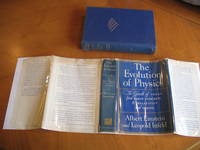
1938035775New York: Simon & Schuster 1938. First American Edition 1st Printing. Blue Cloth. Very Good/Very Good. Illustrated with Black and White Photographs Charts and Diagrams. X 319 Pp 1 Pp Ads At Rear. Blue Cloth Gilt Yellow Endpapers. One Of 6000 Copies Of The American First Printing; Publisher's Note On Dj States That The Uk Dutch And American Editions Were Being Issued Simultaneously. Book Is Very Good Gilt Very Bright Cloth Clean Rear Hinge Cracked In Upper 2 3/4" Clean Unmarked Pages; One Quarter Inch Square Area Of Fading At Upper Left Of Spine Panel. With Heraldic Bookplate On Front Pastedown Mostly Under Flap Of Dj. First Issue Dj Priced $2.50 At Bottom Of Rear Flap With Price Much Nearer The Gold Border Than The Bottom Edge; On Later Printings The Price Is Aligned Midway. Dj Clean Spine Lettering Somewhat Browned Light Wear 1/2" Triangular Chip At Top Of Rear Panel Still Present But Loose; Minute Losses At Corners; Browning To Edges Of White Rear Panel But No Browning At All To Front Panel. <br/> <br/> Simon & Schuster hardcover
1949148432Evanston: The Library of Living Philosophers Inc. 1949. Finely bound edition of Einstein's singular autobiography. Octavo original cloth with gilt titles to the spine top edge gilt frontispiece of Einstein by Yousuf Karsh. Edited by Paul Arthur Schilpp. In near fine condition. Written by the man considered the "Person of the Century" by Time magazine this is not a glimpse into Einstein's personal life but an extension and elaboration into his thinking on science. Two of the great theories of the physical world were created in the early 20th century: the theory of relativity and quantum mechanics. Einstein created the theory of relativity and was also one of the founders of quantum theory. Here Einstein describes the failure of classical mechanics and the rise of the electromagnetic field the theory of relativity and of the quanta. "The greatest physicist of the 20th century" PMM 408. The Library of Living Philosophers, Inc. hardcover
1907003219Leipzig: J. A. Barth 1907. In Annalen der Physik Vierte Folge Band 22. First Edition. Contemporary Cloth. Very Good. J. A. Barth Hardcover
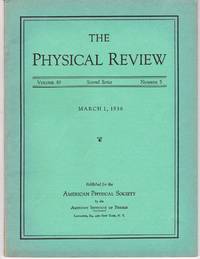
19366550Lancaster PA: American Physical Society 1 March 1936. Second series volume 49 number 5. Very Good. ppl 341-422. Original green wraps. Slight nick at bottom edge of lower wrap else better than very good. <br /><br />Includes the retort by Einstein and Rosen originators of speculation on the existence of "worm-holes" in spacetime to objections made to the general theory of relativity. According to Galina Weinstein: "Between 1935 and 1936 Einstein was occupied with the Schwarzschild solution and the singularity within it while working in Princeton on the unified field theory and with his assistant Nathan Rosen on the theory of the Einstein-Rosen bridges. He was also occupied with quantum theory. He believed that quantum theory was an incomplete representation of real things. Together with Rosen and Boris Podolsky he invented the EPR paradox. I demonstrate that the two-body problem in general relativity was a heuristic guide in Einstein's and collaborators' 1935 work on the Einstein-Rosen bridge and EPR paradox." <br /> <br />Also articles by notable physicists on radioactivity electron mobility quantum-mechanical measurement and so on. American Physical Society paperback
1906292Leipzig: Barth 1906. 1st Edition. FIRST EDITION FIRST ISSUE of two important 1906 Einstein papers. Einstein wrote two papers on the photoelectric effect his revolutionary 1905 paper and "Zur Theorie der Lichterzeugung und Lichtabsorption" his continuation of it. In them Einstein employed Planck's theory that luminous energy can be absorbed or emitted only in discrete amounts called quanta and proposed a theory of light quanta involving particles with no mass photons whose energy depended on frequency. All of Einstein's experimental results confirmed that light actually consisted of discrete energy packets. <br /> <br /> "Based on this theory Einstein wrote an equation describing how the photoelectric effect works. The energy of individual electrons emitted by a photocell is a function of the frequency of the light hitting the photocell and the rate of electron emission is a function of the light source's intensity number of photons with sufficient energy being emitted. This is contrary to what is predicted by classical physics" History of Physics: The Wenner Collection. <br /> <br /> In this Einstein's second paper on photoelectrics he revisited Planck's theory and from it developed his ideas to show that an electromagnetic wave such as light could be described as a particle photon with discrete quanta of energy that was dependent on its frequency. In the long history of quantum mechanics this would lead to a theory of unity between subatomic particles and electromagnetic waves called wave-particle duality in which particles and waves were neither one nor the other but had certain properties of both. <br /> <br /> At first Einstein believed that light-quantum hypothesis was merely 'heuristic': that it behaved only as if it consisted of discontinuous quanta. But in this paper and others to follow Einstein used his statistical mechanics to demonstrate that when light interacts with matter Planck's entire formula can arise only from the existence of light quanta -- not from waves. In other words in explaining the photoelectric effect by extending Planck's concept of quantum of energy had Einstein "demonstrated that his own 'light-quantum hypothesis' was implicit in Planck's earlier work" Honner The Description of Nature 31. <br /> <br /> ALSO included in this volume is "Daz Prinzip von der Erhaltung." The Principle of Conservation of Motion of the Center of Gravity and the Inertia of Energy. In this "ingenious thought experiment involving energy transport in a hollow cylinder Einstein returned to the relationship between inertial mass and energy giving more general arguments for their complete equivalence" Calaprice The Einstein Almanac 18. This was the first statement that the conservation of mass is a special case of the conservation of energy. CONDITION & DETAILS: Leipzig: Barth 1906. Octavo. 8.75 x 6 inches; 222 x 152mm. Ex-libris bearing minimal markings only a small stamp on the title page. Illustration: 6 plates and figures throughout. Entire volume in black cloth gilt-lettered at the spine. The cloth is a bit rubbed and scuffed and there is fading at the spine. Solidly and tightly bound. Bright and clean throughout. Barth hardcover
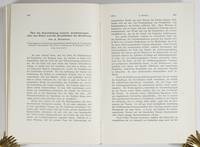
1909524241909. Verh. Dtsch. Physik. Ges. 11/ 1-24. - Hrsg. im Auftrage der Gesellschaft von Karl Scheel. - Braunschweig Druck und Verlag von Friedrich Vieweg und Sohn 1909 8° VII 749 pp. Abbildungen Halbleinenband d.Zt.; St.a.Tit.; feines Expl. First Edition! The true first printing see below of this paper which Wolfgang Pauli said "can be considered as one of the landmarks in the development of theoretical physics" Schilpp p. 154. This paper marks the introduction of the modern "photon" concept although the term itself was introduced much later in a 1926 paper by Gilbert N. Lewis. It contains "the first well-conceived promulgation of the wave-particle duality of light which had implications as profound as Einstein's earlier theoretical breakthroughs" Isaacson p.157. Einstein here anticipated the principle of complementarity one of the fundamental principles of quantum mechanics. His own proposal for a solution of the wave-particle paradox - that Maxwell's equations for electromagnetic fields be modified to allow wave solutions that are bound to singularities of the field - was never developed although it may have influenced Louis de Broglie's pilot wave hypothesis for quantum mechanics developed in his famous thesis Recherches sur la théorie des quanta 1924. The present paper was also published in Physikalische Zeitschrift Vol. 10 1909 but the Verhandlungen printing has priority: it was published on 30 October 1909 the Physikalische Zeitschrift printing appeared on 10 November. "This extensive paper given as lecture before the 81st assembly of the "Gesellschaft Deutscher Naturforscher" in Salzburg on 21st September 1909. He spoke on "The Development of Our View of the Nature and Constitution of Radiation" a topic that embraced both relativity and quanta. Among those who attended Einstein's lecture were some of the world's foremost physicists. In Einstein's austere opinion his address regarded strictly as a work of science was of little importance since as he writes to a co-worker it contained nothing new. Einstein was being overmodest. Besides to many in Einstein's audience and it should be born in mind that it was the year after Minkowski's stirring introduction of the concept of the fourth dimension this Lecture came as a revelation. The occasion was important for Einstein too. He had been working for years in a sort of scientific exile and his curiosity as to what great scientists were like in face-to-face discussion was at least as great as their curiosity about him. His confidence in himself was certainly not harmed when he found that he was able to hold his own easily in their company. Moreover at this congress Einstein first met Planck. In addition he made new'lasting friendships leading to a voluminous scientific correspondence. Amongst those attending the congress were Max von Laue Max Born. Arnold Sommerfeld Hasnohrl. Ladenburg. Max von Laue was to be the first to publish in 1911 the first text-book on relativity theory. All of them are present in this issue with scientific papers of their own." Walter Alicke 11. Jahrg. 30. Oktober 1909 Nr. 20 - Vorgetragen in der Sitzung der physiklaischen abteilung der 81. Versalung Deutscher Naturforscher und Ärzte zu Salzburg am 21. September 1909." Weil No. 30; Schilpp-Shields No. 30; Hoffmann Einstein p. 93. unknown
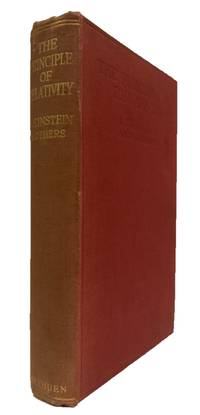
192360195London: Metheun & Co. VG. 1923. 1st Edition. Hardcover. Hardback in Very Good condition without dust jacket. 8vo 8" - 9" tall. 216 pages. Book spine faded. Bound in original red cloth with gilt spine title lettering. 8 pages of ads at the rear. Book is solid straight and no ownership markings. Pages are clean and do not show any signs of foxing or soiling. Corners still sharp while spine ends slightly bumped . Quick shipping excellent customer service. All books carefully packaged in boxes and ship with tracking information. . Metheun & Co. hardcover
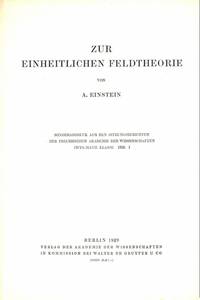
1929270931929. S.Ber. Akad. Wiss. Berl. 1929/ 1. - Berlin Verlag der Akademie der Wissenschaften 1930 8° 8 S. in schönem Pappband der Zeit. First Edition! "The unified Field Theory" is one of Einstein's last important scientific works. According to Weil "This paper represents a new development which was immediate news. A translation by L.L.Whyte appeared in the London Times of Feb. 4 1929. It was quoted in full in "Observatory" vol. 52 under the title "New Field Theory" pp.82-87 and 1930 pp.11-118." In 1928 Einstein embarked on a new approach to a unified field theory . involving what he called 'distant parallelism' . By early 1929 he had solved the main problems involved in writing down field equations for his unified field theory. On the day of offical publication of the third of a formidably technical series of 9 articles on the theory . excited headlines appeared in foreign newspapers throughout the world . In this frenzied unscientific atmosphere Einstein's new theory was hailed in the press as an outstanding scientific advance. Yet Einstein had stated in his article it was still tentative; and soon he found he had to abandon it. - cf.Parkinson Breakthroughs p.279 Weil No. 165 Schlipp Einstein No.226; Alicke No. 141; Norman Coll. I 700 unknown
1930021309London: The Soncino Press 1930. 1st Edition . Hardcover. Fair/Fair. Hardcover book in fair condition. Dust jacket included in poor to fair condition showing toning light staining and tears. Book dampstained closer to spine crack to binding starting at middle. A few instances of marked lines in the margins not affecting text. An excellent resource copy of this scarce first edition. Questions welcome. We ship internationally from the United States and Canada every week. If buying internationally please be aware that additional charges may apply for heavier books. We guarantee a safe quick and secure transaction. 10 years in online bookselling experience. <br/> <br/> The Soncino Press hardcover
190738828Berlin J.A. Barth 1907. Contemp. hcloth. Light wear to top of spine. "Annalen der Physik. Vierte Folge. Band 22" Engraved portrait of Pierre Curie. VIII1016 pp. and 4 plates. Einstein papers. pp. 180-190 pp. 569-572 and p.800. Internally clean and fine. The whole volume offered. <br/><br/><em>All papers in first edition. "From 1905 through 1909 Einstein published five major papers on the hypothesis of energy quanta its theoretical implications and its use in the explanation of various phenomena. Among these papers we have his importent paper "Die Plancksche." and in his second paper from 1906d he asserted that Planck's derivation implicitly assumes quantification of the enrgies of charged oscillators. Now in the paper offered he returned to this question showing that if the structure function in phase space he had introduced earlier is assumed to restrict the oscillators to orbits with energies that are integral mulætiples of 'hv' then the average oscillator energy in a canonical ensemble yealds Planck's law when substituted in eg. The works contains the first systematic introduction of probability factors in the mathematics of Quantum Theory.The second paper represents Einstein's third stage in dealing with brownian motion. He had previous explained the zigzag motion of suspended particles and looked as this penomenon from a more general angle. In the present investigation he extends his reults to all macroscopic parameters by giving a general principle for the calculation of theit fluctuations. Weil: nos 15 1-2 with an asterix a. 16. </em> hardcover
1920B6223Toronto; London: the Ryerson Press.; Methuen & Co. Edition. 1920. A near fine example text and illustrations clean and crisp.<br>. Edition: First Canadian Edition. after the first London. Binding: Contemporary full red cloth title on flat spine debossed stamped title on the upper board lacks the dust jacket. Notes: Albert Einstein 1879 – 1955 was a German-born theoretical physicist who developed the theory of relativity one of the two pillars of modern physics alongside quantum mechanics. His work is also known for its influence on the philosophy of science. He is best known to the general public for his mass–energy equivalence formula which has been dubbed "the world's most famous equation". He received the 1921 Nobel Prize in Physics "for his services to theoretical physics and especially for his discovery of the law of the photoelectric effect" a pivotal step in the development of quantum theory. Size: Octavo 8vo. Illustration: Illustrated with five diagrams and numerous in text mathematical equations. A foundation work in physics and astronomy. <br><br> Category: Book Canada; Book Science & Technology; the Ryerson Press.; Methuen & Co. Edition. hardcover
1911003225Leipzig: J. A. Barth 1911. title continued "Uber der mechanischen Grundlagen der Thermodynamik" pp. 175-76 and Bemerkung zu meiner Arbeit: "Eine Beziehung zxischen dem elastischen verhalten" p. 590 and Berichtigung zu meiner Arbeit: Enie neue Bestimmung der Molkuldimensionen" pp. 591-92. In Annalen der Physik Vierte Folge Band 34. Contemporary three-quarter cloth marbled boards. Short scratch in spine; small stain on rear cover; three nicks in outer edge of rear cover. First Edition. About Very Good. J. A. Barth hardcover
1911003227Leipzig: J. A. Barth 1911. Contemporary three-quarters cloth marbled boards. Discusses bending of light in gravitational field. First Edition. Very Good. J. A. Barth hardcover
1912011596Leipzig: Johann Ambrosius Barth 1912. In bound volume of Annalen der Physik. Vierte Folge Band 38 pp. 355-69. Volume also includes 1 Einstein "Nachtrag zu meiner Arbeit:: 'Thermodynamische Begrundung des photochemischen Aquivalentgesetzes" pp. 881-84; 2 "Antwort auf eine Bermerkung von J. Stark p. 888; and 3 "Relativitat und Gravitation Erwiderung auf eine Bermerkung von M. Abraham" pp. 1059-64. Paper label on spine top of which is worn; library bookplate; perforated stamp on half-title and title page. First Edition. Library Buckram. Good. Johann Ambrosius Barth Hardcover
192162573New York: Henry Holt and Company 1921. Hard cover. Very Good. 0 Very good. No dust jacket. Signed by previous owner. hb vg bk/ no dj 1st American edition dark blue cloth head and heel of spine bumped gilt lettering fading binding tight pages yellowing. Henry Holt and Company hardcover
1910003224Leipzig: J.A.Barth 1910. In Annalen der Physik Vierte Folge Band 33. First two papers coauthored with L. Hopf. Full title of third paper: "Theorie der Opaleszenz von homogenen Flussigkeiten und Flussigkeitsgemischen in der Nahe des kritischen Zustandes." "It was his las major paper on classical statistical mechanics" Abraham Pais 'Subtle is the Lord.' page 103. Buckram two leather spine labels; bookplate; ink stamp on frontfly; small adhesion of title to half-title. First Edition. Contemporary Cloth. About Very Good. J.A.Barth Hardcover
194146476Tucuman Argentina 1941. Royal8vo. Orig. printed wrappers. Offprint from "Revista. Universidad Nacional de Tucuman" Series A Matematicas y Fisica Teorica Vol. 2 Diciembre de 1941 Nos 1 y 2. Pp. 11-15. Fine and clean. This copy has belonged to Abraham Pais 1918-2000 - the famous Einstein scholar theoretical physicist and Einsteins collegue at Princeton - and having his name on top of the frontwrapper "A Pais" <br/><br/><em>First edition of a scarce paper in the offprint version. The paper "represents the basis of the one written by the same author in collaboration with Wolfgang Pauli in 1943 in which by following analogous lines the proof of the non-existence of regular particle-type solutions was generalized to the case of cilyndrical geometries in Kaluza-Klein theory Einstein & Pauli 1943. Besides other generalizations were subsequently presented. The non-existence of such solutions in classical unified field theory was undoubtedly an important criterion leading Einstein's investigations."Galvagno and Giribet."In his search for a unified field theory that could undercut quantum mechanics Einstein considered five-dimensional classical Kaluza-Klein theory. He studied this theory most intensively during the years 1938-1943. One of his primary objectives was finding a non-singular particle solution. In the full theory this search got frustrated and in the x5-independent theory Einstein together with Pauli argued it would be impossible to find these structures." Jeroen van Dongen.Weil: 208. - Boni: 243. </em> unknown
19206874New York: Henry Holt and Company 1920. First American Edition First Printing. First American edition first printing with the 1920 date on the title page and no additional printings listed on the copyright page. Measuring approximately 8.5" x 5.5" with 168 numbered pages. <br /> <br /> This book is in good condition. Heavy spotting to the original dark cloth boards. Moderate foxing to the edges of the textblock. Old bookseller ticket on the front pastedown. Previous owner's stamp on the front endpaper. Moderate foxing to front endpapers and title page. Interior pages are otherwise clean. <br /> <br /> Please view the many other rare titles available for purchase at our store. We are always interested in purchasing individual or collections of fine books.<br /> <br /> Inventory# P1-70. Henry Holt and Company unknown
1912008413Leipzig: Johann Ambrosius Barth 1912. Small pieces missing from spine; rear wrapper carefully reattached; ink stamp on front wrapper; small piece of paper stuck to first page. . First Edition. Original Printed Wrappers. Good. Johann Ambrosius Barth Paperback
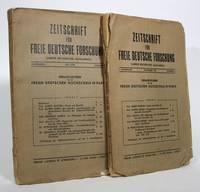
1938016311Rue Cujas Paris: Verlag Science et Literature 1938. 1st Edition. Soft cover. Very Good. 8vo medium. 2 Volumes Tan wrappers lettered in black 168pp; 144pp light foxing and sunning on text-block some unopened pages wrappers somewhat soiled some faint damp stains front wrapper of second volume detached tears and chips to extremities and spine ends of both volumes. Very Good. Scarce According to the Leo Baek Institute for the Study of German-Jewish History and Culture "Ernst Heidelberger established a bookstore in Paris in September 1937. The bookstore offered émigré journals and exile literature. In the following years he published a few books including Einstein's Physik und Realität under the imprint Science et Literature. He also became the publisher of two journals Zeitschrift für freie deutsche Forschung and the Freie deutsche Hochschulen." These two volumes offer articles from Einstein on Physics and Relativity as well as The Logical Psychological and Physical Limits of the Uncertainty Principle On the Philosophy of National Socialism Forms of Government and Administration among Indigenous Peoples National Socialist Science and the Tasks of Free German Science Physics and Reality Principles of German Foreign Policy Forms of Government and Administration among Indigenous Peoples Heinrich Heine and the European Revolutions Studies on the Economic Situation of the Population in Germany I. Study: The Development of Wage Rates in Germany 1932-1938. Published by the Free German Academy in Paris. Verlag Science et Literature unknown
190659121Leipzig Johann Ambrosius Barth 1906. Full cloth. Spine with gilt lettering. In: "Annalen der Physik. Vierte Folge. Band 20. Herausgegeben von Paul Drude." Portrait Paul Drude VIII1048 pp. and 6 plates. Einstein papers: pp. 199-206 and 627-33. Internally fine and clean. The entire volume offered. Broad margins. <br/><br/><em>Both papers first edition. It was for the papers "Ueber einen die Erzeugung und Verwandlung des Lichtes betreffenden heuristischen Gesichtspunkt" of 1905 and "Zur Theorie der Lichterzeugung. Theory of light emission and absorption the offered item that Einstein was awarded the Nobel Prize in 1921. "The quantum theory has affected virtually every branch of physics. Its earliest and one of its most significant developments was Einstein's application of the theory to what is known as the 'photo-electrical effect'.Einstein explained this effext by suggesting that the classical view that light is emitted in the form of continous waves must be abandoned. The photo-electrical effect could be explained only as an example of quantum action where the waves of light or X-rays are emitted in minute particles or bullets. It is he size of the bullet the wave-lenght of the radiation which determines the number of electrons ejected. It was for this and not for the theory of relativity that Einstein was awarded the Nobel Prize in 1921. Einstein's two fundamental papers on this subject are "Ueber einem Erzeugung." 1905 and Zur Theorie der Lichterzeugung the paper offered here" PMM the note to 391. In the second paper Principle of the conservation of the centre of mass motion and the inertia of energy he shows that the conservation of mass is a special application of his energy principle E= Mc2 - Weil: 12 & 13.Among the many papers in this volume we have Max von Laue: Zur Thermodynamik der Inteferenzerscheinungen. pp. 365-378. </em> hardcover
190638794Leipzig Johann Ambrosius Barth 1906. Bound together in one contemp. hcloth. Small tears to spine ends. = "Annalen der Physik. Vierte Folge. Band 20. Herausgegeben von Paul Drude." Portrait Paul Drude VIII1048 pp. and 6 plates. Einstein papers: pp. 199-206 and 627-33. Internally fine and clean. The whole volume offered. <br/><br/><em>Both papers first edition. It was for the papers "Ueber einen die Erzeugung und Verwandlung des Lichtes betreffenden heuristischen Gesichtspunkt" of 1905 and "Zur Theorie der Lichterzeugung. Theory of light emission and absorption the offered item that Einstein was awarded the Nobel Prize in 1921."The quantum theory has affected virtually every branch of physics. Its earliest and one of its most significant developments was Einstein's application of the theory to what is known as the 'photo-electrical effect'.Einstein explained this effext by suggesting that the classical view that light is emitted in the form of continous waves must be abandoned. The photo-electrical effect could be explained only as an example of quantum action where the waves of light or X-rays are emitted in minute particles or bullets. It is he size of the bullet the wave-lenght of the radiation which determines the number of electrons ejected. It was for this and not for the theory of relativity that Einstein was awarded the Nobel Prize in 1921. Einstein's two fundamental papers on this subject are "Ueber einem Erzeugung." 1905 and Zur Theorie der Lichterzeugung the paper offered here" PMM the note to 391. In the second paper Principle of the conservation of the centre of mass motion and the inertia of energy he shows that the conservation of mass is a special application of his energy principle E= Mc2 - Weil: 12 & 13.Among the many papers in this volume we have Max von Laue: Zur Thermodynamik der Inteferenzerscheinungen. pp. 365-378. </em> hardcover