Einstein, AlbertBiblio.com
850 résultats
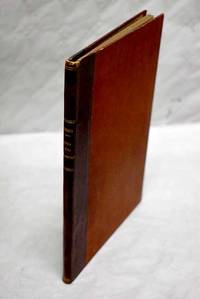
19212545920Madrid. 1921. Hardcover. Cubierta deslucida. Good. 24 cm. 79 p. Encuadernación en tapa dura artesanal con lomo en piel. Einstein Albert 1879-1955. Über die spezielle und die allgemeine Relativitätstheorie. Traducida de la 12ª ed. alemana por F. Lorente de Nó. Imp. de Suc. de S. Peláez. Relatividad Física . Cubierta deslucida. Física.530.12 530 hardcover
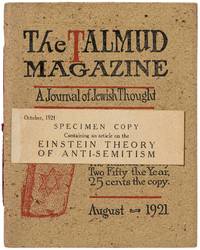
1921553355Boston: Talmud Society 1921. Softcover. Fine. First edition. 12mo. 64pp. Original cord-tied wrappers printed in red and black. The first and last leaf toned from interaction with the wrappers else about fine. An August issue of the magazine apparently used in October to promote the short-lived magazine this copy with a printed slip affixed to the front wrap: “October 1921. Specimen Copy. Containing an article on the Einstein Theory of Anti-Semitism.†Photographic portrait of Einstein on page 14; along with an English translation of his essay: "Jewish Nationalism and Anti-Semitism: Their Relativity" which originally appeared in the London Jewish Chronicle. Talmud Society unknown
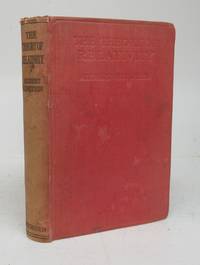
1921419355New York: Henry Holt and Company 1921. First Edition. Hardcover. Used - Very Good. This is the 3rd Large Printing. Translated by Professor Robert W. Lawson M.Sc. Henry Holt and Company hardcover
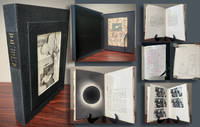
195533706New York: The Ram Press 1955. 1st Edition - Limited. 1st Edition - Limited. We are going to experience another full Solar Eclipse April 8 2024. This volume was to celebrate Albert Einstein and the Solar Eclipse of Jun 30 1954 and June 20 1955. Unusual Signed Kilfitt/Zoomar Eclipse Book with original Einstein Frank Back Photo. 8vo 5 1/2" x 8 1/2" 40pp signed and inscribed by Dr. Back on the second free endpaper. <br /> "To Leslie and Duke.<br /> We should never make statements witch are not planned correct and checked by us .we should not impress by telling sometime .stories in order to make contributions or to say something. Talking is silence. "Silence is gold"<br /> Wish you the very best from the heart.<br /> T F Back sept 11 1965"<br /> <br /> A fine copy in handmade decorative paper covered boards printed glossy paper label on the upper cover limited edition of 3000 copies in the original glassine outer wrapper showing some light sunning. This volume was dedicated to Albert Einstein and is the only book that was ever written by "The Father of the Zoom Lens". With / An original black & white silver gelatin 5 x 7 photograph of Dr. Albert Einstein and Dr. Frank Gerald Back seated together in very fine condition acquired directly from Dr. Back's estate. This photograph was taken circa 1954 and is one of the images published in this limited edition. With An 18" x 22" blueprint folded of the Solar Eclipse Spectrograph size "C" drawing. It was made from the original drawing dated 4/1/55 drawn by Zoomar's Chief Designer Alfred Joseph Quittner "AJQ" & approved by Dr. Back "FGB". A very interesting package indeed. Dr. Back was a very close friend of Albert Einstein. <br /> Dr. Einstein persuaded the author to take the trip commemorated in this beautifully produced volume in order to capture the total eclipse of the sun which occurred on June 20 1955. Dr. Back intended to provide conclusive evidence for Einstein's theory of relativity by calculating the optical distortion if any of starlight caused by the sun's gravity. Earlier in 1919 Einstein's general relativity principles were supported by observations of a solar eclipse. The two scientists conferred on the project for over a year. Armed with a special Zoomar designed & built wide-angle solar-eclipse spectrograph Dr. Back was off to the Philippine Islands to board a military jet & chase the eclipse. Einstein however died while Back was on his way to Manila. Unable to report the excursion to his friend Dr. Back dedicated this book to his memory. Dr. Frank Back held over 200 patents directly relating to photographic equipment. He was the founder & president of Zoomar Inc. The photographic term " zoom" was derived from Zoomar. Dr. Back created the first widely used zoom lenses for motion picture and television; then in 1959 introduced the first zoom lens for still cameras with the introduction of the 36-82mm/f2.8 Voigtlander Zoomar. Dr. Back & Zoomar purchased the great Heinz Kilfitt optical factory of Munich Germany in 1966 & it became a subsidiary of Zoomar Inc. This volume was never widely distributed & when Zoomar Inc. ceased operations at Glen Cove Long Island many cases of this book were discovered & unceremoniously trashed. The existing number of copies is unknown but the book is not frequently encountered. This copy came from the personal estate of Dr. Frank Gerald Back & it is one of the few copies signed by him. An excellent example suited for collectors of Science Astronomy Einstein Zoomar or Photographic History in general. In a lovely custom clamshell case with a window insert displaying the original Einstein/Back photo.<br /> On page 13 there is a typo. He wrote July 301954 instead of June 30 1954 and was never changed. The Ram Press unknown
1931345H4370New York: The Macmillan Company of Canada Limited. Good. 1931. First American Edition. Hardcover. 8 9-94 pages. Select Bibliography. First published in London in 1930. "Professor Einstein is better known as a physicist than as a Zionist. Yet for many years he has given abundant proof both of a keen interest in Zionism and of a penetrating insight into its underlying ideas. He is impelled to Zionism by his acute consciousness of the excessive price at which the blessings of assimilation are bought by the Jewish communities of the Western world which for him are mainly represented by that of Germany. The price is a loss of solidarity of moral independence and self-respect. These in his view can be regained only if assimilated Jews find some common task of absolute human value to which they can bend their corporate energies as Jews. Such a task is to be found in the restoration of Jewish national life in Palestine." - Introduction. Unmarked with average wear. Backstrip lettering faded. Binding tight. A sound copy of this important compilation. Emanuel p.51. Boni Russ & Laurence 306.; 8vo - over 7¾" - 9¾" tall; Zionism Albert Einstein Politics Israel Palestine Theodor Herzl Zionist Organisation Jewish Colonial Trust Balfour Declaration Keren Hayesod Palestine Foundation Fund . The Macmillan Company of Canada Limited hardcover
1907432971907. <p>Einstein Albert 1879-1955. Berichtigung zu meiner Arbeit: "Die Plancksche Theorie der Strahlung etc." Offprint from Annalen der Physik 22 1907. Single sheet p. 800. Unbound as issued. 223 x 145 mm. Lower corner lightly creased but very good.</p> <p>First Edition Rare Offprint Issue. Einstein's important correction to his paper on specific heats "Die Plancksche Theorie der Strahlung und die Theorie der spezifischen Wärme" 1907; see Weil 15 which "made clear for the first time that quantum concepts have a far more general applicability" Pais p. 394. "Einstein initially believed that his oscillating lattice points in a three-dimensional crystal lattice were electrically charged ions. A few months later he published a correction to his paper in which he observed that this was an unnecessary assumption . . . Einstein's correction freed the quantum rules in passing one might say from any specific dependence on electromagnetism" Pais p. 396. Pais Subtle is the Lord pp. 394-396. Weil 15n.</p> . unknown
1938143h5663USA: Crowell 1938. Magazine. Illus. by Reid Robert O. Cover Art; Sawyers Martha; Beall C.C.; McLeod Ronald; Biggs Geoffrey; Cooper Mario; Roth Ben; Lichty George; Timmins Harry L.; Coe RolandBorgstedt Douglas; Keate Jeff; Green George Hamilton; Gentry Thurston; Hilton Ned. Good. Magazine. First Edition. Folio - over 12 - 15" tall. Feature article by Albert Einstein entitled "Why Do They Hate The Jews" offers his views on the subject and includes a large black and white profile photo of the man himself. Additional features include: Local Ghost Makes Good - Jesse James Makes Restitution in Pineville; Coach Ralph Furey explains why football stars are not born article with several photos of football stars of the day; Speak No Evil short story; Hangin' Crazy Benny short story; Uncertain Wings short story; Via All Oceans short story; You Liked a Parade short story; None But The Brave part 5 of 6; Murder for Christmas - part 3 of 10 of this serial by Agatha Christie; Great cover art by Robert O. Reid features young lovely eyeing the dessert table; and more. 70 pages. Unmarked with average wear. Binding intact. Moderate evidence of moisture exposure. A sound vintage copy of this exceptional issue. Boni Russ & Laurence 396. . Crowell Paperback
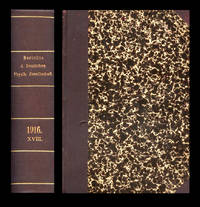
190638892Leipzig 1906. Einstein Albert 1879-1955. 1 Eine neue Bestimmung der Molekuldimensionen. In Ann. d. Physik 4th series 19 1906: 289-306. 2 Zur Theorie der Brownschen Bewegung. In ibid.:371-381. Whole volume 8vo. viii 1080pp. 5 plates. 213 x 143 mm. Original cloth spine faded split in upper half of spine inner hinge cracking. Very good. <p>1 First Edition in Journal Form Revised of Einstein's doctoral thesis ranked by his biographer as being on the same level as his 1905 papers on relativity the light quanta and Brownian motion. In his thesis Einstein presented a new theoretical method for determining molecular radii and Avogadro's number the number of atoms or molecules needed to make up a mass equal to a substance's atomic or molecular weight in grams. The thesis appeared in print in the spring of 1905; in the journal version published at the beginning of 1906 Einstein added a brief appendix containing an improved value of Avogadro's number.</p> <p>Einstein's biographer Abraham Pais wrote of Einstein's thesis as follows: </p> <p>"It is not sufficiently realized that Einstein's thesis is one of his most fundamental papers. Histories and biographies invariably refer to 1905 as the miraculous year because of his article on relativity the light-quantum and Brownian motion. In my opinion the thesis is on a par with the Brownian motion article. In fact in some-not all-respects his results on Brownian motion are by-products of his thesis work emphasis ours. This goes a long way toward explaining why the paper on Brownian motion was received by the Annalen der Physik on May 11 1905 only eleven days after the thesis had been completed.</p> <p>"Three weeks after the thesis was accepted this same journal received a copy of the thesis for publication. It was published only after Einstein supplied a brief addendum in January 1906. . . . As a result of these various delays the thesis appeared as a paper in the Annalen der Physik only after the Brownian motion article had come out in the same journal. This may have helped create the impression in some quarters that the relation between diffusion and viscosity-a very important equation due to Einstein and Sutherland-was first obtained in Einstein's paper on Brownian motion. Actually it first appeared in his thesis . . . ." </p> <p>"Quite apart from the fundamental nature of some results obtained in the thesis there is another reason why this paper is of uncommon interest: it has had more widespread practical applications than any other paper Einstein ever wrote . . . . The thesis dealing with bulk rheological properties of particle suspensions contains results which have an extraordinarily wide range of applications. They are relevant to the construction industry the motion of sand particles in cement mixes to the dairy industry the motion of casein micelles in cow's milk and to ecology the motion of aerosol particles in clouds to mention but a few scattered examples. Einstein might have enjoyed hearing this since he was quite fond of applying physics to practical situations" Pais Subtle is the Lord pp. 89-90. </p> <p>Pais notes that during the period 1970-1974 the 1906 journal version of Einstein's thesis was cited four times more often than his 1916 paper on general relativity and eight times more often than his 1905 paper on light quanta.</p> <p>2 First Edition of Einstein's second paper on Brownian motion containing two further methods for finding Avogadro's number. This was the first of his papers on the subject to include the term "Brownian motion" in the title. Pais pp. 95 98.</p> . unknown
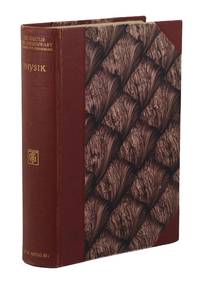
1915140945614Leipzig & Berlin: B.G. Teubner 1915. First edition. First edition. iv viii 762 8 pp. Bound in publisher's three quarter maroon cloth with marbled paper sides gilt spine lettering. Near Fine with rubbing along edges; a few marks to prelims text otherwise free of markings; hint of foxing to edges. Bookplate on paste down. <p>A German-language physics review with the first book publication of two articles by Albert Einstein as well as work by a number of famous physicists of the early 20th century. B.G. Teubner unknown
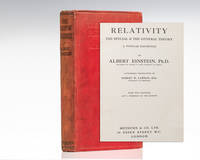
1920134847London: Methuen & Co 1920. First UK Edition. Hardcover. Good. xiii 3 138 2 8 p. 20 cm. 5 diagrams and frontispiece portrait of the author. Red cloth with blank impressing on front black print on spine. Some soiling to covers corners bumped spine faded small tears in spine head. Front pastedown has bookplate for Brenda Mary O'Keefe and small chip to edge. Offsetting to free endpapers. Front hinge cracking internally. A few stains within. 8 p. of Methuen publications listed at rear. <br/><br/>First edition of the authorized translation into English of the "popular exposition" of Einstein's theory of relativity. Includes third appendix on "The Experimental Confirmation of the General Theory of Relativity" written by Einstein specially for this edition at the request of the translator. First published in German in 1916 "Relativity" gives readers an insight into the thought processes of one of the greatest minds of the 20th century. Methuen & Co hardcover
193332820627<p>Original wrappers. Price neatly blacked out at lower corner. Tiny chip from back wrapper. Very good.</p><p>FIRST EDITION.</p><p>This scarce collection of Einstein's writings on war and peace was published in 1933 the year the Nazis took power in Germany and the year Einstein left Germany for the United States. In his prefatory note Einstein writes "Mr. Lief the editor Alfred Lief has taken great trouble in collecting utterances of mine having pacifistic content and he presents them with my authorization. … I consider it my duty to confess my pacific conviction publicly. May the seriousness of my purpose be transferred to you my readers! A. Einstein."</p> John Day paperback
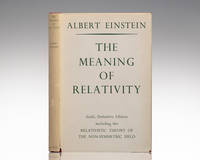
1956149754London: Methuen & Co. Ltd 1956. Sixth edition of Einstein's clear and systematic exposition of the theory of relativity with the ownership stamp on the front and rear pastedowns "Stephen Hawking Newton Institute University of Cambridge Cambridge England." Octavo original cloth. Translated By Edwin Plimpton Adams and Ernest G. Straus. Fine in a very good dust jacket. An exceptional association. In the book Einstein outlines both the special and general theories of relativity explaining their mathematical foundations and physical implications particularly regarding the nature of space time and gravitation. Designed for readers with a background in physics and mathematics the text serves as both a summary of Einstein’s groundbreaking contributions and an accessible guide to the conceptual shifts his theories introduced to modern science. The work remains a significant historical and intellectual document illustrating Einstein’s effort to communicate complex scientific ideas with clarity and precision. Methuen & Co. Ltd hardcover
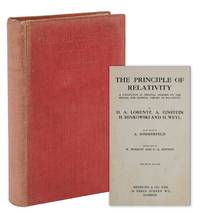
1923140949178London: Methuen & Co 1923. First Edition. Very Good. First British edition first printing. viii 216 8 ads pp. Bound in publisher's red cloth lettered in blind on front board and in gilt on spine; lacking the dust jacket. Very Good with fading light wear and soiling to covers. Evidence of bookplate removal to front pastedown offsetting to free endpapers rear hinge starting. Contents lightly toned with foxing to first and last few pages and textblock edges.<br /> <br /> <p>An influential collection of eleven papers on relativity. Seven are authored by Einstein two by Henrik Lorentz and one each by Hermann Minkowski and Hermann Weyl. The first edition of this translation of Das Relativitaetsprinzip taken from the fourth German edition. Methuen & Co unknown
1907433121907. Offprint from "Zeitschrift für Elektrochemie" 1907. Single sheet pp. 41-42. 287 x 206 mm. Chipped several marginal tears some toning. Fair. First edition offprint issue. "In 1907 Einstein published a paper entitled 'Theoretical Observations on the Brownian Motion' in which he considered the instantaneous velocity of a Brownian particle. Einstein showed that by measuring this quantity one could prove that 'the kinetic energy of the motion of the center of gravity of a particle is independent of the size and nature of the particle and independent of the nature of its environment.' This is one of the basic tenets of statistical mechanics known as the equipartition theorem. However Einstein concluded that due to the very rapid randomization of the motion the instantaneous velocity of a Brownian particle would be impossible to measure in practice. "Einstein: The Formative Years. unknown
1906504131906. <p>Einstein Albert 1879-1955. Über eine Methode zur Bestimmung des Verhältnisses der transversalen und longitudinalen Masse des Elektrons. In Annalen der Physik 21 1906. 583-586pp. Figs. Text-illust. 214 x 140 mm. Laid-in item: notecard with penciled notes probably in the hand of Lord Rayleigh. Red cloth gilt spine. Frontis portrait of P. Curie d. 1906. Whole volume: viii 1056pp. 9 plates 5 b/w silver photos 4 folding. Small cut on spine starting approximately two inches from the head and is about three inches in length -very thin- otherwise Very Good. </p> <br /> <br /> <p>First Edition Whole Volume. In his landmark 1905 paper on special relativity Einstein used the velocity-dependent concepts of transverse and longitudinal mass for the moving electron these terms have now been replaced with the concept of relativistic mass first defined by Lewis and Tolman in 1909. In the present paper Einstein proposed an experimental method for determining the ratio of the transverse to the longitudinal mass and invited experimentalists to verify his special theory of relativity. Einstein later abandoned velocity-dependent mass concepts stating in 1948 that "it is better to introduce no other mass concept than the rest mass" quoted in L. B. Okun "The concept of mass" Physics Today 1989: 31-36. Lavenda A New Perspective on Relativity pp. 7-8. </p> <br /> <br /> <p>Weil's Einstein Bibliography no. 14. <br> Boni's Einstein Checklist no. 14</p> <br /> <br /> <p> John William Strutt third Baron Rayleigh Lord Rayleigh 1842-1919 was a british mathematician and physicist; he was one of the very few members of higher nobility who won fame as an outstanding scientist. Rayleigh was born as the son of John James Strutt second Baron and his wife Clara Elizabeth La Touche eldest daughter of Captain Richard Vicars R.E. Lord Rayleigh was awarded the 1904 Nobel Prize in Physics "for his investigations of the densities of the most important gases for his discovery of argon in connection with these studies." Rayleigh provided the first theoretical treatment of the elastic scattering of light by particles much smaller than the light's wavelength now known as "Rayleigh scattering" - a process which notably explains why the sky is blue. He also made extensive contributions to fluid dynamics e.g. the Rayleigh number critereon for the stability of the Taylor-Couette flow etc. Rayleigh also formulated the circulation theory of aerodynamic lift. His derivation of the Rayleigh-Jeans law for classical black body radiation played an important role in the birth of quantum mechanics i.e. the Ultraviolet catastrophe. During the first World War he was president of the United Kingdom government's Advisory Committee for Aeronautics. Notable students of the 3rd Lord Rayleigh include J.J. Thomson 1856-1940 and Sir William Ramsay 1852-1916 who was awarded the Nobel Prize in Chemistry in 1904 "in recognition of his services in the discovery of the elements in air." In 1871 he married Evelyn Balfour sister of the future prime minister the Earl of Balfour and daughter of James Maitland Balfour and his wide Blanche the daughter of the second Marquis of Salisbury. They had three sons the eldest of whom Robert John Strutt 1875-1946 was to become Professor of Physics at Imperial College of Science and Technology London. Strutt inherited the title of fourth Baron Rayleigh after his father's death in 1919. nobelprize.org. </p> <br /> <br /> <br /> <p> Also in this volume: Einthoven Willem 1860-1927. Weitere mitteilungen ueber das saitengalvanometer. Analyse der saitengalvanometrischen kurven. Masse und spannung des quarzfadens und widerstand gegen die fadenbewengung. Erster teil. In Annalen der Physik ser. 4 21 1906. 483-514 pp. <br> Willem Einthoven 1860-1927 was a Dutch doctor and physiologist who won the Nobel Prize in Physiology or Medicine in 1924 "for his discovery of the mechanism of the electrocardiogram" nobelprize.org. </p> . unknown
192919299Berlin: Verlag der Akademia der Wissenschaften in Kommission bei Walter de Gruyter 1929. FIRST EDITION. Original printed orange wrappers; a fine copy unopened and bound into morocco-backed cloth boards spine labeled in gilt. First edition first issue in the rare author’s offprint form with a newly set title-page. One of Einstein’s last important scientific works this publication of the unified field theory caused quite a sensation. It was the first separate printing of one of a series of five papers published between 1925 and 1929 in which Einstein attempted to develop a unified field theory reconciling in a single formula the laws of electromagnetism and gravitation.<br /> <br /> Weil 165; Printing & the Mind of Man 418. Verlag der Akademia der Wissenschaften in Kommission bei Walter de Gruyter unknown
1923432881923. <p>Einstein Albert 1879-1955 and Paul Ehrenfest 1880-1933. Zur Quantentheorie des Strahlungsgleichgewichts. Offprint from Zeitschrift für Physik 19 1923. 301-306pp. Original printed self-wrappers. 230 x 157 mm. Light toning but very good.</p> <p>First Edition Offprint Issue. In 1916 after publishing his great work on general relativity Einstein returned to the question of blackbody radiation. In November 1916 he wrote to his friend Besso that "a splendid light has dawned on me about the absorption and emission of radiation" quoted in Pais p. 405 one that led him to a new derivation of Planck's radiation law and convinced him of the reality of light-quanta photons. After publishing these results in three papers culminating with the famous "Zur Quantentheorie der Strahlung" 1917 Einstein kept looking for "new ways in which the existence of photons might lead to observable derivations from the classical picture" Pais p. 413. He found none until 1923 when Arthur Compton and Peter Debye independently derived the relativistic kinematics for the scattering of a photon off an electron at rest. The work of Compton and Debye led Wolfgang Pauli to extend Einstein's work of 1917 to the case of radiation in equilibrium with free electrons see Pais p. 414n. "Pauli examined the requirements of detailed balance under Lorentz transformations and found that scattering of light by free electrons must include a term of a form which we would now call stimulated emission . . . Einstein and Ehrenfest then showed that Pauli's results could be obtained by an extension of Einstein's 1917 paper with the unnecessary specialization to discrete energy levels removed . . . The core of Einstein's argument is that the scattering process should be broken into two parts: the absorption of energy from radiation of frequency 1 and the emission of energy as radiation of frequency 2" Lewis p. 42. Lewis "Einstein's derivation of Planck's radiation law" American Journal of Physics 41 1973: 38-44. Pais Subtle is the Lord ch. 21. Weil Albert Einstein Bibliography 138.</p> . unknown
1920001584New York: Henry Holt and Company 1920. 1st Edition . Cloth. Very Good/No Jacket. 8vo - over 7¾ - 9¾" tall. New York: Henry Holt and Company 1920. 8vo 168 pp. Dark blue cloth. Gilt titles to spine and front board. Gilt entirely faded from the spine moderately to the spine. Light foxing to the title and frontispiece. Interior clean. Binding is tight. Very good. A very acceptable copy of a scarce and important book. <br/> <br/> Henry Holt and Company hardcover
190747020Berlin J.A. Barth 1907. 8vo. 2 issues to both the original printed yellow wrappers. No backstrip. Wrappers loose. In: "Annalen der Physik. Vierte Folge. Band 22" No. 1. and No. 4. Pp. 1-208 1 fold. plate a. 1 portrait P. Curie a. pp. 609-800 1 plate. Entire issues offered. Einsteins paper: pp. 180-190 and p. 800. Astamp to verso of plates and a few leaves. THE PRINTED WRAPPERS LOOSE. <br/><br/><em>First printing of a major paper in Quantum Theory introducing the first systematic introduction of probability factors in Quantum Theory."From 1905 through 1909 Einstein published five major papers on the hypothesis of energy quanta its theoretical implications and its use in the explanation of various phenomena. Among these papers we have his importent paper "Die Plancksche." and in his second paper from 1906d he asserted that Planck's derivation implicitly assumes quantification of the enrgies of charged oscillators. Now in the paper offered he returned to this question showing that if the structure function in phase space he had introduced earlier is assumed to restrict the oscillators to orbits with energies that are integral mulætiples of 'hv' then the average oscillator energy in a canonical ensemble yealds Planck's law when substituted in eg. The works contains the first systematic introduction of probability factors in the mathematics of Quantum Theory." Weil: nos 15 1-2 with an asterix denoting a major paper. - Boni: 15. </em> unknown
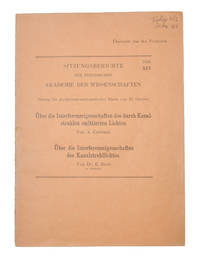
1926465401926. Royal8vo. Author's presentation offprint with the printed presentation statement on top of frontwrapper "Überreicht von den Verfassern" i.e. "Given by the authors". Original printed wrappers. Front wrapper loose but fully intact. "Chilpp 202" and "Recdese 160" written in hand to top of front wrapper. A very fine and clean copy. Pp. 334-351. <br/><br/><em>First edition in the scarce author's presentation offprint issue of this important paper which contains Einstein's theories on wave-particle duality and German physicist Rupp's work on the same subject seemingly to corroborating Einstein's theories. Rupp's experimental results later turned out to have been falsifications and today he is mainly known as the protagonist in one of the biggest scandals in physics in the 20th century.Rupp published a number of papers on the interference properties of light emitted by canal ray sources. These articles particularly the present that came into being in close collaboration with Albert Einstein attracted quite a lot of attention as they probed the wave versus particle nature of light. They also significantly propelled Rupp's career even though they were considered highly controversial to begin with.In April 1926 Albert Einstein proposed to Emil Rupp to carry out two experiments that were to prove the wave nature of light versus the particle nature of light: the so-called 'Wire Grid Experiment' and the 'Rotated Mirror Experiment' experiments that Einstein had worked on theoretically and now would like to gain confirmation of through experiments. Rupp at the time regarded as one of the most important and most competent experimental physicists gladly took up the challenge. Rupp's observations - though highly controversial - confirmed Einstein's theory. Due to the surprising outcome of the experiments Einstein was interested in exactly how it they were conducted as Rupp's initial descriptions did not convince him that the results were feasible."Rupp stood by his observations and suggested yet other circumstances that might explain them. Did Einstein now realize that there was something rather dubious about Rupp's work He had seen him change his data repeatedly-and each time in better accordance with his own criticism and on one occasion in no less than two days. He had had to accept that Rupp claimed to earlier have "unknowingly" or "unconsciously" rotated a mirror and he will likely have seen that Rupp's work was highly controversial amongst experimentalists leading to very public criticism in Die Naturwissenschaften. He himself was now also convinced that in fact Rupp's results were incomprehensible. So did Einstein choose to suspend the publication of Rupp's piece so that an additional round of checks and balances could take place The answer is no: Rupp's paper was presented by Einstein to the Prussian Academy in a session on 21 October 1926 and it appeared in print in the Academy's proceedings in November of 1926-the articles by Einstein and Rupp came out back to back and reprints circulated with both papers bound together with a joint cover page that displayed both titles. Einstein referred in his article to Rupp's claims and he had even written the abstract of Rupp's paper" Dongen: "Emil Rupp Albert Einstein and the Canal Ray Experiments on Wave-Particle".The first clear indication that Rupp's work was impossible to recreate came in 1930 in a paper published by Staub - nothing was wrong with Einstein's theory but Rupp's work was simply impossible: "Rupp immediately set out to respond to Straub's publication. On 12 July 1930 he sent a first draft to Einstein to whom he also announced his intention of redoing his canal ray experiments-Straub was dismissed as a clumsy graduate student with a lousy apparatus. Einstein suggested inviting Straub once Rupp had his experiment up and running again but cautioned him not to engage the polemic in too sharp a tone". Rupp managed to convince the physics society and continued to publish the new few years. In 1934 various different physicians pointed out that Rupp's work was impossible to recreate and in 1935 the final blow to Rupp's career came about when the German Physical Society's decided not to allow any citations of Rupp's work. This seems to have had very severe consequences as today it is almost impossible to find any quotations - or even mentioning of Rupp in general let alone his fraud - in any historical studies of either quantum theory or of Einstein.Despite the unquestionable fraud by Rupp his experiments and collaboration with Einstein might have had a positive influence on the further progression to quantum mechanics. The two present papers became of seminal importance in the discussions between Bohr and Heisenberg which eventually in 1927 resulted in Heisenberg publishing his landmark thesis on the uncertainty principle. When Max Born received the Nobel Prize in physics he stated that: "An idea of Einstein gave me the lead From the present paper. He had tried to make the duality of particles-light quanta or photons-and waves comprehensible by interpreting the square of the optical wave amplitudes as probability density for the occurrence of photons."Boni 160; Weil 153. </em> unknown
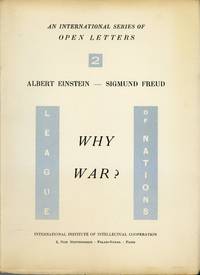
193332820626<p>Original wrappers. Near fine.</p><p>First edition in English one of 2000 numbered copies. Translated from the German by Stuart Gilbert.</p><p>Einstein initiated this correspondence with Freud as part of the International Institute of Intellectual Co-operation's effort to promote dialogue among leading thinkers to promote peace. At the time Einstein and Freud were perhaps the most famous thinkers in the world.</p><p><b>Laid in is a 2pp leaflet advertising this publication and noting the various formats and their prices.</b></p> International Institute of Intellectual Cooperation, League of Nations paperback
1915000012055Leipzig: Verlag von B.G. Teubner 1915. First edition. Hardcover. Near Fine. Large 8vo. 2 pages of publisher's advertisements 6 vi-viii 3 4-762 8 pages of publisher's advertisements pp. Contemporary half black morocco over brown paper boards with gilt lettering in a gilt border on the spine; all edges black. Dark green endpapers and pastedowns. With a blue silk ribbon bookmark bound in. With 106 in-text figures. The second title page states that this is the first volume of the third part of a series Die Kultur der Gegenwart Ihre Entwicklung und Ihre Ziele Herausgegebben von Paul Hinneberg. Dritter Teil Mathematik Naturwissenschaften Medizin. Dritte Abteilung Anorganische Naturwissenschaften unter Lietung von E. Lecher = Contemporary Culture . Part Three: Mathematics Natural Sciences Medicine . . Boni 69-70. Schilpp 76-77. This volume is dedicated to topics within physics: light mechanics motion electricity and other areas of research are illuminated by papers from several of the twentieth century's pre-eminent physicists including Einstein Planck Lorentz among others. This book contains Einstein's "Theoretische Atomistik" and "Die Relativitätstheorie" published here for the first time in book form "Die Relativitätstheorie" first appeared as a journal article. A lovely example. A touch of fading to the boards’ top edges overall an exceptional copy. Verlag von B.G. Teubner hardcover
1920149244London: Methuen & Co. Ltd 1920. First British edition of Einstein's ground-breaking work. Octavo original red cloth frontispiece of Einstein illustrated with five diagrams. In very good condition with toning to the spine. Translated by Robert Lawson. It can hardly be disputed that the theories put forth in this book are among the most important in the history of modern science. "The imprint of Einstein's work on the different areas of physical science is so large and varied" writes Gerald Holton in a recent assessment "that a scientist who tries to trace it would be hard put to know where to start" Simmons The Scientific 100. Methuen & Co. Ltd hardcover
1949053629New York: The Library Of Living Philosophers 1949. 1st Edition 1st Printing. Hardcover. Near Fine/Near Fine. Xvi 781 Pp. Blue Cloth Gilt. Stated First Edition. First Printing Of Einstein's Autobiography With Text In Both German And English; First Publication Of Major Essays On Einstein And An Important Discussion With Niels Bohr. Book Is Near Fine Gilt Brilliant Lightly Used No Marks. Dust Jacket Priced $8.50 Very Slight Wear 1/2" Closed Tear At Top Of Rear Flap Fold. <br/> <br/> The Library Of Living Philosophers hardcover
19161614Braunschweig: Druck und Verlag von Friedr. Vieweg and Son 1916. 1st Edition. FIRST EDITION OF AN IMPORTANT WORK BY EINSTEIN: HIS FIRST PAPER ON THE DERIVATION OF PLANCK'S LAW HERE INTRODUCING THE THEORY OF THE STIMULATED EMISSION OF ELECTROMAGNETIC RADIATION INTO THE QUANTUM THEORY. "EINSTEIN'S CONCEPT OF STIMULATED EMISSION IS THE OPERATING PRINCIPLE OF THE NOW UBIQUITOUS LASER" Brandt Harvest of the Century 136. <br /> <br /> In 1900 Max Planck laid the foundation for quantum theory with his publication of Planck's law. Though Einstein commended Planck in his own "light-quantum hypothesis of 1905 he Einstein postulated that the energy quantization is a property of the radiation field itself and not due to the material resonators as Planck believed" ibid. "Einstein found a similarity between a cavity filled with radiation consisting of quanta and a vessel filled with gas consisting of atoms" Brandt Harvest of the Century 136. Einstein believed that "although either part of Planck's derivation was in itself consistent their combination was logically incompatible.For Einstein this inconsistency was no reason to reject Planck's quantum theory as such" it was a reason to study the foundations of traditional radiation theory and if needed revise them Jammer The Conceptual Development of Quantum Mechanics 26. <br /> <br /> "After completion of his general theory of relativity in 1916 Einstein was able to derive Planck's original quantum law to his satisfaction "by considering the possible interactions between radiation and matter" Brandt. From there he was able to suggest that in addition to spontaneous emission and absorption a process of stimulated emission could also take place. <br /> <br /> In Einstein's derivation of Planck's law he treats "the interaction between light quanta and atoms in the formalism of his A and B coefficients. They describe the probabilities for the absorption and emission of a light quantum of a given energy. The probability of absorption is of course proportional to the density of the radiation of that frequency. The emission is in part spontaneous like radioactivity but there is also stimulated emission which again is proportional to the density of the radiation of that frequency ibid. This is one of two papers Einstein wrote on the subject. <br /> <br /> Einstein's derivation "predicted that as light passed through a substance it could stimulate the emission of more light. This effect is at the heart of the modern laser" The Quantum and the Cosmos I History AIP portal. CONDITION & DETAILS: Braunschweig: Druck und Verlag von Friedr. Vieweg and Son. 8.5 x 6 in. vi 485 1 2 368. 2. Ex-libris with few markings and non at the spine see scan. Tightly bound. Brown cloth over marbled paper boards; gilt- ruled and lettered at the spine. Clean and bright throughout. Near fine. This volume is bound together with the 1916 volume titled Halbmonatliches Literaturverzeichnis der "Fortschritte der Physik" Bi-monthly bibliography of the "Advances in Physics". Druck und Verlag von Friedr. Vieweg and Son hardcover