Einstein, AlbertBiblio.com

850 résultats
1923108095Princeton University Press 1923. 1st Edition. Hardcover. Very Good/Very Good. First edition with Published 1922 on copyright page and 1923 on title page very good in the very rare dust jacket which has some wear and chips and a big tear at rear panel. Previous owner's bookplate attached to front paste-down. Housed in a custom-made collector's slipcase. Princeton University Press hardcover
193846475Princeton NJ. Annals of Mathematics 1938 a. 1940. Both papers in orig. printed wrappers. Offprints from "Annals of Mathematics" Vol. 39 No. 1 january 1938 and Vol. 41 No. 2 April 1940. Pp. 65-100 and pp. 455-464. Both clean and fine. This copy has belonged to Abraham Pais 1918-2000 - the famous Einstein scholar theoretical physicist and Einsteins collegue at Princeton - and having his name on top of both frontwrappers "A Pais". <br/><br/><em>First editions in the scarce offprint versions of Einstein's last and highly important contributions to General relativity and in which is shown that the equation of motion follows directly from the field equation that defined the geometry."Einstein's last importent contribution to general relativity deals again with the problem of motion. It is the work done with Leopold Infeld and Banash Hoffmann on the N-body problem of motion. In these papers the gravitational field is no longer treated as external. Instead it and the motion of its singular sources are treated simultaneously. Anew approximationscheme is introduced in which the fields are no longer necessarily weak but in which the source velocities are small compared with the light velocity . The equations obtained have found use in situations where Newtonian interaction must be included. 'These equations are widely used in analyses of planetary orbits in the solarsystem. For example the Cal Tech Jet Propulsion Laboratory uses them in modified form to calculate ephmerides for high-precision tracking of planets and spacecraft."Pais "Subtle is the Lord" p. 290-91."The problem of the equation of motion of bodies is the following. The 1916 theory had a classical structure in the sense that there were both field equations the curvature of space-time is determined by the mass and motion of bodies in space-time and equations of motion of bodies the world line of small mass is a geodesic. Are these two statements really separate If the field equations were linear they indeed would be. They are not linear however and Einstein showed in the papers offered that if matter is represented by a point singularity of the metric field these singularities are located on world lines that are geodesics of space-time provided its metric satisfies the equation of general relativity."DSB.Weil: 202 a. 295 both with an asterix denoting a major paper. - Boni: 236 a. 236.1. </em> unknown
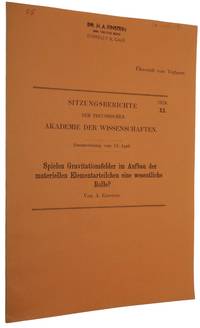
19196166Berlin: Verlag der Akademie der Wissenschaften In Kommission bei Walter de Gruyter Reichsdruckerei 1919. First edition. <p>First edition extremely rare author's presentation offprint 'Überreicht vom Verfasser' and the copy of Einstein's son Hans Albert of "Einstein's first attempt at a unified field theory" Pais Subtle is the Lord. Once Einstein completed work on the general theory of relativity at the end of 1915 "his attention shifted to the search for a unified theory of the electromagnetic and gravitational fields out of which he hoped to be able to explain the structure of matter. Quantum effects were to be derived from such a theory rather than postulated ad hoc. This remained his approach for the rest of his life" Cao Conceptual foundations of quantum field theory.</p>. EINSTEIN'S FIRST ATTEMPT AT A UNIFIED FIELD THEORY" PAIS<br /> HANS ALBERT EINSTEIN'S COPY OF THE PRESENTATION OFFPRINT. <p>First edition extremely rare author's presentation offprint 'Überreicht vom Verfasser' and the copy of Einstein's son Hans Albert of "Einstein's first attempt at a unified field theory" Pais Subtle is the Lord p. 287. Once Einstein completed work on the general theory of relativity at the end of 1915 "his attention shifted to the search for a unified theory of the electromagnetic and gravitational fields out of which he hoped to be able to explain the structure of matter. Quantum effects were to be derived from such a theory rather than postulated ad hoc. This remained his approach for the rest of his life" Cao Conceptual foundations of quantum field theory pp. 166-167. "As so often the case in relativity the story of quantum gravity begins with Einstein himself. Soon after the final formulation of general relativity he pointed out the need for a quantum modification of the theory. In his first paper on gravitational radiation the 1916 paper 'Näherungsweise Integration der Feldgleichungen der Gravitation' 'Approximate Integration of the Field Equations of Gravitation' Einstein argued that quantum effects must modify the general theory of relativity. Two years later he reiterated this conclusion the 1918 paper 'Über Gravitationswellen' 'On Gravitational Waves': 'As already emphasized in my previous paper the final result of this argument which demands a gravitational energy loss by a body due to its thermal agitation must arouse doubts about the universal validity of the theory. It appears that a fully developed quantum theory must also bring about a modification of the theory of gravitation.' Einstein writing in the 1919 paper offered here soon began to speculate whether gravitation plays a role in the atomistic structure of matter: 'There are reasons for thinking that the elementary formations which go to make up the atom are held together by gravitational forces. The above reflections show the possibility of a theoretical construction of matter out of the gravitational field and the electromagnetic field alone' In order to construct such a model of an 'elementary particle' Einstein shows that it is necessary to modify the original gravitational field equations .The major interest of this paper is that his attention now shifted from possible quantum modifications of general relativity to the search for a unified theory of the electromagnetic and gravitational fields on the basis of which he hoped to explain the structure of matter. Quantum effects are to be derived from such a theory rather than postulated ad hoc. Einstein remained committed to this approach for the rest of his life: the search for a 'natural' mathematical extension of the general theory in the hope that such a theory would somehow explain the quantization of matter and energy" Iyer and Bhawal Black Holes Gravitational Radiation and the Universe pp. 525-526. Einstein's work on unified field theory was inspired by James Clerk Maxwell's success in finding a unified theory of electricity and magnetism one of the greatest achievements of nineteenth century physics which showed that light was a form of electromagnetic wave and made possible modern inventios such as radio television and the telephone. Einstein continued his attempts to devise a unified theory of gravitation and electromagnetism for the rest of his life; his contributions in this area represent about a quarter of his entire research output and half his scientific production after 1920. Although he was ultimately unsuccessful a similar vision was realized in the decades after his death in the construction of the 'standard model' a unified theory of electromagnetism with the weak and strong nuclear forces which were unknown in Einstein's time and efforts to incorporate gravity into the model continue to this day. RBH lists three copies. OCLC lists only one copy none in US.</p> <br /> <p>Provenance: Hans Albert Einstein 1904-73 ink stamp and pencil notes on front wrapper. Hans Albert Einstein was a Swiss-American engineer and educator the second child and first son of physicists Albert Einstein and Mileva Marić. He was a long-time professor of hydraulic engineering at the University of California Berkeley.</p> <br /> <p>"As early as 1909 in his fundamental paper 'Zum gegenwärtigen Stand des Strahlungsproblems' 'On the current status of the radiation problem' which resulted from a discussion with Walter Ritz Einstein remarks 'dass des elektrische Elementarquantum e ein Fremdling ist in der Maxwell-Lorentzschen Elektrodynamik' 'that the electrical elementary quantum e is alien to Maxwell-Lorentz electrodynamics'. Einstein expressed the hope that 'die gleiche Modifikation der Theorie welche das Elementarquantum e als Konsequenz enthält auch die Quantenstruktur der Strahlung als Konsequenz enthalten wird' 'the same modification of the theory which contains the elementary quantum e as a consequence will also contain the quantum structure of radiation as a consequence'. Pauli 1949 in his review about 'Einstein's Contribution to Quantum theory' pointed out that though quantum theory later on deduced the quantum structure of radiation it has not solved Einstein's first problem and the elementary charge 'auch in der Quantenmechanik ein Fremdling geblieben ist' 'has also remained alien to quantum mechanics'. He emphasized that just this fact had been one of the strongest arguments to Einstein against the finality of the steps leading to quantum mechanics.</p> <br /> <p>"So during his Berlin years Einstein made it his task to find a synthesis of his general theory of relativity GRT and the then nascent quantum physics. In this connection he attributed logical primacy to the relevant relativistic field theory because it had reached a high degree of maturity in the GRT. After all Einstein's general-relativistic gravitation theory is the first theory on the fundamentals of physics working with genuinely non-linear equations and Einstein observed that such a nonlinearity is necessary for understanding the existence of the 'discrete field-quanta.' A linear theory allowing arbitrary superposition of fields would without further restrictions in the form of boundary and uniqueness conditions never lead to a discrete spectrum of solutions. But recourse to such restrictions means that the fields are held together by the operation of entities outside the scope of the theory .</p> <br /> <p>"In Einstein's view the problem of incorporating the elementary particles into field physics involved the question of finding field-theoretical models of electrons and protons which were the only known particles at that time. Einstein searched for solutions or general-relativistic field equations for the combined gravitational and electromagnetic fields representing mass and charge distributions with central symmetry and he hoped there would emerge self-consistent solutions only for discrete values of the mass and charge parameters i.e. for a 'particle spectrum.'</p> <br /> <p>"This 'Einstein particle problem' pursued ideas that had been developed already in the framework of the special theory of relativity and the Maxwell-Lorentz electrodynamics for instance in the nonlinear theory of the electromagnetic field by G. Mie and D. Hilbert. As an essential progress by the general-relativistic treatment Einstein regarded the genuine nonlinearity of the field equations which Mie and Hilbert had to introduce ad hoc and full consideration of the particle dynamics in the sense of the general-relativistic problem of motion. The generalizations of the Maxwell equations considered by Mie and Hilbert contain a too small number of components for the integrability conditions to determine the particle dynamics whereas the Einstein problem of motion in the GRT furnishers just this dynamics as a consequence of the integrability conditions for the field equations of gravitation. It is the GRT that with its metric field for the first time embraces inertia and gravity that is just those properties which are characteristic of all particles.</p> <br /> <p>"Einstein in fact succeeded in driving self-consistent gravitational and electromagnetic fields which can be interpreted as particle models of that kind. But his success depended on a weakening of his own equations of gravitation which physically amounts to the introduction of an additional hypothetical cosmical field of the 'Poincaré pressure.' By this weakening it becomes possible to set up self-consistent particle models with spherical symmetry for arbitrary centrosymmetric mass and charge distributions. In 1919 Einstein presented his result to the academy in his paper 'Spielen Gravitationsfelder im Aufbau der materiellen Elementarteilchen eine wesentliche Rolle' His answer to the question says that in his particle models the electrical field energy contributes ¾ and the gravitational energy ¼ of the total energy.</p> <br /> <p>"Einstein's first discourses on the particle problem in the GRT were closely related to the 1917/18 papers in which he laid the foundations of relativistic cosmology. In his Academy report 'Kosmologische Betrachtungen zur allgemeinen Relativitätstheorie' 'Cosmological considerations on the general theory of relativity' 1917 Einstein had by introducing the term λgμν with the 'cosmological constant' λ extended his equations of gravitation to his cosmological equations of gravitation</p> <br /> <p>Rμν - ½ gμνR λgμν = - κ Tμν . </p> <br /> <p>He could show that these equations permit as a particular solution with λ > 0 and constant positive mass density a statical model of the universe representing a closed spheric or elliptic three devotional Riemannian space .</p> <br /> <p>"In his paper of 1919 about the role of gravitation in the structure of elementary particles Einstein also interpreted the cosmological constant λ as the universal 'Poincaré' pressure' which according to a hypothesis of H. Poincaré is to guarantee the stability of Lorentz's electrons against their own repulsion forces. Einstein's ideas concerning this matter partly resulted from a controversial discussion with E. Schrödinger 1918 about the gravitational energy in the GRT and the structure of the energy tensor" Treder pp. 149-151.</p> <br /> <p>Indeed Schrödinger had pointed out another way of treating the cosmological constant: moving it from the left-hand side of equation where it represents a contribution to space-time curvature to the right-hand side where it represents a contribution to the energy-matter distribution. Then it would correspond physically to a kind of cosmic pressure. Schrödinger believed this might be the pressure postulated by Poincaré to maintain the stability of charged particles: an electric charge on the surface of a sphere creates a force pushing outwards so without any opposing force the charged sphere would explode outwards. </p> <br /> <p>Einstein never liked the cosmological constant. In the present paper he acknowledged that his introduction of the cosmological constant was "gravely detrimental to the formal beauty of the theory" Cambridge Companion to Einstein p. 257.</p> <br /> <p>Boni-Russ-L. 111; Schilpp 123; Weil 106. Treder 'Antimatter and the particle problem in Einstein's cosmology and field theory of elementary particles A historical essay on Einstein's work at the Akademie der Wissenschaften zu Berlin' Astronomische Nachrichten 296 1975 pp. 149-161.</p> <br/> <br/> Large 8vo 254 x 182 mm pp. 349-356. Original printed wrappers. A very fine copy. Verlag der Akademie der Wissenschaften, In Kommission bei Walter de Gruyter [Reichsdruckerei] unknown
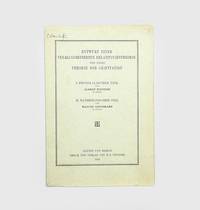
1913188059Leipzig and Berlin: B. G. Teubner 1913. Generalizing relativity First edition of Einstein's early articulation of general relativity his first paper to describe gravity as the curvature of spacetime containing "virtually all the essential features of his general theory of relativity" Norton p. 253. In 1912 Einstein's old school friend Marcel Grossman 1878-1936 secured him a professorship at ETH Zurich where they had both studied as undergraduates. The two men began a collaboration to provide a firmer mathematical foundation to Einstein's concept of gravity as a geometrical property of time and space. The two sections of the Entwurf outline the resulting theory in full complete with gravitational field equations relating the curvature of spacetime to the distribution of mass and energy within it. Einstein contributed the initial section focussing on physical theories while Grossman added the following section developing the more complex mathematical formulae. Michel Janssen editor of the Einstein Papers Project notes that the Entwurf "was published as a separatum in early 1913 and was reprinted the following year in Zeitschrift für Mathematik und Physik" p. 1. The Zeitschrift reprint includes an added section outlining the famed "Hole" argument. An offprint dated 1914 was published with the journal. Provenance: Edward Vermilye Huntington 1874-1952 the American academic who studied the foundations of mathematics at Harvard for 40 years with his signature on the front wrapper. Octavo. Device to title page formulae in the text. Original light green wrappers printed in black. Light rubbing chipping and creasing to wrappers contents clean: a very good copy indeed. Boni 50; Norman 693; Weil 58a. Michael Janssen "Einstein's First Systematic Exposition of General Relativity" 2004; John Norton "How Einstein found his field equations: 1912-1915" Historical Studies in the Physical Sciences vol. 14 no. 2 1984. unknown
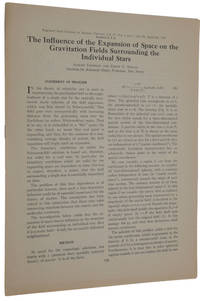
1945180350Lancaster Pennsylvania: American Physical Society 1945 & 1946. His most significant later contribution to cosmology First editions offprint issues of the papers that introduced the Swiss-cheese model of the universe. Einstein and Straus revised the FLRW metric by suggesting that the universe is in fact inhomogeneous. "In two ground-breaking papers Einstein and Straus showed how galaxies fit into a Universe with zero pressure. This model helps to describe the universe observed today" Harwit p. 573. Quarto pp. 5. Disbound wire-stitched as issued. Nicks and creasing to extremities short closed tears to outer margins pp. 120-1 of Influence detached rear blank almost detached: in very good condition. Boni 252 & 252.1; Weil 216. Martin Harwit Astrophysical Concepts 2010. unknown
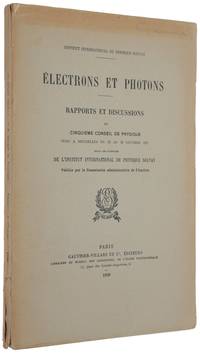
19286594Paris: Gauthier Villars 1928. First edition. <p>First edition rare in the original printed wrappers of the proceedings of the Fifth Solvay Congress 1927-the most celebrated of the Solvay conferences and the setting in which the Bohr-Einstein debate over the consistency and completeness of quantum mechanics first took public programmatic form. Convened under the banner "Electrons and Photons" the meeting brought together nearly all the principal architects of the old and the new quantum theory; seventeen of the twenty-nine participants were or became Nobel Prize laureates.</p>. The Bohr-Einstein Debate Begins. <p>First edition rare in the original printed wrappers of the proceedings of the fifth Solvay Congress where the debate between Bohr and Einstein on the consistency and completeness of quantum mechanics began. It was at this the most famous of the Solvay conferences that Einstein disenchanted with Heisenberg's uncertainly principle made his famous remark that "God does not play dice" to which Niels Bohr replied "Einstein stop telling God what to do!" Seventeen of the twenty-nine attendees which included nearly all the principal architects of the old and the new quantum theory were or became Nobel Prize winners. "The three and a half years since the fourth Solvay Conference . were marked by enormous progress in quantum physics. Partly based on discoveries and ideas that had been available already before 1924 − such as the Compton effect and matter waves − the new atomic theory had arisen which did more than throw new light on the difficulties discussed at the 1924 conference: quantum or wave mechanics went right to the heart of the problems posed by atomic phenomena. The two subjects put programmatically into the title of the fifth Solvay Conference − electrons and photons − designated the crucial points of interest because 'electrons' also stood for the smallest massive constituents of matter and they now became associated with waves and 'photons' a name given only recently in October 1926 by the physical chemist Gilbert N. Lewis to Einstein's light-quanta characterized the quantum-theoretical aspect of electromagnetic radiation. It was the declared intention of the Scientific Committee of the Institut International dePhysique Solvay to contribute by scientific reports and discussions about them to the clarification of the scientific concepts in the physics of the day. In retrospect one may indeed attribute an important success to the 1927 Solvay Conference in marking the completion of the ideas that had first been discussed in the international physics community sixteen years previously at the first Solvay Conference of 1911" Mehra & Rechenberg pp. 233-4. Following a 'Notice nécrologique' by Lorentz the present volume contains the following reports and discussions about them by the participants all articles in French: 'The Intensity of the Reflection of X-rays' by Bragg; 'Disagreement between Experience and the Electromagnetic Theory of Radiation' by Compton; 'The New Dynamics of Quanta' by de Broglie;<br /> 'The Mechanics of Quanta' by Born and Heisenberg; 'The Mechanics of Waves' by Schrödinger;<br /> 'The Quantum Postulate and the New Development of Atomic Theory' by Bohr. No copies located in auction records.</p> <br /> <p>In 1911 the Belgian industrialist Ernest Solvay invited a group of the world's most prominent physicists including Einstein Planck Lorentz Sommerfeld Rutherford and Marie Curie to participate in a scientific conference on the difficulties of reconciling classical physics with quantum theory. The conference "set the style for a new type of scientific meetings in which a select group of the most well informed experts in a given field would meet to discuss the problems at its frontiers and would seek to define the steps for their solution" Mehra Solvay Conferences p. xv. The first Solvay Conference-widely considered a turning point in the history of modern physics-was so successful that in the following year Solvay established a foundation now known as the International Solvay Institutes for Physics and Chemistry "to encourage the researches which would extend and deepen the knowledge of natural phenomena" ibid. and to sponsor further conferences. The next two Solvay Conferences met in 1913 and 1921; subsequent conferences have been held every three years except during wartime.</p> <br /> <p>"From amongst the members of the Scientific Committee of the 1927 Congress two had already played a leading role in 1911: the Chairman Hendrik Lorentz and Albert Einstein; the latter had presented then the most revolutionary report on the light quantum. In spring 1926 in the early stage of preparing for the new conference Lorentz again requested Einstein to write a report. The latter answered promptly: 'If you wish that I take over the report on quantum statistics I shall do so with pleasure; because without being in great difficulty I shall never say "no" to you' Einstein to Lorentz 1 May 1926 . On 17 June 1927 Einstein wrote to Lorentz: 'I recall having committed myself to you to give a report on quantum statistics at the Solvay Conference. After much reflection back and forth I came to the conclusion that I am not competent for giving such a report in a way which really corresponds to the state of the thing. The reason is that I have not been able to participate as intensively in the modern development of quantum theory as would be necessary for that purpose. This is in part because I have on the whole too little receptive talent for fully following the stormy developments in part also because I do not approve of the purely statistical way of thinking on which the new theory is founded .' As a substitute speaker for the topic assigned to him he proposed either Enrico Fermi from Italy or Paul Langevin from France. Ultimately however neither of them gave the report on Einstein's subject. Instead Niels Bohr agreed to contribute a report on a different topic: namely on his latest considerations on the problem of the interpretation of quantum mechanics.</p> <br /> <p>"The rapporteurs at the fifth Solvay Conference fell into three groups: the experimentalists Bragg and Compton; the theoreticians advocating the Gottingen-Cambridge-Copenhagen versions of quantum mechanics − Bohr Born and Heisenberg; and those of the wave-mechanical camp − de Broglie and Schrodinger.</p> <br /> <p>"The selection of Arthur Holly Compton seemed to be most appropriate because the Compton effect − discovered in late 1922 − had been one of the crucial results triggering the entire development which ended with the new atomic theory by providing Einstein's light-quantum hypothesis of 1905 a firm experimental foundation. Since its discovery and even more so after the refutation of the Bohr-Kramers-Slater theory of radiation . Einstein's fundamental light-quantum conception . became a physical reality. Compton's report dwelt on the conceptual consequences rather than on experimental details. In particular he addressed the questions of the aether and of electromagnetic waves on the one hand and the phenomena contradicting the classical wave concepts such as the photoelectric effect X-ray diffraction certain electron-recoil effects observed by C. T. R. Wilson and W. Bothe in 1923 and the individual interaction between radiation-quanta and electrons i.e. the Compton effect. Compton showed also in some detail how the Bohr-Kramers-Slater theory failed to account for these observations.</p> <br /> <p>"The report of William Lawrence Bragg a regular participant in the Solvay Conferences since 1913 appeared to address on first inspection less central points. However from his presentation of the material on reflection of X-rays one easily recognizes the strategy of the Scientific Committee of the Conference: Bragg had to take over the task of stressing those radiation phenomena that could be described by the wave theory namely the diffraction of X-rays by crystal lattices. Consequently he gave the story from Laue's discovery in 1912 over the subsequent work of his father William Henry Bragg and himself to the later investigations of Paul Ewald William Duane and others. Bragg demonstrated in detail how the old and the new wave theories worked to describe the phenomena of diffraction and refraction of X-rays. In the discussion of Bragg's report Hendrik Kramers presented at some length the recent development of the dispersion theory by himself and Ralph Kronig.</p> <br /> <p>"Both experimental reports served as a firm basis for the discussion of the theoretical concepts which provided the central theme of the conference. This significance was shown by the discussions immediately following them. Compton's talk especially gave rise to a lively exchange of ideas and arguments in which besides the experimentalists e.g. Bragg Madame Curie O. W. Richardson and C. T. R. Wilson almost all of the theoretical experts present participated i.e. Bohr Born Debye Dirac Ehrenfest Lorentz Pauli and Schrödinger − with one important exception: according to the published proceedings of the fifth Solvay Conference offered here Einstein remained silent after the presentations of Compton and Bragg .</p> <br /> <p>"The presentation of the theoretical reports at the Solvay Conference proceeded by following the historical order in which the ideas had been published between 1923 and 1926: thus de Broglie's talk came first then Born and Heisenberg's followed by Schrödinger's and finally Bohr's .</p> <br /> <p>"In the course of the year 1927 the Copenhagen physicists Heisenberg among them clarified their ideas on the interpretation of atomic phenomena. Although they admitted the existence and persistence of statistical relations in quantum mechanics they searched for − and succeeded in − formulating principles that in their opinion at least provided the deeper reason for these statistical features: the uncertainty relations and the complementarity principle. In spite of this difference in attitude toward what they regarded as truly fundamental and actually derived Heisenberg felt no difficulty in preparing a joint Solvay report together with his former teacher Max Born. Their report provided a view of the work performed in Göttingen and Cambridge in establishing quantum mechanics with chapters on matrix mechanics and its transformation into wave mechanics I the physical interpretation of the theory II and the uncertainty principle III. The balance in representing the main interests of the two authors was achieved insofar as Section II dealt with Born's statistical interpretation and Section III with Heisenberg's limitation on measurements in quantum mechanics. Moreover the Born-Heisenberg report also signaled the agreement reached by Heisenberg and Niels Bohr during the summer of 1927 .</p> <br /> <p>"Louis de Broglie entitled his report 'The new dynamics of quanta'; he covered the story from his first ideas on matter waves in 1923-24 to the advent of Schrödinger's equation in 1926 and on to the new pilot-wave theory in 1927. He further applied the pilot-wave theory to the problem of the hydrogen atom and claimed that the treatment yielded an easier understanding of the actual situation; finally he spoke about the experimental verification of matter waves obtained recently in the experiments of Clinton Joseph Davisson and Lester Halbert Germer and George Paget Thomson and Alexander Reid . Erwin Schrödinger on the other hand concentrated on the mathematical aspects of his wave-mechanical scheme the time-independent as well as the time-dependent equations the formal equivalence of wave mechanics to the Born-Heisenberg-Jordan matrix scheme and the relativistic wave equation. At the end of the conference Niels Bohr presented a modified version of his Como lecture under the title 'The Quantum Postulate and the New Development of Atomic Theory' .</p> <br /> <p>"Although the Born-Heisenberg and Schrödinger reports provoked only technical questions that of de Broglie and especially the one of Bohr stimulated some conceptual discussion. Thus Lorentz asked de Broglie how the old Sommerfeld quantum conditions could be obtained from the new matter-wave ideas and Pauli provided an appropriate calculation using the conservation law for the relativistic electric current; also Leon Brillouin illustrated some 'optical' applications of matter waves. Finally Bohr's report at the end provided the proper start for a very excited 'General Discussion of the New Ideas Put Forward.'</p> <br /> <p>"Upon an opening reflection of Hendrik Lorentz − who expressed some reservation with respect to the new pictures of electrons in quantum and wave-mechanics − and a technical illustration of Max Born for dealing with many-electron systems in the probability scheme Einstein addressed an elementary problem in the physical interpretation of the theory. He suggested in particular to consider an electron passing through a slit in a screen and to discuss the diffraction phenomena obtained. He claimed that 'with respect to quantum mechanics one can take two standpoints regarding its validity' namely:</p> <br /> <p>Interpretation I: The de Broglie-Schrodinger waves do not correspond to a single electron but to an electron cloud extended in space. The theory does not give then any information about an ensemble of an infinity of elementary processes.</p> <br /> <p>Interpretation II: The theory claims to be a complete theory of individual processes. Each particle which moves towards the screen as far as one can determine from its position and velocity is described by a de Broglie-Schrödinger wave packet of small length and small aperture. This wave packet is diffracted and after diffraction arrives partly at the film where it is registered in a resolved state Einstein in the present work pp. 254-5.</p> <br /> <p>"Evidently Interpretation II went beyond I and even included the latter; it also implied that the conservation laws especially for momentum were valid for individual atomic processes thus explaining the Bothe-Geiger experiment as well as other experiments. Still Einstein also objected to this interpretation because: 'If Ψ2 where Ψ is the wave function were simply considered as the probability for a particle to be at a place at the definite instant it might happen that one and the same elementary process would cause an action at two or more places on the screen' which would imply an action-at-a-distance hence a violation of the relativity postulate. The only way out of this difficulty had to be sought with de Broglie in further attempts to localize the microscopic particle. Einstein claimed further that the multidimensional phase space assumed for many-particle systems in quantum or wave mechanics and the corresponding permutation properties contradicted the new statistical results.</p> <br /> <p>"Although Lorentz tried to illuminate the statistical argument further Wolfgang Pauli contradicted Einstein by referring to the recent work of Paul Dirac Pascual Jordan and Oskar Klein on field quantization. He also refuted another argument of Einstein's that the range of forces in quantum mechanics might create problems by pointing to the work of Walter Heitler and Fritz London on molecular binding. Dirac at first supported Pauli's plea; then he stated his 'opinion about determinism and the significance of numbers which occur in the calculus of quantum theory' notably: 'In the classical theory one starts from certain numbers which completely specify the initial state of the system and one deduces certain numbers which specify the final state. This determination applies only to an isolated system' Dirac in the present work p. 261.</p> <br /> <p>"Now according to Bohr isolated systems are by definition unobservable because any observation must disturb the system; as a result already 'the classical deterministic theory cannot be defended.' Furthermore: 'In the quantum theory one starts from certain numbers from which one deduces certain other numbers . The perturbations which an observer inflicts on a system in order to observe it are directly subject to his control and are acts of his free will. It is exclusively the numbers which describe these acts of free choice that can be taken as initial numbers for a calculation in the quantum theory. Other numbers specifying the initial state of the system are fundamentally unobservable and do not appear in the quantum-theoretical treatment' Dirac loc. cit. .</p> <br /> <p>"After Dirac had illustrated his interpretation of the quantum-mechanical process and its observation in the case of a sample collision experiment Heisenberg remarked that he did 'not agree' with Dirac saying 'that in the experiment described nature makes a choice' because: 'Even if you place yourself very far from your scattering material and if you measure after a very long time you can obtain interference by taking two mirrors. If nature were to make a choice it would be difficult to imagine how the interference can be produced. Evidently we can say that nature's choice can never be known until the decisive experiment has been done; for this reason we cannot make any real objection to this choice because the expression "nature makes a choice" does not have any physical consequences. I would say as I have done in my latest paper that the observer himself makes the choice because it is not until the moment when the observation is made that the "choice" becomes a physical reality and that the phase relation in the waves i.e. the ability to interfere is destroyed' Heisenberg in the present work pp. 264-5 .</p> <br /> <p>"The differences in interpretation among the main pioneers of quantum mechanics that showed in this exchange notably between Bohr and Heisenberg and Dirac would become more pronounced in the future .</p> <br /> <p>"In the recollections of some participants of the fifth Solvay Conference the exchange between Bohr and Einstein on fundamental questions concerning the interpretation of quantum mechanics stands out vividly. Thus Bohr after more than twenty years wrote a detailed account of his 'Discussions with Einstein on Epistemological Problems in Atomic Theory' where he introduced the important part dealing with the 1927 exchange by saying: 'At the general discussions in Como we all missed the presence of Einstein but soon after in October 1927 I had the opportunity to meet him in Brussels at the Fifth Physical Conference of the Solvay Institute . At the Solvay meetings Einstein had from their beginning been a most prominent figure and several of us came to the Conference with great anticipations to learn his reaction to the latest stage of the development which to our view went far in clarifying the problems which he had himself from the outset elicited so ingeniously. During the discussions where the whole subject was reviewed by contributions from many sides Einstein expressed however a deep concern over the extent to which causal account in space and time was abandoned in quantum mechanics.'</p> <br /> <p>"The official discussions referred to above throw light on some of the exchanges on the questions that did interest Einstein although Bohr's participation in them does not seem to have been so active. For example no answer from Bohr to Einstein's analysis of the electron's passage through a slit or screen was recorded. Bohr just made some notes which are to be found in his files and as Louis de Broglie recalled: 'Also Einstein said hardly anything beyond presenting a very simple objection to the probability interpretation. Then he fell silent'. However Heisenberg took away quite a different impression from the conference and decades later he wrote enthusiastically: 'The discussions were soon focused upon a duel between Einstein and Bohr on the question as to what extent atomic theory in its present form could be considered to be the final solution of the difficulties which had been discussed for several decades. We generally met already at breakfast in the hotel and Einstein began to describe an ideal Gedanken experiment in which he thought the inner contradictions of the Copenhagen interpretation were especially clearly visible. Einstein Bohr and I walked together from the hotel to the conference building and I listened to the lively discussion between those two people whose philosophical attitudes were so different and from time to time I added a remark on the structure of the mathematical formalism. During the meeting and particularly in the pauses we younger people mostly Pauli and I tried to analyze Einstein's experiment and at lunch time the discussions continued between Bohr and the others from Copenhagen. Bohr had usually finished the complete analysis of the ideal experiment by late afternoon and would show it to Einstein at the supper table. Einstein had no good objection to this analysis but in his heart he was not convinced. Bohr's friend Ehrenfest who was also a close friend of Einstein said to him 'I am ashamed of you Einstein! You put yourself here just in the same position as your opponents in their futile attempts to refute your relativity theory."</p> <br /> <p>"Thus by piecing together the contemporary documents of 1927 with the later recollections of the participants a fairly consistent historical picture of the great epistemological debate between Bohr and Einstein has arisen. The fifth Solvay Conference would not end this debate however. Both participants returned to the problems involved again and again especially at the sixth Solvay Conference in 1930 and a few years later in 1935. Still quantum mechanics had already scored the main points in its favour. 'The most important success of the Brussels meeting was that we could see that against any objections against any attempts to disprove the theory we could get along with it' Heisenberg summarized the result in an interview in 1963 and added: 'At that time in 1927 it was practically Bohr Pauli and myself perhaps just the three of us. That very soon spread out'" Mehra & Rechenberg The Historical Development of Quantum Theory vol. 6 pp. 232-256.</p> <br /> <p>For an English translation and detailed analysis of the conference reports see Bacciagaluppi & Valentini Quantum Theory at the Crossroads. Reconsidering the 1927 Solvay Conference Cambridge 2009.</p> <br/> <br/> 8vo 255 x 165 mm pp. viii 289 with frontispiece portrait of Lorentz. Original printed wrappers spine ends slightly chipped upper margin of front wrapper sunned. Gauthier Villars unknown
191619266Leipzig: J.A Barth 1916. FIRST SEPARATE EDITION. Original printed wrappers on rippled paper; wrappers and interior soiled and spotted mostly likely with minor water damage. From the library of Einstein protege Dr. Kurt Eisenmann with his siganture and stamps. First separate printing of Einstein’s classic paper. Not an offprint from the Annalen der Physik as is often thought but a completely new setting of type with significant and important additions and revisions including an introduction published here for the first time which was not in the journal issue. <br /> <br /> Printing & the Mind of Man 408; Weil 80a. J.A Barth unknown
1923171111001Princeton: Princeton University Press 1923. First Edition. Hardcover. Very Good. First American edition first printing. Near Fine with slight fade to spine cloth gilt stamping very sharp on front cover. Previous owner bookplate to front paste down with patch of abrasion at nearby gutter. Pages toned with several hinges just slightly over-opened. In a Very Good dust jacket with a large chip and tear at the top of the spine toning to spine and edges and several small edge tears. A very nice copy in the scarce dust jacket. Princeton University Press hardcover
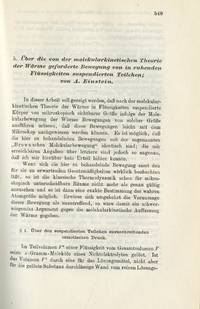
190532820546<p>FIRST EDITION. "On the Movement of Small Particles Suspended in a Stationary Liquid Demanded by the Molecular Kinetic Theory of Heat" appears here on pp. 549-560. This landmark paper on Brownian motion is one of the three great papers from 1905 Einstein <i>annus mirabilis</i>.</p><p>Although most physicists and chemists accepted the idea of atoms as a useful concept in 1905 many still questioned whether they actually existed. Einstein later claimed that "my major aim in this research was to find facts which would guarantee as much as possible the existence of atoms of finite size."</p><p>In 1827 botanist Robert Brown had used a microscope to look at dust grains floating in water. He found that the floating grains were moving about erratically a phenomenon that became known as "Brownian motion." In this paper Einstein proved the reality of these molecules and their motions by producing the first statistical physics analysis of Brownian motion. French physicist Jean Perrin used Einstein's results to experimentally determine the mass and the dimensions of atoms thereby conclusively verifying Dalton's atomic theory first proposed in 1808.</p><p>"Eventually the experimental evidence supporting Einstein's theory of Brownian motion became so compelling that the naysayers were forced to accept the existence of material atoms. His fundamental work on applying statistical methods to the random motions of Newtonian atoms also led to his insights into the photo electric effect through the discovery of a critical connection between his statistical theory of heat and the behavior of electromagnetic radiation. This was the first step in his goal to unify the two fields" APS.</p><br /><p>Complete issue removed from bound volume. Very good.</p>
192559960Berlin Königlich Akademie der Wissenschaften 1925-1929. 1. Einheitliche Feldtheorie von Gravitation und Elektrizität. 1925 pp. 414-419. Uncut unopened n the original printed wrappers. missing small parts of spine and upper part of front wrapper detached otherwise fine. Weil 147 / Boni 155.2. Neue Möglichkeit für eine einheitliche Feldtheorie von Gravitation und Elektrizität. Offprint: S. B. preuss. Akad. Wiss. 1928 pp.235-245. In the original yellow wrappers. Very fine and clean. Weil 162/ Boni 175.3. Zur einheitlichen Feldtheorie. Offprint: S. B. preuss. Akad. Wiss. 1929 pp.2-7. In the original yellow wrappers. Very fine and clean. Weil 165/ Boni 183.4. Einheitliche Feldtheorie und Hamiltonsches Prinzip. Offprint: S. B. preuss. Akad. Wiss. 1929 pp.156-159. In the original yellow wrappers. Very fine and clean. Weil 166/ Boni 184. <br/><br/><em>Fine collection three in offprint and one in the original printed wrappers of the four papers that together constitute Einstein's attempt towards creating a unified field theory: "a new theory of space with a view to unification of all forms of activity that fall within the sphere of physics giving them a common explanation" PMM416. The task of unifying nuclear electromagnetic and gravitational force is nowadays by many considered the holy grail of theoretical physics.Maxwell was the first to develop such a theory when he described the forces of electricity and magnetism as the single force electromagnetism. After Einstein had completed his general theory of relativity a field theory for gravitation he turned his attention towards generalizing his theory even further to include Maxwell's theory. Even though Einstein never succeeded in completing this task in the way that he finished his earlier theories he pioneered and explored many areas of this subject."It had been repeatedly observed that Einstein's general theory of relativity necessitated a pluralistic explanation of the universe. In 1925 he announced that he had resolved this difficulty but the announcement was premature. In 1928 he attacked the problem once more only to find that Riemann's conception of space on which the general theory was based would not permit of a common explanation of electromagnetic and gravitational phenomena. In a series of papers the present devoted to the development of 'A Uniform Theory of Gravitation and Electricity' he outlined a new theory of space with a view to unification of all forms of activity that fall within the sphere of physics giving them a common explanation. All that would then remain to complete a scientific unison is the correlation of the organic and inorganic".PMM 416Barchas 586Weil 147 162 165 & 166. </em> unknown
1908432171908. <p>Einstein Albert 1879-1955 and Jakob Johann Laub 1884-1962. Über die elektromagnetischen Grundgleichungen für bewegter Körper. Offprint from Annalen der Physik 4th series 26 1908. 532-540pp. 225 x 146 mm. Original printed wrappers. Fine.</p> <p>First Edition Offprint Issue. Einstein's first paper written jointly with a collaborator on the relativistic electrodynamics of ponderable media. "In 1908 Laub wrote works together with Einstein on the basic electromagnetic equations which was aimed to replace the four-dimensional formulation of the electrodynamics by Minkowski by a simpler classical formulation. Both Laub and Einstein discounted the spacetime formalism as too complicated. However it turned out that Minkowski's spacetime formalism was fundamental for the further development of special relativity" Wikipedia. Pais Subtle is the Lord pp. 151 154. Shields 23. Weil 23.</p> . unknown
1906432891906. <p>Einstein Albert 1879-1955. Über eine Methode zur Bestimmung des Verhältnisses der transversalen und longitudinalen Masse des Elektrons. Offprint from Annalen der Physik 21 1906. 583-586pp. 223 x 145 mm. Original printed wrappers chipped spine splitting minor spotting. Light toning but very good.</p> <p>First Edition Rare Offprint Issue. In his landmark 1905 paper on special relativity Einstein used the velocity-dependent concepts of transverse and longitudinal mass for the moving electron these terms have now been replaced with the concept of relativistic mass first defined by Lewis and Tolman in 1909. In the present paper Einstein proposed an experimental method for determining the ratio of the transverse to the longitudinal mass and invited experimentalists to verify his special theory of relativity. Einstein later abandoned velocity-dependent mass concepts stating in 1948 that "it is better to introduce no other mass concept than the 'rest mass' m" quoted in L. B. Okun "The concept of mass" Physics Today 1989: 31-36. Lavenda A New Perspective on Relativity pp. 7-8. Weil Albert Einstein Bibliography 14. </p> . unknown
1922B1001-<p>This is the <strong>true first edition</strong> published by Methuen in May 1922 — it preceded the more familiar Princeton edition by one month.</p><p>It's stamped on the title page as a publisher's presentation copy identifying it as a copy distributed by Methuen at the time of publication.</p><p>The Methuen issue is scarce in any state but in presentation form it is especially uncommon which gives this particular copy a distinctive place among other surviving examples.</p><p>The text is based on Einstein's 1921 Stafford Little Lectures at Princeton his first sustained attempt to explain the theory of relativity to an English-speaking audience.</p><p>Delivered only months before he was awarded the Nobel Prize in Physics the lectures marked a turning point in his career extending his influence beyond European academia and onto the broader international stage.</p> Methuen hardcover
1929ZB727262Leipzig : J.A. Barth 1929. 5. Folge 5th Series. Volumes 1 through 43 1929-1943 ALL PUBLISHED; all bound ex library else text clean & bindings tight. - If you are reading this this item is actually physically in our stock and ready for shipment once ordered. We are not bookjackers. Buyer is responsible for any additional duties taxes or fees required by recipient's country. Photos available upon request. Leipzig : J.A. Barth unknown
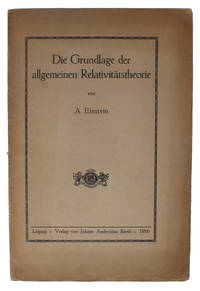
191660254Leipzig Ambrosius Barth 1916. 8vo. Uncut in the original printed wrappers. Light discolouration to margins of wrappers. Inner hinges with professional repairs. Small stamp exlibris to lower part of title-page. Previous owner's name Erik Broekmeyer in contemporary hand to upper outer corner of title-page. A fine copy. 64 pp. <br/><br/><em>First issue of the first edition in book form being not an offprint of the"Annalen der Physik" journal issue as often stated but a separate edition of the paper completely re-set and with significant changes and additions including for the first time in print the "Einleitung" and the "Inhalt".The first issue is distinguished from the later reprints by the printing of "Sonderdruck aus dem "Annalen der Physik" Band 49 1916" and "Druck von Metzger & Wittig in Leipzig. 314" to the verso of the title-page and "Metzger & Wittig Leipzig" to the foot of the back wrapper. Furthermore "This separate edition is printed on good strong paper the wrappers are of strong material too and it is described now as 'the original edition' of this classic paper" Weil. Einstein's seminal "General Theory of Relativity" has had an immense impact on all science philosophy and man's view of the world in general. Few other books of the 20th century can be said to have so basically altered the way that we view the world and our place in it. Determining space and time as being interwoven into a single continuum known as "space-time" and determining that there is no absolute space-time coordinate system - i.e. that there are no absolute positions in time and pace - established the fact that events that occur at the same time for one observer could occur at different times for another i.e. all positions in space and time are relative. This general theory of relativity here presented in its full exposition for the first time in book form is now a basic foundation for scientific thought."The theory of relativity has transformed astrophysics and indeed the whole scientific outlook." PMM."Whereas Special Relativity had brought under one set of laws the electromagnetic world of Maxwell and Newtonian mechanics as far as they applied to bodies in uniform relative motion The General Theory did the same thing for bodies with the accelerated relative motion epitomized in the acceleration of gravity. But first it had been necessary for Einstein to develop the true nature of gravity from his principle of equivalence.Basically he proposed that gravity was a function of matter itself and that its effects were transmitted between contiguous portions of space-time. Where matter exists so does energy; the greater the mass of matter involved the greater the effect of the energy which can be transmitted. In addition gravity affected light. exactly as it affected material particles. Thus the universe which Newton had seen and for which he had constructed his apparently impeccable mechanical laws was not the real universe. Einstein's paper gave not only a correct picture of the universe but also a fresh set of mechanical laws by which its details could be described" R.W. Clark. "This paper was the first comprehensive overview of the final version of Einstein's general theory of relativity after several expositions of preliminary versions and latest revisions of the theory in November 1915. It includes a self-contained exposition of the elements of the tensor calculus that are needed for the theory. T. Sauer in Landmark Writings in Western Mathematics. PMM: 408. Horblit 26 c. Weil 80.Boni: 781 Schilpp-Schields: 86. </em> unknown
1916ABE-1748062254979Verlag von Johann Ambrosius Barth 1916 Pamphlet finely bound in Dark green quarter leather over marbled boards. Signed twice in ink either by Einstein or a decent forger. Signature faded. First separate edition for the first time with the introduction which did not appear in the "Annalen." - "The theory of relativity has turned astrophysics upside down even the entire scientific world view" Carter/Muir Books That Change the World p. 727. "This separate edition is printed on good strong paper the wrappers are of strong material too 163 x 243 and it is described now as 'the original edition' of this classic paper ." Weil. - Cover slightly browned with a few edge chips top and foredge. Minor repairs to rear cover. Carter/Muir Books That Change the World 408 in "Annals of Physics"; Boni 78; Weil 80a; Laurence 78; Norman 696; Horblitt 26c. Signed by Authors. 1st Edition. Hardcover. Very Good. Verlag von Johann Ambrosius Barth hardcover
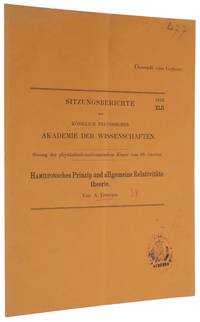
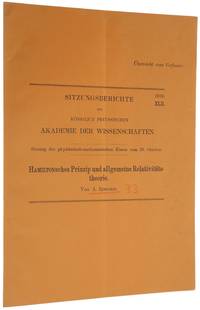
19142124Berlin: Königlichen Akademie der Wissenschaften 1914. FIRST EDITION OFFPRINT. Original wrappers. Fine. FIRST EDITION COMMERCIAL OFFPRINT ISSUE of Einstein's important 1914 paper on the development of general relativity. "In summer 1914 Einstein felt that the new theory general relativity should be presented in a comprehensive review. He also felt that a mathematical derivation of the field equations that would determine them uniquely was still missing. "Both tasks are addressed in a long paper presented in October 1914 to the Prussian Academy for publication in its Sitzungsberichte. It is entitled 'The formal foundation of the general theory of relativity'; here for the first time Einstein gave the new theory of relativity the epithet 'general' in lieu of the more cautious 'generalized' that he had used for the Entwurf" Landmark Writings in Western Mathematics 1640-1940. "According to John Norton 'How Einstein Found His Field Equations' this major review article was intended to convey the full content of the 1913 'Entwurf' theory: 'The principal novelty lies in the mathematical formulation of the theory. Drawing on earlier work with Marcel Grossman Einstein formulated his gravitational field equations using a variation principle. Using this richer mathematical structure Einstein offered a proof purporting to demonstrate that his theory had the maximum covariance compatible with the hole argument; that is covariance under 'justified' transformation between the 'adapted coordinate systems' he had introduced with Grossman'" Calaprice The Einstein Almanac. Offprint from: Sitzungsberichte der Königlich Preussischen Akademie der Wissenschaften XLI 19 November 1914 pp. 1030-1085. Berlin: Königlichen Akademie der Wissenschaften 1914. Octavo original wrappers; custom box. Neat early ownership name on front wrapper. Only the slightest wear; a fine copy. Rare. Königlichen Akademie der Wissenschaften unknown
19455054Lancaster PA: American Physical Society 1945. First edition. <p>First edition extremely rare offprints of Einstein & Straus's introduction of the 'Swiss-cheese' model of the universe. "By the spring of 1945 Einstein and Straus had found a new type of possible universe using Einstein's equations . This was a step towards a more realistic universe in which the matter was not smoothly spread with the same density everywhere but gathered up into lumps like galaxies which were spread about in empty space" Barrow The Book of Universes pp. 106-107.</p>. EINSTEIN'S 'SWISS-CHEESE' MODEL OF THE UNIVERSE - OFFPRINT ISSUE. <p>First edition extremely rare offprints of Einstein & Straus's introduction of the 'Swiss-cheese' model of the universe. "After a decade and a half of sometimes intense work on cosmology Einstein returned to the subject only occasionally in his later years. His most significant later contribution was a discussion of the impact of cosmological expansion on the gravitational field surrounding a star i.e. the offered papers . This was an important first step in understanding the impact of global cosmological expansion on local physics" Janssen & Lehner pp. 257-8. In the 1920s and 1930s a general relativistic model of the universe was developed called the Friedmann-Lemaître-Robertson-Walker FLRW model which correctly described the expansion of the universe discovered by Edwin Hubble. But the FLRW model was 'homogeneous' - it described a universe which looks the same wherever the observer is located. The actual universe however is manifestly inhomogeneous - it contains stars galaxies and clusters of galaxies. Einstein and Straus's papers represent the first serious attempt to model an inhomogeneous universe. "By the spring of 1945 Einstein and Straus had found a new type of possible universe using Einstein's equations. It described a universe which looked largely like one of the simple expanding universes of Friedmann and Lemaître containing material like galaxies which exerted no pressure. But it had spherical regions removed from it like bubbles in a Swiss cheese. Each empty hole then had a mass placed at its centre. The mass was equal in magnitude to what had been excavated to create the hole. This was a step towards a more realistic universe in which the matter was not smoothly spread with the same density everywhere but gathered up into lumps like galaxies which were spread about in empty space" Barrow pp. 106-107. Not on OCLC; no copies in auction records.</p> <br /> <p>In 1916 just a few months after Einstein had formulated his general theory of relativity Karl Schwarzschild had found a solution of Einstein's equations which described the gravitational field in the vicinity of a spherical distribution of mass such as a star or to anticipate later developments a black hole. This was in fact the first exact solution of Einstein's equations to be found - Einstein had earlier calculated an approximate solution which was enough to show that his theory correctly accounted for the advance of Mercury's perihelion. However at great distances from the star Schwarzschild's solution approaches the flat Minkowski spacetime with zero curvature and not the FLRW solution that represented an expanding universe. It seemed therefore that Schwarzschild's solution could not correctly describe the gravitational field of a star in an expanding FLRW universe. If the expansion of the universe meant that Schwarzschild's solution had to be modified this could make it possible to detect and measure the expansion of the universe by making local observations rather than by observing the motion of distant galaxies as Hubble had done. The problem of describing the gravitational field of a star in an expanding FLRW universe was addressed by Einstein and Straus in the offered papers.</p> <br /> <p>"In the early 1930s theorists began to develop a richer account of the evolution of the universe based on expanding models. Hubble's results qualitatively agreed with the redshift effect calculated in these models but the utility of the simple dynamical models depends on whether the universe is approximately uniform. The status of this assumption was the focus of lively debate . Relativistic cosmologists regarded the idealized uniformity of the FLRW models as a simplifying assumption . The unrelenting uniformity built into the FLRW models conflicts with the clear non-uniformity of the stars star clusters and galaxies of the local universe but the models might still serve as a useful approximation if the non-uniformities are negligible at larger scales" Janssen & Lehner p. 256.</p> <br /> <p>"By 1944 Einstein had recruited a new assistant at Princeton. His assistants were always talented young mathematicians who could make up for Einstein's self-confessed weakness in this area. Ernst Straus 1922-1983 was something of a mathematical prodigy . He was born in Munich but after the Nazis came to power in 1933 his family fled to Palestine where he was educated at high school and at the Hebrew University in Jerusalem. Straus didn't stay to take an undergraduate degree and instead while still a teenager moved to New York's Columbia University in 1941 to begin graduate research. In 1944 he found himself recruited as Einstein's new research assistant at the Institute for Advanced Study in Princeton. The young Straus had no background in physics and his mathematical inclinations were towards number theory and 'pure' mathematical topics but he lost no time in filling the gap left by the departures of Nathan Rosen 1935-45 and Leopold Infeld 1936-38" Barrow pp. 105-6.</p> <br /> <p>Einstein and Straus found an exact solution of the equations of general relativity in which a spherical 'hole' is cut out of an FLRW universe and the hole is replaced by a single mass point e.g. a star surrounded by a spherical cavity. The initially homogeneous matter within the cavity can be thought of as having been "condensed into the star". Einstein and Straus found that the interior of the cavity is described by the standard Schwarzschild solution. The radius of the hole is such that at its spherical boundary the outward pull from the cosmological masses is just balanced by the inward pull from the star. The cavity boundary expands according to the Hubble expansion of the whole universe. The universe outside the cavity is described by the standard expanding homogeneous FLRW solution. The possibility of exactly matching the Schwarzschild solution near the star to the FLRW solution outside it showed that it was not in fact possible to detect the expansion of the universe by making observations close to the star. There were similar solutions with more than one hole - Einstein said that this reminded him of the holes in Swiss cheese. The static vacuum region inside the cavity is now called an 'Einstein-Straus vacuole'.</p> <br /> <p>The methods introduced by Einstein and Straus in these papers have been used extensively to model inhomogeneities in the universe. For example in 1968 Martin Rees and Dennis Sciama investigated the effects of large-scale inhomogeneities such as superclusters of galaxies on the cosmic microwave background the so-called 'Rees-Sciama effect'. The Swiss-cheese model has also been used in the study of inflationary models of the early universe. According to this theory the universe expanded exponentially in the first tiny fraction of a second after the big bang with some parts of space-time expanding more quickly than others. This created 'bubbles' in space-time. The Swiss-cheese "embodies a natural way to model physical problems such as describing the boundary between a galaxy and intergalactic space or the relation between bubbles at the end of an inflationary era by taking two different regions where the behaviour is smooth and joining them at a surface of discontinuity" Ellis et al. p. 426.</p> <br /> <p>In the last decade several authors have suggested that Swiss-cheese models might solve a long-standing problem on the rate of expansion of the universe. Distant supernovas have been observed to be dimmer than expected on the basis of standard cosmological theories indicating that the universe is expanding faster than these theories predict. This has been explained by hypothesizing the existence of 'dark energy' although exactly what dark energy might be is a mystery. But if the light from distant supernovas had to cross large vacuoles in reaching an observer on the earth these would act like concave lenses making the supernovas appear dimmer and further away than they really are. Other authors have noted that the Milky Way is near the centre of a region that has fewer galaxies than other parts of the universe and that we might be living near the centre of a particularly large vacuole perhaps more than a billion light years in diameter see for example Bonnor.</p> <br /> <p>Weil 216. Barrow The Book of Universes 2011. Bonnor 'A generalisation of the Einstein-Straus vacuole' Classical and Quantum Gravity 17 2000 pp. 2739-2748. Ellis Maartens & MacCallum Relativistic Cosmology 2012. Janssen & Lehner eds. The Cambridge Companion to Einstein 2014.</p> <br/> <br/> Together two offprints 4to 267 x 200 mm pp. 120-124 & 148-149. Stapled as issued in original self-wrappers. American Physical Society unknown
192552559Berlin Königlich Akademie der Wissenschaften 1925-1929. 1. Einheitliche Feldtheorie von Gravitation und Elektrizität. Offprint: S. B. preuss. Akad. Wiss. 1925 pp.414-419. Original wrappers. Mint. Weil 147 / Boni 155.2. Neue Möglichkeit für eine einheitliche Feldtheorie von Gravitation und Elektrizität. Offprint: S. B. preuss. Akad. Wiss. 1928 pp.235-245. Original wrappers. Mint. Weil 162/ Boni 175.3. Zur einheitlichen Feldtheorie. Offprint: S. B. preuss. Akad. Wiss. 1929 pp.2-7. Original wrappers. Mint. Weil 165/ Boni 183.4. Einheitliche Feldtheorie und Hamiltonsches Prinzip. Offprint: S. B. preuss. Akad. Wiss. 1929 pp.156-159. Original wrappers. Mint. Weil 166/ Boni 184.5. Über den gegenwärtigen Stand der Feldtheorie. In: Festschrift Dr. A. Stodola Zürich Füssli 1929 pp.126-132. Publishers full cloth. Spine slightly faded. Otherwise mint. Weil 168 / Boni 178.All in all a very fine set. <br/><br/><em>Offprint of all four papers and first edition of the final essay constituting Einstein's attempt toward creating a unified field theory: "a new theory of space with a view to unification of all forms of activity that fall within the sphere of physics giving them a common explanation" PMM416. The task of unifying nuclear electromagnetic and gravitational force is nowadays by many considered the holy grail of theoretical physics.Maxwell was the first to develop such a theory when he described the forces of electricity and magnetism as the single force electromagnetism. After Einstein had completed his general theory of relativity a field theory for gravitation he turned his attention towards generalizing his theory even further to include Maxwell's theory. Even though Einstein never succeeded in completing this task in the way that he finished his earlier theories he pioneered and explored many areas of this subject. "It had been repeatedly observed that Einstein's general theory of relativity necessitated a pluralistic explanation of the universe. In 1925 he announced that he had resolved this difficulty but the announcement was premature. In 1928 he attacked the problem once more only to find that Riemann's conception of space on which the general theory was based would not permit of a common explanation of electromagnetic and gravitational phenomena. In a series of papers the present devoted to the development of 'A Uniform Theory of Gravitation and Electricity' he outlined a new theory of space with a view to unification of all forms of activity that fall within the sphere of physics giving them a common explanation. All that would then remain to complete a scientific unison is the correlation of the organic and inorganic".PMM 416Barchas 586 </em> hardcover
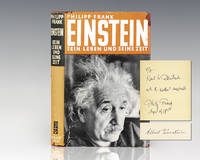
1949133215Munchen: Paul List Verlag 1949. First German edition of this classic work by Frank a famed contemporary of Einstein. Octavo original cloth. Signed by Albert Einstein on the slip to the title page and inscribed by the author on the front free endpaper "To Karl W. Deutsch with the author's compliments Philipp Frank August 10 1950." Philipp Frank was a physicist mathematician and also a philosopher during the first half of the 20th century. He was a logical-positivist and a member of the Vienna Circle. He was influenced by Mach and was one of the Machists criticised by Lenin in Materialism and Empirio-criticism. He studied physics at the University of Vienna and graduated in 1907 with a thesis in theoretical physics under the supervision of Ludwig Boltzmann. Albert Einstein recommended him as his successor for a professorship at the German Charles-Ferdinand University of Prague a position which he held from 1912 until 1938. Very good in a good dust jacket. Much has been written about Albert Einstein technical and biographical but very little remains as valuable as this unique hybrid of a book written by Einstein's colleague and contemporary. Both rich in personal insights and grounded in a deep knowledge of twentieth-century science Phillip Frank's biography anchors the reader with a lucid overview of physics and draws an intimate portrait of the Nobel Prize–winner. Paul List Verlag hardcover
190725711Weinheim: Offprint from: Zeitschrift für Elektrochemie. Nr. 6. 1907 February. First Edition Offprint Issue from Volume 13 number 6. Single sheet approximately 10" x 8" pp 41-42 pp. A very fine example of this rare issue a very minor and unobtrusive stain to an upper corner. SCARCE OFFPRINT ISSUE OF AN IMPORTANT EINSTEIN PAPER OF STATISTICAL MECHANICS and a continuation of his remarkable 1905 and 1906 publications on Brownian Motion which not only led to the proof of the existence of the atom but also worked to determine the size of atoms and how many atoms there are in a mole or the molecular weight in grams of a gas. This paper also contains a note on the technical meaning of "average velocity. Offprint from: Zeitschrift für Elektrochemie. Nr. 6. unknown
192749047Berlin: Ernst Wasmuth A.-G 1927. First edition. Good- to fine condition. 176/330. 41 1pp. 42 plates with printed tissue guards. Original quarter vellum over brown paper-covered boards with gilt vignette on cover gilt lettering on spine. Title page with publisher's device and black double frame. Cover design by Lucian Zabel. With an introduction on Russian culture the tradition of ballet and theater set and costume design by Carl Einstein. Many of the plates with dates ranging from 1910 to 1923 including motifs created during the war. The motifs of the plates range from close-up figure drawings to simple folk costumes elaborate gowns for members of the Court mystical figures and various set designs.<br /> <br /> Illustrated with forty-two plates nineteen of them fully or partially colored by hand or pochoir some heightened in gilt or silver three b/w one sepia-toned lithograph and nineteen plates reproduced in high quality offset printing. The title page calls for forty-two plates and six illustrations in the text. Our copy is illustrated with seven tipped-in color offset reproductions and one b/w lithograph as endpiece on page seventeen.<br /> <br /> In addition the work is extra-illustrated with five color offset reproductions: one full-page embossed color plate with extensive hand-applied gilt overlay facing page seven Le Roi a full-page embossed color offset reproduction with extensive silver overlay facing plate one Phedre Thesee dated 1923 and three full page color offset reproductions facing plates fifteen L'Amazone with black overprinting twenty-five Scheherazade embossed and heightened in silver and Lampe d'Aladin multicolor overprint and thirty-six La Sultane embossed and overprinted in gilt facing the same image though with greater detail.<br /> <br /> The copies listed in OCLC vary in publication dates all calling for 42 plates and six in-text illustrations. Auction records call for 1925. One auction record for the 1925 edition calls for the lithograph line drawing in the text. Our copy contains two plates dated 1922 in addition to others dated 1917. We've been unable to find any bibliographic record that describes seven in-text illustrations or the five additional illustrations facing four of the plates and the first page of the text as described.<br /> <br /> Text in German. Binding with light wear along edges but vellum smudged and variously discolored. Block lightly starting at a few plates 11 15 19 27 30 42. A couples of tissue guards for plates loose but present. Binding in overall good- plates in very good to fine condition. Leon Bakst 1866-1924 was a Russian painter costume and set designer. Bakst studied art at the St. Petersburg Academy of Arts and was a member of the Sergei Diaghilev circle. In 1893 he moved to Paris for four years studying at the Academy Julian. He founded the magazine 'Mir Iskusstva World of Art' with his friends Alexander Benois Sergei Diaghilev and Valentin Serov. Bakst is best known for his work in set and costume design for the Ballet Russes. Ernst Wasmuth A.-G unknown
19166409Berlin: Königlichen Akademie der Wissenschaften 1916. First edition. <p>First editions extremely rare author's presentation offprint not to be confused with the much more common trade separate - see below from the library of the great German physicist Arnold Sommerfeld of Einstein's derivation of the field equations of gravitation from a variational principle. This was the first time Einstein had derived the field equations of gravitation in arbitrary coordinates - in his celebrated 1915 papers he derived the equations in generally-covariant form but only in special 'unimodular' coordinates.</p>. THE GRAVITATIONAL EQUATIONS FROM A VARIATIONAL PRINCIPLE. <p>First editions extremely rare author's presentation offprint not to be confused with the much more common trade separate - see below from the library of the great German physicist Arnold Sommerfeld of Einstein's derivation of the field equations of gravitation from a variational principle. This was the first time Einstein had derived the field equations of gravitation in arbitrary coordinates - in his celebrated 1915 papers he derived the equations in generally-covariant form but only in special 'unimodular' coordinates. In the early 19th century William Rowan Hamilton 1805-65 showed that Newton's equations of motion for a classical mechanical system were equivalent to the statement that the 'action' of the system now called the Lagrangian has a stationary value generally a minimum. A first variational approach to the gravitational field equations of general relativity was unsuccessfully sketched by Einstein and Marcel Grossmann in 1913-1914 and subsequently by Einstein himself in 1914 the so-called Entwurf Theory. But Einstein's 1914 theory was invalidated by a misconception related to the physically unjustified requirement of restricting the covariance of the gravitational field equations and by some mathematical errors in a crucial proof in the theory. Between March and May 1915 the Italian mathematician Tullio Levi-Civita 1873-1941 in his private correspondence with Einstein singled out the mathematical flaws of the Entwurf theory setting Einstein back on the path of general covariance which eventually brought him in November 1915 to the correct formulation of the gravitational field equations. Also in November 1915 the great German mathematician David Hilbert 1862-1943 published an article in which he correctly showed that Einstein's gravitational field equations could be obtained from a variational principle at least in the presence of an electromagnetic field. Five days later independently of Hilbert Einstein obtained in the present paper the same results thus obtaining the definitive variational formulation of the field equations. Einstein considered his approach to be more general than Hilbert's as Hilbert had made some hypotheses about matter which Einstein dispensed with Einstein also refused to accept the electromagnetic origin of matter which Hilbert had assumed. In the course of this paper Einstein also proved a special case of Emmy Noether's second theorem on the relation between symmetry and conservation laws which she published in full generality two years later. The only author's presentation offprint listed on RBH is that is the collection of Einstein's son Hans Albert Christie's 2006; it was not in Einstein's own collection of his offprints Christie's 2008.</p> <br /> <p>Provenance: Arnold Sommerfeld 1868-1951 his characteristic numbering in red pencil '34' on front cover; Institut für Theoretische Physik Munich ink stamp on upper cover. "The son of a physician Sommerfeld was educated at the University of Königsberg. After teaching briefly at the universities of Göttingen Clausthal and Aachen he was appointed professor of physics at the University of Münich in 1906. Sommerfeld should have retired in 1936 in favour of his pupil Werner Heisenberg. Opposition from the Nazi party to Heisenberg's appointment prolonged Sommerfeld's tenure and it was not in fact until late 1939 that he finally retired to be succeeded not by Heisenberg but by Wilhelm Müller a Nazi aerodynamicist without a single publication in physics to his credit. Although Sommerfeld and Heisenberg were not Jewish they were regarded by the Nazis as Jewish sympathizers. Sommerfeld however survived the war and returned to his Münich chair in 1945 continuing to work at physics until he died in a car accident in 1951" Oxford Reference. "Arnold Sommerfeld was one of the most distinguished representatives of the transition period between classical and modern theoretical physics. The work of his youth was still firmly anchored in the conceptions of the nineteenth century; but when in the first decennium of the century the flood of new discoveries experimental and theoretical broke the dams of tradition he became a leader of the new movement and in combining the two ways of thinking he exerted a powerful influence on the younger generation. This combination of a classical mind to whom clarity of conception and mathematical rigour are essential with the adventurous spirit of a pioneer are the roots of his scientific success while his exceptional gift of communicating his ideas by spoken and written word made him a great teacher" Max Born p. 275. </p> <br /> <p>"Einstein's first paper on a metric theory of gravity co-authored with his mathematician friend Marcel Grossmann was published as a separatum in early 1913 and was reprinted the following year in Zeitschrift für Mathematik und Physik. Most of the formalism of general relativity as we know it today was already in place in this Einstein-Grossmann theory. Still missing were the generally-covariant Einstein field equations .</p> <br /> <p>"In the fall of 1915 Einstein came to the painful realization that the 'Entwurf' field equations are untenable. Casting about for new field equations he fortuitously found his way back to equations of broad covariance that he had reluctantly abandoned three years earlier . on November 4 1915 presented the rediscovered old equations to the Berlin Academy. He returned a week later with an important modification and two weeks after that with a further modification .</p> <br /> <p>"When it was all over Einstein commented with typical self-deprecation: 'unfortunately I have immortalized my final errors in the academy-papers;' and 'it's convenient with that fellow Einstein every year he retracts what he wrote the year before.' What excused Einstein's rushing into print was that he knew that the formidable Göttingen mathematician David Hilbert was hot on his trail. Nevertheless these hastily written communications to the Berlin Academy proved hard to follow even for Einstein's staunchest supporters such as the Leyden theorists H. A. Lorentz and Paul Ehrenfest . Ehrenfest's queries undoubtedly helped Einstein organize the material of November 1915 for an authoritative exposition of the new theory .</p> <br /> <p>"In March 1916 Einstein sent his new review article 'Die Grundlage der Relativitätstheorie' to Wilhelm Wien editor of the Annalen . In this paper the field equations and energy-momentum conservation are not developed in generally-covariant form but only in special coordinates. Einstein had found the Einstein field equation in terms of these coordinates in November 1915. This part of the review paper is basically a sanitized version of the argument that had led Einstein to these equations in the first place .</p> <br /> <p>"As he was writing his review article he was already considering redoing the discussion of the field equations and energy-momentum conservation in arbitrary coordinates. In November 1916 he published such a generally-covariant account in the Berlin Sitzungsberichte the offered paper. This paper is undoubtedly much more satisfactory mathematically than the corresponding part of the review article but it does not offer any insight into how Einstein actually found his theory.</p> <br /> <p>Reading the offered paper without having read the November 1915 papers and the 1916 review article one easily comes away with the impression that Einstein hit upon the Einstein field equations simply by picking the mathematically most obvious candidate for the gravitational part of the Lagrangian for the metric field namely the Riemann curvature scalar. This is essentially how Einstein himself came to remember his discovery of general relativity. He routinely trotted out this version of events to justify the purely mathematical speculation he resorted to in his work on unified field theory.</p> <br /> <p>"In this paper he derived the generally-covariant field equations from an action principle with the Riemann curvature scalar as the Lagrangian . The present paper fills two important gaps in the review article. First Einstein derived the generally-covariant version of the Bianchi identities which in conjunction with the field equations imply energy-momentum conservation . Second Einstein showed that the identities guaranteeing energy-momentum conservation are a direct consequence of the covariance of the action functional. Einstein had thus in a mathematically impeccable way found a special case of one of Noether's theorems published two years later.</p> <br /> <p>"From a purely mathematical point of view the discussion of the field equations and energy-momentum conservation in the present paper is far more elegant than in the review article. This more elegant treatment however obscures the way in which Einstein found the Einstein field equations. It makes it look as if it was a matter ofpicking the most obvious candidate for the Lagrangian the Riemann curvature scalar at which point everything else fell into place. Ironically this is exactly what Einstein in his later years came to believe himself in part no doubt because it made his successful search for the field equations of general relativity look so similar to his fruitless search for a unified field theory. The clumsier discussion in unimodular coordinates in the review article however may serve as a reminder that-whatever he believed said or wrote about it later on-Einstein only discovered the mathematical high road to the Einstein field equations after he had already found these equations at the end of a poorly paved road through physics. Serving as road signs were Newton's gravitational theory Maxwell's electrodynamics and such key results of special relativity as the law of energy-momentum conservation. Considerations of mathematical elegance played only a subsidiary role" Janssen.</p> <br /> <p>This author's presentation offprint is of extreme rarity and must be distinguished from other so-called 'offprints' of papers from the Berlin Sitzungsberichte many of which are commonly available on the market. The celebrated bookseller Ernst Weil 1919-1981 in the introduction to his Einstein bibliography wrote: "I have often been asked about the number of those offprints. It seems to be certain that there were few before 1914. They were given only to the author and mostly 'Überreicht vom Verfasser' Presented by the Author is printed on the wrapper. Later on I have no doubt many more offprints were made and also sold as such especially by the Berlin Academy." If the term 'offprint' means as we believe it should a separate printing of a journal article given only to the author for distribution to colleagues then 'offprints' were not commercially available. Although there is certainly some truth in Weil's remark in our view it requires clarification and explanation.</p> <br /> <p>Until about 1916 most of Einstein's papers were published in Annalen der Physik; from 1916 until he left Germany for the United States in 1933 most were published in the Berlin Sitzungsberichte. The Sitzungsberichte differed from other journals in which Einstein published in that it made separate printings of its papers commercially available. These separate printings have 'Sonderabdruck' printed on the front wrapper the usual German term for offprint but they are not offprints according to our definition. They were available to anyone; indeed a price list of these 'trade offprints' is printed on the rear wrapper. True author's presentation offprints can be distinguished from these trade separates by the presence of 'Überreicht vom Verfasser' on the front wrapper.</p> <br /> <p>In the period 1916 to 1919 or 1920 the Sitzungsberichte trade separates are themselves rare. After 1919 or 1920 however the trade separates become much more common although the author's presentation offprints are still very rare. The reason for this change is that it was only in 1919 that Einstein became famous among the general public.</p> <br /> <p>It might seem obvious that Einstein's fame dates from 1905 his 'annus mirabilis' in which he published his epoch-making papers on special relativity and the light quantum. However these works did not make him immediately well known even in the physics community - many physicists did not understand or accept his work and it was two or three years before his genius was fully accepted even by his colleagues. Einstein did not secure an academic position until 1908. Among the general public Einstein became well known only in late 1919 following the success of Eddington's expedition to observe the bending of light by the Sun which confirmed Einstein's general theory of relativity. This was front-page news and made Einstein universally famous. See Chapter 16 'The suddenly famous Doctor Einstein' in Pais Subtle is the Lord for an account of these events. Before 1919 the trade separates of Einstein's papers would probably only have been purchased by professional physicists; after 1919 everyone wanted a memento of the famous Dr. Einstein whether or not they understood anything of theoretical physics and the trade separates of his papers were printed and sold in far greater numbers than before to meet the demand. It is telling that when these post-1919 trade separates appear on the market they are often in mint condition - they were never read simply because their owners were unable to understand them.</p> <br /> <p>BRL 90; Weil 88. Born 'Arnold Johannes Wilhelm Sommerfeld 1868-1951' Obituary Notices of Fellows of the Royal Society 8 1952 pp. 275-296. Janssen 'Einstein's First Systematic Exposition of General Relativity' 2004 .</p> <br/> <br/> 8vo 252 x 180 mm pp. 1111-1116. Original orange printed wrappers light vertical crease for posting. Königlichen Akademie der Wissenschaften unknown
19166408Berlin: Königlichen Akademie der Wissenschaften 1916. First edition. <p>First editions extremely rare author's presentation offprint not to be confused with the much more common trade separate - see below from the library of the great German physicist Arnold Sommerfeld of Einstein's derivation of the field equations of gravitation from a variational principle. This was the first time Einstein had derived the field equations of gravitation in arbitrary coordinates - in his celebrated 1915 papers he derived the equations in generally-covariant form but only in special 'unimodular' coordinates.</p>. THE GRAVITATIONAL EQUATIONS FROM A VARIATIONAL PRINCIPLE. <p>First editions extremely rare author's presentation offprint not to be confused with the much more common trade separate - see below from the library of the great German physicist Arnold Sommerfeld of Einstein's derivation of the field equations of gravitation from a variational principle. This was the first time Einstein had derived the field equations of gravitation in arbitrary coordinates - in his celebrated 1915 papers he derived the equations in generally-covariant form but only in special 'unimodular' coordinates. In the early 19th century William Rowan Hamilton 1805-65 showed that Newton's equations of motion for a classical mechanical system were equivalent to the statement that the 'action' of the system now called the Lagrangian has a stationary value generally a minimum. A first variational approach to the gravitational field equations of general relativity was unsuccessfully sketched by Einstein and Marcel Grossmann in 1913-1914 and subsequently by Einstein himself in 1914 the so-called Entwurf Theory. But Einstein's 1914 theory was invalidated by a misconception related to the physically unjustified requirement of restricting the covariance of the gravitational field equations and by some mathematical errors in a crucial proof in the theory. Between March and May 1915 the Italian mathematician Tullio Levi-Civita 1873-1941 in his private correspondence with Einstein singled out the mathematical flaws of the Entwurf theory setting Einstein back on the path of general covariance which eventually brought him in November 1915 to the correct formulation of the gravitational field equations. Also in November 1915 the great German mathematician David Hilbert 1862-1943 published an article in which he correctly showed that Einstein's gravitational field equations could be obtained from a variational principle at least in the presence of an electromagnetic field. Five days later independently of Hilbert Einstein obtained in the present paper the same results thus obtaining the definitive variational formulation of the field equations. Einstein considered his approach to be more general than Hilbert's as Hilbert had made some hypotheses about matter which Einstein dispensed with Einstein also refused to accept the electromagnetic origin of matter which Hilbert had assumed. In the course of this paper Einstein also proved a special case of Emmy Noether's second theorem on the relation between symmetry and conservation laws which she published in full generality two years later. The only author's presentation offprint listed on RBH is that is the collection of Einstein's son Hans Albert Christie's 2006; it was not in Einstein's own collection of his offprints Christie's 2008.</p> <br /> <p>Provenance: Arnold Sommerfeld 1868-1951 his characteristic numbering in red pencil '33' on front cover. "The son of a physician Sommerfeld was educated at the University of Königsberg. After teaching briefly at the universities of Göttingen Clausthal and Aachen he was appointed professor of physics at the University of Münich in 1906. Sommerfeld should have retired in 1936 in favour of his pupil Werner Heisenberg. Opposition from the Nazi party to Heisenberg's appointment prolonged Sommerfeld's tenure and it was not in fact until late 1939 that he finally retired to be succeeded not by Heisenberg but by Wilhelm Müller a Nazi aerodynamicist without a single publication in physics to his credit. Although Sommerfeld and Heisenberg were not Jewish they were regarded by the Nazis as Jewish sympathizers. Sommerfeld however survived the war and returned to his Münich chair in 1945 continuing to work at physics until he died in a car accident in 1951" Oxford Reference. "Arnold Sommerfeld was one of the most distinguished representatives of the transition period between classical and modern theoretical physics. The work of his youth was still firmly anchored in the conceptions of the nineteenth century; but when in the first decennium of the century the flood of new discoveries experimental and theoretical broke the dams of tradition he became a leader of the new movement and in combining the two ways of thinking he exerted a powerful influence on the younger generation. This combination of a classical mind to whom clarity of conception and mathematical rigour are essential with the adventurous spirit of a pioneer are the roots of his scientific success while his exceptional gift of communicating his ideas by spoken and written word made him a great teacher" Max Born p. 275. </p> <br /> <p>"Einstein's first paper on a metric theory of gravity co-authored with his mathematician friend Marcel Grossmann was published as a separatum in early 1913 and was reprinted the following year in Zeitschrift für Mathematik und Physik. Most of the formalism of general relativity as we know it today was already in place in this Einstein-Grossmann theory. Still missing were the generally-covariant Einstein field equations .</p> <br /> <p>"In the fall of 1915 Einstein came to the painful realization that the 'Entwurf' field equations are untenable. Casting about for new field equations he fortuitously found his way back to equations of broad covariance that he had reluctantly abandoned three years earlier . on November 4 1915 presented the rediscovered old equations to the Berlin Academy. He returned a week later with an important modification and two weeks after that with a further modification .</p> <br /> <p>"When it was all over Einstein commented with typical self-deprecation: 'unfortunately I have immortalized my final errors in the academy-papers;' and 'it's convenient with that fellow Einstein every year he retracts what he wrote the year before.' What excused Einstein's rushing into print was that he knew that the formidable Göttingen mathematician David Hilbert was hot on his trail. Nevertheless these hastily written communications to the Berlin Academy proved hard to follow even for Einstein's staunchest supporters such as the Leyden theorists H. A. Lorentz and Paul Ehrenfest . Ehrenfest's queries undoubtedly helped Einstein organize the material of November 1915 for an authoritative exposition of the new theory .</p> <br /> <p>"In March 1916 Einstein sent his new review article 'Die Grundlage der Relativitätstheorie' to Wilhelm Wien editor of the Annalen . In this paper the field equations and energy-momentum conservation are not developed in generally-covariant form but only in special coordinates. Einstein had found the Einstein field equation in terms of these coordinates in November 1915. This part of the review paper is basically a sanitized version of the argument that had led Einstein to these equations in the first place .</p> <br /> <p>"As he was writing his review article he was already considering redoing the discussion of the field equations and energy-momentum conservation in arbitrary coordinates. In November 1916 he published such a generally-covariant account in the Berlin Sitzungsberichte the offered paper. This paper is undoubtedly much more satisfactory mathematically than the corresponding part of the review article but it does not offer any insight into how Einstein actually found his theory.</p> <br /> <p>Reading the offered paper without having read the November 1915 papers and the 1916 review article one easily comes away with the impression that Einstein hit upon the Einstein field equations simply by picking the mathematically most obvious candidate for the gravitational part of the Lagrangian for the metric field namely the Riemann curvature scalar. This is essentially how Einstein himself came to remember his discovery of general relativity. He routinely trotted out this version of events to justify the purely mathematical speculation he resorted to in his work on unified field theory.</p> <br /> <p>"In this paper he derived the generally-covariant field equations from an action principle with the Riemann curvature scalar as the Lagrangian . The present paper fills two important gaps in the review article. First Einstein derived the generally-covariant version of the Bianchi identities which in conjunction with the field equations imply energy-momentum conservation . Second Einstein showed that the identities guaranteeing energy-momentum conservation are a direct consequence of the covariance of the action functional. Einstein had thus in a mathematically impeccable way found a special case of one of Noether's theorems published two years later.</p> <br /> <p>"From a purely mathematical point of view the discussion of the field equations and energy-momentum conservation in the present paper is far more elegant than in the review article. This more elegant treatment however obscures the way in which Einstein found the Einstein field equations. It makes it look as if it was a matter ofpicking the most obvious candidate for the Lagrangian the Riemann curvature scalar at which point everything else fell into place. Ironically this is exactly what Einstein in his later years came to believe himself in part no doubt because it made his successful search for the field equations of general relativity look so similar to his fruitless search for a unified field theory. The clumsier discussion in unimodular coordinates in the review article however may serve as a reminder that-whatever he believed said or wrote about it later on-Einstein only discovered the mathematical high road to the Einstein field equations after he had already found these equations at the end of a poorly paved road through physics. Serving as road signs were Newton's gravitational theory Maxwell's electrodynamics and such key results of special relativity as the law of energy-momentum conservation. Considerations of mathematical elegance played only a subsidiary role" Janssen.</p> <br /> <p>This author's presentation offprint is of extreme rarity and must be distinguished from other so-called 'offprints' of papers from the Berlin Sitzungsberichte many of which are commonly available on the market. The celebrated bookseller Ernst Weil 1919-1981 in the introduction to his Einstein bibliography wrote: "I have often been asked about the number of those offprints. It seems to be certain that there were few before 1914. They were given only to the author and mostly 'Überreicht vom Verfasser' Presented by the Author is printed on the wrapper. Later on I have no doubt many more offprints were made and also sold as such especially by the Berlin Academy." If the term 'offprint' means as we believe it should a separate printing of a journal article given only to the author for distribution to colleagues then 'offprints' were not commercially available. Although there is certainly some truth in Weil's remark in our view it requires clarification and explanation.</p> <br /> <p>Until about 1916 most of Einstein's papers were published in Annalen der Physik; from 1916 until he left Germany for the United States in 1933 most were published in the Berlin Sitzungsberichte. The Sitzungsberichte differed from other journals in which Einstein published in that it made separate printings of its papers commercially available. These separate printings have 'Sonderabdruck' printed on the front wrapper the usual German term for offprint but they are not offprints according to our definition. They were available to anyone; indeed a price list of these 'trade offprints' is printed on the rear wrapper. True author's presentation offprints can be distinguished from these trade separates by the presence of 'Überreicht vom Verfasser' on the front wrapper.</p> <br /> <p>In the period 1916 to 1919 or 1920 the Sitzungsberichte trade separates are themselves rare. After 1919 or 1920 however the trade separates become much more common although the author's presentation offprints are still very rare. The reason for this change is that it was only in 1919 that Einstein became famous among the general public.</p> <br /> <p>It might seem obvious that Einstein's fame dates from 1905 his 'annus mirabilis' in which he published his epoch-making papers on special relativity and the light quantum. However these works did not make him immediately well known even in the physics community - many physicists did not understand or accept his work and it was two or three years before his genius was fully accepted even by his colleagues. Einstein did not secure an academic position until 1908. Among the general public Einstein became well known only in late 1919 following the success of Eddington's expedition to observe the bending of light by the Sun which confirmed Einstein's general theory of relativity. This was front-page news and made Einstein universally famous. See Chapter 16 'The suddenly famous Doctor Einstein' in Pais Subtle is the Lord for an account of these events. Before 1919 the trade separates of Einstein's papers would probably only have been purchased by professional physicists; after 1919 everyone wanted a memento of the famous Dr. Einstein whether or not they understood anything of theoretical physics and the trade separates of his papers were printed and sold in far greater numbers than before to meet the demand. It is telling that when these post-1919 trade separates appear on the market they are often in mint condition - they were never read simply because their owners were unable to understand them.</p> <br /> <p>BRL 90; Weil 88. Born 'Arnold Johannes Wilhelm Sommerfeld 1868-1951' Obituary Notices of Fellows of the Royal Society 8 1952 pp. 275-296. Janssen 'Einstein's First Systematic Exposition of General Relativity' 2004 .</p> <br/> <br/> 8vo 252 x 180 mm pp. 1111-1116. Original orange printed wrappers light vertical crease for posting. Königlichen Akademie der Wissenschaften unknown
19502896Princeton: np 1950. Very Good. A beautiful photo of Einstein at work in his study seemingly absorbed with his thoughts. The photographer Hermann Landshoff like Einstein was a German-Jewish émigré who settled in the United States in the 1930s. His large body of work encompasses portraits of some of the most influential figures of the century. Landshoff was highly respected by his peers with his work prompting the American photographer Richard Avedon to claim "I owe everything to Landshoff."<br /> <br /> Landshoff visited Einstein to photograph him several times in the 1940s and early 1950s showing Einstein in quieter moments at his home or study in Princeton.<br /> <br /> With Landshoff's copyright stamp on verso marking this as a "Sample copy" and "Not for sale or reproduction." Also with Landshoff's signature on the original matte board. The original non-archival matte was removed during framing to better preserve the photo but the signature was preserved and is now displayed on verso. <br /> <br /> Gelatin silver print with sepia tones. Taken c.1950 likely a contemporary or early printing. Approx. 9.25 x 10.5 in 235 x 263 mm. Archivally framed under museum glass to a size of 16 x 17.5 in. A few tiny spots to image generally in fine condition handsomely framed. np unknown