ALBERT EINSTEINABAA

172 résultats
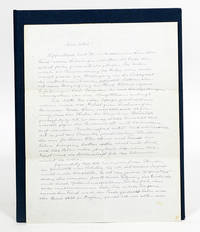
192625045<p><b>ALBERT EINSTEIN.</b>Autograph Correspondence Card Signed to Michele Besso May 1 1926 Berlin. In German. 1 p. 4¼ x 5⅞ in. </p><b>Complete Translation</b><p><i> 1 May 1926</i></p><p><i>Dear Michele</i></p><p><i> I read that paper</i><i>right away at the time but I don't think that anything more profound lies behind it. There is naturally a rough connection between a decrease in volume and energy and from here one can try to come nearer to the empirical phenomena by introducing further parameters. But this happens in such a way that neither rhyme nor reason can be made of it. It is very reminiscent of Traube. Using such apothecary's methods one cannot reveal any of God's secrets I think. Schrödinger did a couple of wonderful studies on quantum rules Ann d Physik.</i> <i>That has the scent of a deeper truth. Let it be explained to you.</i></p><p><i> I'm coming to Switzerland in July. End of July is LN meeting in Geneva.</i> <i>Then I'm going somewhere in the mountains with Tete. So I'll visit you or else we can meet.</i></p><p><i> Warm regards also to Anna and Vero your</i></p><p><i> Albert</i></p><p><b>Historical Background</b></p><p>Early in 1926 Michele Besso sent Einstein an early draft of a paper by Swiss chemist Gottfried Beck on quantum mechanics. Beck had initially submitted the paper to the Swiss scientific journal <i>Helvetica Chemica Acta</i> which rejected it as too speculative. On April 25 1926 Besso wrote to Einstein about Beck's paper. After discussing the details he writes "This surely is an amusing thing; I was surprised that you didn't write me anything about it. Here too reality is once again simpler than the theoretical conceptions would lead one to expect."</p><p>Three months later Einstein wrote to Besso regarding Beck's paper: "it is obviously particularly painful to use the quantum condition together with the equations of motion here because the validity of the latter appears to be irreconcilable with the validity of the former." Einstein was skeptical that Beck's equation "has any reality left within it in the face of quanta. I vigorously doubt it." However Einstein found the construction of the left side of the equation "surely contains a deeper truth." Einstein declared to Besso "I cannot make myself glue two things together like the left- and right-hand sides of this equation that have nothing to do with each other logico-mathematically."</p><p><b>Michele Besso</b> 1873-1955 was born in Zurich Switzerland into an Italian Jewish family. He was a close friend of Albert Einstein when they worked together at the Federal Polytechnic Institute in Zurich and at the patent office in Bern where Einstein helped Besso get a job. Besso met his future wife Anna Winteler through Einstein in June 1897. In 1898 their son Vero was born in Winterthur Switzerland. Einstein referred to Besso as "the best sounding board in Europe" for scientific ideas. Besso died in Geneva just over one month before Einstein died in Princeton New Jersey.</p><p><b>Johann Gottfried Beck</b> 1900-1992 received his Ph.D. in chemistry from the University of Bern in December 1925. He worked as an assistant to Heinrich Zangger at the Institute for Forensic Medicine at the University of Zurich.</p><p><b>Isidor Traube</b> 1860-1943 was born in Hanover the son of a wealthy German-Jewish merchant. He received his doctorate in organic chemistry in 1882. He founded capillary chemistry and conducted advanced research on liquids helping to define the concepts of surface tension and critical temperature. In 1882 he joined the faculty of Technische Hochshule in Berlin and became a professor of chemistry there in 1900. Unacceptable to National Socialists Traube was barred from his laboratory and he left Germany in 1934. Through the aid of British colleagues he was provided with a laboratory at the University of Edinburgh. During his long career he was a persistent and stubborn controversialist in opposition to various theories.</p><p><b>Erwin Schrödinger</b> 1887-1961 was born in Vienna Austria. He was a commissioned officer in the Austrian fortress artillery during World War I. After the war he advanced through the academic ranks to become a full professor in 1921 in Breslau now Wroclaw Poland. That year he moved to the University of Zurich and in 1927 to the Friedrich Wilhelm University in Berlin. He received the Nobel Prize in Physics in 1933 and left Germany as he opposed the Nazis. After brief positions in a number of places he settled in Dublin Ireland in 1940 where he remained until retiring in 1955. During his career Schrödinger developed a number of fundamentals of quantum theory including the wave equation. He also published many works in various fields of physics. Although Schrödinger was an atheist he believed his scientific work was an approach to the godhead in a metaphorical sense.</p><p><b>Eduard Einstein</b> 1910-1965 was born in Zürich Switzerland to Albert and Mileva Marić Einstein. In 1914 his parents separated and his mother returned to Zürich with Eduard and older brother Hans Albert who were both deeply affected. Eduard was interested in music art and poetry. Unlike his father Eduard was a good student. He had started to study medicine and psychiatry but in 1930 was diagnosed with schizophrenia. He was first institutionalized in 1932; it is not clear if his treatment particularly electroconvulsive therapy did more good than harm. Albert fondly referred to Eduard as "Tete" for <i>petit</i> and they corresponded regularly but never saw each other after a heart-breaking final visit in 1933. Marić and Eduard's Swiss citizenship undoubtedly saved Eduard from Aktion T4 the Nazi euthanasia program and perhaps both of them from the Holocaust. His mother cared for Eduard until her death in 1948 and Eduard thereafter lived mostly at a psychiatric clinic in Zurich where he died from a stroke in 1965.</p> books
19312240New York: Covici Friede 1931. 1st. Cloth. Collectible; Very Good. 1931 1st edition. Clean and VG in its original blue cloth. 12mo 109 pgs. Light offsetting at the gutters tasteful former owner bookplate to front pastedown. <br/><br/> Covici, Friede hardcover books
192426006<p>"<i>I'm working a lot but not managing to come up with the real thing. Science is a difficult profession. Sometimes I'm glad that you chose a practical vocation where one doesn't have to search for four-leaf clovers.</i>"</p> <b>ALBERT EINSTEIN.</b>Autograph Letter Signed "<i>Papa</i>" to his son Hans Albert Einstein March 7 1924 Berlin Germany. In German. 1 p.<p><b><br /></b></p><p><b>Complete Translation</b></p><p> <i>7.III.24</i></p><p><i>Dear Albert</i></p><p> <i>My research projects of the past few years are completely inappropriate for a popular lecture and then I generally dread public appearances of such a kind. That's why I unfortunately have to decline the talk this time too. The Fr 45000 I designated for the down payment of the house purchase; and I invested another Fr 45000 which is supposed to belong to you that is Mama. I hope you'll find a suitable little home.</i></p><p> <i>I'm probably going to be staying in Zurich for a bit on the trip back from Naples; on the trip there only briefly. There's no question of it being official; the main thing for me is to be with you for a while. I don't have much time because I'm supposed to go to Kiel in May.</i></p><p> <i>In any case I'm very happy about seeing you all again soon. I'm working a lot but not managing to come up with the real thing. Science is a difficult profession. Sometimes I'm glad that you chose a practical vocation where one doesn't have to search for four-leaf clovers.</i></p><p> <i>Looking forward to a happy reunion! Best regards to the three of you from your</i></p><p> <i>Papa.</i></p><p><b>Historical Background</b></p><p>Einstein's Theory of Relativity published in 1915 describes gravity as a curved geometric property of spacetime. Though <i>E</i>=<i>mc</i>2 captures the theory for which he is most remembered he never won the Nobel Prize in Physics. Rather in 1922 he won for his 1905 explanation of the photoelectric effect.</p><p>In 1914 Albert and Mileva Marić-Einstein separated and she and their sons returned to Zurich. When they divorced in 1919 they agreed that any Nobel Prize money he might win would go to Mileva for the children. He won the Nobel Prize for Physics in 1922.</p><p>In May 1924 two months after this letter Marić purchased a building in Zurich and moved into the third floor apartment. In 1930 she purchased two more buildings but when the worldwide economic crisis reached Switzerland many tenants could not afford their rent; she lost the two additional buildings to foreclosure in 1936. Einstein had invested the remaining prize money in America in Marić's name. He lost much of that due to the Great Depression but he ultimately paid Marić more than he received from the prize.</p><p>Einstein also mentions to his nineteen-year-old son his plans to travel to Naples in May. He would attend the fifth International Congress of Philosophy with his theory of relativity scheduled to be "an object of particular discussion." First organized in 1900 the Congress was a global meeting held every few years under the auspices of the International Federation of Philosophical Societies. It was interrupted by both World Wars but reconvened in 1948 and has been held every five years since in locations throughout the world.</p><p>Einstein also planned to go to Kiel Germany to stay and work with Hermann Anschütz-Kaempfe 1872-1931 a German art historian and inventor. Kaempfe pioneered gyro compasses for ships and submarines.</p><p>From the 1920s until his death in 1955 the most elusive clover for which Einstein searched was a unified field theory. Einstein tried to meld together general relativity and electromagnetism. This would describe a single field in which all forces are mediated and the properties of all particles could be deduced.</p><p><b>Albert Einstein</b> 1879-1955 was born in the Kingdom of Wurttemberg in the German Empire to non-observant Ashkenazi Jewish parents. In 1894 the family moved to Italy. Einstein graduated from the Swiss Federal Polytechnic in Zürich in 1900. In 1903 he married Mileva Marić 1875-1948 with whom he had two sons. In 1905 he received a Ph.D. from the University of Zürich. From 1908 to 1932 he taught at a series of universities in Switzerland the Austrian Empire and the German Empire. As a theoretical physicist he published ground-breaking papers as early as 1905 and developed the theory of relativity including the mass–energy equivalence formula <i>E</i>=<i>mc</i>2. Albert and Mileva divorced in 1919. That same year he married Elsa Löwenthal. In 1922 he received the Nobel Prize in Physics for the discovery of the photoelectric effect. In January 1933 when Adolph Hitler came to power Einstein was visiting the U.S. and remained here In 1939 he signed a letter to President Franklin D. Roosevelt warning that Germany could develop a nuclear bomb thus inspiring the "Manhattan project." He became a U.S. citizen in 1940. After the war he became known for efforts to further world peace. At the Institute for Advanced Study in Princeton N.J. from 1933 until his death in 1955 he worked to develop a unified field theory and to refute the accepted interpretation of quantum physics. Considered the father of modern physics and one of the most prolific intellects of history Einstein published more than 300 scientific papers and over 150 non-scientific works.</p><p><b>Hans Albert Einstein</b> 1904-1973 was born in Bern Switzerland to Albert Einstein and Mileva Marić. Hans followed both parents in studying at ETH the Swiss Federal Institute of Technology in Zurich graduating with a degree in civil engineering in 1926. In 1927 he married Frieda Knecht and they had four children two of whom died very young. In 1936 Hans earned a doctor of technical science degree. At his father's advice he left Switzerland in 1938 to escape the Nazi threat. He settled in Greenville South Carolina and worked for the U.S. Department of Agriculture studying sediment transport. In 1943 he transferred to the California Institute of Technology and in 1947 he accepted a position teaching hydraulic engineering at the University of California Berkeley. He became a full professor and eventually professor emeritus winning several research awards and fellowships.</p> books
1931148499Burbank CA: Warner Brothers 1931. Vintage photograph of Albert Einstein and his wife Elsa on a Warner Brothers film set February 3 1931. <br/><br/>In early 1931 Einstein and his wife visited several studios and sets to see European directors at work. Here Einstein his wife sitting at his left and cinematographer J. Peverell Marley sit in at a screening for the 1931 French language version of "The Big House" in France titled "Revolte dans la prison." As this is a prison film a number of actors in the photo are wearing prison jackets. <br/><br/>Jacques Feyder was the original director of the French version and Pal Fejos and George W. Hill are credited for it as well.<br/><br/>8 x 10 inches. Very Good plus with light creasing at the corners. <br/><br/>Complete collation details available on request. Warner Brothers unknown books
1947010662New York: Prentice-Hall Inc 1947. Book. Very good condition. Hardcover. Reprint edition. Octavo 8vo. xvi 287 pages of text including an index. Hardcover binding with minimal shelfwear. No dustjacket. Small previous owners' label and stamp affixed to the inside front cover "Property of William J. Sturm 1740 No. 54th St. Milwaukee 8 Wis." Sturm a scientist at the University of Chicago was a part of CP-1 Chicago Pile One and present at the December 2 1942 experiment. Sturm has made numerous small notations in pencil throughout the text. Pages are overall moderately browned. Prentice-Hall Inc Hardcover books
192478904London: Methuen & Company 1924. First edition of this classic account of Born's analysis and interpretation of Einstein's theory of relativity. Octavo original cloth frontispiece of Einstein. Signed by Max Born on the verso of the frontispiece. Translated by Henry L. Brose. Very good in a very good dust jacket. Housed in a custom half morocco clamshell box. First editions are uncommon signed examples rare. Einstein's Theory of Relativity is a book in which one great mind explains the work of another great mind in terms comprehensible to the layman is a significant achievement. This is such a book. Max Born was awarded the Nobel Prize in 1954 and was one of the world's great physicists: in this work he analyzes and interprets the theory of Einsteinian relativity. The result is undoubtedly the most lucid and insightful of all the books that have been written to explain the revolutionary theory that marked the end of the classical and the beginning of the modern era of physics. Born follows a quasi-historical method of presentation. The book begins with a review of the classical physics covering such topics as origins of space and time measurements geometric axioms Ptolemaic and Copernican astronomy concepts of equilibrium and force laws of motion inertia mass momentum and energy Newtonian world system absolute space and absolute time gravitation celestial mechanics centrifugal forces and absolute space laws of optics the corpuscular and undulatory theories speed of light wave theory Doppler effect convection of light by matter electrodynamics including magnetic induction electromagnetic theory of light electromagnetic ether electromagnetic laws of moving bodies electromagnetic mass and the contraction hypothesis. Born then takes up his exposition of Einstein's special and general theories of relativity discussing the concept of simultaneity kinematics Einstein's mechanics and dynamics relativity of arbitrary motions the principle of equivalence the geometry of curved surfaces and the space-time continuum among other topics. Born then points out some predictions of the theory of relativity and its implications for cosmology and indicates what is being sought in the unified field theory. This work steers a middle course between vague popularizations and complex scientific presentations. This is a careful discussion of principles stated in thoroughly acceptable scientific form yet in a manner that makes it possible for the reader who has no scientific training to understand it. Only high school algebra has been used in explaining the nature of classical physics and relativity and simple experiments and diagrams are used to illustrate each step. The layman and the beginning student in physics will find this an immensely valuable and usable introduction to relativity. Methuen & Company hardcover books
1979285534Princeton: Princeton University Press 1979. First. hardcover. fine/fine. 235 pages 8vo. stamped orange cloth d.w. First edition. Princeton: Princeton University Press 1979. A fine copy in a fine wrapper.<br/><br/> Princeton University Press unknown books
1953137755New York: Dell Publishing 1953. First Edition. First Edition a paperback original. Basis for the 1956 film noir "While the City Sleeps" directed by Fritz Lang and starring George Sanders and Dana Andrews. <br/><br/>Near Fine in illustrated wrappers. Dell Publishing unknown books
19271324467Paris: The Sign of the Pegasus 1927. First Edition. Hardcover. 16 31 pages; 150 pages; VG; bound in gilt decorated burgundy cloth rebacked with original boards and spine preserved; top edge of text block gilt; mild rubbing and wear; with 150 photographs plus a folded color frontispiece; shelved above front case. 1324467. Shelved Dupont Bookstore. The Sign of the Pegasus hardcover books
1958188282New York: Dover 1958. Near Fine. Reprint. Near fine. Please Note: This book has been transferred to Between the Covers from another database and might not be described to our usual standards. Please inquire for more detailed condition information. Dover unknown books
193110574New York: The Macmillan Company 1931. First American Edition. Cloth. Near fine/good. First American edition of About Zionism: Speeches and Letters by Professor Albert Einstein in scarce dust jacket. Twelvemo 8 9-94pp. Green cloth title stamped in gilt on spine. Published "February 1931" statement on copyright page. Uncut outer edge clean text throughout. Sound binding. In the scarce publisher's dust jacket price clipped retail price of $1.50 stamped on front flap chipping and some loss along top edge shelf wear to both covers a stable but well-worn example. Boni Russ & Laurence 306 An exceptionally scarce example of this work in the publisher's original dust jacket. First published in London in 1930 by The Soncino Press this work was translated into English by Leon Simon. The Macmillan Company unknown books
192037403Berlin: Springer 1920. Springer unknown books
192043308Berlin: Springer 1920. 15pp. 221 x 146 mm. Original printed wrappers foxed. Minor internal foxing but very good. First edition cover title does not include the date Einstein delivered his lecture; see Weil. "By royal decree of June 24 1920 a special chair in Leiden University was created for Einstein enabling him to come to that university for short periods of his choosing. On October 27 1920 Einstein began his new position with an inaugural address on aether and relativity theory" Pais Subtle is the Lord p. 313. Weil Albert Einstein Bibliography 111. Springer unknown books
19511234181951. Rare silver gelatin print inscribed by the father of modern physics Albert Einstein. Inscribed by Einstein on the lower margin of the photograph "To Mr. Satoru Yamano A. <span class="match">Einstein</span>. 51." In near fine condition. Double matted and framed. The entire piece measures 11.5 inches by 10.5 inches. Perhaps best known for the development of his mass-energy equivalence formula E = mc2 German born theoretical physicist Albert Einstein's surname has practically become synonymous with the term 'genius' in modern popular culture. Einstein received the Nobel Peace Prize in 1921 for his "services to theoretical physics" which included his development of the general theory of relativity and contributions to the development of quantum theory the two pillars of modern physics. unknown books
1952720911952. Black and white silver gelatin photograph of Albert Einstein. Signed "A Einstein 52." Full-length group portrait showing Albert Einstein standing with Hadassah National President Rebecca Beldner Shulman and others at his Princeton home in June of 1952 during a celebration marking the commencement of building of the Hadassah-Hebrew University Medical Center in Jerusalem. The photograph measures 8 inches by 9.5 inches. The entire piece measures 19 inches by 20.5 inches. An exceptional piece. Albert Einstein developed the general theory of relativity one of the two pillars of modern physics alongside quantum mechanics. Einstein's work is also known for its influence on the philosophy of science. Einstein is best known in popular culture for his mass-energy equivalence formula E = mc2 which has been dubbed "the world's most famous equation". He received the 1921 Nobel Prize in Physics for his "services to theoretical physics" in particular his discovery of the law of the photoelectric effect a pivotal step in the evolution of quantum theory David Bodanis. unknown books
1952510461952. Black and white silver gelatin photograph of Albert Einstein. Signed "A Einstein 52." Group portrait showing Einstein standing between Talmudic scholar Tamar de Sola Pool and Hadassah National President Rebecca Beldner Shulman at his Princeton home in June of 1952 during a celebration marking the commencement of building of the Hadassah-Hebrew University Medical Center in Jerusalem. The photograph measures 8 inches by 10 inches. Double matted and framed. The entire piece measures 13.5 inches by 15.5 inches. An exceptional photograph of Einstein rare and desirable signed. Albert Einstein developed the general theory of relativity one of the two pillars of modern physics alongside quantum mechanics. Einstein's work is also known for its influence on the philosophy of science. Einstein is best known in popular culture for his mass-energy equivalence formula E = mc2 which has been dubbed "the world's most famous equation". He received the 1921 Nobel Prize in Physics for his "services to theoretical physics" in particular his discovery of the law of the photoelectric effect a pivotal step in the evolution of quantum theory David Bodanis. unknown books
1979300955Princeton Princeton University Press 1979. 1979. First edition. Selected and edited by Helen Dukas and Banesh Hoffman. Frontispiece b/w portrait. Original German texts; chronology. Dust jacket price clipped. Very good. 167 pages. No signatures or bookplates. 1st Edition. Hardcover. Very Good/Very Good. Princeton, Princeton University Press [1979]. hardcover books
19361198491936. Rare typed letter signed by Albert Einstein. One page typescript text in German. The letter is dated 19 June 1936 and addressed to Dr. Hugo Bergman Hebrew University Jerusalem and reads: Lieber Herr Bergmann: Ueberbringer dieses Briefes ist "Seine amerikanische Heiligkeit" Rabbi Silberfeld von Newark New Jersey ein guter Bekannter von mir. Zuhause aller Wege kundig nicht aber in Palaestina. Es ware lieb von Ihnen wenn Sie ihm ein paar Winke gaben damit er sich dort zurechtfindet. Herzlich grusst Sie Ihr "A. Einstein." This translates as: Dear Mr. Bergmann: The bearer of this letter is "His American Holiness" Rabbi Silberfeld of Newark New Jersey a good friend of mine. At home he knows all the ways but not in Palestine. It would be nice of you if you gave him a few hints. yours "A. Einstein." Einstein's close personal friend Rabbi Julius Silberfeld was the rabbi of Temple B'nai Abraham in Newark New Jersey from 1902 to 1939. After it became clear that he could not return to Germany with Hitler's rise to power during his 1933 visit to the United States Einstein resided in England and Belgium for several months before returning to the U.S. where he accepted a position at the Institute for Advanced Study in Princeton New Jersey noted for having become a refuge for scientists fleeing Nazi Germany. It was here that he likely met and formed a close bond with Rabbi Silberfeld. The recipient of the letter Hugo Bergmann was the first rector of the Hebrew University of Jerusalem between 1935 and 1938 which Einstein was instrumental in establishing in 1925 and was among its first Board of Governors. The letter is in near fine condition with a small paper clip imprint. Desirable with noted provenance. Albert Einstein developed the general theory of relativity one of the two pillars of modern physics alongside quantum mechanics. Einstein's work is also known for its influence on the philosophy of science. Einstein is best known in popular culture for his mass-energy equivalence formula E = mc2 which has been dubbed "the world's most famous equation". He received the 1921 Nobel Prize in Physics for his "services to theoretical physics" in particular his discovery of the law of the photoelectric effect a pivotal step in the evolution of quantum theory David Bodanis. unknown books
1949125016Evanston: Library of Living Philosophers 1949. Signed limited edition of Einstein's singular autobiography. Octavo original brown cloth top edge gilt original glassine and slipcase. One of 760 numbered copies signed and dated "Albert Einstein '49" this is number 458. Fine in the rare original glassine which is in near fine condition and in the original slipcase which is in fine condition. Housed in the original publisher's cardboard. An absolute pristine example which has been stored in the original cardboard box since publication. Edited by Paul Arthur Schilpp. Frontispiece portrait of Einstein by Yousuf Karsh. Rare and desirable in this condition particularly scarce in the original glassine and original box. Written by the man considered the "Person of the Century" by Time magazine this is not a glimpse into Einstein's personal life but an extension and elaboration into his thinking on science. Two of the great theories of the physical world were created in the early 20th century: the theory of relativity and quantum mechanics. Einstein created the theory of relativity and was also one of the founders of quantum theory. Here Einstein describes the failure of classical mechanics and the rise of the electromagnetic field the theory of relativity and of the quanta. "The greatest physicist of the 20th century" PMM 408. Library of Living Philosophers hardcover books
1949110472Evanston: Library of Living Philosophers 1949. Signed limited first edition number 711 of 760 copies signed and dated "Albert Einstein '49." Octavo original brown cloth top edge gilt. The book is in fine condition in the rare original dust jacket which is in very good condition. Edited by Paul Arthur Schilpp. Frontispiece portrait of Einstein by Yousef Karsh. Rare and desirable in this condition. Written by the man considered the "Person of the Century" by Time magazine this is not a glimpse into Einstein's personal life but an extension and elaboration into his thinking on science. Two of the great theories of the physical world were created in the early 20th century: the theory of relativity and quantum mechanics. Einstein created the theory of relativity and was also one of the founders of quantum theory. Here Einstein describes the failure of classical mechanics and the rise of the electromagnetic field the theory of relativity and of the quanta. "The greatest physicist of the 20th century" PMM 408. Library of Living Philosophers hardcover books
1927374151927. Offprint from S. preuss. Akad. Wiss. Weil 155. unknown books
1927433031927. Offprint from Sitzungsberichte der preussischen Akademie der Wissenschaften 1927. 235-245pp. 255 x 183 mm. Original printed wrappers. Fine. On the problem of motion in general relativity theory; a follow-up to his and Grommer's paper of the same title published earlier in 1927. Weil Albert Einstein Bibliography 160. unknown books
1921302276Leipzig Felix Meiner 1921. 1921. First edition. 8vo. Foreword by Raymund Schmidt. Articles by Oskar Kraus Friedrich Lepsius Paul F. Lincke Joseph Petzoldt. Text pages numbered 334-500. Original stiff green wrappers printed in black. Very good. Cover title: Zur Relativitatstheorie. Kraus' article entitled: "Fiktion und Hypothese in der Einsteinschen Relativitatstheorie.". 1st Edition. Soft cover. Very Good/No Jacket. Leipzig, Felix Meiner, 1921. paperback books
1930433061930. Offprint from Mathematische Annalen 102 1930. 685-697pp. Original printed self-wrappers. 233 x 157 mm. Very good apart from small split in lower spine. Weil Albert Einstein Bibliography 171. unknown books
19371984Princeton: np 1937. First Edition. Very Good. AN EXTRAORDINARY LETTER BY EINSTEIN TO HIS SON OFFERING LIFE ADVICE AND DISCUSSING FREUD SHAKESPEARE AND SCHILLER. Addressed to his son Eduard "Tetel" Einstein and signed "Papa" the letter written in ink on both sides of one sheet reads in full translated from the original German: 

Dear Tetel

 I hope by now you've received Freud's lectures from Vienna. I've read most of them myself in the past. They really made me admire the Author but they didn't convince me that his theories were correct. 

I must admit however that based on my personal experiences my conviction about those theories is weakening -- I feel now that he was onto something at least in regards to the main theses. I would have written to you sooner but work is keeping me very busy. Even though they say that the work of a single person will not have much of an impact in the big picture it does not diminish the passion in which we pursue our interests and that is a good thing. 

 Although personal illusions may bring warmth and joy into one's life when young they don't last a lifetime. Life would be bleak if the work and the passion for discovery did not exist. In my free time I am currently reading Schiller's poems which I have neglected since my youth. 

They feel a bit pompous but at the same time they are enthralling in their choice of words and grammar. I am really happy that I picked them up again. 

I would have liked to send you another book on the top of the Freud but didn't know which one to send -- especially because I don't get a lot of German writings anymore.

 When I have some extra free time after finishing Schiller I really want to start reading Shakespeare everything from him I can get my hands on. If you like to read it too perhaps we could discuss it at some later time
 

 Albert is a real delight -- he has been traveling up and down the country for the past 6 weeks and will have seen and experienced many interesting things. I really hope he has followed my advice and kept a journal but I am not holding high hopes. When it comes to talking and writing he seems to be chronically constipated. With my warmest regards

 Papa Einstein's life advice underscoring one of his core beliefs: Einstein often stated that his main goal in life was the quest for truth no matter how difficult and painstaking the quest. He advises Eduard in this letter that it is the pursuit and the work in attaining the goal that brings satisfaction and sustains one throughout life even if "the work of a single person will not have much of an impact in the big picture". This he notes is critical to understand after the illusions of youth have succumbed to reality. Einstein Eduard and Freud: Eduard Einstein nicknamed "Tete" or "Tetel" born in 1910 was the second son of Albert and his first wife Mileva. From an early age he became enamored with the teachings of Freud even hanging a picture of famous psychiatrist on his bedroom wall. By the age of twenty he was diagnosed with schizophrenia and consequently was institutionalized several times throughout his life. Einstein's views of Freud's teachings were somewhat more nuanced than those of his son. Initially Einstein did not show much interest in Freud's theories and after their first meeting in 1927 Freud famously remarked "He understands as much about psychology as I do about physics." Over the years however Einstein began studying Freud's works. After corresponding with Freud somewhat regularly throughout the 1930s and even collaborating with him on a project sponsored by the League of Nations "Why War" 1932 Einstein began to move from a deep skepticism to - as indicated in this letter - a growing acceptance. By 1936 - just before this letter was written - Einstein sent birthday greetings to Freud acknowledging: "Until recently I could only apprehend the speculative power of your train of thought together with its enormous influence on the Weltanschauung of the present era without being in a position to form a definite opinion about the amount of truth it contains. Not long ago however I had the opportunity of hearing about a few instances not very important in themselves which in my judgment exclude any other interpretation than that provided by the theory of repression. I was delighted to come across them since it is always delightful when a great and beautiful conception proves to be consonant with reality." 
In this letter to Eduard Einstein admits to Eduard that he now believes Freud "was onto something at least in regards to the main theses." Einstein Shakespeare Schiller: Einstein's fondness for music is well-known but not as much has been recorded about his literary tastes. It is not surprising and has been previously documented that Einstein had a fondness for the great German poet Schiller but we can find no other references to Shakespeare by Einstein in any other letters or manuscripts. His words to Eduard "I really want to start reading Shakespeare everything from him I can get my hands on" imply that Einstein has recently "discovered" Shakespeare and is excited at the discovery. 
Note: Although the letter is not dated we can assume that it was written late November - December in 1937 when Einstein's son Albert was visiting the United States a trip he refers to in the letter. Princeton: November - December 1937. One 8.5x11 inch leaf written on both sides. In German. Usual folds otherwise fine. A LONG REMARKABLE AND REVEALING LETTER UNITING THE INTELLECTUAL GIANTS EINSTEIN FREUD AND SHAKESPEARE AND SHARING ONE OF HIS CORE BELIEFS WITH HIS SON. np unknown books