850 résultats
1995Q-0805815368Psychology Press 1995-12-01. Hardcover. New. New. In shrink wrap. Looks like an interesting title! Psychology Press hardcover
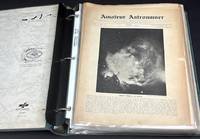
1936H40351New York: Amateur Astronomers Association 1936. Very good. Old cloth 3-ring binder with acetate sheaths containing the issues. This started out as a 4 pp. periodical but expanded in later issues. In 1936 the journal merged with The Sky published by Hayden Planetarium which subsequently merged with The Telescope in 1941 to become Sky & Telescope which is still being published. Condition is mainly very good although the first three issues we have have some damage to fore-edges. The first issue has a supplementary sheet laid in "Professor Einstein Sends Greetings to the Amateur Astronomers Association" reprinting in facsimile the handwritten note with a printed translation and a facsimile of another note from Einstein. We have Vol. I nos. 1 & 2 April and May 1929; Vol. 2 nos. 1 September 1929 - 9 May-June 1930 -- the April 1930 issue has a cover story on the discovery of Pluto then considered the ninth planet. Pluto was first discovered on February 18 1930 by Clyde Tombaugh at the Lowell Observatory in Flagstaff Arizona.The discovery was announced on March 13 1930 in the Astronomical Journal.; Vol. III nos. 1 October-November 1930 - 7/8 May-June 1931; Vol. IV nos. 1 September-October 1931 - 8 Summer 1932; Vol. V nos. 1 September-October 1932 - 3 March 1933 -- these expanded to 6 pp. each; Vol. VI nos. 1 - 3 Winter & Spring 1933-1934 - Summer 1934 -- beginning with Vol. VI these are 16 pp. each; with the Spring issue cover story on Hayden Planetarium; Vol. VII nos. 1 Autumn 1934 - 3 Spring 1935; Vol. VIII nos. 1 Autumn 1935 - 3 Spring 1936. We don't know if we're missing any or not but it's a nice early run of this rare astronomical journal. Amateur Astronomers Association unknown
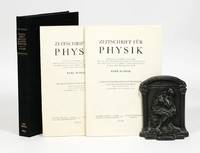
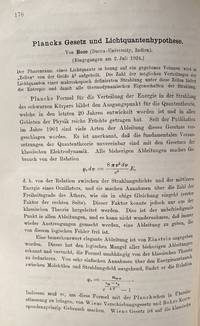
19242905Berlin: Julius Springer 1924. First edition. original wrappers. Very Good. FIRST EDITION IN ORIGINAL WRAPPERS of the presentation of "Bose-Einstein statistics." “In 1924 Bose found a way to derive Planck’s equation for black body radiation using a statistical approach based entirely on the idea that light is made up of tiny particles photons. This echoed the statistical mechanics approach of Ludwig Boltzmann to the behaviour of gases but using a different statistical rule; it derives black body radiation entirely in quantum terms without using the idea of electromagnetic radiation at all. Bose wrote a paper about his discovery and sent it to Albert Einstein who immediately saw its significance translated it into German and arranged for its publication in the prestigious Zeitschrift für Physik. Einstein developed the idea to apply to other kinds of particle not just to a ‘gas’ of photons which is why this approach is usually referred to as ‘Bose-Einstein statistics’. Paul Dirac coined the name ‘bosons’ for particles which obey Bose-Einstein statistics" Gribbin Q is for Quantum.<br /> <br /> Particle Physics: One Hundred Years of Discoveries: “Discovery of new statistical counting rules for light quanta and a new derivation of Planck’s radiation law. Known as Bose-Einstein quantum statistics for particles with integer spins.â€<br /> <br /> WITH a follow-up paper by Bose: "Wärmegleichgewicht im Strahlungsfeld bei Anwesenheit von Materie": "Bose's first paper in 'Zeitschrift für Physik' was followed by another that was also translated by Einstein and published during 1924. In it Bose provided a general statistical treatment of emission and absorption processes for electromagnetic radiation in equilibrium with matter. This paper was accompanied by a note by Einstein expressing serious doubts about the method. In January 1925 Bose wrote to Einstein from Paris that he was working on a paper he felt would remove these doubts. But it seems never to have been completed" DSB.<br /> <br /> Plancks Gesetz und Lichtquantenhypothese. IN: Zeitschrift für Physik Vol 26 No. 3 August 1924 pp. 178-81. Berlin: Julius Springer 1924. “Wärmegleichgewicht†Vol 27 No. 5/6 September 1924 pp. 384-93. Octavo original wrappers. “Planks Gesetz†with small closed tear at rear wrapper edge; otherwise fine condition; “Wärmegleichgewicht†with small chip to base of front wrapper. SCARCE in original wrappers. Julius Springer unknown
192432820524<p>FIRST EDITION of this classic in the history of quantum mechanics "Planck's Law and Light Quantum Hypothesis" pp. 178-181 in vol. 26.</p><p>Bose sent this paper to Einstein who translated it into German for this initial publication with the comment "In my opinion Bose's derivation of the Planck formula signifies an important advance." In this paper he "succeeded in deriving the Planck blackbody radiation law without reference to classical electrodynamics. Einstein's generalization of Bose's method led to the first of two systems of quantum statistical mechanics known as the Bose-Einstein statistics. Paul Dirac later coined the term 'boson' for particles that obey these statistics" DSB. </p><p>"With their work Bose and Einstein established the field of quantum statistics one year before the appearance of quantum mechanics" Brandt <i>The Harvest of a Century</i></p><p>This volume also contains three papers by Werner Heisenberg.</p>Complete vols. 25-26. Contemporary half calf. Near fine without any library markings.
192478904London: Methuen & Company 1924. First edition of this classic account of Born's analysis and interpretation of Einstein's theory of relativity. Octavo original cloth frontispiece of Einstein. Signed by Max Born on the verso of the frontispiece. Translated by Henry L. Brose. Very good in a very good dust jacket. Housed in a custom half morocco clamshell box. First editions are uncommon signed examples rare. Einstein's Theory of Relativity is a book in which one great mind explains the work of another great mind in terms comprehensible to the layman is a significant achievement. This is such a book. Max Born was awarded the Nobel Prize in 1954 and was one of the world's great physicists: in this work he analyzes and interprets the theory of Einsteinian relativity. The result is undoubtedly the most lucid and insightful of all the books that have been written to explain the revolutionary theory that marked the end of the classical and the beginning of the modern era of physics. Born follows a quasi-historical method of presentation. The book begins with a review of the classical physics covering such topics as origins of space and time measurements geometric axioms Ptolemaic and Copernican astronomy concepts of equilibrium and force laws of motion inertia mass momentum and energy Newtonian world system absolute space and absolute time gravitation celestial mechanics centrifugal forces and absolute space laws of optics the corpuscular and undulatory theories speed of light wave theory Doppler effect convection of light by matter electrodynamics including magnetic induction electromagnetic theory of light electromagnetic ether electromagnetic laws of moving bodies electromagnetic mass and the contraction hypothesis. Born then takes up his exposition of Einstein's special and general theories of relativity discussing the concept of simultaneity kinematics Einstein's mechanics and dynamics relativity of arbitrary motions the principle of equivalence the geometry of curved surfaces and the space-time continuum among other topics. Born then points out some predictions of the theory of relativity and its implications for cosmology and indicates what is being sought in the unified field theory. This work steers a middle course between vague popularizations and complex scientific presentations. This is a careful discussion of principles stated in thoroughly acceptable scientific form yet in a manner that makes it possible for the reader who has no scientific training to understand it. Only high school algebra has been used in explaining the nature of classical physics and relativity and simple experiments and diagrams are used to illustrate each step. The layman and the beginning student in physics will find this an immensely valuable and usable introduction to relativity. Methuen & Company hardcover
1971046762New York: Walker & Company 1971. 1st Edition 1st Printing. Hardcover. Near Fine/Very Good. Xi 240 Pp. First Printing. Near Fine Book No Marks. Dj Priced $8.50 Light Wear <br/> <br/> Walker & Company hardcover
1980028718New York: Aspen Institute for Humanistic Studies 1980. Book. Fine. Soft cover. First Edition. 4to - over 9¾" - 12" tall. Stiff color illus. wrasp. Mere hints of handling wear essentially as issued. Square uncreased binding. vii174 pp. Very scarce. Aspen Institute for Humanistic Studies Paperback
1980028752New York: Aspen Institute for Humanistic Studies 1980. Book. VG. Soft cover. First Edition. 4to - over 9¾" - 12" tall. Stiff color illus. wrasp. Light shelf/handling wear diagonal creases to bottom corners. Square uncreased binding. vii174 pp. Very scarce. Aspen Institute for Humanistic Studies Paperback
1995x-0691000999Princeton Univ Pr 1995. Paperback. New. 384 pages. 10.00x7.75x1.00 inches. Princeton Univ Pr paperback
192749047Berlin: Ernst Wasmuth A.-G 1927. First edition. Good- to fine condition. 176/330. 41 1pp. 42 plates with printed tissue guards. Original quarter vellum over brown paper-covered boards with gilt vignette on cover gilt lettering on spine. Title page with publisher's device and black double frame. Cover design by Lucian Zabel. With an introduction on Russian culture the tradition of ballet and theater set and costume design by Carl Einstein. Many of the plates with dates ranging from 1910 to 1923 including motifs created during the war. The motifs of the plates range from close-up figure drawings to simple folk costumes elaborate gowns for members of the Court mystical figures and various set designs.<br /> <br /> Illustrated with forty-two plates nineteen of them fully or partially colored by hand or pochoir some heightened in gilt or silver three b/w one sepia-toned lithograph and nineteen plates reproduced in high quality offset printing. The title page calls for forty-two plates and six illustrations in the text. Our copy is illustrated with seven tipped-in color offset reproductions and one b/w lithograph as endpiece on page seventeen.<br /> <br /> In addition the work is extra-illustrated with five color offset reproductions: one full-page embossed color plate with extensive hand-applied gilt overlay facing page seven Le Roi a full-page embossed color offset reproduction with extensive silver overlay facing plate one Phedre Thesee dated 1923 and three full page color offset reproductions facing plates fifteen L'Amazone with black overprinting twenty-five Scheherazade embossed and heightened in silver and Lampe d'Aladin multicolor overprint and thirty-six La Sultane embossed and overprinted in gilt facing the same image though with greater detail.<br /> <br /> The copies listed in OCLC vary in publication dates all calling for 42 plates and six in-text illustrations. Auction records call for 1925. One auction record for the 1925 edition calls for the lithograph line drawing in the text. Our copy contains two plates dated 1922 in addition to others dated 1917. We've been unable to find any bibliographic record that describes seven in-text illustrations or the five additional illustrations facing four of the plates and the first page of the text as described.<br /> <br /> Text in German. Binding with light wear along edges but vellum smudged and variously discolored. Block lightly starting at a few plates 11 15 19 27 30 42. A couples of tissue guards for plates loose but present. Binding in overall good- plates in very good to fine condition. Leon Bakst 1866-1924 was a Russian painter costume and set designer. Bakst studied art at the St. Petersburg Academy of Arts and was a member of the Sergei Diaghilev circle. In 1893 he moved to Paris for four years studying at the Academy Julian. He founded the magazine 'Mir Iskusstva World of Art' with his friends Alexander Benois Sergei Diaghilev and Valentin Serov. Bakst is best known for his work in set and costume design for the Ballet Russes. Ernst Wasmuth A.-G unknown
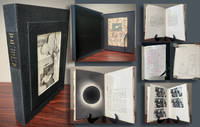
195533706New York: The Ram Press 1955. 1st Edition - Limited. 1st Edition - Limited. We are going to experience another full Solar Eclipse April 8 2024. This volume was to celebrate Albert Einstein and the Solar Eclipse of Jun 30 1954 and June 20 1955. Unusual Signed Kilfitt/Zoomar Eclipse Book with original Einstein Frank Back Photo. 8vo 5 1/2" x 8 1/2" 40pp signed and inscribed by Dr. Back on the second free endpaper. <br /> "To Leslie and Duke.<br /> We should never make statements witch are not planned correct and checked by us .we should not impress by telling sometime .stories in order to make contributions or to say something. Talking is silence. "Silence is gold"<br /> Wish you the very best from the heart.<br /> T F Back sept 11 1965"<br /> <br /> A fine copy in handmade decorative paper covered boards printed glossy paper label on the upper cover limited edition of 3000 copies in the original glassine outer wrapper showing some light sunning. This volume was dedicated to Albert Einstein and is the only book that was ever written by "The Father of the Zoom Lens". With / An original black & white silver gelatin 5 x 7 photograph of Dr. Albert Einstein and Dr. Frank Gerald Back seated together in very fine condition acquired directly from Dr. Back's estate. This photograph was taken circa 1954 and is one of the images published in this limited edition. With An 18" x 22" blueprint folded of the Solar Eclipse Spectrograph size "C" drawing. It was made from the original drawing dated 4/1/55 drawn by Zoomar's Chief Designer Alfred Joseph Quittner "AJQ" & approved by Dr. Back "FGB". A very interesting package indeed. Dr. Back was a very close friend of Albert Einstein. <br /> Dr. Einstein persuaded the author to take the trip commemorated in this beautifully produced volume in order to capture the total eclipse of the sun which occurred on June 20 1955. Dr. Back intended to provide conclusive evidence for Einstein's theory of relativity by calculating the optical distortion if any of starlight caused by the sun's gravity. Earlier in 1919 Einstein's general relativity principles were supported by observations of a solar eclipse. The two scientists conferred on the project for over a year. Armed with a special Zoomar designed & built wide-angle solar-eclipse spectrograph Dr. Back was off to the Philippine Islands to board a military jet & chase the eclipse. Einstein however died while Back was on his way to Manila. Unable to report the excursion to his friend Dr. Back dedicated this book to his memory. Dr. Frank Back held over 200 patents directly relating to photographic equipment. He was the founder & president of Zoomar Inc. The photographic term " zoom" was derived from Zoomar. Dr. Back created the first widely used zoom lenses for motion picture and television; then in 1959 introduced the first zoom lens for still cameras with the introduction of the 36-82mm/f2.8 Voigtlander Zoomar. Dr. Back & Zoomar purchased the great Heinz Kilfitt optical factory of Munich Germany in 1966 & it became a subsidiary of Zoomar Inc. This volume was never widely distributed & when Zoomar Inc. ceased operations at Glen Cove Long Island many cases of this book were discovered & unceremoniously trashed. The existing number of copies is unknown but the book is not frequently encountered. This copy came from the personal estate of Dr. Frank Gerald Back & it is one of the few copies signed by him. An excellent example suited for collectors of Science Astronomy Einstein Zoomar or Photographic History in general. In a lovely custom clamshell case with a window insert displaying the original Einstein/Back photo.<br /> On page 13 there is a typo. He wrote July 301954 instead of June 30 1954 and was never changed. The Ram Press unknown
1915000012055Leipzig: Verlag von B.G. Teubner 1915. First edition. Hardcover. Near Fine. Large 8vo. 2 pages of publisher's advertisements 6 vi-viii 3 4-762 8 pages of publisher's advertisements pp. Contemporary half black morocco over brown paper boards with gilt lettering in a gilt border on the spine; all edges black. Dark green endpapers and pastedowns. With a blue silk ribbon bookmark bound in. With 106 in-text figures. The second title page states that this is the first volume of the third part of a series Die Kultur der Gegenwart Ihre Entwicklung und Ihre Ziele Herausgegebben von Paul Hinneberg. Dritter Teil Mathematik Naturwissenschaften Medizin. Dritte Abteilung Anorganische Naturwissenschaften unter Lietung von E. Lecher = Contemporary Culture . Part Three: Mathematics Natural Sciences Medicine . . Boni 69-70. Schilpp 76-77. This volume is dedicated to topics within physics: light mechanics motion electricity and other areas of research are illuminated by papers from several of the twentieth century's pre-eminent physicists including Einstein Planck Lorentz among others. This book contains Einstein's "Theoretische Atomistik" and "Die Relativitätstheorie" published here for the first time in book form "Die Relativitätstheorie" first appeared as a journal article. A lovely example. A touch of fading to the boards’ top edges overall an exceptional copy. Verlag von B.G. Teubner hardcover
1931909Z26London: Thornton Butterworth Limited 1931. First edition. Cloth. Very Good Indeed. 8.5" by 5.5". None. The first UK edition later state binding of Anton Reiser's biography on the celebrated theoretical physicist Albert Einstein with a foreword by the incredible scientist himself. The very scarce first UK edition in a variant binding. First published in the U.S in 1930 by Albert & Charles Boni.Illustrated with a monochrome frontispiece. In the publisher's original brown cloth binding.This interesting biography on the noted theoretical physicist Albert Einstein was written by Rudolf Kayser under the pseudonym Anton Reiser. Kayser was the husband of Einstein's stepdaughter. The work also includes a foreword written by Albert Einstein himself. In the publisher's original cloth. Lacking dust wrapper. Externally excellent with fading to the spine a lean and slight bumping. Past owner's signature to the front free endpaper. Internally firmly bound with generally clean and age toned pages with spotting to the title page. Very Good Indeed Thornton Butterworth Limited hardcover
1953GB0000CIJJXI3N01Cassell 1953. Hardcover. Good. Missing dust jacket; Pages can have notes/highlighting. Spine may show signs of wear. ~ ThriftBooks: Read More Spend Less.Dust jacket quality is not guaranteed. Cassell hardcover
1992BN255921J.B. Metzler Part of Springer Nature - Springer-Verlag GmbH 1992. 1992. Die Romantik in der Musik <br/><br/>Die Romantik in der Musik Alfred Einstein J.B. Metzler, Part of Springer Nature - Springer-Verlag GmbH unknown
19511248395Pan-verlag Zurich. Good/Good. 1951. Hard Cover. D477 Switzerland language . Pan-verlag Zurich hardcover
1946mon0000573743Cassell 1946-01-01. Hardcover. Good. in x in x in. Ex-library book usual marking. Clean copy in good condition. With Dust Cover. Cassell hardcover
198710620Near new condition. Companion English translation to hardcover text also available. Inventory number 10618 Princeton University Press paperback
1930021309London: The Soncino Press 1930. 1st Edition . Hardcover. Fair/Fair. Hardcover book in fair condition. Dust jacket included in poor to fair condition showing toning light staining and tears. Book dampstained closer to spine crack to binding starting at middle. A few instances of marked lines in the margins not affecting text. An excellent resource copy of this scarce first edition. Questions welcome. We ship internationally from the United States and Canada every week. If buying internationally please be aware that additional charges may apply for heavier books. We guarantee a safe quick and secure transaction. 10 years in online bookselling experience. <br/> <br/> The Soncino Press hardcover
19811-0691023689Princeton Univ Pr 1981. Paperback. New. 167 pages. 8.00x5.25x0.50 inches. Princeton Univ Pr paperback
1949343971949. <blockquote><p>On scientists and military work: “The majority of really good scientists in this country have withdrawn from military work…The young ones who cannot lean upon a standing of their own have generally given in to the almost irresistible pressure. One cannot expect it to be any different.""</p><p> </p><p>Einstein and other scientists faced the harsh reality of the product of their work after the war and the bombing of Japan; Here Einstein in a way grapples with his own role</p></blockquote><p> </p><blockquote><p>On the timeless nature of fighting for what you believe: “The truth appears foolish to the insane.Lost people are content to find themselves in agreement with the masses.""</p></blockquote><p><img class=""alignnone wp-image-34606 size-post-window"" src=""https://cdn.raabcollection.com/wp-content/uploads/20251001204256/Einstein_Letter_11-1-1600x897.jpg"" alt="""" width=""1600"" height=""897"" /></p><p>Although Albert Einstein’s participation in the production of the atomic bomb was limited the public perceived his role as crucial and he was in fact the face of the project to many. The reasons were that although he did not work on the Manhattan Project the US effort to build the bomb his famous equation E=mc2 provided the theoretical basis for understanding the immense energy released in nuclear fission which is the process that powers the bomb. And his 1939 letter to President Roosevelt co-signed by Leo Szilárd alerted the US government to the potential of nuclear weapons and prompted the start of research that eventually led to the Manhattan Project. Feeding the public perceptions of his responsibility were publications like The Smyth Report a history of the development of the bomb published the day after the bombing of Nagasaki which ascribed great historical weight to Einstein’s 1939 letter to President Franklin D. Roosevelt in catalyzing the development of the bomb. In 1946 Time magazine published the famous cover featuring Einstein’s portrait backgrounded by an enormous mushroom cloud emblazoned with “E=mc2†and the accompanying article by Whittaker Chambers referred to him as “the father of the bomb†a title which resonated in the popular imagination. A March 1947 Newsweek cover featured Einstein above the headline “Godfather of the Atomic Bombâ€. Einstein was hounded by the association throughout the rest of his life culminating in his November 1954 admission to Linus Pauling “I made one great mistake in my life when I signed the letter to President Roosevelt recommending that atom bombs be made….â€</p><p>Albert Einstein was known for his dedication to morality which he said was “of the highest importance†as well as beliefs that stemmed from morality like pacifism anti-militarism and loyalty to the facts taught by science. He viewed morality as fundamentally human and believed that ethical behavior should form a basis for both individual well-being and the collective good of humanity. Thus for Einstein the pursuit of morality was the most vital human endeavor essential for bringing beauty and dignity to life and ensuring the survival and thriving of the human race. He shared these beliefs with Dr. Herbert Jehle.</p><p>Dr. Jehle was a pioneering theoretical physicist whose work spanned quantum field theory biophysics and astrophysics. He was a student and friend of Einstein in the 1920s in Germany; and a disciple and friend of Dietrich Bonhoeffer. At Princeton in 1947 he provided Richard Feynman with the spark which would lead to his path integral formulation. Einstein had left for the United States in 1933 the same year that Jehle received his doctorate from the Technische Hochschule Berlin. In the same year Dietrich Bonhoeffer Jehle's friend and mentor stepped down from his professorship at Berlin in protest of the Nazi ascent to power. In 1940 Jehle refused to assist in the German armament and atomic project and was interned in concentration camps. Escaping in 1941 with the help of Quaker and Christian relief organizations Jehle made his way to the United States where he took a position at Harvard University until leaving for Princeton in 1947. At Princeton Jehle's pacifist beliefs coincided with Einstein's own and they reconnected bonding over shared views of social responsibility and ethics in science and playing music together regularly Einstein on violin Jehle on the piano.</p><p>Jehle was also the editor of the Society for Social Responsibility in Science newsletter of which Einstein was a member. Jehle additionally submitted articles to other science publications. During the 1950s Jehle collaborated with Linus Pauling on DNA research as well as advocating with Pauling for peace. In the early 1960s Jehle worked as a consultant to Marshall Nirenberg at the NIH on DNA-coding for which Nirenberg also won a Nobel Prize for in 1968.</p><p>Jehle's 1949 article ""For a Universal Morality"" asserted that ""participation in war preparations posed a challenge to man's conscience under any circumstances. and urged that scientists refuse to participate in war work under any government democratic or totalitarian"" see Nathan & Norden Einstein on Peace p 514. The editor of the Bulletin Eugene Rabinowitch rejected the article in a letter to Einstein to which Einstein replied advocating Jehle's position praising Jehle for not being “deterred by taboos†and then sent this letter to Jehle.</p><p>It is interesting to think how time and war had affected Einstein's thinking. Where his letter did much to advance the nuclear militarization and as a scientist he felt a need to intervene here is advocating the opposite.</p><p><strong>Autograph letter signed</strong> on paper watermarked <em>""Whiting Mutual Bond Rag Content""</em>Princeton 1949 to Herbert Jehle endorsing the article by Jehle that had been submitted to the Bulletin of Atomic Scientists on the topics of science and morality and cautioning Jehle on the complications of his position in the post-war world. <em>“I have read your article several times and find that it agrees exactly with my thinking. In accordance with your wishes I am sending your paper with my recommendation to the Bulletin of Atomic Scientists in the hope that they will publish it.</em></p><p><em>“I doubt however that the effect will correspond with the good intentions of the article. The truth appears foolish to the insane. He suspects disloyal intent and revolts against the thought that the 'foreigner' considers himself a better judge of what Americans should do. There are after all few who think and feel in a supra-national manner. Lost people are content to find themselves in agreement with the masses.</em></p><p><em>“The majority of really good scientists in this country have withdrawn from military work more so than it was ever the case in Germany. The young ones who cannot lean upon a standing of their own have generally given in to the almost irresistible pressure. One cannot expect it to be any different since few are born to be martyrs - if no mass movement drives them in that direction. I see the real justification of your approach in the attempt to help generate such a mass movement.</em></p><p><em>“The predicament in which we are is in a certain sense timeless. The public institutions necessarily represent a rather low moral level as do the men who stand behind these institutions. The individual is at the mercy of these institutions the standards of which he must recognize to be low if he is conscientious and not completely without ideas. He is thus forced into some compromise since he sees that that kind of necessarily imperfect institution cannot be dispensed with.</em></p><p><em>“If those who see the light do not stand honestly and courageously for the good the world will get deeper and deeper into the morass. In expressing my joy that you have acted in this way and continue to do so I remain with friendly greetings. Yours A. Einstein.â€</em></p><p>With: <strong>Autograph statement</strong> as a PS from Einstein in German with Jehle's autograph English translation beneath and annotations above transcribing his recommendation for Jehle which Einstein sent to the editor of the Bulletin. <em>“I am sending you this book article. It comes from a younger physicist who is courageous enough to simply say what is evident without being deterred by taboos. I hope that his note can be published in the Bulletin.â€</em></p><p>An important letter reflecting Einstein's post-war advocacy for morality and peace and assessments of the place of scientists in the moral sphere as well as realistic observations on and understanding of world politics.</p><p>We obtained this letter directly from the Jehle family.</p><p><img class=""alignnone wp-image-25018 size-post-window"" src=""https://cdn.raabcollection.com/wp-content/uploads/20231204144051/Folder-site-11-1600x1327.jpg"" alt="""" width=""1600"" height=""1327"" /></p> unknown
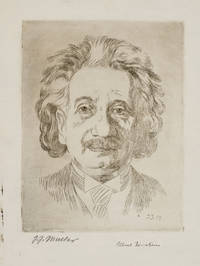
1933H-217<p>A stunning portrait etching of one of the greatest human minds signed by both the artist J J Muller and Albert Einstein.</p><p>The sketch is signed in ink by Einstein and by the artist J. J. Muller in pencil n.p. 1933. Plate 195 x 150mm; sheet 253 x 200mm.</p><p>A true collector's copy of a beautiful signed portrait.</p>
2000Q-0517209845Randon House 2000-01-01. Hardcover. New. In shrink wrap. Looks like an interesting title! Randon House hardcover
1951108Book is in good condition. Some darkening evident on ends of pages. Dust jacket is worn but intact and has been wrapped in Mylar for protection. Tudor Publishing Company hardcover
19542625423/02/1954. <blockquote><p>An increasingly uncommon letter of Einstein on the role of religions philosophy peace and the dangers of the atomic age that he helped usher in</p></blockquote><p><img class=""alignnone wp-image-26334 size-post-window"" src=""https://cdn.raabcollection.com/wp-content/uploads/20231204132831/Einstein-Feb-28-1954-1-e1674939062835-1600x216.jpg"" alt="""" width=""1600"" height=""216"" /></p><p>Albert Einstein believed that wars stood in the way of human progress and he was a lifelong pacifist though he did not believe in pacifism at any price or in all situations. He was also an active promoter of world peace from the days of World War I right up to his death in 1955. In fact one of his last acts before his death was to add his signature to a statement of nine scientists warning that the world risked universal annihilation unless the institution of war was abolished. Knowing his stance people from all over the world appealed to him to assist various causes consistent with these beliefs and to give statements supporting individuals and groups that did so.</p><p>Einstein was also not a member or follower of any organized religion. He considered himself a Jew but was not a practicing Jew. And as for the Christian churches he felt that it “since Constantine has always favored the authoritarian State as long as the State allows the Church to baptize and instruct the masses"". Their conduct in the years up to World War II was worse than disappointing he thought as they made the devil’s bargain - the evil compromise - with the Hitler regime. Einstein addressed this saying “Since when can one make a pact with Christ and Satan at the same time"" He added ""The Church has always sold itself to those in power and agreed to any bargain in return for immunity…If I were allowed to give advice to the Churches I would tell them to begin with a conversion among themselves and to stop playing power politics.†This idea of an evil compromise or devil's pact is central to his feelings about organized religion.</p><p>There was one exception to his criticism of religions - the Quakers. Their community aims at purifying the Christian world and generating social reform by creating direct experience with God without intervention of clergy or other expressions of church. The Quakers greatly influenced science and industry and their community is noted for the pursuit of peace and non-violence. Thus Einstein’s views fit into their belief system. “If I were not a Jew I would be a Quaker†he once wrote. Speaking to a Quaker gathering in 1938 he said ""With admiration and respect I have seen in the course of many years how successfully and selflessly the Society of Friends has worked in the entire world to lessen human suffering and to make the teachings of Christ apply to real life. Everyone who is concerned about a better lot and a more dignified stature for humanity owes deep gratitude to the Society of Friends. This Society is an admirable testimony against the assertion that every organization by its very nature kills the spirit which has called it into life.â€</p><p><img class=""alignnone wp-image-26335 size-post-window"" src=""https://cdn.raabcollection.com/wp-content/uploads/20231204132818/Einstein-Feb-28-1954-2-e1674939294283-1600x653.jpg"" alt="""" width=""1600"" height=""653"" /></p><p>In 1949 the Australian pathologist Alton R. Chapple who was a Quaker wrote to Einstein in the then-current climate of concern regarding the perils of the atomic age for ""a few words of leadership and hope"". Einstein responded stressing the necessity for moral courage by the individual. He said that power is often in the hands of power-loving persons who know very little restrictions when it comes to the realization of their ambitious goals; and answering negatively the question whether self-restraint on what “productive thinkers and explorers†research might not prevent further development of means of mass destruction. He gave three main reasons: 1 The already existing means of destruction are effective enough to bring about total destruction; 2 People really devoted to the progress of knowledge concerning the physical world like Faraday or Rutherford have never worked for practical goals let alone military goals. And nobody could know in advance what kind of application might be developed on the basis of their discoveries; and 3 People of technical skill are so numerous and so dependent economically that they cannot be expected to refuse employment offered them by the state or private industry even if they were able to clearly recognize that their work will lead to disaster on a world-wide scale. He concluded that hope can only be based on the intellectual and moral independence of a sufficient number of people since “honesty and courage of the individual to stand up for his convictions on every occasion is the only essential thingâ€.</p><p>Chapple wrote Einstein again in 1954 about the Quakers and a perceived contradiction that Chapple discerned in the 1949 letter thinking that Einstein stated that he does not expect people to refuse to work in research that generates knowledge for the means of mass destruction. Einstein responded to Chapple giving a virtual primer on his world view and opinions on how a religion and religious individuals could live a moral life and contribute something valuable to society and the cause of peace. This he felt the Quakers did.</p><p><strong>Typed letter signed</strong> on his blind-embossed letterhead Princeton February 23 1954 to Alton Chapple in Australia illuminating Einstein’s judgment and standards of conduct. <em>“Thank you for your letter of February 16th. I consider the Society of Friends the religious community which has the highest moral standards. As far as I know they have never made evil compromises and are always guided by their conscience. In international life especially their influence seems to me to be very beneficial and effective.</em></p><p><em>“There seems to me to be no contradiction in my remarks in my former letter to you. The rules applying to a moral elite can not be expected to be followed by the rank and file.â€Â </em></p><p>So here Einstein praises those religions with “the highest moral standardsâ€. He especially lays out the need for them and for individuals to avoid “evil†compromises and to always be guided by conscience. If an individual does these things or a dedicated group like the Quakers they will gain influence that is both beneficial and effective. Einstein does stand by his statement in the 1949 letter maintaining that from his experience moral elites lead and that those in rank and file don’t necessarily follow that lead. In a sense he is saying that an ethical elite exercising leadership has the best chance of saving the world.</p><p>An increasingly uncommon letter of Einstein on philosophy peace the role of religions and religious individuals and the dangers of the atomic age that he helped usher in.</p><p><img class=""alignnone wp-image-25018 size-post-window"" src=""https://cdn.raabcollection.com/wp-content/uploads/20231204144051/Folder-site-11-1600x1327.jpg"" alt="""" width=""1600"" height=""1327"" /></p> unknown