(NEWTON). FERGUSON, James :Biblio.com
104 résultats
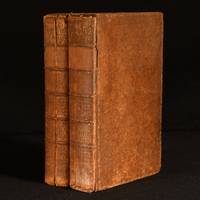
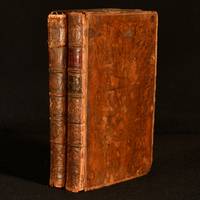
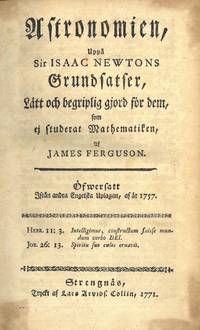
177170469Strengnäs 1771. 8vo. 8vo. Samtidig skinnryggbind med svakt opphøyde ryggbånd. Tittelfelt i lysere brunt skinn. 2 LX 2 331 9 s. Med X kobberstukne foldeplansjer. Tryckt af Lars Arvids. Collin Svensk. <br/><br/><em>Slitasje ved øvre kapitél. Dette skal ha vært den første astronomiboken publisert på svensk som oppnådde stor popularitet. </em> unknown
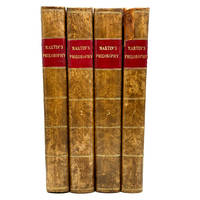
17715136166113<p><strong>NEWTON MARTIN Benjamin</strong><strong>.</strong> <em>Philosophia Britannica: Or A New and Comprehensive System of the Newtonian Philosophy Astronomy and Geography; In a Course of Twelve Lectures; With Notes; Containing the Physical Mechanical Geometrical and Experimental Proofs and Illustrations of All the Principal Propositions in Every Branch of Natural Science: Also a Particular Account of the Invention Structure Improvement and Uses of All the Considerable Instruments Engines and Machines; With New Calculations Relating to Their Nature Power and Operation.</em></p><p>London: Printed for W. Strahan; J. & F. Rivington; W. Johnston; Hawes & Co.; T. Carnan and F. Newbery; B. Collins; W. Frederick; and sold by the Author at his House in Fleet-Street 1771. Third edition. Complete in four volumes. Three text volumes plus a separate atlas volume of plates. Quarto. Approximately 8.5" x 5.5". Vol. I: xxx 333pp 3 ads; Vol. II: xiv 390pp 2 ads; Vol. III: x 405pp index. Atlas volume with 81 engraved copperplates the majority folding. Contemporary or near-contemporary half marbled calf over marbled boards with one repair to the upper spine of Vol. IV. Bindings sound and well-aligned. Engraved plates clean and strong with no losses; folds supple and correctly opening. Text generally clean throughout with manuscript annotations on the versos of the plates linking them to the relevant portions of text. Overall Very Good to Very Good.</p><p>Third and expanded edition of Benjamin Martin's monumental exposition of Newtonian natural philosophy combining physics astronomy geography mechanics and experimental science into a single unified system. The work includes extensive treatment of optics celestial motion gravitation hydrostatics pneumatics electricity and the mechanical powers alongside detailed explanations of contemporary scientific instruments and experimental apparatus. The separate atlas volume contains 81 finely engraved plates illustrating astronomical systems orreries telescopes microscopes air pumps electrical machines engines survey instruments and mechanical demonstrations.</p><p>This third edition represents the fully mature state of Martin's project as a practical synthesis of Newtonian science for broad professional use in the later eighteenth century. Unlike earlier editions which often survive without the full engraved apparatus this issue consolidates the theoretical text and the mechanical-visual program into a coherent instructional system. The separate atlas format allows for larger clearer mechanical and astronomical engravings than the inline plates of earlier printings making this edition particularly well suited for institutional reference in the history of science technology and scientific pedagogy.</p> Printed for W. Strahan; J. & F. Rivington; W. Johnston; Hawes & Co.; T. Carnan and F. Newbery; B. Collins; W. Frederick hardcover
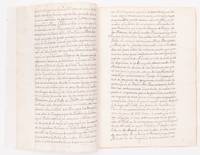
17521862Spain 1752. 18th-century manuscript. Text in Spanish. 24 handwritten pages in ink in three different hands. Later binding of blank paper using old material. Tiny wormholes at the lower edge of the pages on the first 7 leaves not affecting the legibility. Occasional foxing ink ghosting. Water stains on the last 2 leaves. Overall in fine condition. 18th-century manuscript. Text in Spanish. 24 handwritten pages in ink in three different hands. ff 12. <p><br /> 18th-Century Spanish manuscript about the Spanish involvement in the French Geodesic Mission of 1735 and the Ellipsoid Model of the Earth.<br /> <p><p><br /> The manuscript is an interesting collection of contemporary reports proving the importance of the Spanish role performed by Jorge Juan y Santacilia and Antonio de Ulloa in the so-called French Geodesic Mission 1735 with a particular focus on the polemic over the shape of the Earth. The quotations are conjugated with connecting texts by an anonymous author.<br /> <p><p><br /> One of the important scientific disputes of the late 17th early 18th century was the debate on the shape of the Earth. The assumption of the spherical shape was dominating until the late 17th century when Sir Isaac Newton determined that the Earth was oblate a spheroid stretched over the Equator however at the same time Giovanni Domenico Cassini and his son Jacques supposed that the Earth was prolate stretched along the poles. Eventually in 1735 two expeditions were sent by Louis XV and the French Academy to the Arctic Circle Lapland and to the Equator Ecuador and Peru to gain certainty by measuring the meridian arcs at polar and equatorial latitudes. The equatorial mission was accompanied by two Spanish geographers Jorge Juan y Santacilia and Antonio de Ulloa thus it became the first major international scientific expedition. The findings of the missions confirmed Newton’s hypothesis that the Earth was oblate a rotational ellipsoid.<br /> <p><p><br /> The first part of the manuscript is a lengthy citation of an early Spanish report on the equatorial mission published in the Mercurio histórico y político February 1745; pp. 99–107 which is followed by further references and quotations related to the geographer’s their work and the figure of the Earth such as Benito Jerónimo Feijóo y Montenegro’s Theatro critico universal 1751 Bernardo’s de Ulloa’s Antonio’s father Restablecimento de las fabricas y comercio español 1749 and articles from the Journal de Trévoux or the Gaceta de Zaragoza. The second part is Diego de Torres Villarroel’s 1693–1770 study Prevenciones in: Libros en que estan reatados. Vol. IV.; 1752 in which de Torres the almanac writer and professor of mathematics of a dubious repute opposes the findings of the missions and Newton’s hypothesis of the oblate Earth.<br /> <p><p><br /> Antonio de Ulloa 1716–1795 was a Spanish scientist and explorer the first Spanish governor of Louisiana who is also credited as the discoverer of the element platinum. De Ulloa was a Fellow of the Royal Society and a foreign member of the Royal Swedish Academy of Sciences. His associate Spanish scientist in the Geodesic Mission to Peru was Jorge Juan y Santacilia 1713–1773 who during the mission also measured the heights of the mountains of the Andes. Jorge Juan was the founder of the Real Observatorio de Madrid Royal Observatory of Madrid and he became a Fellow of the Royal Society too. Their co-written memoirs were published in Spanish from 1748 on and their books were very soon translated into French English and German.<br /> <p><p><br /> Literature: Lafuente A.; Mazuecos A.: Gentlemen of the Fixed Point: Science Politics and Adventure in the Geodesic Expedition to the Viceroyalty of Peru in the XVIII Century. pp. 171–203. Retrieved on July 8 2020 from Mayboudi L. S.: chapter 5.1 In: Geometry Creation and Import With COMSOL Multiphysics. Dulles VA USA: Mercury Learning & Information 2019.; Richardson D.; et al: The International Encyclopedia of Geography People the Earth Environment and Technology: Chichester UK; Hoboken NJ: John Wiley & Sons 2017.<br /> <p>. unknown
180033248BB1800 . Paris: Brunot um 1800 16°. 208 S. 4 Tafeln Pappband Rücken beschabt; Ecken leicht bestossen; gut erhalten unknown
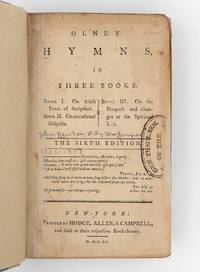
1790374363New York: Printed by Hodge Allen & Campbell and sold at their respective book-stores 1790. Second American edition. vi 1 8-348. 12mo. Recent paper backed boards. Repairs at gutter of title and first leaf. Bookplate and ink stamp of General Theological Seminary. Second American edition. vi 1 8-348. 12mo. Olney Hymns was published in London in 1779 but it was not until publication in the United States the they hymn flourished. The first American printing of Amazing Grace appeared within the New York 1787 edition of Olney Hymns Evans 20588 followed by the New York 1789 edition of the Psalms of David . for the Use of the Dutch Reformed Church Evans 21688. The present 1790 reprinting of the 1787 edition by Hodge Allen and Campbell followed with Amazing Grace appearing on pp. 48-9.<br /> <br /> ESTC records only two other examples of this 1790 edition AAS and NYHS and we find no example of either the first or second American Olney Hymns in the auction records for over a century. Evans 22734; ESTC W26651. On Amazing Grace see D. Bruce Hindmarsh "'Amazing Grace': The History of a Hymn and a Cultural Icon" in: Sing Them Over Again to Me: Hymns and Hymnbooks in America ed. Noll and Blumhofer 2006 Printed by Hodge, Allen, & Campbell, and sold at their respective book-stores unknown
174435969London: J. Osborn and J. Rivington 1744. Hardcover. Very Good. Hardcover. Second Edition which contains a previously unpublished copy of a letter to the author with a copy of the answering letter. Written by Richard Newton 1676 - 1753 the Presbyter of the English Church in response to Henry Wharton's "Defense of Pluralities" 1692. Bound in full tan leather boards with maroon and gilt title label to spine. Most of spine label is no longer present but several gilt letters remain. The leather on both hinges is cracked but the cords remain intact and the boards are still securely attached. Rubbing and wear to spine edges and corners. A few very light spots of foxing to first and last few pages else clean and bright. 402 pages. REL/081722. J. Osborn and J. Rivington hardcover
1733293624London: Printed for J. Strahan 1733. Softcover. Very Good. Second edition. 52pp. Disbound. Some staining good only. Authorship attributed to Richard Newton as per Mansell v. 417 p. 500. Printed for J. Strahan unknown
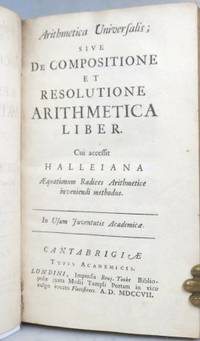
170751058Cantabrigiæ Cambridge: Typis academicis; Londini London impensis Benj. Tooke 1707. First edition. 8vo. viii 343 1 pp. 19th century full diced calf spine with raised bands gilt lettered black label blind tooled borders to the boards ownership inscription of a William Fitton dated June 1800 to the half title another contemporary owner's inscription - that of a Philip Crampton the date cropped "180" mathemetical annotations to the front and rear leaves and in the margins at intervals within. Joints skilfully repaired some mild soiling to the front and rear leaves an attractive copy. A mathemetical text composed entirely in Latin by Newton and edited by William Whiston who had succeeded him as the Lucasian professor of Mathematics at Cambridge University in 1702. The two had become acquainted during the previous decade and Newton was impressed enough with his acolyte that he invited him to lecture at the university when he was occupied with his other work. It was Whiston who persuaded Newton to publish some of his lectures on algebra but Newton was dissatisfied with Whiston's editing and additions to the text - to the extent that he considered buying the entire stock of the book to prevent its appearance in public. That clearly didn't happen although Newton succeeded in having the book published anonymously and its relative scarcity in commerce suggests a truncated print run. The first ownership inscription is that of the Irish geologist William Fitton 1780-1861. The son of a Dublin lawyer his paternal grandfather had been a mathematical instrument maker. Fitton began his studies at Trinity College Dublin in 1794 and earned his B.A. in 1799 but continued studying there until 1803. He went on to study medicine at Edinburgh University becoming a doctor in 1810 and continued his medical studies in London and Cambridge during the following six years. Fitton's interest in geology and mineralogy were his true passions and after marrying into a wealthy family he was able to devote his studies exclusively to these subjects. He subsequently served as secretary and later as president of the Geological Society published numerous reviews and papers plus a small number of books including 'A Geological Sketch of the Vicinity of Hastings' in 1833. Fitton was awarded the Wollaston Medal the society's highest prize in 1852. The other inscription is almost certainly that of Sir Philip Crampton 1777-1858 an Irish surgeon who awarded many honours and held various senior positions in a long and illustrious career: "elected FRS in 1812. In 1813 he was appointed surgeon-general to the forces in Ireland and he was surgeon to the queen in Ireland a member of the senate of the Queen's University of Ireland and four times president of the Royal College of Surgeons in Ireland in 1811 1820 1844 and 1855. In 1839 he was created baronet" ODNB. Cantabrigiæ [Cambridge]: Typis academicis; Londini [London], impensis Benj. Tooke unknown
1730788711730. NEWTON William. The Life of the Right Reverend Dr. White Kennett Late Lord Bishop of Peterborough. With Several Original Letters of the Late Archbishop of Canterbury Dr. Tennison the Late Earl of Sunderland Bishop Kennett &c. and Some Curious Original Papers and Records Never before Publish'd. London: Printed for S. Billingsley 1730. 1st ed. xx2881 postscript 1 advertisement pp. 19th-century paneled calf raised spine bands gilt-chamfered edges. Hinges tender but holding else a very good copy. Sabin 37449. European Americana 730/164. Kennett was the author of the first English bibliography of the New World the Bibliothecae Americanae Primordia published in 1713. He had many American connections and interests and this work includes an account of the Society for the Propagation of the Gospel in America. unknown
172819285London: S. Palmer 1728. FIRST EDITION. With engraved title-vignette of an observatory within a border of instruments 12 folding plates and historiated initials all engraved by J. Pine after J. Grison including the arms of Sir Robert Walpole to whom the work is dedicated. Complete with subscriber’s list including Isaac Newton’s 12 books. Half-calf over marbled boardsspine with gilt decorations and morocco label. An absolutely exquisite wide-margined copy preserved in a slipcase. First edition. Pemberton’s ability in mathematical problems impressed Newton and consequently he asked him to edited the third and definitive edition of his Principia mathematica 1726. The preface contains Pemberton’s recollections of Newton especially in his old age. However this work is most notable for its explanation of Newtonia philosophy. Pemberton 1694-1771 studied under Boerhaave at Leiden and was attached to St. Thomas’ Hospital in London. <br /> <br /> Babson 98; Gray 132. S. Palmer unknown
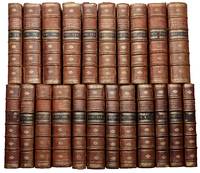
17326441London: Various printers to the Royal Society 1732. 1665-1732. <p>First edition of the first 426 issues an unbroken run from March 1665 to December 1732 of the world's oldest continuous scientific journal and the single most important record of the first announcement and communication of scientific discoveries and inventions PMM. It contains groundbreaking research by Newton - all 17 of his optical papers and therefore his first printed contribution to science - and by Halley Hooke Boyle Flamsteed Leeuwenhoek Cassini Hevelius Huygens and many others across astronomy physics chemistry mathematics medicine and natural history. Through Newton's optical papers of 1672-1676 the Transactions saw the first experimentally grounded proposal for the radical reform of a scientific theory to be advanced through a technical journal - a proposal that became the first to arouse international discussion and debate in print and within the pattern of public announcement discussion and professional consensus then established science has advanced ever since. Provenance: armorial bookplate of Sir Marcus Beresford 1st Earl of Tyrone 1694-1763; contemporary inscription at the end of one issue January 1692/3 noting its donation by Robert Hooke; manuscript corrections and notes on more than eighty pages with eight further pages on the measurement of the Earth bound in at the end.</p>. The World's Oldest Continuous Scientific Journal. <p>First edition of the first 426 issues an unbroken run from March 1665 to December 1732 of the world's oldest continuous scientific journal and the single most important record of the first announcement and communication of scientific discoveries and inventions PMM. It contains groundbreaking research by Newton - all 17 of his optical papers and therefore his first printed contribution to science - and by Halley Hooke Boyle Flamsteed Leeuwenhoek Cassini Hevelius Huygens and many others in astronomy physics chemistry mathematics medicine and natural history. Thomas Henry Huxley observed in his 1866 address On the Advisableness of Improving Natural Knowledge that if every book in the world apart from the Philosophical Transactions were destroyed the foundations of physical science would remain secure and the intellectual progress of the last two centuries largely recoverable. Long unbroken runs of the first four-and-a-half decades are now of the greatest rarity. ABPC and RBH record only two comparable sets at auction in the last three decades - Norman 1694 Christie's New York 15 June 1998 lot 716 $112500 and Macclesfield 1782 Sotheby's 25 October 2005 lot 1782 £96000 = $171400 - and a set of just the seven volumes containing Newton's papers on light realised $75600 at Christie's in October 2022.</p> <br /> <br /> <p>Provenance: armorial bookplate of Sir Marcus Beresford 1st Earl of Tyrone 1694-1763 Anglo-Irish peer and politician on the front pastedowns; contemporary inscription at the end of one issue January 1692/3 noting its donation by Robert Hooke; numerous manuscript corrections on more than sixty pages additional notes on about twenty pages and eight pages of manuscript notes on the measurement of the Earth bound in at the end.</p> <br /> <br /> <p>In November 1660 members of the Oxford Philosophical Club - John Wilkins John Wallis Robert Boyle Christopher Wren Robert Hooke among them - met a group of London natural philosophers at Gresham College and agreed to form a philosophical society that would meet weekly to exchange information and to conduct experiments. The society received its charter from the newly restored Charles II in 1662 and Henry Oldenburg a German-English diplomat and friend of Boyle was installed as one of its two secretaries. One of the charter's terms called for the exchange of information with other learned societies and Oldenburg almost at once began a sustained correspondence - with the Cimento Academy in Florence the Montmor Academy in Paris and after its foundation in 1666 the Académie Royale des Sciences - and with hundreds of working natural philosophers in places that had no scientific society of their own. Oldenburg was fluent in German Dutch French English and Latin and he was able to translate most foreign correspondence himself including Antoni van Leeuwenhoek's letters on his microscopical investigations and the communications of Johannes Hevelius of Gdansk and Marcello Malpighi of Bologna. After some years writing letters without salary Oldenburg decided to compile a monthly newsletter summarising a month's Royal Society activities and send it out to his correspondents in a single printing. On 6 March 1665 Old Style; 16 March by the Gregorian calendar then in use on the continent the first issue of the Philosophical Transactions appeared. It consisted of letter-excerpts reviews and summaries of recently published books and accounts of observations and experiments from European natural philosophers. Some of the pieces Oldenburg wrote himself summarising the minutes of Society meetings; others he translated or adapted from printed sources; still others were composite pieces assembled from the letters of several correspondents on a common subject. After his death in 1677 the journal passed through the hands of a succession of editors frequently also Secretaries of the Society - Edmond Halley and Hans Sloane the best-known among them - and through a succession of printers its form and content broadly reflecting the priorities of the current editor and to a degree of the Society. The Royal Society assumed financial responsibility for the journal only in 1752.</p> <br /> <br /> <p>Until the last third of the seventeenth century most original contributions to science appeared in books in which an author's own findings were embedded within a systematic exposition of a larger subject. The chartering of the Royal Society in 1662 and of the Académie Royale des Sciences in 1666 and the launching in 1665 of the Journal des Sçavans at Paris and the Philosophical Transactions at London gave institutional expression to a new conception of science as a cooperative enterprise: the immediate objective of the individual scientist became the experimental contribution to an eventual system of nature rather than the construction of the system itself and the journal article began to replace the book as the unit in which that contribution was made. Newton was the first to advance through this new medium an experimentally grounded proposal for the radical reform of a scientific theory and his proposal was the first to arouse international debate within the columns of a scientific journal. Through that exchange - in which all the participants modified their positions - a consensus of scientific opinion was produced; and within the same pattern of public announcement discussion and professional consensus science has advanced ever since Kuhn in Cohen Isaac Newton's Papers and Letters on Natural Philosophy 2nd ed. 1978 pp. 27-29.</p> <br /> <br /> <p>Newton's seventeen optical papers comprising his entire published optical contribution to the journal across the 1670s run as a single intellectual sequence: the seminal 1672 New Theory paper No. 80 pp. 3075-3087 introducing the prism experiment and the spectral analysis of white light; the catadioptrical-telescope paper No. 81; a series of exchanges with the French Jesuit Pardies Nos. 82 84 85 with Christiaan Huygens via an 'ingenious person from Paris' Nos. 96 97 and with the Liège Jesuits Linus and Lucas Nos. 110 121 123 128 - together more than half of the seventeen papers all responding to objections raised against the New Theory. Newton's answer to Hooke's objections No. 88 is the most polemical of the set prefiguring the priority dispute that would dominate the Principia years; the answer to Sir Robert Moray on behalf of the Royal Society No. 83 the most measured. Across the seven volumes containing them the papers transformed optics from a body of empirical reports into a quantitative experimental science driven by decisive testing among hypotheses and supplied the methodological core that Newton would eventually assemble decades later into the Opticks of 1704.</p> <br /> <br /> <p>These papers together constitute the first major contribution to science made through a technical journal - the medium that rapidly became the standard mode of communication among scientists - and as Christianson puts it if Newton had published nothing else the optical papers alone would guarantee him a place among the immortals of modern science Christianson In the Presence of the Creator 1984 p. 150. They yield further an insight into Newton's mental processes that the Principia and the Opticks - formal impersonal Olympian - conceal; it is in these early brief sometimes hasty letters to Oldenburg as in his notebooks and unpublished manuscripts that the creative scientist is to be found Kuhn in Cohen pp. 27-29.</p> <br /> <br /> <p>When Newton was first appointed Lucasian Professor at Cambridge in 1669 he chose optics for the subject of his first lectures and researches and by the end of that year he had worked out in detail the decomposition of a beam of white light into rays of different colours by means of a prism the complete explanation of the rainbow following from this discovery. These results formed the subject of his Lucasian lectures in 1669 1670 and 1671 and their principal conclusions were communicated to the Royal Society in February 1672 and printed soon afterwards in the Transactions No. 80. Before Newton light had been believed to be a homogeneous substance and colour was held to be produced by the mixture of light with darkness - the prism in the standard account supplying the darkness that coloured the light with all rays of white light striking the prism at the same angle being equally refracted. Newton's experiments led him to the radically different conclusion that white light is a mixture of rays of many distinct types each refracted at a slightly different angle and each responsible for producing one spectral colour. He set up a prism near his window at Trinity College and projected the spectrum onto a wall twenty-two feet away; to prove that the prism refracted light rather than colouring it he refracted the beam a second time back to white. The crucial experiment that confirmed the theory was to isolate a narrow ray of a single colour from the first spectrum and pass it through a second prism where no further elongation or separation occurred - a demonstration that each spectral ray was itself unmixed and uniformly refrangible. The reception of the paper was mixed. Many contemporaries simply ignored it; Mariotte in 1679 Pardies 1672 and Linus 1675 all claimed to have failed to replicate the basic experiments described. Rather than argue with them in detail Newton invited his critics to repeat his experiments with greater care; they did so without success. Others - Hooke among them who confirmed the experiments himself before a committee of the Royal Society in April 1676 - conceded the results but held that they could be accommodated by minor modification of existing theories making Newton's radical interpretation unnecessary. The controversy lasted six years after the paper's first appearance and left Newton conspicuously wary of publication.</p> <br /> <br /> <p>Newton's invention of the reflecting telescope reported in the issue immediately following his first optical paper No. 81 had in fact prompted the optical work rather than the other way round: the chromatic aberration of refracting lenses - their inability to bring different colours of light to a single focal point - was the original stimulus for Newton's investigation of the nature of light. Newton had sent Oldenburg his letter describing the telescope before his letter describing the new theory and had hoped to present the telescope as a practical test-piece for the theory. Oldenburg however printed the material in the reverse order the theory first followed by the description of the instrument. The telescope made a considerable impression at the Royal Society which promptly elected Newton a Fellow; a corresponding notice appeared in the Journal des Sçavans in February 1672 with emphasis on the instrument's compactness and it was the telescope rather than the theory of light that first made Newton's name known on the Continent Dilaura Bibliotheca Opticoria 1475-1925 2019 pp. 235-236.</p> <br /> <br /> <p>Newton published three non-optical papers in his lifetime all anonymously. His only published paper on chemistry Scala Graduum Caloris No. 270 April 1701 pp. 824-829 states what has since become known as Newton's law of cooling - that the rate at which a hot body loses heat is proportional to the difference between its temperature and that of its surroundings - and describes the construction of a thermometer capable of measuring temperatures up to almost 1000 °C. An Account of the Book entituled Commercium Epistolicum Collinii & Aliorum De Analysi promota No. 342 February 1715 pp. 173-224 is Newton's anonymous review of the Commercium epistolicum the official report of the committee appointed by the Royal Society to adjudicate in the dispute between Newton and Leibniz over priority in the invention of calculus - the most bitter and consequential priority dispute in the history of science; the Account purports to be impartial but was in fact written like the Commercium epistolicum itself by Newton. In the same volume No. 347 March 1716 pp. 399-400 appeared Newton's Problematis Mathematicis Anglis Nuper Propositi Solutio Generalis his response to a challenge problem set by Johann Bernoulli to the English mathematicians; tradition has it that Newton solved it in a single evening after returning from a day's work at the Mint. With the exception of this minor paper none of Newton's original work on gravitation or on mathematics was published in the Transactions. Edmond Halley's review of the Principia however appeared soon after its publication No. 186 pp. 291-297 - Halley was then the journal's editor - and is prefaced by an advertisement apologising for the fact that the Transactions had been delayed for some months because Halley had had the entire care of the Principia's own edition and had therefore as he put it been more serviceable to the Commonwealth of Learning in seeing Newton's book into print than he would have been in issuing his own periodical on time. Halley pointed out with justice that one of the most striking features of the Principia was Newton's great skill in using the new mathematics - by which Halley meant Newton's own method of infinite series.</p> <br /> <br /> <p>Edmond Halley 1656-1742 was one of the most original minds of his time and he made a long series of important contributions of his own to the Transactions. The best-known of them is Astronomiae cometicae synopsis No. 297 March 1705 pp. 1882-1899 the first printing of the theory according to which comets belong to the solar system and move in eccentric elliptical orbits; it was here that Halley set out his method of computing the motion of comets of establishing their periodicity in elliptical orbits and of identifying the comet that would bear his name DSB. The confirmation of the comet's return - in 1759 after Halley's death - was the first time that a body other than a planet had been shown to orbit the Sun the earliest successful observational test of Newtonian physics and a vivid demonstration of its explanatory power; the comet was named after Halley by the French astronomer Nicolas-Louis de Lacaille in 1759. Halley's other major contributions to the journal include his Methodus singularis No. 348 June 1716 pp. 454-464 in which he challenged the international astronomical community to use the transits of Venus across the Sun predicted for 1761 and 1769 to transform astronomy into a fully empirical science by measuring the Earth-Sun distance - a challenge that astronomers took up organising expeditions to the farthest corners of the globe and overcoming obstacles of every kind; A short History of the several New-Stars No. 346 December 1715 pp. 354-356 in which he observed that the new stars of 1572 and 1604 Tycho's and Kepler's stars were not the only changing stars on record that others had been observed in 1596 1600 1670 and 1686 some of them fading and reappearing and one of them - Mira - appearing to wax and wane with a regular 330-day period; An Account of several Nebulae or lucid Spots like Clouds No. 347 March 1716 pp. 390-392 in which Halley assembled the first list of known nebulae with their discoverers crediting the Great Nebula in Orion to Huygens the Andromeda nebula to Boulliau and the two spherical nebulae in Centaurus and Hercules to himself; 'Of the infinity of the sphere of fix'd stars & Of the number order and light of the fix'd stars' No. 364 April 1720 pp. 22-26 in which Halley posed what later generations would call Olbers's paradox a century before Olbers did; and outside astronomy his paper on the Breslaw life table No. 196 January 1692/3 pp. 596-610 which produced the first life table based on sound demographic data and gave the first correct calculation of annuities using essentially the methods still in use today - a paper of first importance in the history of statistics.</p> <br /> <br /> <p>John Flamsteed 1646-1719 was with Halley the most important English astronomer of his generation; his major works are the Historiae coelestis first published in 1712 without his consent by Halley and Newton and the Atlas coelestis published posthumously in 1729 but he also contributed more than thirty articles to the Transactions chiefly on observational astronomy. No other Astronomer Royal before Airy displayed anything like Flamsteed's concern for the reduction and manipulation of his own data: far from bequeathing the mass of raw observations that Bradley would he reduced and applied them himself DSB.</p> <br /> <br /> <p>Robert Boyle 1627-1691 contributed some thirty-seven papers to the Transactions Fulton p. 138 among them his influential questionnaire General Heads for the Natural History of a Country a number of major experimental essays that sometimes filled a whole issue and most revealingly An Experimental Discourse of Quicksilver growing hot with Gold No. 122 February 1675/6 pp. 515-533 - a paper on a kind of mercury that would incalesce when amalgamated with gold suggesting that Boyle had achieved the long-sought alchemical philosophical mercury capable of transmuting base metals. Boyle's trials went back to 1652 when he had received the recipe from his American mentor George Starkey; his decision to go public in 1676 signalled a newly intense period of alchemical activity on his part. The paper drew from Newton - himself a committed alchemical enthusiast - a letter to Oldenburg urging that such matters were not to be communicated without immense damage to the world if there should be any truth in the Hermetic writers; Oldenburg took the hint and the incalescence paper remained a one-off in the Transactions Hunter Alchemy in the Transactions Royal Society blog 1 July 2015.</p> <br /> <br /> <p>The Dutch microscopist Antoni van Leeuwenhoek 1632-1723 contributed 116 articles to the Transactions over the half-century 1673-1723; the most famous of them the letter on the protozoa No. 133 March 1677 pp. 821-831 gives the first detailed description of protists and bacteria in a range of environments. Leeuwenhoek is universally acknowledged as the father of microbiology: he discovered both protists and bacteria but more than being the first to see the microscopic world of his animalcules he was the first even to think of looking - certainly the first with the power to see. Using his own deceptively simple single-lensed microscopes he did not merely observe but conducted ingenious experiments exploring and manipulating his microscopic universe with a curiosity that belied his lack of any map or bearings. The verification of Leeuwenhoek's new world by the natural philosophers of the Royal Society set out the ground rules that still define experimental science today Lane The unseen world: reflections on Leeuwenhoek 1677 Philosophical Transactions B370 2015 pp. 1-10.</p> <br /> <br /> <p>Martin Lister 1639-1712 contributed in 1673 what is now regarded as the earliest journal article on palaeontology: A description of certain stones figured like plants No. 100 pp. 6181-6191 on the preservation of St Cuthbert's beads - crinoid remains - in the approximately 350-million-year-old Carboniferous limestones of northern England. The biological nature of fossils was then controversial: Kircher had argued that they formed by abiogenic plastic forces within the rock while Hooke and Steno had suggested they were the remains of living organisms. Lister was the first to explore how direct observation could decide between the two making observations about what modern geobiology calls taphonomy and biogenicity criteria - observations that presage current debates about the earliest signs of life on Earth and Mars Brasier Philosophical Transactions A373 2015 pp. 1-16. Other natural-historical papers scattered through the journal's first century - Account of a very odd monstrous calf Some experiments and observations on May-dew Some observations on strange swarms of insects - are in places fanciful but in many others acute; Hooke's own contributions which began in the very first issue March 1665 with A spot in one of the belts of Jupiter are sometimes held to include the first observation of the Great Red Spot still visible on Jupiter today.</p> <br /> <br /> <p>The early volumes also contain the record of the world's first experiments with blood transfusion conducted in England in the mid-1660s. The procedure - gruesome - was first carried out between dogs with arteries and veins in the animals' necks opened and blood transferred from one to another through quills most likely of goose feather inserted into the vessels and clamped with running knots; in the physician Richard Lower's account No. 20 pp. 353-358 the transfusion came to an end when the emittent dog fell into convulsions and died. Shortly afterwards Boyle published a remarkable set of questions about the likely effects of transfusion on the animal receiving blood No. 22 pp. 385-388 asking whether transfusion might change a dog of one breed into another alter its temperament render a fierce dog cowardly transmit satiety or hunger obliterate learned behaviours or make a dog forget its master - a sequence of questions which as recent commentators have noted read like an alchemical programme turned inward upon the living body. Researchers soon proposed transfusion into a human subject. Since the procedure generally killed the emittent a human-to-human transfusion was thought impossible and a sheep was settled upon as donor. The choice of human recipient fell in 1667 upon Arthur Coga - mentally unstable but sufficiently educated to report in Latin on the effects of the procedure - and the operation was performed by Lower and the physician Edmund King No. 30 pp. 557-559 who judged that Coga had received nine or ten ounces of sheep's blood. A few days afterwards Coga reported back to the Society in Latin and Samuel Pepys meeting him at a dinner party shortly thereafter found him to speak very reasonably though cracked a little in his head.</p> <br /> <br /> <p>Other contributors in these decades include Cassini on the satellites of Jupiter Huygens on mechanics and optics Malpighi Swammerdam Borelli Steno Fahrenheit and Redi whose experimental refutation of spontaneous generation appeared in the journal alongside a steady stream of domestic material from Harvey Wren Ray Petty Locke Wallis Winthrop Tyson Lancisi Leibniz and Hales. To turn the pages of these thirty-seven volumes is to watch the first two generations of a new scientific public discover how to work together - how to record observation propose hypothesis invite replication agree or disagree in print and build by open argument the provisional consensus that is the hallmark of modern science.</p> <br /> <br /> <p>References: Grolier/Horblit 95b - Macclesfield 1782 - Norman 1694 - PMM 148 Vol. 1 - Brasier Deep questions about the nature of early-life signals: a commentary on Lister 1673 Philosophical Transactions A373 2015 pp. 1-16 - Christianson In the Presence of the Creator 1984. Cohen ed. Isaac Newton's Papers and Letters on Natural Philosophy 2nd ed. 1978 - Dilaura Bibliotheca Opticoria 1475-1925 2019 - Fulton A Bibliography of the Honourable Robert Boyle 1932 - Lane The unseen world: reflections on Leeuwenhoek 1677 Philosophical Transactions B370 2015 pp. 1-10.</p> <br /> <br/> <br/> 37 vols. bound in 22 4to 215 × 165 mm containing all issues from March 1665 No. 1 through December 1732 No. 426 with 380 engraved plates 306 folding 176 woodcut illustrations and diagrams and 7 folding tables occasional damp-staining a few tears and small holes occasionally affecting a word or two a few headlines shaved the plate in No. 56 map of part of Languedoc with a 7 cm tear that in No. 60 apparatus shaved at head and that in No. 196 with bottom corner repaired with loss of about a quarter of the plate relating to the dissection of a rat. Uniformly bound in eighteenth-century probably mid-1730s sprinkled calf spines ruled and tooled in gilt in compartments with title and volume-number labels some joints cracking but firm a few labels missing slightly rubbed. Generally very clean and well-preserved. Various printers to the Royal Society unknown
179943865Halle Rengerschen Buchhandlung 1799. Without wrappers. In "Annalen der Physik. Herausgegeben von Ludwig Wilhelm Gilbert" Bd. 2 Erstes Stück. The entire issue offered. Titlepage to vol. 2. Pp. 1-118 a. 2 folded engraved plates. Cavendish's paper: pp. 1-62. the torsion balance of Michell shown on the plates. <br/><br/><em>First German edition of Cavendish's famous paper in which he calculated the weight of the earth and determined its mass. He also as the first observed gravitational motion of minute portions of matter. He estimates the earth's mass to 66 x 10 to the potential of 24 kg. The original paper "Experiments to determine the Density of the Earth" appeared in Philosophical Transaction 1798."Cavendish published five papers between 1784 and 1809.With one exception they were comparatively minor productions.The exception was his determination of the density of the earth or weighing of the world in 1798 by means of John Michell's torsion balance. The apparatus consisted of two lead balls on either end of a suspended beam; these movable balls were attracted by a pair of stationary lead balls. Cavendish calculated the the force of attraction between the balls fro the observed period of oscillation of the balance and deduced the density of the earth from the force. He found it to be 5.48 times that of water. Cavendish was the first to observe gravitational motions induced by comparatively minute portions of ordinary matter.By weighing the world he rendered the law of gravitation complete. The law was no longer a proportionally statement but a quantitatively exact one; this was the most importent addition to the science of gravitation since Newton."DSB III p. 158. </em> unknown
179948206Halle Rengerschen Buchhandlung 1799. Without wrappers. In "Annalen der Physik. Herausgegeben von Ludwig Wilhelm Gilbert" Bd. 2 Erstes Stück. The entire issue offered. 1-118 a. 2 folded engraved plates. Cavendish's paper: pp. 1-62. the torsion balance of Michell shown on the plates. <br/><br/><em>First German edition of Cavendish's famous paper in which he calculated the weight of the earth and determined its mass. He also as the first observed gravitational motion of minute portions of matter. He estimates the earth's mass to 66 x 10 to the potential of 24 kg. The original paper "Experiments to determine the Density of the Earth" appeared in Philosophical Transaction 1798."Cavendish published five papers between 1784 and 1809.With one exception they were comparatively minor productions.The exception was his determination of the density of the earth or weighing of the world in 1798 by means of John Michell's torsion balance. The apparatus consisted of two lead balls on either end of a suspended beam; these movable balls were attracted by a pair of stationary lead balls. Cavendish calculated the the force of attraction between the balls fro the observed period of oscillation of the balance and deduced the density of the earth from the force. He found it to be 5.48 times that of water. Cavendish was the first to observe gravitational motions induced by comparatively minute portions of ordinary matter.By weighing the world he rendered the law of gravitation complete. The law was no longer a proportionally statement but a quantitatively exact one; this was the most importent addition to the science of gravitation since Newton."DSB III p. 158.The issue contains further papers by Ritter Chladni et al. </em> unknown
17875001062HMS Sirius Portsmouth 1787. Slight tear on the edge of address panel where it was originally opened occasional wear and splitting at folds sealed tear. Quarto three pages and address leaf manuscript in ink on paper with original wax seal two filing holes in lower margin of each leaf; stamped "Gosport" small collector's stamp with manuscript cancellation. <p><p>A wonderful original letter by Newton Fowell the eighteen-year-old midshipman on HMS Sirius whose moving and evocative letters from the First Fleet have been one of the treasures of the State Library of New South Wales since they were acquired in 1987. This candid letter to his father John Fowell of Black Hall North Huish Devon is dated "Sirius 10 May 1787" and was written aboard the flagship of the First Fleet just three days before she set sail for Botany Bay.</p> <p>Newton Fowell was a well-connected "young gentleman" seaman whose family sought the sponsorship of Captain John Hunter and Evan Nepean to ensure his late inclusion in the First Fleet expedition. He joined the Sirius in February 1787 and was the last officer to do so apart from Arthur Phillip himself. In earlier letters to his father Fowell had expressed his impatience at the endless delays in departing. Yet in this letter when their final departure was imminent he was somewhat caught off guard: 'Capt Philip sic came on board yesterday and talks of sailing tomorrow how that will be I cannot say but the Wind at Present is fair'.</p> <p>Fowell describes the haste with which the men were called aboard: 'we had no great notice to get ready. I have some Linen on shore which if I cannot get to day will be left behind' and bemoans the tardiness of receiving their pay: 'We have not yet been paid any Advance it will be paid today and supposed only two Months the Men Murmur very much as most of them have 6 Months Pay due.'.</p> <p>By all accounts Fowell acquitted himself honourably during the nine-month voyage to Botany Bay and was the first officer to receive a promotion after their arrival: a fellow officer on Sirius described him as 'that very Deserving Young Man. Ordered to Act as Lieut. I have Every Reason to Suppose him for the first Promotion. I think him by far the Most Deserving Young Man in the Ship'.</p> <p>Fowell made three further voyages as lieutenant: the rapid circumnavigation with Hunter to the Cape of Good Hope and back on the Sirius and another to Norfolk Island on the Supply during which the Sirius was wrecked. His final voyage was to Batavia on a mission to purchase a replacement for the Sirius and obtain desperately-needed provisions. Having safely reached Batavia Fowell succumbed to the notorious Batavia fever and died aged twenty-two. On 14 March 1791 Phillip wrote to the Admiralty reporting on recent events 'The Supply lost five men in the voyage and left six in the Hospital in Batavia. Mr Newton Fowell who I had appointed second lieutenant of the Sirius when Lieutenant King was sent to Norfolk Island and the gunner of the Sirius likewise died on the Voyage. Both these officers were to have been landed at Norfolk Island had the Supply made it in her passage to Batavia'.</p> <p>The vast majority of First Fleet manuscripts are held institutionally; this example once in the Webster collection is a rare exception. The thirteen letters by Fowell held by the State Library of New South Wales and published in 1988 The Sirius Letters: The Complete Letters of Newton Fowell 1786-1790 give detailed reports of the voyage and the arrival of the Sirius in Port Jackson and difficulties of the first two years of settlement. They form a series which was earlier thought to be complete.</p> </p> . unknown
170247776Oxoniae Oxford E Theatro Sheldoniano 1702. Folio. Contemporary full calf raised bands rectangular blindtooled frames and central panel "mirror" on covers Cambridge-style binding. leather at joints cracked but cords intact so that covers not loose. Corners a bit bumped. Light wear to spine ends. Spine a bit rubbed. Pastedowns and flyleaves with browning. Title-page with large engraved vignette Sheldon Theater. 124942 pp. With numerous textdiagrams. Very light browning to titlepage and a few marginal brownspots to last leaf a fine clean copy printed on good paper with wide margins.On the verso of the title-page is pasted the book plate of Sir William Baird of Newbaith. He habitually pasted his armorial bookplate on the verso of the title-pages of the books in his large and fine library. <br/><br/><em>First edition of the first text book of astronomy based on Newtonian principles. Apart from its importance in the remodeling of astronomy in conformity with physical theory the work is of the utmost importance as a source book - it contains the FIRST PRINTING OF NEWTON'S PAPER ON LUNAR THEORY "Lunae Theoria Newtoniana" pp. 332-336 as well as the FIRST EXPOSITION OF NEWTON'S CLASSICAL SCHOLIA which Newton himself considered an important part of his philosophy.Gregory a Scottish mathematician who taught at Edinburgh and Oxford was one of Newton's closest friends and associates. Newton thought highly of his work and communicated for insertion it in his Lunar Theory. He also permitted Gregory to use the material of that which is known as his "Classical Scholia" which are incorporated into Gregory's preface. "Newtonian scholars have long been aware of a set of draft Scholia to Propositions IV to IX of Book III of the "Principia". These were composed in the 1690's as part of an unimplemented plan for a second edition of the work. Since they describe supposed anticipation of Newton's doctrines in the thought of Greco-Roman antiquity they have been known as the 'classical' Scholia. Newton's thoughts on these matters were not however kept completely concealed. HE PERMITTED DAVID GREGORY TO USE THE MATERIAL EXTENSIVELY in a long historical preface to his "Astronomiae Physicae & Geometricae Elementa" 1702 IF WITHOUT ATTRIBUTION. It was also available to Maclaurin for his much later work." McGuire & Rattansi in "Newton and the Pipes of Pan" 1966."It was the first textbook composed on gravitational principles and remodeling astronomy in conformity with physical theory. Newton thought highly of it and communicated for insertion in it p. 332 his 'lunar theory' long the guide of practical astronomers in determining the Moon's motions. The discussion in the preface in which the doctrine of gravitation was brought into credit on the score of its antiquity likewise emanated from Newton." DNB."His thick folio text on foundations of astronomy Astronomiae.elementa 1702 is a well-documented but unimaginative attempt to graft the gravitational synthesis propounded in the first book and especially the third book of Newton's Principia onto the findings of traditional astronomy. While respected as a source book it is now chiefly remembered for the remarks by Newton on the prisca sapientia of the ancients and their "knowledge" of the inverse-square law of universal gravitation and for the Latin version of Newton's short paper on lunar theory which it reproduces." DSB.Babson No. 71. - Houzeau & Lancaster 9240. </em> hardcover
1800B4784London : Francis Maseres c. 1800. Very good condition. Text toned uniformly. . Binding: Contemporary calf boards rebacked skillfully in matching calf. Spine in six compartments of raised bands with gilt ruling and blind tooled decorative devices. Gilt label on 2. Notes: In the preface the publisher states that “The principle object of the present collection of tracts is to explain and illustrate by examples Mr. Raphson’s and Dr. Halley’s methods of resolving affected algebraic equations by approximation and to compare these two methods with each other in order to be able to form a judgment of their respective merits and determine to which of them we ought to give the preference.â€<br>Francis Maseres 1731-1824 was an English lawyer an attorney general of the Province of Quebec judge mathematician historian member of the Royal Society and cursitor baron of the exchequer. <br> Size: 8vo. 208x120mm. Illustration: Illustrated with a profusion of in text equations. Provenance: Ex Libris on the verso of half title ‘of Mathematical Society’. On the same leaf it states in period hand writing “Twelve copies of this work were presented to the mathematical society for distribution among its members by Baron Meseres. This copy was not Pages: P. Half title Blank with hand written note Title Blank Preface v-lxxii Errata lxxiii-lxxiv Table of Contents lxxv-lxxviii 1-479. Category: Book Canada; Book Science & Technology; Francis Maseres hardcover
17531512210020London: Royal Society Great Britain; The Royal Society of London for Improving Natural Knowledge: 1753 - 1880; 1960 1753. Hardcover. Good. 0x0x0. A massive collection of the Philosophical Transactions of the Royal Society of London. 109 volume set in 102 volumes. Buckram red cloth. Original volumes begin with 1753 volumes: 48 50 part 1 53-56 59-61 63 67 69 71-74 76-84 86-87 89 93-95 97 135 137 140 160 166 167 169-171 end in 1880 vols. 181 186 191-192 197-198 216 1916; Also includes the Royal Society's facsimile reprint of volumes: 1-47 1665 - 1752 49 51-52 57-58 62 64 66 68 70 Index. University library stamps on front paste down title and some edges. Good binding and covers. Over 1053 plates and maps many are folding. <br> The Philosophical Transactions of the Royal Society was first published in 1665 to promote the discussion and diffusion of scientific knowledge. It was the world's first scientific journal and has lasting and significant influence. In the Philosophical Transactions peer review the scientific method and evidence based research were standardized. The discoveries described in this publication are of fundamental importance to the development of our modern world. Robert Boyle John Wilkins and Robert Hooke were some of the original 17th century English polymaths who established and contributed to the publication. Isaac Newton notably led the society which printed his first paper New Theory about Light and Colours in 1672. Notable articles in the original format contained in this set: Thomas Bayle's: An essay towards solving a problem in the Doctrine of Chances. Vol. 53 1763; Barrington's account of Mozart. Volume 60. 1770; Alessandro Volta. Del modo di render sensibilissima la piu debole Elettricita fia Naturale fia Artificiale. vol. 72. 1782; William Roy. The distance between Greenwich and Paris Observatories. Vol. 1783; Flinders. Concerning the Differences in the Magnetic Needle vol. 95. 1805; Benjamin Franklin. Physical and Meteorological Observations vol. 55. 1765; William Herschel. On the Proper Motion of the Sun and Solar System vol. 73. 1783. Printing and the Mind of Man 227; William Herschel. On Nebulous Stars. Volume 81. 1791; William Herschel. Account of a Comet. Volume 71. 1781. Other notable entries: Henry Cavendish's experiments William Hamilton's observations of an earthquake in Italy John Hunter David Rittenhouse's observation of the transit of Venus William Bartram's naturalist observations in America etc. <br> Please contact us if you would like a full list of contents. Note: Domestic shipping is included. International buyers please contact us before purchase. London: Royal Society (Great Britain); The Royal Society of London for Improving Natural Knowledge: 1753 - 1880; 1960 hardcover
1728177<b>4to 288 x 218 mms. pp. 50 407 408 blank engraved vignette on title-page other engraved vignettes and illustrations in text by John Pine after John Grison 12 folding engraved plates. FIRST EDITION. The subscriber s list is also present. Full contemporary calf boards are slightly worn which has been professionally rebacked by the Heritage Bindery. Henry Pemberton was tasked with bringing Newtonian philosophy to the layman with this work which was completed and published a year after Newton s death. Small blind- stamp from the Meadville theological school library on the title page. </b> S. Palmer hardcover
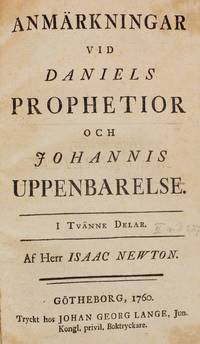
1760B4388Gothenburg c. 1760. In very good condition. Binding: Contemporary half calf with speckled boards. Notes: Ex Libris Abel E. Berland. First Edition in Swedish after original 1733 First Edition in English. <br><br>Newton's work: Observations on the Prophecies on the Prophecies of Daniel and the Prophecies of St. John. Six years after his death Newton's nephew Benjamin Smith published a small portion of Newton's later writings on the prophetic Books of Daniel and Revelation. For more than two centuries this book provided the only glimpse into Newton's prophetic thought. In addition scientific historians suggest that “Newton was an apocalyptic thinker†Snobelen Canadian Journal of History who “arrived at his theory of gravity partly through his exploration of alchemy and early biblical theology†White 358. Size: 8vo: 115mm x 190mm Volume: 2 Volumes in 1 Pages: P. Title Printer infoforward iii-vi Contents vii-viii 1-324 Category: Book Religious Christianity hardcover
1761500030438Amstelodami: Marcum Michaelem Rey 1761. First Edition. . Hardcover. Poor. Giovanni Francesco Mauro Melchiorre SALVEMINI DI CASTIGLIONE. 4to. Richmond College Library bookplate. spine replaced by green cloth. Foxing. Worming affects text & plates up to page 235. Two small worm holes affect plates at rear. <br/> <br/> Marcum Michaelem Rey hardcover
1728000772London: James and John Knapton 1728. 2nd Edition Corrected . Hardcover. Good/N/A. Full leather darkened and some cracking to spine. 5 bands to spine. Vol 2 part 2. Illustrated with Dr. Samuel Clark's notes taken mostly out of Sir Isaac Newton's Philosophy in olde English. Rubricated title page. Hinges cracked. Also fold out tables numbered XII to XXVII laid in the back all in good shape. ex lib from the Hartford Seminary. First belonging to Aaron Day dated May 3 1737. Then belonging to H A Gleason Jr. A very rare book. photos on request. <br/> <br/> James and John Knapton hardcover
1753867P22London: C. Hitch and L. Hawes; J. Hodges; J. and R. Tonson; et al 1753-57. Leather. Good. 8.5" by 5.5". Not Stated. An early set of John Milton's important epic poems an illustrated set edited by biblical scholar Thomas Newton. ESTC citation numbers T132846 and T134240.The fourth Newton edition of 'Paradise Lost' and the second Newton edition of 'Paradise Regain'd'.With a comma after 'edition' to the title page of Volume II of 'Paradise Regain'd'.Volume I illustrated with a portrait frontispiece and six plates. Volume II illustrated with six plates. One leaf of adverts to the rear.Volume III illustrated with a frontispiece and two plates.Volume IV illustrated with three plates.Title pages of 'Paradise Lost' are cancels. Collated complete. Both of John Milton's epic poems bound in four uniform volumes 'Paradise Lost' and 'Paradise Regain'd'.'Paradise Lost' is an epic blank verse poem concerning the biblical Fall of Man with the temptation of Adam and Even and their subsequent expulsion from the Garden of Eden. The poem is considered to be one of the greatest works of literature ever written.The sequel 'Paradise Regain'd' is likewise a blank verse poem though is much shorter than its predecessor being described as a brief epic.'Paradise Lost' includes a life of Milton. Written by John Milton a seventeenth century English poet who is best known for 'Paradise Lost'. He wrote during a period of political upheaval and religious flux in England with the English Civil War.Edited by Thomas Newton a clerical Bishop of Bishop and biblical scholar. In the original calf binding. Externally generally smart. Chip to the spine label to Volume IV. Bumping to the head and tail of the spines and to the extremities resulting in loss to the head of the spines heavier to Volume II. Spines are discoloured and a little rubbed with minor surface cracks. Minor marks to the boards and spines with a larger mark to the front board of Volume III. Crack to the head of the front joint of Volumes I and IV. Crack to the tail of the joints of Volume II. Internally firmly bound. Pages are lightly age-toned and generally clean with some scattered spotting. Title of Volume I has offset to the frontispiece. Ribbon marker of Volumes III and IV are detached but present. Good C. Hitch and L. Hawes; J. Hodges; J. and R. Tonson; et al hardcover
1760838P7DBirmingham; London: John Baskerville; J. and R. Tonson 1760. Leather. Near Fine. 10" by 6.5". None. A beautiful Baskerville edition of John Milton's 'Paradise Lost' and 'Paradise Regain'd' both epic poems bound here in one volume. A Baskerville edition.Complete as two volumes bound in one.ESTC citation number T134228 and N11290 - 'Paradise Regain'd' with 'Life of Milton' paginated in Roman numerals.List of subscribers to the front of 'Paradise Lost'. Pages 69 231 235 262 and 330 misnumbered 96 131 135 268 and 230.Bound by BookEnds.Collated complete.Both of John Milton's epic poems bound in one volume 'Paradise Lost' and 'Paradise Regain'd'.'Paradise Lost' is an epic blank verse poem concerning the biblical Fall of Man with the temptation of Adam and Even and their subsequent expulsion from the Garden of Eden. The poem is considered to be one of the greatest works of literature ever written.The sequel 'Paradise Regain'd' is likewise a blank verse poem though is much shorter than its predecessor being described as a brief epic.Written by John Milton a seventeenth century English poet who is best known for 'Paradise Lost'. He wrote during a period of political upheaval and religious flux in England with the English Civil War.John Baskerville was an important and pioneering printer and type designer who invented 'wove paper'.Prior owner's ink inscription to the verso of the front blank. Prior owner's ink inscription to the head of the title of 'Paradise Lost'. In a modern crushed morocco binding. Externally smart. A little very light rubbing to the extremities and a couple of very faint marks to the boards. Prior owner's ink inscription to the verso of the front blank. Internally firmly bound. Pages are lightly age toned and generally clean with the occasional spot. Tide mark to the gutter of the last few pages. Very small chip to the tail of the title page of 'Paradise Lost'. Prior owner's ink inscription to the head of the title of 'Paradise Lost'. Near Fine John Baskerville; J. and R. Tonson hardcover
1770930P11London: J. Beecroft; W. Strahan; J. and F. Rivington; et al 1770. Leather. Good Only. 8.5" by 5.5". Not Stated. Milton's influential blank verse poem 'Paradise Lost' illustrated with lovely detailed engraved plates for each book of the poem. Complete in two volumes.Illustrated with a frontispiece and six plates to each volume.Collated complete.'Paradise Lost' is an epic blank verse poem concerning the biblical Fall of Man with the temptation of Adam and Even and their subsequent expulsion from the Garden of Eden.Written by John Milton a seventeenth century English poet who is best known for this poem. He wrote during a period of political upheaval and religious flux in England with the English Civil War.This edition with notes of various authors edited by Thomas Newton. One page of adverts to the rear of Volume II. In a full calf binding. Externally worn. The textblock of Volume I is split in two. Leather is rubbed with light marks. Minor bumping to the head and tail of the spine and to the extremities. Lacking the spine labels. Front joint of Volume I is starting cracks to the rear joint. A small amount of loss to the tail of the spine and to the head of the front joint of Volume I. Front hinge of Volume I is strained rear hinge is starting. Joints and hinges of Volume II are starting. Internally Volume I is firmly bound Volume II is split in two between pages 226 and 239 with pages 227 to 238 detached but present. Pages are lightly age-toned and generally clean with a few scattered spots. Good Only J. Beecroft; W. Strahan; J. and F. Rivington; et al hardcover
1773917P24London: J. Beecroft; W. Strahan; J. and F. Rivington; et al 1773. Leather. Good. 8.5" by 5.5". Not Stated. A Georgian edition of John Milton's sequel to 'Paradise Lost' a biblical blank verse poem illustrated with a frontispiece and plates. Complete in two volumes.An eighteenth century edition of John Milton's important poem alongside 'Samson Agonistes' and 'Poems Upon Several Occasions'. John Milton's sequel to his epic blank verse poem on the Fall of Man.This sequel 'Paradise Regain'd' is likewise a blank verse poem though is much shorter than its predecessor being described as a brief epic.Illustrated with a frontispiece and two plates to Volume I and three plates to Volume II.This edition was edited with notes by Thomas Newton.Bookplate of Jessamy B. Stewart to the front paste downs. In a full calf binding. Externally a little worn. Volume II is lacking the spine labels. Loss to the head and tail of the spines. Bumping to the extremities. Leather is a little rubbed with some light marks. Lifting to the spine of Volume II. Small crack to the tail of the front joint of Volume I. Hinges of Volume I are starting but firm front hinge of Volume II is a little strained and the rear hinge is tender. Internally firmly bound. Pages are very lightly age-toned and clean with the occasional spot and handling mark. The occasional ink annotation to the text. Head of the title page of Volume II has been excised with no loss of text. Good J. Beecroft; W. Strahan; J. and F. Rivington; et al hardcover