104 résultats
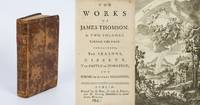
175129868AB1751. Volume I of II. Dublin Printed for G.Risk G. and A. Ewing and W.Smith Booksellers in Dame-Street 1751. Small - Octavo 10 cm x 165 cm. 363 pages with all four original engravings Spring Summer Autumn Winter and also including the section with "A Poem sacred to the Memory of Sir Isaac Newton. Inscribed to the Right Honourable Sir Robert Walpole". Hardcover / Original 18th century full calf. In protective Mylar. Endpaper with small tear. The engraving "Spring" loosened and with damage to upper margin effecting the image. The three other engravings in place and in very good condition see photographic images. Provenance-Entry: "Eliza Hungerford March 5 1771" Elizabeth Hungerford. hardcover
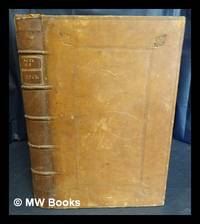
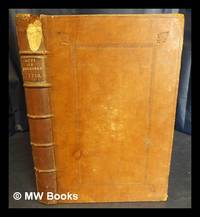
1720423310London : Thomas Newton 1720. 1st edition. Hardcover. Provenance; The right and hon. the Earl of Berkshire bookplate. Poor copy in gilt-blocked embossed leatherette; front board detaching. Spine with raised bands and panel edges somewhat bumped nicked and rubbed as with age with some loss and tears to the material. Marbled end-papers. Creased and cracked pages with some browning. Remains quite well-preserved overall. Physical description; 566 pages 22 x 32 cm. Subjects; Georgii Regis Magna Britannia. Session parliament. British parliament 18th century periodicals. Law Great Britain 18th century. Lay 18th century Great Britain sources. London : Thomas Newton hardcover
1718423307London : Thomas Newton 1718. 1st edition. Hardcover. Provenance; The right and hon. the Earl of Berkshire bookplate. Poor copy in gilt-blocked embossed leatherette; front board detaching. Spine with raised bands and panel edges somewhat bumped nicked and rubbed as with age with some loss and tears to the material. Marbled end-papers. Creased and cracked pages with some browning. Remains quite well-preserved overall. Physical description; 492 pages 22 x 32 cm. Subjects; Georgii Regis Magna Britannia. Session parliament. British parliament 18th century periodicals. Law Great Britain 18th century. Lay 18th century Great Britain sources. London : Thomas Newton hardcover
1793mon0001624192F.& C.Rivington 1793. Hardcover. Good. . Leather spine and corners. F.& C.Rivington hardcover
17604289London: J and R Tonson 1760. Hardcover. Good. 8vo. Tan calf boards with gilt lines Raised bands to spine with red title label. Edges are bumped. Pages are age tanned but clean. Binding is tight. 1760 J and R Tonson hardcover
1787WE22795Elizabethtown NJ: Shepard Kollock 1787. Leather_bound. Good. Two volumes octavo in original plain brown calf hubbed spines spine labels. 412 and 439 pp. with index in Volume II verso of final leaf is adverts. Both volumes are firm in their bindinsg; they show heavy use aith rounding to the extremities and rubbing to the spines some discoloration to the boards. Couple stains to the title page of Vol. I and fingering to the title page of Vol. II. Scattered foxing. Volume I has an inscription on the front free endpaper: "Union Library W. Simsbury No.7/ Bo't March 8th 1791 price 7/6"d/ Meetings 3rd Tuesdays in June 7 Sept/ at 4PM also/ 3rd Tuesdays in Dec & March 9 o'clock PM". Shepard Kollock 1750-1839 was one of New Jersey's earliest printers and editors; his press was located in Elizabethtown. He founded the New Jersey Journal New Jersey's third newspaper in 1779 it continued to be printed later as the Elizabeth Daily Journal for 212 years. He learned his trade in Philadelphia but had to relocate to the West Indies for his health and continued to print there. When news of Lexington and Concord reached him he returned to New Jersey joinging the Continental Army as a Lieutenant he saw action in the Battle of Trenton and other engagements. Resigning his commission in 1779 he was urged by the Continental Congress to start a newspaper the aforementioned New Jersey Journal. Located in Chatham it was an extremely important orgas as Kollock received news directly from Washington's headquarters located just a few miles away in Morristown. After the war the paper renamed the Elizabeth Daily Journal editorialized in favor of Jefferson Madison and Monroe. Kollock printings are highly sought after by collectors. Shepard Kollock unknown
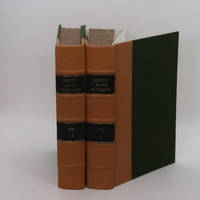
1787FB60 (1 & 2) /8<p>Tan calf spine with black title plates and gilt title. Green cloth boards. Two volumes only. Measurements are for one volume. Although part of a broken set these later two volumes are a meaningful adjunct to any library. <strong>In his day Newton's writings were well accepted – today they are more often seen as an example of man's gullibility. </strong> <strong>Thomas Newton</strong> 1 January 1704 – 14 February 1782 was an English cleric biblical scholar and author. He served as the Bishop of Bristol from 1761 to 1782. Newton was educated at Trinity College Cambridge and was subsequently elected a fellow of Trinity. He was ordained in the Church of England and continued scholarly pursuits. His more remembered works include his annotated edition of <em>Paradise Lost</em> including a biography of John Milton published in 1749. In 1754 he published a large scholarly analysis of the prophecies of the Bible titled <em>Dissertations on the Prophecies</em>. In his 1761 edition of Milton's poetry he gave the title <em>On His Blindness</em> to Sonnet XIX <em>When I Consider How My Light is Spent</em>. Newton was appointed the Bishop of Bristol in 1761 and in 1768 became the Dean of St Paul's Cathedral in London. He has been considered a Christian universalist. One of Newton's famous quotes concerns the Jewish people: <em>The preservation of the Jews is really one of the most signal and illustrious acts of divine Providence. and what but a supernatural power could have preserved them in such a manner as none other nation upon earth hath been preserved. Nor is the providence of God less remarkable in the destruction of their enemies than in their preservation. We see that the great empires which in their turn subdued and oppressed the people of God are all come to ruin. And if such hath been the fatal end of the enemies and oppressors of the Jews let it serve as a warning to all those who at any time or upon any occasion are for raising a clamor and persecution against them. </em> Rebound</p> John Rivington hardcover
1769NC0559Printed by E. Owen and T. Harrison 1769. Hardcover. Used; Good. London 1769. From the library of ABAA Bookseller Tom Nicely. Rebound in Brown cloth covered boards with gold titles; minimal wear; small 8vo 7 3/4" to 9 3/4" tall; no jacket. Pencil notation on free front endpaper; pages toned some light foxing; no internal markings; 58 pages. Photos available upon request. Printed by E. Owen and T. Harrison hardcover
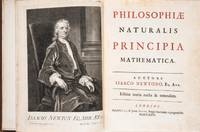
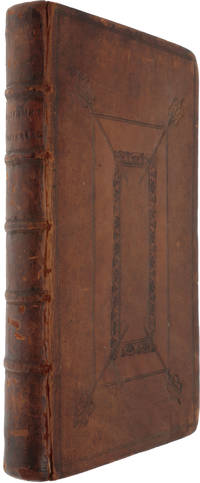
1726H-142<p>Philosophiae Naturalis Principia Mathematica third edition half-title engraved portrait frontispiece title in red and black woodcut illustrations and diagrams some foxing and soiling contemporary calf joints and corners worn <strong>4to</strong> William & John Innys <strong>1726</strong>.<br />This edition was edited by Henry Pemberton and Sir Isaac Newton wrote a preface with new edits just one year before he passed away in 1727. <strong>This third edition printed in London is the very basis of all subsequent printings</strong> of the Principia and a true history existing through time.<br /><strong>One out of 1250 copies</strong> Demy 1000 regular issue see below printed and with complete pagination this copy is a remarkable and rare book in the history of science.</p><p>The 1726 edition was comprised of 1250 copies evidenced by William Bowyer's paper stock ledger which records the following: Superfine 50 largest paper; Royal 200 large paper; Demy 1000 regular issue. Royal copies can be identified by their size and CC watermark. See: Henry P. Macomber and Gerald G. Grubb "A census of the owners of copies of the 1687 first edition of Newton's Principia" <em>PBSA </em>47 1953 269-304 p.293. Babson 11-12 Wallis 9.</p> Guil. & Joh. Innys, Regiae Societatis typographos hardcover
1726hos32Printed for R Franklin 1726 Printed for R Franklin under Toms Coffee House in Ruffel Street Covent Garden 1726 Vol 1 leather hardback xxii 172 pp b/w frontis from the private library of Thomas Braun the well respected Oxford Don Academic Linguist and Classicist with his Signature and date to fep. repair tape to spine book detached from boards with xii detached but still in good tight clean reading order. Full refund if not satisfied. 24 hour dispatch. If not pictured in this listing a scan of the actual book is available on request. Hardcover. Fair. Printed for R Franklin hardcover
17440811695Lausanne and Geneva: Apud Marcum-Michaelem Bousquet & Socios 1744. First Edition. Three-Quarter Leather. Very Good/No Dust Jacket. 64 Copper Engraved Plates 2 Letterpress Plates. 4to - over 9¾" - 12" tall. Three volumes bound in 3/4 leather over speckled paper boards red leather title bands with gilt titilng and ruling to spine 4to 3 Volumes: Vol. I: 8 xxviii 420 2pp.- Vol. II: 4 vi 423pp - Vol. III: 2 vi 566 1pp. Illustrated with 66 plates total; 64 copper plate engravings plus 2 letterpress tables. Titles in red and black each with engraved vignette of Newton’s portrait with allegorical frame of cherubs and scientific instruments - inscribed with motto "NOVIORA CECINIT". Published post-houmously as part of the larger 8 volume collected works of Newton. These three volumes comprise the gathering of many of Newton's most famous and notable works and are often considered as the first collected edition -- typically these volumes are considered complete unto themselves and commonly found separate. Condition: these three volumes have at one time been professionally preserved with the spines and outer hinges professionally reinforced and tactifully restored. General light shelfwear and rubbing to the boards edges corners rubbed with light bumping outer hinges restored revealing similar rubbing in the past. Bindings are tight with text pages showing just minor light browning typical of the era. A nice and collectible first edition of Newton's famous Opuscula Mathematica Philosophica et Philologica and a solid example of publishing output during the 'Age of Reason Apud Marcum-Michaelem Bousquet & Socios unknown
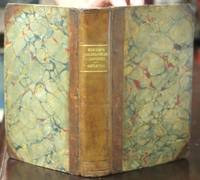
1748B4804London : Patrick Murdoch; Author’s Children c.1748. A very good example plates and text are clean and crisp. Edition: Second Edition. Binding: Contemporary marbled boards rebacked spine with 5 compartments of raised bands gilt lettering on two. Notes: An important commentary by MacLaurin. On Newton’s recommendation he was appointed to his chair at Edinburgh. He died in 1746 and later the work was completed by Murdoch who has added a valuable ‘Account of the Life and Writings of the Authorâ€. Size: 8vo. Illustration: With 6 engraved plates. References: Babson 85; Gray 112. Pages: P. 28 xx 392 Category: Book Science & Technology; Patrick Murdoch; Author’s Children hardcover
1741kb121.105GB: Author & J.& P. Knapton Etc 1741. Frontispiece and title page are heavily spotted. Slight spotting to next few pages but bulk of text is very clean and tight. Bound in old full leather but rebacked in 1968 with a much paler leather spine with green title label. Three old armorial bookplates of Edward Barrett Curties Wm. Fred. D'Arley and Sir Thomas Neame. Book is in good double plus condition with noticeable signs of wear and/or age. . 1st Edition. Hardback. G/No DW. Author & J.& P. Knapton Etc Hardcover
176527631Kbhvn. Weysenhuses Bogtrykkerie 1765. 3 samt. helldrbd. i flammet kalv rig rygforgyldning titel-og tomefelter i skind. Et par kapitæler slidte og lettere brugsspor. 48359;24366;243362 pp. På skrivepapir. <br/><br/><em>Første danske udgave af Thomas Newtons velanskrevne værk. </em> unknown
1794207234New York: Printed for and sold by T. and J. Swords and T. Allen 1794. Hardcover. G: Crack along the spine but the front cover remains attached. Wear to the edges and corners. Rubbing to the spine and plate. Tear along the spine in the front free end page and the first blank page. Tanning and foxing to the pages but they remain easy to read. Two volumes bound in one. A brown casebound book with gilt text on a red plate on the spine. xv 266. xvii 284 22 pages. Printed for and sold by T. and J. Swords, and T. Allen hardcover
1793013002Edinburgh: Morison and Son 1793. Volume II only. Tenth Edition. Full leather with raised spine bands. Considerable wear to the extremities. The boards are scuffed. There is a 2" crack along the front joint. The front endpapers are missing: The title page is the first leaf. There is writing and staining on the front pastedown and rear endpapers. A brief gift inscription dated 1808 is on the verso of the title page. A few pages have underlining. In a tight binding. Hard Cover. Fair/No Jacket. 12mo - over 6¾" - 7¾" tall. Morison and Son Hardcover
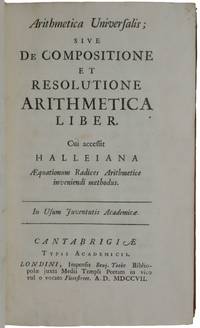
17225823London: Benji & Sam. Tooke 1722. Second edition. <p>Second edition but the first authorised and edited by Newton probably with the assistance of John Machin of his treatise on algebra or 'universal arithmetic' his "most often read and republished mathematical work" Whiteside. "Included are 'Newton's identities' providing expressions for the sums of the ith powers of the roots of any polynomial equation for any integer i plus a rule providing an upper bound for the positive roots of a polynomial and a generalization to imaginary roots of René Descartes' Rule of Signs" Parkinson.</p>. NEWTON'S ALGEBRA - THE FIRST EDITION AUTHORISED AND EDITED BY NEWTON. <p>Second edition but the first authorised and edited by Newton probably with the assistance of John Machin - see below of his treatise on algebra or 'universal arithmetic' his "most often read and republished mathematical work" Whiteside Papers V p. xiv. "Included are 'Newton's identities' providing expressions for the sums of the ith powers of the roots of any polynomial equation for any integer i pp. 251-2 plus a rule providing an upper bound for the positive roots of a polynomial and a generalization to imaginary roots of René Descartes' Rule of Signs pp. 242-5" Parkinson p. 138. About this last rule for determining the number of imaginary roots of a polynomial which Newton offered without proof Gjertsen p. 35 notes: "Some idea of its originality . can be gathered from the fact that it was not until 1865 that the rule was derived in a rigorous manner by James Sylvester." The work is a printed version of lectures Newton prepared in the period 1672-83. Although the editor of the first edition William Whiston later claimed that he had Newton's permission to print the lectures Newton was far from satisfied with the result complaining that the titles and headings were not his and that it contained numerous mistakes. His real concern was that "an unfinished text composed so long before should now be presented to the world as though it represented his latest researches into the structure and applications of algebra" Papers V p. 11 and that Whiston had "too faithfully and impercipiently followed the parent manuscript incorporating in his princeps edition its several inconsistencies and lapses into error without in the main even bringing them to the reader's notice . In his private library copy of the edition Newton corrected many minor misprints inserted more appropriate running heads 'Multiplicatio' 'Divisio' 'Extractio Radicum' 'De Forma Aequationis' 'Reductio Aequationum' 'Resolutio Quaestionum Arithmeticarum Geometricarum' and the like and on the Arithmetica page 279 deleted an unwarranted half-title 'Aequationum Constructio linearis'; more radically he mapped out a large-scale reordering of the sixty-one geometrical problems comprising its central portion seeking to grade them into a more logical sequence and in increasing levels of difficulty while in the concluding section on the 'curvilinear ' construction of equations he pared away all not directly needed flesh reducing it to two skeletal conchoidal neuses now denuded of their proof. That last savage act of butchery apart all these improvements were incorporated in the Latin revise - future parent and rightfully so of all subsequent editions - which he himself brought to publication in 1722" ibid. pp. 13-14. Babson notes that "This edition was the last issued during Newton's lifetime and is almost as rare as the first." In commerce this edition is in fact much rarer than the first: ABPC/RBH list only two other copies of this edition since 1975 but ten of the first.</p> <br /> <p>"In fulfilment of his obligations as Lucasian Professor Newton first lectured on algebra in 1672 and seems to have continued until 1683. Although the manuscript of the lectures in Cambridge University Library carries marginal dates from October 1673 to 1683 it should not be assumed that the lectures were ever delivered. There are no contemporary accounts of them and apart from Cotes who made a transcript of them in 1702 they seem to have been totally ignored. Whiteside Papers V p. 5 believes that they were composed 'over a period of but a few months' during the winter of 1683-4" Gjertsen pp. 33-4.</p> <br /> <p>The Arithmetica "derives partly in its discussion of the elemental algebraic operations and of the reduction and exact solution of equations from Newton's earlier unpublished 'Observations' on the introduction to Cartesian algebra presented by Gerard Kinckhuysen in his 1661 Stelkonst partly in its techniques for delimiting the number and nature real or complex of the roots of equations and for reducing these by factorization from his own independent researches as a young postgraduate student into the theory of equations and partly in its approximate geometrical construction of cubics from his previously elaborated 'Problems for construing aequations'. Apart from novelties in detail and the fabrication of new illustrative 'questions' what is most notable is Newton's developing awareness - still far from completely expressed - of the fundamental structural equivalence which exists between the elements constants and free variables and their functional relationships of algebra and those given lines and undetermined line-lengths and their coordinate interconnections of geometry and his deepening grasp of the still more general isomorphism which permits a two-way 'translation' between mathematical 'speech' and the 'language' of exact science in all its manifestations. His guiding doctrine that algebra is 'universal arithmetick' embroiders a theme stated briefly in an opening phrase of his 1671 treatise on infinite series and fluxions and expounded in a geometrical context earlier still in preface to James Gregory's study of universal mathematical principles. Now also however he reaches tentatively forward to Barrow's notion that algebra is in its essence the abstract logic of relationships between quantities in divorce from their particular setting and hence to be developed as an independent metamathematical system" Papers V pp. 3-4.</p> <br /> <p>"We may reasonably conjecture that pressure was in some manner put upon Newton in late 1683 to fulfil however tardily his statutory obligation annually to deposit a fair copy of ten of his lecture scripts and be all but sure that the arrival in Cambridge the next spring of his young amanuensis Humphrey Newton able to take over from Isaac the dreary time-consuming chore of rewriting his much cancelled and corrected worksheets in legible and coherent form gave him new heart to codify and expand his previous mathematical investigations. But these surmises remain as unproved and essentially undemonstrable as the plausible suggestion that it was Edmond Halley's famous first visit to Cambridge in the late summer of 1684 to talk about the unsolved problem of elliptical planetary motion which provoked him abruptly to relinquish his restructuring of the Arithmetica. We may guess still more tenuously that the appearance in mid-1685 of John Wallis' voluminous Treatise of Algebra Both Historical and Practical would have long deterred Newton from making any efforts to have his own rival studies made publicly available. In later years certainly he grew increasingly soured with the often cumbersome computations and techniques of Cartesian algebra - at one point indeed if we may believe David Gregory he qualified it as 'the Analysis of the Bunglers in Mathematicks - and we may be certain that his reluctance during 1705-6 to have Whiston edit the deposited text of his algebraic lectures was not merely the manifestation of a growing personal antagonism to his successor in the Lucasian chair" ibid. pp. xi-xii.</p> <br /> <p>"When Newton resigned his Lucasian professorship to his deputy William Whiston in December 1701 it was natural that the latter should wish to familiarize himself with the deposited lectures of his predecessor. Whiston did not hesitate to introduce portions of Newton's earlier optical lectures concerning the mathematical theory of the rainbow into his own Lucasian Praelectiones physico-mathematica in the spring of 1706 and about that time also he turned his attention to the succeeding ones on algebra and began to consider their publication. In the meantime rumours began to spread in both Oxford and London that 'Newton's friends solicit him to publish a Treatise of Algebra which he wrote long since. If such ill-founded whispers penetrated to Cambridge Whiston ignored them and went quietly ahead arranging with the London stationer to underwrite the expense of printing the deposited manuscript and then subsequently between September 1705 and the following June correcting both specimen and proof sheets as they emerged from the compositor's bench at the University Press. In February 1706 David Gregory accurately noted in his memoranda that 'Its talked that there is now printing at Cambridge Elements or Principles of Algebra written long since by Sir Isaac Newton but withdrew his added remark that it was 'lately revised by him' when he saw Newton in London in July and was given a first-hand account of the history of the 'Algebra that is printing and near printed at Cambridge'. Though as Whiston was later to announce publicly Newton had given his reluctant approval for the edition . Despite its minor inconsistencies and confusions Gregory's report vividly conveys Newton's concern that an unfinished text composed so long before should now be presented to the world as though it represented his latest researches into the structure and applications of algebra" pp. 8-11.</p> <br /> <p>For a book that was to become Newton's most often republished mathematical work the Arithmetica initially made little impact in Britain and was not even graced by a review in the Philosophical Transactions. On the Continent the reception accorded the lectures was more positive. "Leibniz unhesitatingly divining their author beneath the cloak of anonymity gave them a long review in the Acta Eruditorum of Leipzig in 1708. Written thirty years before he noted and now deservingly printed by William Whiston he assured the reader that 'you will find in this little book certain particularities that you will seek in vain in great tomes on analysis.' His close associate Johann Bernoulli despite some adverse remarks paid Newton the compliment in 1728 of basing his own course on the elements of algebra upon Newton's text. Perhaps partly in consequence of Newton's recent death in Britain too the book began about this time to arouse greater interest than when it was first issued in 1707" Hall p. 174.</p> <br /> <p>Despite the impressive contributions of the work to the theory of equations mentioned earlier it is difficult to pigeonhole the work as being either algebraic or geometric. From one point of view the Arithmetica can be seen as a fulfillment of the programme outlined by Descartes in the Géométrie because it teaches how geometrical problems and also arithmetical and mechanical ones can be translated into the language of algebra. Paradoxically however Newton criticized Descartes maintaining that at least in some cases Apollonian geometry is to be preferred to Cartesian algebra in the analysis of indeterminate problems. Modern analysts he complained had confused algebra and geometry: "The Ancients so assiduously distinguished them one from the other that they never introduced arithmetical terms into geometry. recent people by confusing both have lost the simplicity in which all elegance in geometry consists" Papers V p. 429. The last section of the work 'The linear construction of equations' pp. 279-326 is particularly anti-Cartesian the term 'linear' in this context does not refer to straight lines but derives from Pappus. Newton here deals with the problem of constructing cubics third-degree equations that Descartes solved via the intersection of a circle and a parabola. Newton proposed instead to use a curve of degree higher than the conics as a means of construction namely the conchoid a fourth-degree curve. Newton regarded the conchoid as preferable because it has a mechanical construction and leads to a more elegant solution of the problem.</p> <br /> <p>The present 1722 revision is "the standard text of the Arithmetica published much as before 'Impensis Benj. & Sam. Tooke'. It appeared to Newton's first editor that 'that acute Mathematician Mr. John Machin Professor of Astronomy at Gresham College . and one of the Secretaries of the Royal Society published this Work again by the Author's later Desire or Permission; I lay no claim to it' Whiston Memoirs; John Conduitt's memorandum King's College Cambridge. Keynes MS 130.5 again adds the clarification that 'Machin overlooked the press for which Sir I intended to have given him 100 Guineas but he made him wait 3 years for a preface & then did not write one'. Elsewhere Keynes MS 130.6 2 Conduitt noted that 'Sir I. told me that Machin understood his Principia better than anybody that Halley was the best Astronomer but Machin the best Geometer'. Newton's active stage-managing of the 1722 revise can be documented in several ways: most notably a stray autograph sentence on an otherwise clean folio page now ULC. Add. 3960.7: 95 differs by only a single trivial adverb from an inserted footnote clarifying the reference to the unimplemented 'Regulae post docendae' on page 52 of the deposited copy. The ubiquitous presence of its author's editorial hand was not missed by W. J. 's Gravesande when he came to reissue the Arithmetica ten years later: 'Secunda vice liber in lucem prodiit Londini 1722; sed in statu perfectiore ut quis facile percipiat non omnino foetum abdicasse virum Celeberrimum; ordo propositionum non tantum mutatus est sed in ipsis solutionibus & demonstrationibus correctiones multae reperiuntur non nisi ipsi Auctori tribuendae'" ibid. p. 14 n 60.</p> <br /> <p>"Benjamin Tooke the London publisher and printer he was Queen's printer had eight books published at the Cambridge Press all of them by Whiston between 1702 and 1712. There are two London printer's ornaments used in this volume pp. 283 & 289 and nowhere else but we know that the woodcuts for the illustrations in the 1707 edition were delivered to Cambridge possibly from London 6d. was paid for the parcel. So far as one can tell the woodcuts are identical and we must assume they had been reclaimed by Tooke. Unfortunately we have no letters from Newton about the printing history of this volume" Macclesfield sale catalogue.</p> <br /> <p>Babson 200; Macclesfield 1520; Wallis 278. Gjertsen Newton Handbook 1986. Hall Isaac Newton 1992. Westfall Never at Rest 1983.</p> <br/> <br/> 8vo pp. iv 332 including half-title with list of books on verso woodcut diagrams throughout ink name of Newton on half-title ink inscription identifying Newton as author and another Whiston as editor on title slightly browned. Contemporary panelled calf ink signature of former owner Robert Andrews on front free endpaper corners and edges rubbed joints splitting spine rubbed. Benji & Sam. Tooke unknown
17074639Cambridge; London: Typis Academicus; Benjamin Tooke 1707. First edition. <p>First edition of Newton's treatise on algebra or 'universal arithmetic' his "most often read and republished mathematical work" Whiteside. Included are 'Newton's identities' providing expressions for the sums of the powers of the roots of any polynomial equation plus a rule providing an upper bound for the positive roots of a polynomial and a generalization to imaginary roots of René Descartes' 'Rule of Signs.'</p>. Hardcover. NEWTON'S TREATISE ON ALGEBRA. <p>First edition of Newton's treatise on algebra or 'universal arithmetic' his "most often read and republished mathematical work" Whiteside. "Included are 'Newton's identities' providing expressions for the sums of the ith powers of the roots of any polynomial equation for any integer i pp. 251-2 plus a rule providing an upper bound for the positive roots of a polynomial and a generalization to imaginary roots of René Descartes' Rule of Signs pp. 242-5" Parkinson p. 138. About this last rule for determining the number of imaginary roots of a polynomial which Newton offered without proof Gjertsen p. 35 notes: "Some idea of its originality . can be gathered from the fact that it was not until 1865 that the rule was derived in a rigorous manner by James Sylvester."</p> <br /> <p>Provenance: Jesuit College at Ghent ink inscription 'Bibliotheca Collegii Gandavensis Societatis Jesu.' and shelfmark on title; extensive marginal annotations by a well-informed contemporary reader. This reader was possibly the English Jesuit Christopher Maier 1697-1767. Born in Durham England Maier entered the Society of Jesus in 1715. He taught at Liège where he became interested in astronomy. In 1750 Maire was commissioned by Pope Benedict XIV to measure two degrees of the meridian from Rome to Rimini with fellow Jesuit Roger Boscovich with a view to mapping the Papal States; in turn they proved that the earth is an oblate spheroid as Newton had proposed in Principia publishing their results in Litteraria Expeditione 1755. Maier spent his final years at the English Jesuit College in Ghent.</p> <br /> <p>"In fulfillment of his obligations as Lucasian Professor Newton first lectured on algebra in 1672 and seems to have continued until 1683. Although the manuscript of the lectures in Cambridge University Library carries marginal dates from October 1673 to 1683 it should not be assumed that the lectures were ever delivered. There are no contemporary accounts of them and apart from Cotes who made a transcript of them in 1702 they seem to have been totally ignored. Whiteside Papers V p. 5 believes that they were composed 'over a period of but a few months' during the winter of 1683-4" Gjertsen pp. 33-4. The course of lectures stemmed from a project on which Newton had embarked in the autumn of 1669 thanks to the enthusiasm of John Collins: the revision of Mercator's Latin translation of Gerard Kinckhuysen's Dutch textbook on algebra Algebra ofte stel-konst 1661. Newton composed a manuscript 'Observations on Kinckhuysen' in 1670 see Whiteside Papers II and used it in the preparation of his lectures. He took the opportunity not only to extend Cartesian algebraic methods but also to restore the geometrical analysis of the ancients giving his lectures on algebra a strongly geometric flavor.</p> <br /> <p>"When Newton resigned his Lucasian professorship to his deputy William Whiston in December 1701 it was natural that the latter should wish to familiarize himself with the deposited lectures of his predecessor" Whiteside Papers V p. 8. Whiston later claimed in his Memoirs London: 1749 that Newton gave him his reluctant permission to publish the lectures. Whiston arranged with the London stationer to underwrite the expense of printing the deposited manuscript and then subsequently between September 1705 and the following June corrected both specimen and proof sheets as they emerged from the University Press. The completed editio princeps finally appeared in May 1707 priced at 4s. 6d. without Newton's name on the title page although references inside the work made no attempt to hide the author's identity. It included an appended tract by Halley on 'A new accurate and easy method for finding the roots of any equations generally without prior reduction' pp. 327-343. Publication of the work had been delayed by Newton who complained that the titles and headings were not his and that it contained numerous mistakes. Yet when he prepared a second edition in 1722 the changes he introduced were "primarily reorderings of his own manuscript not corrections of Whiston's additions" Westfall p. 649. In reality Newton's misgivings probably derived more from his reluctance to place before the public a relatively immature and poorly organized work and one that did not take into account the developments in the subject that had taken place in the quarter century since the manuscript was composed.</p> <br /> <p>For a book that was to become Newton's most often republished mathematical work the Arithmetica initially made little impact in Britain and was not even graced by a review in the Philosophical Transactions. On the Continent the reception accorded the lectures was more positive. "Leibniz unhesitatingly divining their author beneath the cloak of anonymity gave them a long review in the Acta Eruditorum of Leipzig in 1708. Written thirty years before he noted and now deservingly printed by William Whiston he assured the reader that 'you will find in this little book certain particularities that you will seek in vain in great tomes on analysis.' His close associate Johann Bernoulli despite some adverse remarks paid Newton the compliment in 1728 of basing his own course on the elements of algebra upon Newton's text. Perhaps partly in consequence of Newton's recent death in Britain too the book began about this time to arouse greater interest than when it was first issued in 1707" Hall p. 174.</p> <br /> <p>Despite the impressive contributions of the work to the theory of equations mentioned earlier it is difficult to pigeonhole the work as being either algebraic or geometric. From one point of view the Arithmetica can be seen as a fulfillment of the programme outlined by Descartes in the Géométrie because it teaches how geometrical problems and also arithmetical and mechanical ones can be translated into the language of algebra. Paradoxically however Newton criticized Descartes maintaining that at least in some cases Apollonian geometry is to be preferred to Cartesian algebra in the analysis of indeterminate problems. Modern analysts he complained had confused algebra and geometry: "The Ancients so assiduously distinguished them one from the other that they never introduced arithmetical terms into geometry. recent people by confusing both have lost the simplicity in which all elegance in geometry consists" Whiteside Papers V p. 429. The last section of the work 'The linear construction of equations' pp. 279-326 is particularly anti-Cartesian the term 'linear' in this context does not refer to straight lines but derives from Pappus. Newton here deals with the problem of constructing cubics third-degree equations that Descartes solved via the intersection of a circle and a parabola. Newton proposed instead to use a curve of degree higher than the conics as a means of construction namely the conchoid a fourth-degree curve. Newton regarded the conchoid as preferable because it has a mechanical construction and leads to a more elegant solution of the problem.</p> <br /> <p>William Whiston 1667-1752 was "a member of the first generation of Cambridge students to emulate Newton's method and principles. He went up to Cambridge in 1686 claimed to have attended one or two incomprehensible lectures by Newton on his Principia and was elected a Fellow of Clare Hall in 1691. After taking orders he left Cambridge for a while returning in 1700 when chosen by Newton to be his deputy as Lucasian Professor. About a year later upon Newton's resignation and commendation Whiston succeeded him. Aberrant theology was to be his downfall. While Newton and their common friend Dr Samuel Clarke kept private their doubts about Trinitarianism the Creed and the Thirty-nine Articles Whiston sought publicly to amend the errors of the Anglican faith; for this he was summoned before the heads of houses in the university and dismissed from his post in 1710" Hall p. 175.</p> <br /> <p>Babson 199; Wallis 277; D. Gjertsen Newton Handbook 1986; A. R. Hall Isaac Newton 1992; R. S. Westfall Never at Rest 1983.</p> <br/> <br/> 8vo pp. viii 343. Woodcut diagrams throughout. Former owner's signature F. Percy White Feb. 1920 on half-title partially erased. Contemporary mottled calf covers with floral border and corner fleurons in blind. / Hardcover. Typis Academicus; Benjamin Tooke unknown
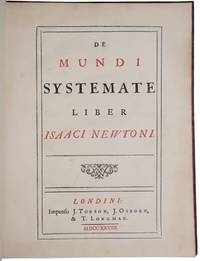
17286610London: J. Tonson J. Osborn & T. Longman 1728. First edition. <p>First edition an extraordinary Newtonian association copy of Newton's rarest book inscribed by James Stirling recording the gift from Abraham de Moivre "Ja: Stirling Ex Dono Dni De Moivre". Drafted in the mid-1680s as the liber secundus of the earliest Principia the text differs substantially from the published Book III. Among its non-Principia contents are the thought-experiment of the orbiting cannonball anticipating the artificial satellite the first acceptable photometric determination of a stellar distance and passages that point to terrestrial tides Michelson 1919 and to the existence of the planet Uranus Herschel 1781. OCLC lists six copies worldwide; no copy in Cambridge.</p>. An Exceptional Newtonian Association Copy. <p>First edition of Newton's rarest book - the discarded first draft of what would become Book III of Principia posthumously published in the year following his death - and an extraordinary association copy in contemporary panelled calf inscribed on the front pastedown by James Stirling: "Ja: Stirling Ex Dono Dni De Moivre". The inscription records the gift in the year of publication from Abraham de Moivre to Stirling his junior by twenty-five years. The two men were the foremost mathematicians at work in London at Newton's death and the leading contemporary proponents of Newtonian mathematics; both had been part of Newton's personal circle for decades both were Fellows of the Royal Society in his lifetime and within two years of the present gift their joint correspondence on the asymptotic behaviour of the binomial coefficient would yield what is now known as Stirling's formula. Of de Moivre the ODNB remarks that he was the man "whose early investigations led Stirling into this topic". The book passed with the rest of Stirling's mathematical library into the family seat at Garden House in Stirlingshire where it remained for nearly three centuries until the dispersal at Lyon & Turnbull Edinburgh on 23 October 2025. No comparable association copy of the Latin first edition is recorded in the modern trade.</p> <br /> <br /> <p>The text Conduitt brought through the press in 1728 had been written in 1685 in the same Cambridge year as the first two books of Principia and was originally intended to constitute the second of two books under the title De motu corporum liber secundus. By the summer of 1685 Newton had expanded the design of Principia to three books with the original second book becoming the third; at the same moment he reconsidered the character of the new Book III. He had at first envisaged a popular treatment that as he noted in the introduction to the published Book III 'might be read by many'; but fearing the controversies such a work would invite he replaced the popular draft with a strictly mathematical exposition that could be read only by those who had mastered the first two books Gjertsen p. 573. Having no immediate use for the rejected version Newton had Humphrey Newton no relation his Cambridge amanuensis make a fair copy of part of the manuscript and on 29 September 1687 deposited it in the Cambridge University Library in the supposed fulfilment of his obligations as Lucasian Professor: that deposit mostly in Humphrey's hand is now ULC MS Add. 3990. A further copy by Roger Cotes is preserved at Trinity College Cambridge and a third copy is held at Clare College; Ernst Weil offered a fourth in his Catalogue 27 no. 152. Newton's distaste for controversy precluded the printing of any of these copies in his lifetime.</p> <br /> <br /> <p>The 1728 publication was arranged by John Conduitt the husband of Newton's half-niece Catherine Barton and his successor as Master of the Mint who had taken charge of Newton's manuscripts after his death in March 1727. Conduitt sold the deposit copy to the bookseller Jacob Tonson for thirty-one pounds and ten shillings and Tonson published in partnership with John Osborn and Thomas Longman. It was almost certainly Conduitt who substituted the title De mundi systemate for Newton's own De motu corporum liber secundus - a definite improvement corresponding much more closely to the content but one that has caused enduring confusion with the title of the published Book III of Principia from which the present text differs sharply in style and method.</p> <br /> <br /> <p>What is published here differs from the printed Book III of 1687 not only in style but in substance. The first part offers a non-mathematical account of centripetal force; the next turns to the dynamics of the solar system; two long discussions then follow on the theory of tides and the nature and dynamics of comets the work closing with the inverse problem of recovering a comet's orbit from its observed velocity and distance from the Sun. Several discoveries and observations preserved in the rejected text never reached the printed Principia at all. Pages 3-4 contain Newton's thought-experiment of the orbiting cannonball with an accompanying diagram here Tab. I Fig. 1 showing that there is no kind-difference between projectile and orbital motion: a ball fired from the top of a mountain with progressively greater velocity falls further and further from the base of the mountain until at length it never reaches the ground at all and enters into orbit. Ernst Weil regarded this as "the anticipation of an artificial satellite 270 years before its advent". The discussion and diagram do not appear in the 1687 Principia in any form.</p> <br /> <br /> <p>More substantial still is the discussion of stellar distances on which the printed Principia is virtually silent. Newton had investigated the question in 1685 by a method devised by James Gregory in 1668: comparing the brightness of the Sun by way of its reflection from Saturn with that of a fixed star and then applying the inverse-square law of photometry. With assumptions about the nature of reflection the absence of light-loss in interstellar space and the equality of intrinsic brightness between the Sun and the comparison star Newton found Sirius to lie at a distance of about a million astronomical units. The figure is too great by an order of magnitude but as J. D. North has argued this can be counted as "the first acceptable determination of a star's distance" Cosmos p. 418. Newton's motivation was theological as much as astronomical: he had been perplexed by the question why the cosmos did not collapse upon itself under the action of universal gravitation and the immense interstellar distances supplied a workable answer.</p> <br /> <br /> <p>The text further records in advance of their observational confirmation two phenomena that would not be detected for another two centuries. Newton points to the possibility of terrestrial tidal effects; these were observed by Albert A. Michelson and Henry G. Gale at Yerkes Observatory in 1919 by the application of monochromatic interference fringes to a determination of the rigidity of the Earth and reported in Science 50 pp. 327-8. In another passage first identified by J. Ph. Wolfers in his German Principia of 1872 Newton indicates the possible existence of a planet beyond Saturn ultimately observed by Herschel in 1781 and named Uranus - ironically Herschel himself on first observation took it to be a comet the very class of body that Newton throughout the present work regards as continuous with the planets and as moving on closely related orbits.</p> <br /> <br /> <p>The publication history of 1728 is further complicated by the simultaneous appearance of an anonymous English translation A Treatise of the System of the World sometimes attributed to Andrew Motte the translator of Principia in 1729; its translator has never been certainly identified. The Latin and English texts diverge in important respects and it is unclear whether the Treatise is a translation of a different and now-lost manuscript or whether the differences reflect interpolations by the translator. The Latin version is unambiguously based on the manuscript in Humphrey's hand: the compositor uses a half-square bracket in the margins to mark the end of one page and the beginning of another in the manuscript and to flag in some places the start of a manuscript signature Cohen p. xii. The translator additionally suppressed Newton's many citations to specific propositions in the original-draft Principia sometimes adversely affecting the readability of the result; in the Latin the citations have been preserved but updated to correspond to the proposition numbering of the third edition of Principia London 1726 which makes the present Latin text the more informative scientifically and historically. The citations were restored only in the second English edition of 1731 an edition that I. B. Cohen accordingly considered "of far more value . than the first" English version Cohen p. xiii. The Treatise is much more frequently encountered in commerce: OCLC lists more than fifty copies of the English first edition and twenty-five or more have appeared at auction. The Latin first edition presents a quite different picture.</p> <br /> <br /> <p>The Latin De mundi systemate is exceptionally rare. OCLC lists only six copies worldwide three of them in North America Chicago the Huntington Library - the Babson copy - and Yale and no copy is recorded in either the Cambridge College libraries or the Cambridge University Library despite Newton's manuscript residing on the same site. The Cambridge Digital Library editorial note to MS Add. 3990 states in a small error perhaps connected to the Cambridge gap that the work was first published in 1731 - the year of the second edition. Auction appearances over the last fifty years have been restricted to two recorded copies: the Honeyman copy rebacked and damp-stained and the Macclesfield copy from the Earls of Macclesfield's celebrated mathematical library at Shirburn Castle. The present copy is the third copy to come to public sale in that period and is the first to be offered with a contemporary presentation inscription linking it directly to two of Newton's closest mathematical contemporaries. The Latin text was reprinted in London in 1731 and again in Amsterdam in 1742; it was incorporated into Johannes Castillioneus's Isaaci Newtoni Opuscula at Lausanne in 1744 and into Samuel Horsley's five-volume Isaaci Newtoni Opera at London in 1779-85; none of these later printings carries the textual authority of the 1728 first edition prepared in the immediate aftermath of Newton's death from the manuscript his executors retained.</p> <br /> <br /> <p>James Stirling 1692-1770 to whom the present copy was given was born at Garden House in Stirlingshire on 11 May 1692 the third son of Archibald Stirling and Anna Hamilton into a Scottish family with deep Jacobite sympathies. He matriculated at Balliol College Oxford on 18 January 1711 as a Snell Exhibitioner from the University of Glasgow and held a Bishop Warner Exhibition from October of the same year. His Jacobite associations cost him both scholarships and his place at Oxford in 1715 when he refused to swear the oaths of allegiance and abjuration following the rising of 1715. Stirling travelled to the Continent - reaching Venice by 1717 - where he supported himself by teaching mathematics and where in the same year he published his first major work Lineae Tertii Ordinis Neutonianae a treatise on the cubic curves that completed and extended Newton's classification appended to Opticks in 1704. The book was dedicated to Newton with whom Stirling had begun corresponding from Venice through Newton's Royal Society colleagues and it secured Stirling's standing in the British mathematical community despite his political exile.</p> <br /> <br /> <p>By 1725 Stirling had returned to London with Newton's personal assistance and was appointed to the staff of William Watts's Academy in Little Tower Street off Covent Garden - one of the leading commercial training schools of the city where Stirling's 1727 syllabus advertised lectures on mechanical and experimental philosophy spanning mechanics hydrostatics optics and astronomy. Newton proposed Stirling for fellowship of the Royal Society; he was elected on 3 November 1726 four months before Newton's death. Throughout his London decade Stirling was a frequent visitor to the aged Newton at his country house at Kensington: "Sr Isaac Newton lives a little way off in the country" he wrote to Maclaurin in 1725 finding Newton kind and serviceable but much enfeebled. The fruit of these London years was Stirling's second and most famous work Methodus Differentialis London 1730 the early classic of numerical analysis containing what are now known as Stirling numbers Stirling's interpolation formula and the asymptotic formula for the logarithm of the factorial that bears his name.</p> <br /> <br /> <p>Abraham de Moivre 1667-1754 the donor had reached England as a Huguenot refugee in 1685 following the Revocation of the Edict of Nantes and supported himself in London by tutoring the sons of the gentry and by giving mathematical lessons in the coffee-houses of St Martin's Lane. He had become a friend of Newton by about 1692 and was elected Fellow of the Royal Society in 1697. He saw Samuel Clarke's Latin Optice through the press in 1706 the year following Opticks in English; in 1712 he served on the Royal Society's commission alongside Halley Arbuthnot Jones Machin and others that arbitrated the priority dispute between Newton and Leibniz over the calculus and adjudicated in Newton's favour. De Moivre's own publications - De Mensura Sortis 1711; The Doctrine of Chances in three editions 1718 1738 1756; Miscellanea Analytica 1730; the formula linking complex exponentials to trigonometry and the early statement of the central limit theorem - placed him among the foremost probabilists of his century. The story preserved by his Royal Society colleagues that the aged Newton would direct mathematical questioners to him with the words "he knows all these things better than I do" was already current in his lifetime.</p> <br /> <br /> <p>The friendship between Stirling and de Moivre was the closest mathematical relationship of the older man's last decades and the most consequential of Stirling's. Stirling's letter to de Moivre of 19 June 1729 preserved in the Royal Society archives and reproduced in Ian Tweddle's annotated translation of Methodus Differentialis Springer 2003 illustrates how Stirling had calculated the coefficient of the middle term of the binomial expansion a bn for large n by means of a logarithmic series; de Moivre who had pursued the same problem for some years was able to extend his earlier results using Stirling's ideas and shortly afterwards published a Supplement to his Miscellanea Analytica. By September 1730 Stirling was relating the new exchange to Gabriel Cramer at Geneva. The joint provenance of the asymptotic formula for n! named after Stirling but resting on de Moivre's earlier "Approximatio ad summam terminorum binomii" has its origin in this exchange. The Methodus Differentialis of 1730 which states the formula in 'Example 2 to Proposition 28' was published two years after the present gift; the book Stirling received from de Moivre in 1728 carried the work of their common master the rejected first draft of Principia into the next mathematical generation.</p> <br /> <br /> <p>The dating of the inscription is precise. The Latin De mundi systemate published in London in the second half of 1728 would have come into the hands of the leading London mathematicians within weeks of issue; de Moivre's presentation to Stirling recorded in Stirling's own hand on the front pastedown can therefore be placed in the closing months of 1728 or in early 1729 in the year following Newton's death and within two years of Stirling's election to the Royal Society. The form of the inscription is the recipient's record of the gift not the donor's presentation: it is unsigned by de Moivre and the courtesy form "Dni De Moivre" Domini De Moivre is the standard early-eighteenth-century Latin used between Fellows. The hand is the same as that of Stirling's 1729 letter to de Moivre and of his autograph manuscript of Methodus Differentialis both preserved at Garden House until the same dispersal of October 2025.</p> <br /> <br /> <p>The book is in entirely original condition in the contemporary panelled calf binding it received in London in 1728: the covers framed by double gilt fillets enclosing a recessed central panel the spine in compartments separated by raised bands the red morocco lettering-piece preserving the gilt label 'DE MUNDI SYSTE MAT' with characteristic compartment dotted ornament and the edges sprinkled red. It travelled with Stirling from London to Garden House in or about 1735 when he relinquished his London teaching to take up the management of the Scots Mining Company at Leadhills in Lanarkshire an appointment he held until his retirement; the books and instruments he had assembled in his London years went with him were preserved by his collateral heirs Stirling died unmarried in Edinburgh on 5 December 1770 and remained at Garden House through nine generations of the Stirling family until the dispersal at Lyon & Turnbull on 23 October 2025. In the same sale Stirling's autograph Methodus Differentialis manuscript brought £50400 his own annotated copy of Principia £42840 and the Edinburgh silver pocket microscope by John Clark used in his Leadhills assays a further £42840: the present De mundi systemate stands within the same archive of working tools by which one of Newton's leading disciples carried his mathematics into the next century.</p> <br /> <br /> References: Babson 16 - Wallis 19 - Norman 1593 English translation only - Gray 19 1731 reprint only - Cohen I. B. introduction to A Treatise of the System of the World London & Berkeley 1969 - Gjertsen D. The Newton Handbook London 1986 p. 573 - North J. D. Cosmos: An Illustrated History of Astronomy and Cosmology Chicago 2008 p. 418 - Tweddle I. James Stirling's Methodus Differentialis: An Annotated Translation of Stirling's Text London 2003 - Hoskin M. A. 'Newton Providence and the Universe of Stars' Journal for the History of Astronomy 8 1977 pp. 77-101 - Walker H. M. Studies in the History of Statistical Method Baltimore 1929 - The Library of James Stirling Mathematician Lyon & Turnbull Edinburgh 23 October 2025 lot 9.<br /> <br/> <br/> <br /> <p>4to 231 × 177 mm pp. iv 108 with two folding engraved plates of geometrical diagrams Tab. I and Tab. II title printed in red and black with engraved typographic ornament. Contemporary panelled calf covers framed by double gilt fillets enclosing a recessed central panel spine in six compartments with five raised bands red morocco lettering-piece preserving gilt 'DE MUNDI SYSTE MAT' edges sprinkled red. Covers rubbed with surface wear to the recessed central panels spine and joints sound lettering-piece intact.</p> . J. Tonson, J. Osborn & T. Longman unknown
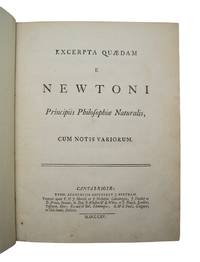
176569380Cambridge: J. Bentham 1765. Full Description:<br> <br> NEWTON Sir Isaac. Excerpta Quaedam. e Newtoni Principiis Philosophiae Naturalis Cum Notis Variorum. Cambridge: J. Bentham 1765.<br> <br> First edition of a selection of excerpts from Newton's "Principia." Subscriber's copy. Quarto 9 3/4 x 8 inches; 248 x 200 mm. ix list of subscribers 1 corrigenda 180 pp. With twelve engraved folding plates and commentary on Newton's text by three Cambridge scholars.<br> <br> Modern full red morocco. Newer marbled endpapers. Binding with some mild rubbing. Some dampstaining along outer lower and fore-edge margins. Title-page and leaf a4 Subscribers have been remargined at inner margin. Leaf Y4 and Plate XI remargined at fore-edge not affecting text. Overall a very good copy.<br> <br> Excerpts for subscribers from "the greatest work in the history of science" PMM.<br> <br> PMM 161. Babson 15.<br> <br> HBS 69380.<br> <br> $1500. J. Bentham unknown
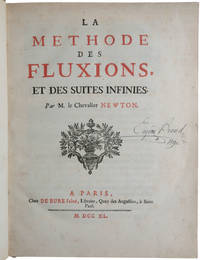
17405802Paris: De Bure l'aine 1740. First edition. <p>First edition in French of Newton's first exposition of his fluxional calculus translated with a long and impotant preface by the celebrated naturalist Comte de Buffon. Originally written in 1671 in Latin this was Newton's first comprehensive presentation of his method of fluxions which according to Hall 'might have effected a mathematical revolution in its own day' Philosophers at War pp. 65-6. It should properly be placed first in the great trilogy of Newton's major works: Fluxions Principia 1687 and Opticks 1704.</p>. BUFFON'S TRANSLATION OF NEWTON'S EXPOSITION OF CALCULUS. <p>First edition in French of Newton's first exposition of his fluxional calculus translated with a long and important preface by the celebrated naturalist Comte de Buffon. Originally written in 1671 in Latin this was Newton's first comprehensive presentation of his method of fluxions which according to Hall 'might have effected a mathematical revolution in its own day' Philosophers at War pp. 65-6. It should properly be placed first in the great trilogy of Newton's major works: Fluxions Principia 1687 and Opticks 1704. Newton's Methodus fluxionum remained unpublished until its English translation by John Colson in 1736. In it he presents a method of determining the magnitudes of finite quantities by the velocities of their generating motions. At its time of preparation it was Newton's fullest exposition of the fundamental problem of the calculus in which he presented his successful general method. Newton prepared this treatise just before his death. The autograph manuscript which survives in Cambridge University Library was entrusted to Henry Pemberton after Newton's death but he did not publish it. John Colson 1680-1760 based his translation on a copy of Newton's original manuscript made by William Jones. Both Newton's manuscript and Jones's copy lack a title page and it is unknown what title if any Newton gave to the manuscript. The title 'De methodus fluxionum' originates with Colson. In the preface Colson writes "I thought it highly injurious to the memory and reputation of our own nation that so curious and useful a piece should be any longer suppressed." Buffon translated Colson's edition in 1737 and added his lengthy preface the following year. The most interesting part of the preface is that dealing with the conception of the infinite and the metaphysical errors to which it leads. This includes a discussion of Berkeley's The analyst 1734 which oddly he criticizes although Berkeley's conclusions are very similar to his own.</p> <br /> <p>Provenance: Eugène Brand signature on title dated 1890.</p> <br /> <p>Newton wrote three accounts of the calculus. The composition of the first a tract entitled 'De analysi per aequationes numero terminorum infinitas' resulted from Newton's reception from Isaac Barrow in the early months of 1669 of a copy of Mercator's Logarithmotechnia a work which contained the series for log1 x. The work in which Newton demonstrated his much more general methods of infinite series was not published until 1711 when William Jones included it along with a number of other tracts in his Analysis per quantitatum series. In 'De analysi' however Newton "did not explicitly make use of the fluxionary notation or idea. Instead he used the infinitely small both geometrically and analytically in a manner similar to that found in Barrow and Fermat and extended its applicability by the use of the binomial theorem. . It will be noticed that although the work of Newton contains the essential procedures of the calculus the justification of these is not clear from the explanation he gave. Newton did not point out by what right the terms involving powers of o were to be dropped out of the calculation any more than Fermat or Barrow . His contribution was that of facilitating the operations rather than of clarifying the conceptions. As Newton himself admitted in this work his method is 'shortly explained rather than accurately demonstrated'" Boyer The Concept of Calculus p.191.</p> <br /> <p>It was first in 'Methodus fluxionum' that "Newton introduced his characteristic notation and conceptions. Here he regarded his variable quantities as generated by the continuous motion of points lines and planes rather than as aggregates of infinitesimal elements the view which had appeared in 'De analysi'. . In the 'Methodus fluxionum' Newton stated clearly the fundamental problem of the calculus: the relation of quantities being given to find the relation of the fluxions of these; and conversely" ibid. pp. 192-3.</p> <br /> <p>In Newton's third exposition De quadratura which was composed some twenty years after 'Methodus fluxionum' and published as an appendix to the Opticks "Newton sought to remove all traces of the infinitely small" ibid.</p> <br /> <p>"It was often lamented that the world had had to wait so many years to see Newton's masterpiece on fluxions. It is astonishing to realize that publication sixty years beforehand would have changed the history of the calculus and would have avoided for Newton any controversy over priority. In 1736 all the results contained in Newton's treatise were well known to mathematicians. However it was too concise for a beginner and Colson added almost 200 pages of explanatory notes. His commentary contributed to the establishment of a kinematical approach to the problem of foundations. In his explanatory notes Colson presents the 'geometrical and Mechanical Elements of Fluxions'. He writes:</p> <br /> <p>'The foregoing Principles of the Doctrine of Fluxions being chiefly abstracted and Analytical. I shall here endeavour after a general manner to shew something analogous to them in Geometry and Mechanicks: by which they may become not only the object of the Understanding and of the Imagination which will only prove their possible existence but even of Sense too by making them actually to exist in a visible and sensible form'.</p> <br /> <p>"Colson was convinced that by using moving diagrams it is possible to exhibit 'Fluxions and Fluents Geometrically and Mechanically . so as to make them the objects of Sense and ocular Demonstration'. The motivation for using the geometrical and mechanical elements of fluxions is clearly that of guaranteeing an ontological basis to the calculus; in fact:</p> <br /> <p>'Fluents Fluxions and their rectilinear Measures will be sensibly and mechanically exhibited and therefore must be allowed to have a place in rerum natura'.</p> <br /> <p>"Colson's approach to the calculus is representative of a whole generation of British mathematicians: his 'sensibly exhibited rectilinear measures' of fluxions are a naive anticipation of Maclaurin's kinematic definitions of the basic concepts of the calculus" Guicciardini The Development of Newtonian Calculus in Britain 1700-1800 pp. 56-57.</p> <br /> <p>"In his preface . Colson noted:</p> <br /> <p>'The chief Principle upon which the Method of Fluxions is here built is. taken from the Rational Mechanicks; which is That Mathematical Quantity particularly Extension may be conceived as generated by continued local Motion; and that all Quantities may be conceived as generated after a like manner. Consequently there must be comparative Velocities of increase and decrease during such generations whose Relations are fixt and determinable and may therefore . proposed to be found.'</p> <br /> <p>"Thus a line or a curve was seen as generated by a continuously moving point a surface by the motion of a line and a solid by the motion of a surface. After defining fluxions fluents and moments Newton went on to show how within this framework significant results could be derived. Following an introduction in which it was shown how equations could be solved with the use of infinite series seven major problems were considered:</p> <br /> <br /> From the Following Quantities fluents given to find their fluxions.<br /> From the given Fluxions to find the Flowing Quantities.<br /> To determine Maxima and Minima of Quantities.<br /> To draw Tangents to Curves.<br /> To find the Quantity of Curvature in any Curve.<br /> To find the Quality of Curvature in any Curve.<br /> To find any number of Curves that may be squared"<br /> <br /> <p>Gjertsen Newton Handbook p. 158.</p> <br /> <p>"Buffon did start his scientific career as a Newtonian. He agreed that science should search for nature's laws and that those laws should be as simple and as universal as possible. Buffon's strong stance in favor of an orthodox Newtonianism was most obvious during his academic polemics with Alexis Clairaut. Buffon also published translations of two English books: Stephen Hales's Vegetable Staticks 1735 and Newton's Treatise on Fluxions 1740. The young man who wrote the prefaces to these books praised the experimental spirit of the English. But to what extent did these texts in fact express Buffon's supposed Newtonian position .</p> <br /> <p>"The case of the preface to Newton's Fluxions 1740 was a different matter since it appeared to be a sign of allegiance both to Newton and to mathematics in the guise of the calculus. But in fact Buffon's preface while acknowledging the perfect clarity of Newton's ideas developed a metaphysical critique of the concept of the infinite that had been closely tied to the practice of geometry. Buffon asserted that our daily experience by means of sensation is restricted to the limited the finite-and therefore that the arithmetical or geometrical infinite had no actual existence. The preface to the Fluxions far from being a sign of Buffon's loyalty to mathematical conceptions of science instead stressed the lack of reality of mathematical ideas. Some of these strong statements would later be developed near the end of the 'Premier discours' of the Histoire naturelle" Hoquet pp. 39-41.</p> <br /> <p>"In his preface Buffon rewrote the history of the calculus - drawing inspiration largely from a book that Fontenelle had published in 1727 Élémens de la géométrie de l'infini - in which he sided strongly with Newton against Leibniz. He was rightly criticized for his lack of objectivity and he became closely tied with English scholars whose point of view he blindly adopted. In France furthermore he became involved with Clairaut Maupertuis and Voltaire in a battle in defense of Newton. His translation and preface must be viewed from his perspective - historical objectivity was not his main concern .</p> <br /> <p>"The debate on infinity tells us something about Buffon's intellectual temperament . At the end of the seventeenth century a lengthy evolution of ideas had led to the Newtonian conception of an infinite time and space and therefore an infinite universe . Calculus gave a new topicality to this philosophical debate since it raised the question of whether the infinitely small quantities manipulated by the new calculus really existed. Leibniz did not believe so . In 1727 Fontenelle defended their real existence and Buffon seemed at first to have accepted his argument. He now attacked Fontenelle without naming him .</p> <br /> <p>"Buffon rejected Fontenelle's conclusion mainly because he did not differentiate between geometrical and metaphysical infinities. 'The idea of infinity' he said 'is only an idea of absence and has no concrete representation.' Even 'space time and duration are not real Infinities.' Likewise 'there is no number that is at present Infinite or infinitely small or smaller or bigger than an Infinity etc.' Because 'Numbers are no more than representations and never exist independently of the things they represent' they do not have a 'real existence' and things themselves cannot be infinite .</p> <br /> <p>"The direct consequence of this philosophy was that mathematics does not teach us anything about reality. More precisely - and here Buffon distanced himself radically from Fontenelle - mathematics does not have its own reality. Fontenelle gives an intellectual reality to numbers and geometrical figures independent of all physical and metaphysical reality. For Buffon there was only physical reality. Thus mathematics was only a tool practical even indispensable but nothing more .</p> <br /> <p>"The last argument in which Buffon intervened was the one that the idealistic philosopher Berkeley had provoked by attacking the metaphysical foundations of calculus .it is clear that Buffon addressed it only to defend his friend the English doctor and mathematician James Jurin. Regardless of what he said Buffon certainly had not read Berkeley's book The analyst 1734 attentively otherwise he would have seen that Berkeley's criticisms of the status of the infinitely small corresponded exactly to his own although they were based on an extremely different metaphysics. As with Leibniz the fundamental philosophical differences prevented Buffon from recognising what they had in common. His attack on Berkeley was more satire than philosophical discussion. By intervening so lightly into a serious debate Buffon exposed himself to criticism. The interesting thing about this episode is that it shows his friendship with James Jurin and suggest that it was Jurin who had advised him in the Leibniz-Newton controversy" Roger pp. 34-38.</p> <br /> <p>Babson 173; Macclesfield 1533; Wallis 236. Hoquet 'History without Time. Buffon's natural history as a nonmathematical physique Isis 101 2010 pp. 30-61. Roger Buffon: A Life in Natural History 1997.</p> <br/> <br/> 4to 255 x 196 mm pp. xxx 4 errata and privilege 148 title printed in red and black woodcut figures in text. Contemporary quarter-morocco and marbled boards spine ruled and in gilt with red lettering-piece a little rubbed joints starting. De Bure l'aine unknown
17296375London: William Innys for the Royal Society 1729. First edition. <p>First edition in the original Latin of Newton's Cambridge lectures on optics-his earliest systematic exposition of the mathematical theory of light and colour delivered as Lucasian Professor and published here for the first time from his manuscripts. These lectures form the foundation of Newton's later Opticks 1704 but include substantial mathematical content omitted from that more accessible English version. Notably they contain Newton's formulation of the compound nature of white light a cornerstone of modern optical theory.</p>. <p>EDITIO PRINCEPS OF NEWTON'S CAMBRIDGE LECTURES ON OPTICS</p> . <p>First edition of the complete text in the original Latin of Newton's inaugural lectures as the second Lucasian professor of mathematics at Cambridge and the first publication of his lectures on his new mathematical science of colour including his discovery of the compound nature of white light. It was from this material that Newton composed his Opticks of 1704 although in the Opticks he left out the specifically mathematical parts of the lectures which are included here. Newton "was obliged by the statutes of the post to lecture and to deposit the lectures in the University Library. For the period 1670-72 Newton lectured on optics and deposited the lectures in the ULC in October 1674. At one time Newton seemed to be contemplating publishing the lectures together with the mathematical work De methodis but by May 1672 he had decided otherwise and wrote to Collins: 'I have now determined otherwise of them; finding already by the little use I have made of the Presse that I shall not enjoy my former serene liberty till I have done with it' Correspondence I p 161. Consequently . the lectures remained unpublished until after his death as did the De methodis" Gjertsen pp. 409-410. Following Newton's death in March 1727 his followers decided to publish the lectures both in the original Latin and in English. In fact only Part I on the mathematical theory of reflection and refraction was translated and published in English in 1728; part II on colours was omitted. The present Latin edition which includes both parts is thus the editio princeps of the complete series of Newton's lectures including the first publication of his lectures on colours. Based on a copy belonging to David Gregory it was discovered during the printing that there were discrepancies between Gregory's copy and the copy deposited by Newton in the ULC which necessitated the inclusion of a five-page 'Addenda and Corrigenda'. "Today we can appreciate the Lectiones as an invaluable document of Newton's investigations of optics that reveals his ideas in the midst of his most productive period of research. In the inevitable comparison with the Opticks 1704 which recounts research for the most part carried out twenty to thirty years earlier and since refined - sometimes overrefined - the lectures must be judged neither as carefully developed nor as polished. But whatever polish it may lack is more than compensated for by its vitality as Newton boldly attempts in the following pages to create a new mathematical science of color" Shapiro p. 25. Since the Lectiones "was his first and most comprehensive account of his theory of color he naturally drew upon it in his later writings. It served as the immediate source for his 'New theory of light and colors' 1672 in the Philosophical Transactions his first public statement of his theory outside the Cambridge lecture halls. And twenty years later it remained the foundation for the 'definitive' statement of his theory in Book I of the Opticks" ibid. p. 1. This was the only separate edition of Newton's complete lectures: the text was published six more times in the eighteenth century in various collections of Newton's works.</p> <br /> <p>Provenance: 'Ex-libris Dutour' on front free endpaper followed by a price; some marginal notes in Latin.</p> <br /> <p>"Upon his appointment as Isaac Barrow's successor to the Lucasian chair in the late autumn of 1669 Newton was confronted with developing a series of lectures to begin the following January. In a natural extension to Barrow's prior series of optical lectures published as Lectiones XVIII 1669 he took the opportunity to make the first formal presentation of his new mathematical science of color. The Lucasian Professor was required to give one lecture for about one hour each week during the term and to submit annually not fewer than ten of those lectures to the Vice-Chancellor for deposit in the University Library for public use. Newton complied with this regulation somewhat tardily in October 1674 when he delivered to the Vice-Chancellor his Optica divided into two parts with a total of thirty-one lectures. According to the marginal annotations the first lecture of Part I was delivered in January 1670 at the beginning of Lent term and Lecture 9 of Part I and Lectures 4 and 14 of Part II opened the Michaelmas terms beginning in October of 1670 1671 and 1672" Shapiro p. 16.</p> <br /> <p>As noted above by the winter of 1671-2 Newton had decided to publish the Optica together with his mathematical treatise De methodis serierum et fluxionum the latter was not actually published until 1736. However following the publication of his 'New theory of light and colours' in the Philosophical Transactions a few months later Newton changed his mind: his 'New theory' had resulted in controversy which he was loathe to encourage by further publications. "In September 1672 Newton had decided to recast his theory in a more formal structure 'in imitation of the Method by wch Mathematicians are wont to prove their doctrines.' The next year in outlining his restructured theory for Christiaan Huygens he recognized that it needed a more rigorous proof . Instead Newton was planning a work very much like the later Opticks . In this newly projected work the sections of the Optica on color were to be extensively rewritten and its mathematical part omitted. There is no evidence that Newton wrote such a discourse during this period but when in the early 1690s he eventually composed the Opticks he in essence followed the plan he had proposed in the mid-1670s . When after still another postponement the Opticks was finally published in 1704 Newton felt it necessary to warn that 'If any other Papers writ on this Subject are got out of my Hands they are imperfect and were perhaps written before I had tried all the Experiments here set down and fully satisfied my self about the Laws of Refractions and Composition of Colours I have here Published what I think proper to come abroad.' He is here inter alia surely referring to his Optica deposited thirty years earlier in the Cambridge University Library . During his lifetime Newton's disavowal was respected by eager members of the Newtonian circle but an English translation of Part I appeared in 1728 the year after his death followed in the next year by the editio princeps of the complete Latin text of the Optica . The editor of the Latin edition emphasized the significance of the geometrical demonstrations and philosophical arguments in Part I because in the Opticks Newton 'seems to have been as careful as possible not to mix geometrical demonstrations with philosophical arguments and when it was necessary to set forth a mathematical proposition its demonstration scarcely ever occurs' . He also perceptively recognized that with respect to color 'many things are found in each with the same meaning but are explained in a different manner'" ibid. pp. 21-23.</p> <br /> <p>"After briefly paying tribute to Barrow and deriding efforts to improve refracting telescopes by the use of nonspherical lenses Newton devotes the first two lectures of Part I to laying the foundations for the whole of the Lectures: a demonstration that direct sunlight consists of rays that differ in their degree of refrangibility. Virtually the entire burden of his demonstration is borne by an analysis of the elongated spectrum formed by passing a narrow beam of sunlight through a prism. Newton's major insight and the key to his demonstration was to recognize that when a prism is placed symmetrically with respect to the incident and emergent beams or at minimum deviation the sun's image would be circular rather than elongated if all rays were refracted equally. An exact solution for the shape of the sun's image with monochromatic rays is exceedingly difficult involving a finite source and aperture and rays incident out of the principal plane; but he is able to demonstrate that under particular conditions such as with a point aperture the image is nearly circular. This was sufficient for his purpose for he had found the spectrum's length to be five times its breadth thus making small deviations from the assumed condition inconsequential.</p> <br /> <p>"Newton begins Lecture 2 by describing the shape of the spectrum to be an oblong bounded by straight edges and semicircular ends and he argues formed by innumerable overlapping circular images of the sun each consisting of rays of a different refrangibility . The thrust of the remainder of the lecture describes how to decrease the effective size of the source and thus the circular images and to approach the ideal spectrum - a straight line with no breadth - formed by a point source. By this mode of demonstration culminating in the observation of Venus's spectrum he makes the actually observed shape of the sun's spectrum inessential to his proof that its elongation is caused by unequal refrangibility ibid. pp. 26-27.</p> <br /> <p>"Newton begins his 'dissertation on the measure of refractions' which constitutes the next three lectures with an explanation of Descartes's sine law of refraction which he extends - without experimental demonstration - to rays of each color . Next in two lemmas he derives the equations for his preferred method to measure the index of refraction that of minimum deviation in prisms one of his most important contributions to quantitative experimental optics . Newton opens Lecture 10 by extending the method of minimum deviation to fluids with the use of a hollow prism with glass sides and he illustrates this method by a measurement of the mean index of refraction of water . He then advances to the next phase of his investigation of refraction: to determine the indices of refraction of the extreme rays or the chromatic dispersion . When the prism is placed at minimum deviation for the mean refrangible rays he measure the length of the spectrum and thereby determines the angular dispersion. He presents a simple measurement and calculation for the dispersion of glass .</p> <br /> <p>"Newton concludes his 'dissertation on the measures of refraction' in Lecture 11 by setting forth a dispersion law which serves as the foundation for the rest of the Lectures. He freely admits that it is a purely theoretical construct that he has not yet experimentally tested. Though he presents his dispersion law solely in mathematical terms without any mechanical interpretation it is evidently a modification of Descartes's projectile model for a single sort of ray extended to apply to polychromatic rays. It represents the very ideal of a rational optics for the indices of refraction of rays of every color in any medium can be determined with only a single measurement as Newton illustrates with water .</p> <br /> <p>"In Lectures 12 and 13 on refraction at a single plane surface Newton attempts to uncover the physical implications of the laws of refraction the sine law and his dispersion law by a thorough mathematical analysis. Since that dispersion law was so tenuously founded and is the starting point for much of his analysis these lectures are now as notable for their mathematical analyses as for their contributions to optics.</p> <br /> <p>"Lecture 12 is . devoted to the single problem in Proposition 3 of determining the position of a luminous point viewed obliquely across a plane reflecting surface. Newton's recognition here that there are two image points effectively begins the study of astigmatism . Lecture 13 . studies a natural extension of Proposition 3: to determine the shape of the extended image of a point source due to the varying index of refraction when the point is viewed across a plane surface. He elegantly demonstrates that the images of the point lie on a Dioclean cissoid .</p> <br /> <p>"In the next two pairs of Lectures 14 15 and 16 17 Newton continues his attempt to create a rational science of color by investigating the variation of angular dispersion as the index of refractions and hence the chromatic dispersion of the refracting media vary . The brief Lecture 18 treats refraction in prisms .</p> <br /> <p>"Section 4 on refraction at curved surfaces the conclusion of the mathematical part of the Optica is its highpoint an intimate blend of mathematics and physics consistently yielding novel interesting results . He effectively begins this section in Proposition 29 by determining the image point in a form equivalent to the Gaussian formula for paraxial rays incident upon a single spherical surface; and then in Proposition 30 he extends this result to any curved surface by substituting the center of curvature determined in Lemma 9 in the immediate neighborhood of the incident rays for the center of the spherical surface. In Proposition 31 Newton applies many of the newly wrought mathematical methods such as series expansions and the determination of extrema to find the longitudinal spherical aberration for rays incident on the plane face of a plano-convex lens and then the circle of least confusion. Because of its algebraic formulation this proposition is particularly accessible to the modern reader and provides a fine example of Newton's application of mathematics to physics. In the next proposition he elegantly derives the location of the primary image point or caustic locus for rays obliquely incident upon a spherical surface while also noting the existence and location of the secondary image point. Proposition 33 extends this result to any curved refracting surface. In Proposition 34 he presents his own solution to a problem posed and solved by Descartes: to find the aplanatic surface a Cartesian oval that refracts rays perfectly from a given point to a given point. Pursuing the Cartesian theme in Propositions 35 and 36 he derives the radii of the primary and secondary rainbows and then moving beyond all his contemporaries he generalizes his solution to bows of any order. And to conclude Newton in Proposition 37 calculates the chromatic aberration to show that it is much more enormous - some 1500 times greater - than spherical aberration and once again stresses the significance of his discovery of unequal refrangibility for practical optics" ibid. pp. 36-41.</p> <br /> <p>In Part II Newton begins the 'dissertation on colors' by reiterating his inaugural remarks on the defects of contemporary telescopes and the impediment presented by chromatic aberration and in prelude to his own theory he vigorously attacks both Aristotelian and more recent modification theories of colour. He then presents his theory in five propositions. The first proposition that to differently refrangible rays there correspond different colors had already been established in Part I. Its converse states that different colors are unequally refracted. "To demonstrate this he introduces his crossed-prism experiments where spectra cast on a second transverse prism become inclined to their original orientation because the blue end is always refracted more than the red. Initially he places the second prism transverse to the first one to minimize the unequal incidence arising from the refraction of the first prism; but by passing the refracted rays through two holes far apart so that they fall on the second prism at very nearly the same angle of incidence he eliminated the requirement for any particular orientation of the second prism and arrives at an experimental arrangement virtually identical to the experimentum crucis of the 'New theory' .</p> <br /> <p>"Proposition 2 on the immutability of monochromatic colors is established by first separating the spectral colors from one another and then demonstrating that the more completely they are separated the smaller are their changes after additional refractions. He first separates the colors with two parallel prisms and observes some color change because the adjacent colors are still intermingled but when he adds two more prisms he is unable to detect any further sensible change .</p> <br /> <p>"In Lectures 4-7 Newton carries out the first part of his demonstration of Proposition 3 that white light in particular sunlight is composed of rays of every color by showing five different ways to make white from a mixture of spectral colors: i colors from three prisms are cast onto a screen where they are mixed; ii one face of a prism is covered with an opaque paper with six slits each functioning as one of the prisms in the preceding experiment and then the colors from the various slits mix on a screen; iii light scattered from a screen on which a spectrum has been projected is received on a second screen where the scattered rays mix; iv the colors dispersed by a prism are transmitted through a lens and brought together at its focus; v in a variant of the preceding way a mirror is substituted for the lens. He also illustrates the compound nature of white by a mixture of colored powders and by a froth of soap bubbles .</p> <br /> <p>"Newton now applies himself to the second and more difficult part of his demonstration of Proposition 3 namely to show that the sun's direct light is compounded of colors even before they are apparent. He bases his demonstration on the phenomenon of total reflection for as he discovered the critical angle of reflection varies for each color. In the first and simplest experiment a beam of sunlight is partially reflected and partially refracted at the base of a prism. As the prism is rotated the colors are totally reflected in sequence and the reflected and transmitted beams change color until when the red rays are at last totally reflected and the transmitted beam vanishes the reflective beam is restored to white. Newton argues implicitly appealing to the emission theory of light that this reveals that the colors are in the rays as they arrive from the sun since they preserve and exhibit the same color whether they are reflected refracted. Furthermore this shows that reflected light is compound since white is restored when the last color red is totally reflected. To make this interpretation still more certain he introduces three variants of this basic experiment one of which is an exact analog of the experimentum crucis but with total reflection replacing the second refraction . Newton concludes the proof of Proposition 3 by briefly explaining why the sun's light is yellowish rather than white and then by showing that black is compounded from all colors grey from white and black and all other compound colors from the painter's primaries red yellow and blue. Despite the need for some restrictions and the brevity of its demonstration Proposition 4 that spectral colors can be compounded from their neighbouring colors is an important contribution to the theory of compound colors and displays Newton's keen experimental skill.</p> <br /> <p>"Newton now turns to his fifth and final proposition that natural bodies derive their color from the sort of rays they reflect most. By the principle of color immutability the color of a ray cannot be changed my reflection so that bodies can appear only the color of the rays illuminating them. To explain why all bodies are not therefore the same color in daylight as this principle alone would demand he adds that bodies reflect more of their own daylight color than others. After demonstrating this by illuminating various bodies with monochromatic light he moves beyond this phenomenological account and attributes two distinct powers to bodies: to reflect rays and to transmit them. These rays are complementary for the rays that are not reflected pass through the body and he illustrates this with the colors of such substances as gold leaf which reflects yellow light and transmits blue. Newton did recognize that most bodies are not of this sort but are the same color all around and to explain this he introduces a third power - and a new concept in optics - selective absorption .</p> <br /> <p>"In the concluding section of the Optica Newton considers the colors generated by refractions at curved surfaces namely lenses the eye and raindrops or the rainbow. He first describes the chromatic aberration of a plano-convex lens and gives a simple physical derivation and numerical estimate of its magnitude. Observing that the eye is a lens of sorts which should likewise suffer from chromatic aberration he presents a simple experimental demonstration of its existence. In the last article of Lecture 14 and in all of Lecture 15 Newton indulges in the sort of speculative or hypothetical natural philosophy that he frequently and vigorously decried yet could not always resist. Exhibiting a firm command of Cartesian natural philosophy he explains the cause of the colored circles or coronas that Descartes saw around a candle after he had pressed his eye shut for a long time. While Newton recognizes that an infinity of causes may be devised to explain these colored circles he ascribes them to refractions in wrinkles impressed on the cornea and invoking the principles of hydrostatics rejects Descartes's own suggestion that they are impressed on the crystalline lens. He concludes the Optica in Lecture 16 with a far more notable achievement an explanation of the dimensions and colors of the rainbow based on the mathematical results derived in Part I" ibid. pp. 28-36.</p> <br /> <p>Babson 155; Wallis 191; ESTC t18664. Gjertsen The Newton Handbook 1986. Shapiro ed. The Optical Papers of Isaac Newton Vol. 1 The Optical Lectures 1670-1672 1984.</p> <br/> <br/> 4to 221 x 165 mm pp xii 144 145-152 153-291 5 Addenda and corrigenda with 24 folding engraved plates some spotting scattered foxing. Contemporary marbled sheep spine gilt in compartments red morocco spine label marbled endpapers red edges a little rubbed minor abrasion to upper board. William Innys for the Royal Society unknown
1704140946960London: Printed for Sam. Smith and Benj. Walford Printers to the Royal Society at the Prince's Arms in St. Paul's Church-Yard 1704. First Edition. Very Good. First edition first issue of this foundational work in the field of optics in which Isaac Newton explores the nature of light and color presenting his experiments and theories on how light behaves. Title printed in red and black within a double-rule border and without author's name. Bound in contemporary paneled calf boards sympathetically rebacked; with 19 engraved folding plates. <p>Very Good. Soiling to textblock and endsheets bookplate of Irish naturalist John Vandeleur Stewart affixed to the front pastedown ownership signature to title page. Amateur repair to gutter at title page. Numerous pencil notations throughout though mostly confined to the margins or blank areas. Plate 5 is torn at the fold plate 6 with corner loss affecting the image several shaved. Second book with page 120 misnumbered as 112. <p>A lovely copy of Newton's second major book on physical science considered one of the Scientific Revolution's three major works on optics. It overturned centuries of thinking attributed to Aristotle or Theophrastus and accepted by scholars in Newton's time that "pure" light such as the light attributed to the Sun is fundamentally white or colorless and is altered into color by mixture with darkness caused by interactions with matter. Here Newton shows the opposite was true: light is composed of different spectral hues he describes seven – red orange yellow green blue indigo and violet and all colors including white are formed by various mixtures of these hues. He demonstrates that color arises from a physical property of light – each hue is refracted at a characteristic angle by a prism or lens – but he clearly states that color is a sensation within the mind and not an inherent property of material objects or of light itself. <p>Unlike his earlier work Philosophiae Naturalis Principia Mathematica which took a more deductive approach Opticks is largely experimental and inductive. Newton's study includes detailed descriptions of his experiments with prisms and lenses leading to the conclusion that white light is composed of a spectrum of colors. The work also delves into the phenomena of diffraction and interference which were crucial to the development of wave theory in later years. The work is notable for containing Newton's first mathematical papers in print and for giving the first full explanation of the rainbow complete with related diagrams. Like Galileo Newton decided to publish this text in his native English rather than Latin the language of scholarship; an enlarged Latin edition would be published two years later. Printed for Sam. Smith and Benj. Walford, Printers to the Royal Society, at the Prince's Arms in St. Paul's Church-Yard unknown
1730035995London: William Innys 1730. 4th Edition 1st Printing. Hardcover. Near Fine. New Calf Spine And Tips Over Marbled Paper Covered Boards New Endpapers. Two Preliminary Blanks Title Advertisements To First Second And Fourth Editions382 Pp 12 Folding Plates And Two Pages Of Publisher's Ads At Rear. Page Block 19.5 Cm Text Block 6.5" X 3 1/2" From Top To Bottom Of Printed Area Including Page Running Headings Tall. Top Edge Of Page Block Is Dark Grey Or Black Fore Edge And Bottom Edge Red All Polished. Leaves 7 5/8" Tall; Binding 7 3/4" X 5 3/16". The Last And Best Edition Prepared By Newton Corrected From The Third Edition By Newton; In This Fourth Edition Of 1730 There Are 31 Queries And It Is The Famous "31St Query" That Over The Next Two Hundred Years Stimulated A Great Deal Of Speculation And Development On Theories Of Chemical Affinity. The Publishers Have Added To This Edition Several Citations From The Lectiones Opticae 1669-1671 To Show Where Demonstrations Omitted From The Opticks May Be Found. Unusually Well Preserved Binding Fine Contents Clean Some Tiny Foxing Spots Mainly In Margins And Mainly Towards Beginning Of Book; Very Slight Wear To Edges Of Page Block. . <br/> <br/> William Innys hardcover
1704157612London: Smith & Walford 1704. First. hardcover. very good. 4 parts in 1 volume. Title page printed in red & black within a double-ruled border. Illustrated with 19 folding copperplate engravings.4 144 211 1 pages. In the second sequence p. 120 is marked 112 and there are blank pages between 137-8 and 138-9. Thick 4to contemporary blind-tooled paneled calf well-worn and now expertly re-backed in sympathetic leather; last several pages have marginal dampstains otherwise a remarkably clean crisp copy. London: Smith & Walford Printers to the Royal Society 1704. First edition first issue - with the author not named on title page.<br/> <br/> "Newton's Opticks expounds his corpuscular theory of light and summarizes his experiments concerning light and colour. It also prints two important mathematical treatises omitted in later editions describing his invention of the fluxional calculus the grounds for his claim of priority over Leibniz. Newton arrived at most of his unconventional ideas on colour by about 1668 and Opticks was largely complete by 1692. However when he first partially expressed his theories in public in 1672 and 1675 they provoked hostile criticism especially on the continent. As a result Newton delayed the publication of Opticks until his most vociferous critics - especially Robert Hooke - were dead. Unusually for Newton and in what was probably a further defensive move the work was first published in English rather than Latin becoming a major contribution to the development of vernacular scientific literature. By about 1715 Opticks established itself as a model for interweaving theory with quantitative experimentation. Newton's aim was not to "explain the properties of light by hypotheses but to propose and prove them by reason and experiments" p. 1. The great achievement of the work was to show that colour was a mathematically definable property."<BR> <BR> The work contains: The First Book of Opticks The Second Book of Opticks The Thrid Book of Opticks Tertii Ordinis: Enumeratio Linearum Tractatus de Quadratura Curvarum. The main work is in English the 2 treatises pages 138-211 are in Latin. Babson 132; Gray 174; Horblit 79b; PMM 172; Norman 1588; Dibner 148; Wallis 174.Provenance: Signature of Francis Cremer the initial owner & contemporary of Newton's dated 1704 is on the title page with the price he paid of 12 shillings. Another ownership signature "Gul Bryant" also a sudent at Cambridge some decades later is on the rear flyleaf and the library label of Francis E. Nipher 1847- 1926 the American physicist on the front paste-down.<br/> <br/> Smith & Walford unknown