[Juan y Santacilia, Jorge]; [Ulloa, Antonio de]; [Torres Villarroel, Diego de]; [Newton, Isaac]Biblio.com
104 résultats
17521862Spain 1752. 18th-century manuscript. Text in Spanish. 24 handwritten pages in ink in three different hands. Later binding of blank paper using old material. Tiny wormholes at the lower edge of the pages on the first 7 leaves not affecting the legibility. Occasional foxing ink ghosting. Water stains on the last 2 leaves. Overall in fine condition. 18th-century manuscript. Text in Spanish. 24 handwritten pages in ink in three different hands. ff 12. <p><br /> 18th-Century Spanish manuscript about the Spanish involvement in the French Geodesic Mission of 1735 and the Ellipsoid Model of the Earth.<br /> <p><p><br /> The manuscript is an interesting collection of contemporary reports proving the importance of the Spanish role performed by Jorge Juan y Santacilia and Antonio de Ulloa in the so-called French Geodesic Mission 1735 with a particular focus on the polemic over the shape of the Earth. The quotations are conjugated with connecting texts by an anonymous author.<br /> <p><p><br /> One of the important scientific disputes of the late 17th early 18th century was the debate on the shape of the Earth. The assumption of the spherical shape was dominating until the late 17th century when Sir Isaac Newton determined that the Earth was oblate a spheroid stretched over the Equator however at the same time Giovanni Domenico Cassini and his son Jacques supposed that the Earth was prolate stretched along the poles. Eventually in 1735 two expeditions were sent by Louis XV and the French Academy to the Arctic Circle Lapland and to the Equator Ecuador and Peru to gain certainty by measuring the meridian arcs at polar and equatorial latitudes. The equatorial mission was accompanied by two Spanish geographers Jorge Juan y Santacilia and Antonio de Ulloa thus it became the first major international scientific expedition. The findings of the missions confirmed Newton’s hypothesis that the Earth was oblate a rotational ellipsoid.<br /> <p><p><br /> The first part of the manuscript is a lengthy citation of an early Spanish report on the equatorial mission published in the Mercurio histórico y político February 1745; pp. 99–107 which is followed by further references and quotations related to the geographer’s their work and the figure of the Earth such as Benito Jerónimo Feijóo y Montenegro’s Theatro critico universal 1751 Bernardo’s de Ulloa’s Antonio’s father Restablecimento de las fabricas y comercio español 1749 and articles from the Journal de Trévoux or the Gaceta de Zaragoza. The second part is Diego de Torres Villarroel’s 1693–1770 study Prevenciones in: Libros en que estan reatados. Vol. IV.; 1752 in which de Torres the almanac writer and professor of mathematics of a dubious repute opposes the findings of the missions and Newton’s hypothesis of the oblate Earth.<br /> <p><p><br /> Antonio de Ulloa 1716–1795 was a Spanish scientist and explorer the first Spanish governor of Louisiana who is also credited as the discoverer of the element platinum. De Ulloa was a Fellow of the Royal Society and a foreign member of the Royal Swedish Academy of Sciences. His associate Spanish scientist in the Geodesic Mission to Peru was Jorge Juan y Santacilia 1713–1773 who during the mission also measured the heights of the mountains of the Andes. Jorge Juan was the founder of the Real Observatorio de Madrid Royal Observatory of Madrid and he became a Fellow of the Royal Society too. Their co-written memoirs were published in Spanish from 1748 on and their books were very soon translated into French English and German.<br /> <p><p><br /> Literature: Lafuente A.; Mazuecos A.: Gentlemen of the Fixed Point: Science Politics and Adventure in the Geodesic Expedition to the Viceroyalty of Peru in the XVIII Century. pp. 171–203. Retrieved on July 8 2020 from Mayboudi L. S.: chapter 5.1 In: Geometry Creation and Import With COMSOL Multiphysics. Dulles VA USA: Mercury Learning & Information 2019.; Richardson D.; et al: The International Encyclopedia of Geography People the Earth Environment and Technology: Chichester UK; Hoboken NJ: John Wiley & Sons 2017.<br /> <p>. unknown
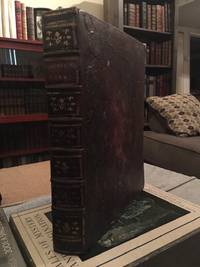
1752BBS-2006348Printed by E. Cave at St. John's Gate; And sold by Mr. Watson an apothecary over-against St Martin's Church in the Strand; Mr Parker at Oxford; Mr Sandby at the Ship in Fleet-Street: London 1752. Hardcover. Very Good. Unpaginated; primarily illustrated with index and preface preceding 174 leaves of plates. This herbal presents images and English names for several thousand trees and plants organized in tables each containing about twenty images grouped by type. It was based on the work of earlier herbals made by James Newton 1639-1718 physician and botanist and was re-issued in 1752 through arrangement of his grandson James Newton Rector of Newnham the author of the dedication. Leather with gilt decoration to front and back cover plates gilt-stamped titling and decoration to spine blind-stamped decoration and four raised bands to spine. Leather boards age-worn with occasional faint cracking rubbing to edges skewed to fraying at fore-edge corners. Spine has been beautifully and unobtrusively repaired. Pages 3-6 of index loose laid-in; binding else sound. Sticker ghost to front paste-down with no residue. No plate numbered 1 as issued. Lacks plates 15 and 16. Engraved frontispiece portrait. 5in x 7.5in. BP-008 Printed by E. Cave at St. John's Gate; And sold by Mr. Watson, an apothecary, over-against St Martin's Church, in the St hardcover
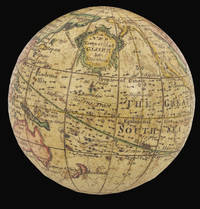
178314487London 1783. Diameter: 70mm 2.75 inches. Globe 12 hand-coloured engraved paper gores clipped at 65 degrees latitude with two polar calottes over a papier mâché and plaster sphere varnished housed within original shagreen over paste-board clamshell case with hooks and eyes lined with 12 hand-coloured engraved celestial gores with two polar calottes varnished. The case split in both halves where hinge would have been loss to exterior and minor loss to celestial gores. Biography During the first half of the nineteenth century the firm of Newton together with Bardin and Cary occupied a leading position in the manufacture of globes in London. The firm was established by John Newton in 1783 and operated originally from the Globe & Sun 128 Chancery Lane moving to 97 Chancery Lane in 1803 before settling at 66 Chancery Lane in 1817. John Newton 1759-1844 was trained by Thomas Bateman fl1754-81 who had previously been apprenticed to Nathaniel Hill fl1746-1768. Newton's first globe was a revised edition of Hill's 1754 pocket globe which he published in 1783 in association with William Palmer. The partnership dissolved shortly after and Newton continued to publish the pocket globe under his own name. John's second son William Newton 1786-1861 joined the firm between 1814-1816 which traded under the name J. & W. Newton. In the same year the firm produced a new series of globes including a new pocket globe. By the 1830s the firm was also active as a patent agent and was joined by Miles Berry a civil engineer and patent agent after which the firm was known as Newton Berry & Son. In 1842 William's eldest son William Edward Newton 1818-1879 joined the business followed by his brother Alfred Vincent Newton 1821-1900. The firm became known as W. Newton & Son or once again on the death of William as simply Newton & Son from 1861 until about 1883. Perhaps the greatest triumph for the Newton family was the Great Exhibition of 1851 where aside from the globes they exhibited from 150 to 635mm 1 to 25 inches in diameter they were awarded a prize medal for a manuscript terrestrial globe of six feet in diameter. Geography Newton used Hill's copper plates from his 1754 pocket globe for the present globe with a number of alternations and updates. He has changed the text within the cartouche to feature his own name however he retains the rococo cartouche that Hill used. Newton added Captain Cook's track and updated the Australian coastline with his discoveries including "New Holland" "New South Wales" "Botany Bay" "Dimens Land" "Lewins Land" the "Isles of St Francis" and "New Zeeland". The globe shows the equinoctial graduated in degrees and the conforming ecliptic is highlighted in green. The prime meridian passes through London and the principal land masses are outlined in colour and annotated with some of the major rivers and mountain ranges. The oceans show the winds with islands labelled and printed with dotted lines for Admiral Anson's Tract and the tract of Captain Cook's first voyage in 1760 while the North Pacific region features a rococo scroll title cartouche. Astronomy The gores are pasted to the inside of the case and the cartography features stars expressed in varying orders of magnitude and allegorical representations of the constellations finely executed. Dekker GLB0029; Dekker and van der Krogt fig.57; for reference see Dahl and Gauvin pp.93-95; van der Krogt Hil 1 and Hil 4; Worms and Baynton-Williams pp.318-319; Dekker pp.355-357. unknown
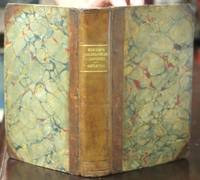
172819285London: S. Palmer 1728. FIRST EDITION. With engraved title-vignette of an observatory within a border of instruments 12 folding plates and historiated initials all engraved by J. Pine after J. Grison including the arms of Sir Robert Walpole to whom the work is dedicated. Complete with subscriber’s list including Isaac Newton’s 12 books. Half-calf over marbled boardsspine with gilt decorations and morocco label. An absolutely exquisite wide-margined copy preserved in a slipcase. First edition. Pemberton’s ability in mathematical problems impressed Newton and consequently he asked him to edited the third and definitive edition of his Principia mathematica 1726. The preface contains Pemberton’s recollections of Newton especially in his old age. However this work is most notable for its explanation of Newtonia philosophy. Pemberton 1694-1771 studied under Boerhaave at Leiden and was attached to St. Thomas’ Hospital in London. <br /> <br /> Babson 98; Gray 132. S. Palmer unknown
1728177<b>4to 288 x 218 mms. pp. 50 407 408 blank engraved vignette on title-page other engraved vignettes and illustrations in text by John Pine after John Grison 12 folding engraved plates. FIRST EDITION. The subscriber s list is also present. Full contemporary calf boards are slightly worn which has been professionally rebacked by the Heritage Bindery. Henry Pemberton was tasked with bringing Newtonian philosophy to the layman with this work which was completed and published a year after Newton s death. Small blind- stamp from the Meadville theological school library on the title page. </b> S. Palmer hardcover
176527631Kbhvn. Weysenhuses Bogtrykkerie 1765. 3 samt. helldrbd. i flammet kalv rig rygforgyldning titel-og tomefelter i skind. Et par kapitæler slidte og lettere brugsspor. 48359;24366;243362 pp. På skrivepapir. <br/><br/><em>Første danske udgave af Thomas Newtons velanskrevne værk. </em> unknown
1748B4804London : Patrick Murdoch; Author’s Children c.1748. A very good example plates and text are clean and crisp. Edition: Second Edition. Binding: Contemporary marbled boards rebacked spine with 5 compartments of raised bands gilt lettering on two. Notes: An important commentary by MacLaurin. On Newton’s recommendation he was appointed to his chair at Edinburgh. He died in 1746 and later the work was completed by Murdoch who has added a valuable ‘Account of the Life and Writings of the Authorâ€. Size: 8vo. Illustration: With 6 engraved plates. References: Babson 85; Gray 112. Pages: P. 28 xx 392 Category: Book Science & Technology; Patrick Murdoch; Author’s Children hardcover
1798057407SOUTHAMPTON: Printed for the author by T. Baker: sold by T. Chapman; S. Conder; T. Conder London; and B. C. Collins Salisbury 1798. First Edition . Wrappers. Very Good. 8vo. SOUTHAMPTON : 1798. Paper-covered spine. Untrimmed edges as issued. Text tight and clean. A little foxed. Friend of John Howard 1726-1790 and John Newton 1725-1807. vi 56 pages. English Short Title Catalog ESTCT84612. Book now in a archival quality clear protective jacket. SCARCE. Rosley Books for Antiquarian Books Theology & Church History. . Printed for the author by T. Baker: sold by T. Chapman; S. Conder; T. Conder London; and B. C. Collins Salisbury. SCARCE <br/> <br/> Printed for the author by T. Baker: sold by T. Chapman; S. Conder; T. Conder, London; and B. C. Collins, Salisbury unknown
179557582Philadelphia: William Young. 1795. Hardcover. Good. Contemporary leather-backed marbled boards. Boards worn/rubbed with paper losses. Points and edges bumped/exposed. Includes one front blank only with gift inscription dated 1820. No rear blanks. Pages evenly toned/foxed. Mainly concerned with life aboard slave ships. Fourteen letters dated from January 12 1763 to February 2 1763. Reprint. No ads maps or illustrations. ; 12mo 7" - 7½" tall; 103 pages . William Young hardcover
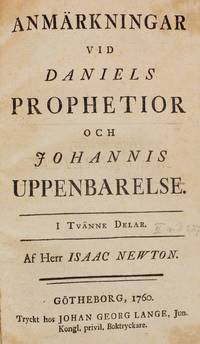
1760B4388Gothenburg c. 1760. In very good condition. Binding: Contemporary half calf with speckled boards. Notes: Ex Libris Abel E. Berland. First Edition in Swedish after original 1733 First Edition in English. <br><br>Newton's work: Observations on the Prophecies on the Prophecies of Daniel and the Prophecies of St. John. Six years after his death Newton's nephew Benjamin Smith published a small portion of Newton's later writings on the prophetic Books of Daniel and Revelation. For more than two centuries this book provided the only glimpse into Newton's prophetic thought. In addition scientific historians suggest that “Newton was an apocalyptic thinker†Snobelen Canadian Journal of History who “arrived at his theory of gravity partly through his exploration of alchemy and early biblical theology†White 358. Size: 8vo: 115mm x 190mm Volume: 2 Volumes in 1 Pages: P. Title Printer infoforward iii-vi Contents vii-viii 1-324 Category: Book Religious Christianity hardcover
1720423310London : Thomas Newton 1720. 1st edition. Hardcover. Provenance; The right and hon. the Earl of Berkshire bookplate. Poor copy in gilt-blocked embossed leatherette; front board detaching. Spine with raised bands and panel edges somewhat bumped nicked and rubbed as with age with some loss and tears to the material. Marbled end-papers. Creased and cracked pages with some browning. Remains quite well-preserved overall. Physical description; 566 pages 22 x 32 cm. Subjects; Georgii Regis Magna Britannia. Session parliament. British parliament 18th century periodicals. Law Great Britain 18th century. Lay 18th century Great Britain sources. London : Thomas Newton hardcover
1718423307London : Thomas Newton 1718. 1st edition. Hardcover. Provenance; The right and hon. the Earl of Berkshire bookplate. Poor copy in gilt-blocked embossed leatherette; front board detaching. Spine with raised bands and panel edges somewhat bumped nicked and rubbed as with age with some loss and tears to the material. Marbled end-papers. Creased and cracked pages with some browning. Remains quite well-preserved overall. Physical description; 492 pages 22 x 32 cm. Subjects; Georgii Regis Magna Britannia. Session parliament. British parliament 18th century periodicals. Law Great Britain 18th century. Lay 18th century Great Britain sources. London : Thomas Newton hardcover
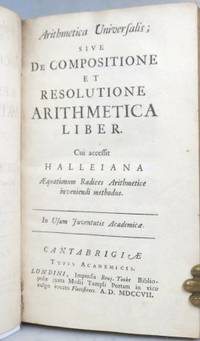
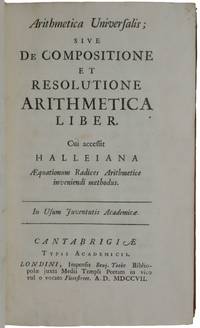
170751058Cantabrigiæ Cambridge: Typis academicis; Londini London impensis Benj. Tooke 1707. First edition. 8vo. viii 343 1 pp. 19th century full diced calf spine with raised bands gilt lettered black label blind tooled borders to the boards ownership inscription of a William Fitton dated June 1800 to the half title another contemporary owner's inscription - that of a Philip Crampton the date cropped "180" mathemetical annotations to the front and rear leaves and in the margins at intervals within. Joints skilfully repaired some mild soiling to the front and rear leaves an attractive copy. A mathemetical text composed entirely in Latin by Newton and edited by William Whiston who had succeeded him as the Lucasian professor of Mathematics at Cambridge University in 1702. The two had become acquainted during the previous decade and Newton was impressed enough with his acolyte that he invited him to lecture at the university when he was occupied with his other work. It was Whiston who persuaded Newton to publish some of his lectures on algebra but Newton was dissatisfied with Whiston's editing and additions to the text - to the extent that he considered buying the entire stock of the book to prevent its appearance in public. That clearly didn't happen although Newton succeeded in having the book published anonymously and its relative scarcity in commerce suggests a truncated print run. The first ownership inscription is that of the Irish geologist William Fitton 1780-1861. The son of a Dublin lawyer his paternal grandfather had been a mathematical instrument maker. Fitton began his studies at Trinity College Dublin in 1794 and earned his B.A. in 1799 but continued studying there until 1803. He went on to study medicine at Edinburgh University becoming a doctor in 1810 and continued his medical studies in London and Cambridge during the following six years. Fitton's interest in geology and mineralogy were his true passions and after marrying into a wealthy family he was able to devote his studies exclusively to these subjects. He subsequently served as secretary and later as president of the Geological Society published numerous reviews and papers plus a small number of books including 'A Geological Sketch of the Vicinity of Hastings' in 1833. Fitton was awarded the Wollaston Medal the society's highest prize in 1852. The other inscription is almost certainly that of Sir Philip Crampton 1777-1858 an Irish surgeon who awarded many honours and held various senior positions in a long and illustrious career: "elected FRS in 1812. In 1813 he was appointed surgeon-general to the forces in Ireland and he was surgeon to the queen in Ireland a member of the senate of the Queen's University of Ireland and four times president of the Royal College of Surgeons in Ireland in 1811 1820 1844 and 1855. In 1839 he was created baronet" ODNB. Cantabrigiæ [Cambridge]: Typis academicis; Londini [London], impensis Benj. Tooke unknown
1761500030438Amstelodami: Marcum Michaelem Rey 1761. First Edition. . Hardcover. Poor. Giovanni Francesco Mauro Melchiorre SALVEMINI DI CASTIGLIONE. 4to. Richmond College Library bookplate. spine replaced by green cloth. Foxing. Worming affects text & plates up to page 235. Two small worm holes affect plates at rear. <br/> <br/> Marcum Michaelem Rey hardcover
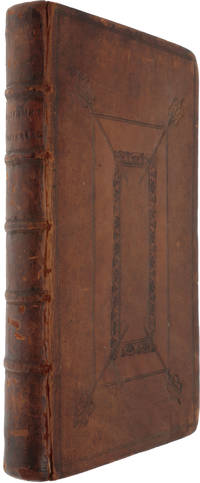
17225823London: Benji & Sam. Tooke 1722. Second edition. <p>Second edition but the first authorised and edited by Newton probably with the assistance of John Machin of his treatise on algebra or 'universal arithmetic' his "most often read and republished mathematical work" Whiteside. "Included are 'Newton's identities' providing expressions for the sums of the ith powers of the roots of any polynomial equation for any integer i plus a rule providing an upper bound for the positive roots of a polynomial and a generalization to imaginary roots of René Descartes' Rule of Signs" Parkinson.</p>. NEWTON'S ALGEBRA - THE FIRST EDITION AUTHORISED AND EDITED BY NEWTON. <p>Second edition but the first authorised and edited by Newton probably with the assistance of John Machin - see below of his treatise on algebra or 'universal arithmetic' his "most often read and republished mathematical work" Whiteside Papers V p. xiv. "Included are 'Newton's identities' providing expressions for the sums of the ith powers of the roots of any polynomial equation for any integer i pp. 251-2 plus a rule providing an upper bound for the positive roots of a polynomial and a generalization to imaginary roots of René Descartes' Rule of Signs pp. 242-5" Parkinson p. 138. About this last rule for determining the number of imaginary roots of a polynomial which Newton offered without proof Gjertsen p. 35 notes: "Some idea of its originality . can be gathered from the fact that it was not until 1865 that the rule was derived in a rigorous manner by James Sylvester." The work is a printed version of lectures Newton prepared in the period 1672-83. Although the editor of the first edition William Whiston later claimed that he had Newton's permission to print the lectures Newton was far from satisfied with the result complaining that the titles and headings were not his and that it contained numerous mistakes. His real concern was that "an unfinished text composed so long before should now be presented to the world as though it represented his latest researches into the structure and applications of algebra" Papers V p. 11 and that Whiston had "too faithfully and impercipiently followed the parent manuscript incorporating in his princeps edition its several inconsistencies and lapses into error without in the main even bringing them to the reader's notice . In his private library copy of the edition Newton corrected many minor misprints inserted more appropriate running heads 'Multiplicatio' 'Divisio' 'Extractio Radicum' 'De Forma Aequationis' 'Reductio Aequationum' 'Resolutio Quaestionum Arithmeticarum Geometricarum' and the like and on the Arithmetica page 279 deleted an unwarranted half-title 'Aequationum Constructio linearis'; more radically he mapped out a large-scale reordering of the sixty-one geometrical problems comprising its central portion seeking to grade them into a more logical sequence and in increasing levels of difficulty while in the concluding section on the 'curvilinear ' construction of equations he pared away all not directly needed flesh reducing it to two skeletal conchoidal neuses now denuded of their proof. That last savage act of butchery apart all these improvements were incorporated in the Latin revise - future parent and rightfully so of all subsequent editions - which he himself brought to publication in 1722" ibid. pp. 13-14. Babson notes that "This edition was the last issued during Newton's lifetime and is almost as rare as the first." In commerce this edition is in fact much rarer than the first: ABPC/RBH list only two other copies of this edition since 1975 but ten of the first.</p> <br /> <p>"In fulfilment of his obligations as Lucasian Professor Newton first lectured on algebra in 1672 and seems to have continued until 1683. Although the manuscript of the lectures in Cambridge University Library carries marginal dates from October 1673 to 1683 it should not be assumed that the lectures were ever delivered. There are no contemporary accounts of them and apart from Cotes who made a transcript of them in 1702 they seem to have been totally ignored. Whiteside Papers V p. 5 believes that they were composed 'over a period of but a few months' during the winter of 1683-4" Gjertsen pp. 33-4.</p> <br /> <p>The Arithmetica "derives partly in its discussion of the elemental algebraic operations and of the reduction and exact solution of equations from Newton's earlier unpublished 'Observations' on the introduction to Cartesian algebra presented by Gerard Kinckhuysen in his 1661 Stelkonst partly in its techniques for delimiting the number and nature real or complex of the roots of equations and for reducing these by factorization from his own independent researches as a young postgraduate student into the theory of equations and partly in its approximate geometrical construction of cubics from his previously elaborated 'Problems for construing aequations'. Apart from novelties in detail and the fabrication of new illustrative 'questions' what is most notable is Newton's developing awareness - still far from completely expressed - of the fundamental structural equivalence which exists between the elements constants and free variables and their functional relationships of algebra and those given lines and undetermined line-lengths and their coordinate interconnections of geometry and his deepening grasp of the still more general isomorphism which permits a two-way 'translation' between mathematical 'speech' and the 'language' of exact science in all its manifestations. His guiding doctrine that algebra is 'universal arithmetick' embroiders a theme stated briefly in an opening phrase of his 1671 treatise on infinite series and fluxions and expounded in a geometrical context earlier still in preface to James Gregory's study of universal mathematical principles. Now also however he reaches tentatively forward to Barrow's notion that algebra is in its essence the abstract logic of relationships between quantities in divorce from their particular setting and hence to be developed as an independent metamathematical system" Papers V pp. 3-4.</p> <br /> <p>"We may reasonably conjecture that pressure was in some manner put upon Newton in late 1683 to fulfil however tardily his statutory obligation annually to deposit a fair copy of ten of his lecture scripts and be all but sure that the arrival in Cambridge the next spring of his young amanuensis Humphrey Newton able to take over from Isaac the dreary time-consuming chore of rewriting his much cancelled and corrected worksheets in legible and coherent form gave him new heart to codify and expand his previous mathematical investigations. But these surmises remain as unproved and essentially undemonstrable as the plausible suggestion that it was Edmond Halley's famous first visit to Cambridge in the late summer of 1684 to talk about the unsolved problem of elliptical planetary motion which provoked him abruptly to relinquish his restructuring of the Arithmetica. We may guess still more tenuously that the appearance in mid-1685 of John Wallis' voluminous Treatise of Algebra Both Historical and Practical would have long deterred Newton from making any efforts to have his own rival studies made publicly available. In later years certainly he grew increasingly soured with the often cumbersome computations and techniques of Cartesian algebra - at one point indeed if we may believe David Gregory he qualified it as 'the Analysis of the Bunglers in Mathematicks - and we may be certain that his reluctance during 1705-6 to have Whiston edit the deposited text of his algebraic lectures was not merely the manifestation of a growing personal antagonism to his successor in the Lucasian chair" ibid. pp. xi-xii.</p> <br /> <p>"When Newton resigned his Lucasian professorship to his deputy William Whiston in December 1701 it was natural that the latter should wish to familiarize himself with the deposited lectures of his predecessor. Whiston did not hesitate to introduce portions of Newton's earlier optical lectures concerning the mathematical theory of the rainbow into his own Lucasian Praelectiones physico-mathematica in the spring of 1706 and about that time also he turned his attention to the succeeding ones on algebra and began to consider their publication. In the meantime rumours began to spread in both Oxford and London that 'Newton's friends solicit him to publish a Treatise of Algebra which he wrote long since. If such ill-founded whispers penetrated to Cambridge Whiston ignored them and went quietly ahead arranging with the London stationer to underwrite the expense of printing the deposited manuscript and then subsequently between September 1705 and the following June correcting both specimen and proof sheets as they emerged from the compositor's bench at the University Press. In February 1706 David Gregory accurately noted in his memoranda that 'Its talked that there is now printing at Cambridge Elements or Principles of Algebra written long since by Sir Isaac Newton but withdrew his added remark that it was 'lately revised by him' when he saw Newton in London in July and was given a first-hand account of the history of the 'Algebra that is printing and near printed at Cambridge'. Though as Whiston was later to announce publicly Newton had given his reluctant approval for the edition . Despite its minor inconsistencies and confusions Gregory's report vividly conveys Newton's concern that an unfinished text composed so long before should now be presented to the world as though it represented his latest researches into the structure and applications of algebra" pp. 8-11.</p> <br /> <p>For a book that was to become Newton's most often republished mathematical work the Arithmetica initially made little impact in Britain and was not even graced by a review in the Philosophical Transactions. On the Continent the reception accorded the lectures was more positive. "Leibniz unhesitatingly divining their author beneath the cloak of anonymity gave them a long review in the Acta Eruditorum of Leipzig in 1708. Written thirty years before he noted and now deservingly printed by William Whiston he assured the reader that 'you will find in this little book certain particularities that you will seek in vain in great tomes on analysis.' His close associate Johann Bernoulli despite some adverse remarks paid Newton the compliment in 1728 of basing his own course on the elements of algebra upon Newton's text. Perhaps partly in consequence of Newton's recent death in Britain too the book began about this time to arouse greater interest than when it was first issued in 1707" Hall p. 174.</p> <br /> <p>Despite the impressive contributions of the work to the theory of equations mentioned earlier it is difficult to pigeonhole the work as being either algebraic or geometric. From one point of view the Arithmetica can be seen as a fulfillment of the programme outlined by Descartes in the Géométrie because it teaches how geometrical problems and also arithmetical and mechanical ones can be translated into the language of algebra. Paradoxically however Newton criticized Descartes maintaining that at least in some cases Apollonian geometry is to be preferred to Cartesian algebra in the analysis of indeterminate problems. Modern analysts he complained had confused algebra and geometry: "The Ancients so assiduously distinguished them one from the other that they never introduced arithmetical terms into geometry. recent people by confusing both have lost the simplicity in which all elegance in geometry consists" Papers V p. 429. The last section of the work 'The linear construction of equations' pp. 279-326 is particularly anti-Cartesian the term 'linear' in this context does not refer to straight lines but derives from Pappus. Newton here deals with the problem of constructing cubics third-degree equations that Descartes solved via the intersection of a circle and a parabola. Newton proposed instead to use a curve of degree higher than the conics as a means of construction namely the conchoid a fourth-degree curve. Newton regarded the conchoid as preferable because it has a mechanical construction and leads to a more elegant solution of the problem.</p> <br /> <p>The present 1722 revision is "the standard text of the Arithmetica published much as before 'Impensis Benj. & Sam. Tooke'. It appeared to Newton's first editor that 'that acute Mathematician Mr. John Machin Professor of Astronomy at Gresham College . and one of the Secretaries of the Royal Society published this Work again by the Author's later Desire or Permission; I lay no claim to it' Whiston Memoirs; John Conduitt's memorandum King's College Cambridge. Keynes MS 130.5 again adds the clarification that 'Machin overlooked the press for which Sir I intended to have given him 100 Guineas but he made him wait 3 years for a preface & then did not write one'. Elsewhere Keynes MS 130.6 2 Conduitt noted that 'Sir I. told me that Machin understood his Principia better than anybody that Halley was the best Astronomer but Machin the best Geometer'. Newton's active stage-managing of the 1722 revise can be documented in several ways: most notably a stray autograph sentence on an otherwise clean folio page now ULC. Add. 3960.7: 95 differs by only a single trivial adverb from an inserted footnote clarifying the reference to the unimplemented 'Regulae post docendae' on page 52 of the deposited copy. The ubiquitous presence of its author's editorial hand was not missed by W. J. 's Gravesande when he came to reissue the Arithmetica ten years later: 'Secunda vice liber in lucem prodiit Londini 1722; sed in statu perfectiore ut quis facile percipiat non omnino foetum abdicasse virum Celeberrimum; ordo propositionum non tantum mutatus est sed in ipsis solutionibus & demonstrationibus correctiones multae reperiuntur non nisi ipsi Auctori tribuendae'" ibid. p. 14 n 60.</p> <br /> <p>"Benjamin Tooke the London publisher and printer he was Queen's printer had eight books published at the Cambridge Press all of them by Whiston between 1702 and 1712. There are two London printer's ornaments used in this volume pp. 283 & 289 and nowhere else but we know that the woodcuts for the illustrations in the 1707 edition were delivered to Cambridge possibly from London 6d. was paid for the parcel. So far as one can tell the woodcuts are identical and we must assume they had been reclaimed by Tooke. Unfortunately we have no letters from Newton about the printing history of this volume" Macclesfield sale catalogue.</p> <br /> <p>Babson 200; Macclesfield 1520; Wallis 278. Gjertsen Newton Handbook 1986. Hall Isaac Newton 1992. Westfall Never at Rest 1983.</p> <br/> <br/> 8vo pp. iv 332 including half-title with list of books on verso woodcut diagrams throughout ink name of Newton on half-title ink inscription identifying Newton as author and another Whiston as editor on title slightly browned. Contemporary panelled calf ink signature of former owner Robert Andrews on front free endpaper corners and edges rubbed joints splitting spine rubbed. Benji & Sam. Tooke unknown
17074639Cambridge; London: Typis Academicus; Benjamin Tooke 1707. First edition. <p>First edition of Newton's treatise on algebra or 'universal arithmetic' his "most often read and republished mathematical work" Whiteside. Included are 'Newton's identities' providing expressions for the sums of the powers of the roots of any polynomial equation plus a rule providing an upper bound for the positive roots of a polynomial and a generalization to imaginary roots of René Descartes' 'Rule of Signs.'</p>. Hardcover. NEWTON'S TREATISE ON ALGEBRA. <p>First edition of Newton's treatise on algebra or 'universal arithmetic' his "most often read and republished mathematical work" Whiteside. "Included are 'Newton's identities' providing expressions for the sums of the ith powers of the roots of any polynomial equation for any integer i pp. 251-2 plus a rule providing an upper bound for the positive roots of a polynomial and a generalization to imaginary roots of René Descartes' Rule of Signs pp. 242-5" Parkinson p. 138. About this last rule for determining the number of imaginary roots of a polynomial which Newton offered without proof Gjertsen p. 35 notes: "Some idea of its originality . can be gathered from the fact that it was not until 1865 that the rule was derived in a rigorous manner by James Sylvester."</p> <br /> <p>Provenance: Jesuit College at Ghent ink inscription 'Bibliotheca Collegii Gandavensis Societatis Jesu.' and shelfmark on title; extensive marginal annotations by a well-informed contemporary reader. This reader was possibly the English Jesuit Christopher Maier 1697-1767. Born in Durham England Maier entered the Society of Jesus in 1715. He taught at Liège where he became interested in astronomy. In 1750 Maire was commissioned by Pope Benedict XIV to measure two degrees of the meridian from Rome to Rimini with fellow Jesuit Roger Boscovich with a view to mapping the Papal States; in turn they proved that the earth is an oblate spheroid as Newton had proposed in Principia publishing their results in Litteraria Expeditione 1755. Maier spent his final years at the English Jesuit College in Ghent.</p> <br /> <p>"In fulfillment of his obligations as Lucasian Professor Newton first lectured on algebra in 1672 and seems to have continued until 1683. Although the manuscript of the lectures in Cambridge University Library carries marginal dates from October 1673 to 1683 it should not be assumed that the lectures were ever delivered. There are no contemporary accounts of them and apart from Cotes who made a transcript of them in 1702 they seem to have been totally ignored. Whiteside Papers V p. 5 believes that they were composed 'over a period of but a few months' during the winter of 1683-4" Gjertsen pp. 33-4. The course of lectures stemmed from a project on which Newton had embarked in the autumn of 1669 thanks to the enthusiasm of John Collins: the revision of Mercator's Latin translation of Gerard Kinckhuysen's Dutch textbook on algebra Algebra ofte stel-konst 1661. Newton composed a manuscript 'Observations on Kinckhuysen' in 1670 see Whiteside Papers II and used it in the preparation of his lectures. He took the opportunity not only to extend Cartesian algebraic methods but also to restore the geometrical analysis of the ancients giving his lectures on algebra a strongly geometric flavor.</p> <br /> <p>"When Newton resigned his Lucasian professorship to his deputy William Whiston in December 1701 it was natural that the latter should wish to familiarize himself with the deposited lectures of his predecessor" Whiteside Papers V p. 8. Whiston later claimed in his Memoirs London: 1749 that Newton gave him his reluctant permission to publish the lectures. Whiston arranged with the London stationer to underwrite the expense of printing the deposited manuscript and then subsequently between September 1705 and the following June corrected both specimen and proof sheets as they emerged from the University Press. The completed editio princeps finally appeared in May 1707 priced at 4s. 6d. without Newton's name on the title page although references inside the work made no attempt to hide the author's identity. It included an appended tract by Halley on 'A new accurate and easy method for finding the roots of any equations generally without prior reduction' pp. 327-343. Publication of the work had been delayed by Newton who complained that the titles and headings were not his and that it contained numerous mistakes. Yet when he prepared a second edition in 1722 the changes he introduced were "primarily reorderings of his own manuscript not corrections of Whiston's additions" Westfall p. 649. In reality Newton's misgivings probably derived more from his reluctance to place before the public a relatively immature and poorly organized work and one that did not take into account the developments in the subject that had taken place in the quarter century since the manuscript was composed.</p> <br /> <p>For a book that was to become Newton's most often republished mathematical work the Arithmetica initially made little impact in Britain and was not even graced by a review in the Philosophical Transactions. On the Continent the reception accorded the lectures was more positive. "Leibniz unhesitatingly divining their author beneath the cloak of anonymity gave them a long review in the Acta Eruditorum of Leipzig in 1708. Written thirty years before he noted and now deservingly printed by William Whiston he assured the reader that 'you will find in this little book certain particularities that you will seek in vain in great tomes on analysis.' His close associate Johann Bernoulli despite some adverse remarks paid Newton the compliment in 1728 of basing his own course on the elements of algebra upon Newton's text. Perhaps partly in consequence of Newton's recent death in Britain too the book began about this time to arouse greater interest than when it was first issued in 1707" Hall p. 174.</p> <br /> <p>Despite the impressive contributions of the work to the theory of equations mentioned earlier it is difficult to pigeonhole the work as being either algebraic or geometric. From one point of view the Arithmetica can be seen as a fulfillment of the programme outlined by Descartes in the Géométrie because it teaches how geometrical problems and also arithmetical and mechanical ones can be translated into the language of algebra. Paradoxically however Newton criticized Descartes maintaining that at least in some cases Apollonian geometry is to be preferred to Cartesian algebra in the analysis of indeterminate problems. Modern analysts he complained had confused algebra and geometry: "The Ancients so assiduously distinguished them one from the other that they never introduced arithmetical terms into geometry. recent people by confusing both have lost the simplicity in which all elegance in geometry consists" Whiteside Papers V p. 429. The last section of the work 'The linear construction of equations' pp. 279-326 is particularly anti-Cartesian the term 'linear' in this context does not refer to straight lines but derives from Pappus. Newton here deals with the problem of constructing cubics third-degree equations that Descartes solved via the intersection of a circle and a parabola. Newton proposed instead to use a curve of degree higher than the conics as a means of construction namely the conchoid a fourth-degree curve. Newton regarded the conchoid as preferable because it has a mechanical construction and leads to a more elegant solution of the problem.</p> <br /> <p>William Whiston 1667-1752 was "a member of the first generation of Cambridge students to emulate Newton's method and principles. He went up to Cambridge in 1686 claimed to have attended one or two incomprehensible lectures by Newton on his Principia and was elected a Fellow of Clare Hall in 1691. After taking orders he left Cambridge for a while returning in 1700 when chosen by Newton to be his deputy as Lucasian Professor. About a year later upon Newton's resignation and commendation Whiston succeeded him. Aberrant theology was to be his downfall. While Newton and their common friend Dr Samuel Clarke kept private their doubts about Trinitarianism the Creed and the Thirty-nine Articles Whiston sought publicly to amend the errors of the Anglican faith; for this he was summoned before the heads of houses in the university and dismissed from his post in 1710" Hall p. 175.</p> <br /> <p>Babson 199; Wallis 277; D. Gjertsen Newton Handbook 1986; A. R. Hall Isaac Newton 1992; R. S. Westfall Never at Rest 1983.</p> <br/> <br/> 8vo pp. viii 343. Woodcut diagrams throughout. Former owner's signature F. Percy White Feb. 1920 on half-title partially erased. Contemporary mottled calf covers with floral border and corner fleurons in blind. / Hardcover. Typis Academicus; Benjamin Tooke unknown
170247776Oxoniae Oxford E Theatro Sheldoniano 1702. Folio. Contemporary full calf raised bands rectangular blindtooled frames and central panel "mirror" on covers Cambridge-style binding. leather at joints cracked but cords intact so that covers not loose. Corners a bit bumped. Light wear to spine ends. Spine a bit rubbed. Pastedowns and flyleaves with browning. Title-page with large engraved vignette Sheldon Theater. 124942 pp. With numerous textdiagrams. Very light browning to titlepage and a few marginal brownspots to last leaf a fine clean copy printed on good paper with wide margins.On the verso of the title-page is pasted the book plate of Sir William Baird of Newbaith. He habitually pasted his armorial bookplate on the verso of the title-pages of the books in his large and fine library. <br/><br/><em>First edition of the first text book of astronomy based on Newtonian principles. Apart from its importance in the remodeling of astronomy in conformity with physical theory the work is of the utmost importance as a source book - it contains the FIRST PRINTING OF NEWTON'S PAPER ON LUNAR THEORY "Lunae Theoria Newtoniana" pp. 332-336 as well as the FIRST EXPOSITION OF NEWTON'S CLASSICAL SCHOLIA which Newton himself considered an important part of his philosophy.Gregory a Scottish mathematician who taught at Edinburgh and Oxford was one of Newton's closest friends and associates. Newton thought highly of his work and communicated for insertion it in his Lunar Theory. He also permitted Gregory to use the material of that which is known as his "Classical Scholia" which are incorporated into Gregory's preface. "Newtonian scholars have long been aware of a set of draft Scholia to Propositions IV to IX of Book III of the "Principia". These were composed in the 1690's as part of an unimplemented plan for a second edition of the work. Since they describe supposed anticipation of Newton's doctrines in the thought of Greco-Roman antiquity they have been known as the 'classical' Scholia. Newton's thoughts on these matters were not however kept completely concealed. HE PERMITTED DAVID GREGORY TO USE THE MATERIAL EXTENSIVELY in a long historical preface to his "Astronomiae Physicae & Geometricae Elementa" 1702 IF WITHOUT ATTRIBUTION. It was also available to Maclaurin for his much later work." McGuire & Rattansi in "Newton and the Pipes of Pan" 1966."It was the first textbook composed on gravitational principles and remodeling astronomy in conformity with physical theory. Newton thought highly of it and communicated for insertion in it p. 332 his 'lunar theory' long the guide of practical astronomers in determining the Moon's motions. The discussion in the preface in which the doctrine of gravitation was brought into credit on the score of its antiquity likewise emanated from Newton." DNB."His thick folio text on foundations of astronomy Astronomiae.elementa 1702 is a well-documented but unimaginative attempt to graft the gravitational synthesis propounded in the first book and especially the third book of Newton's Principia onto the findings of traditional astronomy. While respected as a source book it is now chiefly remembered for the remarks by Newton on the prisca sapientia of the ancients and their "knowledge" of the inverse-square law of universal gravitation and for the Latin version of Newton's short paper on lunar theory which it reproduces." DSB.Babson No. 71. - Houzeau & Lancaster 9240. </em> hardcover
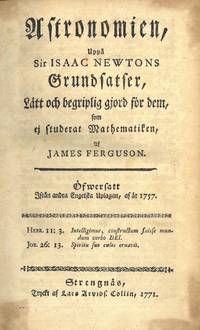
177170469Strengnäs 1771. 8vo. 8vo. Samtidig skinnryggbind med svakt opphøyde ryggbånd. Tittelfelt i lysere brunt skinn. 2 LX 2 331 9 s. Med X kobberstukne foldeplansjer. Tryckt af Lars Arvids. Collin Svensk. <br/><br/><em>Slitasje ved øvre kapitél. Dette skal ha vært den første astronomiboken publisert på svensk som oppnådde stor popularitet. </em> unknown
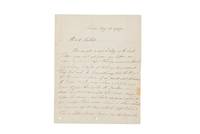
17875001062HMS Sirius Portsmouth 1787. Slight tear on the edge of address panel where it was originally opened occasional wear and splitting at folds sealed tear. Quarto three pages and address leaf manuscript in ink on paper with original wax seal two filing holes in lower margin of each leaf; stamped "Gosport" small collector's stamp with manuscript cancellation. <p><p>A wonderful original letter by Newton Fowell the eighteen-year-old midshipman on HMS Sirius whose moving and evocative letters from the First Fleet have been one of the treasures of the State Library of New South Wales since they were acquired in 1987. This candid letter to his father John Fowell of Black Hall North Huish Devon is dated "Sirius 10 May 1787" and was written aboard the flagship of the First Fleet just three days before she set sail for Botany Bay.</p> <p>Newton Fowell was a well-connected "young gentleman" seaman whose family sought the sponsorship of Captain John Hunter and Evan Nepean to ensure his late inclusion in the First Fleet expedition. He joined the Sirius in February 1787 and was the last officer to do so apart from Arthur Phillip himself. In earlier letters to his father Fowell had expressed his impatience at the endless delays in departing. Yet in this letter when their final departure was imminent he was somewhat caught off guard: 'Capt Philip sic came on board yesterday and talks of sailing tomorrow how that will be I cannot say but the Wind at Present is fair'.</p> <p>Fowell describes the haste with which the men were called aboard: 'we had no great notice to get ready. I have some Linen on shore which if I cannot get to day will be left behind' and bemoans the tardiness of receiving their pay: 'We have not yet been paid any Advance it will be paid today and supposed only two Months the Men Murmur very much as most of them have 6 Months Pay due.'.</p> <p>By all accounts Fowell acquitted himself honourably during the nine-month voyage to Botany Bay and was the first officer to receive a promotion after their arrival: a fellow officer on Sirius described him as 'that very Deserving Young Man. Ordered to Act as Lieut. I have Every Reason to Suppose him for the first Promotion. I think him by far the Most Deserving Young Man in the Ship'.</p> <p>Fowell made three further voyages as lieutenant: the rapid circumnavigation with Hunter to the Cape of Good Hope and back on the Sirius and another to Norfolk Island on the Supply during which the Sirius was wrecked. His final voyage was to Batavia on a mission to purchase a replacement for the Sirius and obtain desperately-needed provisions. Having safely reached Batavia Fowell succumbed to the notorious Batavia fever and died aged twenty-two. On 14 March 1791 Phillip wrote to the Admiralty reporting on recent events 'The Supply lost five men in the voyage and left six in the Hospital in Batavia. Mr Newton Fowell who I had appointed second lieutenant of the Sirius when Lieutenant King was sent to Norfolk Island and the gunner of the Sirius likewise died on the Voyage. Both these officers were to have been landed at Norfolk Island had the Supply made it in her passage to Batavia'.</p> <p>The vast majority of First Fleet manuscripts are held institutionally; this example once in the Webster collection is a rare exception. The thirteen letters by Fowell held by the State Library of New South Wales and published in 1988 The Sirius Letters: The Complete Letters of Newton Fowell 1786-1790 give detailed reports of the voyage and the arrival of the Sirius in Port Jackson and difficulties of the first two years of settlement. They form a series which was earlier thought to be complete.</p> </p> . unknown
17901230921790. First Edition. NEWTON John. The Christian Correspondent; or A Series of Religious Letters Written by The Rev. John Newton to Captain Alexr. Clunie From the Year 1761 to the Death of the Latter in 1770. Hull: Printed by George Prince 1790. Octavo modern half olive cloth black morocco spine labels. $1200.First edition of the collected 18th-century letters between John Newton a slaveship master and born-again Christian to Alexander Clunie a fellow slaveship captain and Newton's Christian mentor.The Rev. John Newton was born into a sailing family. His father was a shipmaster in the Mediterranean. While Newton's mother raised him as a Christian she died when he was just six years old. Newton spent a few years in boarding school before joining his father at sea. While Newton was slated to become a slave master at a Jamaican sugar plantation he was forced into naval service. After attempting to desert and surviving a brutal court marshal Newton went to work in the slave trade. While he found Christianity in 1748 after nearly dying in a storm at sea he remained an active slave shipmaster. ""In the summer of 1750 Newton began another slaving expedition this time as master of the Duke of Argyle Throughout this voyage and the next as master of the African Newton felt no scruples about slave trading seeing it as the work marked out for him by Providence though he admits to his horror at slavery's brutal accoutrements and his prayer that in God's own time he would receive a more humane calling one that would keep him in regular communion with other Christians perhaps a reflection of his new friendship with Alexander Clunie whom he met when the African called at St. Kitts. Clunie a fellow ship master and believer convinced Newton of the importance of the fellowship of believers and of his security in the covenant of grace. In 1790 their long-term friendship ultimately resulted in the publication of The Christian Correspondent a collection of letters they exchanged over the years"" mainly dealing with Christianity and family life Encyclopedia of Christian Literature 489. In the time between the writing and publication of these letters a great deal changed in Newton's life. Following a series of strokes in 1854 that forced him to leave the seafaring life Newton reconsidered his association with slavery. He acknowledged the damage that it wreaked on a person's humanity and began to view it as fundamentally opposed to Christian beliefs. In the final years of his life he became an ardent abolitionist. He wrote extensively on the subjectas he had on all subjects throughout his lifeand counted Wilberforce among his closest friends. ESTC T18631. Contemporary owner signature.Scattered soiling to interior binding fine. A near-fine copy. hardcover
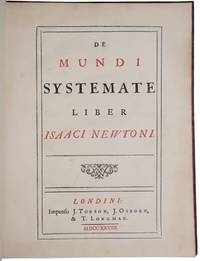
17286610London: J. Tonson J. Osborn & T. Longman 1728. First edition. <p>First edition an extraordinary Newtonian association copy of Newton's rarest book inscribed by James Stirling recording the gift from Abraham de Moivre "Ja: Stirling Ex Dono Dni De Moivre". Drafted in the mid-1680s as the liber secundus of the earliest Principia the text differs substantially from the published Book III. Among its non-Principia contents are the thought-experiment of the orbiting cannonball anticipating the artificial satellite the first acceptable photometric determination of a stellar distance and passages that point to terrestrial tides Michelson 1919 and to the existence of the planet Uranus Herschel 1781. OCLC lists six copies worldwide; no copy in Cambridge.</p>. An Exceptional Newtonian Association Copy. <p>First edition of Newton's rarest book - the discarded first draft of what would become Book III of Principia posthumously published in the year following his death - and an extraordinary association copy in contemporary panelled calf inscribed on the front pastedown by James Stirling: "Ja: Stirling Ex Dono Dni De Moivre". The inscription records the gift in the year of publication from Abraham de Moivre to Stirling his junior by twenty-five years. The two men were the foremost mathematicians at work in London at Newton's death and the leading contemporary proponents of Newtonian mathematics; both had been part of Newton's personal circle for decades both were Fellows of the Royal Society in his lifetime and within two years of the present gift their joint correspondence on the asymptotic behaviour of the binomial coefficient would yield what is now known as Stirling's formula. Of de Moivre the ODNB remarks that he was the man "whose early investigations led Stirling into this topic". The book passed with the rest of Stirling's mathematical library into the family seat at Garden House in Stirlingshire where it remained for nearly three centuries until the dispersal at Lyon & Turnbull Edinburgh on 23 October 2025. No comparable association copy of the Latin first edition is recorded in the modern trade.</p> <br /> <br /> <p>The text Conduitt brought through the press in 1728 had been written in 1685 in the same Cambridge year as the first two books of Principia and was originally intended to constitute the second of two books under the title De motu corporum liber secundus. By the summer of 1685 Newton had expanded the design of Principia to three books with the original second book becoming the third; at the same moment he reconsidered the character of the new Book III. He had at first envisaged a popular treatment that as he noted in the introduction to the published Book III 'might be read by many'; but fearing the controversies such a work would invite he replaced the popular draft with a strictly mathematical exposition that could be read only by those who had mastered the first two books Gjertsen p. 573. Having no immediate use for the rejected version Newton had Humphrey Newton no relation his Cambridge amanuensis make a fair copy of part of the manuscript and on 29 September 1687 deposited it in the Cambridge University Library in the supposed fulfilment of his obligations as Lucasian Professor: that deposit mostly in Humphrey's hand is now ULC MS Add. 3990. A further copy by Roger Cotes is preserved at Trinity College Cambridge and a third copy is held at Clare College; Ernst Weil offered a fourth in his Catalogue 27 no. 152. Newton's distaste for controversy precluded the printing of any of these copies in his lifetime.</p> <br /> <br /> <p>The 1728 publication was arranged by John Conduitt the husband of Newton's half-niece Catherine Barton and his successor as Master of the Mint who had taken charge of Newton's manuscripts after his death in March 1727. Conduitt sold the deposit copy to the bookseller Jacob Tonson for thirty-one pounds and ten shillings and Tonson published in partnership with John Osborn and Thomas Longman. It was almost certainly Conduitt who substituted the title De mundi systemate for Newton's own De motu corporum liber secundus - a definite improvement corresponding much more closely to the content but one that has caused enduring confusion with the title of the published Book III of Principia from which the present text differs sharply in style and method.</p> <br /> <br /> <p>What is published here differs from the printed Book III of 1687 not only in style but in substance. The first part offers a non-mathematical account of centripetal force; the next turns to the dynamics of the solar system; two long discussions then follow on the theory of tides and the nature and dynamics of comets the work closing with the inverse problem of recovering a comet's orbit from its observed velocity and distance from the Sun. Several discoveries and observations preserved in the rejected text never reached the printed Principia at all. Pages 3-4 contain Newton's thought-experiment of the orbiting cannonball with an accompanying diagram here Tab. I Fig. 1 showing that there is no kind-difference between projectile and orbital motion: a ball fired from the top of a mountain with progressively greater velocity falls further and further from the base of the mountain until at length it never reaches the ground at all and enters into orbit. Ernst Weil regarded this as "the anticipation of an artificial satellite 270 years before its advent". The discussion and diagram do not appear in the 1687 Principia in any form.</p> <br /> <br /> <p>More substantial still is the discussion of stellar distances on which the printed Principia is virtually silent. Newton had investigated the question in 1685 by a method devised by James Gregory in 1668: comparing the brightness of the Sun by way of its reflection from Saturn with that of a fixed star and then applying the inverse-square law of photometry. With assumptions about the nature of reflection the absence of light-loss in interstellar space and the equality of intrinsic brightness between the Sun and the comparison star Newton found Sirius to lie at a distance of about a million astronomical units. The figure is too great by an order of magnitude but as J. D. North has argued this can be counted as "the first acceptable determination of a star's distance" Cosmos p. 418. Newton's motivation was theological as much as astronomical: he had been perplexed by the question why the cosmos did not collapse upon itself under the action of universal gravitation and the immense interstellar distances supplied a workable answer.</p> <br /> <br /> <p>The text further records in advance of their observational confirmation two phenomena that would not be detected for another two centuries. Newton points to the possibility of terrestrial tidal effects; these were observed by Albert A. Michelson and Henry G. Gale at Yerkes Observatory in 1919 by the application of monochromatic interference fringes to a determination of the rigidity of the Earth and reported in Science 50 pp. 327-8. In another passage first identified by J. Ph. Wolfers in his German Principia of 1872 Newton indicates the possible existence of a planet beyond Saturn ultimately observed by Herschel in 1781 and named Uranus - ironically Herschel himself on first observation took it to be a comet the very class of body that Newton throughout the present work regards as continuous with the planets and as moving on closely related orbits.</p> <br /> <br /> <p>The publication history of 1728 is further complicated by the simultaneous appearance of an anonymous English translation A Treatise of the System of the World sometimes attributed to Andrew Motte the translator of Principia in 1729; its translator has never been certainly identified. The Latin and English texts diverge in important respects and it is unclear whether the Treatise is a translation of a different and now-lost manuscript or whether the differences reflect interpolations by the translator. The Latin version is unambiguously based on the manuscript in Humphrey's hand: the compositor uses a half-square bracket in the margins to mark the end of one page and the beginning of another in the manuscript and to flag in some places the start of a manuscript signature Cohen p. xii. The translator additionally suppressed Newton's many citations to specific propositions in the original-draft Principia sometimes adversely affecting the readability of the result; in the Latin the citations have been preserved but updated to correspond to the proposition numbering of the third edition of Principia London 1726 which makes the present Latin text the more informative scientifically and historically. The citations were restored only in the second English edition of 1731 an edition that I. B. Cohen accordingly considered "of far more value . than the first" English version Cohen p. xiii. The Treatise is much more frequently encountered in commerce: OCLC lists more than fifty copies of the English first edition and twenty-five or more have appeared at auction. The Latin first edition presents a quite different picture.</p> <br /> <br /> <p>The Latin De mundi systemate is exceptionally rare. OCLC lists only six copies worldwide three of them in North America Chicago the Huntington Library - the Babson copy - and Yale and no copy is recorded in either the Cambridge College libraries or the Cambridge University Library despite Newton's manuscript residing on the same site. The Cambridge Digital Library editorial note to MS Add. 3990 states in a small error perhaps connected to the Cambridge gap that the work was first published in 1731 - the year of the second edition. Auction appearances over the last fifty years have been restricted to two recorded copies: the Honeyman copy rebacked and damp-stained and the Macclesfield copy from the Earls of Macclesfield's celebrated mathematical library at Shirburn Castle. The present copy is the third copy to come to public sale in that period and is the first to be offered with a contemporary presentation inscription linking it directly to two of Newton's closest mathematical contemporaries. The Latin text was reprinted in London in 1731 and again in Amsterdam in 1742; it was incorporated into Johannes Castillioneus's Isaaci Newtoni Opuscula at Lausanne in 1744 and into Samuel Horsley's five-volume Isaaci Newtoni Opera at London in 1779-85; none of these later printings carries the textual authority of the 1728 first edition prepared in the immediate aftermath of Newton's death from the manuscript his executors retained.</p> <br /> <br /> <p>James Stirling 1692-1770 to whom the present copy was given was born at Garden House in Stirlingshire on 11 May 1692 the third son of Archibald Stirling and Anna Hamilton into a Scottish family with deep Jacobite sympathies. He matriculated at Balliol College Oxford on 18 January 1711 as a Snell Exhibitioner from the University of Glasgow and held a Bishop Warner Exhibition from October of the same year. His Jacobite associations cost him both scholarships and his place at Oxford in 1715 when he refused to swear the oaths of allegiance and abjuration following the rising of 1715. Stirling travelled to the Continent - reaching Venice by 1717 - where he supported himself by teaching mathematics and where in the same year he published his first major work Lineae Tertii Ordinis Neutonianae a treatise on the cubic curves that completed and extended Newton's classification appended to Opticks in 1704. The book was dedicated to Newton with whom Stirling had begun corresponding from Venice through Newton's Royal Society colleagues and it secured Stirling's standing in the British mathematical community despite his political exile.</p> <br /> <br /> <p>By 1725 Stirling had returned to London with Newton's personal assistance and was appointed to the staff of William Watts's Academy in Little Tower Street off Covent Garden - one of the leading commercial training schools of the city where Stirling's 1727 syllabus advertised lectures on mechanical and experimental philosophy spanning mechanics hydrostatics optics and astronomy. Newton proposed Stirling for fellowship of the Royal Society; he was elected on 3 November 1726 four months before Newton's death. Throughout his London decade Stirling was a frequent visitor to the aged Newton at his country house at Kensington: "Sr Isaac Newton lives a little way off in the country" he wrote to Maclaurin in 1725 finding Newton kind and serviceable but much enfeebled. The fruit of these London years was Stirling's second and most famous work Methodus Differentialis London 1730 the early classic of numerical analysis containing what are now known as Stirling numbers Stirling's interpolation formula and the asymptotic formula for the logarithm of the factorial that bears his name.</p> <br /> <br /> <p>Abraham de Moivre 1667-1754 the donor had reached England as a Huguenot refugee in 1685 following the Revocation of the Edict of Nantes and supported himself in London by tutoring the sons of the gentry and by giving mathematical lessons in the coffee-houses of St Martin's Lane. He had become a friend of Newton by about 1692 and was elected Fellow of the Royal Society in 1697. He saw Samuel Clarke's Latin Optice through the press in 1706 the year following Opticks in English; in 1712 he served on the Royal Society's commission alongside Halley Arbuthnot Jones Machin and others that arbitrated the priority dispute between Newton and Leibniz over the calculus and adjudicated in Newton's favour. De Moivre's own publications - De Mensura Sortis 1711; The Doctrine of Chances in three editions 1718 1738 1756; Miscellanea Analytica 1730; the formula linking complex exponentials to trigonometry and the early statement of the central limit theorem - placed him among the foremost probabilists of his century. The story preserved by his Royal Society colleagues that the aged Newton would direct mathematical questioners to him with the words "he knows all these things better than I do" was already current in his lifetime.</p> <br /> <br /> <p>The friendship between Stirling and de Moivre was the closest mathematical relationship of the older man's last decades and the most consequential of Stirling's. Stirling's letter to de Moivre of 19 June 1729 preserved in the Royal Society archives and reproduced in Ian Tweddle's annotated translation of Methodus Differentialis Springer 2003 illustrates how Stirling had calculated the coefficient of the middle term of the binomial expansion a bn for large n by means of a logarithmic series; de Moivre who had pursued the same problem for some years was able to extend his earlier results using Stirling's ideas and shortly afterwards published a Supplement to his Miscellanea Analytica. By September 1730 Stirling was relating the new exchange to Gabriel Cramer at Geneva. The joint provenance of the asymptotic formula for n! named after Stirling but resting on de Moivre's earlier "Approximatio ad summam terminorum binomii" has its origin in this exchange. The Methodus Differentialis of 1730 which states the formula in 'Example 2 to Proposition 28' was published two years after the present gift; the book Stirling received from de Moivre in 1728 carried the work of their common master the rejected first draft of Principia into the next mathematical generation.</p> <br /> <br /> <p>The dating of the inscription is precise. The Latin De mundi systemate published in London in the second half of 1728 would have come into the hands of the leading London mathematicians within weeks of issue; de Moivre's presentation to Stirling recorded in Stirling's own hand on the front pastedown can therefore be placed in the closing months of 1728 or in early 1729 in the year following Newton's death and within two years of Stirling's election to the Royal Society. The form of the inscription is the recipient's record of the gift not the donor's presentation: it is unsigned by de Moivre and the courtesy form "Dni De Moivre" Domini De Moivre is the standard early-eighteenth-century Latin used between Fellows. The hand is the same as that of Stirling's 1729 letter to de Moivre and of his autograph manuscript of Methodus Differentialis both preserved at Garden House until the same dispersal of October 2025.</p> <br /> <br /> <p>The book is in entirely original condition in the contemporary panelled calf binding it received in London in 1728: the covers framed by double gilt fillets enclosing a recessed central panel the spine in compartments separated by raised bands the red morocco lettering-piece preserving the gilt label 'DE MUNDI SYSTE MAT' with characteristic compartment dotted ornament and the edges sprinkled red. It travelled with Stirling from London to Garden House in or about 1735 when he relinquished his London teaching to take up the management of the Scots Mining Company at Leadhills in Lanarkshire an appointment he held until his retirement; the books and instruments he had assembled in his London years went with him were preserved by his collateral heirs Stirling died unmarried in Edinburgh on 5 December 1770 and remained at Garden House through nine generations of the Stirling family until the dispersal at Lyon & Turnbull on 23 October 2025. In the same sale Stirling's autograph Methodus Differentialis manuscript brought £50400 his own annotated copy of Principia £42840 and the Edinburgh silver pocket microscope by John Clark used in his Leadhills assays a further £42840: the present De mundi systemate stands within the same archive of working tools by which one of Newton's leading disciples carried his mathematics into the next century.</p> <br /> <br /> References: Babson 16 - Wallis 19 - Norman 1593 English translation only - Gray 19 1731 reprint only - Cohen I. B. introduction to A Treatise of the System of the World London & Berkeley 1969 - Gjertsen D. The Newton Handbook London 1986 p. 573 - North J. D. Cosmos: An Illustrated History of Astronomy and Cosmology Chicago 2008 p. 418 - Tweddle I. James Stirling's Methodus Differentialis: An Annotated Translation of Stirling's Text London 2003 - Hoskin M. A. 'Newton Providence and the Universe of Stars' Journal for the History of Astronomy 8 1977 pp. 77-101 - Walker H. M. Studies in the History of Statistical Method Baltimore 1929 - The Library of James Stirling Mathematician Lyon & Turnbull Edinburgh 23 October 2025 lot 9.<br /> <br/> <br/> <br /> <p>4to 231 × 177 mm pp. iv 108 with two folding engraved plates of geometrical diagrams Tab. I and Tab. II title printed in red and black with engraved typographic ornament. Contemporary panelled calf covers framed by double gilt fillets enclosing a recessed central panel spine in six compartments with five raised bands red morocco lettering-piece preserving gilt 'DE MUNDI SYSTE MAT' edges sprinkled red. Covers rubbed with surface wear to the recessed central panels spine and joints sound lettering-piece intact.</p> . J. Tonson, J. Osborn & T. Longman unknown
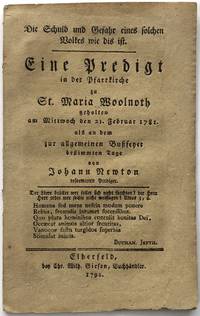
1791Q164<p>Elberfeld Germany: Christian Wilhelm Giesen Buchhandler 1791. Paperback. Near Fine. Disbound pamphlet 32pp. Near Fine with minimal wear. A German translation of John Newton's 'The guilt and danger of such a nation as this! A sermon preached in the parish church of St. Mary Woolnoth on Wednesday Feb. 21 1781.' Rare. </p> Christian Wilhelm Giesen, Buchhandler paperback
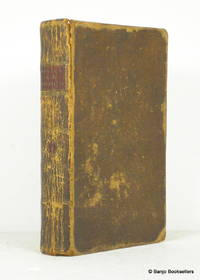
1794207234New York: Printed for and sold by T. and J. Swords and T. Allen 1794. Hardcover. G: Crack along the spine but the front cover remains attached. Wear to the edges and corners. Rubbing to the spine and plate. Tear along the spine in the front free end page and the first blank page. Tanning and foxing to the pages but they remain easy to read. Two volumes bound in one. A brown casebound book with gilt text on a red plate on the spine. xv 266. xvii 284 22 pages. Printed for and sold by T. and J. Swords, and T. Allen hardcover
1793013002Edinburgh: Morison and Son 1793. Volume II only. Tenth Edition. Full leather with raised spine bands. Considerable wear to the extremities. The boards are scuffed. There is a 2" crack along the front joint. The front endpapers are missing: The title page is the first leaf. There is writing and staining on the front pastedown and rear endpapers. A brief gift inscription dated 1808 is on the verso of the title page. A few pages have underlining. In a tight binding. Hard Cover. Fair/No Jacket. 12mo - over 6¾" - 7¾" tall. Morison and Son Hardcover
1793mon0001624192F.& C.Rivington 1793. Hardcover. Good. . Leather spine and corners. F.& C.Rivington hardcover