104 résultats
179943865Halle Rengerschen Buchhandlung 1799. Without wrappers. In "Annalen der Physik. Herausgegeben von Ludwig Wilhelm Gilbert" Bd. 2 Erstes Stück. The entire issue offered. Titlepage to vol. 2. Pp. 1-118 a. 2 folded engraved plates. Cavendish's paper: pp. 1-62. the torsion balance of Michell shown on the plates. <br/><br/><em>First German edition of Cavendish's famous paper in which he calculated the weight of the earth and determined its mass. He also as the first observed gravitational motion of minute portions of matter. He estimates the earth's mass to 66 x 10 to the potential of 24 kg. The original paper "Experiments to determine the Density of the Earth" appeared in Philosophical Transaction 1798."Cavendish published five papers between 1784 and 1809.With one exception they were comparatively minor productions.The exception was his determination of the density of the earth or weighing of the world in 1798 by means of John Michell's torsion balance. The apparatus consisted of two lead balls on either end of a suspended beam; these movable balls were attracted by a pair of stationary lead balls. Cavendish calculated the the force of attraction between the balls fro the observed period of oscillation of the balance and deduced the density of the earth from the force. He found it to be 5.48 times that of water. Cavendish was the first to observe gravitational motions induced by comparatively minute portions of ordinary matter.By weighing the world he rendered the law of gravitation complete. The law was no longer a proportionally statement but a quantitatively exact one; this was the most importent addition to the science of gravitation since Newton."DSB III p. 158. </em> unknown
179948206Halle Rengerschen Buchhandlung 1799. Without wrappers. In "Annalen der Physik. Herausgegeben von Ludwig Wilhelm Gilbert" Bd. 2 Erstes Stück. The entire issue offered. 1-118 a. 2 folded engraved plates. Cavendish's paper: pp. 1-62. the torsion balance of Michell shown on the plates. <br/><br/><em>First German edition of Cavendish's famous paper in which he calculated the weight of the earth and determined its mass. He also as the first observed gravitational motion of minute portions of matter. He estimates the earth's mass to 66 x 10 to the potential of 24 kg. The original paper "Experiments to determine the Density of the Earth" appeared in Philosophical Transaction 1798."Cavendish published five papers between 1784 and 1809.With one exception they were comparatively minor productions.The exception was his determination of the density of the earth or weighing of the world in 1798 by means of John Michell's torsion balance. The apparatus consisted of two lead balls on either end of a suspended beam; these movable balls were attracted by a pair of stationary lead balls. Cavendish calculated the the force of attraction between the balls fro the observed period of oscillation of the balance and deduced the density of the earth from the force. He found it to be 5.48 times that of water. Cavendish was the first to observe gravitational motions induced by comparatively minute portions of ordinary matter.By weighing the world he rendered the law of gravitation complete. The law was no longer a proportionally statement but a quantitatively exact one; this was the most importent addition to the science of gravitation since Newton."DSB III p. 158.The issue contains further papers by Ritter Chladni et al. </em> unknown
17917496BB1791. 3 Bände. Elberfeld Chr. Wilhelm Giesen 1791. 8°. XX S. 2 Bl. 608 S.; XXXIX 574 S.; 4 Bl. 400 S. Mit gest. Portrait. Pappband der Zeit mit verg. Rückensch. Einbände berieben und bestossen. unknown
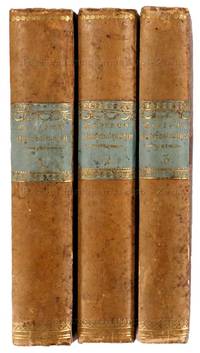
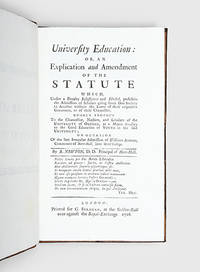
1726190064London: Printed for G. Strahan 1726. Envisaging a university education founded on "piety learning and good manners" First edition of this manifesto for university reform a testament to fierce inter-collegiate squabbles in early 18th-century Oxford. Richard Newton 1676-1753 spent the latter part of his career fighting to expand and reform Hart Hall in Oxford envisaging a collegiate structure which actively sought to mould its pupils - mentally and morally. As he made clear in the preface Newton's vision encompassed "piety learning and good manners" p. xvi. The plan ran into opposition from several other colleges which coveted Hart Hall's lands and pupils. Octavo 190 x 115 mm pp. xvi 207 1. Contemporary panelled calf edges sprinkled red. Although unmarked as such from the Sandys family library at Ombersley Court Worcestershire. Light bumping and rubbing a couple of spots of foxing but contents generally crisp: an excellent copy. ESTC T53430. unknown
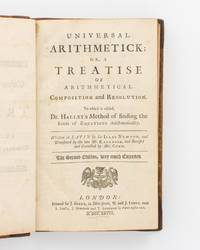
1728117773London: Printed for J. Senex W. and J. Innys J. Osborne and T. Longman 1728. 2nd Edition. Hardcover. Very Good. London Printed for J. Senex W. and J. Innys J. Osborne and T. Longman 1728 'Second Edition very much Corrected'/ 1720 first edition in English/ 1707 first edition in Latin. Octavo iv half-title and title leaves versos blank iv 271 1 publisher's advertisement pages plus 8 full-page plates. Early full polished calf decorated in blind on the sides later expertly recornered and rebacked retaining the original gilt-decorated spine with two contrasting leather title-labels; leather a little unevenly discoloured and rubbed with minor loss to the polished surface of the spine; scattered foxing moderate in places; plates offset; tiny blemish to the bottom margin of one plate a paper flaw well clear of the printed surface; trifling signs of age and use a shallow crease to the bottom corner-tip of the last ten leaves is about the extent of it; overall an excellent copy. The eight plates normally found with a small folding section are bound into this copy in an unfolded state by the simple expedient of having the narrow left-hand border of the printed surface of each plate deep in the gutter. The border is visible in four instances and although the border cannot be seen on the other four plates all of the other printed plate surface is visible. Interestingly the plates show no evidence of ever having been folded. Babson 202. Printed for J. Senex, W. and J. Innys, J. Osborne, and T. Longman hardcover
17693016<p>1769. Hardcover. Very Good/No Dust Jacket. Printed for W. Johnston; London 1769; translated by Mr. Ralphson and Revised and Corrected by Mr. Cunn; to which is added a Treatise upon the Measures of Ratios by James Maguire the whole Illustrated and Explained in a series of Notes by the Rev. Theak</p> hardcover
1720523641720. Amsterdam Chez Pierre Humbert 1720 12° 15 1 328 pp.; 1 pp.331-583; 17 pp. Catalgoue des Livres Impres Chez Pierre Humbert . 12 gefalt. Kupferstichtafeln; Ledereinband d.Zt.; Rücken erneuert; feines Exemplar. PREMIERE EDITION FRANCAISE ! Pierre Coste 1668-1747 "the translator spent many years in England where he fled on the revocation of the Edict of Nantes and where he became intimate with Locke. His translations were of durable service and helped to introduce english thought to the French of the XVIIIth century" Babson Babson 139; Wallis 186; Dibner 148; PMM 172; Horblit N° 79b all 1st engl. Ed. unknown
1800B4784London : Francis Maseres c. 1800. Very good condition. Text toned uniformly. . Binding: Contemporary calf boards rebacked skillfully in matching calf. Spine in six compartments of raised bands with gilt ruling and blind tooled decorative devices. Gilt label on 2. Notes: In the preface the publisher states that “The principle object of the present collection of tracts is to explain and illustrate by examples Mr. Raphson’s and Dr. Halley’s methods of resolving affected algebraic equations by approximation and to compare these two methods with each other in order to be able to form a judgment of their respective merits and determine to which of them we ought to give the preference.â€<br>Francis Maseres 1731-1824 was an English lawyer an attorney general of the Province of Quebec judge mathematician historian member of the Royal Society and cursitor baron of the exchequer. <br> Size: 8vo. 208x120mm. Illustration: Illustrated with a profusion of in text equations. Provenance: Ex Libris on the verso of half title ‘of Mathematical Society’. On the same leaf it states in period hand writing “Twelve copies of this work were presented to the mathematical society for distribution among its members by Baron Meseres. This copy was not Pages: P. Half title Blank with hand written note Title Blank Preface v-lxxii Errata lxxiii-lxxiv Table of Contents lxxv-lxxviii 1-479. Category: Book Canada; Book Science & Technology; Francis Maseres hardcover
175129868AB1751. Volume I of II. Dublin Printed for G.Risk G. and A. Ewing and W.Smith Booksellers in Dame-Street 1751. Small - Octavo 10 cm x 165 cm. 363 pages with all four original engravings Spring Summer Autumn Winter and also including the section with "A Poem sacred to the Memory of Sir Isaac Newton. Inscribed to the Right Honourable Sir Robert Walpole". Hardcover / Original 18th century full calf. In protective Mylar. Endpaper with small tear. The engraving "Spring" loosened and with damage to upper margin effecting the image. The three other engravings in place and in very good condition see photographic images. Provenance-Entry: "Eliza Hungerford March 5 1771" Elizabeth Hungerford. hardcover
17531512210020London: Royal Society Great Britain; The Royal Society of London for Improving Natural Knowledge: 1753 - 1880; 1960 1753. Hardcover. Good. 0x0x0. A massive collection of the Philosophical Transactions of the Royal Society of London. 109 volume set in 102 volumes. Buckram red cloth. Original volumes begin with 1753 volumes: 48 50 part 1 53-56 59-61 63 67 69 71-74 76-84 86-87 89 93-95 97 135 137 140 160 166 167 169-171 end in 1880 vols. 181 186 191-192 197-198 216 1916; Also includes the Royal Society's facsimile reprint of volumes: 1-47 1665 - 1752 49 51-52 57-58 62 64 66 68 70 Index. University library stamps on front paste down title and some edges. Good binding and covers. Over 1053 plates and maps many are folding. <br> The Philosophical Transactions of the Royal Society was first published in 1665 to promote the discussion and diffusion of scientific knowledge. It was the world's first scientific journal and has lasting and significant influence. In the Philosophical Transactions peer review the scientific method and evidence based research were standardized. The discoveries described in this publication are of fundamental importance to the development of our modern world. Robert Boyle John Wilkins and Robert Hooke were some of the original 17th century English polymaths who established and contributed to the publication. Isaac Newton notably led the society which printed his first paper New Theory about Light and Colours in 1672. Notable articles in the original format contained in this set: Thomas Bayle's: An essay towards solving a problem in the Doctrine of Chances. Vol. 53 1763; Barrington's account of Mozart. Volume 60. 1770; Alessandro Volta. Del modo di render sensibilissima la piu debole Elettricita fia Naturale fia Artificiale. vol. 72. 1782; William Roy. The distance between Greenwich and Paris Observatories. Vol. 1783; Flinders. Concerning the Differences in the Magnetic Needle vol. 95. 1805; Benjamin Franklin. Physical and Meteorological Observations vol. 55. 1765; William Herschel. On the Proper Motion of the Sun and Solar System vol. 73. 1783. Printing and the Mind of Man 227; William Herschel. On Nebulous Stars. Volume 81. 1791; William Herschel. Account of a Comet. Volume 71. 1781. Other notable entries: Henry Cavendish's experiments William Hamilton's observations of an earthquake in Italy John Hunter David Rittenhouse's observation of the transit of Venus William Bartram's naturalist observations in America etc. <br> Please contact us if you would like a full list of contents. Note: Domestic shipping is included. International buyers please contact us before purchase. London: Royal Society (Great Britain); The Royal Society of London for Improving Natural Knowledge: 1753 - 1880; 1960 hardcover
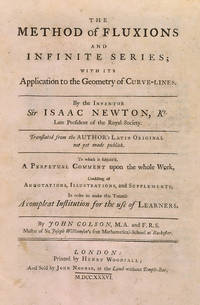
173614348London: Henry Woodfall 1736. FIRST EDITION. With engraved frontispiece interpolated leaf 143-144 and leaf containing errata on the recto publisher’s advertisements on the verso. Paneled sprinkled calf in a contemporary style; a large paper copy with very wide margins a few contemporary annotations. First edition of Newton’s treatise on the calculus a work of great importance and rarity. Ready for publication in 1671 Newton circulated the manuscript among his friends who urged him to establish priority by publishing his own work. He steadfastly refused and prior to his death entrusted it to Henry Pemberton who never had it published. It was not until 1736 that Method of fluxions was finally published in the present English translation by John Colson who added a lengthy commentary. The original Latin edition did not appear until 1779 in the Opera omnia.<br /> <br /> Babson 171; Gray 232; Wallis 232; Smith History of Mathematics I p. 404. Henry Woodfall unknown
1741710Printed for the Author 1741. 8vo. First Edition with engraved frontispiece; nineteenth century full roan sides with blind frame border gilt back uncut patterned endpapers backstrip chafed at extreme head a very fresh clean copy of a scarce work. The proposed 'Appendix' mentioned in the final leaf was not issued. The first published individual history of the county town. A VERY DESIRABLE COPY . Anderson p.143; Upcott p.431 Printed for the Author, unknown
1741kb121.105GB: Author & J.& P. Knapton Etc 1741. Frontispiece and title page are heavily spotted. Slight spotting to next few pages but bulk of text is very clean and tight. Bound in old full leather but rebacked in 1968 with a much paler leather spine with green title label. Three old armorial bookplates of Edward Barrett Curties Wm. Fred. D'Arley and Sir Thomas Neame. Book is in good double plus condition with noticeable signs of wear and/or age. . 1st Edition. Hardback. G/No DW. Author & J.& P. Knapton Etc Hardcover
1733293624London: Printed for J. Strahan 1733. Softcover. Very Good. Second edition. 52pp. Disbound. Some staining good only. Authorship attributed to Richard Newton as per Mansell v. 417 p. 500. Printed for J. Strahan unknown
1752B4844London : Samuel Peterson c.1752. . A near fine copy. Plates and text are clean and crisp. . Edition: Second Edition. Binding: Contemporary calf boards with gilt decorative borderings. Rebacked skillfully. Spine in six compartments of raised bands with gilt decorative devices and rulings. Gilt title on green calf label on 2. Notes: This is one of the most important works introducing Newtonian physics to continental Europe. Wilhelm Jacob Gravesande 1688-1742 was a Dutch lawyer and natural philosopher chiefly remembered for developing experimental demonstrations of the laws of classical mechanics. As professor of mathematics astronomy and philosophy at Leiden University he helped to propagate Isaac Newton’s ideas in Continental Europe. Size: 8vo. 184x127mm. Illustration: Illustrated with a multitude of in text equations as well as 4 fold out plates depicting mathematical relationships. Pages: P. Title Blank Preface iii-iv 1-187 Category: Book Science & Technology; Samuel Peterson hardcover
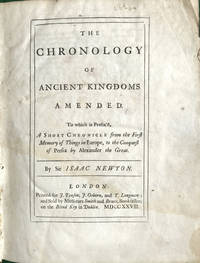
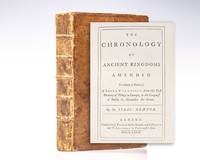
173858701<p>NEWTON'S RADICAL THEOLOGICAL OPINIONS SANITIZED - RARE ISSUE FOR SALE IN IRELAND</p><p>first edition issue with title page indicating for sale in Ireland 4to.26 x 20.5 cms. xvi 376pp. 3 folding plates of the Temple of Solomon contemporary sprinkled calf double gilt fillet border on sides with tiny gilt leaf ornaments at corners. spine panelled by raised bands edges sprinkled red short crack at head of front joint lacks title label on spine front free endpaper pasted down very light water mark on early leaves running to about p.80 but always light and generally unobtrusive and generally diminishing so that by p.100 it is barely discernable very light waterstain at one point on fore-margin of the last few leaves else a fresh copy.</p><p>Contemporary inscription on upper edge of a terminal blank endpaper "10s.10d To E: Hudson" and a faint early signature in a small hand at upper margin of title page "G. T. Payne".</p><p>ESTC t30722 GRAY 'Newton Bibliography' 309<br />The imprint of the standard first edition ESTC n2784 names only the London booksellers Tonson Osborn and Longman but special cancel title pages were printed for copies destined to be sold in both Dublin and Edinburgh ESTC n962 and these are understandably much rarer than the standard one. <br />Newton 1642–1727 natural philosopher and mathematician had been elected a fellow of Trinity College Cambridge in 1667 and Lucastrian professor of mathematics in 1669. Those positions combined with income from his estate made him both financially secure and almost free from prescribed duties. His great researches on optics were the first fruits of that freedom. However at the same time he became an earnest student of both alchemy and of theology. His surviving manuscripts show that in the latter field he reached firstly an anti-Trinitarian or Arian position which developed into an even more radical position which saw Jesus as merely the latest of a series of prophets sent by God to reclaim mankind from false gods a position Newton developed in the 1680s in the unpublished manuscript of "his most important theological composition 'Theologiae gentilis origines philosophicae' 'The philosophical origins of gentile theology'" O.D.N.B.<br />Such opinions were completely unacceptable to contemporary society and Newton realising that they would have undermined his position kept them a closely guarded secret but in later life he revisited the treatise and "thoroughly purged it became his 'Chronology of Ancient Kingdoms Amended' 1728. The original treatise he kept to himself . When he died his heirs found the completed manuscript of the Chronology which they immediately sold to a publisher for £350" O.D.N.B. and the book was published shortly thereafter.<br />The book was distributed in Dublin by Smith and Bruce. John Smith an Ulster Presbyterian whose radical activities had led to his expulsion from Glasgow University in 1722 came to Dublin in 1724 where with the sympathetically minded William Smith and later William Bruce he established a book-selling business. They were notable for their intellectual and continental connections they were cousins of the philosopher Francis Hutcheson and their publication of works challenging conventional opinions. <br />E. Hudson is probably Edward Hudson 1703 ca. - 1757 of Ardee Co. Louth who having entered Trinity College in 1722 aged 19 became a Fellow in 1728 the year of publication of this book. He was later Rector of Omagh. The signature on the title page may be that of Rev. George Thomas Payne 1819-1888 of Kilkenny who had entered T.C.D. in 1833.</p> Printed for J. Tonson, J. Osborn, and T. Longman; and sold by Messieurs Smith and Bruce Booksellers on the Blind Key in Dublin hardcover
1728149863London: Printed for J. Tonson in the Strand and J. Osborn and T. Longman in Pater-noster Row 1728. First edition of Newton's ambitious attempt to reconstruct and rationalize the timelines of ancient history. Quarto bound in full contemporary Cambridge calf ruled and tooled in blind with speckled panels gilt turn-ins ordinary paper issue illustrated with 3 folding engravings. From the library of Harvard University professor Owen Gingerich. Owen Gingerich 1930–2023 was an American astronomer and historian of science renowned for his scholarship on early modern astronomy particularly his meticulous census of De revolutionibus that illuminated how Copernicus’s work was read and received in the sixteenth century. A longtime professor at Harvard and a senior astronomer at the Smithsonian Astrophysical Observatory Gingerich helped bridge scientific and humanistic inquiry demonstrating how historical context shapes the development and interpretation of scientific ideas. In very good condition. The Chronology of Ancient Kingdoms Amended published posthumously in 1728 was Isaac Newton’s ambitious attempt to reorganize and compress the timelines of ancient history by applying critical philology comparative mythology and astronomical calculation. Seeking to reconcile classical sources with biblical chronology Newton argued that the conventional dating of Egyptian Greek and Near Eastern kingdoms was excessively long and he used evidence such as eclipse records regnal lists and mythic genealogies to propose a shorter more unified ancient past. Although modern historians largely rejected Newton’s revised dates the work was significant for revealing the breadth of his intellectual pursuits beyond physics and mathematics and for illustrating how early Enlightenment thinkers employed scientific reasoning to interrogate historical and scriptural authority. Printed for J. Tonson in the Strand, and J. Osborn and T. Longman in Pater-noster Row unknown
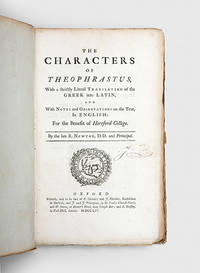
1754168895Oxford: Printed; and to be had of R. Clements and J. Fletcher Oxford and J. and J. Rivington & 2 others London 1754. First edition of this critical edition of Theophrastus's Characters featuring biting pen-portraits of everyday Athenians. Richard Newton 1676-1753 an academic and administrator re-founded Hertford College Oxford. The Characters is a posthumous publication of certain academic exercises undertaken during his tenure as Principal and was published as "his Last Gift" to the College dedication. Provenance: "Jean Pio 1850" 1833-1884 a Danish classical tutor who published the first collection of Greek folk-tales in modern Greek and presumably acquired these academic exercises during his own studies at the Roskilde Cathedral School with his inscription on the front free endpaper. Octavo 224 x 135 mm. Text in English Latin and Greek. Contemporary quarter calf smooth spine ruled in gilt and with red morocco label marbled paper sides uncut edges. Bookplate of Robert J. Hayhurst 20th-century pharmacy mogul on front pastedown. 19th-century inscription on front pastedown resembling "Kjöbt hallig med Bekkers Demosth. og Aiskhines orr n. cor for 28/." and remnants of erased early signature on title page. Light bumping and wear small patch of paper applied to front pastedown faint browning to outer margins of contents lacking rear free endpaper: a very good copy. P. R. Quarrie "Classics" in Ian Gadd ed. The History of Oxford University Press vol. I p. 378. unknown
1742702044 107 7 102 pages With a statement of authenticity signed by the publisher on title page verso also contains The Money'd Man's Pocket-Book. Being Tables of Simple Interest Exactly Computed; For One to Twelve Months and for One to Ninety-one Days or a Quarter of a Year with separate title page and authentication page signed by publisher Printed for Thomas Astley hardcover
174761266Printed for John Osborne. 1747. Hardcover. Very Good. v 162pp little creasing in some pages sm tear in last page bound in full leather sl mottled; Octavo . Printed for John Osborne hardcover
1728000772London: James and John Knapton 1728. 2nd Edition Corrected . Hardcover. Good/N/A. Full leather darkened and some cracking to spine. 5 bands to spine. Vol 2 part 2. Illustrated with Dr. Samuel Clark's notes taken mostly out of Sir Isaac Newton's Philosophy in olde English. Rubricated title page. Hinges cracked. Also fold out tables numbered XII to XXVII laid in the back all in good shape. ex lib from the Hartford Seminary. First belonging to Aaron Day dated May 3 1737. Then belonging to H A Gleason Jr. A very rare book. photos on request. <br/> <br/> James and John Knapton hardcover
17294526London: For Benjamin Mott 1729. first Edition in English. Two vols. 8vo. 19 x 11 cm. Paginated: 36 320; 2 393 13; viii 3 4-71 1 pp. Collation = Ad 1: pi1 A2 2A8 a8 B-X8. Ad 2: pi1 B-Z8 Aa-Cc8 Dd3 lacking blank leaf Dd4 as commonly; a4 A-D8 E4 with cancel C1 headling = "Gentium"; stain on fols. b7-8 and c1-2. Lacking engraved allegorical frontispiece to each volume not unusually. With 47 engraved folding plates numbered 1-25 and 1-19 with 3 unnumbered plates at rear of volume 2 2 folding letterpress tables 3 engraved headpieces. Bound in contemporary English sprinkled calf very minor wear wear along binding extremities spines with red morocco lettering pieces gilt black oval volume numbers gilt old shelf labels in MS on paper circles "30". BEAUTIFUL COPY OF THE FIRST ENGLISH-LANGUAGE EDITION OF THE GREATEST WORK IN THE HISTORY OF SCIENCE "PERHAPS THE GREATEST INTELLECTUAL STRIDE THAT IT HAS EVER BEEN GRANTED TO ANY MAN TO MAKE" EINSTEIN. <br /> <br /> "The Principia is generally described as the greatest work in the history of science. These provided the great synthesis of the cosmos proving finally its physical unity. Newton showed that the important and dramatic aspects of nature that were subject to the universal law of gravitation could be explained in mathematical terms within a single physical theory. With him the separation of natural and supernatural of sublunar and superlunar worlds disappeared" Bernard Cohen Introduction in The Mathematical Principles of Natural Philosophy 1968.<br /> <br /> PMM: "Copernicus Galileo and Kepler had certainly shown the way; but where they described the phenomena they observed Newton explained the underlying laws." Originally published in Latin in 1687 the Principia "marked the culmination of the scientific revolution . ushered in modern science and through its legacy the work may have done more to shape the modern world than any other ever published" ODNB. Newton here laid the foundation for classical mechanics establishing the three laws of motion and universal gravitation. It is universally considered a masterpiece that unified physical laws of the heavens and earth. <br /> <br /> This finely printed translation into English by Mott made the work available to a wider lay audience. This edition also contains John Machin's attempt to rectify Newton's lunar theory "The Laws of the Moon's Motion according to Gravity." Most copies have an engraved frontispiece in each volume although some have only one Ransom Center etc. while a surprising number have neither of them as here including the Gonville and Caius copy at Cambridge University M.26.7-8. Because the book has been of enduring interest for almost 300 years with commensurately heavy use copies as fresh as this in contemporary bindings are of genuine rarity.<br /> <br /> Babson 20. Wallis 23. PMM 161. For Benjamin Mott unknown
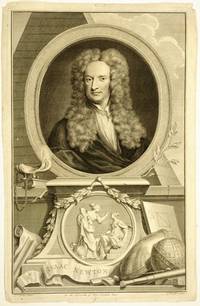
1747438651747. Birch's Heads 1747/1752. - Line J.Houbraken sculpsit G. Kneller pinx 1743 363 x 232 auf 402 x 260 mm. Sir Isaac Newton 1642-1727 P.R.S. Lucasian profewssor of nathgematics; physicist and philosopher. Portr. Wellcome Inst. Hist. Med. R.Burgess No.2140.5 unknown
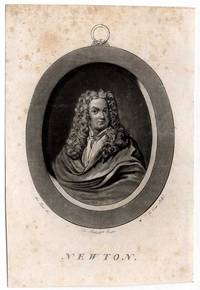
1787343001787. Galerie universelle des hommes qui se sont illustres dalls l'emoire des lettres . Imbert. S. Comte de la Platiere. Paris 1787 des Rais del le Couer Sculp. Ex Biblioth.ca Regia Schabkunstblatt 16 x 122 cm auf 20 x 148 cm. Seltenes Portrait von Issac Newton. unknown
17433300108London: J.Osborn and J.Rivington 1743. Book. Very Good. Full-Leather. First Edition. 8vo - over 7¾" - 9¾" tall. pp xv 1 403 internally very good owners plate on inside front cover. Boards look to be contemporary spine relatively recent endpapers having been replaced. J.Osborn and J.Rivington Hardcover