232 résultats
1979BN256759Reinbek bei Hamburg : Rowohlt 1979. 1979. Theorie und Geschichte der Semiotik. Thomas A. Sebeok. Aus d. Amerikan. übers. von Achim Eschbach Rowohlts deutsche Enzyklopädie ; 389 <br/><br/>Theorie und Geschichte der Semiotik. Thomas A. Sebeok. Aus d. Amerikan. übers. von Achim Eschbach Rowohlts deutsche Enzyklopädie ; 389 Semiotik / Theorie / Geschichte - Sebeok Thomas Albert Reinbek bei Hamburg : Rowohlt unknown
2000ZB2633902000. vol. 1 ex library good. - If you are reading this this item is actually physically in our stock and ready for shipment once ordered. We are not bookjackers. Buyer is responsible for any additional duties taxes or fees required by recipient's country. Photos available upon request. unknown
190744822Leipzig Barth 1907. No wrappers. Extracted from "Annalen der Physik" Vierte Folge Bd. 23. Pp. 989-990 a. pp. 991-996. The leaves is punched in inner margins after cords. Fine and clean. <br/><br/><em>First edition of Laue's importent paper in which he gives an experimental proof of the non-addition and non-subtraction phenomena in respect of the velocity of light. - Laue was awarded the Nobel Prize in 1914."Einstein’s special theory of relativity dispensed with the addition or subtraction of the velocities hitherto assumed to be self-evident and applied instead a special "addition theorem." In 1907 Laue demonstrated that this theorem readily yields Fizeau’s formula with the previously enigmatic Fresnel drag coefficient: u = c/n ± v1 - 1/n2. Laue thereby furnished Einstein’s theory with an important experimental proof which along with the Michelson-Morley experiment and arguments from group theory contributed to early acceptance of the theory. Having thus proved himself an expert in relativity theory in 1910 Laue wrote the first monograph on the subject. He expanded it in 1919 with a second volume on the general theory of relativity; the work went through several editions."DSB. </em> unknown
2000x-0521594243Cambridge Univ Pr 2000. Hardcover. New. 227 pages. 9.50x6.50x0.75 inches. Cambridge Univ Pr hardcover

1996__3110142198Walter De Gruyter Inc 1996. Hardcover. New. 445 pages. 10.00x7.25x1.00 inches. Walter De Gruyter Inc hardcover
2000x-0521620309Cambridge Univ Pr 2000. Hardcover. New. 1st edition. 394 pages. 9.25x6.50x1.00 inches. Cambridge Univ Pr hardcover
1991x-0521370906Cambridge Univ Pr 1991. Hardcover. New. 493 pages. 9.00x6.25x1.00 inches. Cambridge Univ Pr hardcover
1993x-0582087686Longman Pub Group 1993. Paperback. New. 1st edition. 288 pages. 9.45x6.61x0.71 inches. Longman Pub Group paperback
1989x-0521333954Cambridge Univ Pr 1989. Hardcover. New. 376 pages. 9.00x6.20x0.90 inches. Cambridge Univ Pr hardcover
1999__0080430341Pergamon Pr 1999. Paperback. New. 2nd edition. 1173 pages. 12.25x8.75x2.75 inches. Pergamon Pr paperback
191363411Chicago IL & Amherst MA: Carter White Lead Company Arms Pocket Book & Leather Novelty Co. 1913. 64mo. 2.5 x 4 in. 2 55 3 pp. With 1 large folding 4-pp. paint sample plate w/ 32 mounted colour paint samples text elevation illustrations of Arts & Crafts 4-Square and Spanish Revival homes. Flexible brown pigskin embossed borders rounded corners gilt lettering stamped on front cover couple minor closed tears to final text leaf minor age toning to endpapers still a VG copy. Third edition of this compact vest pocket edition of the very scarce Carter paint calculator designed to provide specific instructions on how to mix Carter White Lead Paints sold by the gallon with their specific additional colours linseed oil turpentine and “Japan Drier†to be carefully mixed beforehand after the painter had determined the specific amount of paint by using the calculator. Carter Master Painter “Color Packs†came in 53 different colours shades and tints including Lamp Black French Ochre Venetian Red Raw Umber Burnt Sienna Parisian Blue and others as carefully depicted in the folding colour paint sample chart. Carter White Lead Co. was founded in 1878 by Levi Carter 1831-1903 and partners who pioneered the use of powdered lead in mixing durable paints building and operating the Chicago plant which at the beginning of the 20th Century was the largest single white lead factory in the World as well as plants in East Omaha and Montreal. In the first decade of the 20th Century they claimed to produce half of all paint used in North America. Worldcat locates 1 copy Athenaeum of Philadelphia; See: Adam Fletcher A History of the Carter White Lead Company Factory in East Omaha North Omaha History Jan. 20 2020; Jacqui Ainlay-Conley: Progress in a Can: An Examination of One Industry Through the Gilded Age and Progressive Era Historical Studies Journal Spring 2007 Vol. 24 pp. 1-15. Carter White Lead Company, [Arms Pocket Book & Leather Novelty Co.], hardcover
19992-0824771478Marcel Dekker Inc 1999. Paperback. New. 1st edition. 576 pages. 10.25x7.25x1.25 inches. Marcel Dekker Inc paperback
195549679Los Angeles & Oakland CA: Boysen Colorizer Paints ca. 1955. 4to. 8 pp unpaginated. Colour and black & white illustrations colour-illustrated self-printed wrappers stapled as issued very minor tear at foot of spine slight shelfwear VG-; Fourteen original photographs 12 sized 8 x 10.25 in. two sized 5 x 7 in. nine silver gelatin black & white several w/ commercial photographers stamps on verso 5 colour photographs NF set. First edition of this very scarce dealer’s promotional packet extolling the virtues of the Boysen Colorizer System complete with sales pitch and fantastic photographs showing the displays and products. The original Colorizer System was developed in the 1930s by two anonymous entrepreneurs in Salt Lake City UT. In 1949 they contracted with the Walter N. Boysen Paint Company in Oakland CA to produce the paints which were then introduced nationwide as a rapid paint-formulation system in a House & Garden Magazine article. The original system adopted by Boysen consisted of 1322 paint colours derived from 31 concentrated colourants as well as white and light gray base paints into which the concentrates were mixed. The brochure and photographs provide a fantastic guide for the marketing of the system with a paint sample album for 60-second color matching Color Center chip display as well as the national advertising campaign pushed by Boysen. The photographs include a photo of painter and housewife examining the sample book by Joern Gerdts Commercial Photographer Salt Lake City UT; Boysen Colorizer Paints advertising spot on the Ed Sullivan Show at CBS photo by Joseph Alpern Beverly Hills CA; an anniversary Boysen Paint Sale window display and more. See: Kuehni & Schwarz Color Ordered: A Survey of Color Systems from Antiquity to the Present 2007 pp. 268-270; No copies located in Worldcat. Boysen Colorizer Paints, unknown
192348873Braunschweig u. Berlin Vieweg & Sohn Julius Springer 1923. Contemp. hcloth. . Stamp on titlepage. In "Zeitschrift für Physik. Hrsg. von Karl Scheel" Bd. 13. IV406 pp. Bohr's paper: pp. 117-165. Clean and fine. <br/><br/><em>First edition. As Bohr in his 1918 paper The quantum theory of line spectra had discussed the expectation that there was a necessary connection between the classical and the future theory in the limit of large quantum numbers and in a later paper 1920 named it "Korrespondenzprincip" Principle of Correspondance Bohr now in the paper offered discussed again the fundamental principles of Quantum Theory in connection with the Principle of Correspondence.Rosenfeld No 29. </em> hardcover
1994x-082479270XMarcel Dekker Inc 1994. Paperback. New. 1st edition. 384 pages. 10.25x7.25x0.75 inches. Marcel Dekker Inc paperback
19802091502133537147San'yoshinbunsha 1980. Soft Cover. Fine. Number of books: 1 San'yoshinbunsha paperback
1960100979AB1960. Yale / London / and others MacMillan / and others c. 1960 - c. 2000. Octavo. More than 3000 pages. Original Softcover and Hardcover bindings. All Volumes with signs of external wear but overall in very good condition. In addition the collection also includes a few publications on Administration Policy. From the library of an irish Councilman and University lecturer. Includes for example the following essays: paperback
1979x-0824768450Marcel Dekker Inc 1979. Paperback. New. 1st edition. 256 pages. 10.25x7.25x0.05 inches. Marcel Dekker Inc paperback
1984x-0824771303Marcel Dekker Inc 1984. Paperback. New. 1st edition. 592 pages. 10.25x7.25x1.00 inches. Marcel Dekker Inc paperback
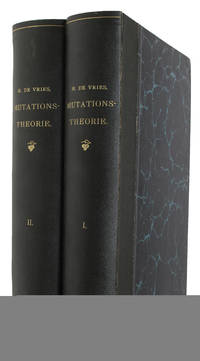
190144710Leipzig Veit & Comp. 1901-03. Lex8vo. Bound in 2 contemp. hcalf spines gilt and with gilt lettering. Spines slightly rubbed. XII648;XIV752 pp. textillustrations and 12 colourplates. Internally fine and clean. <br/><br/><em>First edition og this classic work in genetics where de Vries further develops the theory of mutations.- "De Vries experimental work in the 1890' led to the rediscovery of Mendel's laws and the discovery of the phenomenon of mutation. The rediscovery of Mendel's laws was announced almost simultabeously by de Vries Correns and Tschermak-Seysenegg - in that order.The results of his more than ten years of experimentation and study were laid down in de Vries's "Die Mutationstheorie.1901-1903 in which he described in detail his work on the segregation laws on phenomena of variation and on plant mutations. The book made him famous and he was recognized as one of the foremost botanists of his time."DSB."De Vries discovered revealed and proved the importence of Mendel's work. Advanced the theory of "mutations" or discontinous change in the character of species." Horblit. One Hundred Books famous in Science No. 73 b. - Dibner. Heralds of Science No 36. - Garrison & Morton No 240. - Sparrow. Milestones of Science No 194. </em> unknown
190144522Leipzig Veit & Comp. 1901-03. Lex8vo. Bound in 2 contemp. hcloth. Gilt lettering to spines. XII648;XIV752 pp. textillustrations and 12 colourplates. Internally fine and clean. <br/><br/><em>First edition og this classic work in genetics where de Vries further develops the theory of mutations.- "De Vries experimental work in the 1890' led to the rediscovery of Mendel's laws and the discovery of the phenomenon of mutation. The rediscovery of Mendel's laws was announced almost simultabeously by de Vries Correns and Tschermak-Seysenegg - in that order.The results of his more than ten years of experimentation and study were laid down in de Vries's "Die Mutationstheorie.1901-1903 in which he described in detail his work on the segregation laws on phenomena of variation and on plant mutations. The book made him famous and he was recognized as one of the foremost botanists of his time."DSB."De Vries discovered revealed and proved the importence of Mendel's work. Advanced the theory of "mutations" or discontinous change in the character of species." Horblit. One Hundred Books famous in Science No. 73 b. - Dibner. Heralds of Science No 36. - Garrison & Morton No 240. - Sparrow. Milestones of Science No 194. </em> hardcover
1997Adhya-9780306456930SPRINGER 1997. Hardcover. New. SPRINGER hardcover
190142079Leipzig Veit & Comp. 1901-03. Lex8vo. Bound in 2 fine contemp. hcalf. Raised bands gilt spines and with gilt lettering. A few minor scratches. A name cut from front free endpaper. XII648;XIV752 pp. textillustrations and 12 colourplates. Internally fine and clean. <br/><br/><em>First edition og this classic work in genetics where de Vries further develops the theory of mutations.- "De Vries experimental work in the 1890' led to the rediscovery of Mendel's laws and the discovery of the phenomenon of mutation. The rediscovery of Mendel's laws was announced almost simultabeously by de Vries Correns and Tschermak-Seysenegg - in that order.The results of his more than ten years of experimentation and study were laid down in de Vries's "Die Mutationstheorie.1901-1903 in which he described in detail his work on the segregation laws on phenomena of variation and on plant mutations. The book made him famous and he was recognized as one of the foremost botanists of his time."DSB."De Vries discovered revealed and proved the importence of Mendel's work. Advanced the theory of "mutations" or discontinous change in the character of species." Horblit. One Hundred Books famous in Science No. 73 b. - Dibner. Heralds of Science No 36. - Garrison & Morton No 240. - Sparrow. Milestones of Science No 194. </em> hardcover
192248912Paris Gauthier-Villars 1922. 4to. Bound in 2 uniform full cloth but of slightly different sizes. Paperlabels pasted to lower part of spines. A faint stamp to titlepage and some of the issues. In "Comptes Rendus Hebdomadaires des Séances de L'Academie des Sciences" Tome 174. 18151 pp. Entire volume offered. Cartan's papers: pp.437-439 593-595 734-737 857-60 1104-1107. <br/><br/><em>First edition of these papers in which Cartan intruced the concept of "Torsion" the main inspiration for Einstein in his searce for a unified field theory. The ECT of gravity is a modification of the General relativity Theory"The Einstein-Cartan theory also known as the Einstein-Cartan-Sciama-Kibble theory is a classical theory of gravitation similar to general relativity but relaxing the assumption that the affine connection has vanishing antisymmetric part torsion tensor so that the torsion can be coupled to the intrinsic angular momentum spin of matter much in the same way in which the curvature is coupled to the energy and momentum of matter. In fact the spin of matter in curved spacetime requires that torsion is not constrained to be zero but is a variable in the principle of stationary action. Regarding the metric and torsion tensors as independent variables gives the correct generalization of the conservation law for the total orbital plus intrinsic angular momentum to the presence of the gravitational field. The theory was first proposed by Élie Cartan in 1922 and expounded in the following few years. Dennis Sciama and Tom Kibble independently revisited the theory in the 1960s and an important review was published in 1976. Albert Einstein became affiliated with the theory in 1928 during his unsuccessful attempt to match torsion to the electromagnetic field tensor as part of a unified field theory. This line of thought led him to the related but different theory of teleparallelism." Wikipedia. </em> hardcover