3 résultats
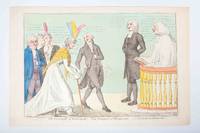
18005629London: S. W. Fores 1800. First edition. Illustrated hand-colored broadside measuring 270 x 400mm and printed to verso only. Faint offsetting to recto and faint traces of mounting to corners. In all a Fine example of this visual satire commenting on the phenomenon of younger men seeking marriage with elderly widows for their own financial gain -- and the cultural anxiety surrounding the marital sexuality of such brides. Unrecorded in ESTC and OCLC we have located two examples of the present work at the British Museum and Yale. <br /> <br /> The present broadside draws together a wide matrix of debates and social anxieties surrounding the economic and sexual status of widows and the financial motivations for marriage among second sons and men of the middle class. Though women were more frequently forced into experiencing marriage as a form of 'honorable prostitution' in which their physical desirability served as their key for accessing wealth and stability under coverture it was increasingly acknowledged that large swaths of young men also suffered under this system. And while widows could escape the system -- shifting from the disempowered femme covert to the more legally independent femme sole on their husbands' deaths -- there was both a social fantasy of reinserting them into the marriage market as a means for regaining control over their money and bodies as well as a social anxiety about their ability to corrupt through the range of knowledge and authority they gained through previous marital experience. Here a young man walks his aging crone down the aisle. Ornately clad and expressing her anticipation for "the comforts of matrimony" she is ridiculed by the ministers at the pulpit who posit that if "matrimony was first ordained.for a remedy against fornication" then "the remedy will be worse than the disease" in this instance. Untroubled the young groom focuses on the land deeds bank notes and jewelry accounts which stuff his pockets -- assets which will legally become his after the ceremony and which serve as his marital comforts. Meanwhile two young women observe from the sidelines one of them planning her future with the groom after his aging bride's eventual demise. "Those jewels will look better on me than on the last owner" she notes as her companion whispers hopefully "you'll let me take a morning ride with you sometimes."<br /> <br /> A visual commentary on the financial and social issues surrounding marriage under coverture which Daniel Defoe would deride as "matrimonial whoredom."<br /> <br /> <br /> British Museum 1935.0522.8.109. Yale Center for British Art B1974.12.328. S. W. Fores unknown
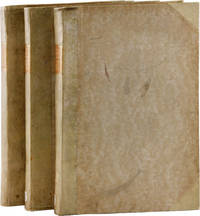
175456749Venetiis Venice: Apud Nicolaum Pezzana 1754. Folio 37cm. Three volumes rebound in early twentieth-century half-vellum with tan paper over boards titles in gilt on orange-painted spines; later plain endpapers; vol. I: lxxvi380pp; vol. II: 308pp; vol. III: 438pp. Title page of vol. I printed in red and black. Ex-library with stamp "Biblioteca Seminario Cividale" to vol. II t.p. and call number labels to base of spines. Stamp of unidentified Archbishop showing galero with 10 tassels to title pages. Sturdy copies with minor general wear and scuffing to boards endpapers discolored contents clean apart from occasional minor foxing: Very Good. <br /> <br /> Vol. I: 2o: a4 b-e8 χ2 A-Z8 2A6. Vol. II: 2o: A-T8 χ2. Vol. III: 2o: A-S8 T-V6 X-2D8 2E-2F4. Detailed work on marital sexuality written by a Jesuit priest and casuist to guide other priests hearing confessions about sexual behavior. Sánchez "depicted human nature as strongly sexualized and proclaimed that a wide range of sexual pleasures could be enjoyed in marriage without being tainted by mortal sin" Watt. The Church disagreed with his permissive stance on some activities and caused some passages to be expurgated in 1610. Later in 1666 and 1679 multiple Popes placed the third volume on the Index of Prohibited Books. Nonetheless the work was frequently reprinted from its first appearance in 1602-1605 until this 1754 edition. <br /> <br /> Sánchez whose other well-known work discussed lying and mental reservation is also recognized as "one of the greatest casuists" FRAXI i.e. Ashbee Bibliography of Prohibited Books II p.81. See Watt Review of Fernanda Alfieri Nella camera degli sposi Bibliothèque d'Humanisme et Renaissance LXXIII.1 2011. Apud Nicolaum Pezzana unknown
17875031London: Charles Eyre & Andrew Strahan 1787. First edition. 27 George III Chapter 44. A Fine copy measuring 310 x 190mm and collating complete: 2 987-988. A scarce and important piece of legal history which ESTC records at only one library Lincoln's Inn and which does not appear in the modern auction record. The present is the only example on the market. <br /> <br /> At the start of the Restoration "English church courts were revived by an act of Parliament on 27 July 1661 to resume their traditional task of correcting spiritual and moral misdemeanors. Soon thereafter parishioners across England's dioceses once more faced admonition fines excommunication and even imprisonment if they failed to conform to the laws of the restored Church of England" Aklund. As much as these courts sought to reestablish a monolithic Anglican communal identity during Charles II's reign their position in the 18th century became "a case study in the secularization of the legal system" particularly given their theoretical justification based in the problematic concept of divine right Harris. Numerous acts the present example among them "represented an important step in the direction of limiting the reach of of ecclesiastical jurisdiction" Harris. <br /> <br /> An Act to Prevent Frivolous and Vexatious Suits in Ecclesiastical Courts was passed in 1787 drawn from a bill presented in Parliament the previous year. Its major accomplishment was the removal of Church authority in the regulation of private sexual behaviors: "It shall be further enacted by the Authority aforesaid That no Suit shall be commenced in any Ecclesiastical Court for Fornication or Incontinence of for any striking or brawling." While the Church may have voiced its moral codes or enacted social shaming within its own communities it no longer had the legal authority to regulate or punish sexual behavior. Such secularization had significant benefits across a number of communities. For survivors of assault it ended the Church's ability to mandate that a woman marry her attacker; for queer communities it prevented Biblically based persecution; for sex workers it took away the risk of arrest or fines for conducting their livelihoods. Ultimately the jurisdiction of ecclesiastical courts over sexual behavior whether in the form of obscene or defamatory words sexual engagement and sensual pleasure was terminated by this act. Little to no legal regulation of sex would be enacted until the next century when the 1861 Offences Against the Person Act and a series of Contagious Diseases Acts would seek to give secular courts more control over individuals' bodies. <br /> <br /> ESTC N58717. Charles Eyre & Andrew Strahan unknown