54 résultats
174014160Paris: de L’Imprimerie Royale 1740. Complete with errata’s and original blank leaves two of three finely engraved frontispieces chapter vignettes ornamental head and tail pieces and 82 folding plates. Full mottled calf rebacked the corners a bit worn. Interior is lightly toned with some browning on the preliminaries and last leaves. Generally this is an excellent set. First editions of these three volumes from a series published by the Academy of Sciences. It is a summary of the activities and inventions that have been made and contains the most important discoveries of the time. These periodicals which were at the forefront of scientific development during the Enlightenment contain works produced by an elite class of French scientist for the years 1722 1731 and 1740. Each volume provided an overview of advancements in math and science for each year and the writings therein shaped the world’s understanding of physics mathematics astronomy anatomy and other fields of science. They further provide invaluable historical data such as meteorological and astrological records for each year. <br /> <br /> The memoirs for 1722 include data recorded on both a lunar and solar eclipse as well as other astronomical observations by Jacques Cassini 1677-1756 best know for completing his fathers work on determining the meridian of Paris. The distinguished astronomer provided further research on lunar eclipses in the memoirs of 1731 where he is in great company alongside distinguished mathematicians Alexis-Claude Clairaut 1713-1765 Pierre Bouguer 1698-1758 known for his work in physics photometry and hydrography and the foremost proponent of the Newtonian movement in France Pierre de Maupertuis 1698-1759. Of special note in the 1731 memoirs is Maupertuis’s ballistic arithmetic which was used to try to better understand the movement of the earth and its gravity. Too an article by Clairaut on new formulas for finding the center of gravity. These articles contributed greatly to a better understanding of the earth’s shape and the mechanics of its rotation particularly Bouguer’s essay on the tendency of objects set in motion to move in a curvilinear fashion. The 1740 edition contains Cassini De Thury’s De la Maridienne de Paris. which was an important step in the process of mapping the shape of the earth. Cassini 1714-1784 representing the third generation of the distinguished family of astronomers was the first to question <br /> <br /> <br /> Picard’s measurements which had been used to map the Maridian of Paris. Clairaut’s essay on integral calculus in the same volume which established the existence of an integrating factor for linear differential equations was an important step in the history of mathematics and Mairan’s treatise on reflection and refraction of light and the human eye was essential to the advancement of optics. Mairan 1678-1771 would set the foundation for optical theory with this treatise. de L’Imprimerie Royale unknown
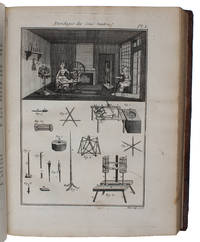
176226629Berlin Stettin und Leipzig Johann Heinrich Rüdigern 1762-75. 4to. Bound in 13 fine uniform full calf raised bands gilt backs. Remains of paperlabels on backs. Top of spine on one volume frayed. Small rubber stamp on titles. A few brownspots. A good copy. Having in all 374 of 585 fine engraved plates 1 plate supplied in xerox-copy. Plates measure around 37x24cm. <br/><br/><em>First German edition of one of the main works of the 18th century in the fields of crafts and technology as it is a translation of the famous series "Description des Arts et Metiers" issued by Academie Royale des Sciences 1760-75. The French edition was published in folio. Band 1: Kohlenbrennen Lichtziehen Ankerschmieden Nadler Papiermacher. 31 plates and 1 table;Band 2: Eisenhämmer. Teil 1-2 Wachsziehen Pergamentmachen Leder-Vergoldung Schieferbrüche. 22 plates; Band 3: Eisenhämmer. Teil 3-4 Spielkartenherstellung Seidenfärberei Pappenmacher. 29 plates 1 plate supplied in xerox-copy; Band 4: Böttcherkunst Weißgerber Ziegelstreichen Zuckersieden Silber affinieren. 30 plates; Band 5: Messingherstellung Tuchmacherkunst Lohgerberei. 33 plates. Band 6: Tuchfrisierkunst Saffianleder-Herstellung Leder auf ungarische Art Weißgerber Hutmacher Dachdecker. 19 plates; Band Band 7: Tapetenweberei Kalkbrennerkunst Ziegelstreichen in Holland Ziegelhütten Ball- und Raquettenmacher. 30 plates and 1 table; Band 8: Perückenmacherkunst Müller Nudelmacher und Bäcker. 15 plates; Band 9: Schuster Schlösserkunst. 48 plates; Band 10: Steinkohlenbergbau Indigobereiter. 22 plates; Band 11: Eisenbergwerke und Hüttenwerke in der Steiermark Leimsiederei Fischerei Teil 1. 25 plates and 1 table; Band 12: Fischerei Teil 2. 50 plates; Band 13: Fischerei Teil 3 Porzellanherstellung. 23 plates and 1 engr. frontisp.; Band 14: Glasmalerei und Glasarbeiten. Mit 13 von 14 Tafeln; Band 15: Wollenzeugfabrikant. 17 plates; Band 16: Seifensider Leinwandhandel Schneiderhandwerk Leinenmanufaktur Tabaksmanufaktur. 27 plates; Band 17: Bleiarbeiter mathematische und astronomische Instrumente Baumwoll-Samtfabrikation. 38 plates; Band 18: Stickerkunst Siebmacher Riemer und Sattler mit Kutschenbau Drahtzieherei Stahlblattmacher. 51 plates Band 19: Schiffbaukunst. 18 plates and 1 engr. frontisp.;Band 20: Zinngießerkunst. 32 plates; Band 21: der Strumpfwirkerstuhl und sein Gebrauch. 14 plates. </em> hardcover
176256316Königsberg und Leipzig Kanter Berlin Stettin Leipzig Rüdigern 1762-75. 4to. Bound in 13 uniform contemp. full calf. Raised bands. Richly gilt spines. Titlelabels with gilt lettering. On all boards the gilt monogram on red background of King Christian VII. A stamp on title-pages. Around 6000 pp. 4 folded tables and 366 folded engraved plates 1 plate in xerox-copy. Occassionally a few minor brownspots but fine and clean. <br/><br/><em>First German edition of this importent collection of books on crafts which is a translation of "Descriptions des Arts et Métiers." published in French between 1761 and 1788. The full French series comprises 113 parts cahiers in 27 folio volumes along with three supplements and "provide detailed accounts of a wide range of handcraft and manufacturing processes carried out in France at that time. The volumes are well-illustrated with precise engravings by Jean Elie Bertrand 1737-1779 a noted typographer from Neuchâtel where the printing was done. Many of them provide the background for shorter articles in Diderot's Encyclopedia which was appearing at much the same time. The project had its origin in request from Colbert in 1675 to the Academy Royal des Sciences for detailed accounts of various mechanic arts to be prepared and for new machines to be reported upon. This led to the formation of the Bignon Commission under Abbé Bignon. René-Antoine Ferchault de Réaumur 1683-1757 became editor soon after he joined the Academy. He inherited number of drawings the earliest prepared in 1693 and an illustrated manuscript on printing type and book binding which had been prepared in 1704. It was left to Réaumur's successor Duhamel du Monceau to bring about the publication of the series probably as the result of the competition from the Encyclopedia." Wikipedia.Brunet II618 ff. only French editions - Graesse II 367 only the French editions. - Fromm 7040. </em> hardcover
177156289Neuchatel L'Imprimerie de la Société Typographique 1771-83. 4to. Bound in 19 contemp. uniform full mottled calf. Raised bands. Gilt spines. Title-and tomelabels with gilt lettering. Spine-ends on nearly all volumes strenghtened. Stamp on title-pages. Each volume around 650 pp. With 508 fine engraved plates. <br/><br/><em>Second edition and the first 4to-edition was published in 19 volumes plus an additional volume by Jean Elie Bertrand where vol. 20 is an additional volume published much later 1799 - not present here - dealing with the art of printing. This importent collection of books on crafts was published by between 1761 and 1788. The full series comprises 113 parts cahiers in 27 folio volumes along with three supplements and "provide detailed accounts of a wide range of handcraft and manufacturing processes carried out in France at that time. The volumes are well-illustrated with precise engravings by Jean Elie Bertrand 1737-1779 a noted typographer from Neuchâtel where the printing was done. Many of them provide the background for shorter articles in Diderot's Encyclopedia which was appearing at much the same time. The project had its origin in request from Colbert in 1675 to the Academy Royal des Sciences for detailed accounts of various mechanic arts to be prepared and for new machines to be reported upon. This led to the formation of the Bignon Commission under Abbé Bignon. René-Antoine Ferchault de Réaumur 1683-1757 became editor soon after he joined the Academy. He inherited number of drawings the earliest prepared in 1693 and an illustrated manuscript on printing type and book binding which had been prepared in 1704. It was left to Réaumur's successor Duhamel du Monceau to bring about the publication of the series probably as the result of the competition from the Encyclopedia." Wikipedia.Brunet II618 ff. - Graesse II 367. </em> hardcover