9 résultats
1890WRCAM43779Rochester N.Y.: Vredenberg & Co. 1890. Forty-one leaves of chromolithographs. Oblong. Original black cloth stamped in gilt on cover. Light wear and soiling to binding. Minor dampstaining to contents. Very good. Salesman's specimen book for the Rochester Nursery Co. advertising a wide selection of apples plums grapes trees roses and several varieties of berry all shown in eighty-two full color plates. The book is marked as "No. 101" on the inside of the front cover. A nice example of chromolithographic fruit plates. Vredenberg & Co. hardcover books
18800000808Rochester NY 1880. Full leather. Very good. Oblong 8vo. Contemporary black morocco; border tooling on boards later spine gilt on front; wear to corners and edges. Collation: circa 90 plates mostly fruit and flowers a few trees at end. Plates are signed J. W. Thompson & Co’s Fruit and Flower Plates. A number of the plates are trimmed affecting image. The last plate of a “Properly Trimmed Honey Locust Hedge” is from D. M. Dewey. Each Thompson plate has the common name of the fruit flower or tree and information about properties some with origin size flavor and time of year for maturation for fruit or fragrance and time of flowering. Exceptional sample book. <br/><br/> hardcover books
1890WRCAM43780Rochester N.Y.: Vredenburg & Co. 1890. Forty-eight plates. Oblong. Original black cloth covers. Hinges cracked internally. Plates dampstained with some offsetting. Good. Nursery specimen book containing forty-eight color plates showing a wide selection of fruits trees and flowers. Specimens offered include a wide variety of grapes berries roses and trees. Vredenburg & Co. hardcover books
1890WRCAM43336Rochester N.Y. 1890. 136 leaves. Chromolithographic plates. Oblong octavo. Contemporary calf cover gilt expertly rebacked in matching calf. Light scattered soiling a few leaves with minor edge tears. Very good. An extensive album of Rochester fruit plates in a nursery specimen book for the Chautauqua Nursery Co. of Portland New York displaying a wide array of fruits including many varieties of grapes as well as trees roses and other flowers. Although there is no titlepage as typical with these books there is a printed label on the front pastedown completed in manuscript indicating that this book was carried by Mr. Frank Gasco a certified sales representative for the nursery. Most of the plates are chromolithographs printed by the Rochester Lithographing Co. though a few are by D.M. Dewey or Stecher both also of Rochester. unknown books
1880WRCAM37566Rochester N.Y. 1880. 164 leaves consisting of 157 chromolithograph plates and seven photomechanical plates one handcolored one with text on verso. Oblong 12mo. Later 20th-century calf boards and spine gilt "The Chase Nurseries" gilt on front cover. Some plates abraded with slight loss due to earlier adhesion of leaves some plates lightly worn at edges. A few plates cracking near inner gutter one plate torn bottom half lacking. A good copy. A specimen book of fruits and flowers compiled for the Chase Brothers Nursery Company of Rochester consisting primarily of chromolithograph plates printed by two firms in that city the Rochester Lithography Company and the Stecher Lithography Company. The volume also includes seven photomechanical plates showing the nursery's buildings orchards and specific products. There is no titlepage but the first two leaves are both photomechanical reproductions with the caption "The Chase Nurseries The R.G. Chase Company." Other photomechanical plates also include the firm's name. A good copy of a turn-of-the century nursery specimen book displaying examples of both chromolithographic and photographic reproduction techniques. hardcover books
1880WRCAM43778Rochester N.Y.: Rochester Lithography Co. 1880. 162pp. containing 146 chromolithographic illustrations. Contemporary leather wallet-style binding; leaves in three tri-fold sections joined by pink linen straps. Moderate wear to binding one clasp lacking. Minor soiling. Some contemporary manuscript notations. Very good. In a blue cloth clamshell case leather label. Salesman's nursery sample book containing 146 chromolithographic for over a dozen types of plants including many varieties of fruits and flowers. This book offers an extensive selection of apples peaches grapes roses and trees among other things. A nice example. Rochester Lithography Co. hardcover books
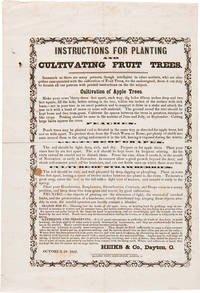
1852WRCAM55573Dayton Oh.: Gazette Print 1852. Letterpress broadside 12 3/4 x 8 3/4 inches with ornamental border. Old folds minor foxing two ink spots in left margin. Very good. A seemingly-unrecorded broadside detailing instructions on the planting cultivating culturing pruning gathering and preserving of various fruit trees in Ohio in the middle of the 19th century. The nursery owners explain their reason for issuing the broadside: "Inasmuch as there are many persons though intelligent in other matters who are altogether unacquainted with the cultivation of Fruit Trees we the undersigned deem it our duty to furnish all our patrons with printed instructions on the subject." The broadside was produced by Heiks & Company of Dayton who provide guidance on proper procedures for care of apple trees peaches grapes and strawberries with brief mentions of gooseberries raspberries and currants. Whether this broadside was given out to customers along with their purchases or posted at the Heiks & Company nursery is unknown but likely the former. A taste of the instructions regarding apple trees reads: "Make your rows thirty-three feet apart each way dig holes fifteen inches deep and two feet square fill the hole before setting in the tree within ten inches of the surface with rich loam - set in your tree in an erect position and to support it drive in a stake and attach the tree to it with a band of straw or some soft material. The ground around the tree should be kept loose and free from grass. Cultivate the spaces between the trees in potatoes turnips or like crops. Pruning should be done in the months of June and July or September. Cutting large limbs injures the trees." <br> <br> Little is known of the issuing company Heiks & Co. other than they were a nursery in Dayton and possibly Troy for some time into the 20th century. We can locate no other copies of the broadside in trade auctions or on OCLC. This is perhaps a unique surviving example. Gazette Print unknown books
18782222005<p>Small octavo. illustrations; charts; index. Original green cloth gilt stamped. No dust jacket. Very good short tear head of spine. 128 pages. No signatures or bookplates.</p><p>Includes: A short history of fruits and their value. Instructions as to soils and locations - how to grow from seeds how to bud and graft the making of cuttings pruning best age for transplanting etc.</p> D. M. Dewey hardcover books
184938759Great Britain 1849. Approx. 60 pages. Bound into the rear of: William Forsyth. A Treatise on the Culture and Management of Fruit-Trees; in which a new method of pruning and training is fully described . The Fourth Edition. London: Printed for Longman Hurst Rees and Orme 1806. xxviii 523pp. 13 engraved plates 11 folding. Contemporary calf rebacked to style. Provenance: unidentified armorial bookplate on verso of the title featuring a wolf rampant and the motto Vincit Veritas. Unusual early 19th century gardening diary of an English fruit grower.<br/> <br/>The manuscript records the efforts of a knowledgable gardener. Although unidentified a Liverpool stationeer's blindstamp in the rear and a reference to a Kirkdale gardener suggests a gardener from a Lancashire estate. The manuscript begins with an entry dated 21 Aug. 1812 in which the diarist records his efforts to save a damaged peach tree: "Finding a young tree which had been planted about four years from a two year old plant very much decayed apparently from rain having got into the grafting which had rotted nearly the whole upper part of the stock I tried the following method of cure. I cut away all the rotten part about nine inches in length . plentifully with tar and covered the mixture of cow dung and marl." He updates the entry several times recording prunings to the tree and notes in 1814 that "the tree have two peaches this year . the covering wound was become loose . the tree otherwise healthy." A 15 July 1813 entry records a visit to Mr. Farrer of Kirkdale "for the purpose of enquiring into the mode I had been informed he had adopted of destroying the Coceus or American Buglas in apple trees . he showed me a tree on which the experiment had been made last spring." He describes the method of using mercury in detail and refers to the experiments of Hales. Other entries record his planting pruning and grafting of vines as well as nectarines and apricots and recipes for destroying worms caterpillars slugs and other pests. The manuscript further transcribes extracts concerning the care of fruit trees from the Horticultural Society Transactions and other sources. Many of the later entries concern the hothouse cultivation of grapes; for example a 28 November 1848 inscription: "The hothouse has not had any artificial heat during this year. We cut 14 lbs of excellent grapes." This manuscript is bound into the rear of a copy of Forsyth's Treatise. The Treatise "ran through seven editions in twenty-two years the first three in only two years and two American adaptions of it were also published . Some readers thought the book greatly indebted to Thomas Hitt's Treatise of Fruit-Trees first published in 1755 but E.A. Bunyard. explains the lack of originality of 'the voluble Forsyth' by saying that 'the details of the culture had been well thrashed out by previous authors and little room for innovations was left" Oak Spring Pomona p.101. "William Forsyth was one of that legion of Scottish gardeners who spent their working lives south of the border. His career began at Chelsea Physic Garden and continued at Syon House until he returned to Chelsea in 1771 to take over the care of the garden from Philip Miller. In 1774 Forsyth constructed one of the earliest rock gardens . Ten years later he took charge of the royal gardens at St James's and Kensington. His eminence in the gardening world made him one of the founder members of the Royal Horticultural Society" op. cit.<br/> <br/>For Forsyth: Bradley Bibiliography III p.141; Pritzel 2985; cf. Raphael Oak Spring Pomona 37. unknown books