36 résultats
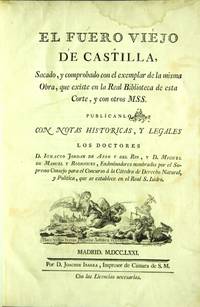
177148726Madrid: por D. Joachin Ibarra 1771. Small folio pp. 4 lvi 143 1; engraved vignette title page; bound with: Jordán de Assó y del Río Ignacio & Miguel Manuel y Rodríguez El ordenamiento de leyes que D. Alfonso XI hizo en las Cortes de Alcalá de Henares el año de mil trescientos y quarenta y ocho. Publícanlo con notas. Madrid: Ibarra 1774 pp. 2 xxxiv 158 2; woodcut vignette on title page tail-pieces; decorative initial. Laws statutes etc. of the Kingdom of Castile in Spain. Miguel Manuel y Rodríguez of Seville was one of the great historians of Spain in the 18th century and he was also the first librarian of the Colegio Imperial de Madrid. Together with Dr. Ignacio Jordán de Asso y Rio a Spanish historian jurist and naturalist who was also known under the pseudonym Melchor de Azagra they published these two works dedicated to Spanish law: the first on the Charter Viejo de Castilla; and the second El Ordenamiento de Leyes in which they deal with the system of laws that Don Alfonso XI made in the courts of Alcala de Henares in the year 1348 here published with notes and an accounting of the Kingdom of Castile. Palau 18725 and 18726 respectively. Lasala 287 and 345 respectively. por D. Joachin Ibarra unknown
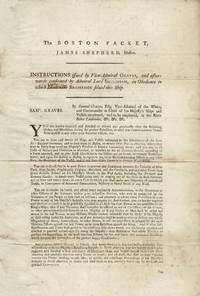
178059007but actually London: William Strahan 1780. Folio broadsheet 17½" x 11"; 3 horizontal folds the paper a bit dusty else very good. With its original separately printed title leaf folded into a wrap-around sleeve. In January 1776 Captain Bromedge wrote to Vice Admiral Schuldham regarding his boarding of the ship Boston Packet and his suspicion that they were carrying stores to the enemy. "I am informed by the crew of the Boston Packet that the Master declared repeatedly on the Passage that could he make Cape Codd he would go in there and land his cargo or could he make Cape Ann he did not fear meeting with some of his Friends to carry him into Beverly or Salem" see Naval Documents of the American Revolution Vol III p. 1005 for the full text of his letter. Regarding this and similar allegations Vice Admiral Graves issued the orders printed here specifically pertaining to the Boston Packet: "You are to seize and detain all Ships and Vessels belonging to the Inhabitants of the four New England Provinces and to send them to Boston." On the verso is printed Rear Admiral Schuldham's confirmation of Graves' order "the probability of these stores being smuggled away to the Enemy.makes me think it highly proper that they should be detained." In effect this is a Letter of Marque issued during the Revolutionary War but pertaining only to a particular class of merchant ships and to two vessels in particular one of which was the Boston Packet. Rare. OCLC shows only the John Carter Brown holding a copy. With manuscript additions dating the document September 1775 and addressing it to Captain Bromadge. ESTC also locates a copy at the BL. unknown
17828291Madrid: Imprenta Real 1782. First Edition Primera edición. Hardcover Tapa dura. Madrid Imprenta Real s.a. 1782. En folio. 31 h. 326 136 24 pp. 1 lámina. Encuadernación en pergamino a la romana de finales del siglo diecinueve planos con rueda gofrada y flor en los vértices lomera con tejuelo en marroquén y letrería también dorada. Primera edición de las Ordenanzas de Intendentes para el virreinato del Río de la Plata posiblemente las ordenanzas más importantes que se dictaron para América. Las primeras ordenanzas se dieron para los cuerpos de intendentes en España en 1718 que después sirvieron de ejemplo para las de América. Las Ordenanzas definen a los Intendentes en América como magistrados puestos para fomentar la agricultura promover el comercio estimular la industria y favorecer la minería; la legislación general para los intendentes se fue configurando a medida que se iban solventando las deficiencias que aparecían en el ejercicio diario de sus funciones. La primeras ordenanzas en América se establecieron en Cuba en 1764. Las presentes Ordenanzas para el virreinato de Buenos Aires o Río de la Plata fueron las primeras que se realizaron para el continente americano y son la base de las leyes relativas al comercio y la hacienda en América durante el reinado de Carlos III hasta el fin de la dominación española en América. La premura en este virreinato fue producto de la situación de crisis y conflicto que la sublevación indígena había conseguido establecer en gran parte de su jurisdicción especialmente en el Alto Perú. Este levantamiento indígena que se dio de manera simultánea en distintos lugares tuvo uno de sus focos en Chayanta Potosí liderado por los hermanos Kataris el cual extendiéndose por el altiplano terminó contactando con el movimiento de Tupac Amaru y alcanzando un importante impacto en ciudades como Oruro o La Paz. Una de las quejas de los indígenas sublevados fue la extorsión y abusos de los corregidores. La reforma administrativa a partir de la aplicación del régimen de intendencias contemplaba entre uno de sus objetivos acabar con la odiosa figura del corregidor de indios y sustituirla por los subdelegados. Ejemplar con extensas anotaciones contemporáneas en los márgenes y con dos folios manuscritos adicionales. La primera hoja que contiene la lámina con el escudo está restaurada en el margen interior pero sin afectar al grabado por lo demás es un magnífico ejemplar con muy amplios márgenes. Imprenta Real hardcover
177130904MADRID: En la Imprenta de Francisco Xavier García 1771. Primera edición.- 4º Mayor.- 6 hojas de Portada Prólogo Tabla e Introducción.- LXX 70 páginas de Introducción.- CCCXLIV 344 páginas de Texto.- 1 Hoja de Erratas.- Encuadernado a plena pasta española de época y del taller de Sancha. Lomera con nervios tejuelo y entre nervios florones filetes y hierros dorados. Muy buen ejemplar limpio y muy marginoso con una encuadernción de época. Preocedencia: Al pie de la portada consta manuscrito: Hilario Cisnero y Saco. Primera edición de este texto jurídico publicado conjuntamente con Miguel de Manuel y Rodríguez. Juan Sempere y Guarinos en ""Ensayo de una Biblioteca Española de los Mejores Escritores del Reinado de Carlos III"" hace un extenso elogio de la obra y en particular de la Introducción: ""Las esquisitas noticias que se dan en esta introducción sacadas de los instrumentos antiguos M. S. y de libros impresos los más raros y preciosos la hacen por si misma una obra muy apreciable que manisfiesta al mismo tiempo lo que hay que adelantar todavía en el estudio de nuestra legislación y Jurisprudencia"". Palau 18717 - Sempere y Guarinos I- página 147 - Aguilar Piñal IV - 4932 En la Imprenta de Francisco Xavier García hardcover
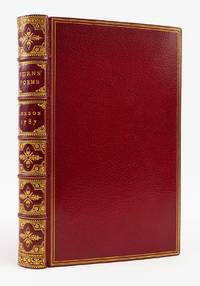
1787ST19529aLondon: Printed for A. Strahan; T. Cadell; and W. Creech 1787. Third Edition; First London Edition First State with "stinking" instead of "skinking" in "To a Haggis". 210 x 126 mm. 8 1/4 x 5". xlviii 13-372 pp. With half title and the subscriber list to the Edinburgh edition. <br/> VERY FINE RED CRUSHED MOROCCO GILT BY RIVIERE & SON stamp-signed on front turn-in cover with French fillet border raised bands spine compartments with acorn-and-lancet central ornament floral vines at corners gilt lettering turn-ins with complex gilt roll marbled endpapers all edges gilt. Engraved frontispiece portrait of Burns. Gibson p. 6; Egerer 2. ◆Perhaps pressed not washed but AN ESPECIALLY FINE COPY quite clean and fresh internally IN A SPARKLING BINDING with no signs of use.<br/> <br/> This is one of the most famous poetic publications in history offered here in a most attractive copy of the first London printing following an Edinburgh edition the same year and the extremely rare Kilmarnock first edition of 1786. Burns issued the poems at the age of 27 in order to raise passage money for a voyage to Jamaica where he had been offered an agricultural post on a plantation. At a time when his contemporaries were searching for the "natural bard" and in the process had unearthed poetical threshers poetical milk maidens and poetical cobblers the charming plowman Burns delivered his simple and beautiful lyrics with most propitious timing. He found himself famous almost at once and his fame has not faltered over time even though after the appearance of the present work he did little during the rest of his life except write songs and drink. The very attractive binding is the work of one of the longest-lived English binderies. Robert Riviere began as a bookseller and binder in Bath in 1829 then set up shop as a binder in London in 1840; in 1881 he took his grandson Percival Calkin into partnership at which time the firm became known as Riviere & Son. The bindery continued to do business until 1939 when it was acquired by George Bayntun of Bath a firm that is still producing fine work and is still in family hands. Printed for A. Strahan; T. Cadell; and W. Creech unknown
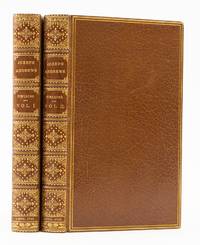
1742ST18426London: Printed for A. Millar 1742. FIRST EDITION. 165 x 98 mm. 6 1/2 x 3 7/8". With four pages of ads at the end of volume I; one leaf of ads at the beginning and two pages of ads at the end of volume II. Two volumes. <br/> VERY PRETTY TAN CRUSHED MOROCCO GILT BY RIVIERE & SON stamp-signed on front turn-ins covers with French fillet border raised bands spine compartments with central fleuron within a lozenge of dots curling cornerpieces gilt lettering lacy gilt turn-ins dark green endpapers all edges gilt. Housed together in a brown buckram slipcase. Front pastedown with morocco bookplate of Robert Hoe. Cross III 305; Rothschild 844; Tinker 1034. ◆Occasional mild browning or faint foxing but AN ESPECIALLY FINE SET clean and fresh internally in unworn bindings.<br/> <br/> This is a handsomely bound copy with superior provenance of the first appearance of a breakthrough work in the field of English literature. Fielding had a profound influence in determining the development of the novel and this was the first great instrument of that influence. Although some of the names of the characters are facetious the events personalities and settings are all characterized by convincing verisimilitude. The book was begun as a spoof of Richardson's sentimental "Pamela" but it ended up on its own as one of the best novels of the period. The beautiful bindings by the leading English workshop Riviere and the sparkling condition here are characteristic of books from the collection of our earlier owner Robert Hoe 1839-1911 founding member and first president of the Grolier Club. According to Beverly Chew Hoe's library was "the finest America has ever contained." Hoe acquired illuminated manuscripts early printing French and English literature and very fine bindings; when his library was sold in 1911-12 it fetched nearly $2 million a record that held until the Streeter sale more than 50 years later. Printed for A. Millar unknown
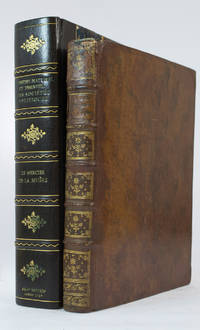
176766881London and Paris: Chez Jean Nourse and Chez Desaint 1767. An Important and Representative Physiocratic Work<br> <br> LE MERCIER DE LA RIVIÈRE Pierre Paul. L'Ordre naturel et essentiel des sociétés politiques. London: Chez Jean Nourse Libraire; & se trouvé à Paris Chez Desaint Libraire 1767.<br> <br> First quarto edition published in the same year as the first twelvemo edition. Measures 10 x 7 3/4 inches. 6 viii 511pp 1blank.<br> <br> Contemporary French mottled calf spine elaborately gilt-stamped with five raised bands. Marbled endpapers all edges red. Previous owner's old ink notes on front free endpaper. Housed in a custom quarter brown morocco clamshell gilt-stamped.<br> <br> One of the most important French economic texts of the period representative of physiocratic views and concepts. This work brought about the attack by Mably in his Doutes proposés aux philosophes économistes sur l'ordre naturel et essentiel des sociétés politiques 1768.<br> <br> Higgs Bibliography of Economics 3980. Goldsmiths' 10270. Higgs 3980. Kress 6475 quarto edition. Marsh/Hollander 1992 quarto edition. BM XV p. 9 col. 468 quarto edition.<br> <br> HBS 66881.<br> <br> $5000. Chez Jean Nourse and Chez Desaint unknown
1767119925London: John Nourse and Desaint Paris 1767. Praised by Adam Smith - the second of Schumpeter's physiocrat textbooks First edition by "the ablest expositor of this i.e. Physiocratic system" McCulloch written following Le Mercier's retirement from Parliament in 1759. Praised by Adam Smith and Diderot amongst others L'Ordre naturel was according to Palgrave considered more highly than De l'Esprit des loix by some of Le Mercier's contemporaries. The author argues that there is a natural law of property which is based on the physical order of nature and which underlies all other laws. Taxation and the use of public revenue by the ruler are both governed by the natural law of property. Schumpeter lists this work as the second textbook of Physiocrat orthodoxy the first being Mirabeau's Philosophie rurale. Quarto 255 x 195 mm. Contemporary French mottled calf triple-rule border in blind to covers spine ruled and decorated gilt in compartments red morocco label marbled endpapers red edges green silk ribbon marker. Joints and corners professionally repaired occasional light spotting; a very good copy. Goldsmiths' 10269; Higgs 3979; Kress 6475; Mattioli 1959; Sraffa 3258. unknown
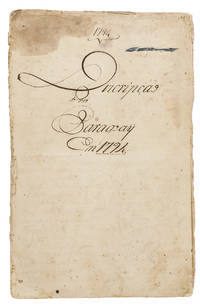
1794ABC_47826Paraguay and/or Brazil 1794. 34 x 22 cm. Stitched through 2 single holes only one remains intact. Written in brown ink in a very legible late 18th-century cursive. 1 1 blank 12 2 blank pp. A contemporary unpublished and unrecorded Portuguese manuscript describing the Paraguay River and the lands rivers and territories adjoining including the location of former Jesuit Missions. It is written within the context of the Portuguese-Spanish dispute over the frontier between Portuguese Brazil and the Spanish colonies and focuses in particular on the upper reaches of the river which at that time still remained relatively unknown. The Portuguese under the governorship of Luis de Albuquerque 1739-97 had recently in 1778 established the towns of Albuquerque today Corumbá Laredo Villa María today Cáceres Casalvasco and Salinas. These new establishments and their locations on the Paraguay River are mentioned here. The terms of the 1777 Treaty of San Ildefonso between Portugal and Spain directed that a Portuguese-Spanish delegation be sent to the Paraguay River region to determine a definitive border between the territories. The Spanish delegation arrived in 1781 under the command of the military officer and naturalist Félix Manuel de Azara 1746-1821 and waited in Asunción in Paraguay for the Portuguese. The latter in the end never arrived but the Spanish delegation remained in the region until the 1790s Azara until 1801 exploring and measuring the region as well as handling the ongoing disagreements with the Portuguese over the demarcation. This Portuguese description of the River Paraguay is undoubtedly connected to these ventures though whether it is a contemporary translation into Portuguese of a Spanish survey or a survey of the river carried out by the Portuguese themselves is uncertain. It is however the only known copy of an unpublished description of the River Paraguay and it describes in detail the little-known upper regions of the Paraguay River.With a crossed-out annotation on the title-page the title-page and the last blank leaf are somewhat water stained. The paper is otherwise uniformly toned and showing some occasional foxing the edges of the leaves are somewhat frayed slightly affecting the text at the head of each page. Overall in good condition. unknown
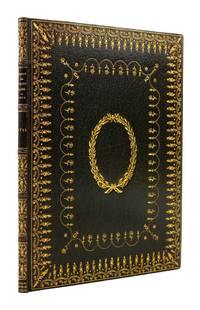
1711ST20182London: W. Lewis 1711. FIRST EDITION First Issue. 280 x 152 mm. 8 1/8 x 6". 1 p.l. 43 1 pp. <br/> VERY PRETTY DARK GREEN CRUSHED MOROCCO ELABORATELY GILT IN PERIOD STYLE BY RIVIERE & SON stamp-signed on front turn-in covers with double frames formed of floral sprigs drawer handles and other small tools the frames enclosing an elegant central wreath; raised bands spine panels densely gilt with stippling floral tools radiating from small central flower gilt lettering turn-ins densely gilt with scrolling foliate tools all edges gilt. With an attractive woodcut headpiece and tailpiece; one foliated woodcut initial. Front pastedown with the bookplate of Winston Henry Hagen and book label of William A. Strutz. Griffith 2; Rothschild 1564; Foxon P806; Day "History of English Literature 1600-1837" pp. 73-4. Sheets uniformly a little toned because carefully washed the usual offsetting on facing flyleaves from turn-ins but a very pleasing copy--the text without signs of use and the exceptionally pretty binding lustrous and virtually unworn.<br/> <br/> This first printing of Alexander Pope’s first independent publication called by Day "one of the most quoted poems in English" offers a sumptuous binding in the style of the period retains its scarce original half-title and boasts an impressive provenance. Pope 1688-1744 composed "An Essay on Criticism" early in his career possibly when he was just 18. In this poem which introduced several expressions now common in the lexicon including "to err is human; to forgive divine" and "fools rush in where angels fear to tread" Pope provides his philosophy on what makes good criticism and by extension good poetry. Of it Day writes: "no one can claim originality for the content of 'Essay on Criticism' but all must admit the incomparable mastery of verse and language." This copy retains the half-title which is often missing primarily because it was often used as part of the volume's wrappers. Our copy does lack the final leaf of ads as almost always with copies of this edition. The strikingly attractive binding done in an elaborately gilt style reminiscent of a Roger Payne design is the work of Riviere one of the foremost names among English binderies. Our copy has belonged to two notable collectors. According to Dickinson Hagen 1859-1918 was a collector whose library especially strong in English literature "reflected a highly developed intelligent connoisseurship." Beverly Chew wrote in the foreword to the catalogue for the Hagen sale at Anderson Galleries 13 May 1918 that the library which featured high spots bought at the Lefferts and Poor sales "was one of the best ever submitted to the public at auction." William A. Strutz 1934-2024 was a North Dakota attorney and passionate bibliophile who assembled a library of over 15000 rare and important literary works. Our first printing of "Essay on Criticism" is not easy to find in the attractive condition seen here. W. Lewis unknown
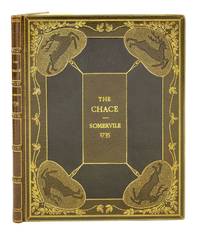
1735ST15797London: Printed for G. Hawkins and sold by T. Cooper 1735. FIRST EDITION. ONE OF 750 COPIES. 263 x 207 mm. 10 1/4 x 8 1/8". 6 p.l. 106 pp. 1 leaf errata. <br/> SUPERB OLIVE GREEN CRUSHED MOROCCO BY RIVIERE & SON stamp-signed on front turn-in cover with lettered central panel surrounded by four onlaid sections of darker green morocco outer frame of leafy vines emanating from the tips of the fan-palm-shaped cornerpieces each of these compartments with a blind-stamped leaping stag on a stippled gold ground raised bands spine with gilt-ruled compartments gilt titling gilt-ruled turn-ins all edges gilt. In a somewhat worn fleece-lined burgundy buckram chemise and marbled paper slipcase. Engraved allegorical frontispiece featuring Diana and Apollo by Scotin after Gravelot. Front pastedown with morocco ex-libris of Alfred Barmore Maclay. Foxon S-562; Hayward 158; Rothschild 1932; Schwerdt II 166. ◆Leather on spine uniformly sunned to olive brown as expected with green morocco text perhaps lightly washed and pressed in keeping with bibliophilic fashion at the time of binding occasional faint marginal smudges otherwise fine internally and in a very lustrous binding with no signs of wear.<br/> <br/> This is the first edition of the most popular work by Somerville 1675-1742 a mock-heroic poem about hunting in an apt and very striking binding by a renowned English workshop. Divided into four books of Miltonic blank verse "The Chace" is considered to be one of the finest didactic poems of the first half of the 18th century. The text covers hounds and their kennels along with the hunting of hare fox and otter and there are digressions that bring in methods of the chase in exotic localities. Most of the hunts described are accompanied by dogs and set in England past or present but the poet occasionally strays far afield to describe lion stalking or the hunting habits of Genghis Khan. According to Schwerdt the book was "highly approved of by the first literary characters of his day." The extraordinarily handsome binding by Riviere incorporates the hunting motif with four stags appearing to chase one another around the covers. Riviere is one of the foremost names in English binding partly because the firm did consistently fine work and partly because it was so long in business. Robert Riviere began as a bookseller and binder in Bath in 1829 then set up shop as a binder in London in 1840; in 1881 he took his grandson Percival Calkin into partnership at which time the firm became known as Riviere & Son and the bindery continued to do business until 1939. Our volume comes from the library of Alfred Barmore Mackay 1871-1944 who after a very brief career at his family's bank devoted himself to collecting books art and antiques engaging in equestrian sports and designing a sumptuous garden at his Florida estate now a state park. Printed for G. Hawkins, and sold by T. Cooper unknown