247 résultats
19722091202133001943Kawade Shobo Shinsha 1972. Soft Cover. Fine. Number of books: 1 Kawade Shobo Shinsha paperback
19562110502150415280Shinchosha 1956. Soft Cover. Fine. Volume: 1 Shinchosha paperback
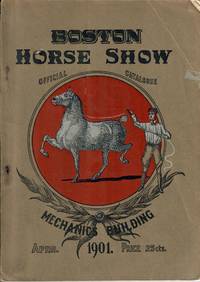
190132728Boston: Boston Horse Show Company 1901. First edition. Soft cover. Good cover wear but binding is sound. 144p some ills. in the ads. No pictures of the horses. The second photo shows the back cover. Lists the entries in almost 130 classes which emphasize driving. Occasional results penciled in H.L. de Bussigny won the High School class. The overall categories with judges listed were Trotters Roadsters and Road Rigs; Hackneys Half-Bred Hackneys and Coach Horses; Ponies in Harness Pony Stallions and Pony Brood Mares; Four-in-Hands Tandems Harness Horses Carriages and Appointments Horses and Hansom Cabs and Driving Competition; Saddle and Police Horses Ponies under Saddle and High School Horses; Heavy Draught Horses; Polo Ponies; Hunters and Jumpers; and Military Riding. With a long index of the exhibitors their addresses and the classes they entered. Many old Boston families are represented--Higginson Lawson Peabody Forbes Thayer Appleton etc. With many ads for horses stable equipment and local businesses. A great piece of horse show history! Can be sent outside the US for less than the default shipping rate. Boston Horse Show Company unknown
193658054New York: Derrydale Press 1936. Large 4to. 10 x 13 in. xxvii 3 218 pp. Frontisp. photo plates text illustrations historiated vignettes maps 1 double-page 1 colour plate from Harrington Bird painting. Blue publisher’s cloth embossed & decorated in blind horse vignettes at corners gilt lettering minor bumping & wear to corners some edgewear slight scuffing still VG copy signed by author on ffep. dated June 1943. Second edition state without Derrydale Press on title page or spine or limitation notice 1 of the original colour plates and no listing of the colour plate within the list of illustrations. This informative work is still considered an excellent reference on the Arabian Peninsula and the Arabian horse. Derrydale Press], hardcover
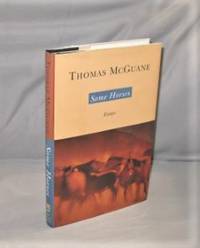
199927480New York:: Lyons Press 1999. First Printing of the First US Edition. A Fine tight copy in a Fine bright unclipped dust jacket. In the nine essays in this collection Montana novelist Tom McGuane animates the wide prairie the ranches where cattle roam and cutting horses are trained and the packed coliseums in which these horses compete for prestige and prize money. Best of all McGuane brings to life the horses he has known celebrating the unique glories that make each of them memorable. McGuane's writing is infused with a love of the cowboy life and the animals and people who inhabit that world where the intimate dance between horse and rider is as magical as flight--well beyond what the human body could ever discover on its own. Lyons Press, hardcover
191443941New York: Thomas Floyd-Jones 1914. 8vo. xxxi 1 275 1 pp. Photo frntsp. numerous plates facsimile plates of letters & documents. Gray cloth gilt lettrng on spine mnr bmpng to crnrs mnr shlfwr some dustsoilng still a VG- copy. First edition of this exceedingly scarce personal memoir of the horse racing and trotting sport as it evolved in New York through the 19th century. The author’s family and he owned and raced thoroughbreds and trotting horses and were key members in the Union Course Long Island. Of particular interest is the exhaustive 75 page index Floyd-Jones appended to the work which details every name horse and event mentioned in the book. Thomas Floyd-Jones, hardcover
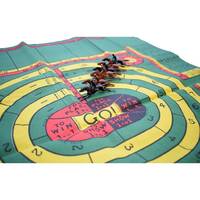
19212571Philadelphia: Racego Game Company 1921. Good in a Poor box. Box: 9-3/4 x 12 inches. Game includes: linen board printed in green yellow black and red 26-1/2 x 26-3/4 inches when unfolded; 4pp set of directions for play printed in black on cream paper; six metal playing pieces in the shape of jockeys riding horses painted black or brown numbered consecutively and housed in a cardboard holder with individual "stalls" for the pieces; cardboard box containing 60 flat circular red white and blue bone betting counters.Based on a description of Go! in a 1922 ad in Modern Stationer this copy of the game is lacking 40 betting counters but is otherwise complete. Heavy wear to box with splitting to all edges and numerous neat black tape repairs; apron missing from one side of the lid and the lid is now taped to the base at that edge so it opens like a hinge. Light wear to directions; some scuffing to playing pieces. Scarce horse racing-themed board game that capitalizes on the popularity of the sport in the 1920s with pieces named Man o' War Sir Barton Behave Yourself Broomspun Gray Lag and Audacious -- all famous racing horses of the era. Using an ordinary deck of cards not included players move the pieces around the board in such a way that "the horses speed up or drop back pass each other and fight for the 'pole' and inside positions just as the live ones do on the track" Directions p.2. Meanwhile the players place wagers on the winners colors and time using white red or blue betting counters to indicate the amount of their wager.Racego Game Company may have been formed solely to sell this game as we find no record of other games associated with it and advertisements for the game only in 1922. The copyright holder James B. Ludlow appears to have been a Philadelphia salesman at the time; census records indicate that he sold a variety of goods but in 1920 was engaged in selling rubber tires.Not located in OCLC although we know of one holding at UVA. Racego Game Company unknown
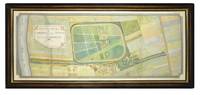
1903F6LCZ7CDMSG7Poissy: Charles Robin 1903. Framed 105 x 205 cm. Large hand-coloured four-sheet plan 90 x 170 cm as assembled. Drawn in pen and ink graphite and watercolour on paper mounted on canvas. Large manuscript plan beautifully drawn in ink and watercolour: a unique witness to Vanderbilt's passion and ambitions. A member of one of America's wealthiest and most prominent families William Kissam Vanderbilt 1849-1920 managed railroads and bred horses. He was one of the founders of The Jockey Club and the owner of a successful racing stable. In 1896 he built the American Horse Exchange at 50th Street Manhattan. In World War II the United States liberty ship SS William K. Vanderbilt was named in his honour.The present impressive manuscript plan represents the horse-racing stable and track at the chateau which Vanderbilt built in 1906 with the help of Henri Guillaume and Pierre Sardou architects. The hippodrome comprised three oval tracks the outer of which was 2400 metres as well as a straight track. A long wall separated the racing areas from the Chateau St. Louis where the Vanderbilts lived called the Chemin Plat now known as Avenue Vanderbilt. When World War I started the racing stables were shut down and eventually sold. Ch[arles] Robin, unknown
1904306793<p>First edition so stated. Thick octavo. Frontispiece and 48 b/w halftone illustrations. Full gilt stamped contemporary dark green morocco by Stikeman t.e.g. others uncut the spine with gilt stamped horse head fish and sporting dog devices. Fine. Heraldic bookplate of M.C.D. Borden on the front pastedown. 369 pages. Number 20 of 100 copies on large paper. The American Sportsman Library. Printed by the Norwood Press Norwood Massachusetts.</p> The Macmillan Company hardcover
190460288Detroit MI: Tuttle & Clark Manufacturers The Improved Printing Co. Half-tone illustrations made by Detroit Electro-Gravure Co. 1904. Two parts in one vol. 222 2; 32 unpaginated. pp. With 100’s of text illustrations diagrams throughout both. Quarter-black cloth over purple-coloured decorated limp thick covers Arts & Crafts cover art in green red & gilt rounded corners minor shelfwear slight sunning to fore-edges; second part w/ self-printed softcovers mounted on verso of front cover still an excellent pair. First edition of this lavishly illustrated and very scarce horse tack & harness catalogue. This catalogue illustrates racing harnesses sulky harnesses pole harness harness ornaments bridle fronts monograms rosettes horse hooves boots of a dizzying array blankets halters and more. Tuttle 1862-1937 began as a harness maker and leather merchant in Hamtramck MI in post-Civil War Michigan and by the end of the 19th Century with partner John Clark 1871-1931 had built the thriving harness & tack business on Jefferson & Woodward in downtown Detroit. No copies in Worldcat. Tuttle & Clark, Manufacturers, [The Improved Printing Co., Half-tone illustrations made by Detroit Electro-Gravure Co.], paperback
191458466Buffalo NY: Smith Sons Harness Co. Inc. 1914. 4to. 9 x 12.25 in. 95 1 pp. Over 500 illustrations many photos. Purple-gray printed softcovers printed front cover w/ woodcut border company logo on back cover minor chipping head & foot of spine edgewear minor creasing a few leaves w/ minor foxing still VG copy. First edition of this lavishly illustrated and very scarce saddle and tack catalogue. This was the first catalogue issued after incorporation by the longtime saddlery hardware manufacturer in Buffalo NY which supplied many of the harness & saddle shops in and around New England & New York. Of interest are the sections on harness bridles collars whips bits rosettes hardware and much more. This catalogue also includes products such as riveting machines Boston Coach axle oil Buffalo Robes and more. No copies located in Worldcat; See: Trade News From Near and Far Harness Vol. 28 January 1915 pp. 26-27. Smith Sons Harness Co., Inc., paperback
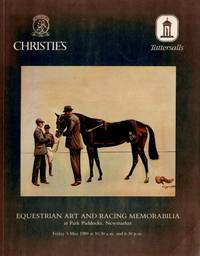
198932485AB1989. London / Newmarket Christie's 1989. Quarto. 124 pages plus Index. Illustrated Softcover. Some pages loosened. Otherwise in very good condition with only minor signs of wear. From the private library of Keith Money with name of a relative on endpaper D.A.Money. paperback
198362373Glendale CA: The Arthur H. Clark Co. Prosperity Press 1983. 4to. 74 4 pp. Title in red & black marginalia notes printed in blue 5 colour plates tipped-in. Blue publisher’s linen printed label front cover w/ d.j. NF/NF copy. First edition 1 of 250 copies printed of this account of the rash and impulsive action which resulted in a seriously undermanned detachment of a teenage Lt. Grattan newly graduated from West Point 2 sergeants and 27 enlisted men to arrest High Forehead from the Brule village near Fort Kearny NE. The entire detachment was wiped out including Lt. Grattan with 24 hours in his body and ignited the next 22 years of War between settlers Native Americans and the U.S. Army. The Arthur H. Clark Co., [Prosperity Press], unknown
193152339New York: E.P. Dutton & Co. Inc. 1931. 8vo. 255 1 pp. Colour frontisp. Yellow-coloured publisher’s cloth black lettering w/ d.j colour cover art sunning to spine minor shelfwear rubbing still NF/G- copy. First edition stated of this curious memoir in which Big Chief White Horse Eagle claimed to be an Osage Indian born in 1822 who had supposedly interacted with early settlers over the trail knew Buffalo Bill Calamity Jane and rails against the Indian bureau. However he chose as his biographer the famed Nazi academic whose chief scholarly interest lay in demonstrating the rise of the German Race and Adolf Hitler as well as a mish-mash of cliched language by a non-Native American and “alternative facts.†See: Mike Kelly Donations Imposters and Moose 2014; Laura Browder Slippery Characters: Ethnic Impersonators and American Identities pp. 123-124; Robert Dale Parker Changing is Not Vanishing: A Collection of American Indian Poetry to 1930 False Attributions p. 395. E.P. Dutton & Co., Inc., hardcover
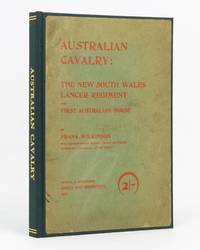
1901129531Sydney: Angus and Robertson 1901. First Edition. Hardcover. Fair. Sydney Angus and Robertson 1901. Quarto x 64 pages with an illustration plus 8 plates but lacking the colour frontispiece called for by Dornbusch. Modern binder's cloth with the front panel of the original green wrapper printed in red mounted on the front board; text block tide-marked near the head of the spine with the plates a little stained; some discolouration and foxing heavy in places; minor signs of age and use; a decent copy of an absolute rarity. This history of these two cavalry units from their foundation through to the end of the Boer War is 'undoubtedly a regimental record but it is something more - it is an attempt to explain and to some extent combat the unreasoning prejudice which has grown up as a result of the South African campaign against the cavalry arm of the service. On this point Mr. Wilkinson says:- "It is my purpose to show not only that cavalry regiments like the New South Wales Lancers have done equal yeoman service to the Empire in the South African struggle with their comrades in the other branches of the service but that they have done infinitely more as the pioneers of the cavalry movement in Australia to enhance the value of our defence force and to shew the world of what fighting stuff our men are made"' from a review in the 'Daily Telegraph' 12 October 1901. The last 18 pages contain numerous appendices including nominal and casualty rolls. <p>Dornbusch 126; Fielding and O'Neill page 126. Angus and Robertson hardcover
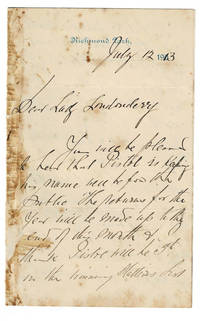
191397593Richmond Park South Australia: July 12 1913. 1913. Good. - Approximately 300 words penned on 4 sides of a folded sheet of creamy white paper with each page measuring 8 inches high by 5 inches wide. "Richmond Park" is printed at the top of the cover page. Aldridge has altered the partially printed date from "1903" to "1913". Started on the cover page Aldridge has continued his letter on the last page to then conclude on the inner 2 leaves. Signed "J.H. Aldridge" on the inner leaf. Once apparently mounted along the inner edge with glue or tape there are heavy stains with remnants of glue to the inner edge of the first and last page. There is a tiny tear along the fold with some light brown stains or foxing to all four pages. Good. <p>A RARE LETTER REPLETE WITH HORSE RACING ASSOCIATIONS. Aldridge writes to the Marchioness of Londonderry praising the horse he purchased from her and the Marquis of Londonderry. "You will be pleased to hear Pistol is keeping his name well before the public.I think Pistol will be 5th on the Winning.List in all Australia of course in this State 'South Australia' he is easily 1st.Londonderry by Pistol Antilles won the Broken Hill Cup a few days ago & the Chairman in presenting the cup to the winner referred to the fact that the horse got his name from his Breeder the Marchioness of Londonderry.Pistol is a most prolific father of winners & that is better than one good one & twenty duffers as some sires record. I believe there is only one sire in Australia which has produced more winners this year." He goes on to complain about the season as a whole mentions some "great loss" that she has had and he wishes the Marquis well and that "his illness worries will be settled ere long" Signed "J. H. Aldridge".<p>James Henry "Jim" Aldridge 1849-1929 was a popular and highly respected Australian sportsman. he began his career as a hotelier in Adelaide. He managed the Globe Hotel in Rundle Street a hotel that was popular with sportsmen. He later took charge of the Grand Hotel Broken Hill and the Gresham Hotel. In 1890 with the intent of establishing a stud farm he purchased at a Sydney sale the Stallion Carlyon. Carlyon was to be the lord of the harem so to speak. In addition he purchased a richly bred brood of a half-dozen mares. Sometime between 1888 and 1890 Aldridge purchased Richmond Park in South Australia from its original owner John Chambers. With the Chester horse Carlyon and the stud established Aldridge rapidly became well-known as a breeder. Carlyon and the thoroughbreds he sired at the Richmond Park stud farm made Aldridge's name famous throughout Australian racing circles. Although still able to perform as a stud Carlyon was badly injured in 1905. As it happened however in 1904 Aldridge had purchased Pistol the son of the famous English sire Carbine. Pistol was foaled in 1899 and arrived in South Australia as a five year old. He was purchased from the Marquis of Londonderry for the large sum of 1250 pounds. As a stud Pistol performed into his 26th year and sired winners of more than 641 races out of 1423 competitions. Up until Aldredge's death in 1829 the Pistol progeny had won approximately 200000 pounds in stake money. In atribute after his death the Chairman of the S.A.J.C. South Australian Jockey Club Whitmore Blake Carr "Doc Carr" wrote: "For years Mr. Aldridge has been one of the best widely known and most popular identities of the turf in South Australia and one to whom the sport owed much of its maintenance and stability. When he ran horses he did so for the pure love of the sport and the applause which always attended the success of his colours was a fine tribute by the racing public to the popularity of the owner. He was an exceptionally fine judge of a horse. The gratifying results which have been achieved at Richmond Park making it stand today so high in the list of studs in the Commonwealth was due to his sound judgment and ripe experience." Richmond Park, [South Australia]: July 12, 1913. unknown
19212351929Leominster Massachusetts: The Eusey Press Inc 1921. Facsimile. Hard Cover. Near Fine/No Jacket. 1980s facsimile of 1921 original. Rear endpaper lightly soiled small dealer bookplate on rear endpaper corner. Binding tight and square text clean bright and unmarked. 587 pp. No images making it an oddity in the series other volumes include numerous photographs. The first volume of the series composed entirely after the death of the register's original author Joseph Battell he passed away shortly before the publication of volume three. The Morgan horse is one of the earliest horse breeds developed in the United States. Tracing back to the foundation sire Figure later named Justin Morgan after his best-known owner Morgans served many roles in 19th-century American history being used as coach horses and for harness racing as general riding animals and as cavalry horses during the American Civil War on both sides of the conflict. Morgans have influenced other major American breeds including the American Quarter Horse Tennessee Walking Horse and the Standardbred. During the 19th and 20th centuries they were exported to other countries including England where a Morgan stallion influenced the breeding of the Hackney horse. In 1907 the US Department of Agriculture established the US Morgan Horse Farm near Middlebury Vermont for the purpose of perpetuating and improving the Morgan breed; the farm was later transferred to the University of Vermont. The first breed registry was established in 1909 and since then many organizations in the US Europe and Oceania have developed. Popular children's authors including Marguerite Henry and Ellen Feld have portrayed the breed in their books; Henry's Justin Morgan Had a Horse was later made into a Disney movie. The Eusey Press, Inc hardcover
19602351932Providence Rhode Island: The Oxford Press Inc. / The Morgan Horse Club Inc 1960. Facsimile. Hard Cover. Fine/No Jacket. 0x0x0. 1980s facsimile of 1960 original. An exceptional copy. Binding tight and square pages clean bright and unmarked. 427 pp. Black-and-white photographs throughout. A continuation of the series begun by Joseph Battell who passed away shortly before the publication of volume three. The Morgan horse is one of the earliest horse breeds developed in the United States. Tracing back to the foundation sire Figure later named Justin Morgan after his best-known owner Morgans served many roles in 19th-century American history being used as coach horses and for harness racing as general riding animals and as cavalry horses during the American Civil War on both sides of the conflict. Morgans have influenced other major American breeds including the American Quarter Horse Tennessee Walking Horse and the Standardbred. During the 19th and 20th centuries they were exported to other countries including England where a Morgan stallion influenced the breeding of the Hackney horse. In 1907 the US Department of Agriculture established the US Morgan Horse Farm near Middlebury Vermont for the purpose of perpetuating and improving the Morgan breed; the farm was later transferred to the University of Vermont. The first breed registry was established in 1909 and since then many organizations in the US Europe and Oceania have developed. Popular children's authors including Marguerite Henry and Ellen Feld have portrayed the breed in their books; Henry's Justin Morgan Had a Horse was later made into a Disney movie. The Oxford Press, Inc. / The Morgan Horse Club, Inc hardcover
19392351930West Hartford Connecticut: American Morgan Horse Register 1939. Facsimile. Hard Cover. Near Fine/No Jacket. 0x0x0. 1980s facsimile of 1939 original. Owner bookplate on front endpaper minor loss of gilt from spine. Binding tight and square pages clean bright and unmarked. 230 2 pp. Black-and-white photographs throughout. A continuation of the series begun by Joseph Battell who passed away shortly before the publication of volume three. The Morgan horse is one of the earliest horse breeds developed in the United States. Tracing back to the foundation sire Figure later named Justin Morgan after his best-known owner Morgans served many roles in 19th-century American history being used as coach horses and for harness racing as general riding animals and as cavalry horses during the American Civil War on both sides of the conflict. Morgans have influenced other major American breeds including the American Quarter Horse Tennessee Walking Horse and the Standardbred. During the 19th and 20th centuries they were exported to other countries including England where a Morgan stallion influenced the breeding of the Hackney horse. In 1907 the US Department of Agriculture established the US Morgan Horse Farm near Middlebury Vermont for the purpose of perpetuating and improving the Morgan breed; the farm was later transferred to the University of Vermont. The first breed registry was established in 1909 and since then many organizations in the US Europe and Oceania have developed. Popular children's authors including Marguerite Henry and Ellen Feld have portrayed the breed in their books; Henry's Justin Morgan Had a Horse was later made into a Disney movie. American Morgan Horse Register hardcover
19492351931Burlington Vermont: The Champlain Printers 1949. Facsimile. Hard Cover. Fine/No Jacket. 0x0x0. 1980s facsimile reprint of 1949 original. An exceptional copy. Binding tight and square pages clean bright and unmarked. 350 pp. Black-and-white photographs throughout. A continuation of the series begun by Joseph Battell who passed away shortly before the publication of volume three. The Morgan horse is one of the earliest horse breeds developed in the United States. Tracing back to the foundation sire Figure later named Justin Morgan after his best-known owner Morgans served many roles in 19th-century American history being used as coach horses and for harness racing as general riding animals and as cavalry horses during the American Civil War on both sides of the conflict. Morgans have influenced other major American breeds including the American Quarter Horse Tennessee Walking Horse and the Standardbred. During the 19th and 20th centuries they were exported to other countries including England where a Morgan stallion influenced the breeding of the Hackney horse. In 1907 the US Department of Agriculture established the US Morgan Horse Farm near Middlebury Vermont for the purpose of perpetuating and improving the Morgan breed; the farm was later transferred to the University of Vermont. The first breed registry was established in 1909 and since then many organizations in the US Europe and Oceania have developed. Popular children's authors including Marguerite Henry and Ellen Feld have portrayed the breed in their books; Henry's Justin Morgan Had a Horse was later made into a Disney movie. The Champlain Printers hardcover
199510666Amarillo Texas: AQHA American Quarter Horse Association 1995. 10 page staple bound booklet 8.1/2" high x 11" long. Stiff covers 8 interior glossy pages. A bit of light wear but binding secure and minmal smudges. No tears. Shows the external features of the horse - knowledge of points is of great importance when registering an animal with the association. There is an illustration showing the muscles others showing the organs and the skeleton. There is a detailed page showing the hoof and foot bones and three pages devoted to the teeth and determining age. Scarce. Information useful to all horseman with interest in any breed not just the Quarter Horse. Illustrator not named. Size: 4to - Oblong. Illus. by Illustrated. Soft cover. Good/No Jacket. AQHA American Quarter Horse Association Paperback
194824249Hammond & Hammond London 1948. HBDJ 1948 First Edition Small Green cloth Hard Cover with Horses Head on Front Titled on Spine. Book Condition: VG-. Dust Jacket Condition:GOOD- AS-IS. Book is clean and tight . Wrapper is worn around the edges with some areas of loss & on front Bottom DJ small triangular Chip out Affects Illustrator Name Cover light Rub Wear Interior Nice tight clean light FOX WearSmall chip Bottom spine DJ 128 pgs . Story describes exciting adventures of anne Gaylord & her Intelligent Pony who mysteriously Disappeared . First Edition. Hard Cover. Hammond & Hammond, London hardcover
1930150929140Arab Horse Society 1930-01-01. Hardcover. Like New. Arab Horse Society hardcover
1937150929141Arab Horse Society 1937. Hardcover. Like New. Arab Horse Society hardcover
1966150929144Arab Horse Society 1966. Hardcover. Like New. Arab Horse Society hardcover