86 résultats
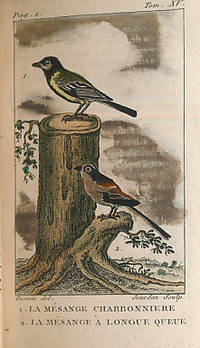
1802cdb08gParis: Chez Deterville. G : in good condition. Cover rubbed with loss to spine. Some neat hand written annotation Ex Royal College of Surgeons in Ireland Library. 1802. Nouvelle Édition. Brown hardback leather cover. 140mm x 90mm 6" x 4". 307pp. 6 engraved plates by Deseve. . Chez Deterville hardcover
1802cdb08pParis: Chez Deterville. G : in good condition. Cover rubbed with loss to spine. Ex Royal College of Surgeons in Ireland Library. 1802. Nouvelle Édition. Brown hardback leather cover. 140mm x 90mm 6" x 4". 313pp. 6 engraved plates by Deseve. . Chez Deterville hardcover
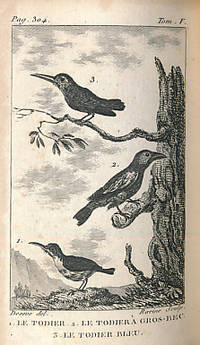
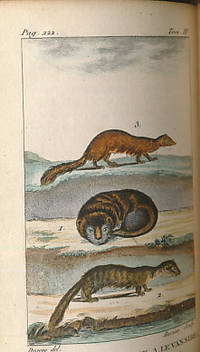
1802cdb08hParis: Chez Deterville. G : in good condition. Cover rubbed. Ex Royal College of Surgeons Ireland Library. 1802. Nouvelle Édition. Brown hardback leather cover. 140mm x 90mm 6" x 4". 317pp plates. 17 hand coloured plates by De Seve. Text in French. . Chez Deterville hardcover
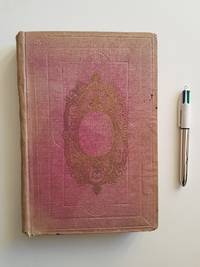
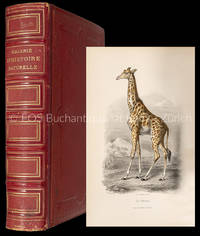
1868LRB618Tours: Alfred Mame et Fils 1868 Titre : Histoire naturelle extraite de Buffon et de Lacépède - Quadrupèdes Oiseaux Serpents Poissons et CétacésAuteur : Buffon Georges-Louis Leclerc ; Lacépède Bernard-Germain deÉditeur : Alfred Mame et FilsLieu d'édition : ToursDate d'édition : 1868Langue : FrançaisReliure : Percaline éditeur rose-or plats frappés à froid et décor central doré dos lisse titré orÉtat : Usure d'usage aux plats et au dos passé coins émoussés petites taches aux plats rousseurs éparses tache brune au faux-titre et au titre intérieur globalement propre et solideIllustrations : Frontispice gravé « Le Condor » et très nombreuses gravures sur bois dans le texteFormat : Grand in-8 environ 28 x 19 cmDescription : Jolie édition populaire du XIXe siècle réunissant des extraits de l'Histoire naturelle de Buffon et de Lacépède couvrant les mammifères oiseaux reptiles poissons et cétacés. Impression soignée chez Mame richement illustrée de vignettes naturalistes. Exemplaire au cartonnage éditeur orné typique des productions Mame. Hardcover. Good. Alfred Mame et Fils hardcover
18046665Paris: De l'Imprimerie Royale later Imprimerie des Bâtimens du Roi; Hôtel de Thou; Plassan 1804. First edition. <p>First edition a very fine uniformly-bound contemporary set with the separately-issued and frequently-absent atlas to the Minéraux of the first work to present natural history as a continuous secular narrative - from planetary formation through geology and mineralogy to the quadrupeds birds fishes and cetaceans and at last to the human races - and the work in which across fifty-five years and four political regimes the biblical chronology that had organised European natural science since antiquity ceased to be the only frame within which educated readers could discuss the age of the earth. In the Époques de la Nature 1778 Buffon proposed seven epochs of earth history and from cooling experiments in his own forge at Montbard estimated its age at roughly seventy-five thousand years; in unpublished notes his private estimate reaches three million - the order of magnitude Lyell would later extract from stratigraphy and Darwin require for natural selection to operate.</p>. The Founding Treatise of Secular Science. <p>First edition of the first work to present natural history as a continuous secular narrative-from planetary formation through geology and mineralogy to the quadrupeds birds fishes and cetaceans and at last to the human races-and the work in which across fifty-five years and four political regimes the biblical chronology that had organised European natural science since antiquity ceased to be the only frame within which educated readers could discuss the age of the earth. Buffon was appointed Intendant du Jardin du Roi in 1739 at thirty-two and spent nearly half a century converting the royal cabinet of natural-history specimens into a compendium that at its close under Lacépède's hand in 1804 comprised forty-four quarto volumes more than twelve hundred engraved plates and a style so supple that Buffon's elegies on individual species remained set texts in French lycées into the twentieth century. Uniformly bound in contemporary French mottled calf and preserving all forty-four text volumes together with the separately-issued and frequently-absent atlas to the Minéraux the present copy is of a completeness and coherence uncommon in a publication whose fifty-five-year issue spanned four successive Parisian imprints. His prose made deep time habitable. Within thirty years of the final volume Lyell was writing the Principles of Geology; within sixty Darwin the Origin. Ernst Mayr called Buffon "the father of all thought in natural history" at his time; the DSB records that he "established the intellectual framework within which most naturalists up to Darwin worked."</p> <br /> <br /> <p>The publishing history is itself a monument. The first three volumes appeared together in the autumn of 1749 from the Imprimerie Royale sold out in six weeks were reprinted three times within the same interval and provoked the Sorbonne's faculty of theology into delivering Buffon a list of propositions judged heretical-to which Buffon submitted a carefully calibrated retraction while continuing to print the offending volumes unchanged. The initial prospectus of 1748 had promised fifteen volumes in three divisions; by the time Buffon died in 1788 thirty-five were in print a thirty-sixth was on the press and the plan of covering the vegetable kingdom had quietly been abandoned. The seventh and final Supplément appeared posthumously in 1789 through Lacépède's editorship; the fifth volume of the Minéraux containing the Traité de l'aimant had issued a year earlier from the Imprimerie des Bâtimens du Roi and was accompanied by a separately-issued atlas of folding maps and tables. Lacépède then continued the animal-kingdom programme with the Quadrupèdes ovipares et Serpens 1788-89 the Poissons 1798-An XII and the Cétacées 1804. The combined output of four imprints across three generations of Parisian printers-the Imprimerie Royale the Imprimerie des Bâtimens du Roi the Hôtel de Thou under Panckoucke and Plassan and Plassan imprimeur-libraire-makes the uniformly-bound contemporary set one of the more elusive bibliographical objects of the French Enlightenment.</p> <br /> <br /> <p>Volume I opens the series with the Premier Discours: De la manière d'étudier et de traiter l'histoire naturelle a forty-page frontal assault on Linnaean classification that argues from a position of mathematical and empirical rigour rare in the literature of the period that species as Linnaeus conceived them were artificial abstractions imposed on the continuous variability of individuals and that a taxonomy built on stamen-counts and pistil-counts had no purchase on nature. The attack was political as well as philosophical. Linnaeus's Systema Naturae Leiden 1735 had already been adopted as the common grammar of European zoology; Buffon's Discours delivered from within the most prestigious press in France asserted that the Swede's method was a convenience of memory mistaken for a description of the world. The volume continues with the Second Discours: Histoire et théorie de la Terre dated by Buffon himself "à Montbard le 3 octobre 1744" which proposes a cosmogony in which the planets were struck from the sun by the oblique impact of a comet and have been cooling ever since and with the Preuves de la théorie de la Terre in which Buffon develops his theory across seventeen articles and provides two engraved terrestrial maps drawn under his supervision by Robert de Vaugondy fils. These arguments delivered within a volume bearing the royal arms of France on its title-page vignette constituted the most public challenge to Mosaic cosmogony yet mounted in eighteenth-century France.</p> <br /> <br /> <p>The geological argument reached its mature form a generation later in the fifth Supplément the Époques de la Nature 1778 published when Buffon was seventy-one. Here he proposed seven epochs of the earth's history estimated their combined duration at roughly 75000 years and in unpublished manuscript notes pushed his private estimate to three million-an order of magnitude consistent with the timescales that Lyell would later extract from stratigraphy and that Darwin would require for natural selection to operate. The significance of the Époques is not only the number. It is the rhetorical form of the argument: Buffon marshals fossil molluscs at Alpine altitudes the decay of volcanic emissions the rate at which heated iron spheres cool in Buffon's own forge at Montbard and the distribution of living species across climate zones and weaves these into a cumulative inductive case in which each line of evidence corroborates the others. The technique is no longer antiquarian but probabilistic-Buffon had after all published a French translation of Newton's Method of Fluxions in 1740 and would publish original work on the probability that a needle tossed on a ruled floor should cross a line the problem that bears his name in modern geometric probability. When the Époques reached Edinburgh and Cambridge in the 1780s it announced to Anglophone readers that the earth's antiquity had become a quantitative problem rather than a scriptural one.</p> <br /> <br /> <p>The core of the programme is the animal kingdom. Volumes 4 through 15 1753-1767 treat the quadrupeds in an arrangement that combines Buffon's natural-historical essays with Daubenton's anatomical descriptions-a division of labour Buffon defended in the Preface to volume IV and that Daubenton eventually came to resent his name disappearing from the later volumes. The Oiseaux volumes numbered I-IX on their title-pages but continuously as tomes XVI-XXIV on their half-titles 1770-1783 are the work of Buffon with Philibert Guéneau de Montbeillard and the Abbé Bexon and assume decisively that geographic distribution is a datum of zoology rather than an incidental fact about individual animals-a premise that commits the Histoire naturelle to the biogeographic thinking which Alfred Russel Wallace would systematise a century later. The Minéraux volumes I-V 1783-1788 extend the account to the inorganic world and conclude with the Traité de l'aimant Buffon's last publication in his lifetime accompanied by the atlas that the present set preserves. Lacépède's eight continuation volumes close the series with the Ovipares et Serpens the Poissons five volumes 1798-An XII drawing on the manuscript collections of Philibert Commerson and the Cétacées 1804-the whole project begun under Louis XV and finished under the Consulate of Bonaparte.</p> <br /> <br /> <p>The plate programme numbering 1275 copper engravings including the portrait frontispiece of Buffon and twelve folding maps was entrusted principally to Jacques de Sève and his son Jacques-Eustache de Sève with additional designs by Buvée l'Amériquain Oudry and Baron and engravings by Baquoy Basan Moitte and Tardieu. De Sève père is the designing sensibility that defines the visual character of the Histoire naturelle: his quadrupeds stand in pastoral European landscapes-villages rivers mountains ruins-that place each species within a habitat rather than isolating it on the diagrammatic ground of the pre-Linnaean iconotheca. The aesthetic choice is not decorative. It performs Buffon's thesis that species are functions of geography; the elk against a Norwegian spruce-line and the jerboa against a North African dune argue in visual shorthand a zoogeography that the text elaborates. The plates in the present set are in the original uncoloured state as issued by the Imprimerie Royale and its successor presses; the hand-coloured Planches enluminées of Edme-Louis Daubenton 1765-1786 1008 plates issued separately to accompany the de luxe folio edition of the Oiseaux are a distinct publication and do not belong to the quarto edition.</p> <br /> <br /> <p>Buffon was born Georges-Louis Leclerc at Montbard in Burgundy on 7 September 1707 the son of a magistrate of the Estates of Burgundy who in 1714 inherited a substantial fortune from a maternal relative and acquired the lordship of Buffon - the toponym from which the future comte took the name by which he is universally known. He was educated by the Jesuits at Dijon studied mathematics at Angers and travelled in Italy and England in 1730-1733 in the company of the young Duke of Kingston and his Genevan tutor Nathaniel Hickman. Election to the Académie des Sciences followed at twenty-six in 1734. His earliest publications were French translations of Newton's Method of Fluxions 1740 and Stephen Hales's Vegetable Staticks 1735 published 1735 and an original 1733 communication to the Académie on the geometric probability of a needle dropped at random across a ruled floor - the "needle problem" that bears his name in the founding literature of integral geometry. The 1739 appointment as Intendant du Jardin du Roi secured through the patronage of Maurepas gave him the cabinet the printing privilege and the institutional platform that the Histoire naturelle required. From 1739 onward his year was strictly bisected: October to April in Paris among the specimens May to September at Montbard where the great house the gardens the ducal tower and from 1768 an industrial-scale ironworks furnished both the writing room and the experimental laboratory.</p> <br /> <br /> <p>The Montbard forge is the experimental backbone of Buffon's late geological writing. From 1765 onward he conducted a sustained programme of cooling experiments in which iron and stone spheres of graduated diameter were heated to incandescence and the time required for them to cool to ambient temperature was measured under controlled conditions. Extrapolating from sphere to planet on the assumption that the earth had begun as a molten body progressively congealed Buffon arrived at the published 75000-year estimate of the Époques de la Nature and at the manuscript figure three million years that he allowed his students to read but did not put into print. The forge was simultaneously a working blast-furnace producing pig-iron for the Burgundian armaments trade - the revenue from which subsidised the publication and freed Buffon from dependence on royal subvention. The orangery at Montbard housed parallel experiments on plant respiration and the germination of seeds; the great walled garden was a controlled environment for testing the hardiness of imported species against Burgundian winters. The whole estate in effect was an early instance of the gentleman-natural-philosopher's establishment as instrument - comparable in scale to Tycho's Uraniborg to Boyle's Stalbridge or to Darwin's later Down House. The Histoire naturelle is the published face of this experimental enterprise.</p> <br /> <br /> <p>The literary reception of Buffon was nearly as consequential as the scientific. His 1753 reception address to the Académie française the Discours sur le style "le style est l'homme même" became one of the most quoted statements of French neoclassical aesthetics and reframed the Histoire naturelle as a literary as well as a scientific monument. The set-piece elegies on the horse the lion the swan the orangutan and the dog were detached from the parent volumes and circulated as morceaux choisis; they remained obligatory recitation pieces in the French lycée through the Third Republic and were anthologised by Sainte-Beuve in the Causeries du lundi in 1855 as the model of mid-eighteenth-century French prose. Diderot read and annotated the early volumes for the Encyclopédie; Rousseau with whom Buffon's relations were polite but distant took the geographic-determinist passages as silent corroboration of his own anthropology; Voltaire who shared Buffon's anti-Sorbonne instinct but resented his court success kept up a guarded correspondence. The Smellie translation Edinburgh 1780-1785 and Goldsmith's History of the Earth and Animated Nature London 1774 an avowed abridgment carried the work into the English-speaking world where Erasmus Darwin's Zoonomia 1794-96 silently absorbed Buffon's transformist hints into its own evolutionary speculation.</p> <br /> <br /> <p>The afterlife of Buffon's argument runs straight through nineteenth-century evolutionary thought. Cuvier lecturing at the Muséum d'Histoire Naturelle from 1795 treated the Histoire naturelle as the institutional charter of his own comparative-anatomical programme even while disputing its transformism. Lamarck who had reorganised the botanical galleries under Buffon in 1788 developed his 1809 Philosophie zoologique by extending Buffon's observations of climate-driven variability into a fully transformist mechanism. Lyell's Principles of Geology 1830-33 acknowledged in its preface that the eighteenth-century revolution in geological time had been Buffon's and Darwin in the historical sketch added to the third edition of the Origin 1861 placed Buffon at the head of the line of pre-evolutionary speculators - with the politically careful note that the Histoire naturelle had at one point been condemned by the Sorbonne. Thomas Jefferson who owned the work at Monticello Sowerby 1024 for volumes 1-31 and 637 for the Suppléments and corresponded with Buffon about American zoology was so stung by Buffon's thesis that New World fauna were degenerate forms of Old World types that he had the bones of an American moose shipped across the Atlantic to Paris as evidence in rebuttal - the most picturesque single episode in the trans-Atlantic reception history of the work. The German reception travelled along a separate but parallel channel: Goethe read the Époques in 1781 and absorbed its rhetoric of geological depth into his own morphological writing and Alexander von Humboldt whose Kosmos 1845-1862 is the nineteenth-century lineal descendant of the encyclopaedic ambition of the Histoire naturelle repeatedly cited Buffon as the founder of the genre to which he conceived his own work as belonging. The scholarly modern editions - the Imprimerie Nationale Pléiade selection of 1954 under the editorship of Jean Piveteau the 1971 Bibliothek Suhrkamp German selection edited by Jacques Roger and Roger's own 1989 Fayard biography translated as Buffon: A Life in Natural History Cornell 1997 - are all built on direct consultation of the original quarto edition of which complete uniformly-bound contemporary sets remain the necessary collation copy. The Centre international d'étude du XVIIIe siècle's Buffon: Histoire naturelle générale et particulière bibliography Pierre Lecouturier and Roger Hahn 1972 supplemented by Jeff Loveland and others through the 2010s confirms that no two contemporary sets are identical in title-page state advertisement leaves or the order of the prefatory matter and treats the uniformly-bound quarto with a complete Minéraux atlas as the bibliographical reference state for the work.</p> <br /> <br /> <p>References: Printing and the Mind of Man 198 Carter and Muir identify Buffon's priority in presenting the natural world as a single unified field - Dibner Heralds of Science 193 described as the most celebrated treatise on animals ever produced - Nissen ZBI 672 - Wellcome II 267 - Norman 369-370 - Brunet I 1376 Brunet recommends that collectors always seek out this first quarto edition for the beauty of its engravings - Sowerby Catalogue of the Library of Thomas Jefferson 1024 and 637 - Evans First Editions of Scientific Books Berkeley exhibition 1934 no. 97.</p> <br /> <br/> <br/> <br /> <p>45 volumes 4to 242 × 188 mm comprising the 44 text volumes and the separately-issued atlas to the Minéraux. 1275 engraved plates including the portrait frontispiece of Buffon and twelve folding maps mostly by Jacques de Sève père and his son Jacques-Eustache de Sève with further designs by Buvée l'Amériquain Jean-Baptiste Oudry and Nicolas Baron engraved by Baquoy Basan Moitte and Tardieu. Uniform contemporary French mottled calf the spines gilt in compartments with small lozenge tools and two black morocco lettering-pieces triple gilt fillet on the covers marbled edges and matching Spanish-shell marbled endpapers; narrow blue silk ribbon markers at the heads of the spines. The completeness of the Minéraux atlas is unusual and the uniformity of the calf binding across four imprints and fifty-five years of publication particularly so. A very fine set of one of the most substantial publishing undertakings of the eighteenth century.</p> . De l'Imprimerie Royale [later Imprimerie des Bâtimens du Roi; Hôtel de Thou; Plassan] unknown
1802cdb08zParis: Chez Deterville. G : in Good condition . Cover rubbed with loss to spine. Some neat hand written annotation. Ex Royal College of Surgeons in Ireland Library. 1802. Nouvelle Édition. Brown hardback leather cover. 140mm x 90mm 6" x 4". 360pp. 8 hand coloured plates by Deseve. . Chez Deterville hardcover
18251380658Paris: Menard et Desenne 1825. Hardcover. 12mos Thirty-Six Volumes. In Good plus condition. Bound in quarter Navy blue leather with navy blue textured paper boards. Boards show rubbing to corners exposing boards light bumping to corners and mild edge and shelf wear. Chipping to head edge of spine of Volumes 1 4 8 and 36. Cracking to front joint of Volume 36. Textblocks have light age toning and foxing to pages and slight brown staining to endpapers and pastedowns. Volume 36 has front gutter completely split and spine only attached at rear gutter. Shelved top right shelf Aisle 10 three volumes on display the rest boxes -DS. 1380658. Special Collections. Menard et Desenne hardcover
180271956319 pages 11 tissue guarded colour plates in French Published by Deterville hardcover
1850320541850. Paris Paulin 1844. Un vol. au format in-12 188 x 123 mm de 4 ff. n.fol. 367 pp. et 1 f. bl. Reliure de l'ÂŽpoque de demi-chagrin maroquinÂŽ ÂŽbÂne plats ornÂŽs d'un entrelacs en creux de larges fleurons dos ˆ nerfs ornÂŽ de triples caissons d'encadrement gras et maigres dorÂŽs large roulette dorÂŽe sur les nerfs titre dorÂŽ tranches mouchetÂŽes. Edition originale. Exemplaire revÂtu d'une agrÂŽable reliure du temps. Table : IdÂŽes de Buffon sur la mÂŽthode - L'ÂŽconomie animale - SystÂme de Buffon sur la gÂŽnÂŽration - IdÂŽes sur le dÂŽgÂŽnÂŽration des animaux et la mutabilitÂŽ des espÂces - FixitÂŽ des espÂces - Lois de la fÂŽconditÂŽ - Intelligence de l'homme et mÂŽcanisme des bÂtes - VariÂŽtÂŽs de l'espÂce humaine - ThÂŽorie de la terre - SystÂme de Buffon sur la formation des planÂtes - Epoques de la nature - Du caractÂre propre de Buffon considÂŽrÂŽ comme historien de la terre - Philosophie gÂŽnÂŽrale de Buffon - Vie de Buffon - Lettres. Angles et coupes lÂŽgÂrement ÂŽlimÂŽs. Claires rousseurs dans le corps d'ouvrage. Plissure angulaire affectant un feuillet. DiscrÂte cerne claire dans le corps d'ouvrage. Du reste bonne condition. b42961 unknown
18805553CB1880. Paris Garnier Frères 1880. Kl.-4°. XII 622 S. 2 Bl. Mit 32 handkolorierten Tafeln und Textillustrationen in Holzstich. Roter Halblederband aus der Zeit mit Rückenvergoldung und dreiseitigem Goldschnitt Blindprägung auf Deckeln Ch. Magnier. Sehr attraktiv illustrierte Ausgabe zusammengestellt aus den Werken von Georges Louis Leclerc de Buffon 17071788 die sich mit Säugetieren und Vögeln befasst. Kanten leicht berieben sonst schönes sauberes Exemplar Besitzereintrag auf Vorsatz. unknown
18212309250073J. Shurtleff and R. Wauchope New York 1821. Hardcover. Acceptable. Boards detached. Spine perished. 204 pages : numerous illustrations ; 19 cm. Sold with all faults. At least one page torn. J. Shurtleff, and R. Wauchope, New York hardcover
182432129Paris: Chex Boiste Fils. Very Good with no dust jacket. 1824. Hardcover. Zoology; B&W Illustrations; 16mo 6" - 7" tall; 347 pages; 60 illlustrations of various creatures on ten heavy paper sheets. Some scattered foxing. Last 5 pages with small dog ears. Contemporary calf leather lacking part of spine cover. Provenance- Estate of William Nixon III. . Chex Boiste Fils hardcover
1860317791860. Paris Garnier FrÂres 1860. Un fort vol. au format in-12 162 x 112 mm de 1 f. bl. 3 ff. n.fol. xcv - 298 pp. et 2 ff. bl. Reliure de l'ÂŽpoque de demi-veau glacÂŽ fauve dos ˆ nerfs ornÂŽ de filets gras en noir filets maigres dorÂŽs piÂce de titre de maroquin bordeaux titre dorÂŽ tranches mouchetÂŽes. Edition originale. Elle s'agrÂŽmente de planches dÂŽpliantes reproduisant quelques ÂŽcrits de Buffon. ''Ce volume se compose de trois parties : la premiÂre est une ÂŽtude des manuscrits de Buffon. La seconde la reproduction de quelques fragments de ces Manuscrits. La troisiÂme indique au lecteur la part qui peut Âtre assignÂŽe ˆ chacun des trois principaux collaborateurs de Buffon : Daubanton Gueneau de Montbeillard et Bexon. L'Introduction prÂŽsente Buffon dans l'abandon de la vie privÂŽe''. TrÂs lÂŽgÂres marques d'usage affectant la reliure. Rousseurs dans le corps d'ouvrage ; dont quelques feuillets sont davantage pourvus. Du reste bonne condition. b42961 unknown
186495326Paris: Peltier et Mulo Editeurs 1864. Rilegato hardback. Molto buono Very Good. Deuxième édition. 8 incisioni protette da velina. 16mo. pp. 324. Molto buono Very Good. Fioriture leggere Some light yellowing. Seconda edizione 2nd Edition. Peltier et Mulo Editeurs, hardcover
1853189172Paris: Furne 1853. Hardcover. G Covers have general wear edge/corner damage Spines have some folding. Bookblocks have age toning Interior pages have age toning and foxing. French language text. Decorative cloth boards Black leather spine and corners. Gilt lettering on spine Vol 1 782 pgs. Vol 2 775 pgs. Furne hardcover
1811422263ª Ed. Española.- Madrid: Imprenta de Villalpando 1802-1811.- 22 VOLS. 314 p. 1 h. un retrato del autor / 343 p. / 310 p. 1 h. / 335 p. / 312 p. 5 láminas / 310 p. 5 láminas / 312 p. 6 láminas / 286 p. 8 láminas / 300 p. 6 láminas / 310 p. 7 láminas / 300 p. 6 láminas / 321 p. 7 láminas / 309 p. 3 láminas / 279 p. 3 láminas / 205 p. 4 láminas / 312 p. 10 láminas / 310 p. 1 lámina / 309 p. 5 láminas / 312 p. 4 láminas / 311 p. 4 láminas / 312 p. 2 láminas / 348 p. 4 láminas: En total contiene 91 láminas grabadas al cobre incluso el retrato de Buffon; 8º minúsculo 143 x 82 cm; Enc. de la época en Plena Piel pasta antigua lomo liso dorado tejuelo.- BONITA COLECCION COMPLETA DE ESTA FAMOSA OBRA. Palau Nº 36751. La encuadernación con las normales señales del tiempo y pequeñas faltas de piel reparadas en las cejillas de la cabeza del lomo de 3 tomos. Tiene unas pequeñas galerÃas de polilla en unas pocas hojas de 4 tomos que tocan a muy pocas letras no afectando a su lectura. DICHO ESTO QUE ES PRECEPTIVO la obra en general se encuentra en MUY BUEN ESTADO. ZOOLOGÃA BIOLOGÃA ANIMAL ECOLOGÃA EN GENERAL Y MEDIO AMBIENTE Libro en español Imprenta de Villalpando hardcover
18313736DB1831. 2 Bände. Milano Gaetano Schiepatti 1831. 8°. XXIII 279 S.; 305 S. 2 Bl. Mit 2 gest. Frontisp. 2 gest. Titel mit Portrait und 36 Kupfertafeln. Moderne Pappbände mit mont. Orig.-Buchdeckel. Seiten unbeschnitten. Neu aufgebunden. unknown
1864224825Paris : Garnier Frères 1864. First Edition. Hardback. Scattered foxing. Provenance; bookplate of the Bibliotheque Guille-Alles Guernsey. Good copies only in the original aniline calf over marble boards. Raised bands & gilt-cross bands &c. Spine bands worn with loss panel edges rubbed and dust-toned. Text not affected. ; 8vo 8"" - 9"" tall; Physical description; 2 v. ; 24 cm. Subjects; Natural history. Language; French. Portrait frontis illustrated. Paris : Garnier Frères hardcover
183715482Expedition von Bueffons Naturgeschichte Köln 1837-1840. 1837. priv Hln. 2 Bände 640 483s 71 farbige Tafeln. Fraktur. . in gutem Zustand AZC33. HC Expedition von Bueffons Naturgeschichte, Köln 1837-1840., unknown
183715484Köln 1837 1837. Ohleder. 2 Bände 911 822s Tafeln. Fraktur. in gutem Zustand AZC33 HC Köln 1837, unknown
18376498C1837. 3 Bände von 4. Köln: Expedition von Büffons Naturgeschichte. 1837-1840. 8° ca. 21 x 14 cm. 911; 822; 819 Seiten Fraktur mit insgesamt 13 Tafeln. Ganzleinen der Zeit mit goldgeprägtem Rückentitel. Einbände berieben Rücken leicht geblichen. Seiten papierbedingt unterschiedlich stark gegilbt teilweise etwas stockfleckig. Alte handschriftliche Signaturen und gelöschte Stempel auf Titelseiten. 2 Falttafeln in Band 1 mit Fehlstellen 8 x 9 cm und 26 x 4 cm der eigentliche Inhalt Landkarten ist aber praktisch nicht betroffen. Insgesamt noch guter Zustand. Band 1 von 1837 enthält die Kapitel: Akademische Reden Naturgeschichte Beweise zu der Lehre von der Erde Naturgeschichte der Mineralien sowie 2 Falttafeln; Band 2 von 1840 enthält: Wagesätze Von den Zeitpunkten der Natur sowie 6 Tafel davon 2 Falttafeln; Band 3 von 1839 enthält: Mineralien Versuche über Pflanzen Naturgeschichte der Thiere sowie 5 Tafeln. unknown
1831ST20481-04London: Thomas Tegg; J. Cumming Dublin; and R. Griffin and Co. Glasgow 1831. 170 x 100 mm. 6 3/4 x 4". Four volumes. Edited by John Wright. <br/> Contemporary black morocco covers with an elaborate frame in gilt and blind raised bands spine compartments gilt with foliate volutes turn-ins with a narrow gilt roll marbled endpapers all edges gilt rear hinge of fourth volume very neatly repaired. The first volume WITH AN EXCELLENT FORE-EDGE PAINTING DEPICTING ROTTERDAM FROM THE WATER. The first volume WITH AN EXCELLENT FORE-EDGE PAINTING DEPICTING ROTTERDAM FROM THE WATER. All volumes with numerous wood-engravings in the text. Corners and spine somewhat worn joints a little rubbed hinges of first volume open but nothing loose; pastedowns with shadow of bookplate removal but internally fresh clean and bright with only trivial defects.<br/> <br/> This set of an English adaptation of one of the most widely read works of the Enlightenment features a pleasing fore-edge painting full of charming detail. With his enormously influential "Histoire Naturelle" Buffon 1707-88 became the first person to present the natural world as one unified whole entirely explicable in scientific terms and in a popular form. Modern evolutionary biologist Ernst Mayr called Buffon "the father of all thought in natural history in the second half of the 18th century" and declared that the "Natural History" was read by "every educated person in Europe." Our editor John Wright has augmented Buffon's work with the works of other naturalists including Culver Lacepede and "a British botanist of acknowledged note" among others. The text is supplemented by numerous wood engravings with perhaps livelier and more attractive depictions than might be expected from a small format abridged edition like this one. The main attraction here the fore-edge painting has been done with not inconsiderable skill and charm. In it two vessels cruise the glassy waters of Rotterdam the city's iconic canal houses and the gothic church of St. Lawrence rising in the background. The scene mixes tranquility and commerce in a tableau rendered with a great deal of care and delicacy in its minute details. Thomas Tegg; J. Cumming, Dublin; and R. Griffin and Co., Glasgow unknown
1875206576New York: World Publishing House 1875. Hardcover. Good. 298 pages plus advertising. Pages are in very good clean condition; edges are a little yellowed. Illustrated. Marbled edges. Previous owner's small stamp is on several pages at the front. Red cloth with gilt titles bands and decoration on the spine. Spine is faded and shows some fraying. Small label glued on the spine. Corners are bumped and frayed. Light scuffing and soiling on the covers. Binding tight. Interior of book is VG- covers only GOOD-. <br/> <br/> World Publishing House hardcover
1870cdb07bLondon: Printed for G Berger. G: in Good condition without dust jacket. Lacking one plate pl.51. Occasional light marking and foxing. 1870. Reprint. Green hardback cloth cover. 230mm x 150mm 9" x 6". iv 352; 424pp viii. 100 b/w plates including frontis and title page. Frontis title page and two plates butterflies and moths unnumbered. Heavy item - shipping supplement may apply for overseas. . Printed for G Berger hardcover
1821627273London: Printed for the Editor & Sold By T. Tegg 1821. viii 352; iv 426 pp. 22 x 14 cm. Maroon full leather covered boards with gitl tooling to covers and gilt tooling and titling to spine gilt inside dentelles and all edges gilt. Illustrated with 100 engraved plates including frontispieces and engraved title pages for both volumes. Rubbing to spines and extremities of boards with some very light bumping and light wear to corners. Gift inscription dated 1835 to first blank page of Volume 1 followed by a second gift inscription dated 1941. Previous owner's name in pencil on front free endpaper of Volume 2. Foxing to frontispiece and title page of each volume with some additional mild foxing to initial and final pages. Interiors otherwise clean and unmarked. All 100 beautifully engraved plates present with 44 plates in Volume 1 and 56 plates in Volume 2 with some of the plates being marked "Proof". Both bindings are quite sound and have silk bookmarks bound in. Originally published between 1749 and 1788 as "Histoire naturelle generale et particuliere" in 36 volumes Rev. Hutton's abridgement of 1821 was a much more affordable yet still informative and beautifully illustrated version of Buffon's monumental work encompassing much of the three kingdoms of nature. Due to the size and weight of this set additional shipping may be required for international orders. . Hard Cover. Very Good. Printed for the Editor & Sold By T. Tegg Hardcover