881 résultats
18909032323New York: D. Appleton and Co 1890. Hardcover. Very Good. Author's Edition stamped with same and faux author signature on half-title pages. One of 1000 numbered copies copyright page states "Authorized Edition." Bound in half burgundy leather with marbled boards and five raised bands spines and covers stamped in gilt marbled endpapers. Top edges gilt. Illustrated with engravings charts drawings maps photographs and geological studies including fold-outs in black and white and color. All pages clean and bright. Minor wear to corners and extremities. Includes: Animals and Plants Under Domestication I & II Structure and Distribution of Coral Reefs The Descent of Man and Selection in Relation to Sex Expression of the Emotions in Man and Animals The Different Forms of Flowers on Plants of the Same Species Geological Observations on the Volcanic Islands and Parts of South America Insectivorous Plants The Life and Letters of Charles Darwin I & II The Power of Movement in Plants The Origin of Species I & II The Formation of Vegetable Mould Through the Action of Worms Journal of Researches Into the Natural History and Geology of the Countries Visited During the Voyage of H.M.S. Beagle Round the World. A bright and beautiful set. 5 1/2 x 8 1/4 inches. <br/><br/> D. Appleton and Co hardcover
18682642London: John Murray 1868. FIRST EDITION. Original Cloth. Very Good. FIRST EDITION FIRST ISSUE IN ORIGINAL CLOTH of Darwin's sequel to the Origin of Species including his first use of the term "survival of the fittest". "The Variation was a full statement of the facts on which the theories of the Origin were based. <br /> <br /> "After the Origin's publication Darwin embarked on two broad lines of research: botanical experiments and studies of variation sexual selection and emotional expressions in humans and mammals. In 1860 he began recycling the early as yet unpublished chapters of 'Natural selection' and studying the osteology of domestic pigeons ducks and geese for a book on how breeders and horticulturists modify species. This was The Variation of Animals and Plants under Domestication 1868. Its two volumes were intended to provide overwhelming evidence for the ubiquity of variation although they would also incidentally answer Lyell and Gray who maintained that variations had not occurred purely by chance but were providentially directed. Darwin showed that breeders indeed selected from a vast array of minute random variations. He gave numerous instances of the causes of variability including the direct effect of the conditions of life reversion the effects of use and disuse saltation prepotency and correlated growth.<br /> <br /> "The Variation also addressed a key criticism of the Origin of Species: that it lacked an adequate understanding of inheritance. Darwin's 'provisional hypothesis of pangenesis' was constructed to explain how heritable traits were passed from parents to offspring. He supposed that each part of a parent organism throws off minute particles or 'gemmules' which circulate in the body and collect in the sexual organs to be transmitted in reproduction. Because gemmules are received from two parents the offspring develop to resemble them both more or less. 'The child strictly speaking does not grow into the man but includes germs which slowly and successively become developed and form the man' Darwin Variation.<br /> <br /> "The term 'survival of the fittest' borrowed at Wallace's insistence from Herbert Spencer's 1866 Principles of Biology first appeared in the Variation. It was a partial substitute for Darwin's more anthropomorphic 'natural selection' which many critics took to imply the existence of a 'selector'. Mistaking Darwin's metaphor they concluded that intelligence lay as much behind nature's selecting as behind a pigeon fancier's. Nevertheless Darwin defended his use of 'natural selection' while conceding that he had personified it too much" Dictionary of National Biography. <br /> <br /> First issue: with 1-line publisher's imprint on cloth at base of spines 5 lines of errata in vol. I and 7 in vol. II. <br /> <br /> Complete with 32 pages of ads dated April 1867 at rear of vol. I 2 pages of ads dated February 1868 at rear of vol. II as issued and 43 in-text wood engravings. <br /> <br /> London: John Murray 1868. Octavo original cloth. Two volumes. Handsome bookplate and small bookseller's Foyle's sticker on front pastedown of each volume and neat owner signature in pencil on flyleaves. A little foxing to flyleaf and title of volume 2 otherwise text generally clean. Cloth with only a little rubbing and a few mild spots of soiling. Volume 1 possibly recased spine cloth tight against text block. Spine gilt exceptionally bright. A handsome copy in original cloth of an essential Darwin text. John Murray unknown

1890126612c.1890. Highly unusual Darwinian polyptych Striking and handsomely presented photographic polyptych of major British figures of the late 19th century a number having a strong association with Charles Darwin or his "bulldog" T. H. Huxley including Frederick Temple archbishop of Canterbury Sir John Lubbock and Huxley himself. Top row: 1 Queen Victoria 1819-1901: this fine portrait was taken by the studio of William Ernest Downey described by a contemporary as "the doyen of British professional photographers". He first photographed Victoria in the early 1860s; "royal patronage undoubtedly assisted the firm which grew to be one of the premier society photographers of the late nineteenth century" Encyclopaedia of Nineteenth-Century Photography vol. I p. 436; 2 Frederick Temple 1821-1902 archbishop of Canterbury: Temple welcomed the insights that Darwin's theory of evolution offered to religion and in an essay entitled "Religion and the Doctrine of Evolution" published in The Popular Science Monthly December 1884 declared that "the doctrine of Evolution restores to the science of Nature the unity which we should expect in the creation of God"; 3 Sir Wilfrid Lawson second baronet 1829-1906 politician and temperance campaigner; 4 Ernst Haeckel 1834-1919 zoologist Darwin's leading popularizer in Germany; 5 Sir John Lubbock 1834-1913: "was the closest of CD's younger friends and frequent visitor to Down House from childhood. Lubbock suggested Westminster Abbey funeral for CD and organized letter to the Dean; served as a Pall Bearer" Freeman; 6 Frederic Farrar 1831-1903 dean of Canterbury novelist and philologist: "in 1860 he published An Essay on the Origin of Language. This work emphasizing the onomatopoeic force of primitive language and its evolutionary development interested Tennyson and intrigued Darwin who made use of it in The Descent of Man and proposed Farrar for a fellowship of the Royal Society in 1866. Years later Farrar controversially arranged for Darwin to be buried in Westminster Abbey and preached the funeral sermon" ODNB; he too was also a pall bearer at the funeral. Bottom row: 7 John Ruskin 1819-1900 "one of the great thinkers and critics of the Victorian period" NPG: "1879 CD met and made friends with in the Lake District; visited his home Brantwood Coniston" Freeman; 8 Sir Frederick Leighton 1830-1896 painter and president of the Royal Academy. Leighton and T. H. Huxley sat together on the Provisional Council of the National Trust in July 1894; 9 William Ewart and Catherine Gladstone 1809-1898 "the grand old man of British politics; leader of the Liberal Party and prime minister in four governments from 1848 to 1894" National Portrait Gallery: "1876 visited Down House Darwin's Kent home in company with Huxley. 1877-79 CD corresponded with mostly on behaviour" Freeman; 10 Lord Salisbury 1830-1903 prime minister on three separate occasions between 1885 and 1902 married to Georgina Alderson who "was on 'Personal Friends invited' list for CD's funeral" Freeman and a cousin of Darwin's wife Emma; 11 T. H. Huxley 1825-1895 known as "Darwin's Bulldog" was "a key figure in Victorian scientific life. A vigorous supporter of Darwin's theory of evolution particularly during the famous 1860 Oxford debate with Samuel Wilberforce Bishop of Oxford" NPG; 12 William Booth 1829-1912 founder of the Salvation Army. Following the publication of In Darkest England and the Way Out 1890 - "a classic in the literature of poverty" ODNB - Booth was attacked by T. H. Huxley: "In the winter of 1890-91 the 'bulldog' spirit in Huxley was briefly sidetracked into tangling in The Times with what he felt was the dangerously authoritarian structure and financially irresponsible governance of General William Booth's Salvation Army" J. Vernon Jensen Thomas Henry Huxley: Communicating for Science 1991 p. 122. Folding red grain skiver arch-top display case 360 X 135 mm unfolding to 855 mm wide each window glazed and with a gilt border liner of dark blue silk embossed with a foliate pattern. 12 original cabinet card photographs by various studios Barraud Bassano W. & D. Downey Elliott & Fry London Stereoscopic Company John Moffat of Edinburgh James Russell & Sons; all measuring approximately 140 x 105 mm 5 1/2 x 4 inches some trimmed to fit frame. A few light abrasions to case glass missing from portrait of Booth otherwise in particularly nice condition. Freeman Charles Darwin: A Companion. unknown
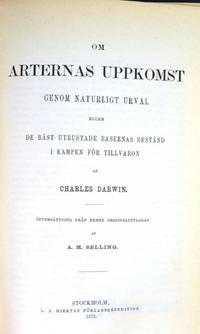
187156496Stockholm L.J. Hiertas Förlagsexpedition 1871. 8vo. Contemporary half calf with gilt lettering to spine and gilt ornamentation forming five compartments. Hindges with a few worm holes back hindges mostly affected but binding still tight and firmly attached to book block. Previous owner's stamp to pasted down front end-paper. Internally extraordinarily fine and clean. XI 1 420 pp. plate with genealogical tree inserted between p. 96 and p. 97. <br/><br/><em>The rare first Swedish translation also being the first in Scandinavia of Darwin's Origin of Species. Initially the work mainly received attention from religious institutions who also compared to most other countries were fiercely against Darwin's theory. Freeman wrongly lists this first Swedish edition as appearing in 1869 he also does not register the plate. </em> unknown
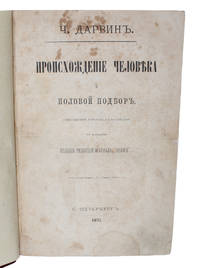
187156375S.-Peterburg Izdanie redaktsii zhurnala "Znanie 1871. 8vo. In recent half calf with four rasied bands and gilt lettering to spine. Soiling and damp stain to title-page. Light brownspotting throughout. 2 VII 5 439 7 pp. <br/><br/><em>The exceedingly rare first Russian translation of Darwin's 'Descent of Man' published only four months after the original English. The Russian publisher was eager to have a translation published hence this early abridged edition - two other Russian translations followed later the same year - The present translation being the very first into any language. "The Descent of Man showed that the process of organic evolution propelled by the struggle for existence and natural selection applied to man no less than to the rest of the animal kingdom. It gave explicit recognition to the idea of the anthropoid origin of man. This claim surprised no one for it was clearly hinted at in the great work of 1859 and was elaborated in Thomas Huxley's Man's Place in Nature and Vogt's Lectures on Man. Nor was it much of a surprise when three Russian translations of The Descent appeared within one year after the publication of the English original. Two general ideas represented the essence of The Descent: natural selection is not only behind the physical survival of man but also behind the evolution of cultural values; and the differences between animal and human behavior are differences of degree rather than of kind." Darwin in Russian Thought "The Expression helped lay the foundations for a scientific study of the psychological aspect of the evolution of species. The book appeared in a Russian translation only a few months after the publication of the English original. The paleontologist Vladimir Kovalevskii was the translator and the embryologist Aleksandr Kovalevskii was in charge of editorial tasks. In 1874 Vladimir wrote to Darwin that nearly two thousand copies of the Russian translation were sold." " The Expression deals much more extensively with selected aspects of human and animal behavior than with general problems of evolutionary biology. The Russian reviewers were generally impressed with Darwin's descriptions and categorizations of animal behavior. The Journal of the Ministry of Public Education was unusually profuse in praising the book's content and writing style. The reviewer commended Darwin's impartiality and avoidance of "materialistic trappings." Even the adherents of spiritualism could read the book he wrote without the least discomfort. The reviewer thought that psychologists would benefit from the information the book presented on the "physiological" basis of behavior. Indeed he recommended the book to all readers interested in the scientific foundations of human behavior. The liberal journal Knowledgewas equally laudatory. It noted that the book was eminently successful on two counts: it offered a "rational explanation" of many expressions of human emotions and it integrated the study of animal and human behavior into the universal process of organic evolution. In fact no educated person could afford to ignore it.N. P. Vagner professor of zoology and comparative anatomy at St. Petersburg University called The Expression a book with "great strengths and minor flaws." The volume reminded him of Darwin's previous works which marked "turning points in the history of science." The strength of the book lay much more in its suggestion of new topics for comparative-psychological research than in a presentation of a theoretically and logically integrated system of scientific thought. Insufficient exploration of the physiological underpinnings of mental activities represented the book's major shortcoming" Darwin in Russian Thought In Russia Darwinism had a profound influence not only upon the different sciences but also on philosophy economic and political thought and the great literature of the period. For instance both Tolstoy and Dostoevsky referenced Darwin in their most important works as did numerous other thinkers of the period.Like Strakhov however Dostoevsky acknowledging the significance of the "Origin of Species" saw the dangers of the theory. In the same year as the publication of Rachinsky's translation he lets the narrator in "Notes from Underground" 1864 launch his attack on Darwinism beginning: "As soon as they prove you for instance that you are descended from a monkey then it's no use scowling you just have to accept it."In "Crime and Punishment" two years later 1866 the Darwinian overtones inherent in Raskolnikov's theory of the extraordinary man are unmistakable. He describes the mechanism of "natural selection" where according to the laws of nature by the crossing of races and types a "genius" would eventually emerge. In general Darwinian themes and Darwin's name occur in many contexts in a large number of Dostoevsky's works.'Descent of Man' was transted into Danish Dutch French German Italian Polish Russian and Swedish in Darwin's lifetime. Freeman 1107. </em> unknown
18397627<p>This is a rare volume of the publication "The London Quarterly Review" containing an early review of the 1st edition publication of CHARLES DARWIN'S "The Voyage of the Beagle." The volume contains four separate issues: June October and December 1839 and March 1840. Each issue has its own Contents page. Curiously the volume opens with the Contents page for the October 1837 issue.no contents from this issue are actually present only the singular Contents page. There is an Index for the June and October1839 issues at the front and a separate Index for the December 1839 and March 1840 issues at the center. Volume LXIV. American edition published by Jemima M. Mason in New York. "The London Quarterly Review" was the American edition of the UK version called the "Quarterly Review."<br /><br />The highlight of this volume is the December 1839 issue which contains a rare early possibly the first lengthy 21-page review of the books "Journal of Researches into the Geology and Natural History of the Various Countries Visited by the H.M.S. Beagle" by CHARLES DARWIN and "Narrative of the Surveying Voyages of H.M.S. Adventure and Beagle" by Captain Philip Parker King and Captain Robert Fitzroy. This review of Darwin's book more commonly known as "The Voyage of the Beagle" was published the same year as the true first edition London and precedes the first American edition 1846 by seven years. The reviewer describes Darwin's book as "One of the most interesting narratives of voyaging that it has fallen to our lot to take up and one which must always occupy a distinguished place in the history of scientific navigation."</p> Jemima M. Mason hardcover
186216360London: John Murray 1862. FIRST EDITION. Text illustrations. Original plum cloth with an orchid in gilt on front cover. Covers and spine worn spine a bit shabby chipped at foot. Interior is excellent with a modern presentation signature on front flyleaf. First edition of Darwin's primary work on plant fertilization. Detailing the relationship between the sexual structure of orchids and the insects that fertilize them this was the first of three volumes that followed the publication of the Origin which contained supporting evidence for the author's theory of natural selection. Darwin concludes that plants are equal to animals in the marvels of their adaptation; for example he observes that wind-pollinated flowers have no colours; it is only those insect-pollinated varieties that have bright coloured petals and sweet smelling nectars. John Murray unknown
1875182454London: John Murray 1875. A meticulous study of botanical evolution First edition first issue in particularly fresh condition. Darwin consulted leading physiologists and chemists in this experimental work to show that carnivorous plants adapted to trap and digest insects enabling them to survive in poor soil. Two of the woodcuts figures 7 and 8 are after drawings by Darwin himself while several are after drawings by his sons George and Francis. Darwin started researching insectivorous plants in 1860 after observing a sundew while resting in Sussex. "During subsequent years whenever I had leisure I pursued my experiments and my book on 'Insectivorous Plants' was published in July 1875 - that is sixteen years after my first observations. The delay in this case as with all my other books has been a great advantage to me; for a man after a long interval can criticise his own work almost as well as if it were that of another person. The fact that a plant should secrete when properly excited a fluid containing an acid and ferment closely analogous to the digestive fluid of an animal was certainly a remarkable discovery" van Wyhe. The finished book discussed the whole range of such plants their adaptations and evolutionary relationships and their specialized digestive processes. Octavo. Woodcuts in text. Original green cloth spine lettered and decorated in gilt covers panelled in blind brown coated endpapers. Bookplate of Henry Wade Deacon 1852-1932 son of chemist and industrialist Henry Deacon; contemporary bookseller's ticket of G. G. Walmsley Liverpool to front pastedown. Cloth bright and unmarked extremities lightly rubbed rear inner hinge starting but holding firm majority of gatherings unopened endleaves foxed: a near-fine copy. Freeman 1217; Norman 601. John van Wyhe "Insectivorous Plants" Darwin Online. hardcover
186048456London: John Murray 1860. Second edition second issue fifth thousand 8vo x 502 pp bound without the advertisements. Folding table leaf N2 pp. 267/8 with some marginal loss and old tape repairs. Modern green half calf marbled sides and endpapers. Freeman 376. First published the previous year. The first issue of the second edition also appeared in 1859; but for the the mention of "fifth thousand" on the title page the two issues are identical. London: John Murray unknown

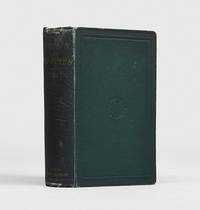
1872184789London: John Murray 1872. The most important biological book ever written Sixth edition first issue. This is the last lifetime edition and the first Origin to use the term "evolution" earlier used by Darwin in The Descent of Man 1871. This copy has the publisher's blind stamp "Presented by Mr Murray" on the title page. The sixth edition includes a new chapter VII refuting the arguments of the Roman Catholic biologist St George Mivart as well as a glossary by W. S. Dallas. "The edition was aimed at a wider public and printed in smaller type. giving the general impression of a cheap edition which at 7s. 6d. it was" Freeman. The first issue reads "eleventh thousand" on the title page noting the total issue of copies from the first edition of 1859 onwards the second issue reading "twelfth thousand". Both were issued in the same year. Octavo. Folding diagram facing p. 91. Original green ribbed cloth spine lettered and ruled in gilt and blind frames and central vignette blind-stamped to covers brown coated endpapers. Extremities gently worn spine dulled and wrinkled ends chipped inner hinges cracked but firm contents generally clean bar a handful of marginal marks and light spotting a few corners creased: a very good copy in an unrestored state. Freeman 391. hardcover
1868172871London: John Murray 1868. Survival of the fittest First edition first issue of the first of Darwin's works to use the famous evolutionary phrase preceding by a year its first appearance in Origin of Species fifth edition 1869. "Survival of the fittest" was coined by the philosopher and sociologist Herbert Spencer on reading Origin and remains the most succinct summary of Darwin's theory of natural selection. Variation under Domestication represents "the first two chapters of the projected 'big book' on the origin of species of which Origin was an abstract; this was the only section of the 'big book' published during Darwin's lifetime" Norman. It was "intended to provide overwhelming evidence for the ubiquity of variation although it would also incidentally answer Lyell and Gray who maintained that variations had not occurred purely by chance but were providentially directed. Darwin showed that breeders indeed selected from a vast array of minute random variations. He gave numerous instances of the causes of variability including the direct effect of the conditions of life reversion the effects of use and disuse saltation prepotency and correlated growth. Variation also addressed a key criticism of Origin: that it lacked an adequate understanding of inheritance" ODNB. As such Variation is a full statement of the facts on which the theories of Origin were based leaving aside an account of human evolution for Descent of Man 1871. This is the only Darwin title published by Murray to appear in the larger format of demy octavo. The first issue was published in a run of 1500 copies for which this copy has all the relevant points: five errata in Volume I nine errata on seven lines in Volume II and the spine imprint on one line. The second issue with substantial textual variations was published in a run of 1250 copies in February and is distinguished by a single erratum in Volume I no errata in Volume II and a two-line imprint on the spine. 2 vols demy octavo. With 43 woodcuts in text. Vol. I with 32 pp. of publisher's advertisements dated April 1867 vol. II with 2 pp. of advertisements dated February 1868. Original green cloth spines lettered and decorated in gilt covers panelled in blind dark green coated endpapers binder's ticket of Edmonds & Remnants to rear pastedown of vol. I. Bookplates and markings of the Ashmolean Natural History Society to front pastedowns and title pages. Spine ends and corners bumped spine panel of vol. II creased at centre cloth lightly cockled and with damp stain to rear cover rear inner hinge of vol. II split but holding gathering 2C of same starting cords occasionally visible contents clean: a very good copy. Freeman 877; Garrison-Morton 224.1; Norman 597. hardcover
1864feb02681<p>1864. First Italian Edition - On the Origin of Species by Means of Natural Selection or the Preservation of Favoured Races in the Struggle for Life by Charles Darwin.<br />Sull'origine delle specie per elezione naturale ovvero conservazione delle razze perfezionate nella lotta per l'esistenza by Charles Darwin</p><p>Used book For more details and availability please contact me</p> Modena hardcover
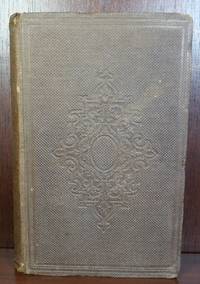
18605723New York: D. Appleton and Company 1860. First American Edition First Printing First Issue. First American edition first printing first issue with only two reviews facing the title page. Measuring approximately 8" x 5.25" with 432 numbered pages. <br /> <br /> This book is in good plus condition. Moderate surface wear with some cloth loss at the spine ends. Some fading to the gilt lettering on the spine. Moderate foxing to the edges of the textblock. Interior pages lightly foxed. Top of the half-title and title pages neatly trimmed by a previous owner likely to remove previous owner's name. Front endpaper nearly detached.<br /> <br /> "On the Origin of Species" is considered to be the foundation of evolutionary biology. Darwin's book introduced the scientific theory that populations evolve over the course of generations through a process of natural selection. The book presented a body of evidence that the diversity of life arose by common descent through a branching pattern of evolution.<br /> <br /> Please view the many other rare titles available for purchase at our store. We are always interested in purchasing individual or collections of fine books.<br /> <br /> Inventory #O2-74. D. Appleton and Company unknown
1882451781882. <p>Darwin Charles 1809-82. Funeral of Mr. Darwin. Westminster Abbey Wednesday April 26th 1882 at 12 o'clock precisely . . . G. G. Bradley Dean. Printed card black-bordered with the Dean's seal in black wax in the left margin and the letters "C. H." in red ink on either side of the seal. N.p. 1882. 92 x 122 mm. Fine.</p> <p> Darwin had died at Down House on 19 April 1882 expecting to be buried in the local churchyard. His fame and reputation were such however that Huxley Galton and others felt it would be appropriate to have him buried at Westminster Abbey one of the highest honors that can be bestowed on a British citizen. As Desmond and Moore put it "getting a freethinker into the Abbey was not easy" Darwin p. 666. But Huxley stepped in supported in Parliament by Darwin's neighbor Sir John Lubbock and by a press campaign led by The Standard. The Reverend George Granville Bradley Dean of Westminster Abbey was happy to acquiesce.</p> <p> The Chapter House to which our card allows admission is where those who were to follow the coffin into the Abbey assembled: "On that grey day committees adjourned judges put on mourning dress and Parliament emptied as members trooped across the road. From embassies scientific societies and countless ordinary homes they came. Under leaden skies they converged on the Abbey anticipating the awe and spectacle of a state occasion. In the Chapter House where Parliament had once met the elders of science State and Church the nobility of birth and talent stood waiting to file though the cloisters behind the coffin. They were "the greatest gathering of intellect that was ever brought together in our country" said one' Desmond and Moore p. 672. Darwin was laid to rest beneath the monument to Newton at the north end of the choir screen. </p> . unknown
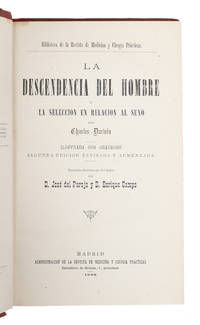
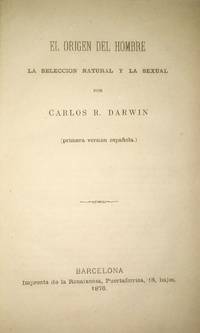
188562338Madrid Administracion de la Revista de medicina y cirugia practicas 1885. 8vo. In contemporary red half calf with gilt lettering to spine. Light wear to extremities cloth-boards with repairs. Inner hinges split. Bookbinder-stamp to front free end-paper. Internally very fine and clean. VIII 725 pp. <br/><br/><em>A landmark in the history of Darwinism in the Spanish-speaking world this 1885 Madrid edition is the first full Spanish translation of “The Descent of Man†and without question the most important Spanish edition of Darwin’s major work on human evolution. “Segunda edición revisada y aumentada†stated on the title-page strictly refers to the fact that this phrase is translated directly from the title-page of the second edition of Darwin’s “The Descent of Man Second Edition Revised and Augmentedâ€. A earlier partial translation Barcelona 1876 was made however only the seven chapters of Part I was translated none of Darwin's footnotes are translated or mentioned and none of the illustrations are reproduced here. The translator states in his "Preface" that he is indeed summarizing much and that his intention is to give a most complete extract of Darwin's main works in one single volume. And since it's necessary to be familiar with "The Origin of Species" he believes that a good way of explaining the basics is to translate a few pages from Ernst Haeckel which occupies pp. ix to xi of said preface. He doesn't specify the source but it seems to be a translation of Haeckel's The History of Creation chapter VII paragraphs 153-161. This present edition edition is unabridged translating the full content of both volumes including Darwin’s detailed exposition on sexual selection racial theory and moral evolution accurately annotated preserving Darwin’s own footnotes and incorporating his illustrations unlike any prior Spanish attempt and being scientifically rigorous following the English second edition directly without filtering through French intermediaries or secondary paraphrases and without reference to earlier Spanish partial versions. This 1885 edition of "La descendencia del hombre" represents a key moment in the Spanish reception of Darwin’s ideas. As the first complete and direct translation of "The Descent of Man" it provided Spanish readers with full access to Darwin’s arguments on human evolution including material previously unavailable in earlier partial versions. Its continued use well into the 20th and even 21st century underscores its bibliographic importance and lasting influence - a major Spanish publisher reused this 1885 translation as late as 2019. In Darwinian thought in the Spanish-speaking world it remains a significant and foundational edition. Freeman 1122c Blanco & Llorca 124 </em> hardcover
1860033209New York: D. Appleton & Co 1860. Book. Very Good. Hardcover. First American Edition. 432pp. First American edition first issue with two quotes opposite the title page.Gilt lettering on the spine is darkened. Spine professionally rebacked the original spine present. Bound in pebbled brown cloth brown endpapers and the foldout chart is present and in excellent condition. The corners of the front panel show moderate wear. Prev. owner's name in pencil on the front free endpaper and the title page. The hinges are tight and the text block is clean. Overall a very well preserved copy of this classic work. Darwins theory argued that organisms gradually evolve through a process he called natural selection. In natural selection organisms with genetic variations that suit their environment tend to propagate more descendants than organisms of the same species that lack the variation thus influencing the overall genetic makeup of the species. Size: Octavo. D. Appleton & Co Hardcover
186250871Paris Guillaumin et Cie Victor Masson et Fils 1862. 8vo. Bound uncut and with the original printed front wrapper expertly restored in a very fine later half morocco binding with four raised bands and gilt title to spine. Very light minor brownspotting to a few pages. An exceptionally nice clean and attractive copy. LXIV incl. half-title I-XXIII 24- 712. pp. and 1 folded plate between pp.160 a. 161. Fully complete. <br/><br/><em>The scarce first French edition of Darwin's masterpiece one of the most important books ever printed. The "Origin" started the greatest of all intellectual revolutions in the history of Mankind.There were some difficulties with the first French edition. Mlle Royer who Darwin described as 'one of the cleverest and oddest women in Europe' and wished 'had known more of natural history' added her own footnotes. He was not really happy until the third translation by Éduard Barbier appeared in 1876. Freeman. Freeman No 655 Freeman does not mention the plate which is present here. </em> hardcover
187153279S.-Peterburg Izdanie redaktsii zhurnala "Znanie 1871. 8vo. In contemporary black half calf with four rasied bands and gilt lettering to spine. Corners of binding with repairs and a three cm long tear to lower front hindge. Light miscolouring throughout especially to first 10 leaves. 2 VII 6 439 pp. <br/><br/><em>The exceedingly rare first Russian translation of Darwin's 'Descent of Man' published only four month after the original English. The Russian publisher was eager to have a translation published hence this early abridged edition - two other Russian translations followed later the same year - The present translation being the very first into any language. "The Descent of Man showed that the process of organic evolution propelled by the struggle for existence and natural selection applied to man no less than to the rest of the animal kingdom. It gave explicit recognition to the idea of the anthropoid origin of man. This claim surprised no one for it was clearly hinted at in the great work of 1859 and was elaborated in Thomas Huxley's Man's Place in Nature and Vogt's Lectures on Man. Nor was it much of a surprise when three Russian translations of The Descent appeared within one year after the publication of the English original. Two general ideas represented the essence of The Descent: natural selection is not only behind the physical survival of man but also behind the evolution of cultural values; and the differences between animal and human behavior are differences of degree rather than of kind." Darwin in Russian Thought "The Expression helped lay the foundations for a scientific study of the psychological aspect of the evolution of species. The book appeared in a Russian translation only a few months after the publication of the English original. The paleontologist Vladimir Kovalevskii was the translator and the embryologist Aleksandr Kovalevskii was in charge of editorial tasks. In 1874 Vladimir wrote to Darwin that nearly two thousand copies of the Russian translation were sold." " The Expression deals much more extensively with selected aspects of human and animal behavior than with general problems of evolutionary biology. The Russian reviewers were generally impressed with Darwin's descriptions and categorizations of animal behavior. The Journal of the Ministry of Public Education was unusually profuse in praising the book's content and writing style. The reviewer commended Darwin's impartiality and avoidance of "materialistic trappings." Even the adherents of spiritualism could read the book he wrote without the least discomfort. The reviewer thought that psychologists would benefit from the information the book presented on the "physiological" basis of behavior. Indeed he recommended the book to all readers interested in the scientific foundations of human behavior. The liberal journal Knowledgewas equally laudatory. It noted that the book was eminently successful on two counts: it offered a "rational explanation" of many expressions of human emotions and it integrated the study of animal and human behavior into the universal process of organic evolution. In fact no educated person could afford to ignore it.N. P. Vagner professor of zoology and comparative anatomy at St. Petersburg University called The Expression a book with "great strengths and minor flaws." The volume reminded him of Darwin's previous works which marked "turning points in the history of science." The strength of the book lay much more in its suggestion of new topics for comparative-psychological research than in a presentation of a theoretically and logically integrated system of scientific thought. Insufficient exploration of the physiological underpinnings of mental activities represented the book's major shortcoming" Darwin in Russian Thought In Russia Darwinism had a profound influence not only upon the different sciences but also on philosophy economic and political thought and the great literature of the period. For instance both Tolstoy and Dostoevsky referenced Darwin in their most important works as did numerous other thinkers of the period.Like Strakhov however Dostoevsky acknowledging the significance of the "Origin of Species" saw the dangers of the theory. In the same year as the publication of Rachinsky's translation he lets the narrator in "Notes from Underground" 1864 launch his attack on Darwinism beginning: "As soon as they prove you for instance that you are descended from a monkey then it's no use scowling you just have to accept it."In "Crime and Punishment" two years later 1866 the Darwinian overtones inherent in Raskolnikov's theory of the extraordinary man are unmistakable. He describes the mechanism of "natural selection" where according to the laws of nature by the crossing of races and types a "genius" would eventually emerge. In general Darwinian themes and Darwin's name occur in many contexts in a large number of Dostoevsky's works.'Descent of Man' was transted into Danish Dutch French German Italian Polish Russian and Swedish in Darwin's lifetime. Freeman 1107. </em> unknown
186050927Stuttgart E. Schweizerbart'sche Verlagshandlung und Druckerei 1860. 8vo. Bound in contemporary half calf with gilt lettering and ornamentation to spine. Small stamp and previous owner signature to title page. Leather on lower part of spine with a tear and part detached. Hinges weak but book-block firmly attached. VIII including half 520 6 pp 1 plate. <br/><br/><em>The very scarce first edition of the highly important first German translation which appeared just months after the original.This translation came to play a tremendous role in the spreading of Darwinism in Germany and Northern Europe in general. It was through this translation that Darwinian thought reached most of the German scientists and thinkers of the period and it was this translation that challenged German scholars to think in new ways about morphology systematics paleontology and other biological disciplines. It was from this translation that Ernst Haeckel Darwin's most famous nineteenth-century proponent and popularizer in Germany got his Darwinism and was able to further spread the new ideas in his own country. The German translation of Darwin's "The Origin of Species" appeared in 1860 just months after the original thanks to Heinrich Georg Bronn a distinguished German paleontologist whose work in some ways paralleled Darwin's. Bronn's version of the book with his own notes and commentary appended did much to determine how Darwin's theory was understood and applied by German biologists for the translation process involved more than the mere substitution of German words for English."Its Origin of Species greatest impact on German biological practice lay in the introduction of historical modes of explanation for the observable phenomena of living nature. The historical approach to nature was rejected not only by the opponents of evolution but also by the idealist evolutionist. Whether they favored a teleological or a reductionist biology the idealists could not see the point of a theory that emphasized the irregularities and exceptions in the organic world. In the timeless real of idealist thinking unchanging laws worked out an inevitable destiny. But Darwin taught his followers to look at living beings one by one. Thus prompted they recognized as if for the first time the surprising fact of anomaly and the wisdom of an open-ended theory." Glick The Comparative Reception of Darwinism. "Darwin was not happy about the first German translation. It was done from the second English edition by H.G. Bronn who had at Darwin's suggestion added an appendix of the difficulties which occurred to him; but he had also excised bits of which he did not approve. This edition also contains the historical sketch in its shorter and earlier form." Freeman.Freeman No 672 - Freeman does not mention the lithographed plate. </em> hardcover
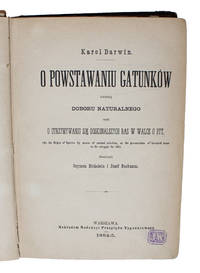
188456005Warszawa Przegladu Tygodniowego 1884. Large8vo. In contemporary half calf. Spine with wear lacking the upper 1 cm. Small stamp to title-page. Hindges weak and back board detached from bookblock. Verso of title-page and first leaf on content. 437 1 XVI Including the plate pp. <br/><br/><em>First edition of the first full Polish translation of Darwin's "Origin of Species". An attempt to publish a Polish translation was made as early as 1873. This was however never completed and only half of the work was published Freeman 739 thus making the present copy the very first full Polish translation. As seen in several other countries especially in Japan the majority of Polish intellectuals adopted a Social Darwinism perspective at a very early stage rather than appreciating the English naturalist's caution in applying his ideas to human society."Before the first translations of Darwin's appeared . many Polish intellectuals such as positivist writer Eliza Orzeszkowa 1841-1910 complained about the increasing confusion over the essence of the English naturalist's ideas which had all too often been mixed up with all sorts of ideological debates. However when Darwin's books were actually available in Polish translations the novelty of his concepts gradually wore off making room for more serious attempts to come to terms with evolutionary theory." Glick The Reception of Charles Darwin in Europe. "It appears that the struggle for or against Darwinism in partitioned Poland prefigured a pattern that is relevant for Polish thinking up to the present day: the conflict of striving for progress with the help of powerful allies abroad and of virulently rejecting all foreign advice for fear of losing one's cultural identity." Ibid.Translation was begun by Szymon Dickstein who in the processe of the translation committed suicide. It was completed by Józef Nusbaum who also translated 'The Variation of Animals and Plants under Domestication' in 1888.Freeman 740 </em> unknown
18761701Barcelona: Imprenta de la Renaixensa 1876. First Spanish edition. In contemporary half leather. Marbled endpapers. Spine with small damage to the head wormholes at joints. Corners slightly bumped. Pages yellowed due to aging. Last pages with wormholes. Overall in very good condition. First Spanish edition. In contemporary half leather. Marbled endpapers. XI 2 14–322 2 p. First Spanish edition of Charles Darwin’s 1871 groundbreaking book on human evolution and the sexual selection “The Descent of Manâ€. Imprenta de la Renaixensa unknown
1891feb02673<p>1891. First German Edition of Letters on Geology.<br /><br /> Extract from Deutsche Rundschau</p><p>Used book For more details and availability please contact me</p> E. Schweizerbartsche Verlagshandlung
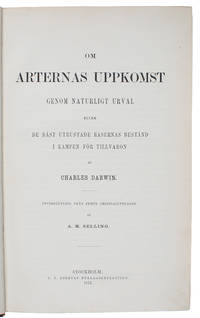
1871feb02733<p>1871. First Swedish Edition - On the Origin of Species by Means of Natural Selection or the Preservation of Favoured Races in the Struggle for Life by Charles Darwin.<br />Om Arternas Uppkomst genom naturligt Urval eller de bäst utrustade rasernas Bestånd i Kampen för Tillvaron.</p><p>Used book For more details and availability please contact me</p> L.J. Hiertas hardcover
1860023046London: John Murray 1860. Second edition fifth thousand. Octavo pp x 502 32 page publisher's catalogue dated January 1860 slight age-toning and very slight occasional foxing several lightly creased corners a small marginal tear to page 13/14 the folding plate at page 117 is a little foxed but one part of the three sections is now detached and frayed at the bottom edge the hinge following page 120 is widely cracked but no looseness the front free endpaper very slightly marked the front hinge beginning to crack but no weakness the front paste-down endpaper has two early signatures - James Sharp and E. Byres of Claremont House Balham original green cloth the corners very slightly bruised very slight rubbing the spine slightly dull the spine head slightly pulled and similarly so at the base but with one small tear. Freeman 376 variant a . Second edition. Cloth. Good. John Murray Hardcover
1896177013New York: D. Appleton and Company 1896-97. The first collected edition The Authorized edition uncommon complete with the publisher's half morocco bindings in bright and attractive condition. The American publisher Appleton made the first serious attempt towards a uniform collection an idea that was most comprehensively achieved nine decades later under the imprint "The Pickering Masters" 1986-9. There was no collected edition published during Darwin's lifetime. Together 12 works in 15 vols octavo. Illustrated with photographic half-tone plates folding maps line drawings and diagrams. Original red half morocco spines lettered in gilt marbled sides top edges gilt other edges uncut some leaves unopened. Bookseller's ticket on rear pastedowns. Bindings bright the spines near-uniformly red faint splash mark to a few top edges affecting outer leaves clean overall trivial stub tear to a couple of folding maps. A near-fine set. unknown