DARWIN, CARLO (CHARLES).Biblio.com

881 résultats
186455760Modena Nicola Zanichelli e. Soci 1864. 8vo. In contemporary half calf with four raised bands and gilt lettering to spine. Reinforced in inner margins and plate with waterstains to lower margin. An unusually fine and well preserved copy internally as well as externally. XV 403 pp 1 plate. <br/><br/><em>Rare first edition of the first Italian translation of Darwin's seminal "Origin of Species" quite unusually authorized by Darwin himself. The work was very well received and - compared to France and Spain - Darwinism was quickly adopted by Italian biologist and zoologist and meet only little catholic opposition. "The impact of Darwinism on Italian naturalists was powerful; the logic and rigorous treatment of the problem of the origin of species as Darwin had presented it forced zoologists and anthropologists to reconsider those passages of Lamarckisms that they had agreed to with excessive enthusiasm". Capanna Darwinism and the Italian academies. The reception of Darwin's work in France 1862 and Spain 1877 were characterized by a strong chatolic opposition which also had a strong suppressing effect on the spread of his ideas to academic institutions.Despite of Italy being a catholic stronghold the reception of Darwinism was very favourable and meet very limited criticism from the church:"In contrast to the power Catholicism was able to exert against Darwinism in Spain it was practically impotent in Italy. Neither could the Italian Catholic intellectual establishment draw upon a repertory of anti-Darwinism arguments from the Italian scientific establishment as was done in France. As in France under the Third Republic and as was the case sporadically in Spain the advent of Darwinism in Italy provided a source of ideology for the anticlerical movement. Although Darwinism enjoyed a number of close connections with the English source the peculiarities of the Italian situation set Darwinism in Italy apart from other situations. Italy was in the forefront in recognizing Darwin electing him to various academies and societies and awarding him the famous Bressa Prize in 1875. In Italy the translation of the Origin "1864" was given an impeccable scientific presentation by Giocanni Canestrini and Leonardo Salimbeni which avoided the type of situation that arose from the presentation of Darwinism in France by Clémence Royer as a new scientific basis for a secularistic Weltanschauung. As a general explanation of course it is reasonable to accept Cermenati's arguments that the favorable receptivity of the scientific community and the general indifference to ecclesiastical objections to Darwinism are the chief factors explaining the quick spread of Darwinism in Italy". Glick The Comparative Reception of Darwinism.Emma Darwin Darwin's wife wrote publisher John Murry on the 17th of December: "Mr Darwin desires me to say that as you have never hesitated to authorize a foreign translation he has taken upon himself to authorise a translation into Italian without consulting you." When Darwin was informed that his work was being translated into Italian he wrote to his close friend J. D. Hooker: "There is an Italian Edit. of Origin preparing!!! This makes fifth foreign Edit ie in five foreign countries. Owen will not be right in telling Longmans that Book wd be utterly forgotten in ten years. Hurrah!".Freeman no. 706 </em> hardcover
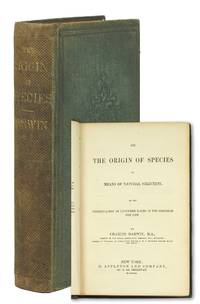
18601263511860. New York: D. Appleton and Company 1860. <br /> <br /> 8vo 7 5/8 x 5 inches; 195 x 125 mm. 432 pp. Folding lithographed diagram speciation tree facing p. 108. Original dark green bead-grain cloth with covers decoratively stamped in blind and spine ruled in gilt and blind and lettered in gilt. Original dark brown coated endpapers front free endpaper removed; early ink signature J.F. Oakes dated 1868; bookplate of Isador H. Coriat and stamp of Edmund Brill with inscription. Professionally conserved: hinges strengthened head and foot of backstrip renewed.<br /> <br /> § First issue of the first American edition. One of the most influential scientific works of the nineteenth century "On the Origin of Species" was and still is one of the most controversial books ever printed. In it "Darwin not only drew an entirely new picture of the workings of organic nature; he revolutionized our methods of thinking and our outlook on the natural order of things. The recognition that constant change is the order of the universe had been finally established and a vast step forward in the uniformity of nature had been taken" Printing and the Mind of Man. Although published the same year as the second English edition the text of the first American edition with the two stereo reprints of the same year is identical to the first English edition Freeman 373 with the whale-bear story surviving intact. Freeman 377. Grolier/Horblit 23b "the most influential scientific work of the nineteenth century". Printing and the Mind of Man 344b describing the 1859 first edition. unknown
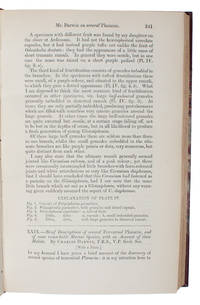
184456991London Taylor and Francis 1844. 8vo. In a nice later half morocco binding with five raised bands and gilt lettering to spine. Blind stamped to upper outer corner of first leaf of table of contents. In "The Annals and Magazine of Natural History" volume 14. A very fine and clean copy. Darwin's paper pp. pp. 241-251. Entire volume: vii 1 - 472 12 plates. <br/><br/><em>First edition of Darwin's paper on flatworms collected by him during the Beagle voyage one of the important early papers by Darwin on invertebrates originally intended for publication in The Zoology of the Voyage of HMS Beagle. This is Darwin's first publication on taxonomy: illustrated with a plate drawn by Darwin it describes a new genus and 15 new species of flatworm. Extremely rare on the market."The paper on flatworms . was Darwin's first venture into taxonomy. In it he described a new genus and 15 new species; most of the latter are still recognised as valid. He took a great deal of interest in these animals making extensive notes on their morphology and behaviour" Porter Darwin's Sciences.Previously familiar only with marine species Darwin was astounded to discover two new species of flatworm living on dry land in Brazil. He was intrigued by their close resemblance to snails and evolutionary questions may well lie behind his strong interest in them. PROVENANCE: From the collection William Pickett Harris Jr. 1897 - 1972 pencil note on p. iii. American investment banker and biologist. Following a career in banking Harris was appointed Associate Curator of the Museum of Zoology at the University of Michigan in 1928. "Harris played a highly important role in developing mammalogy and systematic collections of mammals at the University of Michigan" Hooper p. 923.Freeman 1669 </em> hardcover
18602D-2DIJ-J9AND. Appleton and Company. Very Good. 1860. Unknown Binding. Appleton 1860. First American edition fourth issue with New Edition Revised and Augmented by the Author on title page. 3 blurbs opp. title. Pages: xi 440 2. Folding plate. Yellow endpapers cracked at rear but holding well. Laid flat a few places but binding tight. Mispagination of 116-21. Freeman 380. Original dark green blind stamped cloth light rubbed slight fraying top spine. Ink gift inscription.; 432 pages . D. Appleton and Company unknown
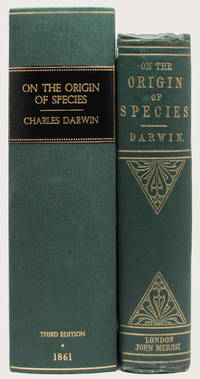
186133919London: John Murray 1861. A very early issuance and only the third edition seventh thousand of the title with important additions and corrections of Darwin's monumental work. This edition is printed in the same format and binding as the first edition and includes "An Historical Sketch of the Recent Progress of Opinion on the Origin of Species" in which Darwin acknowledges his fellow scientists as regards the theory of evolution as well as a table of corrections to the first and second editions. Two-thousand copies only were printed and issued in April 1861. Folding lithographed diagram by W. West. Quarto in 12's 7 3/4" x 5 7/8" 193mm x 124mm publisher's original green cloth gilt decorated on the spine and blocked in blind on the covers salmon glazed paper end-leaves with the binders Edmonds & Remnants ticket on the rear paste-down. Housed in a handsome morocco labeled slipcase with chemise. i-v vi-xix 538 2 ads. and with one folding plate. A very fresh and clean copy fine and very bright both internally and externally with only very light evidence of age or use. The end-leaves in excellent condition and unusually clean the hinges strong and pleasing and without refurbishment a slight bit of rubbing only at the extremities. An especially pleasing copy unusually well preserved. One of the best we have seen. AN ESPECIALLY HANDSOME AND PLEASING COPY OF THIS GREAT BOOK. THE THIRD AND HIGHLY IMPORTANT ISSUANCE OF CHARLES DARWIN'S MASTERWORK.<br> The book is rare in cloth in this condition.<br> Darwin's Revolutionary Masterwork in which he not only "drew an entirely new picture of the workings of organic nature; he revolutionized our methods of thinking and our outlook on the natural order of things. The recognition that constant change is the order of the universe had been finally established and a vast step forward in the uniformity of nature had been taken." PMM Together with Copernicus' DE REVOLUTIONIBUS and Newton's PRINCIPIA it is deemed one of the three greatest and most important scientific works ever penned.<br> "The most influential scientific work of the nineteenth century" and "The most important biological work ever written" Horblit Freeman. Darwin's elaboration of the theory of natural selection laid the groundwork for the controversy over the evolution of man and with only slight modification by such scientists as Stephen Jay Gould Darwin's ideas remain the umbra under which most current biological research is conducted.<br> The import of the ORIGIN need hardly be stated. This edition for the first time contains Darwin's historical treatment of theories of evolution: "An Historical Sketch of the Recent Progress of Opinion on the Origin of Species" xiii-xix. Here Darwin acknowledges the impact of Lamarck Patrick Matthew and others right up to 1860 on his thought. As such it is the first edition that situates Darwin in his broader intellectual context.<br> Copies of the ORIGIN are often quite worn but the present item is unusually well preserved bright clean tight and especially handsome. The book was if ever used handled very kindly indeed.<br> Darwin had intended the book to be an abstract of his 'big book' on transmutation of which only the first part Variation Under Domestication 1868 was published in his lifetime. John Murray hardcover
186456000S.-Peterburg 1864. 8vo. Bound in a beautiful recent pastiche-binding of brown half calf with marbled papers over boards and elegant gilding to spine. End-papers renewed. A few dampstains and a bit of brownspotting throughout. A nice copy. XIV 399 1 pp. 1 plate. <br/><br/><em>First edition of the first Russian translation of Darwin's "Origin of Species" a main reason for the widespread effect of Darwinism in Russia where the theory met less resistance in the 1860'ies than it did in Western Europe. In Russia Darwinism had a profound influence not only upon the different sciences but also on philosophy economic and political thought and the great literature of the period. For instance both Tolstoy and Dostoevsky referenced Darwin in their most important works as did numerous other thinkers of the period."In 1864 S.A. Rachinsky professor of plant physiology at St. Petersburg University produced the first Russian translation of the "Origin". Although not a masterpiece of translation art the book sold out so quickly that in 1865 it went through a second printing. By this time Darwin's ideas were discussed not only by scientists but also by such popular writers as Dmitri Pisarev and M. A. Antinovich." Glick p. 232. Rachinsky began translating the "Origin" in 1862 and wrote an important article on the theories presented in it while working on the translation. This article and the translation of the "Origin" into Russian were responsible for the great success and rapid widespread knowledge of Darwinian theory of evolution in Russia. "Darwin was concerned that the "Origin of Species" reach naturalists across the world but translations of that complicated work raised problems for Darwin. If he found it difficult to make the reader "understand what is meant" in England and America at least in those two countries he and the reader were discussing the "Origin of Species" in the same language. Foreign language editions raised not only the thorny question of translating Darwinian terms but also the problem of translators who often thought it proper to annotate their editions to explain the "significance" of Darwinism. The first Russian translation of the "Origin of Species" 1864 appeared however without any comment whatever by the translator Sergei A. Rachinsky professor of botany at the University of Moscow. Rachinsky had begun the translation in 1862 and published an article on Darwinism while continuing work on the translation in 1863." Rogers p. 485. In the year of publication of the translation 1864 Pisarev wrote a long article in "The Russian Word" which purports to be a review of this translation; the critic complains about the absence of notes and commentaries by the translator. Pisarev furthermore points to several errors in the translation and to numerous infelicities of expression. Acknowledging the importance of the work however and of the spreading of Darwinism in Russia he goes on in his own essay to provide a much more popular account of Darwin's theory and to impress upon his readers its revolutionary significance.Nikolai Strakhov also reviewed the translation immediately upon publication acknowledging the effect it would have. Strakhov however recognized potential dangers inherent in the theory and expressed them in his review of Rachinsky's translation. He praised the work for its thoroughness and rejoiced in the evidence that man constituted the highest stage of organic development; but then he went on to argue that by moving into questions of philosophy and theology the Darwinists were exceeding the limits of scientific evidence. Like Pisarev Tolstoy enthusiastically embraced Darwinism. "The first mention of Darwin in Tolstoy's literary "Nachlass" is found in one of the drafts to "War and Peace". There Darwin is listed apparently quite favorably among leading thinkers "working toward new truth" . Thus by the late 1860's the name of Darwin as a leading scientist was already familiar to Tolstoy and duly respected." McLean p. 160. A fact which is often overlooked is that Tolstoy actually knew Rachinsky quite well. Interestingly it was in a letter to Rachinsky in reply to a question about the structure of "Anna Karenina" that Tolstoy made the famous statement that all Tolstoy scholars and lovers know by heart: "I am proud of the architecture - the arches are joined in such a way that you cannot discover where the keystone is". Like Strakhov however Dostoevsky acknowledging the significance of the "Origin" saw the dangers of the theory. In the same year as the publication of Rachinsky's translation he lets the narrator in "Notes from Underground" 1864 launch his attack on Darwinism beginning: "As soon as they prove you for instance that you are descended from a monkey then it's no use scowling you just have to accept it."In "Crime and Punishment" two years later 1866 the Darwinian overtones inherent in Raskolnikov's theory of the extraordinary man are unmistakable. He describes the mechanism of "natural selection" where according to the laws of nature by the crossing of races and types a "genius" would eventually emerge. In general Darwinian themes and Darwin's name occur in many contexts in a large number of Dostoevsky's works.Freeman: 748. See: James Allen Rogers: The Reception of Darwin's Origin of Species by Russian Scientists. In: Isis Vol. 64 No. 4 Dec. 1973 pp. 484-503.Thomas F. Glick: The Comparative Reception of Darwinism. 1974.Hugh McLean: In Quest of Tolstoy. 2008. </em> hardcover
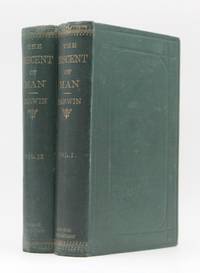
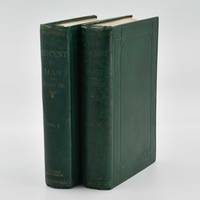
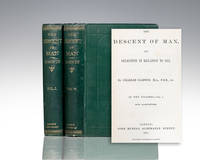
1871376128London: John Murray 1871. First edition first issue with errata on verso of vol. II title-leaf. viii 423 1; viii ii 475 1 pp. 1 vols. 8vo. Publisher's green cloth. Light wear to covers expertly recased. Bookplate. First edition first issue with errata on verso of vol. II title-leaf. viii 423 1; viii ii 475 1 pp. 1 vols. 8vo. Darwin's Descent of Man created an uproar second only to his Origin of the Species; however "contrary to popular error prevalent now as well as then Darwin never said that man was descended from apes let alone monkeys; what he claimed was that man's ancestors if alive today would have to be classified among the Primates" De Beer Charles Darwin pp. 210-1. ODNB further clarifies "The Descent understood by Darwin as a sequel to the Origin was written with a maturity and depth of learning that marked Darwin's status as an élite gentleman of science" Freeman 937 John Murray unknown
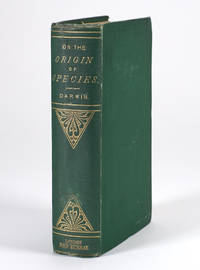
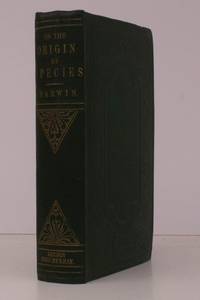
186642820890<p>FOURTH EDITION. Fifteen hundred copies were printed. "It was again extensively altered and it was in this one that the date if the first edition as given on the verso of the half title is corrected from October 1st to November 24th" Freeman.</p><p><strong><em>On the Origin of Species</em></strong><strong> is "certainly the greatest biological book ever written</strong>" Freeman and "<strong>the most important single work in science</strong>" Dibner.</p><p>Darwin's theory of the origin of species by means of natural selection arose out of his studies in the 1830s during and after the voyage of H.M.S. <em>Beagle</em>. From 1831 to 1836 Darwin sailed around the world on the <em>Beagle</em>. During this five-year voyage Darwin and the <em>Beagle</em> visited the Galapagos Islands Brazil Argentina Tierra del Fuego Chile Peru Tahiti Australia New Zealand and other islands and countries finally returning to England by sailing around the Cape of Good Hope. Darwin observed "It appears to me that nothing can be more improving to a young naturalist than a journey in distant countries."</p><p>The voyage of the <em>Beagle </em>was "the most important event in Darwin's intellectual life and in the history of biological science. Darwin sailed with no formal scientific training. He returned a hard-headed man of science knowing the importance of evidence almost convinced that species had not always been as they were since creation but had undergone change. … The experiences of his five years … and what they led to built up into a process of epoch-making importance in the history of thought" DSB.</p><p>Over the coming thirty years Darwin refined the ideas that had germinated aboard the <em>Beagle </em>and finally published them in <em>On the Origin of Species</em>. Darwin concluded his book "There is grandeur in this view of life with its several powers having been originally breathed into a few forms or into one; and that whilst this plan has gone cycling on according to the fixed law of gravity from so simple a beginning endless forms most beautiful and most wonderful have been and are being evolved."</p><p><strong>Darwin's ideas about evolution and natural selection are the underpinnings of modern biological science. Moreover they have given us a new way of viewing and talking about the world. </strong>"Darwin not only not only drew an entirely new picture of the workings of organic nature; he revolutionized our methods of thinking and our outlook on the order of natural things. The recognition that constant change is the order of the universe had finally been established" Printing and the Mind of Man 344b.</p><p>Provenance: contemporary inscription "Adamson The Towers Didsbury." Daniel Adamson was an English engineer boiler manufacturer and driving force behind the Manchester Ship Canal in the 1880s. His home the Towers is sometimes called the Calendar House for its 365 windows 52 doors and 12 chimneys.</p><p>Freeman 385.</p> John Murray hardcover
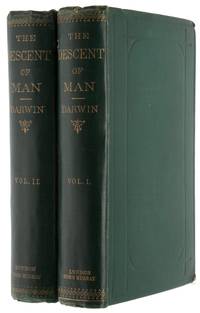
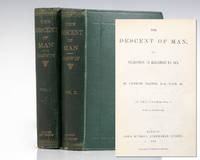
18746679London: John Murray 1874. Second edition. <p>First edition first issue of the book in which Darwin finally gave his public account of two ideas he had withheld from the Origin: the descent of Homo sapiens and - his more original contribution - the mechanism of sexual selection. On page 2 of Volume I the word evolution appears the first appearance of the word in any Darwin work a year before the sixth edition of the Origin. The descent of man made him famous. Sexual selection made him lonely: it required his readers to credit birds fishes and insects with something like aesthetic judgment - that females choosing generation after generation had driven ornament that natural selection alone could not explain. Wallace would not accept it and the community followed him. Sexual selection remained a neglected corner of Darwinism for a century until Trivers 1972 Zahavi 1975 and Hamilton and Zuk 1982 vindicated female choice and placed it at the centre of evolutionary biology. The delay tells its story: Darwin had seen further than his readers who had simply refused to follow.</p>. What Darwin Left Out of the Origin. <p>First edition first issue of the book in which Darwin finally gave his public account of two ideas he had withheld from the Origin of Species: the descent of Homo sapiens from pre-existing forms and - his more original and more contested contribution - the mechanism of sexual selection. The Origin had deliberately excluded man from its argument "light will be thrown on the origin of man and his history" and had mentioned sexual selection only briefly as a special case within natural selection. Twelve years later with the evolutionary argument secured in the scientific literature and the public polemics largely past Darwin set out the two positions he had kept in reserve. The first made him famous; the second neglected for a century is now recognised as one of the most powerful explanatory frameworks in evolutionary biology.</p> <br /> <p>The twelve-year delay was not accidental. Darwin had been collecting notes on human descent since the Beagle years of the 1830s but had withheld them for strategic reasons. He had written to Wallace in December 1857 that he would avoid the subject of man as surrounded by too many prejudices even while admitting that it was the highest and most interesting problem for the naturalist. By 1871 the climate had changed. Huxley's Evidence as to Man's Place in Nature 1863 had done much of the defensive work; Lyell's Antiquity of Man 1863 had established deep human prehistory; and Haeckel's Generelle Morphologie 1866 had pushed the evolutionary argument onto the Continent and drawn the first explicit phylogenies of the human line. The Descent therefore arrived not as an opening salvo but as the master's own statement delivered at a moment when the main resistance had already been absorbed. The storm that had greeted the Origin did not repeat itself in 1871; Darwin wrote to a friend that he was surprised to find everyone talking about the book without being shocked and took this as a measure of the increasing liberality of the age.</p> <br /> <p>The first volume opens with a page that would prove diagnostic. On page 2 in the introduction Darwin refers to the principle of gradual evolution - the first appearance of the word evolution in any of his published works a year before its appearance in the sixth edition of the Origin. The word had hitherto belonged to embryology and to Herbert Spencer; Darwin had avoided it in the Origin in favour of descent with modification and natural selection partly because evolution still carried its older sense of the unfolding of a preformed germ and partly because Spencer's usage had given it metaphysical baggage Darwin preferred not to inherit. That he now allowed the word onto his own page marks a small but real shift in nomenclature: from 1871 forward the subject would be called evolution and the Descent is where Darwin formally joined the convention he had helped to make inevitable.</p> <br /> <p>The first volume and the opening chapters of the second are devoted to the argument for the descent of man from a pre-existing form. The strategy is cumulative: no single piece of evidence is decisive but each addition narrows the space of alternative explanations. Darwin begins with the homologies of bodily structure between man and the other mammals - the bones of the hand the arrangement of the viscera the musculature - arguing that these resemblances are inexplicable except as the signature of common descent. He proceeds to embryonic development where he reproduces the famous side-by-side comparison of a human embryo with that of a dog the Ecker-Bischoff figure Vol. I p. 15 arguing that in their early stages the two are practically indistinguishable and that embryology therefore preserves in miniature the shared ancestry of the vertebrate body plan. He turns to rudimentary organs - the vermiform appendix the musculus auricularis the coccyx the tubercle on the outer edge of the ear - as fossil evidence carried in the living body structures that make sense only on the assumption that they once served a function in a remoter ancestor. And he finally addresses the mental faculties arguing from comparative psychology - the affection of dogs the jealousy of birds the rudimentary reason observable in the higher apes - that there is no unbridgeable gap between human and animal cognition but rather a difference of degree. The argument leans on his cousin Francis Galton's Hereditary Genius 1869 which had established to Darwin's satisfaction that mental and moral qualities were inherited along the same channels as physical ones and could therefore be brought within the selective argument. The conclusion to the first part is stated with characteristic caution: that man is descended from some less highly organised form and that the grounds upon which the conclusion rests will Darwin writes never be shaken.</p> <br /> <p>A long chapter on the races of man mounts an argument against the polygenist position - then widely held particularly in the American anthropological literature after Morton and Nott - that the human races constitute separate species with separate origins. Darwin argues from the fertility of crosses from shared mental and moral characteristics and from the continuous rather than discrete distribution of racial traits for a single origin of Homo sapiens. His ethnographic scaffolding carries the prejudices of its period; his conclusion however is monogenist and anti-polygenist and in the politics of nineteenth-century race science that was the liberal position decisively opposed to the scientific racism then institutionalised in the American schools.</p> <br /> <p>The moral sense receives its own treatment. Against those who held that conscience and altruism must be divinely implanted because they could not be derived from self-interest Darwin argues that the social instincts - present in rudimentary form throughout the higher animals - provide a natural foundation for ethics. An animal that lives in a group is selected for behaviours that sustain the group; over generations those behaviours become internalised as moral feelings. It is the earliest sustained naturalistic account of ethics in the evolutionary literature and it is precisely the argument that Wallace a recent convert to spiritualism refused to accept.</p> <br /> <p>With the descent of man established Darwin turns in the remainder of the second volume to his second and originally his primary subject: sexual selection. This is the book's most sustained theoretical innovation. Darwin had been troubled since the 1850s by a class of biological traits that natural selection could not easily explain - elaborate male ornament ornate plumage antlers display behaviours bright colours - which often appeared to reduce the bearer's chances of survival rather than enhance them. The peacock's tail had become his standing example of the problem. Writing to Asa Gray in April 1860 only months after the publication of the Origin Darwin confessed that "the sight of a feather in a peacock's tail . makes me sick." The remark is only half a joke. It identifies the precise class of phenomena that resisted the argument of the Origin and it locates the theoretical problem that would occupy him for the next eleven years. The solution developed in the Descent was that a second mechanism distinct from natural selection was at work: selection not for survival but for reproductive success acting through mate choice and intrasexual competition.</p> <br /> <p>Sexual selection in Darwin's formulation has two components. The first - male-male combat - accounts for weapons and body size: antlers horns spurs large canines the fighting armature of rival males. The second - female choice - accounts for ornament: song colour display behaviour elaborate plumage. The implication was radical. Female preference exercised generation after generation was sufficient to drive the evolution of male traits that would otherwise be selected against. Darwin was asking his readers to believe that birds fishes and insects were in effect making aesthetic judgments and that those judgments had consequences at the species level. The comparative tour that occupies the bulk of Volume II - insects Chapters X-XI fishes amphibians and reptiles Chapter XII containing the arresting figure of Plecostomus barbatus a South American siluroid catfish in which the male's mouth and interoperculum are fringed with a beard of stiff scale-like hairs of which the female shews hardly a trace birds Chapters XIII-XVI by far the longest treatment taking in courtship display vocal performance plumage and the geographical distribution of ornament and mammals Chapters XVII-XX - is in effect a six-hundred-page argument that this aesthetic mechanism is real widespread and responsible for most of the secondary sexual characters in the animal kingdom.</p> <br /> <p>Wallace would not accept it. The disagreement had been building for years. Darwin and Wallace had corresponded intensively through 1867 and 1868 about the coloration of female birds the selective meaning of sexual dimorphism and - the point that eventually separated them - whether animals were capable of the kind of preference that Darwin's theory required. Wallace's 1868 Westminster Review essay on ornament already hedged: he would allow that bright colour could indicate vigour but not that it could be chosen for beauty alone. In his 15 March 1871 Academy review of the Descent he broke with Darwin publicly and in the papers that followed through the 1870s he argued that apparent ornament was really cryptic colouration or species recognition misread and that female choice - which required crediting animals with something like aesthetic sense - was implausible. Most of the scientific community followed Wallace. Sexual selection remained a neglected and faintly embarrassing corner of Darwinism for most of a century mentioned in textbooks as a historical footnote but rarely taken up as a research programme. It was resurrected only in the 1970s when Robert Trivers's 1972 parental-investment paper gave female choice a rigorous economic foundation Amotz Zahavi's 1975 handicap principle explained why costly ornaments could function as honest signals of genetic quality and W. D. Hamilton and Marlene Zuk's 1982 Science paper connected ornament to parasite resistance. Sexual selection is now one of the central research programmes in evolutionary biology and Darwin's six hundred pages are read as a founding document rather than a historical curiosity. The delay tells its own story: Darwin had seen further than his readers and his readers had simply refused to follow for a hundred years.</p> <br /> <p>Darwin's eldest daughter Henrietta Emma Darwin had read the manuscript and suggested corrections of style; in a letter of 28 March 1871 Darwin called her his very dear coadjutor and fellow-labourer and the book's argumentative clarity owes something to her editorial hand. The wood-engraved illustrations were drawn from life by the zoological artist T. W. Wood whose earlier work for Alfred Russel Wallace's Malay Archipelago 1869 had made him the best-placed draughtsman in England for the natural-history figures the Descent required; his economical diagnostic style suited the comparative method of the second volume where the illustrations carry much of the argumentative weight. The corrected proofs went to Murray on 15 January 1871 and the first issue of 2500 copies appeared on 24 February priced at £1/4/- the two-volume set. Demand was immediate: within three weeks a reprint had been ordered and by the end of March 1871 some 4500 copies were in print earning Darwin close to £1500. The religious press was hostile - the Edinburgh Review the Dublin Review and the Quarterly Review all published long attacks - but the scientific periodicals took the book more or less on its own terms. The most damaging review was the Quarterly's published anonymously in July 1871: Darwin guessed correctly that the author was St George Jackson Mivart Huxley's disillusioned former pupil whose own On the Genesis of Species January 1871 had already mounted a Catholic-metaphysical critique of natural selection. Mivart argued that the Descent would unsettle half-educated classes and licence moral relativism; Darwin felt the sting told Huxley that he expected to be viewed as the most despicable of men and was relieved when Huxley counter-attacked in the Contemporary Review that autumn. The episode permanently soured the Darwin-Mivart relationship and figures prominently in the 1874 second edition where Darwin silently corrected several of Mivart's specific objections without naming him. Translations appeared quickly: German Carus 1871 the two-volume Stuttgart edition that Darwin came to regard as authoritative and used when correcting his own text for later editions Dutch Hartogh Heys van Zouteveen 1871-2 French Moulinié 1872 Italian Russian and Swedish all within three years of the first printing. By the time Darwin died in 1882 the Descent had reached a wider international readership than any of his other works with the sole exception of the Origin itself. Two further English issues of the two-volume edition appeared in April and December 1871 the seventh and eighth thousands each incorporating small textual corrections; a second edition followed in 1874 in a single volume rearranged into three parts with sexual selection in relation to man split off as Part III a supplementary note on the brains of man and apes supplied by Huxley pp. 199-206 a five-line errata slip and extensive textual revisions throughout Freeman 944. Darwin had initially intended Wallace to help him prepare the new edition but his wife Emma intervened; the editorial assistance came from their son George Darwin instead and Darwin wrote an apologetic letter to Wallace explaining the reassignment.</p> <br /> <p>The present copy is the first issue of February 1871 distinguished from the second issue March 1871 2000 copies by four diagnostic features in Volume II all of which are present and correct. First the verso of the title leaf carries the printed errata list - seventeen corrections for Volume I and eight for Volume II - replaced in the second issue by a list of nine other works by Darwin. Second a separately tipped-in Postscript leaf paginated pp. ix-x and inserted after the Contents on which Darwin acknowledges "a serious and unfortunate error" in his argument on sexual selection affecting Volume I pp. 297-9 and Volume II pp. 161 and 237. Darwin had realised too late to correct the printed text that he had conflated two distinct phenomena: the coincidence between the onset of sexual maturity and the appearance of secondary sexual characters which he had attributed to sexual selection and which he now recognised was better explained by natural selection operating at a correspondingly late life-stage. The Postscript does not rewrite the passages; it flags them. Third the verso of the Volume II half-title carries the printer's note William Clowes and Sons Stamford Street and Charing Cross blank in the second issue. Fourth the first word on p. 297 of Volume I - the opening of the passage Darwin apologises for - is transmitted replaced by When in the second issue after the pages had been entirely reset. Both volumes retain the sixteen-page inserts of Murray's advertisements dated January 1871. The first-issue leaves are therefore witnesses to Darwin's thinking in the act of correcting itself and their collective presence is the signature of a copy printed in the earliest state.</p> <br /> <p>Institutional copies of the first issue are securely held at Cambridge University Library Darwin's own copy in the Darwin Archive the British Library the Bodleian the American Museum of Natural History the Linda Hall Library the Huntington and the Norman Library lot 599 in the 1998 Christie's dispersal; auction appearances of complete first-issue sets in publisher's green cloth are not common at the better grades with the standard reference points the Garden 1989 Sotheby's catalogue the Norman 1998 Christie's sale and the Nordmann 2006 Christie's Paris dispersal. Census coverage in WorldCat returns several hundred holdings for the 1871 imprint as a whole but does not distinguish issue by record; Freeman's four-feature collation remains the operative test for assigning a given copy to the first issue rather than to the second. The present copy carries all four features and an indistinct pencil monogram apparently EH at the head of the Volume I half-title the only ownership mark in either volume; the marginal annotations and underlinings are the unsigned hand of a careful contemporary reader who worked through both volumes and who paused with particular attention at the bird and mammal chapters of Volume II.</p> <br /> <p>References: Freeman 937 - Garrison-Morton 170 - Norman 599 - Printing and the Mind of Man 169 - R. B. Freeman The Works of Charles Darwin: An Annotated Bibliographical Handlist 2nd ed. Folkestone 1977 pp. 128-31 - van Wyhe ed. The Complete Work of Charles Darwin Online F937.</p> <br /> <br /> <br/> <br/> <p>Two volumes 8vo 191 × 125 mm. Vol. I: pp. viii 423 1 16 pp. publisher's advertisements dated January 1871; Vol. II: pp. viii ii: errata on verso of title leaf and tipped-in Postscript leaf 475 1 16 pp. publisher's advertisements dated January 1871. Numerous wood-engraved illustrations in the text. Publisher's original green diaper-pattern vertical-rib cloth spines lettered and decorated in gilt with foliate ornaments at head and foot "LONDON / JOHN MURRAY" at the foot of each spine blind-stamped panelled boards yellow endpapers. Faint pencil ownership monogram at the head of the Vol. I half-title indistinct. Occasional pencil underlinings and small marginal annotations throughout - the marks of a careful contemporary reader who worked through both volumes. Rubbing and light wear to extremities and spine caps; minor chipping to a few leaf edges; foxing to text block edges and occasional light internal foxing; text block of Vol. II split at p. 161 - the page Darwin apologises for in the Postscript - but holding and entirely unrestored. A good honest copy in original cloth read and annotated rather than merely shelved.</p> . John Murray unknown
18602302021London: Murray 1860. Second. hardcover. Very good. The second edition in original cloth very good but for moisture stain in top corner of front endpapers. Housed in a custom-made collector's slipcase. Second edition second issue with "fifth thousand" on title page one of only 3000 copies and yet the largest printing of any edition or issue in Darwin's lifetime and the last English edition to contain the whale-bear story. Folding lithographed plate 32pp. of publisher's advertisements at rear. Original publisher's green cloth covers stamped in blind gilt spine. Murray unknown
1871142104London: John Murray 1871. First edition first issue of both volumes with "transmitted" the first word on p. 297 in the first volume; in the second the printer's note on the verso of the half-title errata on title verso and the postscript leaf after p. viii. Both volumes have the January ads. Octavo two volumes original green cloth with gilt titles and tooling to the spine. In excellent condition with rubbing to the extremities with the spine gilt bright. The book in its first edition contains two parts the descent of man itself and selection in relation to sex. The word 'evolution' occurs Volume I p. 2 for the first time in any of Darwin's works" Freeman 128-29. It also contains Darwin's important and then controversial statement that the extinct ancestors of Homo Sapiens would have been classified among the primates. "One of the ten most significant books ever written" Sigmund Freud. Freeman 937; Garrison-Morton 170; Printing and the Mind of Man 169; Rieber 121. John Murray hardcover
18712980London: John Murray 1871. First edition. Original cloth. Very Good. FIRST EDITION FIRST ISSUE one of only 2500 copies in original cloth of Darwin's seminal work on the evolution of man. "This is really two works. The first demolished the theory that the universe was created for Man while in the second Darwin presented a mass of evidence in support of his earlier hypothesis regarding sexual selection. In the Origin Darwin had avoided discussing the place occupied by homo sapiens in the scheme of natural selection stating only that `light will be thrown on the origin of man and his history.' Twelve years later he made good his promise with The Descent of Man in which he compared man's physical and psychological characteristics to similar traits in apes and other animals showing how even man's mind and moral sense could have developed through evolutionary processes. In discussing man's ancestry Darwin did not claim that man was directly descended from apes as we know them today but stated simply that the extent ancestors of homo sapiens would have to be classified among the primates; however this statement as misinterpreted by the popular press caused a furor second only to that raised by the Origin" Norman 599. "The word `evolution' occurs for the first time in any of Darwin's works on page 2 of the first volume of the first edition" Freeman p.129.<br /> <br /> London: John Murray 1871. Octavo original green cloth; custom box. Two volumes. First issue with second volume with errata on verso of title and Postscript leaf tipped in after Contents. With 16-page publishers' catalog at end of each volume dated January 1871 first issue. Nearly invisible expert repair to upper hinge of volume 1; small blindstamp on front free endpapers; foxing to last few leaves of ads in both volumes as often; small hole likely paper flaw and line of soiling to volume 2 title page. A very good copy in original cloth. John Murray unknown
1871140397London: John Murray 1871. First edition of both volumes with "transmitted" the first word on p. 297 in the first volume; in the second the printer's note on the verso of the half-title errata on title verso and the postscript leaf after p. viii. both volumes have the January ads. Octavo two volumes original green cloth with gilt titles and tooling to the spine. In excellent condition with light rubbing and wear to the extremities. Housed in a custom half morocco clamshell box. The book in its first edition contains two parts the descent of man itself and selection in relation to sex. The word 'evolution' occurs Volume I p. 2 for the first time in any of Darwin's works" Freeman 128-29. It also contains Darwin's important and then controversial statement that the extinct ancestors of Homo Sapiens would have been classified among the primates. "One of the ten most significant books ever written" Sigmund Freud. Freeman 937; Garrison-Morton 170; Printing and the Mind of Man 169; Rieber 121. John Murray hardcover
18711409510John Murray Albemarle Street London 1871. 1st Edition. Hardcover. Very Good. First edition 1st issue. London: John Murray 1871 1871. 2 volumes octavo. Original green cloth titles to spines gilt sides with panels blocked in blind blue coated end papers. The covers are in very good condition. Gilt nice and bright. There is scuffing to the covers and the corners are a bit bumped. The bindings are very tight and square. Internally both volumes are very good. Gutters of vol.1 have been repaired. Previous owners' name and initial on front free end paper and half-title page of vol. 1 on front free end paper of vol.2. Some foxing to first and last few leaves of each volume but the text pages are clean and bright throughout. The original adverts are complete and dated January 1871. Some scuffing to front paste-down of vol.2. Cloth very lightly rubbed. Engravings throughout. First edition first issue with the errata on the verso of the title leaf of vol. II. Here the word "evolution" appears for the first time in any of Darwin's works preceding its appearance in the sixth edition of The Origin of Species the following year. Darwin had hoped that one of his supporters might tackle the thorny question of human evolution but was forced to face the logic of his own theory himself. Darwin deviated from his ostensible subject of mankind to describe sexual selection in the animal kingdom enabling him to answer those who saw peacock tails as an expression of divine aesthetics. Darwin also set out a definite family tree for humans tracing their affinity with the Old World monkeys and laid out his views on the evolutionary origins of morality and religion. "The Descent understood by Darwin as a sequel to the Origin was written with a maturity and depth of learning that marked Darwin's status as an "élite gentleman of science" ODNB. Housed in a custom-made collectors slipcase. Quite uncommon in the true first issue. John Murray, Albemarle Street, London hardcover
187121219841871. London: John Murray. 1871. 8vo. Original green cloth covers embossed in blind spines titled in gilt; pp. 423 16pp. adverts. and pp. 475 16pp. adverts. with 76 wood-engraved illustrations; cloth a little mottled light foxing to prelims and ads previous owner's pencilled signature to half-titles otherwise very clean hinges strong very good.First edition first issue with Murray's advertisements at the end of each volume dated ""Jan. 1871"". Vol. I p. 297 starts with ""transmitted"". Vol. II has the inserted postscript and has errata on the verso of the title-page. Freeman points out that ""the word evolution occurs for the first time in any of Darwin's works on page 2 of the first volume.""In this work Darwin expounded fully his theory of sexual selection and discussed at length the link he recognised between human and ape lineage. This piece further enhanced Darwin's fame - if not his popularity - and is one of the most significant works in the evolutionary debate. It addresses the issue of human evolution in terms that Darwin had shied away from in On the Origin of Species knowing how controversial his ideas would be. By 1871 he had the confidence and stature to publicise this crucially important part of his theory of natural selection.Freeman 937. hardcover
1871146549London: John Murray 1871. First edition first issue of both volumes of this seminal work in the history of evolutionary biology and anthropology. Octavo two volumes original green cloth. With all of the issue points unique to the first edition: in the first volume "transmitted" as the first word on p. 297; in the second the printer's note on the verso of the half-title errata on title verso and postscript leaf after p. viii; both volumes with January ads listing Murray's "Popular Works" in the first volume and "Standard Works" in the second. In very good condition with some light rubbing. A very sharp example. The book in its first edition contains two parts the descent of man itself and selection in relation to sex. The word 'evolution' occurs Volume I p. 2 for the first time in any of Darwin's works" Freeman 128-29. It also contains Darwin's important and then controversial statement that the extinct ancestors of Homo Sapiens would have been classified among the primates. "One of the ten most significant books ever written" Sigmund Freud. Freeman 937; Garrison-Morton 170; Printing and the Mind of Man 169; Rieber 121. John Murray hardcover
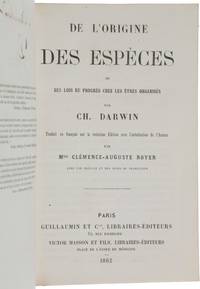
18626677Paris: Guillaumin et Cie; Victor Masson et Fils 1862. First edition. <p>First edition in French of the single most important biological work ever written and the most disputed of its early translations - rendered prefaced footnoted retitled and intellectually re-framed by Clémence-Auguste Royer 1830-1902 the self-taught philosopher whom Darwin reading the finished book in June 1862 pronounced "one of the cleverest & oddest women in Europe." Royer's sixty-four-page preface is a manifesto - anti-clerical positivist proto-eugenic - enlisting Darwin's biology for a programme he had never endorsed. Her footnotes override his hedges; her rendering of natural selection as élection naturelle drifted toward the voluntarism he abhorred; her retitling ou des Lois du Progrès chez les êtres organisés substituted Lamarckian ascent for Darwin's competitive statistics. Darwin replaced her with Moulinié in 1873 and Barbier in 1876; but French Darwinism in its first decade was shaped as much by Royer's preface as by Darwin's text and the present book is the original container of that collision.</p>. The First Edition in French in the Translation Darwin Came to Regret. <p>First edition in French of the single most important biological work ever written and the most disputed of its early translations - rendered prefaced footnoted retitled and intellectually re-framed by Clémence-Auguste Royer the self-taught philosopher economist and feminist whom Darwin reading the finished book in June 1862 pronounced "one of the cleverest & oddest women in Europe." Royer's sixty-four-page translator's preface is not a preface in any ordinary sense. It is a manifesto: an anti-clerical positivist and proto-eugenic document that enlists Darwin's biology for a social and political programme he had never endorsed and would spend the rest of his life partly repudiating. Her footnotes run through the main text sometimes clarifying often disputing and occasionally correcting Darwin from positions he did not share. Her rendering of natural selection as élection naturelle rather than the later-standard sélection naturelle was a lexical choice he quietly detested. Her substitution of his sober subtitle - or the Preservation of Favoured Races in the Struggle for Life - with her own progressivist formula - ou des Lois du Progrès chez les êtres organisés - was an ideological edit. Darwin had seen none of this before publication. By 1873 he had arranged a new translation by Jean-Jacques Moulinié; by 1876 a further one by Edmond Barbier. But the damage if that is the word was done: French Darwinism in its first decade was shaped as much by Royer's preface as by Darwin's text and the present book is the original container of that collision.</p> <br /> <br /> <p>Darwin had had difficulty finding a French translator at all. Louise Belloc the first he approached declined on the grounds that the material was too scientific. Pierre Talandier a French political exile who had offered to undertake the work withdrew when no publisher would associate with him. Royer who was already placing her own two-volume Théorie de l'Impôt with the Parisian publishing house of Guillaumin learned of the vacancy and approached Darwin with a firm publishing agreement from Guillaumin et Cie and Victor Masson et Fils already in hand. On 10 September 1861 Darwin wrote to John Murray asking that a copy of the third English edition of the Origin be sent to her at 2 Place de la Madeleine Lausanne. What he knew of her was modest and on its face reassuring: she had delivered a course of scientific lectures in Lausanne in 1859; she had paid careful attention to Lamarck; she had corresponded with republican radicals across Europe; she had written on economics and on logic. The authorisation went forward. The French title page prints avec l'autorisation de l'Auteur in small capitals as if the phrase endorsed the whole enterprise; in fact it referred only to Darwin's permission to translate the third English edition of 1861. Royer proceeded without supervision.</p> <br /> <br /> <p>She was an extraordinary figure and the absence of supervision is in retrospect the decisive error. Born in Nantes on 21 April 1830 the illegitimate daughter of Augustin-René Royer - an army captain and Bourbon legitimist - and of Joséphine-Gabrielle Audouard a Nantes seamstress she acquired her full name only when her parents married in 1837. Her earliest childhood was spent in Swiss exile her father having taken part in the 1832 rebellion to restore the Bourbon dynasty; the family returned to France on his surrender and acquittal in Orléans. She received patchy formal schooling and a year at a convent school before after her father's death in 1849 educating herself through self-study and teaching certificates. In 1854 she taught at a girls' school in Wales - acquiring the English that would later serve her for Darwin - and there encountered a religious diversity that precipitated her own drift from Catholicism. She returned to France in 1855; a year later to Lausanne where she read systematically through the municipal library. She opened a women's course in logic in 1859 followed by a forty-lesson course on the Philosophy of Nature and History in which she was already arguing a Lamarckian transformism before she had so much as heard of Darwin. She began writing for the journals of Pascal DuPrat - the French republican politician with whom she would from 1865 live openly as "wife." In 1860 her entry on tax reform took second place in the canton of Vaud's competition; her two-volume Théorie de l'Impôt was published by Guillaumin in 1862 and it was through this connection that the Origin commission reached her. Her intellectual loyalties - to Comte to the Saint-Simonians to philosophical positivism in its most anti-theological form - were formed and in print before Darwin's book arrived on her desk. She saw in it the scientific foundation her programme had been waiting for. She did not see - or more likely did not care - that Darwin's argument was narrower than the use to which she proposed to put it.</p> <br /> <br /> <p>Her preface running to sixty-four pages before Darwin's own Introduction begins is accordingly a document of French intellectual life as much as of Darwinian biography. It opens with the creedal sentence of nineteenth-century positivism: a profession of faith in revelation - not the Mosaic or the Christian but the permanent revelation of man to himself through the cumulative acquisition of scientific truths and the elimination of inherited errors. A survey of world history follows arranged as the progressive overcoming of religious superstition by reasoned knowledge with Zoroaster Moses Confucius Pythagoras Plato and the Catholic Fathers adduced as steps in a single ascending arc and Darwin's theory of descent with modification presented as the latest and most decisive revelation of this secular kind. Royer is explicit that Darwin's theory must displace the Mosaic account of creation that it renders natural theology untenable that it is fundamentally and irremediably heretical and that those who attempt to reconcile it with Christian doctrine are either dishonest or confused. In the second half of the preface she applies the theory to human society arguing that the struggle for life observed in nature should be allowed to run its course in human populations without the artificial protections of charity welfare and the preservation of the weak by the strong - the passage which more than any other has earned her the retrospective label of an early eugenicist. The argument is made with verve and in excellent French. It is also wholly absent from Darwin's own text. The reader of this French first edition meets Royer before meeting Darwin and a great many of those readers - Clemenceau Zola the circle around the Revue des Deux Mondes the young Gustave Le Bon - took their first impression of Darwinism from this entry corridor.</p> <br /> <br /> <p>Her interventions did not end at the preface. Footnotes occur throughout the main text sometimes briefly and technically more often at length and argumentatively; where Darwin hedges she is firm; where he defers to theological sensitivities she removes the deferrals. Her choice of élection naturelle was defended on philological grounds - sélection she argued carried misleading overtones of deliberate choice - but in practice the word drifted toward a voluntarist almost teleological reading that was the opposite of Darwin's blind-statistical mechanism. Her retitling - the addition of ou des Lois du Progrès chez les êtres organisés - moved the centre of the book from the preservation of favoured races under competitive pressure to a supposed lawful ascent of organised beings an inflection Darwin took pains to resist throughout his career. Behind the scenes supervision had been attempted: the Geneva zoologist Édouard Claparède whom Royer had enlisted for biological advice tried and failed to temper her commentary and wrote to Darwin with some exasperation describing the attempt as hopeless. The book that resulted runs to LXIV XXIII 712 pages - LXIV the preface XXIII the French rendering of Darwin's own Historical Sketch newly added to the third English edition of 1861 and 712 the body of the text with Royer's notes running beneath it. Lithographed as the single illustration Darwin's branching diagram from Chapter IV was reset in Paris by the firm of Delarue preserving the fourteen geological horizons and the ancestral species A through L but carrying its captions and chapter head in French. The printing itself was not done in Paris proper but at Saint-Denis by the typographical house of A. Moulin whose imprint appears at the foot of the final text page. The book was issued on 31 May 1862.</p> <br /> <br /> <p>When his copy reached Down House in early June Darwin read it with a growing and characteristic unease. In mid-June he wrote to the American botanist Asa Gray the assessment that has become the most-quoted fragment of this whole episode: the French translator he told Gray was "one of the cleverest & oddest women in Europe"-an ardent deist violently hostile to Christianity convinced that the struggle for life could be made to account for all morality politics and human nature - and about to publish he predicted a strange production on exactly those subjects. The tone is recognisable. Darwin was rarely sharp about anyone; his method of expressing disapproval was to call a colleague odd or a book strange. What the understated sentence conceals is the deeper problem: a theory he had spent twenty years writing up with methodological caution was about to enter French intellectual life attached to Royer's philosophical programme and there was in the short term nothing he could do. A month later he would regret to Armand de Quatrefages that his translator had not known more of natural history; to Hooker that Royer corrected his own expressed doubts by appending footnotes denying that any doubt was warranted at all; to Claparède private thanks for an intervention that had plainly not worked.</p> <br /> <br /> <p>He could at least wait. A second edition of Royer's translation appeared in 1866 with expanded notes a new avant-propos and - in response to corrections Darwin had by now supplied - a switch from élection to sélection naturelle flagged by a defiant footnote in which Royer conceded the popular usage but declined to concede the underlying linguistic point. A third edition further revised but published without Darwin's knowledge appeared in 1870 from the same houses; by this time Darwin had issued the fourth and fifth English editions of the Origin none of whose corrections Royer had incorporated. Worse she had added to the third edition a further preface attacking the theory of pangenesis that Darwin had propounded in his Variation of Animals and Plants under Domestication of 1868 - a theory with no direct bearing on the Origin at all. That was the breaking point. In late 1869 Darwin wrote to his Paris publisher C.-F. Reinwald and through him to the young Geneva naturalist Jean-Jacques Moulinié asking for a fresh translation. Moulinié began the work at the end of 1869 rendering first from the fifth English edition and then as Darwin's sixth edition appeared in 1872 incorporating its new chapter and additions as an appendix. The Franco-Prussian war of 1870-71 and Moulinié's own illness delayed him and he died in 1872 before his translation could be published. The book appeared in 1873 from Reinwald with a prefatory letter from Darwin dated 23 September 1872 and printed in both English and French explaining the change of translator and renouncing any royalty from the new edition. Moulinié's successor at Reinwald Edmond Barbier then produced in 1876 a second fresh translation - this time from Darwin's definitive sixth English edition of 1872 - which became and has remained the standard French Origin. Royer was not finished. A fourth edition of her translation appeared from Flammarion in 1882 the year of Darwin's death; it continued to be reprinted by that house into the 1930s thirty years after Royer's own death in Paris on 6 February 1902.</p> <br /> <br /> <p>The consequences for French intellectual life were considerable. The working French naturalists of the 1860s were slow to embrace Darwin: Quatrefages Milne-Edwards and Claude Bernard either ignored the book or engaged with it sceptically and the Académie des Sciences declined to elect Darwin a correspondant until 1878 and then only in botany. Part of this reluctance was the French scientific establishment's native attachment to a Lamarckian transformism which it preferred to defend rather than replace; part of it was the tendency of French Darwinism as refracted through Royer to be dismissable as anti-clerical propaganda dressed up as science. Paul Broca coined the neologism transformisme in 1868 to name the hypothesis in its Lamarck-to-Darwin arc and it is symptomatic that French readers through the 1870s continued to locate Darwin inside Lamarck's genealogy rather than outside it. Royer's progressivist framing made it harder for them to distinguish Darwin's argument from the older broader and less biologically rigorous evolutionism of Lamarck and of Herbert Spencer with which her preface actively confused it. Darwin writing to Gaston de Saporta in 1872 remarked wistfully that French opinion of his work had been formed in large part on the basis of a translation that was not his own. Royer for her part went from strength to strength in Paris. In 1870 she became the first woman elected to the Société d'Anthropologie de Paris a body founded and still led by Broca; she published her own major work Origine de l'homme et des sociétés the same year; and Ernest Renan in a phrase that became famous and eventually furnished the title of Joy Harvey's modern biography described her as almost a man of genius. The preface to the first French Origin is today reprinted as a standalone text in Geneviève Fraisse's Clémence Royer philosophe et femme de sciences of 1985 and discussed at length in Harvey's Almost a Man of Genius: Clémence Royer Feminism and Nineteenth-Century Science of 1997 where its status as a founding document of French social Darwinism - and more quietly of French feminist scientific writing - is now generally acknowledged.</p> <br /> <br /> <p>The book itself aside from these celebrated peculiarities of its making carries the full text of Darwin's third English edition including the Historical Sketch that Darwin had added in 1861 in response to accusations of having neglected his predecessors. It is the earliest form in which a French reader could encounter the third-edition apparatus - Lamarck Geoffroy Saint-Hilaire Erasmus Darwin Chambers Wallace and the others whom Darwin acknowledged as having anticipated one or another piece of his theory. The branching diagram of Chapter IV the only illustration survives here in the Delarue lithograph cleanly printed and unreinforced. Darwin's closing sentence - on the grandeur of the view of life with its several powers having been originally breathed by the Creator into a few forms or into one - appears in Royer's French in perceptibly softened form with the divinely breathed-in creative act rendered as an impersonal first cause. Small as the adjustment is it is characteristic of her hand.</p> <br /> <br /> <p>The provenance is French and aristocratic from an unidentified Château de Beaulieu whose library stamp - an oval in blue ink with the legend CHÂTEAU DE BEAULIEU around the circumference and the owner's initials G. T. F. in the centre - is placed at the upper margin of the half-title above an ink signature Beaulieu and a flourished calligraphic initial D. A later pencil annotation below identifies the book as the Édition originale Française. Several Châteaux de Beaulieu are candidates - in the Allier the Charente the Loir-et-Cher and the Mayenne among others - and the monogram G. T. F. has not yet been matched to a documented collector.</p> <br /> <br /> <p>References: Freeman 655. For the English first edition of 1859: PMM 344b Dibner Heralds of Science 199 Horblit 18b Garrison-Morton 220. Fraisse Clémence Royer philosophe et femme de sciences 1985 reprinting Royer's preface in full; Harvey Almost a Man of Genius: Clémence Royer Feminism and Nineteenth-Century Science 1997.</p> <br /> <br/> <br/> <br /> <p>8vo 175 × 111 mm: LXIV XXIII 25-712 pp. Folding lithographed plate by Delarue of Paris bound between pp. 160 and 161. Printed at Saint-Denis by A. Moulin. Contemporary French half red morocco over marbled paper-covered boards spine with five raised bands set off by gilt double fillets gilt-lettered CH. DARWIN and ORIGINE DES ESPÈCES in the second and third compartments small gilt ornament to the remaining compartments red-speckled endpapers edges yellowed. Library stamp of the Château de Beaulieu monogrammed G. T. F. at the head of the half-title. Joints and hinges sound and unrestored; morocco fresh and unrubbed at the bands gilt bright; corners lightly bumped; text block clean and tight with the usual scattered light foxing to preliminaries; folding plate unreinforced without tears or repairs at the folds.</p> . Guillaumin et Cie; Victor Masson et Fils unknown
187118750London: John Murray 1871. FIRST EDITION FIRST ISSUE. Numerous text illustrations. Original publisher's green cloth binding; an excellent set. First edition first issue of Darwin’s classic work in comparative anatomy his first inclusion of man in the general theory of natural selection and the first appearance of the term “evolution†in any of his works see Volume I page 2.<br /> <br /> In the twelve years since the publication of Origin the author had expanded his thinking as to man's inclusion with the other animals and this title which grew out of his Variations of Animals and Plants is based on his vast collection of data dating from 1837. Here by comparing the physiological and psychological aspects of man and ape he fills in what had been merely suggested in Origin that man's ancestor if still alive today would be classified among the primates and on a lower scale than the apes. The last chapter is an added essay on sexual selection that is the preferential chances of mating that some individuals of one sex have over their rivals. “Perhaps Darwin’s greatest contributions in this area was to show that secondary sexual characteristics had evolved in relation to a complex pattern of reproductive behavior which must itself be the product of natural selection†DSB III p. 575. This essay ends with the famous and often misquoted statement “Man still bears in his bodily frame the indelible stamp of his lowly origin.â€<br /> <br /> Freeman 937; Garrison & Morton 170. John Murray unknown
1861304713<p>Third edition with additions and corrections seventh thousand. Octavo. Half title page folding diagram at p. 123. 2 pages of advertisements at end. Original green cloth stamped in gilt and blind; brown coated endpapers. Binder's ticket of Edmonds & Remnants on back pastedown. A fresh bright tight copy of a book that is usually found in worn condition. No foxing. Small booksellers label on verso front free endpaper. Neat signatures of two previous owners on the half title page. Freeman 381. "The most important biological book ever written" Freeman p. 73.</p> John Murray hardcover
186028009John Murray 1860. 8vo. Fifth Thousand Second Edition Second Issue with folding diagram neat contemporary signature in pencil at head of title with second pencilled signature lower down front free endpaper a little chafed at fore-edge three or four small fox-spots each on half-title title and diagram; original green cloth boards elaborately blocked in blind gilt back brown endpapers uncut expertly recased with original endpapers preserved a remarkably bright fresh copy in minimally restored publisher's binding. With 32pp publisher's catalogue dated January 1860 bound in at end and the binder's ticket of Edmonds & Remnants on rear paste-down. The second edition second issue is not so named on title but simply labelled 'Fifth Thousand'; Freeman records that 3000 copies were printed following the 1250 copies of the first edition. Although Darwin considered this edition a rapid revision to meet demand his changes are much more than mere correction. 'The total number of changes in this edition is impressive enough. No chapter was untouched' Peckham. The most famous alteration is the dilution of the whale bear passage on p.184 which Darwin later regretted although he never restored it. With the signed and ruled advertisements which Freeman considers the first issue. Freeman 113 variant a; Freeman F376. John Murray, hardcover
1860190193London: John Murray 1860. The most influential scientific work of the 19th century Second edition the usual issue correctly dated 1860 on the title page of "the most influential scientific work of the 19th century" Horblit and "certainly the most important biological book ever written" Freeman. Darwin's Origin was first published in 1859. The second edition substantially reprinted the text of the first edition with a few authorial changes ranging from correction of the misprint "speceies" to the notable dilution of Darwin's "whale-bear" story where he speculated that a bear scooping insects from the water may evolve into a whale-like creature. The hypothesis was seen as absurd at the time and was seized upon by Darwin's critics to ridicule and criticise both the scientist and his evolutionary theory; Charles Lyell advised him to remove it entirely. "This story is not found again in any printing except in the American editions of 1860 until the end of copyright" Freeman. All copies of the second edition save for those few dated 1859 are marked "fifth thousand" on the title page noting the total issue of copies from the first edition onwards; the edition is not otherwise noted as the second edition. It was published in the form in which it is typically seen on 7 January 1860 in a print run of 3000 copies. Octavo signed and sewn in 12s. Original green diagonal-wave-grain cloth spine lettered in gilt covers blocked in blind Freeman's variant a no priority light brown coated endpapers fore edge untrimmed Edmonds & Remnants binder's ticket on rear pastedown. Folding diagram facing p. 117. 32 pp. publisher's advertisements dated January 1860 at rear. Contemporary Australian gift inscription on half-title "William C. Windeyer from Kate and Lottie. December 5th 1860": Sir William Charles Windeyer 1834-1897 was a New South Wales politician and judge. Spine ends and corners bumped extremities lightly worn cloth bright and unmarked expertly recased contents browned and foxed in places: a very good copy. Freeman 376. See Horblit 23b first edition. hardcover
1896133260New York: D. Appleton and Company 1896-97. The Authorized edition of the works of Charles Darwin. Octavo 15 volumes bound in original three quarters morocco gilt titles to the spine top edge gilt illustrated with in-text drawings and plates some volumes with frontispieces. In near fine condition. An exceptional set. Charles Darwin has been widely recognized since his own time as one of the most influential writers in the history of Western thought. His books were widely read by specialists and the general public and his influence had been extended by almost continuous public debate over the past 150 years. His most well known works are The Origin of Species The Descent of Man and Voyage of the Beagle. D. Appleton and Company unknown
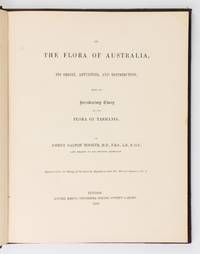
1859105735London: Lovell Reeve 1859. First Edition. Hardcover. London Lovell Reeve November 1859 first separate edition. Large quarto viii 128 pages complete with the half-title. Later half roan and stippled cloth lightly rubbed at the extremities; a very crisp and bright copy. 'The first important botanical work by a supporter of the doctrine of evolution by natural selection' Norman often quoted but not going nearly far enough in our opinion!. A singular rarity of the utmost importance. In the concluding paragraph of the postscript unique to this edition Hooker writes: 'I would further observe here to avoid ambiguity that my friend Mr. Darwin's just completed work "On the Origin of Species by Natural Selection" sic from the perusal of much of which in MS. I have profited so largely had not appeared during the printing of the Essay or I should have largely quoted it. Kew November 4 1859'. Lovell Reeve hardcover
18711308103John Murray UK 1871. 1st Edition. Hardcover. Near Fine/No Jacket. London: John Murray 1871 1871. 2 volumes octavo. Original green cloth titles to spines gilt sides with panels blocked in blind blue coated endpapers. The covers are in good condition and very secure - both spines have been professionally rebacked. Gilt nice and bright. There is a scuffing to the covers and the corners are a bit bumped but with very little loss - a quite presentable set. The bindings are very tight and square having been repaired strengthened and re-cased. Internally both volumes are very good indeed. The endpapers have been expertly reinforced with matching period paper - something that could well be missed without careful scrutiny. Previous owner name and notes in light pencil to the verso of the half-title which could be easily erased. Some foxing to first and last few leaves of each volume but the text pages are clean and bright throughout with very little foxing that I can see and no previous ink marks. The original adverts are complete and dated January 1871. Cloth very lightly rubbed a lovely set. Engravings throughout. First edition first issue with the errata on the verso of the title leaf of vol. II. Here the word "evolution" appears for the first time in any of Darwin's works preceding its appearance in the sixth edition of The Origin of Species the following year. Darwin had hoped that one of his supporters might tackle the thorny question of human evolution but was forced to face the logic of his own theory himself. Darwin deviated from his ostensible subject of mankind to describe sexual selection in the animal kingdom enabling him to answer those who saw peacock tails as an expression of divine aesthetics. Darwin also set out a definite family tree for humans tracing their affinity with the Old World monkeys and laid out his views on the evolutionary origins of morality and religion. "The Descent understood by Darwin as a sequel to the Origin was written with a maturity and depth of learning that marked Darwin's status as an élite gentleman of science" ODNB. Housed in a custom-made collectors slipcase. Along with Darwins Origin of Species one of the most important books in all of science and thus in all of human knowledge. Quite uncommon in the true first issue. John Murray, UK hardcover
187460158Budapest Kiadja a Természettudományi Társulat Academy of Sciences 1873 & 1874. 8vo. In two contemporary embossed full cloth bindings with gilt letter- and numbering to spine. Bindings with light wear primarily affecting hindges. Previous owner's stamp to half title and title page in both volumes. Light occassional brownspotting primarily affecting first and last leaves. An overall nice copy. XVI 2 303 1; VII 1 361 1 pp. 1 leaf of Advertisement 2 plates A frontiespiece of Darwin and one listing the evolution of the different generations. <br/><br/><em>The exceedingly rare first Hungarian translation of Darwin's "Origin of Species". Together with the Serbian and the Spanish the first Hungarian translation of the "Origin" is arguably the scarcest of all the translations of the work and very few copies of it are known. The Hungarian public was introduced to Darwinism early on when Ferenc Jánosi reviewed The Origin of Species in the Budapesti Szemle Budapest Review half a year after it first appeared in English. Darwin's principal works were first published in Hungarian translation by the Royal Hungarian Natural Science Society Királyi Magyar Természettudományi Társulat. Translator Dapsy László had been actively working to make Darwin and his idea known in Hungary. Through his articles he consistently presented Darwinism as a possible model for the type of progressive society that Hungary should attempt to achieve thus being one of the very earliest to apply Darwin's theories to human society and politics in general. "Dapsy's translation inspired by liberal ideals of progress increasingly became part of the conservative discourse of Hungarian politics reinterpreted and appropriated according to the nationalist agendas merging in Hungarian Society". Mund The Reception of Charles Darwin in Nineteenth-Century Hungarian Society.Prior to his translation in 1872 Dapsy wrote Darwin: "I am sorry to say that as yet here such tendencies are received with a good deal of aversion but I believe that by-and-by they will accept it and it would be a great advancement for our political life too". Dapsy to Darwin 12 June 1872. Darwin's response is not known. "It is characteristic of the enlightened spirit of the country in this period that Darwin received academic recognition earlier in Hungary than in England. Although Cambridge did not honor Darwin until 1879 he was elected an honorary member of The Hungarian Academy of Sciences in 1872 the same year on this occasion the renowned Hungarian zoologist Tivadar Margó visited him at Down.Historical circumstances played a major role in this quick appearance of Darwinism and its popularity in Hungary. The failure of the 1848-49 revolution and war of independence seemingly put an end to progressive political discourse signaling an ideological crisis among the intelligentsia. In this context the natural sciences with their 'eternal truths' promised a way out inasmuch as science's promised objectivity might well serve as a politically neutral expression of progressive values" Mund The Reception of Charles Darwin in Nineteenth-Century Hungarian Society.The present book was one of four scientific works published between 1872 and 1874 by the Hungarian Academy of Sciences the others being Bernhard von Cotta's Geologie der Gegenwart 1865 Huxley's Lectures on the Elements of Comparative Anatomy 1864 and Tyndall's Heat Considered as a Mode of Motion 1863. An advertisement for these books occurs on the final leaf of vol. II.During Darwin's lifetime 'Origin' was published in eleven different languages some of them in more than one edition: The first foreign translation was the German 1860 followed by a Dutch 1860 French 1862 French 1862 Italian 1864 Russian 1864 Swedish 1869 Danish 1872 Hungarian 1873 Spanish 1877 and Serbian 1878 the last three by far being the rarest. OCLC locates only three complete copies: Paris Mazarin Library University Library of Szeged and The Huntington Library CA. Staatsbibliothek zu Berlin only hold volume 1. Freeman 703. </em> hardcover