DARWIN, CHARLESBiblio.com
881 résultats
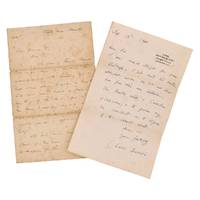
1881611<p>Autograph letter signed concerning carnivorous beetles. Down Beckenham Kent 13th September 1881 8vo 205 x 131mm horizontal mailing folds 1pp. in fine condition signed "Charles Darwin"; with retained copy of Harmer's letter to Darwin Wick near Arundel 1881 8vo 205 x 130mm horizontal mailing folds weak at folds.</p><p>A fine unpublished letter to John Harmer thanking him for his account of a beetle attacking a six-inch worm and for the beetle itself which Harmer had enclosed.</p><p>Harmer had captured the beetle in Arundel Park in Sussex after witnessing the beetle attack the worm he writes "not having noticed any thing of the kind before I carried him home to satisfy myself whether such was his food or whether his appetite would be affected by captivity. He has since disposed of the fluids of two more which he cuts up in a very business like manner." Harmer fed it more worms then sent it to Darwin in case there was "an element of interest in the circumstance".</p><p>Darwin's response reads "I am much obliged for your kindness. I had read that beetles attacked worms but did not know how far this was authentic. The beetle sent is Carabus Violaceus; & the genus may be considered as the tiger of the insect world."</p><p>The posthumous revised edition of <em>"The Formation of Vegetable Mould Through the Action of Worms"</em> 1882 notes that "the larger species of Carabus and Staphylinus… attack… worms ferociously". This observation is absent from the first edition of 1881 so it seems Harmer's efforts were put to good use.</p><p>Not in the Darwin Correspondence Project but Harmer's letter to Darwin is DCP-LETT-13332.</p>
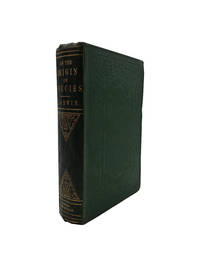
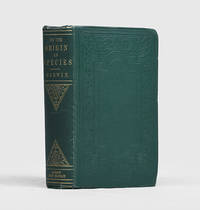
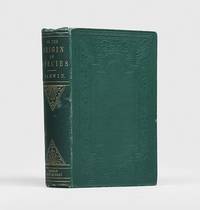
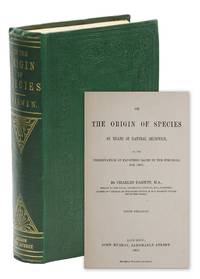
1860001613London: John Murray 1860. 5 vi-ix 2 2-502pp 1 2-32pp. Original embossed cloth title author and publisher in gilt to spine chocolate coloured endpapers. Later recased on an Oxford hollow corners gently bumped couple of minor bumps to board edges minor rubbing to extremities. Internally some light foxing especially to first two sections an old repair to tiny tears to fore edge of half title and title former owner's name and address to front endpaper but generally fairly clean. With the folding lithographic chart by William West between pages 116 and 117; 32pp of adverts dated January 1860 to rear. Bookseller's label of Folthorp of Brighton to front pastedown and the binder's ticket of Edmonds & Remnants to lower pastedown. Now housed in a cloth drop back box with title and author in gilt to spine made by Temple Bookbinders. The fifth thousand or second edition second issue though not so-called on the title page one of three thousand copies with the misprint 'speceies' corrected and the whale-bear story diluted see Freeman page 78 binding variant 'a' with upright of L in London over right hand upright of H in John. Freeman 376. Second Edition. Hardback. Good/No Jacket. 8vo. John Murray Hardcover
1881feb0144<p>1881. First Japanese Edition 3 books of The descent of man and selection in relation to sex by Charles Darwin.</p><p>.人祖論.</p><p>Used book For more details and availability please contact me</p> Ichibe Yamanaka
187932820659<p>One page. Original folds. Very good condition. Nicely framed.</p><p><strong>Darwin discusses the hereditary transmission of behavior and a vivid example of the phenomenon from the opening chapter of <em>The Expression of the Emotions in Man and Animals.</em></strong></p><p>In this letter Darwin thanks Fanny Kellogg for "communicating the curious case of an habitual gesture like that which I have described as inherited. I may add that since I wrote the action has been transmitted to another generation. Your case shall be sent to Mr. Galton who gave me the information."</p><p>In <em>The Expression of the Emotions in Man and Animals</em> 1872 Darwin had discussed the heritability of habitual gestures. There he cited at length a remarkable case related to him by his cousin Francis Galton. Galton a distinguished scientist in his own right was keenly interested in the inheritance in humans and the two men often shared findings and theories. Darwin quoted Galton in <em>The Expression of the Emotions</em> on page 33:</p><p>"A gentleman of considerable position was found by his wife to have the curious trick when he lay fast asleep on his back in bed of raising his right arm slowly in front of his face up to his forehead and then dropping it with a jerk so that the wrist fell heavily on the bridge of his nose. The trick did not occur every night but occasionally and was independent of any ascertained cause. Sometimes it was repeated incessantly for an hour or more. The gentleman's nose was prominent and its bridge often became sore from the blows which it received. At one time an awkward sore w as produced that was long in healing on account of the recurrence night after night of the blows which first caused it. His wife had to remove the button from the wrist of his night-gown as it made severe scratches and some means were attempted of tying his arm."</p><p>Galton went on "Many years after his death his son married a lady who had never heard of the family incident. She however observed precisely the same peculiarity in her husband but his nose from not being particularly prominent has never as yet suffered from the blows. The trick does not occur when he is half-asleep as for example when dozing in his arm-chair but the moment he is fast asleep it is apt to begin …" Galton further noted that the behavior had been passed down to the son's daughter. Darwin's letter offered here reveals that he learned after the publication of <em>Expression of Emotions</em> that yet another generation has acquired the remarkable habitual behavior!</p><p>This fascinating letter demonstrates the lengths to which Darwin went gathering data and telling examples for his writings. His published books reached a wide audience producing additional correspondence with yet more evidence for his theories.</p><p>The letter is also noteworthy for being signed in full "Charles Darwin" instead of the more usual abbreviated "Ch. Darwin."</p>
1860200052New York: D. Appleton & Company 1860. First Edition; First Printing. Hardcover. First American edition first printing first issue with two quotes/reviews opposite the title page. Near fine condition. 432 pp. Bound in publisher's green pebbled cloth decorated in blind titles in gilt on the spine original coated brown endpapers folding chart intact. A Near Fine copy. Light rubbing to cloth at corners/tips. Light foxing and occasional offsetting to contents. Small tear at rear endpaper. Text is unaffected. No other interior marks bar owner's name in pencil remained for potential provenance. D. Appleton & Company hardcover
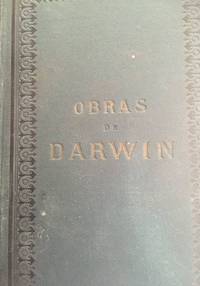
1877feb02727<p>1877. First Spanish Edition - On the Origin of Species by Means of Natural Selection or the Preservation of Favoured Races in the Struggle for Life by Charles Darwin.</p><p>El origen de las especies<br /><br />Used book For more details and availability please contact me</p> Biblioteca Perojo hardcover
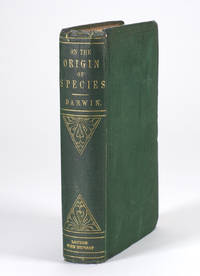
186042820886<p>SECOND EDITION published on January 7 1860 less than two months after the first edition. Three thousand copies were printed.</p><p><strong><em>On the Origin of Species</em></strong><strong> is "certainly the greatest biological book ever written</strong>" Freeman and "<strong>the most important single work in science</strong>" Dibner.</p><p>Darwin's theory of the origin of species by means of natural selection arose out of his studies in the 1830s during and after the voyage of H.M.S. <em>Beagle</em>. From 1831 to 1836 Darwin sailed around the world on the <em>Beagle</em>. During this five-year voyage Darwin and the <em>Beagle</em> visited the Galapagos Islands Brazil Argentina Tierra del Fuego Chile Peru Tahiti Australia New Zealand and other islands and countries finally returning to England by sailing around the Cape of Good Hope. Darwin observed "It appears to me that nothing can be more improving to a young naturalist than a journey in distant countries."</p><p>The voyage of the <em>Beagle </em>was "the most important event in Darwin's intellectual life and in the history of biological science. Darwin sailed with no formal scientific training. He returned a hard-headed man of science knowing the importance of evidence almost convinced that species had not always been as they were since creation but had undergone change. … The experiences of his five years … and what they led to built up into a process of epoch-making importance in the history of thought" DSB.</p><p>Over the coming thirty years Darwin refined the ideas that had germinated aboard the <em>Beagle </em>and finally published them in <em>On the Origin of Species</em>. Darwin concluded his book "There is grandeur in this view of life with its several powers having been originally breathed into a few forms or into one; and that whilst this plan has gone cycling on according to the fixed law of gravity from so simple a beginning endless forms most beautiful and most wonderful have been and are being evolved."</p><p><strong>Darwin's ideas about evolution and natural selection are the underpinnings of modern biological science. Moreover they have given us a new way of viewing and talking about the world. </strong>"Darwin not only not only drew an entirely new picture of the workings of organic nature; he revolutionized our methods of thinking and our outlook on the order of natural things. The recognition that constant change is the order of the universe had finally been established" Printing and the Mind of Man 344b.</p><p>Provenance: nineteenth-century bookplate and signature of William Pearce.</p><p>Original green cloth. Light wear to spine ends. A fine copy with the fragile inner hinges intact.</p><p>Freeman 376.</p> John Murray hardcover
1860171418London: John Murray 1860. The most influential scientific work of the 19th century Second edition of "the most important biological book ever written" Freeman the issue dated 1860 on the title page. Darwin's Origin was published in 1859. The second edition largely reprinted the text of the first with a few authorial changes ranging from correcting the misprint "speceies" to diluting Darwin's "whale-bear" story where he speculated that a bear scooping insects from the water may evolve into a whale-like creature. The hypothesis was seen as absurd at the time and was seized upon by Darwin's critics to ridicule and criticize both the scientist and his evolutionary theory; Charles Lyell advised him to remove it entirely. "This story is not found again in any printing except in the American editions of 1860 until the end of copyright" Freeman p. 78. All copies of the second edition save for a handful dated 1859 are marked "fifth thousand" on the title page; the edition is not otherwise indicated as the second. The issue dated 1860 - the form in which the second edition is almost always seen - was published on 7 January 1860 in a print run of 3000 copies. Octavo in 12s. Folding diagram facing p. 117. With 32 pp. of publisher's advertisements dated January 1860 at rear. Original green diagonal-wave-grain cloth spine lettered and decorated in gilt covers blocked in blind Freeman's variant a light brown coated endpapers. Housed in a dark green quarter morocco solander box by the Chelsea Bindery. Cloth and gilt bright and unmarked spine ends and corners bumped; inner hinges expertly restored endmatter lightly spotted else contents clean upper outer corner of L1 creased resulting in small split. A near-fine copy. Freeman 376. hardcover
188160016Tokyo Ichibe Yamanaka. Meiji 14. 1881. 8vo. 3 volumes all in the contemporary original yellow wrappers Traditional Fukuro Toji binding/wrappers. Extremities with wear and with light soiling promarily affecting vol. 1. Title in brush and ink to text-block foot. A few ex-ownership stamps. Folding plate with repair. A fine set. 46 ff; 70 ff. 9 plates of which 1 is folded; 72 ff. "Vol. I contains prefaces to 1st and 2d editions of Descent of man Nos 936 & 944; vol. II contains chapter 1 and vol. III chapter 2. All published intended to form 9 vols containing chapters 1-7 and 21." Darwin-Online. <br/><br/><em>The exceedingly rare first translation of Darwin's Descent of Man and the first partial translation of Origin of Species constituting the very first translation of any of Darwin's work into Japanese and arguably being the most influential - albeit in a different way than could be expected - of all Darwin-translations. "The first translation of a book by Darwin was published in 1881: a translation of The Descent of Man titled as Jinsoron On the Ancestors of Man; Darwin 1881. The translator was a scholar of education Kozu Senzaburo . In spite of its title the book was actually a hybrid which included a mixture of chapters of the Descent namely chapters 1-7 and 21 together with other texts: the Historical Sketch that Darwin appended to the third edition of the Origin 1861 and some sections taken from Thomas Huxley's Evidence as to Man's Place in Nature Kaneko 2000. So this book can also be described as the first publication including a partial translation of a text from the Origin" Taizo Translating "natural selection" in Japanese: from "shizen tota" to "shizen sentaku" and backDarwin's theories had a profound influence on Japan and Japanese culture but in a slightly different way than in the West: Darwinism was marked as social and political principles primarily embraced by social thinkers philosophers and politicians to advocate the superiority of Japanese culture and society and military and not by biologist and zoologist. "It was as if Darwin's famous oceanic journey and the meticulous research into the animal and plant kingdoms that he spent his life undertaking had all been staged as an elaborate excuse for composing a theory whose true object was Victorian society and the fate of the world's modern nations." Golley Darwinism in Japan: The Birth of Ecology.The popularity of Darwin's works and theories became immensly popular in Japan: "Curiously there are more versions of "The Origin" in Japanese than in any other language. The earliest were literary with subsequent translations becoming more scientific as the Japanese developed a technical language for biology." Glick The Comparatice Reception of Darwinism P. XXIIDarwin's work had in Japan - as in the rest of the world - profound influence on the academic disciplines of zoology and biology however in Japan the most immediate influence was not on these subjects but on social thinkers: ". it exerted great influence on Japanese social thinkers and social activists. After learning of Darwin's theory Hiroyuki Kato the first president of Tokyo Imperial University published his New Theory of Human Rights and advocated social evolution theory social Darwinism emphasizing the inevitable struggle for existence in human society. He criticized the burgeoning Freedom and People's right movement. Conversely Siusui Kautoku a socialist and Japanese translator of the Communist Manifesto wrote articles on Darwinism such as "Darwin and Marx" 1904. In this and other articles he criticized kato's theory on Social Darwinism insisting that Darwinism does not contradict socialism. The well known anarchist Sakae Osugi published the third translation of On the Origin of Species in 1914 and later his translation of peter Kropotokin's Mutial Aid: A Factor of Evolution. Osugi spread the idea of mutual aid as the philosophical base of Anarcho-syndicalism." Tsuyoshi The Japanese Lysenkoism and its Historical Backgrounds p. 9 "Charles Darwin's theory of evolution was introduced to Japan in 1877 Morse 1936/1877 during Japan's push to gain military modernity through study of western sciences and technologies and the culture from which they had arisen. In the ensuing decades the theory of evolution was applied as a kind of social scientific tool i.e. social Spencerism or social Darwinism Sakura 1998:341; Unoura 1999. Sakura 1998 suggests that the theory of evolution did not have much biological application in Japan. Instead Japanese applied the idea of 'the survival of the fittest' which was a misreading of Darwin's natural selection theory to society and to individuals in the struggle for existence in Japan's new international circumstances see also Gluck 1985: 13 265.However at least by the second decade of the 1900s and by the time that Imanishi Kinji entered the Kyoto Imperial University the curricula in the natural and earth sciences were largely based on German language sources and later on English language texts. These exposed students to something very different from a social Darwinist approach in these sciences. New sources that allow us to follow" ASQUITH Sources for Imanishi Kinji's views of sociality and evolutionary outcomes p. 1."After 1895 the year of China's defeat in the Sino-Japanese War Spencer's slogan "the survival of the fittest" entered Chinese and Japanese writings as "the superior win the inferior lose." Concerned with evolutionary theory in terms of the survival of China rather than the origin of species Chinese intellectuals saw the issue as a complex problem involving the evolution of institutions ideas and attitudes. Indeed they concluded that the secret source of Western power and the rise of Japan was their mutual belief in modern science and the theory of evolutionary progress. According to Japanese scholars traditional Japanese culture was not congenial to Weastern science because the Japanese view of the relationship between the human world and the divine world was totally different from that of Western philosophers. Japanese philosophers envisioned a harmonious relationship between heaven and earth rather than conflict. Traditionally nature was something to be seen through the eyes of a poet rather than as the passive object of scientific investigations. The traditional Japanese vision of harmony in nature might have been uncongenial to a theory based on natural selection but Darwinism was eagerly adopted by Japanese thinkers who saw it as a scientific retionalization for Japan's intense efforts to become a modernized military and industial power. Whereas European and American scientists and theologians became embroiled in disputes about the evolutionary relationship between humans and other animals Japanese debates about the meaning of Darwinism primarily dealt with the national and international implications of natural selection and the struggle for survival. Late nineteenth-century Japanese commentators were likely to refer to Darwinism as an "eternal and unchangeable natural law" that justified militaristic nationalism directed by supposedly superior elites". Magner A History of the Life Sciences Revised and Expanded p. 349"Between 1877 and 1888 only four works on the subject of biological evolution were published in Japan. During these same eleven years by contrast at least twenty Japanese translations of Herbert Spencer's loosely "Darwinian" social theories made their appearance. The social sciences dominated the subject and when Darwin's original The Origin of Species Seibutsu shigen finally appeared in translation in 1896 it was published by a press specializing in economics. It is not surprising then that by the early 20th century when Darwin's work began to make an impact as a biological rather than a "social" theory the terms "evolution" shinka "the struggle for existence" seizon kyôsô and "survival of the fittest" tekisha seizon had been indelibly marked as social and political principles. It was as if Darwin's famous oceanic journey and the meticulous research into the animal and plant kingdoms that he spent his life undertaking had all been staged as an elaborate excuse for composing a theory whose true object was Victorian society and the fate of the world's modern nations." Golley Darwinism in Japan: The Birth of Ecology.Freeman 1099c </em> unknown
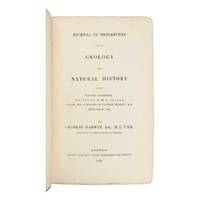
1839612<p>London Henry Colburn 1839 FIRST EDITION FIRST ISSUE publisher's cloth rebacked replacing original spine. 8vo uncut pp xiv i.e. xii 615 1 blank <em>Addenda</em> 609-629 two folding charts a little foxing to charts as usual with 16 pp inserted publisher's advertisements dated August 1839 8pp prospectus for other publications.</p><p>First edition first issue an attractive copy of the first separate issue of Darwin's <em>Journal </em>his first formal publication and a classic of natural history travel narrative. It was perhaps the most important scientific voyage ever undertaken for it gave impetus and direction to all of Darwin's later research. 'The five years of the voyage were the most important event in Darwin's intellectual life and in the history of biological science. Darwin sailed with no formal scientific training. He returned a hard-headed man of science knowing the importance of evidence almost convinced that species had not always been as they were since the creation but had undergone change. He also developed doubts of the value of the Scriptures as a trustworthy guide to the history of the earth and of man with the result that he gradually became an agnostic. The experiences of his five years in the <em>Beagle</em> how he dealt with them and what they led to built up into a process of epoch-making importance in the history of thought' Gavin de Beer in DSB.</p><p>The <em>Journal of Researches</em> was issued as part of the <em>Voyage of the Beagle</em> volumes and also as a separate book as above; this separate issue comprises sheets from the same print-run but with cancel half-title and title-page. Both were published and available in June 1839.</p><p><em>Freeman 11 </em></p> Henry Colburn hardcover
1860174014London: John Murray 1860. The most influential scientific work of the 19th century Second edition of "the most important biological book ever written" Freeman the issue dated 1860 on the title page. The second edition includes a few authorial changes responding to criticism of certain claims made in the first. This is a bright and fresh copy. The second edition largely reprints the text of the first edition of 1859. Among the changes the misprint "speceies" is corrected while the "whale-bear" story speculating that a bear scooping insects from the water may evolve into a whale-like creature is heavily diluted. The hypothesis was seen as absurd at the time and was seized upon by Darwin's critics to ridicule both the scientist and his evolutionary theory; Charles Lyell advised him to remove it entirely. "This story is not found again in any printing except in the American editions of 1860 until the end of copyright" Freeman p. 78. All copies of the second edition save for a handful dated 1859 are marked "fifth thousand" on the title page; the edition is not otherwise indicated as the second. The issue dated 1860 - the form in which the second edition is almost always seen - was published on 7 January 1860 in a print run of 3000 copies. Octavo in 12s. Folding diagram facing p. 117. With 32 pp. of publisher's advertisements dated January 1860 at rear. Original green diagonal-wave-grain cloth spine lettered ruled and decorated in gilt covers blocked in blind Freeman's variant a light brown coated endpapers binder's ticket of Edmonds & Remnants on rear pastedown. Housed in custom modern green solander box. With 1860 ownership signature of Dr R. H. H. Sankey 1831-1921 an Oxford physician and philatelist to front pastedown 20th-century pencil inscription "I. H. Taylor 12 Southdale Road Oxford" to half-title. Cloth and gilt bright light bumping and wear to extremities minor cockling to rear cover small mark to centre of spine inner hinges split but holding firm short closed tears to half-title and title page edges contents clean bar a few brown spots: a very good unrestored copy. Freeman 376. hardcover
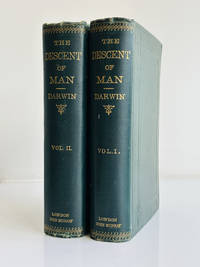
187120642London: John Murray 1871. John Murray London 1871. First edition first issues of both volumes with "transmitted" the first word on p. 297 in the first volume; in the second the printer's note on the verso of the half-title errata on title verso and the postscript leaf after p. viii. The first issue had a print-run of just 2500 copies. Both volumes in comparable excellent near fine condition. One small name within each F. Bond. Neat internal repair to each gutter of both volumes. Internally exceptionally clean and externally also remarkably fresh with only a little wear to the spine tips and edges and a little bubbling to the bottom of the rear panels. The binding is exceptionally tight. Not usually encountered in such beautiful condition. Charles Darwin expands on his theory of evolution focusing on human origins and the role of sexual selection. In this groundbreaking work Darwin argues that humans share a common ancestor with other animals particularly apes emphasising the continuity between humans and the rest of the natural world. He explores how natural selection and sexual selection have shaped human physical and behavioural traits including differences between sexes and races. Darwin also discusses the development of moral sense intellect and social behaviour suggesting that these too evolved gradually. The book was controversial challenging religious and scientific views of the time by placing humans firmly within the framework of evolutionary biology. 'The Descent of Man' not only deepened public understanding of human evolution but also laid the foundation for later studies in anthropology psychology and evolutionary theory making it a landmark in scientific literature and is claimed to be such by Sigmund Freud "One of the ten most significant books ever written". John Murray unknown
1860140949121London: John Murray 1860. Second Edition. Very Good. Second edition second issue with "fifth thousand" listed on the title page. x 502 32 pp. Bound in publisher's emerald green cloth with decorative stamping in blind and gilt brown coated endpapers. Very Good with slight darkening and lean to spine and crimping at head and tail light bumping to corners and board edges and shallow indentation to rear board center. Hinges repaired two preliminary leaves beginning to detach overopened throughout; binding cracked but holding at p. 121. Occasional foxing to margins. Gift inscription dated 1860 to half-title page recipient's bookplate to front pastedown small binder ticket to rear pastedown. A remarkably good copy with crisp blindstamping and bright gilt.<br /> <br /> <br /> <p>An immensely influential work considered to be the foundation of evolutionary biology in which Darwin postulates that species evolve over the course of generations through natural selection. This copy was gifted to the Reverend Archibald Weir by a grateful student "in remembrance of his preparing him in Classics for the preliminary examination at Apothecaries Hall. John Murray unknown
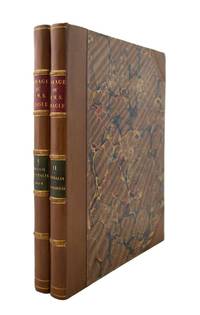
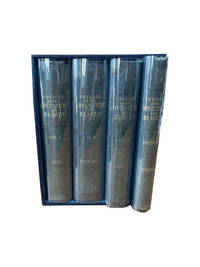
183869522London: Smith Elder and Co 1838. OWEN Richard. WATERHOUSE George R. The Zoology of the Voyage of the H.M.S. Beagle. Under the Command of Captain Fitzroy R.N. During the Years 1832 to 1836. Part I II. Mammalia. London: Smith Elder and Co. 1838.<br> <br> Full Description:<br> <br> DARWIN Charles. OWEN Richard. WATERHOUSE George R. The Zoology of the Voyage of the H.M.S. Beagle. Under the Command of Captain Fitzroy R.N. During the Years 1832 to 1836. Part I II. Mammalia. London: Smith Elder and Co. 1838-1840.<br> <br> First editions of Part I and Part II of Mammalia in two quarto volumes 12 1/8 x 9 1/2 inches; 307 x 241 mm.<br> <br> Part I. Owen Richard. Fossil Mammalia. 1838-1840. 2 iv iv 111 1 colophon pp. Complete with thirty-two lithographic plates by G. Scharf one of which is folding and two which are double paged. With the preface to the whole work and a geological introduction by Charles Darwin. Bound without the half-title but with the additional fly-title.<br> <br> Part II. Waterhouse George Robert. Mammailia. 1839. 4 xii 97 3 blank pp. Complete with thirty-two hand-colored lithographic plates and three numbered engraved plates. With the errata slip bound in before B1. Bound without the half-title but with the additional fly-title. This volume with a geographical introduction and notes by Darwin.<br> <br> Two volumes uniformly bound in half tan calf over contemporary marble boards. Spines each with red and green morocco spine labels lettered in gilt. Contemporary endpapers. All edges speckled red. Some repairs to inner hinges. Text is very clean. The final three plates in volume II with some foxing otherwise all plates are very clean. Overall a very good copy of these two volumes.<br> <br> These first two volumes out of the complete work in 5 volumes are the only two volumes to be published with introductions by Charles Darwin. In the first volume he writes a Geological Introduction and in the second volume he writes a Geographical Introduction. "Darwin contributed a geological introduction to Part I the Fossil Mammalia pp. 3-12 and a geographical introduction to Part II the Mammalia pp. i-iv." Freeman p 26.<br> <br> In 1832 Captain Robert Fitzroy of the Royal British Navy undertook a five-year circumnavigation of the earth. Fitzroy who was only twenty-seven at the time asked a young Charles Darwin to be the naturalist for the voyage. The five-year journey included passing the coastlines of South America and particularly the Galapagos Islands near Ecuador. Darwin collected numerous specimens and data from this now famous area and these became the basis for his theory of natural selection which was a key component in his masterful theory of evolution.<br> <br> "The lavish scientific record of Darwin's collecting endeavours during the five-year voyage of the Beagle originally issued in 19 numbers. The 166 plates 82 finely hand-colouredof the complete works were due to the tireless energy and flair which the relatively untrained ship's scientist put first into the collection of specimens and then into ensuring that the zoological specialists duly reported on them after his return. The cost of the plates was covered by a treasury grant of one thousand pounds but to complete the work for Smith and Elder who were publishers of large illustrated books and government publications Darwin had to persevere as steadily with his pen as with his gun and geological hammer turning himself into a considerable authority during the course of five years spent editing the work of others." Christies<br> <br> "He superintended the Zoology's text wrote introductions for the different parts and added notes from his various Beagle records about animal behaviour and habitats wherever appropriate while also supervising the printers proofreading the sheets arranging artists for the plates chivying the experts and keeping them all moving forward within a tight self-imposed budget" Janet Browne Charles Darwin: Voyaging 2003 p. 370.<br> <br> Freeman Darwin 9.1 & 9.2. Nissen IVB 384. Nissen ZBI 1391. Sabin 18649.<br> <br> HBS 69522.<br> <br> $25000. Smith, Elder and Co unknown
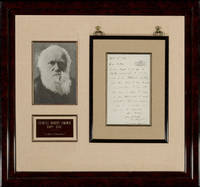
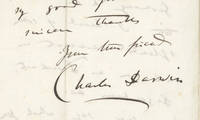
18661259011866. Signed. DARWIN Charles. Autograph letter signed. Down Beckenham Kent: Dec 17 1866. One leaf of black-edged mourning stationery measuring 4-1/2 by 7 inches penned on recto for one page; floated matted and framed with an early photographic card; entire piece measures 17 by 14 inches. $29500.Fine unpublished 1866 autograph letter written by Charles Darwin answering the questions of an anonymous correspondent concerning editions of his landmark work On the Origin of Species boldly signed by him with his full name ""Charles Darwin"" he often used ""C."" or ""Ch."" instead of his full given name. Beautifully framed with an early photographic card.The letter reads in full: ""Down Beckenham Kent Dec. 17th. Dear Sir Four editions of the Origin have appeared; that published last month is considerably added to & can be procured through any bookseller. I am glad to hear that you are interested in the subject. Dear sir yours faithfully Charles Darwin."" In November Darwin had copies of the substantially revised and augmented fourth edition of the Origin sent to Huxley and Wallace among others; their letters acknowledging receipt and praising the new edition are dated November 11 and November 19 respectively. The mourning stationery reflects the death of Darwin's sister Susan Elizabeth Darwin in October; another sister Emily Catherine Langton had died in January that year. See ""Darwin in letters 1866; Survival of the Fittest"" Darwin Correspondence Project online. Darwin Correspondence Project 5310F summary only. Very faint fold marks. Darwin's full signature bold and fine. Letters in which Darwin discusses his landmark work are particularly scarce and desirable. unknown
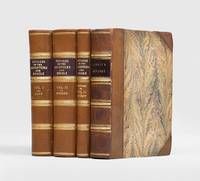
1839189657London: Henry Colburn 1839. An outstanding account of natural history exploration First edition of the Voyage of the Beagle with the third volume Darwin's Journal of Researches being the first separate edition of his account. The popularity of Darwin's contribution to the series meant that his volume was reissued three months later as a standalone publication the version present in this set. The first issue of Darwin's Journal appeared in May 1839 as Volume III of the Narrative under the title Journal and Remarks Freeman 10. The second issue was published in August printed from the same sheets but with variant preliminaries Freeman 11. It "is undoubtedly the most often read and stands second only to On the Origin of Species as the most often printed" of Darwin's works Freeman p. 31. Volume I of the Narrative contains King's account of the expedition on the Adventure made between 1826 and 1830 surveying the coasts of Patagonia and Tierra del Fuego. In Volume II its appendix bound separately as issued FitzRoy describes the narrative of the Beagle's second voyage between 1831 and 1836 to South America the Galapagos Islands Tahiti New Zealand and Australia. 3 vols in 4 vols I-III and appendix to vol. II octavo 224 x 145 mm; 219 x 137 mm. With 47 engraved plates 9 folding engraved maps 3 bound in and 6 linen-backed and loose in front pockets diagrams and tables within text. Recent and late 19th-century vol. III half calf spines lettered and ruled in gilt spine labels marbled sides and edges buff endpapers. Contemporary ownership signature of one I. S. G. Smith on title page of vol. III partially obscured during binding process; 1950s unattributed inscription on first blank of vol. I; ownership signatures of one Thomas Leighton dated 1979 on vol. I II and appendix blanks; 20th-century bookplates of one Richard Campbell perhaps of the Campbells of Kildalloig and later Carmarthenshire. Wear to vol. III extremities spine of same a little darkened foxing to maps plates and occasionally to contents tear to half-title of vol. I closed tears to map folds repairs to folding map facing p. 463 vol. I and both maps in vol. III first of which creased and standing a little proud: overall in very good condition. Freeman 10 Narrative vols I & II & 11 Journal. Francis Darwin ed. The Life and Letters of Charles Darwin 1887. unknown
1870266381870. <blockquote><p>Our first Darwin signed photograph in all these years</p></blockquote><p>Charles Darwin English naturalist whose scientific theory of evolution by natural selection became the foundation of modern biology and evolutionary studies. Darwin's explanation for the great unfolding of life through time - evolution by natural selection - transformed our understanding of the living world and focused attention on the cumulative inherited change in a population of organisms through time leading to the appearance of new forms: the process by which new species or populations of living things develop from preexisting forms through successive generations. Darwin revolutionized the understanding of the development of living things as Einstein revolutionized our understanding of the physical universe.</p><p>An attractive<strong> Carte de Visite signed</strong> <em>""Ch. Darwinâ€</em> circa late 1870s very good condition though with a few small adhesive tape marks. The photograph was taken by Elliott & Fry 56 Baker Street London and has their front and back stamps. For a century after its founding in 1863 the firm’s core business was taking and publishing photographs of the Victorian public and social artistic scientific and political luminaries. Among the notables known to have sat for a photograph by Elliott & Fry were Prime Minister William Gladstone Alfred Lord Tennyson W.S. Gilbert Rudyard Kipling Oliver Wendell Holmes Sr. Florence Nightingale and Charles Darwin.</p><p>In all our years in the field we have seen just a handful of Darwin signed photographs and have never ourselves had one. This is indeed a rarity. But the provenance is just as fascinating as finding a signed Darwin photograph with provenance is perhaps unique.</p><p>William Bateson was a British biologist who founded and named the science of genetics and whose experiments provided evidence basic to the modern understanding of heredity. He was a dedicated evolutionist and his early works on the mechanisms of biological evolution were strongly influenced by Charles Darwin though he believed that Darwin’s theory of evolution required a firmer base in heredity. Bateson also became the foremost champion of Gregor Mendel’s work on genetics. Darwin died in 1882 when Bateson was at college and though Bateson may have written Darwin such letter is unknown. Bateson and his wife did however correspond with Darwin’s family in later years as “Darwin Online†indicates.</p><p>This CDV comes with an <strong>autograph letter signed</strong> from Darwin’s granddaughter Margaret Keynes dated January 23 1929 addressed to Sir George Buckston Browne proposing an alternative date for her and her husband Dr. Geoffrey Keynes to come for lunch expressing gladness that Browne wanted <em>""the Bateson letter and the other things""</em> and acknowledging that he attended the same school as Dr. Keynes. Browne had bought Darwin's old home so lunch there would have been a homecoming of sorts for Margaret. Finding the CDV and letter together we would conjecture that this CDV was the property - one of <em>“the other thingsâ€</em> - of Margaret that she mentioned in the letter that she was glad Browne wanted and had descended in the family to her along with the Bateson letter. Thus this CDV was apparently property of the Darwin family the most important provenance imaginable.</p><p><img class=""alignnone wp-image-25018 size-post-window"" src=""https://cdn.raabcollection.com/wp-content/uploads/20231204144051/Folder-site-11-1600x1327.jpg"" alt="""" width=""1600"" height=""1327"" /></p> unknown
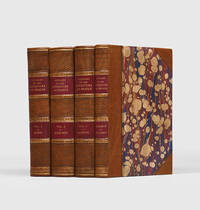
1839169069London: Henry Colburn 1839. From the Wedgwood family library First edition association copy with the inscription "Wedgwood Maer" faintly pencilled on the half-title of Darwin's volume itself the first issue of his first published book. The prominent Wedgwood family were relatives; he frequently visited their Staffordshire home Maer Hall and consulted them about the publication of his account of the Beagle's voyage. The Darwin and Wedgwood families became intertwined in the 18th century linked by friendships business dealings and a number of first- and second-cousin marriages. Charles's grandfathers were the renowned pottery entrepreneur Josiah Wedgwood and the physician Erasmus Darwin and Charles himself married his cousin Emma Wedgwood in 1839. He corresponded with several members of the Wedgwood family about the publication of his volume the Journal and Remarks now popularly known as The Voyage of the Beagle and invited them to read the manuscript notebook of his travels upon which the work was based. Fanny and Hensleigh Wedgwood were specifically asked to provide feedback which the latter gave in a letter dated 20 December 1836 describing it as a "very interesting journal" Darwin Correspondence Project. Darwin also discussed the possibility of his account being accompanied by that of Fitzroy with his sister Caroline Wedgwood. At the time of publication Maer Hall was owned by Josiah Wedgwood II and the rector of Maer parish church was John Allen Wedgwood. We have been unable to attribute the inscription to any one individual member of the family. Maer Hall was sold in 1843 suggesting that this copy was incorporated into the Wedgwood library before this date. These four volumes on the voyages of HMS Adventure and Beagle including Darwin's Journal and Remarks are "famous as the genesis of his theory of evolutionary biology" Hill. Darwin's volume is an outstanding account of natural history exploration describing the fieldwork that ultimately led to the publication of On the Origin of Species 1859. As Freeman notes of Darwin's books this "is undoubtedly the most often read and stands second only to On the Origin of Species as the most often printed" p. 31. Darwin himself would state that "the voyage of the 'Beagle' has been by far the most important event in my life and has determined my whole career. I have always felt that I owe to the voyage the first real training or education of my mind; I was led to attend closely to several branches of natural history and thus my powers of observation were improved" Life and Letters I p. 61. The Journal and Remarks was printed before the end of January 1839 the month Darwin was elected to the Royal Society and so his name appears without the letters "F.R.S." on the second title. Volume I contains Phillip Parker King's account of the expedition on the Adventure made between 1826 and 1830 surveying the coasts of Patagonia and Tierra del Fuego. In Volume II and its appendix bound separately as issued Captain FitzRoy describes the Beagle's second voyage between 1831 and 1836 to South America the Galapagos Islands Tahiti New Zealand and Australia and other countries. Volume III is Darwin's account of his time aboard the Beagle. The popularity of the latter exceeded its companion volumes leading to Colburn bringing out a separate edition in the same year. 3 vols in 4 vols I-III and appendix to vol. II octavo 225 x 142 mm. With 47 engraved plates after P. King A. Earle C. Martens R. Fitzroy and others by T. Landseer S. Bull T. Prior and others 9 folding engraved maps by J. Gardner and J. and C. Walker 8 bound in and 1 loose in pocket at rear pastedown of vol. II numerous diagrams and tables within text. Rebound to style in brown half calf twin red morocco spine labels compartments and raised bands elaborately tooled in blind and gilt respectively marbled sides and edges brown endpapers. Vol. I bound without half-title. Binding presenting smartly; contents generally fresh and clean occasional neat pencil marginal annotations and small ink "90" to half-titles upper margin of vol. I sig. 2D8 creased and nicked at edge; plates and maps foxed closed tears to latter repaired with no loss and in most cases discreetly faint damp stain along top edge of first map in vol. I second map of same sometime reattached with cloth tape. Overall a handsome set in very good condition. Freeman 10; Hill I pp. 104-5; Norman 584; Sabin 37826. Francis Darwin ed. The Life and Letters of Charles Darwin 1887; Darwin Correspondence Project letter 7 December 1836 to Caroline Darwin ref. DCP-LETT-325; 20 December 1836 from Hensleigh Wedgwood ref. DCP-LETT-332. hardcover
1869315466Down Beckenham Kent 1869. 3 pp. Bifolium of Down Bromley Kent stationery with "Bromley" crossed out and corrected to Beckenham. 1 vols. 8vo. Fine. 3 pp. Bifolium of Down Bromley Kent stationery with "Bromley" crossed out and corrected to Beckenham. 1 vols. 8vo. Unpublished.<br /> <br /> Charles Darwin 1809-1882 writes to Charles Layton London agent for Appleton about bringing out a revised and expanded second American edition of On the Origin of Species. The letter is a reply to Layton's of the day before in which he'd inquired after stereotyped plates of the English edition. In part:<br /> <br /> "The last or 5th Edit. of the Origin was printed off some months ago & it is impossible to supply stereotypes. I hope that you will inform Mr. Appleton of what I have said of the increased size of this last & 5th Edit. As 2000 copies of this Edit were printed there will not be a new Edit. for a considerable time . If Mr. Appleton will reprint this 5th Edition . I will pledge myself to endevour to persuade Mr. Murray to supply stereotype plates of my new book on the Descent of Man; but as I never before heard of such such a scheme I have no idea whether he will comply. At any rate I will please myself on the above conditions & on the terms suggested in your letter to send over the sheets as printed & stereotype casts of the woodcuts. But please remember my new book will not got to press for many months."<br /> <br /> Appleton had published the first American edition of Origin in 1860 from Murray's second English edition. In keeping with the terms of the present letter Appleton published the second American edition based on the 5th English edition in 1870 followed by the first American edition of The Descent of Man in 1871.<br /> See Darwin Correspondence Project DCP-LETT-7003 for Layton to Darwin 22 November 1869. unknown
1839001512London: Henry Colburn 1839. First edition early issue 3 vols in 4 8vo ownership signature to half-title vol. I title vol. II half-title vol. III; 9 folding engraved maps by J. Gardner and J. & C. Walker; 47 etched plates after P. King A. Earle C. Martens R. Fitzroy and others original blue blind stamped cloth gilt glazed yellow endpapers vols I-III neatly recased preserving majority of original spines inner hinges of vols I-III neatly strengthened. This set with the following early issue points: the half-title to vol. III does not contain the initials F.R.S. after Darwin's name thus denoting an early printing of the preliminaries prior to Darwin becoming a Fellow of the Royal Society on 24th January 1839 all spines imprinted Colburn / London rather than London / Colburn each volume bears the author's name lacking from later issues this set without advertisements as sometimes and as noted by Freeman light foxing and stains to frontispiece and plates vol. II overall a good clean set with important Australian provenance. Darwin's first published and his most widely read book: the account of the most important 19th-century voyage. On this voyage Darwin prepare for his life's work ultimately leading to The Origin of the Species.From the library of Charles Joseph LaTrobe Superintendent of the Port Phillip District of New South Wales from 1839 to 1851 and from 1st July 1851 until his departure three years later the first Lieutenant-Governor of the Colony of Victoria; with his distinctive signature to all three volumes. An evangelical Christian his father was a leader of the Moravian Church LaTrobe spent fifteen years in the Australian colonies leaving in 1854 a disillusioned and dispirited man. His time in office coincided with a period of tremendous expansion with major infrastructure projects roads and sanitation being a priority however much of central Melbourne's green landscape can be put down to LaTrobe's foresight in preserving this land as open space. On his arrival in Port Phillip LaTrobe's first speech put him at odds with the settlers of the District. These pioneers were looking to better their lot expecting grants of land which would lead to the dispossession of the aboriginal peoples yet LaTrobe spoke of different priorities: 'It is not by individual aggrandisement by the possession of numerous flocks or herds or by costly acres that the people shall secure for the country enduring prosperity and happiness but by the acquisition and maintenance of sound religious and moral institutions without which no country can become truly great'. This clash of ideas was highlighted by Darwin in his Journal of The Voyages of HMS Beagle published a few months before LaTrobe made his speech. In it Darwin observed that in 'the wide extent of the Americas Polynesia the Cape of Good Hope and Australia' the native populations were being suppressed. 'The varieties of man' he noted 'seem to act on each other in the same way as different species of animals the stronger always extirpating the weaker.' This theory of the survival of the fittest became the justification for many colonists in the removal of indigenous peoples from their native land. Darwin was given the third volume The Voyages of HMS Beagle writing 'I am to have the third volume in which I intend giving a kind of journal of a naturalist not following however always the order of time but rather the order of position' The first volume contains King's account of the expedition in the Adventure made between 1826 and 1830 which surveyed the coasts of Patagonia and Tierra del Fuego; and the second and its appendix volume describes the narrative of the Beagle's second voyage under Capt. Fitzroy made between 1831 and 1836 to South America the Galapagos Islands Tahiti New Zealand Australia and other islands and countries. 'The five years of the voyage were the most important event in Darwin's intellectual life and in the history of biological science. Darwin sailed with no formal scientific training. He returned a hard-headed man of science knowing the importance of evidence almost convinced that species had not always been as they were since the creation but had undergone change . The experiences of his five years . and what they led to built up into a process of epoch-making importance in the history of thought' DSB. First Edition. Hardback. Good. 4to. Henry Colburn Hardcover
184614205London: Smith Elder and Co 1846. I: First edition. Includes a description of six species of corals from the Palaeozoic formation of Van Diemen’s Land by W. Lonsdale. “Darwin’s published work during this period secured his position as one of Britain’s foremost naturalists. His study of the volcanic islands visited during the Beagle <br /> voyage was based on a wide range of rock and mineral specimens including his own and considerable research into contemporary theories of volcanic activity mountain formation and the elevation of extensive tracts of land relative to the sea†Correspondence Vol. 3 p. 331.<br /> II: First edition. When Darwin sailed on the Beagle he had with him the first volume of Lyell’s Principles of geology which advanced a gradualist theory of geological evolution through elevation subsidence and erosion over an immense period of time contrary to the dominant catastrophist theory of sudden upheaval. Darwin was able to interpret the geology of South America according to Lyell’s principles and his book offered the first adequate geological investigation of the continent. His “demonstration of the origin of metamorphic rocks by deformation and of the distinction between cleavage and sedimentary bedding was a major contribution to geology†DSB. He also worked out an accurate model for fossil formation from which he demonstrated the erratic and incomplete nature of the fossil record.<br /> Freeman 272; 273. Smith, Elder and Co unknown
18643456104/11/1864. <blockquote><p>Darwin's work had profound implications for the relationship between science and religion and here he opposed anyone who would seek to profess religious over scientific faith</p><p> </p><p>Scientists Darwin felt should work in the spirit of seeking ""truth"" with no preconceived notions</p><p> </p><p>The adoption of the Theory of Evolution by scientists is ""the real cream of the enjoyment to me; indeed it is to me worth far more than any medal.""</p><p> </p><p>Significantly he hopes to continue his work in science</p><p> </p><p>One of the most important Darwin letters we have carried</p></blockquote><p><img class=""alignnone wp-image-34774 size-post-window"" src=""https://cdn.raabcollection.com/wp-content/uploads/20251016172859/Darwin-2-1-1600x1200.jpg"" alt="""" width=""1600"" height=""1200"" /></p><p>Charles Darwin's ""On the Origin of Species"" was one of the most important books of all time. When it was published in 1859 there was skepticism within as well as without the scientific community about the central premise that species changed through time by a process Darwin labeled natural selection. The idea that human beings evolved from other previous species struck at the heart of the generally accepted belief that humans were different from other animals and that species were fixed or immutable. Everyone had learned the story of creation from the Bible and Darwin's ideas presented a challenge to those who looked at the question through a literal religious perspective. But Darwin hoped that scientists as well as others would be able to accommodate adopt an essentially new view and accept evolution. Yet at the same time he realized that many who had grown up in the previous scientific school would have a hard time doing so. It seemed that perhaps a new generation of scientists might have to rise before his work was generally accepted.</p><p>The Copley Medal the highest award of the Royal Society is given for “sustained outstanding achievements in any field of scienceâ€. In 1864 Darwin was nominated to receive the medal and was awarded it ""For his important researches in geology zoology and botanical physiologyâ€. Previous winners included scientists like Benjamin Franklin William Herschel Alessandro Volta Humphry Davy and Michael Faraday.</p><p>Hugh Falconer was a paleontologist and botanist who was an admirer of Darwin though not a convert to his theory of evolution. He seconded the nomination of Darwin for the medal and Darwin wrote to thank him for doing so. In his letter Darwin made some points of great importance: 1. That more and more scientists were becoming converts to his theory of evolution; 2. That he hopes to continue his work in science despite advancing age; 3. That scientists should work in the spirit of seeking truth with no preconceived notions and 4. That the support of scientists he respected like Falconer meant more than the medal to him.</p><p>Falconer was outraged by a petition that was circulating within Britain’s learned societies that attempted to limit the bounds of scientific enquiry. The petition claimed that scientific research was being “‘perverted by some…into occasion for casting doubt upon the Truth and Authenticity of the Holy Scriptures†and was specifically aimed against evolutionary theory and investigations into the antiquity of man. Falconer made clear to Darwin that he aimed to ""protest against the profession of religious against scientific faithâ€.</p><p><img class=""alignnone wp-image-34775 size-post-window"" src=""https://cdn.raabcollection.com/wp-content/uploads/20251016172938/Darwin-4-1-1600x680.jpg"" alt="""" width=""1600"" height=""680"" /></p><p><strong>Autograph letter signed</strong> four pages with the addressed envelope Down House headed stationery Kent November 4 1864 to Hugh Falconer making all the important points cited above. <em>“What a good kind friend you are. I know well that this medal must have cost you a great deal of trouble. It is a very great honor to me but I declare that the knowledge that you & a few other friends here so much interested themselves in the subject is the real cream of the enjoyment to me; indeed it is to me worth far more than any medal. So accept my true and cordial thanks. I hope that I may yet have strength to do a little more work in natural science; shaky and old though I be.â€</em></p><p><em>“I have chuckled and triumphed over your postscript about poor M. Brullé and his young pupils. About a week ago I had a nearly similar account from Germany and at the same time I heard of some splendid converts in such men as Rudolf Leuckart Carl Gegenbaur &c. You may say what you like about yourself but I look at a man who treats Natural History in the spirit with which you do exactly as good for what I believe to be the truth as a convert. Farewell my good friend with sincere thanks your true friend Charles Darwin.â€</em></p><p>In mentioning M. Brullé Darwin alludes to an amusing story told by Falconer to him in a previous letter relaying the complaint of the entomologist Gaspard Auguste Brullé that he heard of nothing but Darwin from his students.</p><p>Darwin need not have worried about his future productivity in this 1864 letter. Afterwards he wrote several more books which include “The Variation of Animals and Plants Under Domestication†1868 which explored the principles of heredity and how variations occur in domesticated species; his famous “The Descent of Man†1871 applying the theory of natural selection to human evolution and discussing sexual selection; “The Expression of the Emotions in Man and Animals†1872 examining the evolutionary origins of emotions and facial expression; and “The Formation of Vegetable Mould through the action of worms"" 1881.</p><p>Falconer replied to Darwin’s letter on November 7 and the spirit with which he treated Natural History and the reason for his support for Darwin were evidenced in that reply. Falconer explained that he believed the award of the Copley medal to Darwin was doubly important: “1. As regards due appreciation of yourself. 2d. As a determined protest against the profession of religious against scientific faithâ€.</p><p>Falconer was right to be concerned about the reaction of the religious community and its sympathizers to the theory of evolution. Darwin’s ideas provoked a harsh response from religious leaders and their allies of which this petition was one example. As examples of the criticism of evolution England’s highest-ranking Catholic official Henry Cardinal Manning denounced Darwin’s views as “a brutal philosophy – to wit there is no God and the ape is our Adam.†And Samuel Wilberforce the Anglican Archbishop of Oxford and one of the most highly respected religious leaders in 19th-century England also condemned natural selection in a now-famous speech on what he deemed the theory’s deficiencies.</p><p>This is one of the most important Darwin letters we have carried dealing as it does with support for his theory of evolution his hopes for future work in science and the role of science in seeking truth.</p><p><img class=""alignnone wp-image-25018 size-post-window"" src=""https://cdn.raabcollection.com/wp-content/uploads/20231204144051/Folder-site-11-1600x1327.jpg"" alt="""" width=""1600"" height=""1327"" /></p> unknown
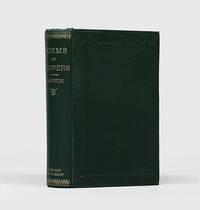
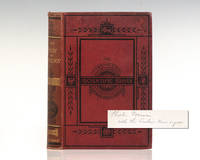
1877164452London: John Murray 1877. Presentation copy inscribed in Darwin's own hand First edition presentation copy inscribed on the title page "With the compliments of the author". The inscription is in Darwin's own hand rather than one of Murray's clerks. Different Forms of Flowers was published in a first edition of 1250 copies on 9 July 1877. There was only a single issue with the publisher's catalogue dated either January or March 1877 here the latter without priority. Darwin explained in his autobiography that "this book consists chiefly of the several papers on heterostyled flowers originally published by the Linnean Society corrected with much new matter added together with observations on some other cases in which the same plant bears two kinds of flowers. As before remarked no little discovery of mine ever gave me so much pleasure as the making out the meaning of heterostyled flowers" Life and Letters I p. 78. Freeman remarks that "had Darwin not chosen such genetically complex examples he might have approached more nearly to an understanding of the laws of particulate inheritance". Regardless it remains a seminal text on plant reproduction adaptation and evolution. It was translated into French and German during Darwin's lifetime followed by four further languages after his death. Octavo. 15 woodcut illustrations and 38 tables within text. Publisher's 32-page catalogue dated March 1877 at rear. Original green cloth spine lettered in gilt decorative bands at ends in gilt covers blocked in blind dark brown coated endpapers Simpson & Renshaw binder's ticket on rear pastedown. Housed in a dark green quarter morocco solander box by the Chelsea Bindery. Spine ends gently bumped cloth bright binding very discreetly restored and recoloured endpapers slightly faded previous ownership signature on dedication page subsequently erased a handful of neat pencil marks annotation to p. 1 translating the title into French marginal crosses and lines to a few other pp. faint semicircular damp mark running through upper margins of first c.140 pages else the contents notably clean publisher's catalogue lightly foxed towards end: a near-fine copy. Freeman 1277; Norman 602. Francis Darwin ed. The Life and Letters of Charles Darwin 1887. hardcover
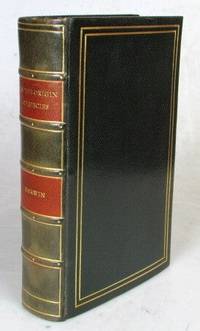
185951915London: John Murray 1859. First edition. 8vo. iii-x 502 28 pp bound without the half title but with all the advertisement leaves barring the final two. Early 20th century green full morocco spine with raised bands twin gilt lettered red labels marbled endpapers bookplate of K.F. Russell to the front pastedown and with a long note in his hand on the flyleaf describing the volume's provenance. Folding table mounted on linen. Slight sunning to the spine an attractive copy. The first printing of one of the most important books in the history of scientific thought. "Darwin not only drew an entirely new picture of the workings of organic nature; he revolutionised our methods of thinking and our outlook on the natural order of things. the theory of evolution became with Darwin an interpretation of nature and eventually a causal theory affecting every department of scientific research" Printing and the Mind of Man 344. Kenneth Fitzpatrick Russell 1911-87 was an eminent Australian academic. He was made Chair of Anatomy and Medical History by the University of Melbourne in 1969 having previously been conferred with a DLitt by them - an exceptional award for a science graduate. In 1963 he published "British Anatomy 1525-1800: A Bibliography" a testament to his erudition and one of the standard works on the subject. Russell's handwritten note to the front of the volume states that he bought it in the bookshop Quaine's of Melbourne in 1935. He found the original covers in a parlous state with the spine and upper cover missing and the rear board torn in half this damage clearly also accounting for the absence of the half title and the final advertisement leaves. Russell notes that he had the volume rebound thus by the binder Green paying slightly more for the restoration work than he had done for the book itself. Freeman 373 and pp. 75-77. With the misprint "speceies" on page 20 and the full whale-bear story to page 184. The first page of the advertisements is dated June 1859 as required. London: John Murray unknown
1873141586London: Henry S. King & Co 1873. First edition association copy of famed English philosopher Herbert Spencer's classic work on the evolution of society; presented and inscribed by him to Charles Darwin. Octavo original publisher's cloth with gilt titles to the spine dark green endpapers. Association copy inscribed by the author on the title page "Charles Darwin with the Author's kind regards." English philosopher biologist sociologist and anthropologist Herbert Spencer invented the expression "survival of the fittest" which he coined in his Principles of Biology 1864 after reading Charles Darwin's On the Origin of Species 1859. A description of the mechanism of natural selection in Principles of Biology Spencer drew parallels between his own economic theories and Darwin's biological ones: "This survival of the fittest which I have here sought to express in mechanical terms is that which Mr. Darwin has called 'natural selection' or the preservation of favoured races in the struggle for life." Darwin responded positively to Alfred Russel Wallace's suggestion of using Spencer's new phrase "survival of the fittest" as an alternative to "natural selection" and adopted the phrase in The Variation of Animals and Plants Under Domestication published in 1868. In On the Origin of Species he introduced the phrase in the fifth edition published in 1869 intending it to mean "better designed for an immediate local environment" Gould. Darwin wrote on page 6 of The Variation of Animals and Plants Under Domestication published in 1868 "This preservation during the battle for life of varieties which possess any advantage in structure constitution or instinct I have called Natural Selection; and Mr. Herbert Spencer has well expressed the same idea by the Survival of the Fittest. The term 'natural selection' is in some respects a bad one as it seems to imply conscious choice; but this will be disregarded after a little familiarity." He defended his analogy as similar to language used in chemistry and to astronomers depicting the "attraction of gravity as ruling the movements of the planets" or the way in which "agriculturists speak of man making domestic races by his power of selection." Spencer and Darwin were occasional correspondents and would regularly send each other copies of their latest works. Accompanied by an autograph letter signed by Charles Darwin's great grandson Edward Darwin gifting the book to a relative dated November 27th 1969. In very good condition. Housed in a custom half morocco clamshell box by the Harcourt Bindery. Books from Darwin's library are very rare to the market. Spencer developed an all-embracing conception of evolution as the progressive development of the physical world biological organisms the human mind and human culture and societies. “It is a function that no one has performed since†DSB. During his lifetime he was considered "the single most famous European intellectual" Eriksen 37. "The only other English philosopher to have achieved anything like such widespread popularity was Bertrand Russell and that was in the 20th century" Richards. Spencer's philosophies were heavily influenced by Darwin he cites Darwin several times in this book and references On the Origin of Species as "one of the most influential scientific publications of recent times." Given the primacy which Spencer placed on evolution his sociology might be described as social Darwinism mixed with Lamarckism. However despite its popularity this view of Spencer's sociology is mistaken. While his political and ethical writings had themes consistent with social Darwinism such themes are absent in Spencer's sociological works which focus on how processes of societal growth and differentiation lead to changing degrees of complexity in social organization. The evolutionary progression from simple undifferentiated homogeneity to complex differentiated heterogeneity was exemplified Spencer argued by the development of society. He developed a theory of two types of society the militant and the industrial which corresponded to this evolutionary progression. Militant society structured around relationships of hierarchy and obedience was simple and undifferentiated; industrial society based on voluntary contractually assumed social obligations was complex and differentiated. Society which Spencer conceptualised as a 'social organism' evolved from the simpler state to the more complex according to the universal law of evolution. Moreover industrial society was the direct descendant of the ideal society developed in Social Statics although Spencer now equivocated over whether the evolution of society would result in anarchism as he had first believed or whether it pointed to a continued role for the state albeit one reduced to the minimal functions of the enforcement of contracts and external defense. Henry S. King & Co hardcover