881 résultats
18801104181880. London: John Murray 1880. <br /> <br /> 8vo x 592 32 ads dated May 1878 pp. Illustrated with 196 in-text woodcuts. Original green blind-stamped cloth backstrip titled in gilt brown coated endpapers hinges cracked a little wear to crown and foot of backstrip text block edges but not pages stained an unsophisticated copy. <br /> <br /> § § First edition first issue inscribed in Charles Darwin's hand "Elizabeth Darwin From her Father." Presentation copies from Darwin in his own hand are exceptionally rare most presentation copies were inscribed "from the author" by the publisher; a copy inscribed to a family member by Darwin himself is extraordinarily so. <br /> <br /> Elizabeth Darwin known as Bessy was Charles and Emma Darwin's youngest daughter and perhaps the most enigmatic of all their ten children. She is remembered as a quiet soul who lived in the family home until the death of her mother and then in a cottage on her own near her three brothers until her death in 1926. The book which Darwin has inscribed to her was written with the assistance of her brother Francis who had himself become an accomplished botanist. It is an extension of Darwin's earlier work on movement in climbing plants showing that the same mechanisms hold true for flowering plants in general. It was well reviewed and immediately sold 1500 copies.<br /> <br /> Darwin was an exceptionally affectionate father whose anxious feelings for his own children greatly spurred his study of inherited characteristics and of evolution. He and his wife Emma were first cousins a genetic liability that tormented him. This book written in partnership with one of his children and presented to another is a potent testament to the intertwining of scientific genius and fatherhood that so characterized Darwin and catalyzed his momentous career. Books inscribed by Darwin to his children are extremely rare on the market. The last such book at auction - a copy of The Descent of Man and Selection in Relation to Sex inscribed by Darwin to his daughter Henrietta who had edited the book - sold for £90000 at Sotheby's in 2015. unknown
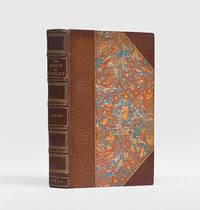
1859372885London: John Murray 1859. First Edition one of only 1250 copies. 1 vols. 8vo. Bound with half-title and without publisher's adverts. Folding diagram lithographed by W. West. Late 19th-century half brown morocco by Zaehnsdorf spine lettered and ruled in gilt raised bands marbled sides and endpapers top edge gilt brown silk bookmarker. Red morocco book label of Valentine Hollingsworth 1883-1942. Front joint repaired. Light rubbing slight darkening to spine a few light spots of foxing to preliminaries but otherwise crisp and clean tiny closed tear at foot of title page folding diagram with short closed tear and neat repair at foot: a very good smartly bound copy. First Edition one of only 1250 copies. 1 vols. 8vo. "The most important single work in science brought man to his true place in nature" Heralds of Science 199. <br /> <br /> Darwin "revolutionized our methods of thinking and our outlook on the natural order of things. The recognition that constant change is the order of the universe had been finally established and a vast step forward in the uniformity of nature had been taken" PMM 344. <br /> <br /> "The publication of the Origin of Species ushered in a new era in our thinking about the nature of man. The intellectual revolution it caused and the impact it had on man's concept of himself and the world were greater than those caused by the works of Copernicus Newton and the great physicists of more recent times. Every modern discussion of man's future the population explosion the struggle for existence the purpose of man and the universe and man's place in nature rests on Darwin" Mayr. Freeman 373; PMM 344; Norman 593; Garrison-Morton 220; Grolier/Horblit 23b; Brent Charles Darwin p. 427 John Murray unknown
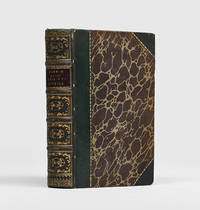
1859184317London: John Murray 1859. Ushering in a new era of thought about the nature of man First edition of "the most influential scientific work of the 19th century" Horblit and "certainly the most important biological book ever written" Freeman. The initial 1250 copies of Darwin's magnum opus prompted an intellectual revolution comparable to that of Newton or Copernicus. While recognizable theories of evolution had been developing since at least the mid-1750s the Origin introduces the critical mechanism of natural selection to explain the direction of the process. When married with Mendelian genetics natural selection became the foundation of modern evolutionary theory: "every modern discussion of man's future the population explosion the struggle for existence the purpose of man and the universe and man's place in nature rests on Darwin" Mayr pp. vii-xxviii. Octavo 187 x 114 mm. Folding diagram lithographed by W. West. Bound with half-title and without publisher's advertisements as often. Near-contemporary green half calf spine and covers decorated in gilt spine with dark red calf label marbled sides endpapers and edges. Housed in custom green half morocco cloth box. Ornithological bookplate of the zoologist Brunsdon Yapp 1909-1990 author of a study of bird illustrations in medieval texts. Infrequent 20th-century pencil annotations to margins. Light wear faint ghosting to front endpapers minor browning and foxing to contents short closed tears to upper margin of O10 and S2 the latter touching text and short split to fold of diagram: a very good copy. Dibner 199; Freeman 373; Garrison-Morton 220; Grolier/Horblit 23b; Norman 593; Printing and the Mind of Man 344b. Ernst Mayr introduction to the Harvard University facsimile edition 1964. hardcover
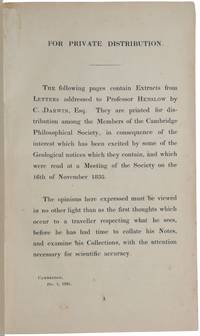
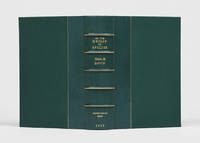
18356395Cambridge: the University Press for the Cambridge Philosophical Society 1835. First edition. <p>First edition very rare of Darwin's first separately printed work - the thirty-one-page pamphlet in which John Stevens Henslow Cambridge Regius Professor of Botany and the mentor who had placed him aboard the Beagle printed extracts from ten of Darwin's letters from South America for private distribution to the Cambridge Philosophical Society on 1 December 1835. Darwin was then in the South Pacific and would not learn for six months that the pamphlet existed. Extracts had already been read aloud - at the Cambridge Philosophical Society on 16 November and two days later at the Geological Society of London by Adam Sedgwick with Charles Lyell serving his first term as President in the audience. By the time the Beagle docked at Falmouth in October 1836 his reputation had been made in his absence. This is the document by which Darwin was first introduced to the scientific community - twenty-four years before the Origin of Species a career before the books that would carry his name around the world.</p>. The Pamphlet that Made Darwin's Reputation before He Knew It Existed. <p>First edition very rare of Darwin's first separately printed work - the thirty-one-page pamphlet in which John Stevens Henslow Cambridge Regius Professor of Botany Darwin's mentor and the man who had secured him his berth on the Beagle printed selected passages from Darwin's letters home for private distribution to the Fellows of the Cambridge Philosophical Society on 1 December 1835. Darwin was then in the South Pacific had just called at Tahiti and would not learn for almost half a year that the pamphlet existed. He did not see a copy until October 1836 when he was back in England. In those intervening months the pamphlet circulated rapidly through the British geological establishment and the verdict was already being returned. This is the document by which the public naturalist of the following quarter-century was first introduced to the scientific community - twenty-four years before the Origin of Species thirty-six before the Descent of Man and a career before the books which would carry his name around the world. It is his first separately printed work and the first of the ninety-five entries in Freeman's bibliography.</p> <br /> <br /> <p>The pamphlet was the printed form of extracts that had already been read aloud. On 16 November 1835 at the Cambridge Philosophical Society's meeting chaired by the president the Rev. Dr William Clark Henslow read extracts from ten of Darwin's letters from South America with remarks contributed by Adam Sedgwick. Two days later at the Geological Society of London in Somerset House Sedgwick read further extracts and introduced them as a very great mass of information connected with almost every branch of natural history - from which he would for the present occasion confine himself to the geology. The Athenaeum summarised the Geological Society session in its number of 21 November and by Caroline Darwin's transcription of that report Sedgwick had given specific notice of her brother's observations on the tertiary formation of Patagonia & Chili & on the changes of level between land & sea and of the description of the Uspallata Pass with its tertiary and igneous alternations and its veins of true granite gold and other metals. Charles Lyell then serving his first term as President of the Geological Society 1835-1837 was in the audience for this reading; so was Henslow's friend Leonard Jenyns the Cambridgeshire naturalist who had himself been offered and declined the Beagle berth four years earlier. By the time the Beagle docked at Falmouth in early October 1836 Darwin's scientific reputation in Britain had been made in his absence.</p> <br /> <br /> <p>Henslow was then thirty-nine a Regius Professor of Botany who had previously held the chair of mineralogy and was in several respects the architect of Cambridge natural science in the 1830s: he had been a founder of the Cambridge Philosophical Society in 1819 had taught the botany course that Darwin took at Christ's College for three years running had conducted the Saturday field excursions at which Darwin had done most of his undergraduate natural-history apprenticeship and had presided over the Friday Evening scientific soirées in his own drawing-room at which Darwin as an undergraduate met Sedgwick Whewell Peacock and the senior figures of the University's scientific community. Darwin himself in the Autobiography of 1876 described the friendship with Henslow as the circumstance that had influenced his whole career more than any other and remembered being called by some of the dons "the man who walks with Henslow." When in August 1831 the Beaufort-Peacock-FitzRoy search for a gentleman naturalist to sail on the Beagle reached Henslow's desk - Peacock writing from Cambridge on behalf of his friend Francis Beaufort Hydrographer of the Navy - Henslow first considered going himself declined on account of his wife and family and having first offered and been declined by Leonard Jenyns wrote the letter of recommendation that determined the rest of Darwin's life.</p> <br /> <br /> <p>Darwin sailed from Plymouth on 27 December 1831 as the self-funded naturalist of the Beagle's second survey voyage at a salary of nothing and at the age of twenty-two. Henslow had proposed him for the berth - the best qualified person he knew of - and in the five years following was the recipient of Darwin's scientific letters from the field ten of which survive as the source of the present extracts. The topics the letters ranged over were already those of the later career: the geology of the South American coast from Patagonia to the equator fossil mammals from the pampas the Megatherium bones that Richard Owen would soon describe the gradual uplift of the Chilean shore that Darwin had witnessed directly in the Concepción earthquake of February 1835 the transect across the Andes from Mendoza to the Pacific at which he had found marine shells at twelve thousand feet and petrified trees standing upright through successive sandstones. The emphasis is geological throughout. The South American palaeontology that would drive his incipient evolutionary thinking is present only in outline and the word species does not yet appear as a theoretical term. But the habit of sustained observation under a unifying theory - Charles Lyell's uniformitarian Principles of Geology whose three volumes Darwin had taken with him on the Beagle and whose second volume had reached him at Montevideo in 1832 - is already formed and the pamphlet is the first public trace of its formation.</p> <br /> <br /> <p>The immediate precipitating occasion was a field-geological one. Darwin's long letter of April 1835 describing the cross-Cordillera transect at the Puquenas and Portillo passes and the upright petrified trees at Uspallata had reached Henslow at Cambridge in the autumn of 1835 and had been at once seen by Sedgwick to be a finding of the first importance. After the 16 November Cambridge reading and the 18 November Geological Society reading the Council of the Cambridge Philosophical Society resolved on 30 November that the printing of certain extracts from Mr Darwin's correspondence be submitted to Mr Whewell Mr Peacock and Prof. Henslow - William Whewell Fellow of Trinity College who had resigned the chair of mineralogy in 1832 and two years earlier had coined the word scientist George Peacock Fellow and tutor at Trinity who would be appointed Lowndean Professor of Astronomy two years later and Henslow himself. The pamphlet was in press the following day. Its preface dated 1 December 1835 and signed by Henslow explains the occasion and carries a disclaimer that must be read as the botanist's gentle protection of his absent correspondent: the opinions expressed are presented only as first thoughts of a traveller respecting what he sees before he has had time to collate his notes and examine his collections with the attention necessary for scientific accuracy.</p> <br /> <br /> <p>Darwin for his part was for some weeks horrified. The first hint of the pamphlet reached him at the Cape of Good Hope on 1 June 1836 in a letter of 29 January from his youngest sister Catherine mentioning in passing the little books with the Extracts from your Letters. He replied from the Cape on 3 June confessing himself "a good deal horrified" by the sentence protesting that he had written to Henslow in the same careless manner as to his own family and that to print what had been written without care or accuracy was to play with edge tools. He could only quote the Spaniard's proverb - no hay remedio there is no remedy. The horror was converted into a different feeling when on the next leg northwards a November 1835 letter from his sister Susan caught up with him at Ascension Island in mid-July with the news that Sedgwick himself had predicted he would have a great name among the naturalists of Europe. Darwin later recalled the effect of reading Sedgwick's estimate on a volcanic island in the middle of the Atlantic: he had clambered over the mountains of Ascension with a bounding step and made the volcanic rocks resound under his geological hammer.</p> <br /> <br /> <p>The reader of the 1835 pamphlet however encounters a Darwin who is still entirely a geologist. His first theoretical book would be a geological one - The Structure and Distribution of Coral Reefs 1842 developed from the theory he had worked out in the South Pacific of the subsidence that had produced the oceanic atolls; his second and third the geological volumes of the Beagle series 1844 1846 would remain within the Lyellian framework. The transition from the Lyellian geologist of 1835 to the evolutionary biologist of 1859 is the subject of the two decades between the pamphlet and the Origin of Species. The present pamphlet is where that career begins in print and it begins as the career of a field geologist already competent enough for Sedgwick at Cambridge and Lyell in London to take his observations seriously the moment they arrived. The evolutionary Darwin who would reach French readers in Clémence Royer's translation of 1862 German readers in H. G. Bronn's of the same year American readers in Asa Gray's editions from 1860 and eventually Japanese readers in Tachibana SenzaburÅ's of 1896 begins his printed career as the geological Darwin whose Andes transect is the climax of the letters excerpted here.</p> <br /> <br /> <p>Its influence in its own year was out of all proportion to its size. It was most consequentially through the pamphlet that Charles Lyell took Darwin seriously as a geologist. Presiding over the Geological Society from the chair at Somerset House on 18 November 1835 Lyell heard Darwin's Chilean and Andean observations as the first empirical vindication of the Principles of Geology from a working field geologist in the Southern Hemisphere: direct observation of ongoing elevation of the land along the Chilean coast of marine shells at twelve thousand feet in the Andes of tertiary formations at altitudes where on the Lyellian account one would expect to find them. Lyell wrote to Henslow early in 1836 asking for every scrap of further Darwin material that came in. When the Beagle finally docked at Falmouth in October 1836 Lyell called on Darwin within a fortnight of his arrival in London. The friendship that followed - Lyell's unreserved support for Darwin's early geological work of 1838-1846 Lyell's reluctant acceptance in 1859 of the argument of the Origin after twenty years of friendly resistance to it Darwin's description of Lyell in the Autobiography as the man to whom he owed more scientifically than any other - begins at this reading of the pamphlet in November 1835.</p> <br /> <br /> <p>Henslow for his part sent copies to the Darwin family on Christmas Day 1835 with a note hoping that Darwin would soon be back to take his position among the first Naturalists of the day. Dr Robert Waring Darwin the traveller's father who had had doubts about his son's career in natural history read it through in one sitting. Caroline Darwin wrote to her brother on 29 December: their father "did not move from his seat till he had read every word" had been very much gratified had liked the simple clear way in which the information was conveyed and had particularly admired the frank and unhackneyed manner of his son's writing. He wrote at once to Henslow to thank him observing that his son's letters carried their own natural good-humoured energy. Earlier at the end of November their sister Susan had also forwarded the news that Sedgwick writing to Dr Butler at Shrewsbury had reported that the former schoolboy was doing admirably in South America and would take his place among the naturalists of Europe: a prediction carrying particular weight in a household that had once worried its son might become an idle man. Dr Darwin gave copies of the pamphlet to friends and relatives; Henslow sent six to Samuel Butler headmaster at Shrewsbury where Darwin had been at school; Tom Eyton and William Darwin Fox received further copies. By the end of January 1836 the pamphlet was already circulating well beyond the membership of the Cambridge Philosophical Society for whom it had been produced.</p> <br /> <br /> <p>Henslow's selection is quotation not summary. It runs through ten of Darwin's letters from the voyage from 18 May 1832 written at Botafogo near Rio de Janeiro four months after leaving England to 18 April 1835 the long letter from ValparaÃso describing the double transect of the Andes. A further letter of 12 August 1835 from Lima was received by Henslow too late for inclusion. The sequence moves from the tropical forests of Brazil through the pampas and Patagonia to Tierra del Fuego and the Falklands; up the Chilean coast; and across the Andes. Embedded in the geology and the zoology are the first printed passages of Darwin as a writer - the observations of the Fuegian Yahgan in contrast to the anglicised Jemmy Button aboard the Beagle; the description at Rio de Janeiro of the young naturalist whose servant Syms Covington had just been taught to skin birds and quadrupeds; the ironic grumble from Montevideo that Alcide d'Orbigny might collect the cream of the good things first; the note again from Montevideo of Juan Manuel de Rosas's war of extermination against the Indians; and everywhere the sustained geological attention that would be elaborated for the next decade in the Beagle geological volumes. It is the voice of the mature Darwin in formation.</p> <br /> <br /> <p>The edition is among the rarest of Darwin items. Freeman states that fewer than one hundred copies were printed and that although it has always been assumed that the pamphlet was issued to members of the Cambridge Philosophical Society in December 1835 he had not seen a copy with a dated ownership inscription or accession stamp for that year; the surviving evidence for a December 1835 issue is a letter from Dr Robert Waring Darwin to Henslow of 28 December 1835. A proof copy with some twenty pencil corrections appeared at Sotheby's on 13 March 1973 lot 404; since then according to American Book Prices Current only four copies have sold at auction the most recent at Christie's New York on 19 June 2014 sale 2861 $221000. One of the recorded auction copies had been presented by Henslow himself to the Ashmolean Natural History Society at Oxford. Institutional holdings are concentrated in Cambridge the Cambridge Philosophical Society's own copy the University Library and Christ's College where Darwin had been an undergraduate with further copies at the British Library the American Philosophical Society and Down House where Darwin's own copy is preserved. A close facsimile was issued by the Cambridge Philosophical Society in 1960 with a new preface by Sydney Smith reproducing the Society's minutes of 16 and 30 November 1835 to mark the centenary of the Origin of Species; that reprint and the original are easily distinguished and cause no confusion.</p> <br /> <br /> <p>References: Freeman 1; Norman 583; Garrison-Morton 8920. Standard scholarly treatment of the pamphlet's production and reception is in Frederick Burkhardt ed. The Correspondence of Charles Darwin vol. 1: 1821-1836 Cambridge 1985 pp. 468-472 and 507-511; see also Janet Browne Charles Darwin: Voyaging New York 1995 pp. 340-343 and Susannah Gibson The Spirit of Inquiry: How One Extraordinary Society Shaped Modern Science Oxford 2019 pp. 86-92.</p> <br /> <br /> <br/> <br/> <br /> <p>8vo 217 × 142 mm: pp. 1-3 4-31 1 blank; a single gathering of 16 leaves signatures A-Bâ¸; printed by the University Press Cambridge on wove paper edges untrimmed. Original plain pale grey paper wrappers as issued sewn without printed lettering. A remarkably fresh copy of a famously fragile pamphlet: wrappers bright with only light age-toning and a few faint surface marks; the preface leaf lightly foxed at the head; the text block clean and crisp throughout.</p> . [the University Press for the Cambridge Philosophical Society unknown
1859116380London: John Murray 1859. First edition of "certainly the most important biological book ever written" Freeman one of 1250 copies. Octavo bound in original cloth half-title one folding lithographed diagram without advertisements. In very good condition with cracks to inner hinges and a touch of shelfwear. Housed in a custom clamshell box. A fine example of this landmark work. Darwin “revolutionized our methods of thinking and our outlook on the natural order of things. The recognition that constant change is the order of the universe had been finally established and a vast step forward in the uniformity of nature had been taken†PMM 344. “Without question a watershed work in the history of modern life sciences Darwin’s Origin elaborated a proposition that species slowly evolve from common ancestors through the mechanism of natural selection. As he himself expected Darwin’s theory became and continues to be in some circles the object of intense controversy†American Philosophical Society. “The five years of Darwin’s voyage on the Beagle were the most important event in Darwin’s intellectual life and in the history of biological science. Darwin sailed with no formal training. He returned a hard-headed man of science… The experiences of his five years in the Beagle how he dealt with them and what they led to built up into a process of epoch-making importance in the history of thought†PMM. John Murray hardcover
1859172148London: John Murray 1859. Presented to his botanical counterpart in France who prefigured Darwin's theory of adaptation First edition presentation copy inscribed on the front free endpaper in a secretarial hand "Dr Weddell Bagnères de Bigorre from the author". This is a premier copy: Weddell is one of the earliest named recipients on Darwin's list of presentation copies. Darwin and Weddell who had comparable experience as scientists aboard major expeditions to South America exchanged findings plant specimens and presentation copies throughout their careers. Though born in England Hugh Algernon Weddell 1819-1877 was raised in France and qualified as a physician there in 1841. He joined the Castelnau scientific expedition to South America the following year aged 23 before leaving in 1845 to concentrate on his own plant collecting in the Andes. He returned to France in 1848 having discovered coca and cinchona among other plants and collected over 5000 specimens. These travels and a later trip to Bolivia established him as a specialist in South American flora. He served as an assistant naturalist at the Muséum d'histoire naturelle in Paris from 1850 to 1857 before settling in Bagnères-de-Bigorre and later in Poitiers. Histoire naturelle des quinquinas ou monographie du genre 1849 the two-volume Chloris Andina 1855-57 and Monographie de la famille des Urticés 1856 are among his most noted publications. "Weddell was the first to demonstrate scientifically the medical importance of coca. as well as the dangers attached to its misuse. His work contributed to the cultivation of cinchona in the Dutch East Indies and other tropical regions and earned him the Order of the Netherlands Lion in 1855 a rare distinction for a foreigner. His observations on the fossils of Tarija in Bolivia and on the different varieties of cinchona led him to elaborate between 1850 and 1860 a theory of adaptation that anticipated Darwin at least in France" Natural History Museum. In 1858 Darwin and Hooker consulted the new data in Weddell's 1856 monograph to calculate the number of species and varieties in large and small genera. Weddell sent Darwin a copy of his paper on the Cynomorium plant in 1860 and two years later Darwin responded in kind by gifting Weddell a copy of Orchids on page 19 of which he cites Weddell's work on the "naturally produced" hybrids of Aceras. Weddell is also included on Darwin's presentation list for "Two forms in species of Linum" 1863 which prompted a written correspondence on pollination mechanisms. In his letter of 13 May 1863 DCP-LETT-4161 Weddell apologizes to Darwin for being unable to find the requested samples of Ophrys apifera bee orchids in his local area: "If at any future period I am more lucky I shall not fail to observe a sufficient number of them as respects their manner of fertilisation and make you acquainted with the results". The final exchange between Darwin and Weddell concerned membership of the Académie des Sciences. Darwin applied twice to become a corresponding member of its botanical section but it was not until after Weddell's death that the Académie offered the newly vacant place to him DCP-LETT-11640A. Darwin drafted his list of recipients of presentation copies of the Origin between August and October 1859. Weddell appears on the first page of the list as "Dr. Weddell Bagneres de Bigorres Haute Pyrenees" Correspondence Vol. 8 p. 555. "There are no known author's presentation copies of the first edition inscribed in Darwin's hand" Norman. Subsequent provenance: Louis Devergne likely the archpriest 1891-1941 at Loudon some 40 miles from Poitiers where Weddell died his neat ink ownership inscription on front free endpaper; private French collector. Octavo. Folding diagram lithographed by W. West. 32-page publisher's catalogue at rear dated June 1859. Original green cloth spine lettered and decorated in gilt Freeman variant b no priority brown endpapers. Housed in a green quarter morocco solander box by the Chelsea Bindery. Extremities rubbed and bumped cloth and gilt bright small patch of dampstain at upper edge of rear cover with resulting area visible at gutter of rear endpapers contents notably clean bar very occasional faint spotting and soiling neatly repaired closed tear at fore edge of G5 tiny nick at fore edge of P5: a fine copy. Freeman 373; Garrison-Morton 220; Horblit 23b; Norman 593; Printing and the Mind of Man 344b. "Appendix III - Presentation copies of Origin" in Frederick Burkhardt & James Second eds The Correspondence of Charles Darwin Volume 8: 1860 1993. hardcover