881 résultats
189271380Ward Lock 1892. eleventh editionj. Hardcover. Fair Condition/No Dust Jacket. From the corrected and enlarged edition of 1845 Edited by G.T. Bettany. The book is rubbed with slight wear. Internally good Size: Small Octavo. Quantity Available: 1. Shipped Weight: Under 1 kilo. Category: Travel & Places; Inventory No: 71380. . Ward Lock hardcover
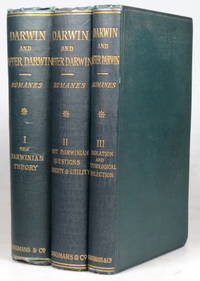
189740531London: Longmans Green and Co. 1905 1900 1897. Mixed impressions third "new" i.e. second and first printings respectively. Three volumes. Publisher's uniform dark green cloth gilt lettered to the spines contemporary monogrammed bookplate of a Frederic Weston to all three front pastedowns plus another's ownership inscription to the first half title dated 1918. Frontispiece portraits to each volume plus further illustrations in the text. A very good set. London: Longmans, Green, and Co. unknown
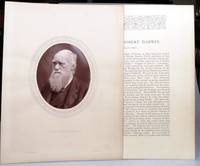
187849938London: Sampson Low Marston Searle and Rivington c.1878. Oval Woodburytype photographic portrait approximately 11.5 x 9 cm with a printed border overall sheet measuring c. 27.5 x 21 cm supplied with the original printed page of biography. Very good. Originally issued as part of Lock and Whitfield's "Men of Mark: A Gallery of Contemporary Portraits" published between 1876 and 1883. Price is inclusive of VAT. [London: Sampson Low, Marston, Searle and Rivington unknown
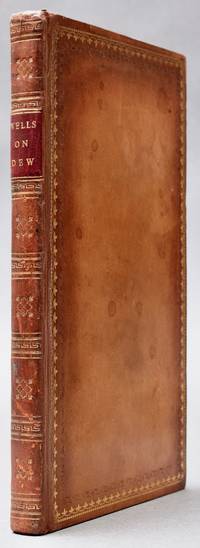
1815BB2499London: printed for Taylor and Hessey No. 93 Fleet Street 1815. Full Calf. Fine. Second Edition of this classic of meteorology first published in 1814 which revolutionized the understanding of ventilation in public places and for which Wells was awarded the Rumford Medal of the Royal Society. Demy 8vo 212 x 127mm: 4150pp. Beautifully bound in contemporary calf spine richly gilt in six compartments covers framed in blind and gilt red leather lettering piece gilt Prussian blue end papers. Manuscript presentation to title page: "To Dr. James Jackson from the Author" with Jackson's engraved armorial book plate to front paste-down. A gorgeous example tightly bound and generally clean throughout. Lowndes 2871 "A valuable little work". Garrison-Morton 1604. Norman 2199 and Christies 848. Blocker p. 416. Waller 12191. Knight p. 191 "Perhaps more important than any writings on induction by philosophers was the splendid example of inductive reasoning by William Charles Wells. . . . his Essay on Dew was rapidly recognized as a classic.". Wells was born in Charleston South Carolina but left America at the start of the Revolution for London where he became physician to St. Thomas's Hospital. In the autumn of 1811 he began a series of researches in the Surrey garden of his friend James Dunsmore comparing the formation of dew under varying conditions of temperature humidity weather cloud cover season and time of day. He concluded that dew results from the condensation of air in contact with objects cooled by radiating their heat into the cloudless night sky. "His researches . . . were of major importance in the development of the science of ventilation particularly in its relation to relative humidity and the influence of the latter on the comfort of the occupants of factories ships theatres etc." Garrison-Morton Wells's inquiry into the nature of dew was widely cited in the 1830s as an outstanding example of inductive scientific inquiry. Sir John Herschel used it as the primary illustration in his Discourse on the study of Natural Philosophy calling the theory "one of the most beautiful specimens we can call to mind of inductive experimental enquiry lying within a moderate compass." In 1836 the Encyclopedia Metropolitana reported "We know of no work in our day which has been more universally admired than the Treatise of Dr. Wells certainly none that practically exemplifies in a purer and better form the admirable inductive system which it was the object of Bacon to teach." John Tyndall and William Whewell also praised it. N. B. With few exceptions always identified we only stock books in exceptional condition carefully preserved in archival removable mylar sleeves. All orders are packaged with care and posted promptly. Satisfaction guaranteed. Fine Editions Ltd is a member of the Independent Online Booksellers Association and we subscribe to its codes of ethics. printed for Taylor and Hessey, No. 93, Fleet Street unknown
185553775Boston: Gould and Lincoln 1855. 8vo. x 11-273 1 pp. plus 12 pp. publisher’s ads. Engraved frontisp. Blue-green embossed ribbed publisher’s cloth gilt lettering on spine edgewear rubbing slightly cocked very minor foxing to endpapers still VG copy ownership markings on endpapers. First edition of this scarce anti-evolution polemic written against Robert Chambers Vestiges of the Natural History of Creation which had caused a shift in popular opinion followings its’ anonymous 1844 publication. The ideas in the work were notably derided by clergyman in England and America most significantly by Louis Agassiz who was a lifelong opponent of Darwin’s theory of evolution and evolutionary biology. Walker 1805-1887 was acting pastor of a church in Sandusky OH lectured on the harmony between science and revealed religion at Oberlin College and Chicago Theological Seminary. Gould and Lincoln, hardcover
1894PW1191Edinburgh:: T. & T. Clark 1894. 1894. 8vo. xvi 358 10 pp. Crimson blind- and gilt-stamped cloth. Ownership signature of Robert Maxwell Young. Very good a nice copy. PROVENANCE: Robert M. Young is a historian of science specializing in Darwinism. T. & T. Clark, 1894. hardcover
18885768London: Harrison & Sons 1888. Hardcover. Very good. Near fine in modern red cloth. Full volume contains the first printing pp. i:xxv of Huxley's long obituary and short biography of Darwin written and published after a five-year delay. Harrison & Sons hardcover
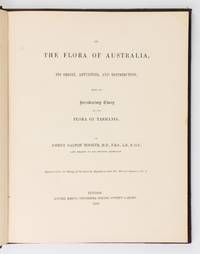
1859105735London: Lovell Reeve 1859. First Edition. Hardcover. London Lovell Reeve November 1859 first separate edition. Large quarto viii 128 pages complete with the half-title. Later half roan and stippled cloth lightly rubbed at the extremities; a very crisp and bright copy. 'The first important botanical work by a supporter of the doctrine of evolution by natural selection' Norman often quoted but not going nearly far enough in our opinion!. A singular rarity of the utmost importance. In the concluding paragraph of the postscript unique to this edition Hooker writes: 'I would further observe here to avoid ambiguity that my friend Mr. Darwin's just completed work "On the Origin of Species by Natural Selection" sic from the perusal of much of which in MS. I have profited so largely had not appeared during the printing of the Essay or I should have largely quoted it. Kew November 4 1859'. Lovell Reeve hardcover
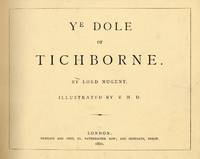
18712200159<p><i>Oblong 8vo pp. 4 with nine anastatic plates by 'V H D'arwin the first folding and with poetic verses facing two leaves of introduction in the original publisher's bind stamped green cloth upper board lettered in gilt inner joints lightly cracked else a very good sound copy.</i></p><p>Published to capitalise on the infamous Tichborne case then beginning to run its course through the courts.</p><p>The poem recounts the history of the Tichborne dole of bread a charity festival active until the 1790's and held at the village of Tichborne in Hampshire during the Feast of the Annunciation. The tale concerns a curse by twelfth century Lady Mabella Tichborne on her descendants. This predicted that should the dole stop the family would produce only daughters and die out which indeed did happen with the male issue cut down by early death and shipwreck all of which paved the way to the interminable Tichborne claimant cause.</p><p>The illustrations are very clearly in the style of Richard Doyle's <i>The Manners and Customs of Ye Englyshe</i> which first appeared in <i>Punch</i> in 1849 they capture many of the more absurd parts of the tale in a mock medieval manuscript technique replete with a border of a dragon.</p><p>The illustrator Violetta Harriot Darwin 1826-1880 was a half cousin to the famous Charles both sharing Erasmus Darwin as a grandfather. Although Charles descended through Erasmus' first wife Polly and Violetta through his second wife Elizabeth the cousins despite being near contemporaries appear to have had very little contact. A number of Violetta's anastactic topographical views were published in the 1860's and her illustrated version of Southey's <i>Bishop Hatto: a legend of the Mouse-Tower on the Rhine</i> in 1861 but these are both in a quite different style.</p><p>The author of the poems Lord Nugent unlike many of the Grenville clan supported the cause of anti-slavery parliamentary reform religious liberty penal reform and the amelioration of the condition of the rural poor. He also inherited an aptitude for literary and scholarly pursuits as well as their tendency to corpulence and financial ineptitude. He was not a great poet however some of his smaller works found a willing space in the 'Annuals'. Under the less antiquated title 'The Dole of Tichborne' the poem first appeared first in the 1830 volume of <i>The Gem</i>.</p><p>OCLC records only a second edition at the National library of Wales only.</p> Bemrose and Sons
189232936Chicago: Open Court Publishing 1892. 12mo. xiv 2 460 pp. plus 4 pp. publ. ads. Engravd frntsp. numerous engravings text illusts. Blue cloth gilt lettrng mnr bmpng to crnrs shlfwr VG- w/ numerous contemporary clippings laid-in. First edition of this first volume in the author's exposition of evolutionary biology including sections on the major proponents of Darwin and their advances and discoveries in classification morphology embryology palaeontology natural selection and more. Open Court Publishing, hardcover
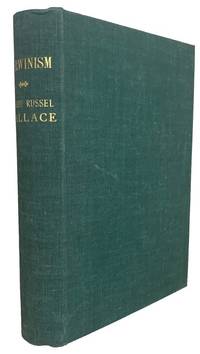
188943530London & New York: Macmillan and Co 1889. 12mo. 19.7cm The First Edition xvi4942p. ads for Wallace’s books; half title frontis portrait with 39 mainly text illustrations colour folding map expertly rebound in fine grain green book linen gilt spine titles in fine clean condition thus. Alfred Russell Wallace was a co-discoverer of the theory of evolution by natural selection with Charles Darwin. He became a staunch defender of the theory and wrote extensively on it including this book Darwinism 1889. His most significant fieldwork was in the Amazon and the Malay Archipelago. Macmillan and Co unknown
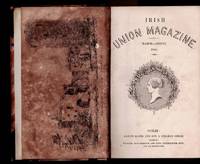
184532226AB1845. First Edition. Two Volumes bound in one. Dublin Martin Keene and Son 1845. Octavo. Frontispiece-Engraving "The ruins of Leix Castle Queens Co. - From a Sketch by Chidley Coote Esq." engraved titlepage 468 pages including Index / Followed by Volume II now titled "The Irish Monthly Magazine" - September - February Dublin 1846: 494 pages. Hardcover / Original half-leather with gilt lettering and original spinelabel. Very good condition with only minor signs of wear. An extraordinay Volume very rare with the Literary Notices on Charles Darwin's "Journal of Researches into the Natural History and Geology of the Countries visited during the Voyages of H.M.S.Beagle round the world second edition. With several interesting articles political poetic and literary. Among which is also "Mary Mansfield Or Ireland Ten Years Since". The Volume published at the outbreak of the Famine is the last reflection of an already shaken country which is entering a fate-altering few years. The Union Magazine - Volume I All published under this title Following articles are included in this very rare 1845-Volume: 1. The Position and Prospects of Ireland in 1845 2. Mesmerism - Miss Martineau's Letters 3. Memoir if Leix Castle Queens Country related to the Frontispiece 4. An Irish Queer Fellow - Peregrin Glass 5. Mary Mansfield Or Ireland Ten Years Since a continuation story through several issues of this Volume including chapters titled "The Ghost" "The Trial" etc. 6. Narrative of some Military Events in Scinde Beeloochistan and Afghanistan during the Years 1839 1840 1841 1842 and 1843 by John H.Hall Esq. H.M.'s 40th Regiment Nephew of the Late Captain Basil Hall continued through several issues 7. A Free and Easy Translation of the First Scene of the Andrian of P.Terentius 8. To L.E.L. in 1828 A fancy Sketch 9. The Irish Poor Law / Poor Laws Limerick Union 10. "Sketches of Character" - by the "Elderly Gentleman" 11. "The Country and the Town" 12. "A Pinch of Snuff from Dean Swift's Box" with a page of Illustration of Jonathan Swift's Snuff Box 13. 'Tis a Hundred Years Since" 14. "The Difficulties of a Young Clergyman in Times of Division" - London 1844 15. "A Report to the Lord Bishop of Meath on the State of Elementary Schools in the Diocese and the Opinions of the Clergy respecting the question of National Education" By the Rev. Edward A. Stopford Archdeacon of Meath; with a Correspondence between the Lord Bishop of Meath and the Home Secretary on the Subject of the Report Grant and Bolton Dublin 1845 16. "On National Schools - A Tract for the Times in Ireland - By an Ulster Clergyman" - W.Curry Jun. and Co. Dublin 1845" 17. "The Irish Art Union" 18. "Luna by Day" by Jean Paul Fr.Richter 19. An Anglo-Latin Account of a Steam Journey from Dublin to London in 1845 A short Poem in Latin 20. Foreign Travellers and many more articles hardcover
188157971Tokyo Nishimura Tomijiro Fukuda Eizo Meiji 21 1881. 8vo. In the original cloth binding with printed front board depicting a monkey reading a newspaper. Light wear and soiling to extremities and end papers soiled otherwise in fine condition. 285 pp. 3 plates. <br/><br/><em>The rare first Japanese translation of W. P. Lyon's anti-evolutionary text ' Homo versus Darwin'. It constitutes the very first publication in Japanese to reject Darwin's theory. A year after the publication the book was banned for 'corrupting public morals'.The present work is Lyon's reply to the publication of Darwin's The Descent of Man. Here he sees Darwin being charged by Homo of denying him from being a creature made by a God and declaring man to be merely some kind of animal. The author is recorded as being 'Eisa Gurei' Asa Gray but in 1986 a study confirmed the text to be a translation of Lyon's work.'Saru no Saiban' is an important work in the history of the reception of Darwinism in Japan. Darwin's theories had a profound influence on Japan and Japanese culture but in a slightly different way than in the West: Darwinism was marked as social and political principles primarily embraced by social thinkers philosophers and politicians to advocate the superiority of Japanese culture and society and military and not by biologists and zoologists. "It was as if Darwin's famous oceanic journey and the meticulous research into the animal and plant kingdoms that he spent his life undertaking had all been staged as an elaborate excuse for composing a theory whose true object was Victorian society and the fate of the world's modern nations." Golley Darwinism in Japan: The Birth of Ecology. </em> hardcover
188127509AB1881. London and New York Macmillan and Co. 1881. 4°. XVI 624 pages including an original full page potrtrait-engraving of scottish mathematical physicist James Clerk Maxwell. Original Hardcover recently beautifully rebacked with gilt lettering on spine. Very good condition with only minor signs of wear. Pages 559 to 564 with central tear. Few small library stamps discarded. Also with a contribution by Darwin in the section "Letter to the editor" Darwin responds to an article "Leaves injured at Night by free radiation". James Clerk Maxwell FRS FRSE 13 June 1831 5 November 1879 was a Scottish scientist in the field of mathematical physics. His most notable achievement was to formulate the classical theory of electromagnetic radiation bringing together for the first time electricity magnetism and light as manifestations of the same phenomenon. Maxwell's equations for electromagnetism have been called the "second great unification in physics" after the first one realised by Isaac Newton. With the publication of "A Dynamical Theory of the Electromagnetic Field" in 1865 Maxwell demonstrated that electric and magnetic fields travel through space as waves moving at the speed of light. Maxwell proposed that light is an undulation in the same medium that is the cause of electric and magnetic phenomena. The unification of light and electrical phenomena led to the prediction of the existence of radio waves. Maxwell helped develop the MaxwellBoltzmann distribution a statistical means of describing aspects of the kinetic theory of gases. He is also known for presenting the first durable colour photograph in 1861 and for his foundational work on analysing the rigidity of rod-and-joint frameworks trusses like those in many bridges. His discoveries helped usher in the era of modern physics laying the foundation for such fields as special relativity and quantum mechanics. Many physicists regard Maxwell as the 19th-century scientist having the greatest influence on 20th-century physics. His contributions to the science are considered by many to be of the same magnitude as those of Isaac Newton and Albert Einstein. In the millennium poll a survey of the 100 most prominent physicists Maxwell was voted the third greatest physicist of all time behind only Newton and Einstein. On the centenary of Maxwell's birthday Einstein described Maxwell's work as the "most profound and the most fruitful that physics has experienced since the time of Newton". Wikipedia hardcover
1878140London: The Graphic 1878. First Edition. Very Good . 4to full page circular engraving of Charles Darwin 1809 - 1882 shortly before his death with text summarizing many of his accomplishments published by the London magazine The Graphic in 1878. An Excellent profile of the great naturalist suitable for framing. The Graphic unknown
1888677london: John Murray 1888. Later printing. Leather_bound. Very Good. Contemporary three quarter leather binding by Mudie. seventeenth thousand 519 pages including index plus i to ix preface. Beautiful /leather binding with raised bands to spine. Gilded lettering ruled lines and design to spine with the title on a black leather .background. Attractive marbled boards and endpapers. Tan calf leather in good condition - some surface loss to the corner pieces . All page ends also marbled - the pages edges are quite perfect with a noticeable gloss to them. <br/><br/> John Murray hardcover
1889153561London: John Murray 1889. First Edition; Early Printing. Hardcover. Near Fine in green cloth. Neat owner name. John Murray hardcover
188960London: John Murray 1889. Hardcover. Fair. Original green board in plastic protective covers. Gilt on spine and illusltration on front cover. Spine weak but holding - front portrait of Darwin almost detached and foxing to protective tissue paper Otherwise a nice well kept copy of this early edition. John Murray hardcover
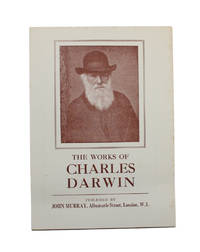
1900031933UK: John Murray 1900. Paper. Near Fine. 24mo - over 5" - 5¾" tall. C1900 A Lovely Rare Four Sided Flyer Printed by John Murray for their Works of Charles Darwin Series that was published in the early 1900s. In near fine condition. Ref 19388 <br/> <br/> John Murray unknown
1889feb02702<p>1889. First Norwegian Edition of Autobiography in 3 Volumes by Charles Darwin Son - Francis Darwin.<br /><br />liv og breve med et kapitel selvbiografi</p><p>Used book For more details and availability please contact me</p> Bibliothek for de tusen hjem hardcover
1888feb02667<p>1888. First French Edition of Autobiography in 2 Volumesby charles Darwin son Fancis Darwin.<br /><br />La vie et la correspondance de Charles Darwin avec un chapitre autobiographique</p><p>Used book For more details and availability please contact me</p> C. Reinwald hardcover
1891feb73967<p>1891: First Polish Edition of Autobiography by Charles Darwin<br /><br />Autobiografia i wybór listów. Wydane przez Syna<br /><br />Used. For more details please contact me</p> Wydawnictwo Przeglądu Tygodniowego hardcover
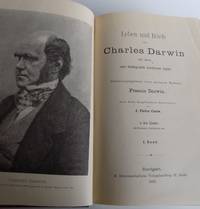
1887feb58494<p>1887:First German Edition of Autobiography in 3 Volumes bounded into one by Charles Darwin <br /><br />Used. For more details please contact me</p> E. Schweizerbartsche Verlagshandlung hardcover
18842502190011Theodor Thomas Leipzig 1884. Hardcover. Very Good. 6x1x9. Bound in publisher's cloth. Paper spine label. Hardcover. Gothic German text. Good binding and cover. Shelf wear. A couple markings on preliminary pages else unmarked. viii 442 1 p. ; 17 cm. <br> From the library Dr. Owen Hannaway. Hannaway was director of the Center for the History and Philosophy of Science at Johns Hopkins University. He authored numerous books and served as an editor of academic magazines in the history of science. Partial list of publications: Chemists and the Word: The Didactic Origins of Chemistry 1975; Observation Experiment and Hypothesis in Modern Physical Science 1985; The Evolution of Technology 1989; Science and the Practice of Medicine in the Nineteenth Century 1994; and The Foundations of Modern Science in the Middle Ages: Their Religious Institutional and Intellectual Contexts 1996. Theodor Thomas, Leipzig hardcover
18643456104/11/1864. <blockquote><p>Darwin's work had profound implications for the relationship between science and religion and here he opposed anyone who would seek to profess religious over scientific faith</p><p> </p><p>Scientists Darwin felt should work in the spirit of seeking ""truth"" with no preconceived notions</p><p> </p><p>The adoption of the Theory of Evolution by scientists is ""the real cream of the enjoyment to me; indeed it is to me worth far more than any medal.""</p><p> </p><p>Significantly he hopes to continue his work in science</p><p> </p><p>One of the most important Darwin letters we have carried</p></blockquote><p><img class=""alignnone wp-image-34774 size-post-window"" src=""https://cdn.raabcollection.com/wp-content/uploads/20251016172859/Darwin-2-1-1600x1200.jpg"" alt="""" width=""1600"" height=""1200"" /></p><p>Charles Darwin's ""On the Origin of Species"" was one of the most important books of all time. When it was published in 1859 there was skepticism within as well as without the scientific community about the central premise that species changed through time by a process Darwin labeled natural selection. The idea that human beings evolved from other previous species struck at the heart of the generally accepted belief that humans were different from other animals and that species were fixed or immutable. Everyone had learned the story of creation from the Bible and Darwin's ideas presented a challenge to those who looked at the question through a literal religious perspective. But Darwin hoped that scientists as well as others would be able to accommodate adopt an essentially new view and accept evolution. Yet at the same time he realized that many who had grown up in the previous scientific school would have a hard time doing so. It seemed that perhaps a new generation of scientists might have to rise before his work was generally accepted.</p><p>The Copley Medal the highest award of the Royal Society is given for “sustained outstanding achievements in any field of scienceâ€. In 1864 Darwin was nominated to receive the medal and was awarded it ""For his important researches in geology zoology and botanical physiologyâ€. Previous winners included scientists like Benjamin Franklin William Herschel Alessandro Volta Humphry Davy and Michael Faraday.</p><p>Hugh Falconer was a paleontologist and botanist who was an admirer of Darwin though not a convert to his theory of evolution. He seconded the nomination of Darwin for the medal and Darwin wrote to thank him for doing so. In his letter Darwin made some points of great importance: 1. That more and more scientists were becoming converts to his theory of evolution; 2. That he hopes to continue his work in science despite advancing age; 3. That scientists should work in the spirit of seeking truth with no preconceived notions and 4. That the support of scientists he respected like Falconer meant more than the medal to him.</p><p>Falconer was outraged by a petition that was circulating within Britain’s learned societies that attempted to limit the bounds of scientific enquiry. The petition claimed that scientific research was being “‘perverted by some…into occasion for casting doubt upon the Truth and Authenticity of the Holy Scriptures†and was specifically aimed against evolutionary theory and investigations into the antiquity of man. Falconer made clear to Darwin that he aimed to ""protest against the profession of religious against scientific faithâ€.</p><p><img class=""alignnone wp-image-34775 size-post-window"" src=""https://cdn.raabcollection.com/wp-content/uploads/20251016172938/Darwin-4-1-1600x680.jpg"" alt="""" width=""1600"" height=""680"" /></p><p><strong>Autograph letter signed</strong> four pages with the addressed envelope Down House headed stationery Kent November 4 1864 to Hugh Falconer making all the important points cited above. <em>“What a good kind friend you are. I know well that this medal must have cost you a great deal of trouble. It is a very great honor to me but I declare that the knowledge that you & a few other friends here so much interested themselves in the subject is the real cream of the enjoyment to me; indeed it is to me worth far more than any medal. So accept my true and cordial thanks. I hope that I may yet have strength to do a little more work in natural science; shaky and old though I be.â€</em></p><p><em>“I have chuckled and triumphed over your postscript about poor M. Brullé and his young pupils. About a week ago I had a nearly similar account from Germany and at the same time I heard of some splendid converts in such men as Rudolf Leuckart Carl Gegenbaur &c. You may say what you like about yourself but I look at a man who treats Natural History in the spirit with which you do exactly as good for what I believe to be the truth as a convert. Farewell my good friend with sincere thanks your true friend Charles Darwin.â€</em></p><p>In mentioning M. Brullé Darwin alludes to an amusing story told by Falconer to him in a previous letter relaying the complaint of the entomologist Gaspard Auguste Brullé that he heard of nothing but Darwin from his students.</p><p>Darwin need not have worried about his future productivity in this 1864 letter. Afterwards he wrote several more books which include “The Variation of Animals and Plants Under Domestication†1868 which explored the principles of heredity and how variations occur in domesticated species; his famous “The Descent of Man†1871 applying the theory of natural selection to human evolution and discussing sexual selection; “The Expression of the Emotions in Man and Animals†1872 examining the evolutionary origins of emotions and facial expression; and “The Formation of Vegetable Mould through the action of worms"" 1881.</p><p>Falconer replied to Darwin’s letter on November 7 and the spirit with which he treated Natural History and the reason for his support for Darwin were evidenced in that reply. Falconer explained that he believed the award of the Copley medal to Darwin was doubly important: “1. As regards due appreciation of yourself. 2d. As a determined protest against the profession of religious against scientific faithâ€.</p><p>Falconer was right to be concerned about the reaction of the religious community and its sympathizers to the theory of evolution. Darwin’s ideas provoked a harsh response from religious leaders and their allies of which this petition was one example. As examples of the criticism of evolution England’s highest-ranking Catholic official Henry Cardinal Manning denounced Darwin’s views as “a brutal philosophy – to wit there is no God and the ape is our Adam.†And Samuel Wilberforce the Anglican Archbishop of Oxford and one of the most highly respected religious leaders in 19th-century England also condemned natural selection in a now-famous speech on what he deemed the theory’s deficiencies.</p><p>This is one of the most important Darwin letters we have carried dealing as it does with support for his theory of evolution his hopes for future work in science and the role of science in seeking truth.</p><p><img class=""alignnone wp-image-25018 size-post-window"" src=""https://cdn.raabcollection.com/wp-content/uploads/20231204144051/Folder-site-11-1600x1327.jpg"" alt="""" width=""1600"" height=""1327"" /></p> unknown