DARWIN, CharlesBiblio.com

881 résultats
183869522London: Smith Elder and Co 1838. OWEN Richard. WATERHOUSE George R. The Zoology of the Voyage of the H.M.S. Beagle. Under the Command of Captain Fitzroy R.N. During the Years 1832 to 1836. Part I II. Mammalia. London: Smith Elder and Co. 1838.<br> <br> Full Description:<br> <br> DARWIN Charles. OWEN Richard. WATERHOUSE George R. The Zoology of the Voyage of the H.M.S. Beagle. Under the Command of Captain Fitzroy R.N. During the Years 1832 to 1836. Part I II. Mammalia. London: Smith Elder and Co. 1838-1840.<br> <br> First editions of Part I and Part II of Mammalia in two quarto volumes 12 1/8 x 9 1/2 inches; 307 x 241 mm.<br> <br> Part I. Owen Richard. Fossil Mammalia. 1838-1840. 2 iv iv 111 1 colophon pp. Complete with thirty-two lithographic plates by G. Scharf one of which is folding and two which are double paged. With the preface to the whole work and a geological introduction by Charles Darwin. Bound without the half-title but with the additional fly-title.<br> <br> Part II. Waterhouse George Robert. Mammailia. 1839. 4 xii 97 3 blank pp. Complete with thirty-two hand-colored lithographic plates and three numbered engraved plates. With the errata slip bound in before B1. Bound without the half-title but with the additional fly-title. This volume with a geographical introduction and notes by Darwin.<br> <br> Two volumes uniformly bound in half tan calf over contemporary marble boards. Spines each with red and green morocco spine labels lettered in gilt. Contemporary endpapers. All edges speckled red. Some repairs to inner hinges. Text is very clean. The final three plates in volume II with some foxing otherwise all plates are very clean. Overall a very good copy of these two volumes.<br> <br> These first two volumes out of the complete work in 5 volumes are the only two volumes to be published with introductions by Charles Darwin. In the first volume he writes a Geological Introduction and in the second volume he writes a Geographical Introduction. "Darwin contributed a geological introduction to Part I the Fossil Mammalia pp. 3-12 and a geographical introduction to Part II the Mammalia pp. i-iv." Freeman p 26.<br> <br> In 1832 Captain Robert Fitzroy of the Royal British Navy undertook a five-year circumnavigation of the earth. Fitzroy who was only twenty-seven at the time asked a young Charles Darwin to be the naturalist for the voyage. The five-year journey included passing the coastlines of South America and particularly the Galapagos Islands near Ecuador. Darwin collected numerous specimens and data from this now famous area and these became the basis for his theory of natural selection which was a key component in his masterful theory of evolution.<br> <br> "The lavish scientific record of Darwin's collecting endeavours during the five-year voyage of the Beagle originally issued in 19 numbers. The 166 plates 82 finely hand-colouredof the complete works were due to the tireless energy and flair which the relatively untrained ship's scientist put first into the collection of specimens and then into ensuring that the zoological specialists duly reported on them after his return. The cost of the plates was covered by a treasury grant of one thousand pounds but to complete the work for Smith and Elder who were publishers of large illustrated books and government publications Darwin had to persevere as steadily with his pen as with his gun and geological hammer turning himself into a considerable authority during the course of five years spent editing the work of others." Christies<br> <br> "He superintended the Zoology's text wrote introductions for the different parts and added notes from his various Beagle records about animal behaviour and habitats wherever appropriate while also supervising the printers proofreading the sheets arranging artists for the plates chivying the experts and keeping them all moving forward within a tight self-imposed budget" Janet Browne Charles Darwin: Voyaging 2003 p. 370.<br> <br> Freeman Darwin 9.1 & 9.2. Nissen IVB 384. Nissen ZBI 1391. Sabin 18649.<br> <br> HBS 69522.<br> <br> $25000. Smith, Elder and Co unknown
187714434London and New York: Macmillan and Co. 1877. FIRST EDITION. Half-calf and marbled boards; an excellent copy with the bookplate of Charles Edward Fewster of Hull. First printing of Darwin’s original paper discussing sexual selection in his 1871 work Descent of man stating that the case of the “brightly-coloured hinder ends and adjoining parts of certain monkeys†was the most interesting and perplexing to him. He quotes a work by Johan von Fischer partly published in Der zool. Garten. April 1876 dealing with the expression of monkeys under various emotions “which is well worthy of study by any one interested in the subject.†An interesting article on an interesting subject.<br /> <br /> Also included in this volume are two reviews of Darwin books as follows: 1 Review of the second edition of Geological observations on the volcanic islands and parts of South America London Smith Elder and Co. 1876 by John W. Judd. pp. 289-290; and 2 Review of The effects of cross- and self-fertilisation in the vegetable kingdom London Murray 1876 by W. T. Thiselton Dyer pp. 329-332.<br /> <br /> In addition there are two testimonials to Darwin. The first p. 356 is a testimonial on Darwin’s sixty-ninth birthday a mistake in that he was sixty-eight in February 1877 from a group of 154 men of science of Germany presenting to him an album of their photographs. Darwin also received an album with the photographs of 217 distinguished professors and lovers of science from Holland. The second testimonial pp. 410-412 comes from Prof. P. Harting of Utrecht University also on the occasion of Darwin’s birthday who has sent a letter along with the photograph album referred to above from the Directors of the Netherlands Zoological Society and includes Darwin’s reply. <br /> <br /> The volume includes articles by many of the most important scientists of the day.<br /> Freeman 1773; Freeman 1776. Macmillan and Co. unknown
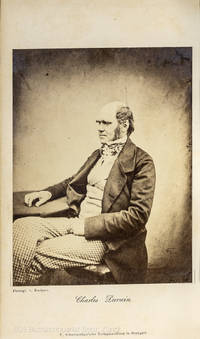
18627863CB1862. Zweite verbesserte und sehr vermehrte Auflage. Stuttgart Schweizerbart 18621863. 8°. VIII 551 S. Mit einem fotografischen Portrait und einer Tafel. Halblederband der Zeit. Freeman 673. Zweite deutsche Ausgabe. Nur dieser Ausgabe hinzugefügt die Porträt-Fotografie von Carl Johann Sigmund Bucher. Das Papier durchgehend gebräunt und stockfleckig. Der Einband berieben. unknown
1899436968Stuttgart : E. Schweizerbart'sche Verlagshandlung 1899. First Edition. Hardcover. Very good copy in the original gilt-blocked cloth. Spine bands and panel edges somewhat dust-toned and rubbed as with age. Remains quite well-preserved overall. Physical description; vi 578 p. : ill. ; 23 cm. Notes; Index : p. 566-578. Subjects; Evolution. Natural selection. Stuttgart : E. Schweizerbart'sche Verlagshandlung hardcover
1884900Stuttgart Germany: E. Schweizerbart'sche Verlagshandlung E. Koch 1884. 6" x 9" pp. vi 578; text in the German language. Hardcover bound in green cloth boards with gold stamping on spine. Boards are scuffed at corners with a few minor tears without loss. Minor break at front free end paper but attached. Text is lightly toned at edges but otherwise sound. Good.<br /> <br /> A German language 7th edition of Charles Darwin's famous "On the Origin of Species" work outlining the modern premises of evolutionary science. E. Schweizerbart'sche Verlagshandlung (E. Koch) unknown
186050927Stuttgart E. Schweizerbart'sche Verlagshandlung und Druckerei 1860. 8vo. Bound in contemporary half calf with gilt lettering and ornamentation to spine. Small stamp and previous owner signature to title page. Leather on lower part of spine with a tear and part detached. Hinges weak but book-block firmly attached. VIII including half 520 6 pp 1 plate. <br/><br/><em>The very scarce first edition of the highly important first German translation which appeared just months after the original.This translation came to play a tremendous role in the spreading of Darwinism in Germany and Northern Europe in general. It was through this translation that Darwinian thought reached most of the German scientists and thinkers of the period and it was this translation that challenged German scholars to think in new ways about morphology systematics paleontology and other biological disciplines. It was from this translation that Ernst Haeckel Darwin's most famous nineteenth-century proponent and popularizer in Germany got his Darwinism and was able to further spread the new ideas in his own country. The German translation of Darwin's "The Origin of Species" appeared in 1860 just months after the original thanks to Heinrich Georg Bronn a distinguished German paleontologist whose work in some ways paralleled Darwin's. Bronn's version of the book with his own notes and commentary appended did much to determine how Darwin's theory was understood and applied by German biologists for the translation process involved more than the mere substitution of German words for English."Its Origin of Species greatest impact on German biological practice lay in the introduction of historical modes of explanation for the observable phenomena of living nature. The historical approach to nature was rejected not only by the opponents of evolution but also by the idealist evolutionist. Whether they favored a teleological or a reductionist biology the idealists could not see the point of a theory that emphasized the irregularities and exceptions in the organic world. In the timeless real of idealist thinking unchanging laws worked out an inevitable destiny. But Darwin taught his followers to look at living beings one by one. Thus prompted they recognized as if for the first time the surprising fact of anomaly and the wisdom of an open-ended theory." Glick The Comparative Reception of Darwinism. "Darwin was not happy about the first German translation. It was done from the second English edition by H.G. Bronn who had at Darwin's suggestion added an appendix of the difficulties which occurred to him; but he had also excised bits of which he did not approve. This edition also contains the historical sketch in its shorter and earlier form." Freeman.Freeman No 672 - Freeman does not mention the lithographed plate. </em> hardcover